I visited a Class 1 last week — there are so many of them now! — and what the outing lacked in action was made up for in sentimentality. I’ve been fishing these waters for a long time. Walking down its banks is like opening the restaurant door when you’re meeting a friend for lunch. Like many of the newly minted Class1s, this stream has fallen on hard times in the last decade-plus. Gone are the days when I’d pricks multiple dozens of brookies and browns, some of them a fairly impressive length for such small stream in the middle of nowhere. On this day, I managed only handful of swipes and one to net.
The water was an ideal height, probably about the same temperature as the air on this chilly day, in the mid-40s.
This is typically the time of year when I’ll wade through an unproductive pool after blanking in it. My gait is rather haphazard, as I’m hoping to spook some fish and suss out their lies. I rousted virtually no one; one languid stretch had about a half dozen fish, but they were all small yearling size. I did get to enjoy a cigar, and even when I stumbled and sat in the river, soaking my hindquarters, all was right with the world. I fished a dry-dropper system for most of the outing, but what was interested showed a clear preference for the dry. But, funny thing! The only one I landed came on a micro streamer.
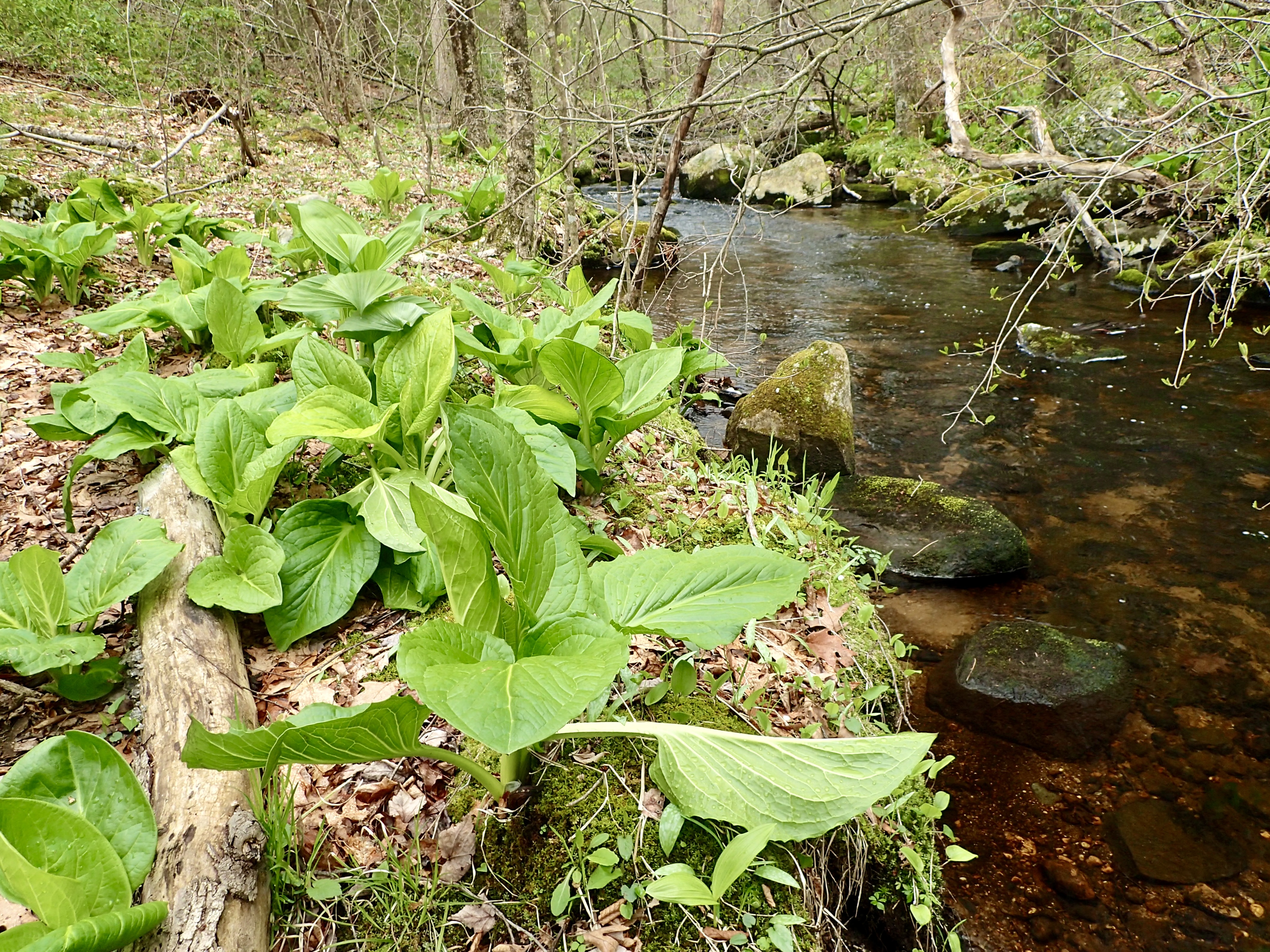
Skunk cabbage leafing out near the banks of a trout stream in Connecticut in April takes me back to my youth, Opening Day, Salmon River. They kinda look like tobacco plants, don’t they?
I fished the lower end of PTMA yesterday from noon to 3:30pm. Once got to the river, I ran into a group of wonderfully chill gentlemanly anglers, and we had a short gab-fest before I decided to head into the river for some pre-hatch prospecting. Bob, of Bob-and-Andy fame, was also there. I’d met Bob-and-Andy at this mark many years ago, and since then, it’s really not April unless we cross paths on the river.
The wind made it an unfavorable day for casting a team of three wets, but I managed to go almost the entire session without a fouled-up leader. After an hour that produced one lonely bump, I declared to the group that one or more of three things was true: there are not a lot of fish here; the hatch is going to be underwhelming; the trout are content to feed on the bottom. It turns out that options A and C were likely in play. When the hatch finally got going, around 2:15pm, there were bugs everywhere: in the air, on the surface — and precious few trout rising to them. I’d give this hatch volume an 8 out of 10; when you can count the rises per minute on a few fingers (instead of dozens) that’s not going to make for epic fishing. Normally, with this Hendrickson hatch volume, I’d bang up a good dozen fish or more fishing wets pre-hatch and during the emergence. Not today.
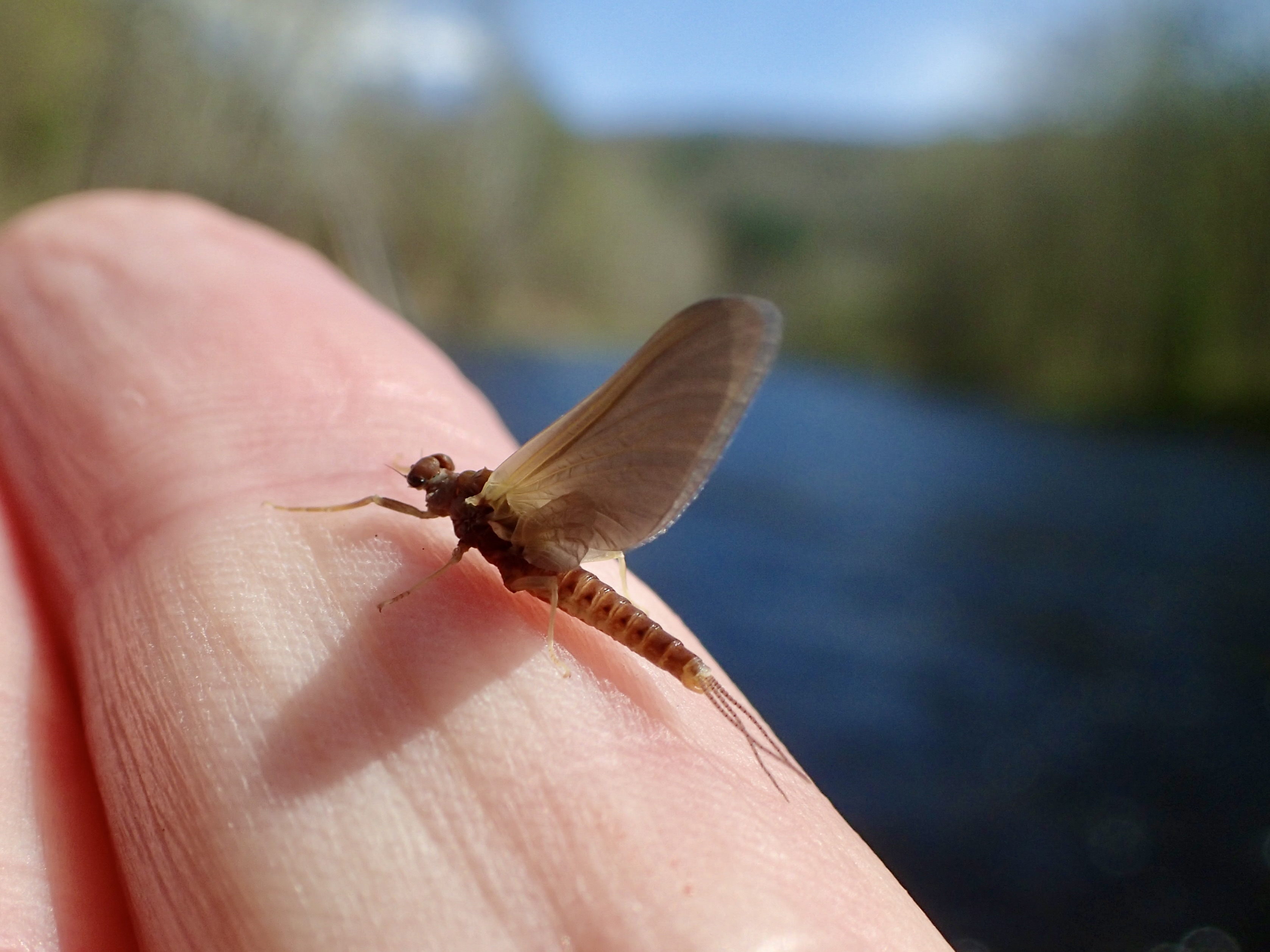
Hello, old friend. This would be a male Hendrickson; three tails, darker cast, large eyes.
What did follow script was the place in the water column where the fish were feeding. Pre- and during emergence, they took the wet, until the point where they didn’t, and then it was dry flies on the surface. This is a good time to talk about shadow hatches, which I do in the Farmington River book. In addition to Hendricksons, there were also caddis and BWOs in the mix. The savvy wet fly angler will want to have at least one of those other food groups represented. What do you know? Of the three trout I took on wet flies, two came on the caddis middle dropper (Hare’s Lug and Plover).
I managed two more on the surface, bringing my total to five. At the risk of sounding ungrateful, I was not impressed. Of course, I could have gone elsewhere. But with three anglers below me and five above me, real estate was scarce. So I stayed.
Today, writing about it, I have to scold myself for being so dour. It was a sunny, April day. The Hendricksons were out. There were some rising fish who wanted to eat. I got to reconnect with old friends and make some new ones. I didn’t put two dozen in the hoop or land a 20″ wild brown. But, yeah. That’s still a really good day of fishing.
I’d come to the Everglades with a single purpose: land my first tarpon. Oh, sure, I’d take all the snook I could get — I love snook — but tarpon was the prize.
There were only two problems. First, the weather. It had been been a colder than normal spring and the water temp wasn’t quite where the tarpon like it. But, nothing can be done about that. The second problem was of my own doing. I’d already had one shot at a tarpon on day one, but completely blew the hookset. I’d have to do better on this day.
We arrived at the scene of yesterday’s rolling tarpon to find only 1/3 the number of visible fish. That was discouraging, but we nonetheless had at it. I was really feeling like I was going to get my first tarpon, so much that I said it aloud. And that’s where problem two reared its ugly head. For some reason, even though I knew otherwise, my brain was telling me to wait to feel the weight of the fish before setting the hook. Eventually, a tarpon roared out of the shaded mangroves, struck the fly, and once again, I missed it. The lesson was driven home by an inspection of the leader; the first six inches above the fly bore the marks of the edges of the tarpon’s mouth. It was proof that fly was inhaled deep enough to get a hook set. As Charlie Brown would say: “Rats.”
I tried not to let it bother me. Really, I did. But I was mad at myself for missing yet another opportunity, especially since the winds tomorrow were likely going to be strong enough to make the Everglades a non-starter. Plus, who knew if we’d even seen another tarpon? I decided to not let it wreck my day. After all, I was fishing in the Everglades with my oldest son, and smoking cigars. That’s a win.
Since the snook bite generally stunk, we decided to lightning raid as many creeks and lagoons as we could in hopes of finding our target. Finally, after silent electric motoring up a mangrove-covered creek entrance not much wider than the boat, we found a roller. As I set up to cast, I reconned the surroundings and reinforced the procedure: on a hit, I’m not waiting on my strike. I’m setting low and hard to my left. I was repeating it like a mantra while imagining the movement.
First cast. No love.
Second cast, same result.
Third cast. Here he comes! It all happens so quickly that your conscious mind really can’t separate the greenish flash of the sun off flank, the water bulge and then boil around your fly, the sudden tension on the line, and the sound of violent water displacement. It’s almost simultaneous. This time, I was ready. “Down hard and to the left.” It all went down in one exhilarating moment, and I made the move and stuck the set.
The tarpon thrashed on the surface, then sped away from the boat like a perp in a getaway vehicle. “Let him run!” shouted Capt. Mark, but I needed no coaxing as this fish immediately put itself on the reel. The first jump was a spectacle of power and fury, the spray shimmering in the morning sun like a thousand tiny LEDs. The tarpon made a sudden 180 and swam back to the boat. “Keep that line tight!” Reel fast!” were the captain’s instructions, but I was already doing it. I cranked furiously, still tight to the fish. It was at this moment that I knew I was going to land this fish. But I didn’t plan for the mangrove wild card.
The fish moved to the left, just ahead of the boat, toward a treacherous-looking mangrove root system. (There are also multiple dead roots/branches/tree remnants in any given space along the shoreline). I thought I steered the fish out of harm’s way, but when he made his second leap, the leader hung up on a submerged root and the fly popped off. I was left with the temporary illusion that the fish was still on — the hook was stuck below the waterline — but I knew in my heart the tarpon was gone.
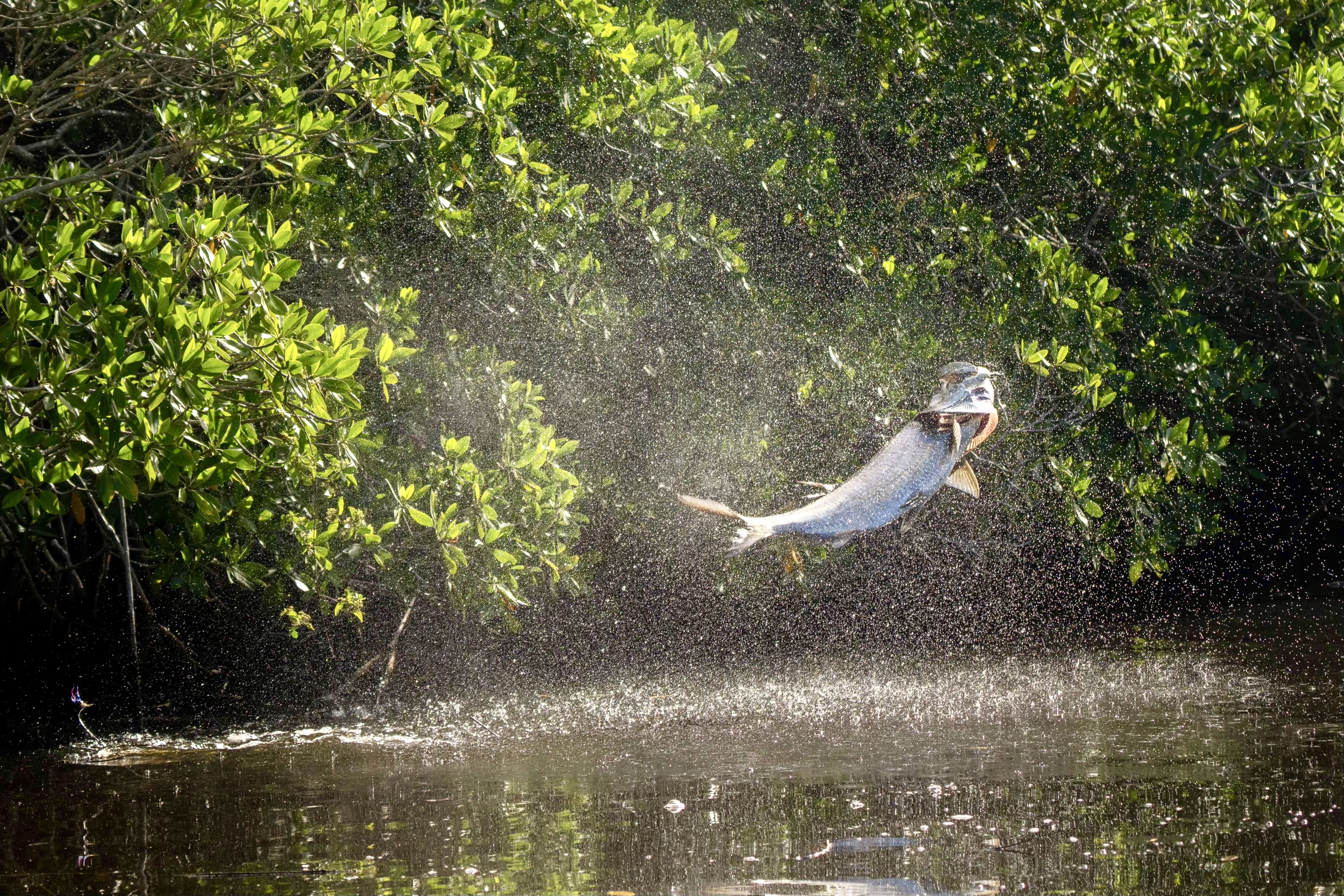
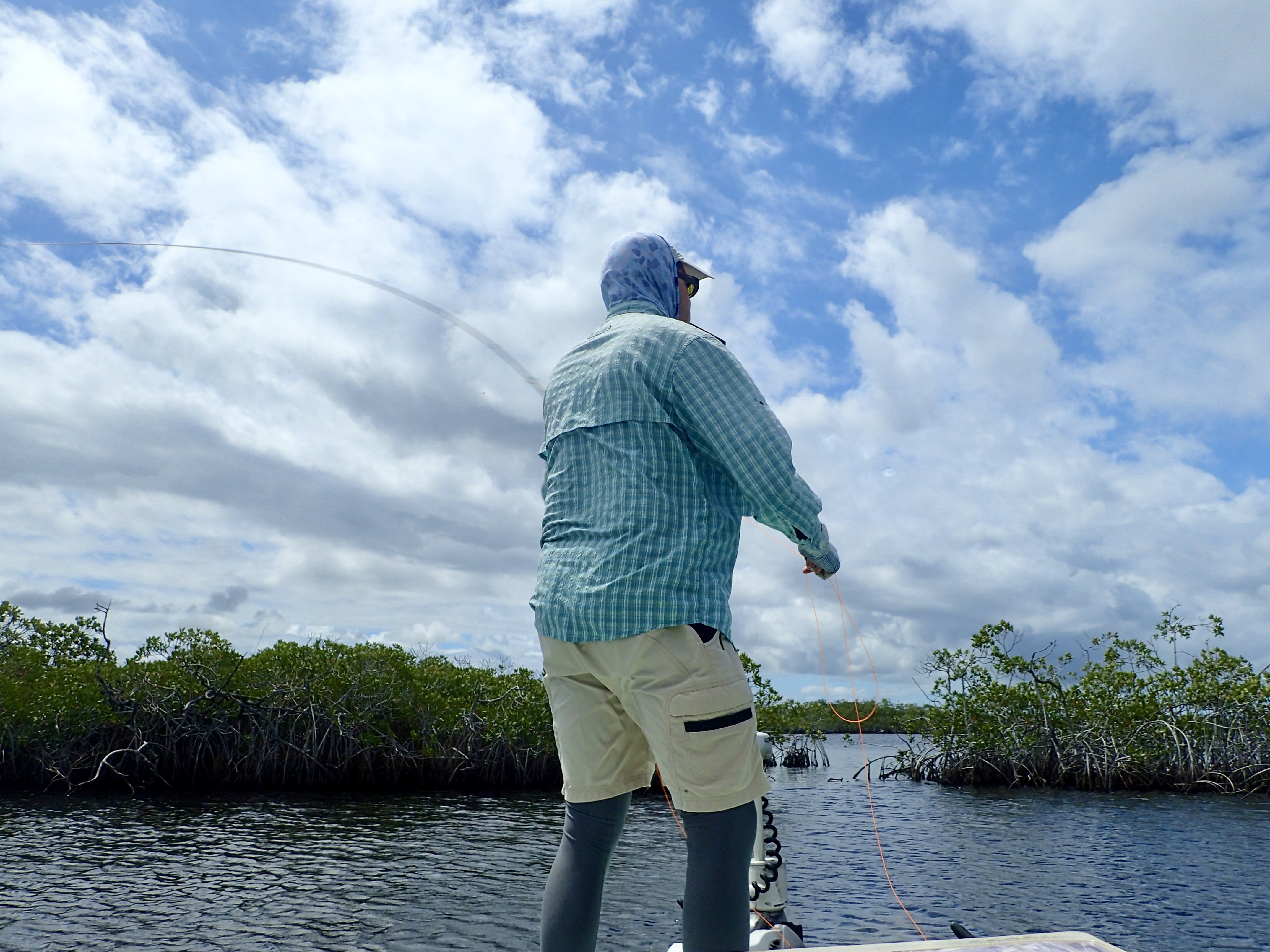
The last blast, the moment the tarpon escaped the bond of the hook and line. You can see the fly, stuck on the tiny branch peeking out of the water on the lower left. The fish landed with a thunderous splash. Then it was gone.Photo by Mark Giacobba.
Now, you might think at this moment that I would be in a state of shock and despair. But no. Just the opposite. I was giddy, almost chortling. Amazed and full of wonder. That was terrific! I wasn’t about to let a little bit of bad luck ruin my day. For I had quietly, patiently stalked my quarry, waited for that moment — and then, finally, fully prepared, was ready. I’d done my best. And that’s all anyone can ever do.
You know, I’m thinking that I’m going to land the next one.
I love living and fishing in Connecticut. But if I had to choose one other part of the country in which to live and fly fish, it wouldn’t be an easy decision. Western PA and NE Ohio (steelhead and smallmouth) would get some consideration. Colorado would be a worthy choice, as would Montana — all that blue ribbon trout water! Then, there’s the Everglades. So vast, so mysterious, so alien, so loaded with fish and fly fishable water that you couldn’t possibly cover it in a lifetime. I really don’t know where I’d choose, but the Everglades might currently be at the top of the leaderboard.
I’ve now fished the Everglades three times, the last in November of 2021. I was ready last year, but too busy with the book. I wanted to go in the March through May window, prime time for tarpon, because I’d never hooked one, and you’ve got to hook one to land one. Color me eager on tarpon. Then, there are snook.
While tarpon are one of my bucket list fish, I’ve caught snook before. I’m a big fan. They’re ambush predators that lurk in the submerged mangrove roots, and their attack speed is breathtaking; they go from zero to meteor-reentering-the-atmosphere-fast when they see a meal. They fight like the dickens, even the smaller ones. Think of a sleeker, faster, more agile striped bass, and you’ve got the general dope on battling a snook.
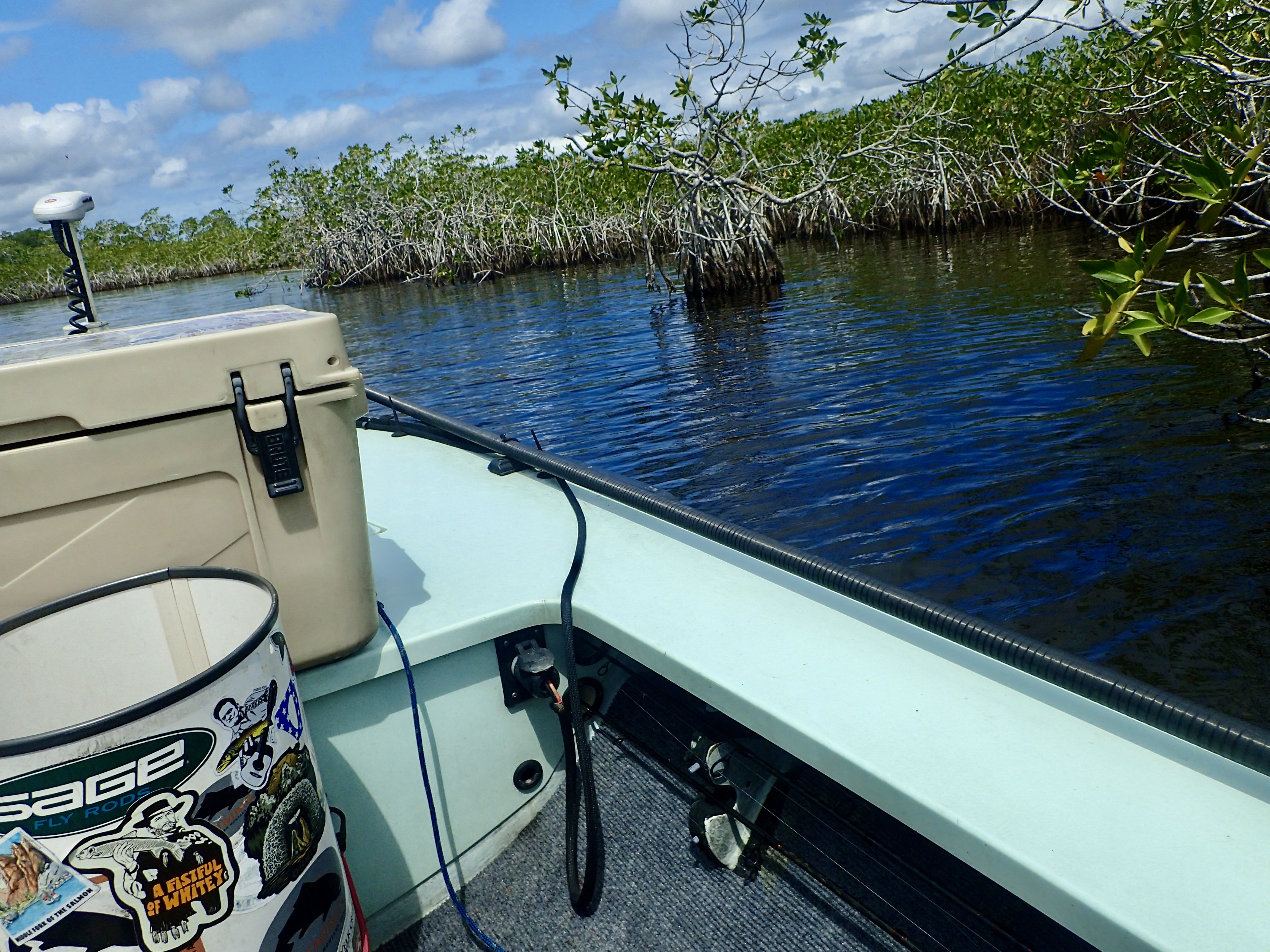
Snook country. While the Everglades can look like one expansive lake, you’re looking for structure along the shoreline, whether near open water or in one of the hundreds of labyrinthine passages that lead to a lagoon, and sometimes to nowhere. Downed tree in the water? Make a cast. Dining room table-sized cove in the mangroves? Make a cast. If a snook is nearby, and you don’t spook it — they’re in a constant state of red alert — it’s going to move with a sense of urgency to your fly.
Once again, I was fishing with Capt. Mark Giacobba. Tarpon were first on the agenda, and we spent the better part of an hour getting to the mark. Right on cue, we found rolling fish. (Tarpon will come up to the surface to gulp air, and these “rolls” give away their position.) To make a long story short, I had two follows and one take upon which I completely blew the hookset. A little later, we found some 40+ pound fish in a shallow lagoon, but they were immediately on to us, and skedaddled for points elsewhere, leaving opaque clouds of silt in their wake. With the sun continuing to climb (we’d launched at 6:30am), the target turned to snook. Hell, yeah. Let’s go.
This would be a good time to say that the fishing has been a little off in the Everglades this spring. The nights and mornings (and, consequently, the water) have been cooler than normal. The snook bite was funky; it was either action on the first few casts or nothing. We bounced around from mark to mark, staying when there were fish, bailing when there weren’t. I held off taking any pictures since I was hopeful to lock into a bigger one, but ’twas not to be. You can see one of the smaller fish I landed on Instagram @stevecultonflyfishing.
Pounding the structure. It took me a while to get up to speed, as this kind of fishing is truly different from what I normally do back home. We took a few subsurface, then switched over to topwater, which produced some explosive takes. You cast, give the bug two short pops (“Knock-knock” as Mark described it), then let the fly sit there, and wait. Maybe a couple more knocks, then it’s recast and send it to an adjacent area. You don’t strip in the fly, and it never gets even halfway to the boat before you recast. On this day, the snook weren’t shy about making their presence known.If they weren’t there, we motored.
Th final tally was six snook and one sea trout. Not great. Not terrible. Definitely fun. Up next: Day 2. It’s a story of disappointment and redemption (of sorts). You’ll see.
When the rest of the world zigs, Steve Culton usually zags. Nowhere is this more evident than in my fly fishing (wet flies, anyone?).
When I was researching the Fly Fishing Guide to the Farmington River, I spent a significant amount of time on and off the water with other guides and serious, highly skilled anglers. One thing they all had in common: they carried lots and lots of fly patterns. They also tended to have multiple fly boxes. Even a see-through plastic-lidded nymph box a little larger than a letter-size envelope has room for over a hundred flies, and many of those boxes they carried were filled. What they didn’t carry, they kept in more boxes in their vehicle. Out west, my good friend Pat Dorsey also has a — I think the scientific term is “shit ton” — of fly boxes stuffed with fly patterns. (He may have more midge patterns than I have total flies!) Pat’s one of the best guides on the planet, so he’s doing something right.
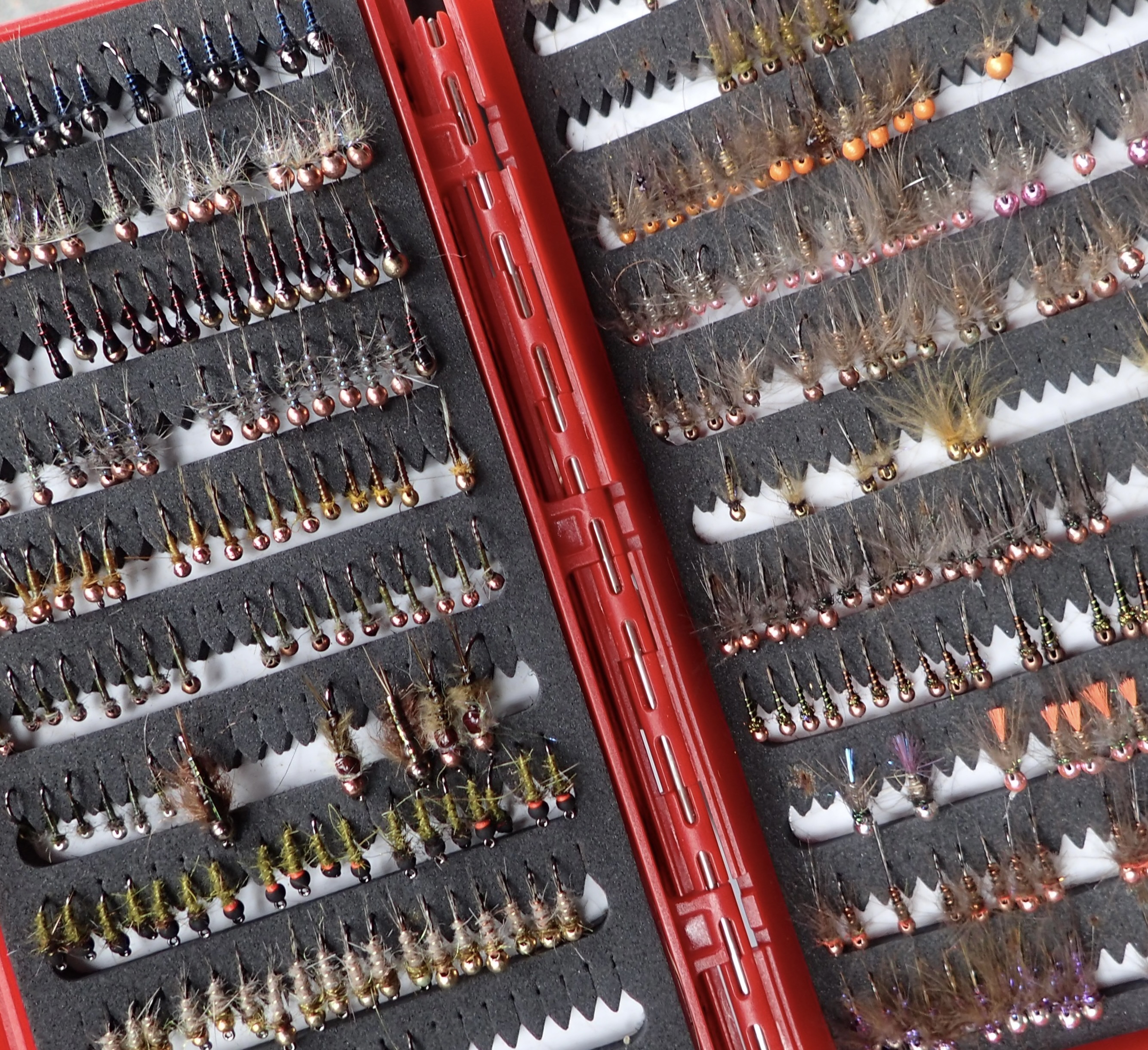
One of Joey Takeman’s many nymph boxes. I was impressed by the sheer volume of patterns he carries, and clearly, as a skilled Euro-nympher, he needs more variance in bead weights to match water speed and depth than a drop-shot nymph guy like me. But this cannot be understated: Joey has a system that works, and works very well for him.
There are two points of consequence that must now be stated.
The first is that clearly, these people have a system that works for them. They will likely be prepared for any situation with any number of patterns, variants, sizes, and colors. They believe in their system.
The second is that this approach is not for me (see “Steve Culton zags,” above).
I don’t want to carry that many patterns, let alone tie them. It’s not a matter of brain freeze, or fear of paralysis by analysis. Clearly, I do not suffer in the slightest from FOMO. It’s simply this: I have, over time, curated a selection of high confidence patterns that consistently produce. Yes, I do occasionally add new patterns into the mix. But many of the patterns I use on the Farmington have been in my rotation for decades: the Magic Fly, BHSHPT, and Squirrel and Ginger, just to name a few. I’m in good company. Legendary guide and Catskills trout angler extraordinaire Ed Van Put was famous for using precious few flies over the course of the season, even on highly technical rivers like the Delaware.
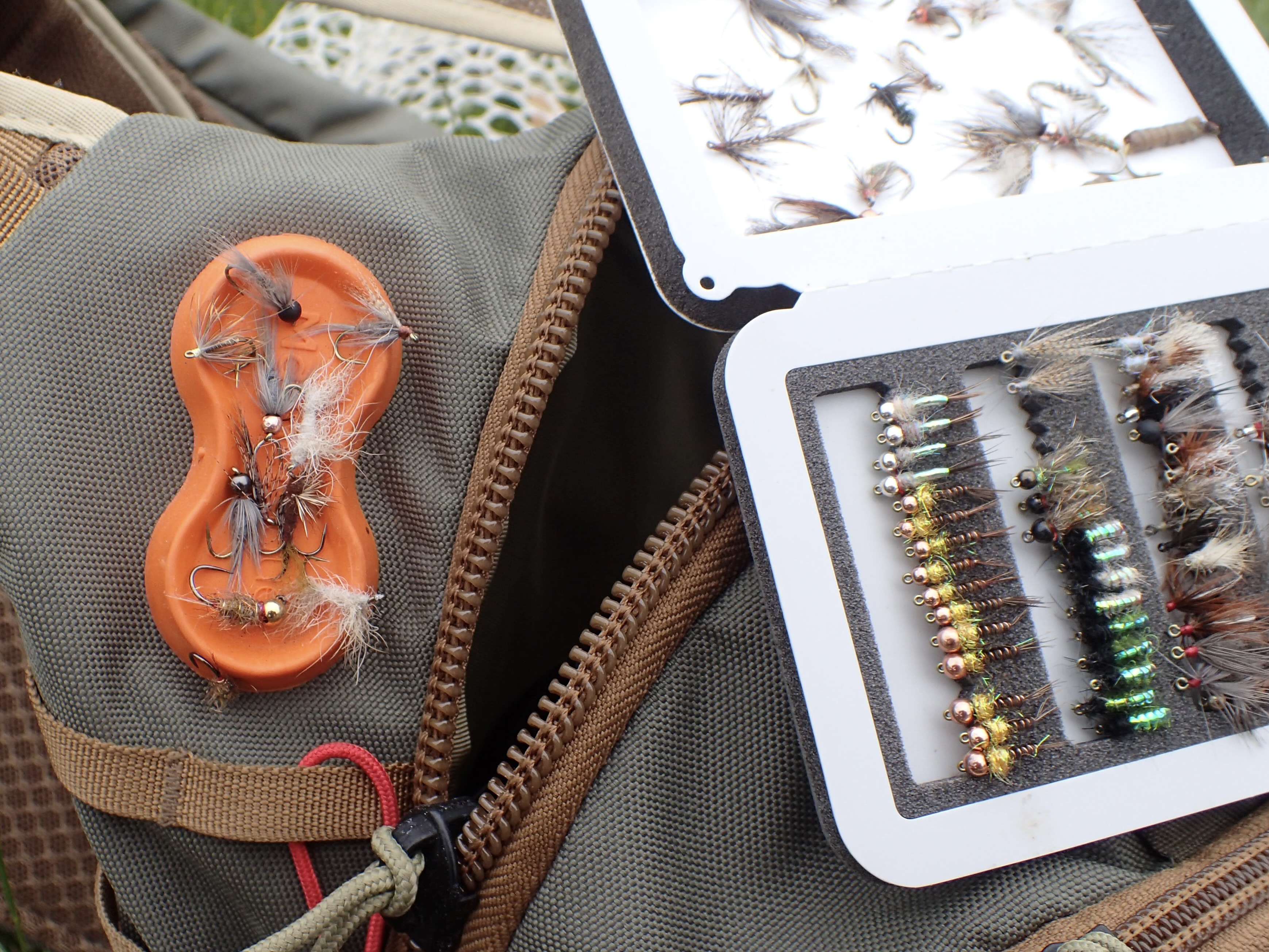
I’m a huge fan of this “day’s worth” size box, right, from C&F Design. I have several of them, each filled with seasonal patterns and fly types. This is my early season nymphs and wet flies box. Note the incredible lack of selection, though to be fair, some rows are out of sight. I’ve since migrated the nymphs to a more traditional nymph box, the kind with the see-through cover. I keep that in my pack 24/7, along with a few of these small C&F boxes, to keep me covered for various scenarios. I attach the C&F box to my pack with a Velcro patch; they’re easy to rotate in and out, so I have what I need at my fingertips, and right in front of my face.Photo from the “Fly Fishing Guide to the Farmington River,” coming August 4, 2026.
Use the system that works for you. Because this is true: confidence catches fish.
Happy Tuesday. I’m sure we’re all chuffed that it’s April, with winter (despite subfreezing temps tonight) in the rearview mirror. The glorious promise of a new season is spread before us like an all-you-can-eat buffet. Since I haven’t written anything instructional in a while, here are some considerations for April fly fishing in the northeast, submitted for your approval.
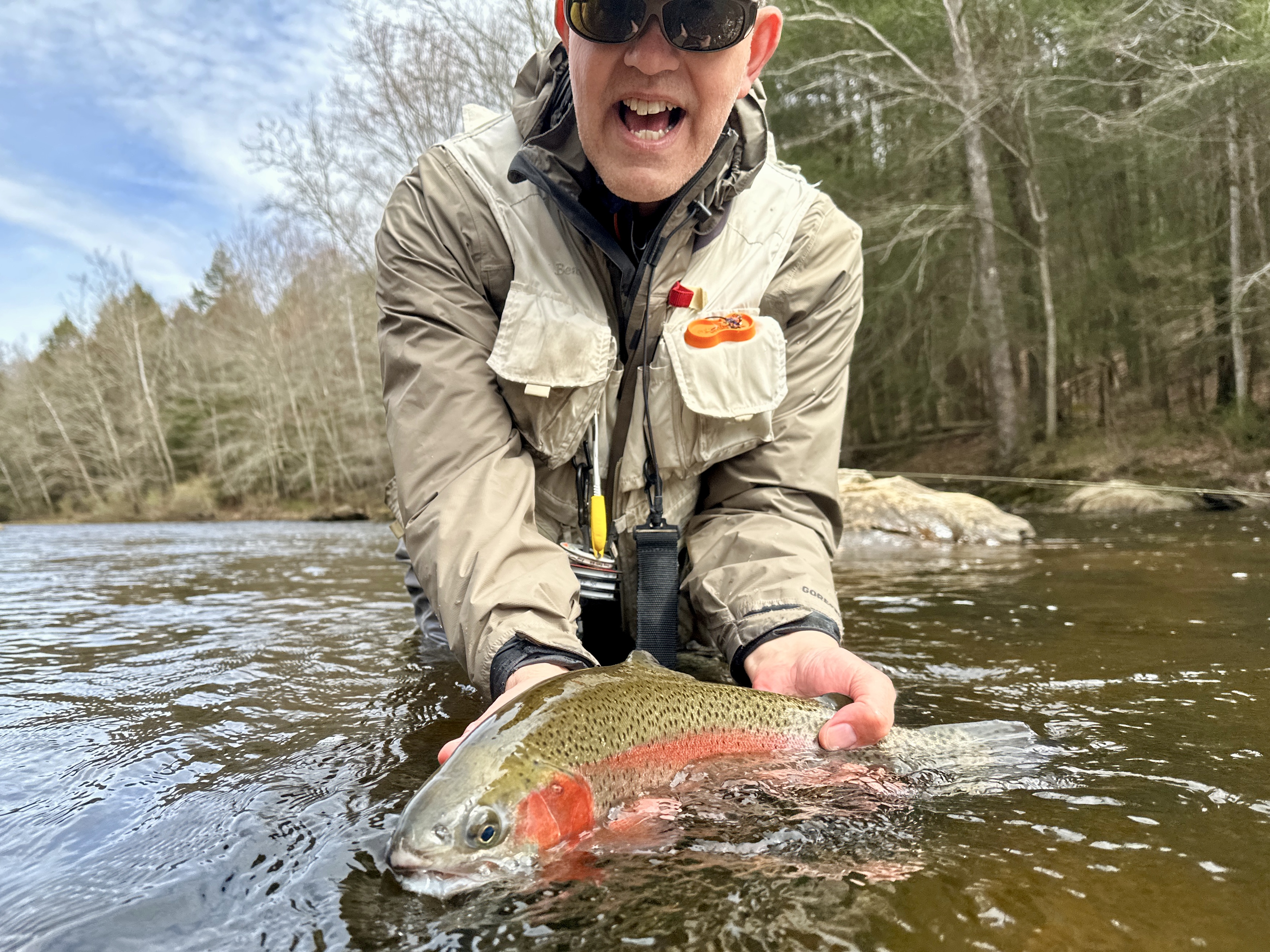
A handsome April rainbow, taken on a mini-jig streamer. Run silent, run deep.Photo by Toby Lapinski
Be prepared to go deep. The water is still plenty cold, and will be even on the warmest, sunniest April day. It may also be high. Which means that unless the trout have a reason to be active surface feeders, dries will be challenging. Your highest percentage plays are going to be dead-drifted nymphs and jig or traditional streamers, dead drifted, swung, or stripped.
The fish aren’t spread out. Generally speaking, the fish aren’t everywhere; rather, they will pod up. So where you catch one, you’ll likely catch another. An exception would be large, alpha wild browns. Look for them in the prime lies at the heads of pools, dump-ins, and even some whitewater.
Pick and choose your dry fly days. Just because it’s warm and sunny doesn’t mean the fish will be feeding on the surface. Rather, look for specific hatches and hatch windows. Hendricksons, caddis, and BWOs will all be hatching and, in the case of the mayflies, spinning and falling. If you must prospect with a dry, a nymph or wet fly dropper is almost never a bad idea this time of year. Of course, if there is hatch and feeding activity, rock on.
Don’t poo-poo junk flies. High water, off-color water, stupid stockers — these are all compelling reasons to fish Squirmy Works, Mops, and other ghastly creations.
Be (ware/aware) of shadow hatches. I write about this in greater detail in the book. Just because the Hendrickson are hatching doesn’t mean that the trout are eating Hendricksons. Know everything that is likely to be a food source and you’ll catch more fish.
Be courteous to other anglers. It can get crowded out there. Try to share the water when possible. Ask if you can fish near someone. Good fishing karma comes to those who are polite. And in a matter of weeks, the crowds will begin to thin out.
May comes next. Another topic that’s covered in the book. You think it’s going to be high 70s and sunny, and all too often it’s 50s and cloudy and windy. May is caddis month. So get those boxes filled on your April off days.
Is this a great time of year to be a fly fisher, or what?
A little random potpourri day on currentseams. I had written a post similar to this one, which was supposed to go live on Tuesday, but somehow WordPress ate my draft (don’t you just love when technology fails?). So here we are.
I received about two dozen requests for personalized copies of the book through me, and that’s enough for me to proceed. My next steps are to figure out how much all this will cost me (mailers, postage — probably media mail) so I can then pass the cost along to you. (How’s that for transparent business practice?) I’m hoping to have that information out by the end of the month, and if you want a signed copy from me, you still have plenty of time to let me know. I won’t ask for money until I get all those ducks in a row, and hopefully I can get books out to you before the official release day of August 4.
Fishing time has been scarce for me this spring, especially on the striper front. I didn’t go once from January through March. Normally, I’d go at least once a month in January and February. But every time I had a time and tide window, it was either sub-freezing cold front misery or a disgustingly high water. I’m really looking forward to being able to swing some flatwings in April. If the elements allow!
March can be a productive big-bass-on-the-fly-from-shore window. Not this year. At least, not for me.
On our local trout waters, it’s a tricky time of year. You basically have two options: targeting stocked trout or targeting wild and holdover trout. I must confess that playing the stocker game is fun for a while; however, I have a limited interest for that. Wild or stocked, the trout will tend to remain stacked up this time of year, even though it’s beginning to warm up and we’re seeing more bug activity. They’ll begin to spread out sometime in April. Bug-wise, think little dark stone flies and midges and caddis, which are plentiful food supplies. Of course, the Hendricksons will be the first big glamour hatch of the year, starting on the lower Farmington in about two weeks. But after last year‘s disappointing showing, that hatch remains a big question mark. We shall see.
Mrs. H, missing the middle fork of her tail.
I did get out to a small stream last week after the rains, but the water was high and cold. There were no bugs and the air temp in the 30s didn’t help. I went out this week in much warmer temperatures and a little bit lower water, and what a difference a week made. But I’ll give you more on that in a post next week.
As a newly minted member of the Regal Vise Pro-Staff, I’m working on a wet fly piece for their website (which is currently under reconstruction). I have no idea when it will post but I’ll let you know. Also look for a future blog post for me on the J. Stockard website, where I’m also a Pro Tyer.
Finally, many thanks to the Yale Fishing Club for hosting me on Tuesday night. It’s always a good time, and I’m a sucker for New Haven style pizza — well done, group! They’re going to fish the Salmon River in New York in a couple weeks, so we tied up some Blood Dot eggs which will serve them well.


 currentseams.com