I’d come to the Everglades with a single purpose: land my first tarpon. Oh, sure, I’d take all the snook I could get — I love snook — but tarpon was the prize.
There were only two problems. First, the weather. It had been been a colder than normal spring and the water temp wasn’t quite where the tarpon like it. But, nothing can be done about that. The second problem was of my own doing. I’d already had one shot at a tarpon on day one, but completely blew the hookset. I’d have to do better on this day.
We arrived at the scene of yesterday’s rolling tarpon to find only 1/3 the number of visible fish. That was discouraging, but we nonetheless had at it. I was really feeling like I was going to get my first tarpon, so much that I said it aloud. And that’s where problem two reared its ugly head. For some reason, even though I knew otherwise, my brain was telling me to wait to feel the weight of the fish before setting the hook. Eventually, a tarpon roared out of the shaded mangroves, struck the fly, and once again, I missed it. The lesson was driven home by an inspection of the leader; the first six inches above the fly bore the marks of the edges of the tarpon’s mouth. It was proof that fly was inhaled deep enough to get a hook set. As Charlie Brown would say: “Rats.”
I tried not to let it bother me. Really, I did. But I was mad at myself for missing yet another opportunity, especially since the winds tomorrow were likely going to be strong enough to make the Everglades a non-starter. Plus, who knew if we’d even seen another tarpon? I decided to not let it wreck my day. After all, I was fishing in the Everglades with my oldest son, and smoking cigars. That’s a win.
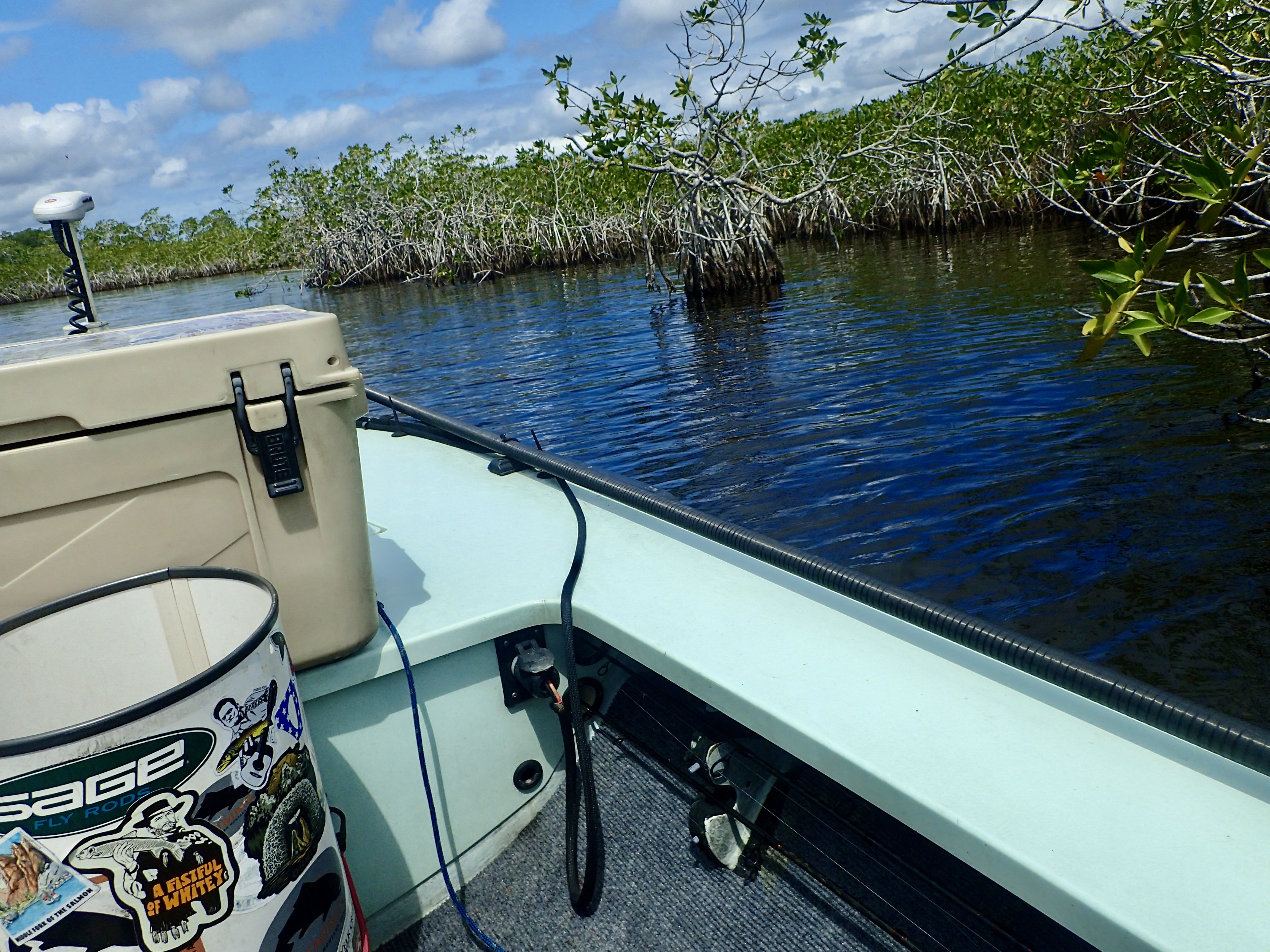
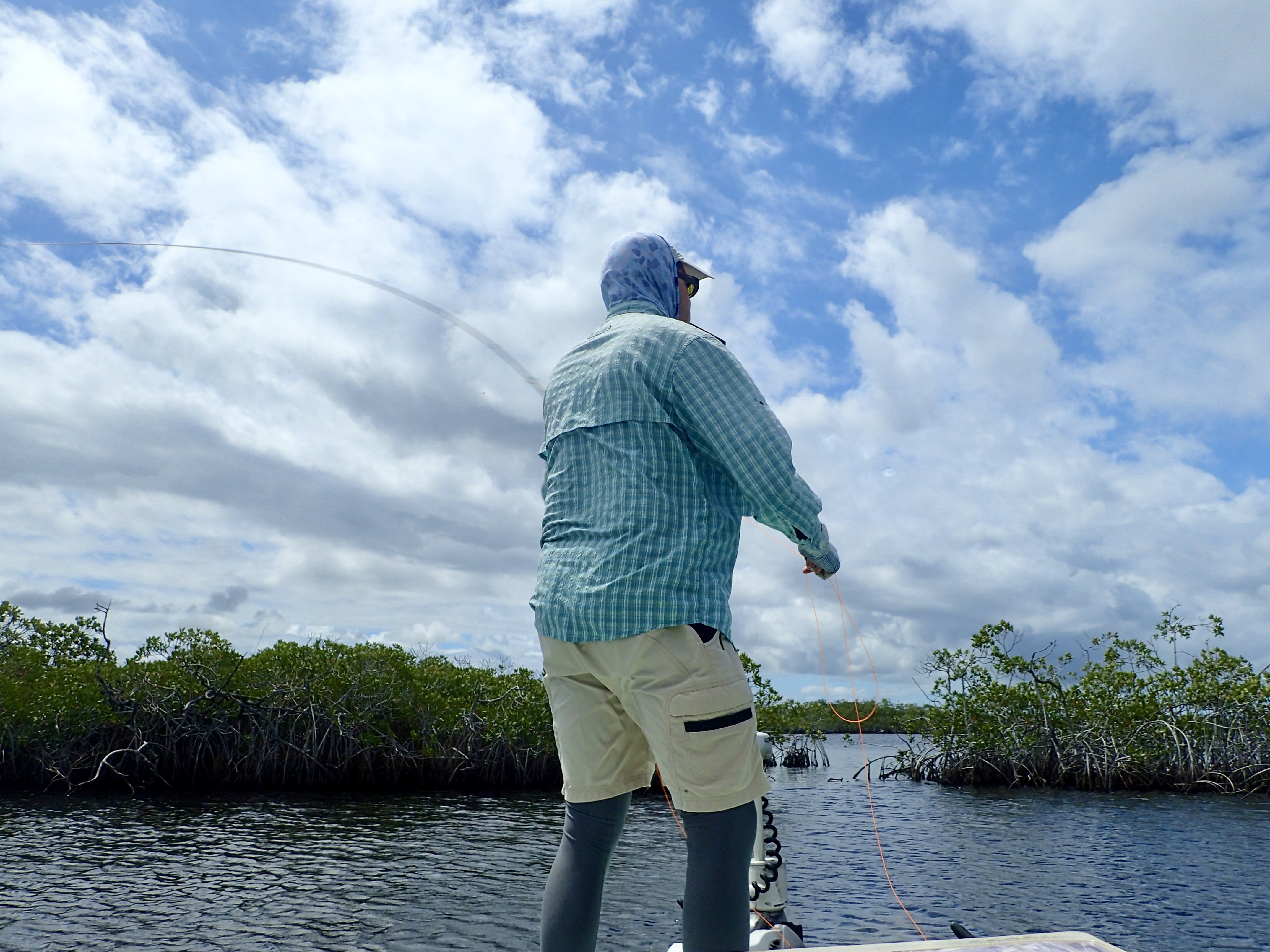
Since the snook bite generally stunk, we decided to lightning raid as many creeks and lagoons as we could in hopes of finding our target. Finally, after silent electric motoring up a mangrove-covered creek entrance not much wider than the boat, we found a roller. As I set up to cast, I reconned the surroundings and reinforced the procedure: on a hit, I’m not waiting on my strike. I’m setting low and hard to my left. I was repeating it like a mantra while imagining the movement.
First cast. No love.
Second cast, same result.
Third cast. Here he comes! It all happens so quickly that your conscious mind really can’t separate the greenish flash of the sun off flank, the water bulge and then boil around your fly, the sudden tension on the line, and the sound of violent water displacement. It’s almost simultaneous. This time, I was ready. “Down hard and to the left.” It all went down in one exhilarating moment, and I made the move and stuck the set.
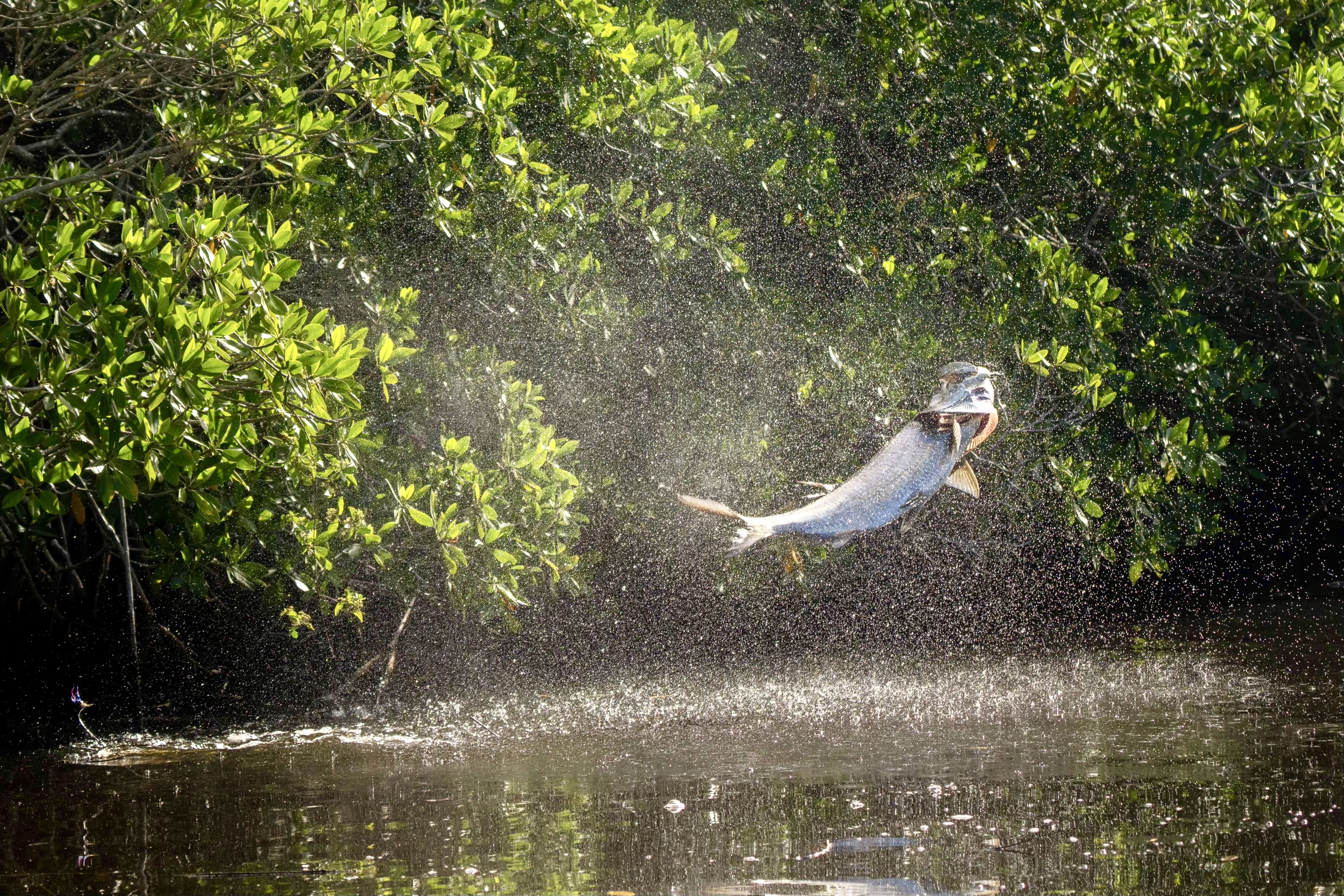
The tarpon thrashed on the surface, then sped away from the boat like a perp in a getaway vehicle. “Let him run!” shouted Capt. Mark, but I needed no coaxing as this fish immediately put itself on the reel. The first jump was a spectacle of power and fury, the spray shimmering in the morning sun like a thousand tiny LEDs. The tarpon made a sudden 180 and swam back to the boat. “Keep that line tight!” Reel fast!” were the captain’s instructions, but I was already doing it. I cranked furiously, still tight to the fish. It was at this moment that I knew I was going to land this fish. But I didn’t plan for the mangrove wild card.
The fish moved to the left, just ahead of the boat, toward a treacherous-looking mangrove root system. (There are also multiple dead roots/branches/tree remnants in any given space along the shoreline). I thought I steered the fish out of harm’s way, but when he made his second leap, the leader hung up on a submerged root and the fly popped off. I was left with the temporary illusion that the fish was still on — the hook was stuck below the waterline — but I knew in my heart the tarpon was gone.
Now, you might think at this moment that I would be in a state of shock and despair. But no. Just the opposite. I was giddy, almost chortling. Amazed and full of wonder. That was terrific! I wasn’t about to let a little bit of bad luck ruin my day. For I had quietly, patiently stalked my quarry, waited for that moment — and then, finally, fully prepared, was ready. I’d done my best. And that’s all anyone can ever do.
You know, I’m thinking that I’m going to land the next one.