Fly Fishing the Everglades, Day 2: The thrill of defeat and the agony of… well, nothing

I’d come to the Everglades with a single purpose: land my first tarpon. Oh, sure, I’d take all the snook I could get — I love snook — but tarpon was the prize.

There were only two problems. First, the weather. It had been been a colder than normal spring and the water temp wasn’t quite where the tarpon like it. But, nothing can be done about that. The second problem was of my own doing. I’d already had one shot at a tarpon on day one, but completely blew the hookset. I’d have to do better on this day.

We arrived at the scene of yesterday’s rolling tarpon to find only 1/3 the number of visible fish. That was discouraging, but we nonetheless had at it. I was really feeling like I was going to get my first tarpon, so much that I said it aloud. And that’s where problem two reared its ugly head. For some reason, even though I knew otherwise, my brain was telling me to wait to feel the weight of the fish before setting the hook. Eventually, a tarpon roared out of the shaded mangroves, struck the fly, and once again, I missed it. The lesson was driven home by an inspection of the leader; the first six inches above the fly bore the marks of the edges of the tarpon’s mouth. It was proof that fly was inhaled deep enough to get a hook set. As Charlie Brown would say: “Rats.”

I tried not to let it bother me. Really, I did. But I was mad at myself for missing yet another opportunity, especially since the winds tomorrow were likely going to be strong enough to make the Everglades a non-starter. Plus, who knew if we’d even seen another tarpon? I decided to not let it wreck my day. After all, I was fishing in the Everglades with my oldest son, and smoking cigars. That’s a win.

Since the snook bite generally stunk, we decided to lightning raid as many creeks and lagoons as we could in hopes of finding our target. Finally, after silent electric motoring up a mangrove-covered creek entrance not much wider than the boat, we found a roller. As I set up to cast, I reconned the surroundings and reinforced the procedure: on a hit, I’m not waiting on my strike. I’m setting low and hard to my left. I was repeating it like a mantra while imagining the movement.

First cast. No love.

Second cast, same result.

Third cast. Here he comes! It all happens so quickly that your conscious mind really can’t separate the greenish flash of the sun off flank, the water bulge and then boil around your fly, the sudden tension on the line, and the sound of violent water displacement. It’s almost simultaneous. This time, I was ready. “Down hard and to the left.” It all went down in one exhilarating moment, and I made the move and stuck the set.

The tarpon thrashed on the surface, then sped away from the boat like a perp in a getaway vehicle. “Let him run!” shouted Capt. Mark, but I needed no coaxing as this fish immediately put itself on the reel. The first jump was a spectacle of power and fury, the spray shimmering in the morning sun like a thousand tiny LEDs. The tarpon made a sudden 180 and swam back to the boat. “Keep that line tight!” Reel fast!” were the captain’s instructions, but I was already doing it. I cranked furiously, still tight to the fish. It was at this moment that I knew I was going to land this fish. But I didn’t plan for the mangrove wild card.

The fish moved to the left, just ahead of the boat, toward a treacherous-looking mangrove root system. (There are also multiple dead roots/branches/tree remnants in any given space along the shoreline). I thought I steered the fish out of harm’s way, but when he made his second leap, the leader hung up on a submerged root and the fly popped off. I was left with the temporary illusion that the fish was still on — the hook was stuck below the waterline — but I knew in my heart the tarpon was gone.
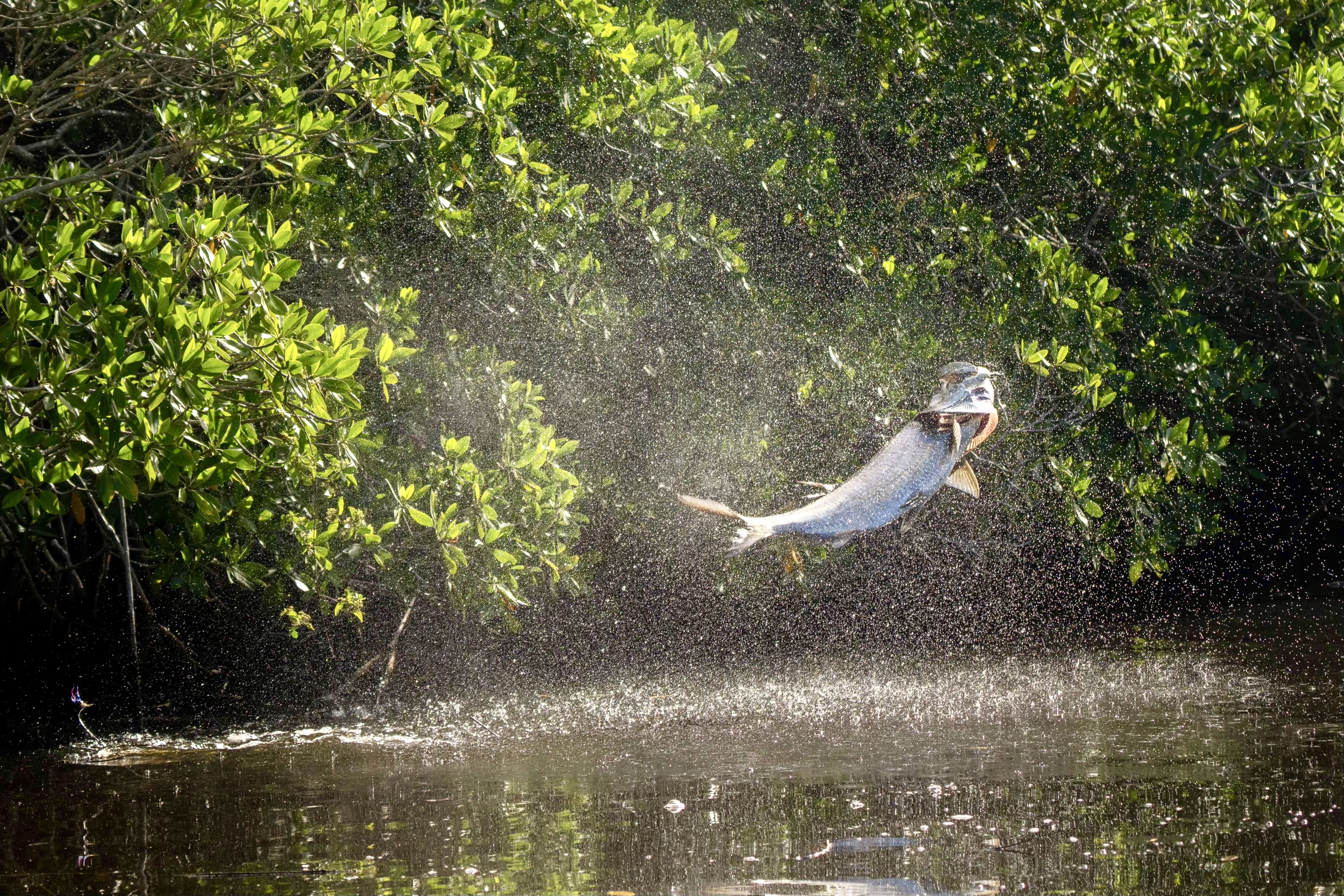
The last blast, the moment the tarpon escaped the bond of the hook and line. You can see the fly, stuck on the tiny branch peeking out of the water on the lower left. The fish landed with a thunderous splash. Then it was gone. Photo by Mark Giacobba.

Now, you might think at this moment that I would be in a state of shock and despair. But no. Just the opposite. I was giddy, almost chortling. Amazed and full of wonder. That was terrific! I wasn’t about to let a little bit of bad luck ruin my day. For I had quietly, patiently stalked my quarry, waited for that moment — and then, finally, fully prepared, was ready. I’d done my best. And that’s all anyone can ever do.

You know, I’m thinking that I’m going to land the next one.

The Everglades, Part 4: Bill and Dad Ride Again!

Before this trip, I’d had only one Everglades fishing experience. That was four years ago, and it was a single day excursion with my oldest son, Bill, who was graduating from law school. Our target on that May day was snook and tarpon, but I never even got a taste of a tug. Sure, the jacks and ladyfish and sea trout were fun, but I was disappointed. The highlight of the day was a fine snook Bill grabbed out of a shallow tidal flat.

And so it came to pass that Bill and I were heading out again. I’d already gotten my snook, and then some, and had an all-too-brief encounter with a tarpon, so in a sense this was a gravy day for me. Bill was getting married in three days, and at the very least we’d soak up some sunshine and enjoy some cigars.

Wednesday turned out to be the warmest of the three days, but there was still an early morning chill that was amplified by the boat slicing through the pre-dawn canals. I wore fleece pants all three days — I’m generally always inclined to be cold — but later on this day I almost broke the shorts seal. I knew what was coming in a couple weeks, and I kept reminding myself that regardless of the action, this wasn’t steelheading — and I should enjoy the blessing of actually being able to feel my toes and fingers.
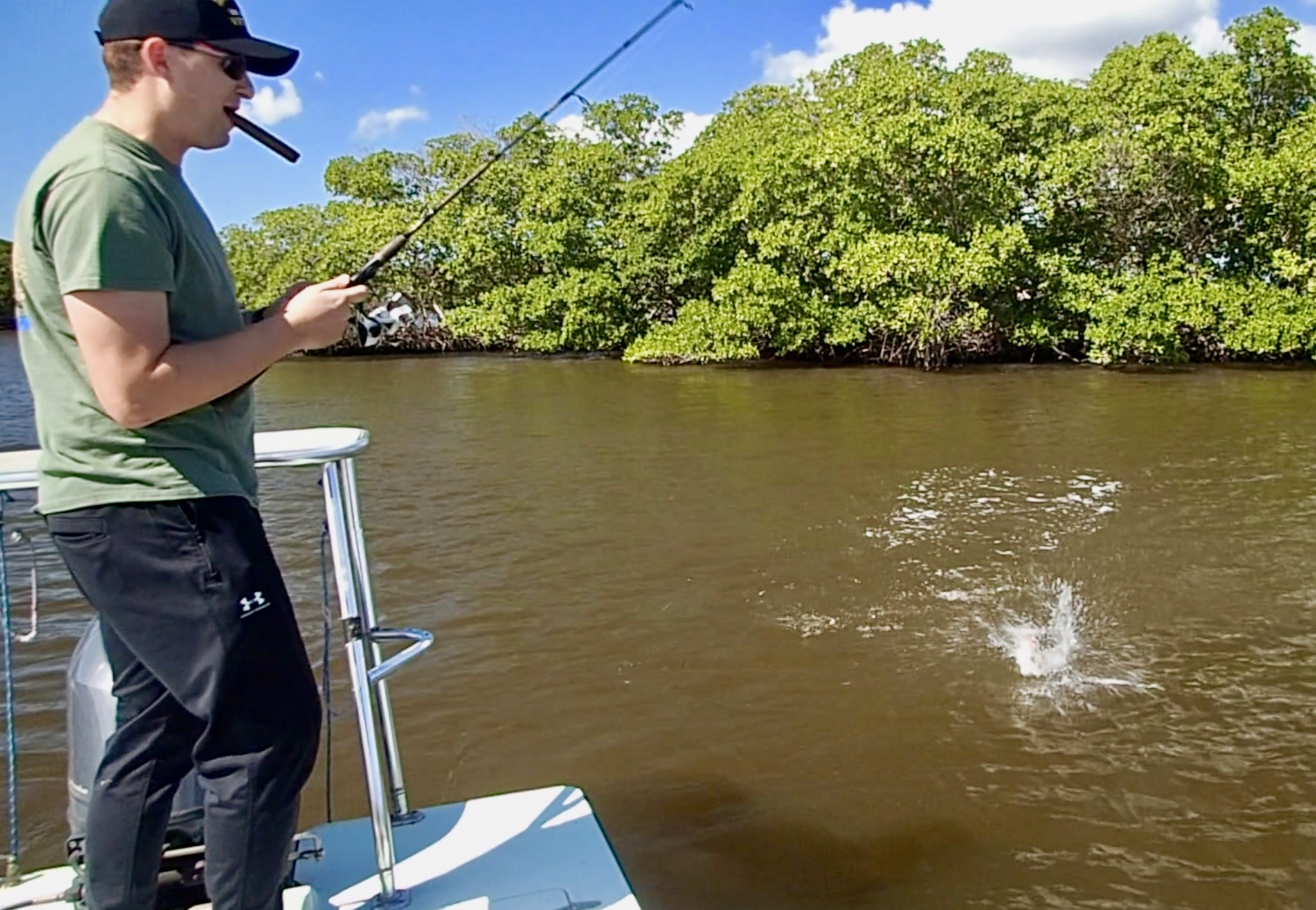
A left-handed fly caster on the bow and a right-handed spin guy on the stern makes it easy to do double duty. However, as we drifted past this island, I wanted to get some footage of my Marine doing battle. Bill found a pod of sea trout and had at them. These are beautiful fish, and they can be highly aggressive with their follows and takes. We liked this spot so much that we asked Mark to do another pass around. we never saw another boat until the very end of the day.
We made a run to where the Everglades dumps into the Gulf, and I loved this mark: current, loads of structure, and all kinds of birds and mammals and reptiles to eyeball. We actually fished hundreds of yards of shoreline. By now, I felt like my presentations and hook sets had come light years from my first trip. As we drifted past a downed tree within a pocket channel, I thought I saw a shadow. One cast, a couple strips, snook on! A decent fish for sure, but sight casting him in lightly stained water made me feel on top of my game. Bill and I each took multiple smaller snook at this mark. Of course, just when you think you’re all that, a baby tarpon in a cove near a creek mouth will remind you that you aren’t. And so, having touched two tarpon on the trip, I am resolved to get one on my next. Like Boss Rojack said in My Favorite Year, “The fighting is rounds…this is round one”

The Everglades, Part 3: Win some, lose some.

The first time I fished the Everglades with Mark I was green. This is a specialized type of fly fishing, and by the time I felt like I was getting the hang of it, the day was over. What’s more, it was one of those days where the shots at fish weren’t plentiful. I’d gone down with the intention of catching snook and tarpon, but we had no opportunities at the latter and only a couple with the former.

So you can imagine that on this trip, I was raring to go. But, there’s always something conspiring against you, isn’t there? Wind, rain, cold fronts, pandemics…the list of potential villains is endless. Add to that that I have an uncanny talent for picking lousy fishing days months in advance. And so it was that Mark informed me that the Everglades bite had been slow. Very, very slow. But you go and you fish and you do your best, and that’s all any of us can ask.

A few hours in I’d landed ladyfish and sea trout and jacks, but no precious snook, let alone even a sighting of tarpon. Mark, being the guide extraordinaire that he is, thought we might have better luck in some of the more intimate creeks and ponds. Getting to some of these spots is an experience. You use the electric motor or the Evinrude on its lowest setting, and start down these labyrinthine waterways, some of which are not much wider than the boat. Mangrove branches and leaves try to smack you in face, and they’ll swat away anything on deck that isn’t lashed down.

Once inside the pond or cove, you assume a ready position on the bow. There’s no chatter, only hushed tones that are essentially a loud whisper. If we don’t see any cruisers, we systematically attack the mangrove-choked shoreline. In particular, you look for structure, like downed trees and especially little notches in the shoreline or micro-creek mouths. It’s a precision cast — the closer to the mangrove roots the better, and watch out for those overhanging branches that want to eat your fly — then short, fast strips the moment the fly touches water. I didn’t know it yet, but if there are snook or tarpon lying in wait, they will race to the fly with breathtaking speed.

I was working one of those little notches in a shaded corner when it happened. The water bulged, I felt a bump, and I saw a large shadow turn and melt away into the tobacco-stained water.

Snook. A good one.

There was no hook set, no point-finding-purchase, no sense that the fish was spooked. So I made the same cast.

The bulge re-appeared, moving at attack speed, and the snook slammed into the fly. I’ve screwed up plenty of hook sets in my life, but not this one. Rod tip down and dirty, hard strip back and to the right, and the Everglades exploded.

Right from the start, I felt like I had this fish. (A strong set and 20-pound test is good for confidence.) Still, when you’ve never caught a species before, you don’t know how it’s going to behave. This fish did everything in its power to screw me up, like repeatedly trying to find refuge in the submerged roots and sounding under the boat. I never put it on the reel; it was all hand stripping. “Don’t let him breathe!” was constantly running through my head, and Mark did a great job of kibitzing during the battle. Then, the inevitable. Snook landed.

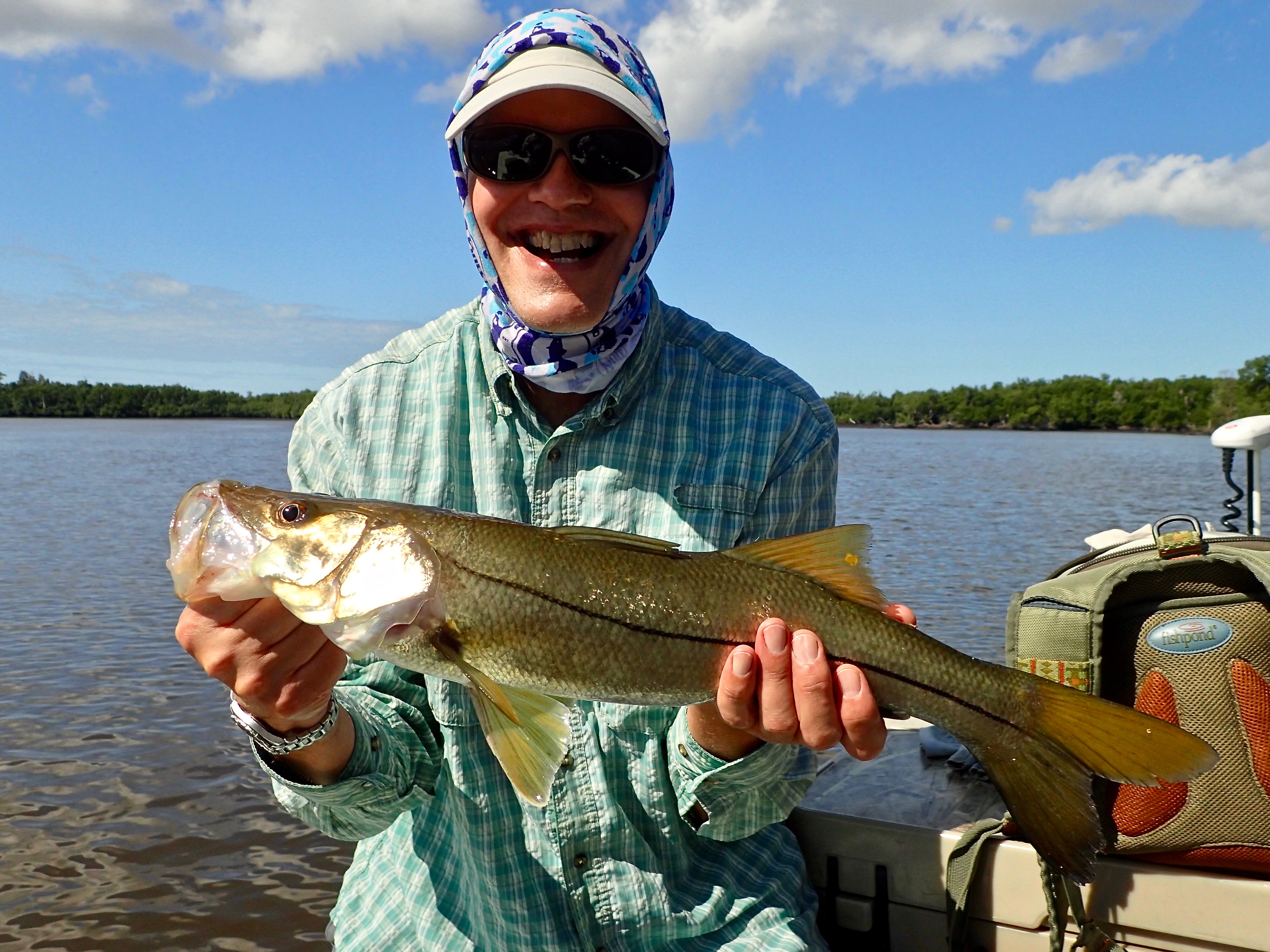
Time for a victory cigar. My first striper on the fly went 30″. My first snook was in the same ballpark. What a magnificent beast! Snook will color to match their surroundings, and this one is perfectly camouflaged for the dark bottom of its home. Taken on Mark’s Blue Claw streamer. Photo by Mark Giacobba.

Most of the rest of the day was anti-climatic. We found another stretch of shoreline, this time in the sun, that was infested with smaller snook, 12″-16″. It was a great opportunity to observe how snook ambush feed. The speed with which they move to their target is impressive. We didn’t count, but it had to be at least a dozen more snook to hand.

While fun, these smaller fish can lull you into a false sense that you are infallible. I remember losing a pig of a striper on the Cape a few years ago. Dink after dink after dink — then when a really good bass hit, I was unprepared and dropped the fish. You can see where this is going. All of a sudden, I rolled a tarpon. I was so surprised that I was late on the set. I still thought I had him, but after a moment of wild spray and boiling water, it was gone. I stood alone on the front deck, the heat of regret and embarrassment crawling up the back of my neck. You gotta set the hook, Steven. You gotta set the hook.

Still, it was hard to let that moment trump the victory of the morning. I had my snook, and then some. And I also had tomorrow.