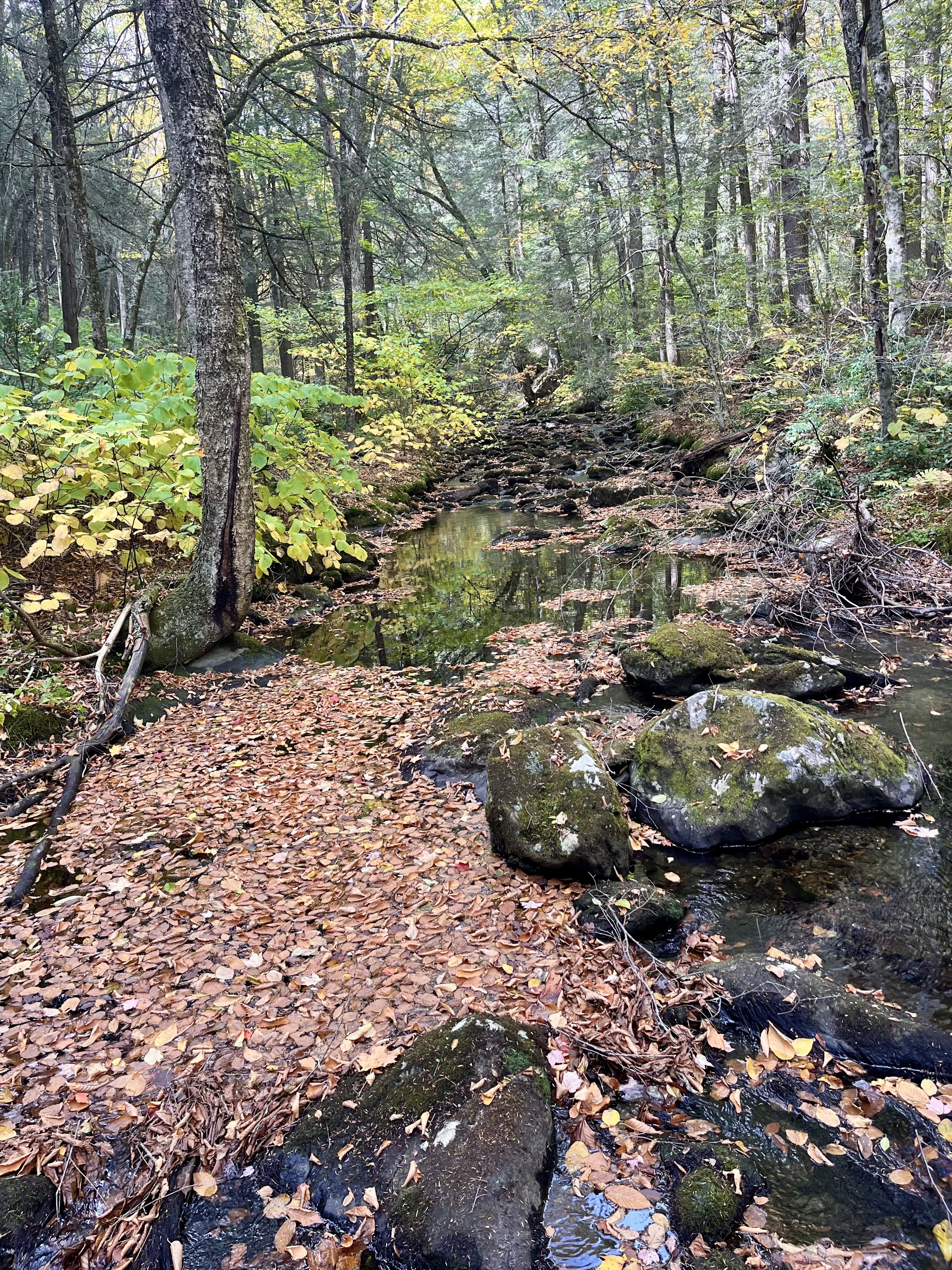
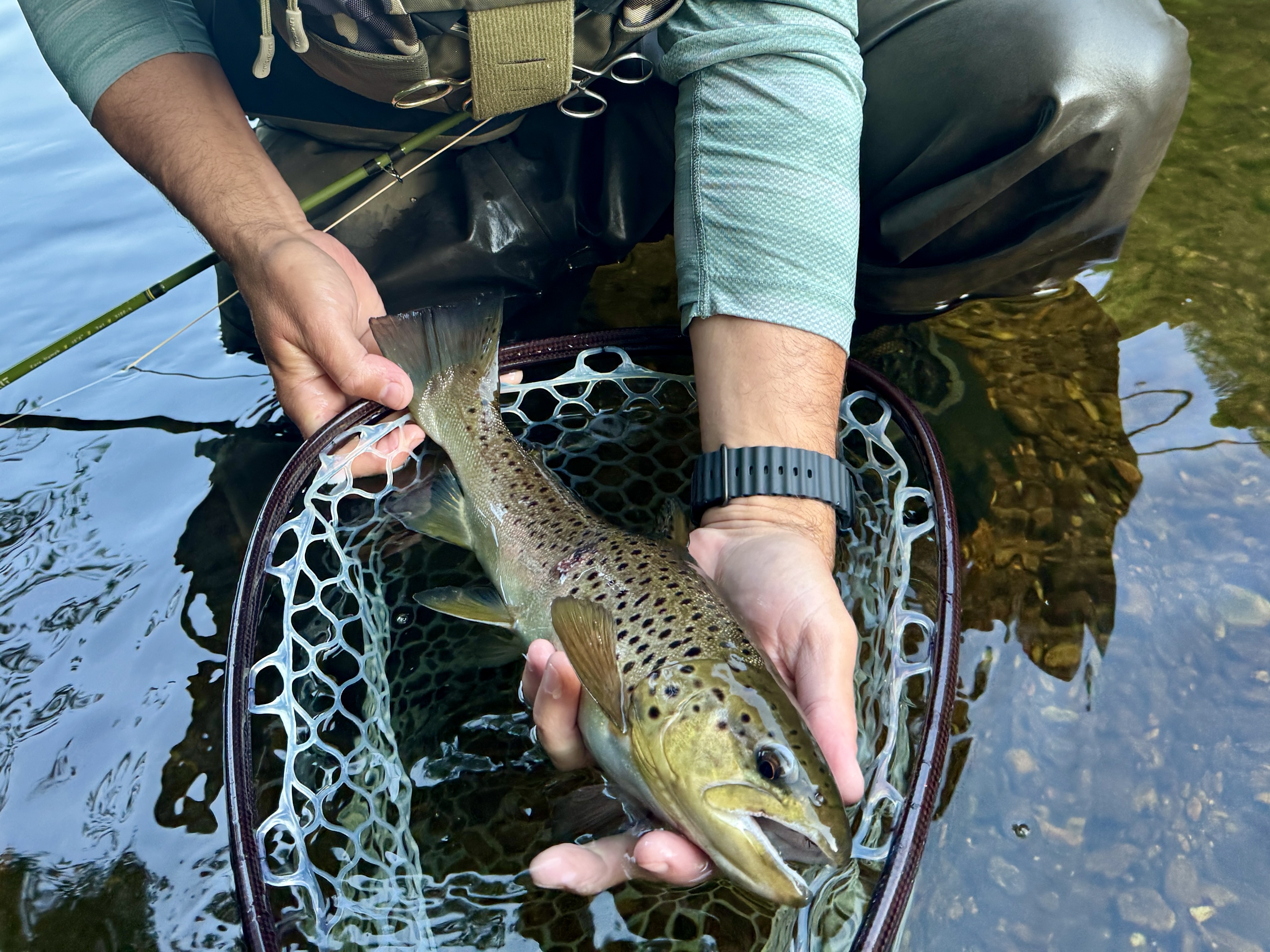
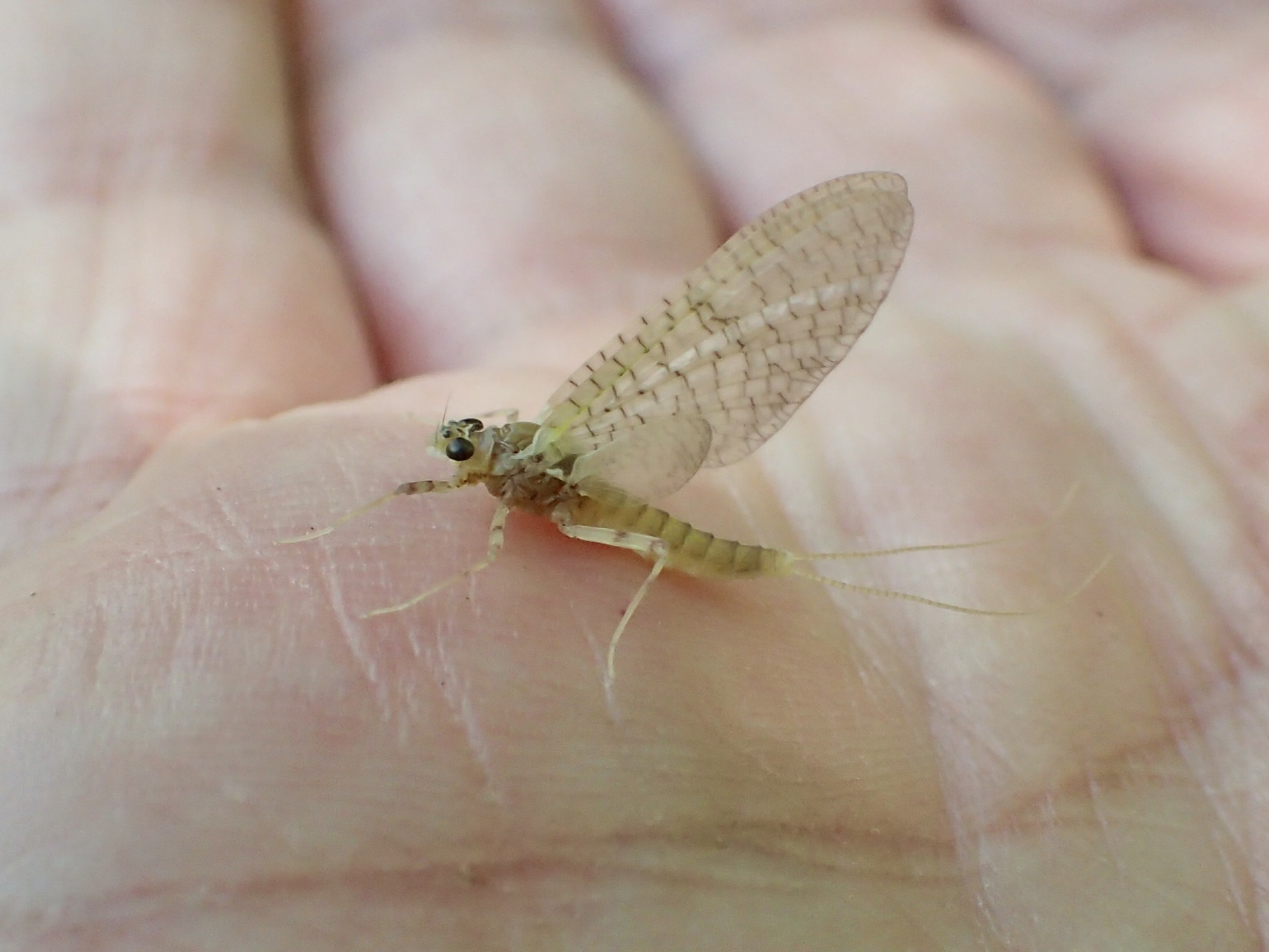
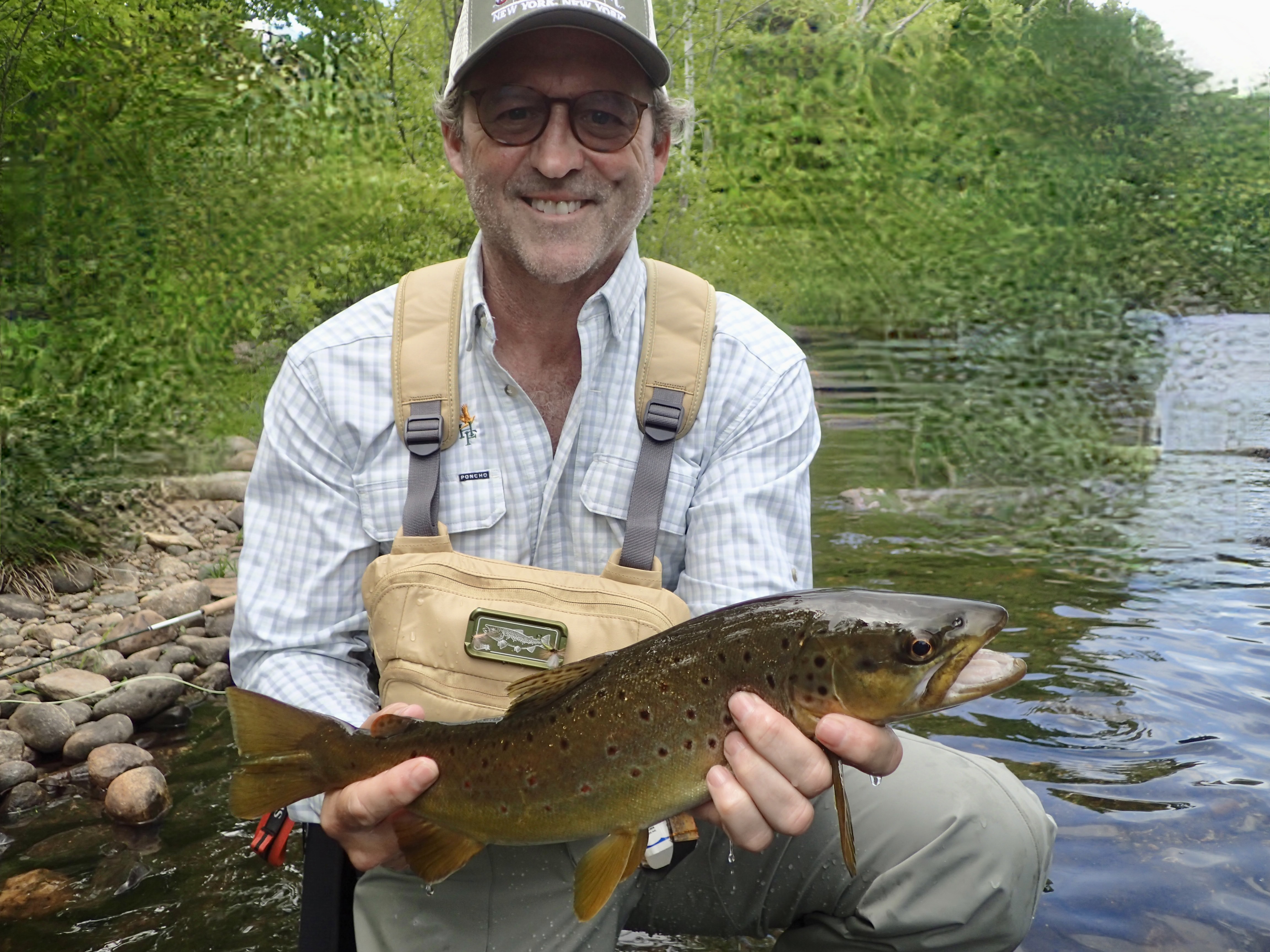
I fished a favorite small stream last Friday and the water was painfully low. Those of you who are acquainted with me know that I detest low water. On this day, it meant that the longer, deeper pools had precious little movement. Sometimes the only discernable flow was at the extreme upper end of the head. Leaves were a problem, not because they were interfering with drifts, but rather because they had amassed in large quantities on the surface, essentially creating a sheet of leaves. Great for fish to hide under; not so great if you’re trying to present a fly to them.
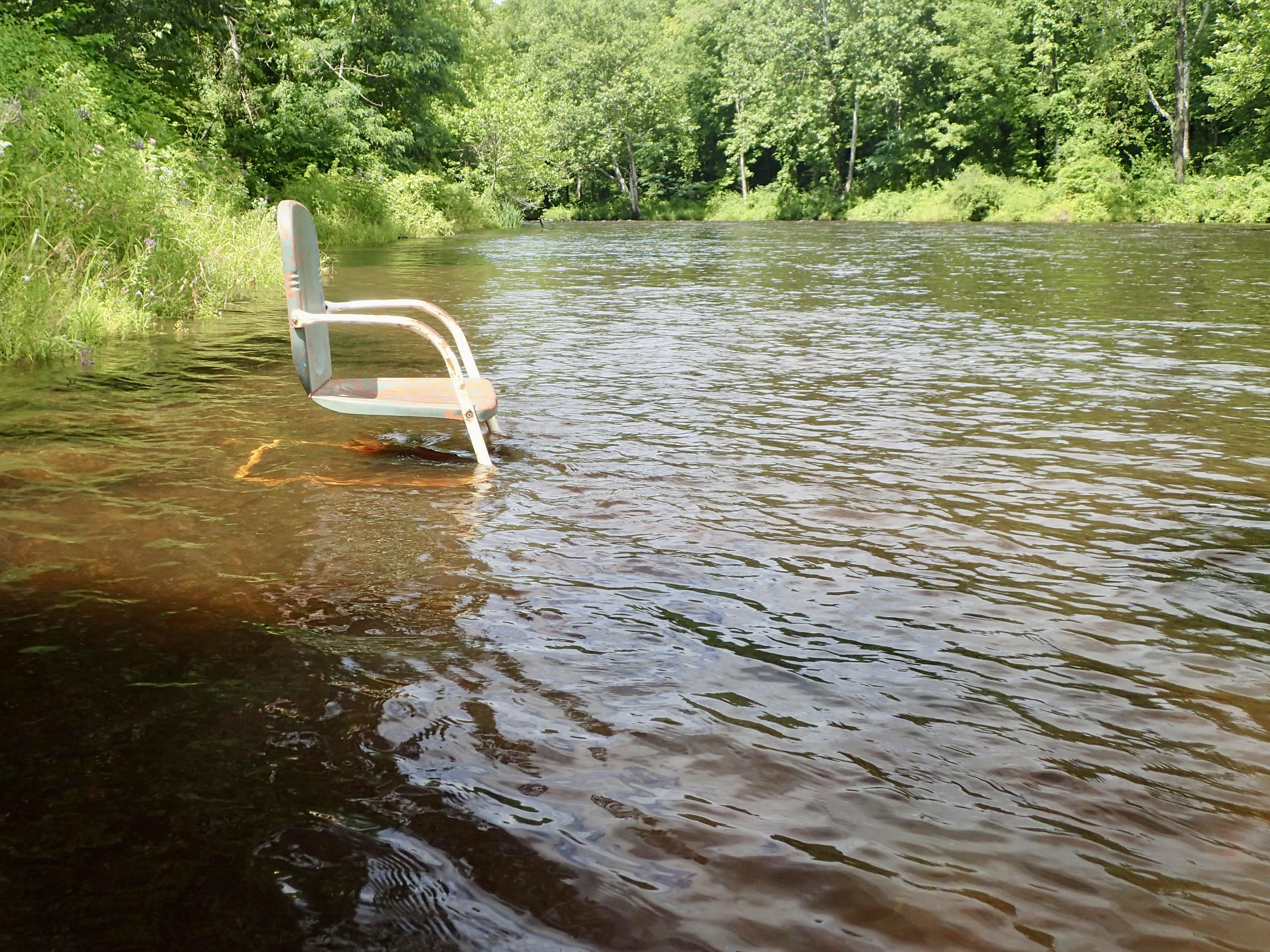
This is what I’m talking about. That lower end looks like a pile of leaves on dry land; they’re actually resting on the surface of the water.
My solution to the low flow/leaf problem was to fish a dry-dropper in the faster sections, and to go heavy subsurface with micro-jig streamers. Both produced fish, although most of the dry/dropper hookups were on the trailing bead-head nymph rather than the dry. I’m all about watching wild fish slash at the dry, but there’s something cool about using it as a strike indicator — now you see it, now you don’t. Set that hook!
I’m not sure yesterday’s rain qualifies as a blowout, but it certainly should have been enough to move some leaves. The Farmington gauges bumped up a bit, but most of it was generated by the Still River. I expect the Farmington to be in excellent shape for most of the week.
It’s been like forever since I’ve played a doubleheader. And it really wasn’t looking good to start. I’ve been suffering through a series of random back spasms over the last few weeks, and the morning — Tuesday — I was planning on going, one snuck up on me and blasted my lower back. But I decided that movement was probably a good thing, bending over and uneven terrain be damned, so I loaded my ice packs and heating pad in the truck and headed for the Litchfield hills.
I’ve hadn’t been to this stream in about a year, and in a situation like that, on the drive I’m generally obsessed with questions like, what has changed? Will it be better, or worse? What will the flows be like? Well, not much had changed. There were, as usual, some randomly-placed-by-Mother Nature branches in the water that completely cocked up a pool or run. Despite last weekend’s rain — it didn’t deluge everywhere — the water was on the low side of medium, just barely what I would call decent. But there was cloud cover, and there were fish on the hunt, along with some active hatches. I fished a dry (ARF Humpulator size 14) with a size 18 2x short BHPT dropped off the bend by a foot of 5x. They mostly wanted the dry, including the one rising fish I targeted, but I pricked several on the dropper. I would have liked more water in the system, but you take what nature gives you and do your best. Cigar? Rocky Patel 55 Robusto. It was delicious.
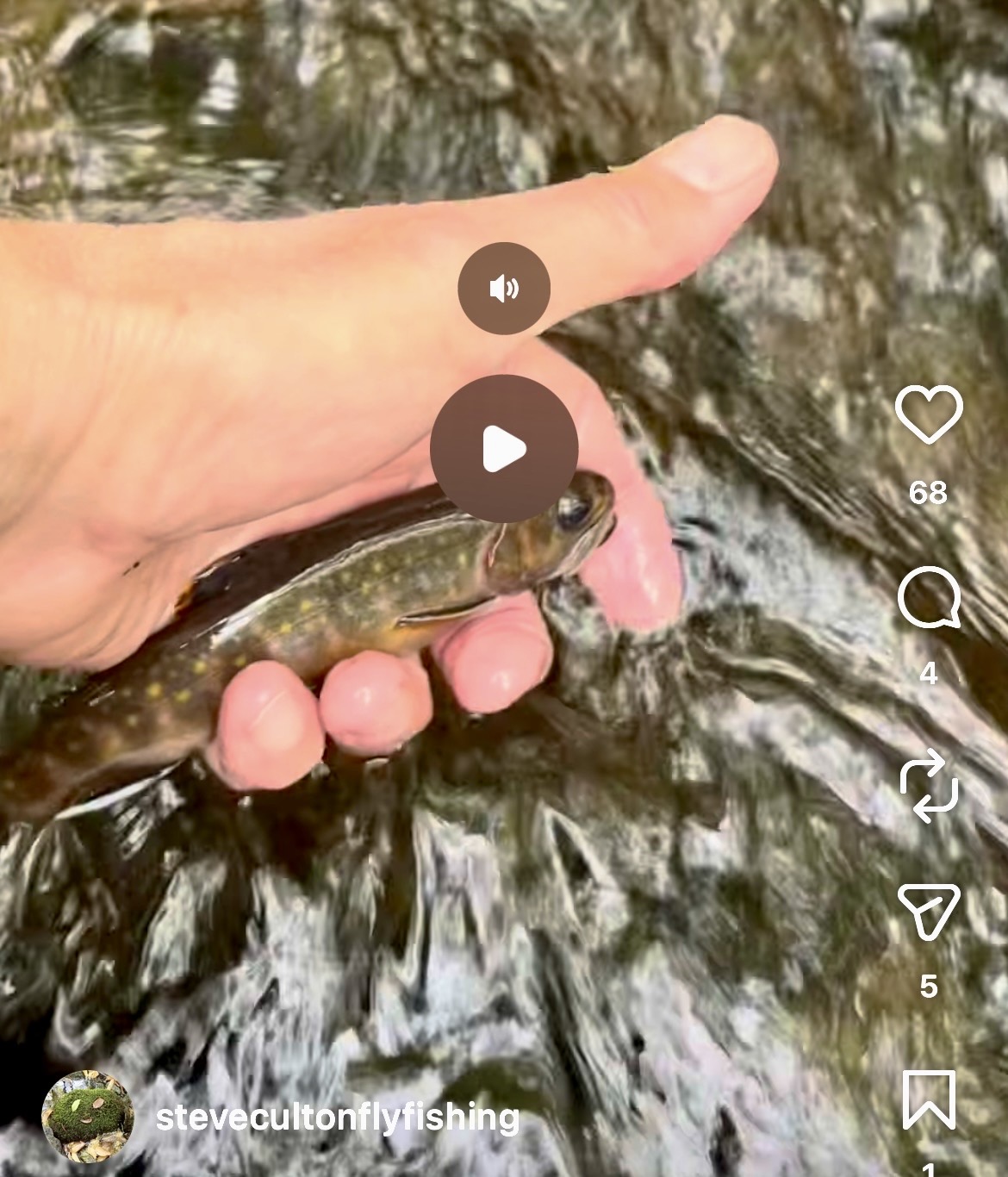
You can see the full video of the release if you follow me on Instagram @stevecultonflyfishing.com. I put all kinds of unique content on Instagram, from fishing experiences to instruction to tips, so following me is a worthy addition to your social media experience.
Since no backs were harmed in the making of the wild trout expedition, I got reckless and decided to go striper fishing. Surfcaster extraordinaire Toby Lapinski and I travelled to a top-secret location on LIS, and although we had favorable wind and surf — the water had cleaned up nicely from the storm — the bass didn’t get the memo. Toby took the only hit of the night, but even that was momentary. I wish I could tell you that we were bailing 20-pounders, but I don’t get to make that call. I’ll end here: in what universe can it be late September, and I have yet to catch a striper this year?!? Eight trips. Eight blanks. Not even a courtesy tap. Yeesh.
Last week I snuck out for a few hours on a local small stream. The water was medium-low, crystal clear, and the fact that the sun was out meant the locals were on high alert. Holy sandbars! The bottom structure of this stream had shifted quite a bit over the summer. In some sections, it felt like I was in brand new water. I fished a bushy dry (AFR Humpulator) and a BHPT dropper, and pricked four on the dry and two on the nymph. At the end, I switched to the Jiggy Squirmy Thingy and had a few small guys bull-rush the fly, but no char were brought to hand.
On Thursday, I guided Tim for a subsurface lesson. Like the small stream, the Farmington was low and clear, but plenty cold. We fished the mid and lower river sections. Mid-river was nymphing, and I was astonished that we didn’t even get a touch. What?!? We headed downstream to try our hand at wet flies, and we managed to stick three fish, although all of them became unbuttoned. Like many new to wet fly fishing, Tim needed to wait on the hookset after the hit. You feel the hit, and you want to set, but if you do, you’ll pull the hook right out of the fish’s mouth. You feel the strike, pause, asking, “Are you still there?” And if you do, the fish will always answer yes, having hooked himself neatly in the corner of his mouth. We will absolutely get them next time, Tim. A pleasure fishing with you, sir. Oh — we had hatches. Caddisflies and tiny BWOs and especially Isonychia. I love Isos.
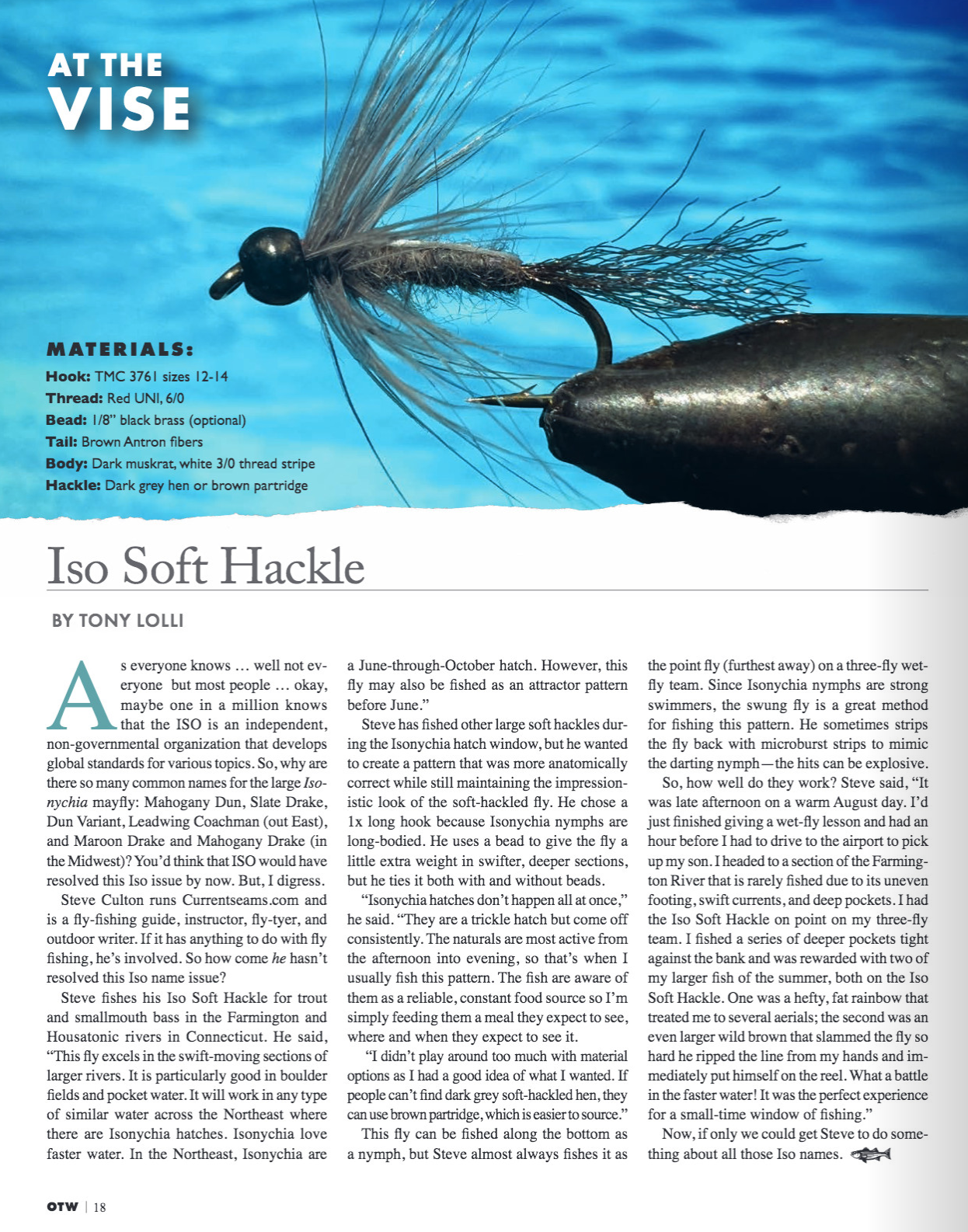
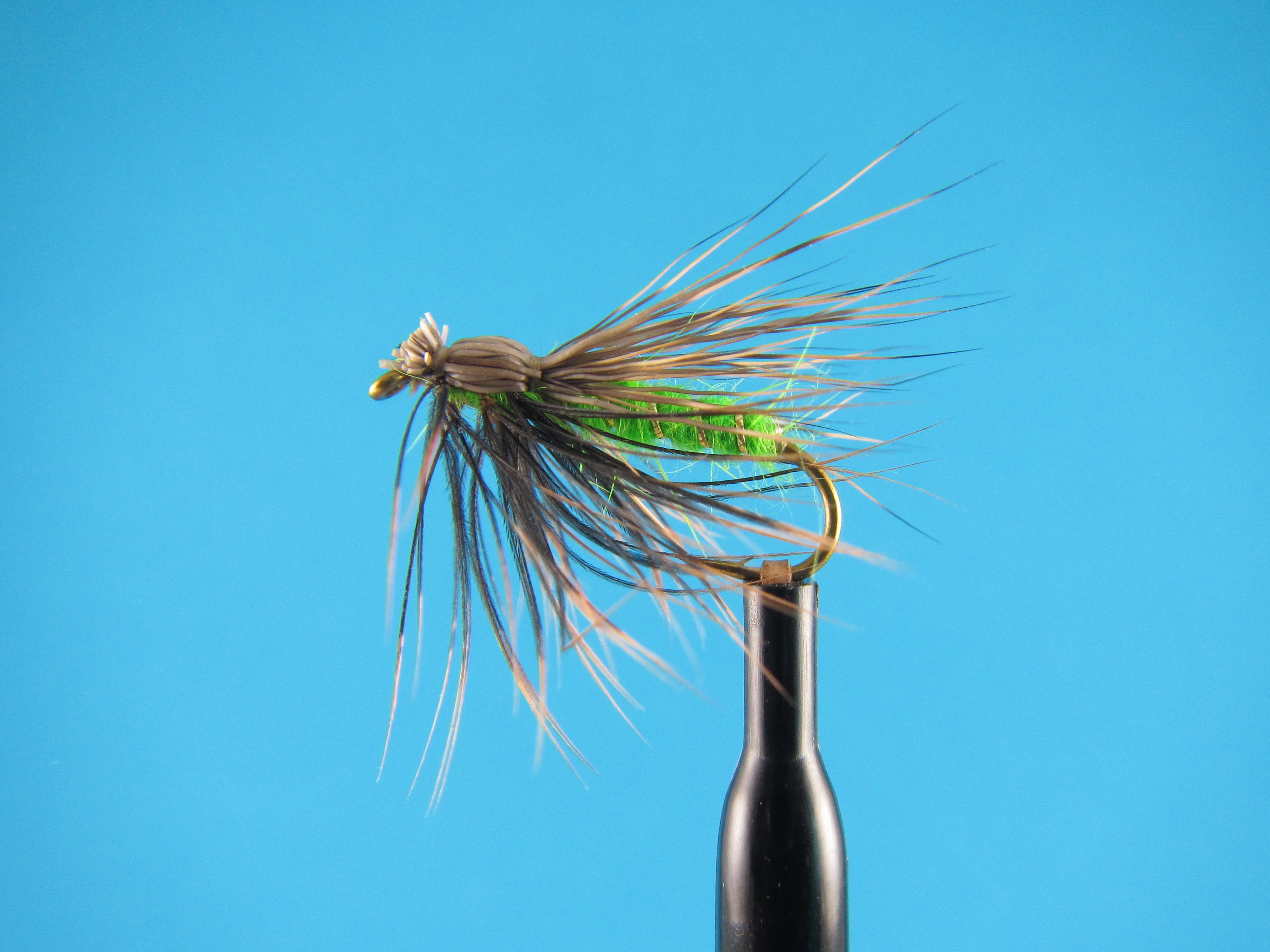
If you own my book, Fly Fishing Guide to the Farmington River, then you’ve seen this photo. I love swinging wets for Isos, and I’ve done very well with my Iso Soft Hackle pattern.
Finally, all this rain. It really depends on where you live — we got pounded in Durham on Saturday, while the rain barely made a dent in the Farmington flows. Today, the storm is finally manifesting — the Unionville gauge has jumped from 230cfs to 540 — but I expect the river will clear up quickly.
This can be a challenging time of year to fish the Farmington, but I arrived on the river with a plan: swing wets in snotty, treacherous pocket water, then find a dry fly spot for the evening rise. The water bump from the dam, which put the flow in the PTMA at around 290cfs, was a welcome enhancement. (I got 54 degrees just above the PTMA at 6pm, which is wheelhouse water for trout.)
I was wading and swinging a team of three (Drowned Ant on top, LaFontaine’s Diving Caddis in the middle, my Iso Soft Hackle on point) by around 5pm. After a slow start, I connected with what would be the first of 6 trout on the wets — 5 of those fish were wild browns. And 5 of the 6 fish took the Iso soft hackle. While I didn’t see a single Isonychia flitting about — I’d rate the overall hatch activity on this evening a 2/10 — this underscores the importance of that bug as a food source for trout. Every year, some of the biggest fish I hook on a wet fly come in August on the Iso.
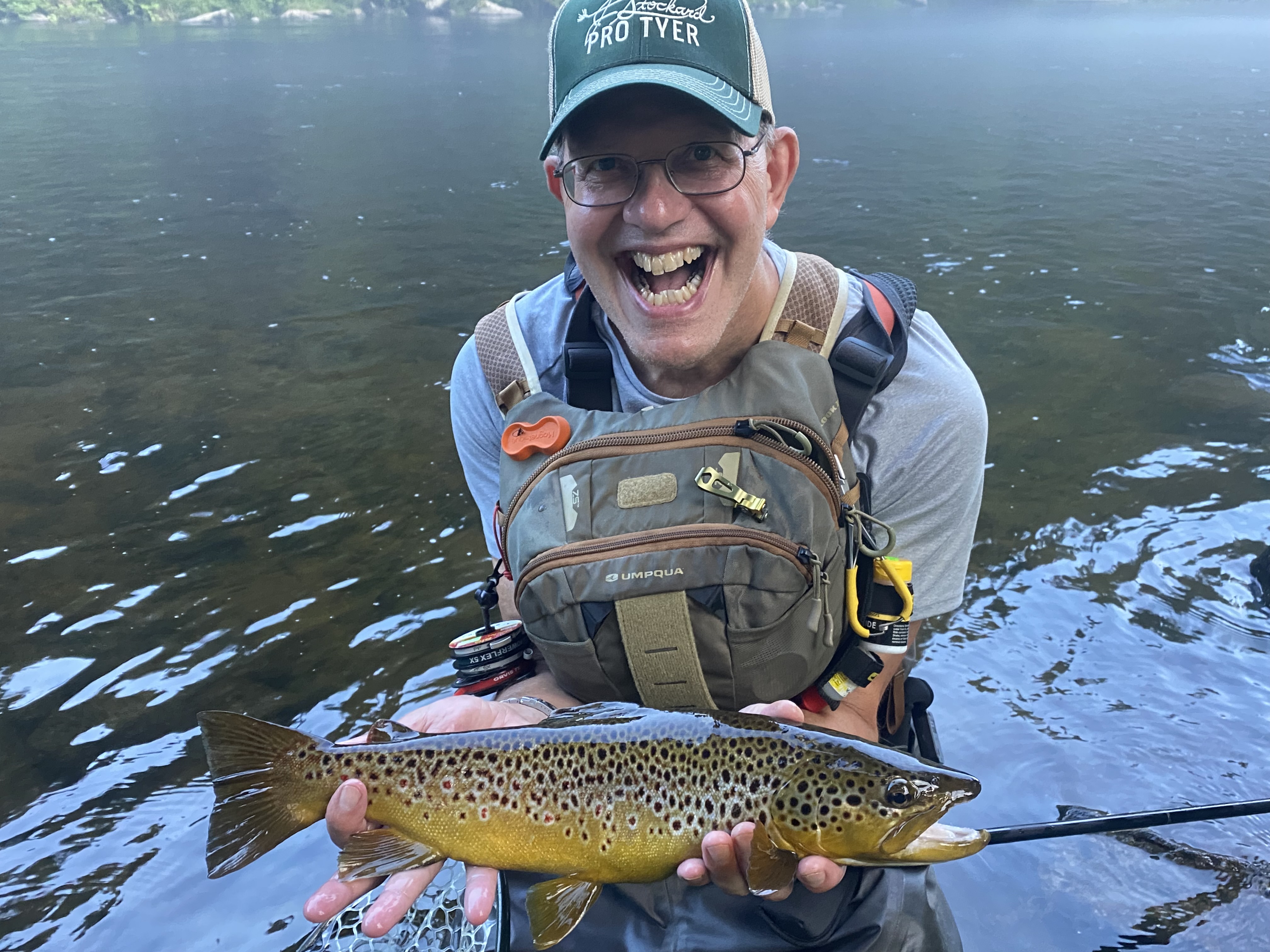
I’d already locked into a mid-teens wild brown when a big old buck ate the fly. Prior to this hookup, every take had come on the dangle. This one was on the dead drift, close enough to the surface for me to see the take. Three times the fish bulldogged its way upstream, twice, he seemed ready for the net, only to bolt. Between the speed of the current and the size of the fish, my forearm was on fire. I carefully walked downstream to a more favorable LZ. Finally, to the net.
Best trout of the year. No wonder this guy looks so excited!
The dry fly action from 7:30pm to 9pm was rather disappointing, having nothing to do with already landing such a fantastic fish. I found one fish working a foam line, but he was small, and though I rose him 4 times on three different patterns, there was no hookset. Finally, on the walk out in the fog, I spied a sipper that ended up clobbering my size 12 Catskills-style Light Cahill.
My victory cigar was one that I truly relished.
This is fly, minus the bead. This time of year, in lower light situations and moderate flows, there’s a good chance the fish will be looking up.
I have neglected the Farmington this month most cruelly. I understand the fishing has been excellent in spite of the low water, but I have been pulled in some other directions.
But not yesterday. Yesterday was one of those summer flow spikes I look for, the kind that puts some color in the water and chases most of the anglers away. The plan on those days is to throw streamers and look for a big ol’ brown that’s been hiding under a logjam for the past few weeks and is now in the hunt for a protein payoff. Yesterday I fished a full-sink tip line with an assortment of weighted and non-weighted streamers — trying to present at several levels in the water column — in both muted and bright colors. I walked about 500 yards of water, pounding the banks, waiting for that roll at the surface or that dull thud below.
It never came. The plan was go big or go home, and since I didn’t do the former — not a touch in two hours — I did the latter. But oh, man, it felt wondrous to be back.
Bring your waders if you want to sit. The water was moderately stained, 650cfs, and 64 degrees in the PTMA. As you read this, the flow has dropped dramatically and has cleared up, making for excellent conditions this weekend.
This is a late report from last week, but it’s a report that I think is worthy of your attention. I fished the evening (virtually non-existent) rise with surfcaster extraordinaire Toby Lapinski at popular dry fly mark within the PTMA. We fished from 4:30pm-9pm. When we arrived, I was delighted to see that there were no other cars in the small dirt parting area; in hindsight, I wonder if it was because everyone else knew something I didn’t.
Here’s the bottom line: the sulphur hatch stunk like a salt marsh at low tide. I’d give it a 1 out of 10. So, that was disappointing. What was even more disappointing was the lack of fish over 8″ long. What was rising was, by and large, small wild fish, mostly brookies, with a few browns in the mix. Now, this could also be considered good news. In fact, I’ve never run into such a substantial pod of wild brook trout on the Farmington. Between us, we easily landed a dozen of them. Once, at dusk, I hooked one, and as it sped into the shallows in a desperate attempt to get free, a larger brown charged out of its hole in hot pursuit. I could see the bulge in the water as the predator neared its target; unfortunately at the last moment, the hunt was aborted. But that was cool to witness, and I wish you could have been there to see it, too!
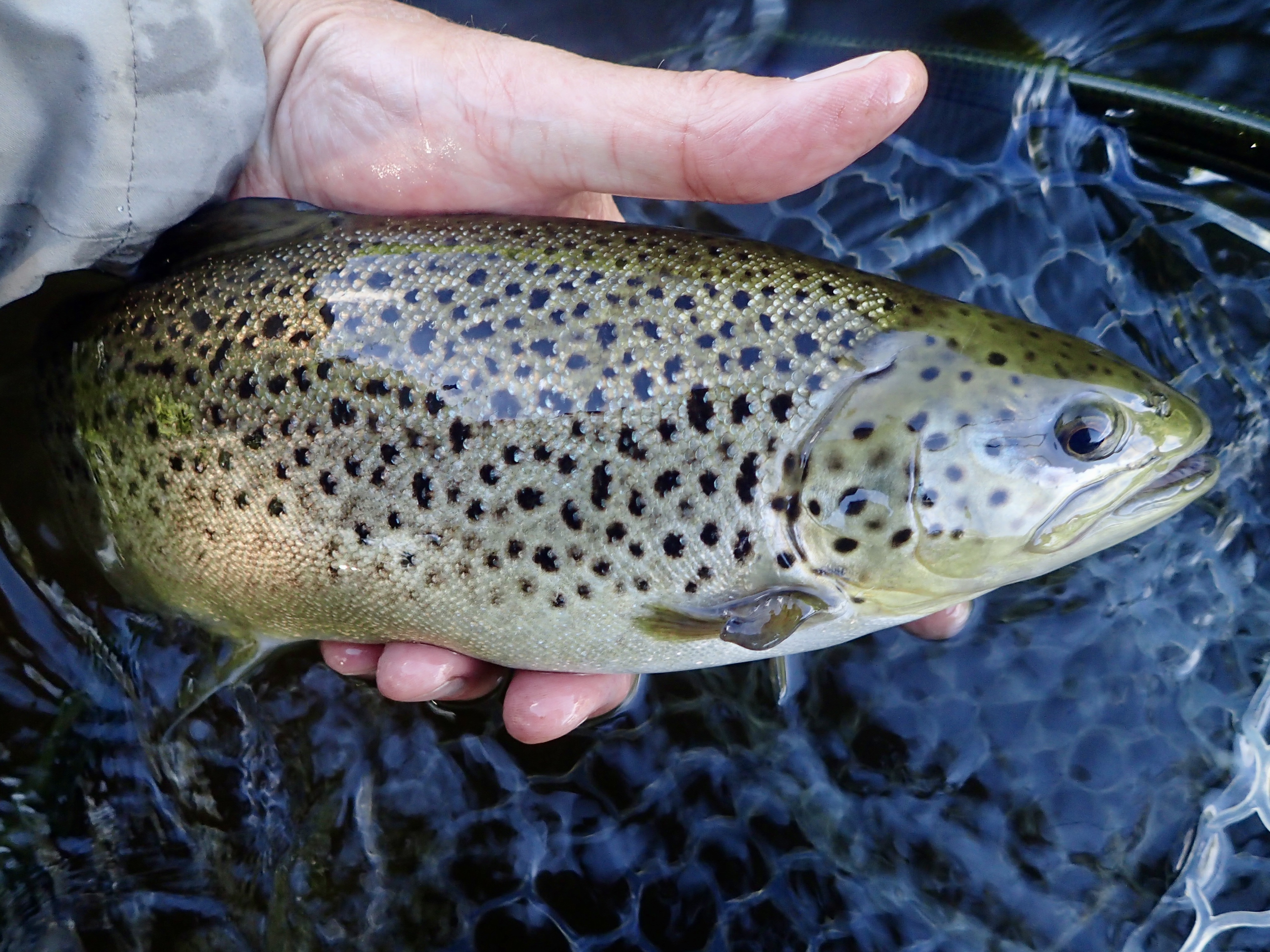
We only put one decent fish in the hoop, this some-teen wild brown by Toby. It had three bird wounds; you can see one of them on the midway point of the fish’s flank.
I’ve been so busy in the yard this spring that I haven’t been able to get out to the Farmington as much as I’d like. But the rest of the summer is still ahead, in all its lazy, hazy, crazy glory.
It was cold on Monday for June 1, but today we are firmly in a warming trend with great flows (275cfs). I’m anticipating stronger hatches and better fishing.
It wasn’t that way on Monday. I guided Matt and John for the purpose of teaching them the art of wet fly fishing. They’d seen me talk at the Edison Fly Fishing Show, and we’d had this date on the calendar for months. Sadly, we had unseasonably cool weather and a gusty day that held hatch activity to a minimum. We only got two in the hoop, but on another day both anglers would have easily been into double-digits. Strong casting, good mends, hundreds of fish-worthy presentations — I’m really excited for them to experience wet fly fishing at its productive best in the future. Well done, gentlemen!
Not a sulphur, but a Cream Cahill, size 12-14. They’ve been out in decent numbers on the lower river.
After our session I ventured downstream. Very weird evening. I stuck eight trout on wets but had only two hooksets, and landed neither. It was as if the fish couldn’t make up their mind about eating. At 7pm, I switched over to dry flies, and while there were plenty of fish rising, none of them seemed to be in a steady rhythm. I had my best action from 8pm into dark, using creamy colored dries and one big, honking Iso dry.
I’m back to heavy-duty yard work mode, so this will be my only post this week. I’ll try to get back to normal posting next week. In the meantime, fish on. It’s the most wonderful time of the year….
I guided Jeff, Andrew, and Angelo on Tuesday, and we couldn’t have asked for nicer weather. While Angelo was off exploring parts north solo, Jeff and Andrew headed downriver with me to learn the ways of the wet fly. We began in a snotty boulder field, and right away, Jeff was into a fat, stocked brown. There were caddis and some Cream Cahills in the air, but all of the four trout we put in the hoop took the size 12 SHBHPT. The second mark we hit featured similar water, but we only had one bump in 20 minutes, so we headed north, still in the mid-river, to see if we could find open water. Score! This is a superb run for fishing wet flies, and while the action wasn’t gangbusters, Jeff scored an 18.5″ (taped) wild brown. At this point, Angelo joined us to do some indicator nymphing, sticking one fish. It’s always gratifying to give a wet fly lesson and see your clients rewarded with multiple hits, and having everyone land a trout made it even sweeter. Fantastic job, gentlemen, and it was a pleasure guiding you.
I was downstream with Andrew when Jeff stuck this quality wild brown. Once I saw it was a decent fish, I hustled up with the net so we could enjoy this photo op. Even when you’re in the STMA, you can still find places where wild browns like to hang out.
Last night I fished with surfcaster extraordinaire Toby Lapinski from about 4:45pm into dark, 9pm. We hit the same initial run I took Jeff and Andrew to, and the fish were cooperative. We stuck 8 between us, but I wanted to investigate some favorite water a little bit upstream. We had the entire run to ourselves, and were in position at 5:45pm. The water was significantly lower than Tuesday, 325cfs and dropping, and with the sparse release from the dam, the water reached 64 degrees on the thermometer. The trout seemed to love those conditions. I stuck fish after fish on wet flies, with the runaway favorite being the SHBHPT. I have no idea how many trout I landed — the fishing was that good. The rainbows, in particular, seemed to all believe that they were steelhead. I’ve never had so many fish leap so many times, some of them even after they’d spit the hook. Tremendous sport!
Meanwhile, Toby wasn’t having the same results. But it turns out that he was saving his chips for the dry fly action. At 7pm, while I was still poking around with wets in some faster water, Toby was fishing dries in some more languid pools, and seemingly hooking trout at will. His secret weapon was an Iso dry, and Isonychia were among the bugs we saw (caddis, midges, a few sulphurs, a couple BWOs). I made the switch to dry around 8pm, and once I found some risers, I too got in on the dry fly action. Usuals and Light Cahill dries were my producers.
Thus begins (almost here!) my favorite month on the Farmington.
Stocked brown, but he ate well at the hatchery, and gave me quite the battle. All of last night’s trout were full of piss and vinegar.
Tom is a long-time currentseams follower and an avid fly fishing show attendee and angler. He couldn’t have picked a finer day weather wise for a wet fly lesson: sunny, 85, 210cfs and 52 degrees water temp in the PTMA…and all those caddis! At one point I counted over 2 dozen of them crawling around his legs and backside: tan, black, and one funky darker one I couldn’t ID. Plus: micro caddis. Really small stuff that flitted around my forearms under the Church Pool bridge, enough of them to be a nuisance.
So where are all the trout? Not feeding near the surface. I saw just three rises in our four hour session. We stuck two, landed one, and that was two more fish than seven of the other nine anglers we watched or talked to had. One angler said he did very well nymphing, and so that spring trend has continued into mid-May despite the warm weather. Tom did an excellent job of managing his drifts, and he deserved far better than what the river gave him on this day. But he is certainly a dangerous wet-fly-machine in the making! Way to go, Tom.
Tom scores a lovely wild brown on his last cast — really! — in a top-secret location. The fish ate a size 14 Squirrel and Ginger.
Usually, by this time of year, I’ve given you at least one report headlined with words like “spectacular wet fly action.” But not in 2026. It continues to be cooler than normal and windy and blech. When hatch activity has been strong, the fish seem content to feed on the bottom. This, of course, will change. I feel like we’ll go instantly from early spring to mid-summer weather, the surface bite will pick up, and you’ll get your enthusiastic, superlative-laden wet fly report. But for now, it’s keep on-keeping on.
I gave Jason a wet fly lesson from 11am-3pm on Thursday, and he deserved way, way better than what he got, which was two hits in four hours. To be fair, one of them was a very good fish, although it was camera shy. Jason did an excellent job of casting and getting his team of three where it needed to be, then mending and presenting. Some time later this month or in June, he’s going to hit it right, and people are going to be following him off the water, asking him, “What fly were you fishing?!?”
It’s way too early for me to be thinking about grasshoppers, but I did see one on my driveway yesterday. This is my Hopper Hammerdown.
We had 310cfs in the PTMA and points south. Water temp was in the high 50s. When it’s windy, the seed pods that blow into the water (which look very much like soft-hackled flies) do us no good, and that was yet another factor. Oh, did I mention the cold front that came through the night before? We got into our fish because we moved aggressively through pools, looking for biters. Do likewise when the fishing is slow, and you’ll up your odds significantly.
And a reminder: May is caddis month on the Farmington.