Farmington River Mini Report 6/1/26: June is bustin’ out all over!

It was cold on Monday for June 1, but today we are firmly in a warming trend with great flows (275cfs). I’m anticipating stronger hatches and better fishing.

It wasn’t that way on Monday. I guided Matt and John for the purpose of teaching them the art of wet fly fishing. They’d seen me talk at the Edison Fly Fishing Show, and we’d had this date on the calendar for months. Sadly, we had unseasonably cool weather and a gusty day that held hatch activity to a minimum. We only got two in the hoop, but on another day both anglers would have easily been into double-digits. Strong casting, good mends, hundreds of fish-worthy presentations — I’m really excited for them to experience wet fly fishing at its productive best in the future. Well done, gentlemen!

Not a sulphur, but a Cream Cahill, size 12-14. They’ve been out in decent numbers on the lower river.

After our session I ventured downstream. Very weird evening. I stuck eight trout on wets but had only two hooksets, and landed neither. It was as if the fish couldn’t make up their mind about eating. At 7pm, I switched over to dry flies, and while there were plenty of fish rising, none of them seemed to be in a steady rhythm. I had my best action from 8pm into dark, using creamy colored dries and one big, honking Iso dry.

I’m back to heavy-duty yard work mode, so this will be my only post this week. I’ll try to get back to normal posting next week. In the meantime, fish on. It’s the most wonderful time of the year….

Farmington River Report 5/26 & 5/28/26: Finally, some wet fly action worth writing about!

I guided Jeff, Andrew, and Angelo on Tuesday, and we couldn’t have asked for nicer weather. While Angelo was off exploring parts north solo, Jeff and Andrew headed downriver with me to learn the ways of the wet fly. We began in a snotty boulder field, and right away, Jeff was into a fat, stocked brown. There were caddis and some Cream Cahills in the air, but all of the four trout we put in the hoop took the size 12 SHBHPT. The second mark we hit featured similar water, but we only had one bump in 20 minutes, so we headed north, still in the mid-river, to see if we could find open water. Score! This is a superb run for fishing wet flies, and while the action wasn’t gangbusters, Jeff scored an 18.5″ (taped) wild brown. At this point, Angelo joined us to do some indicator nymphing, sticking one fish. It’s always gratifying to give a wet fly lesson and see your clients rewarded with multiple hits, and having everyone land a trout made it even sweeter. Fantastic job, gentlemen, and it was a pleasure guiding you.

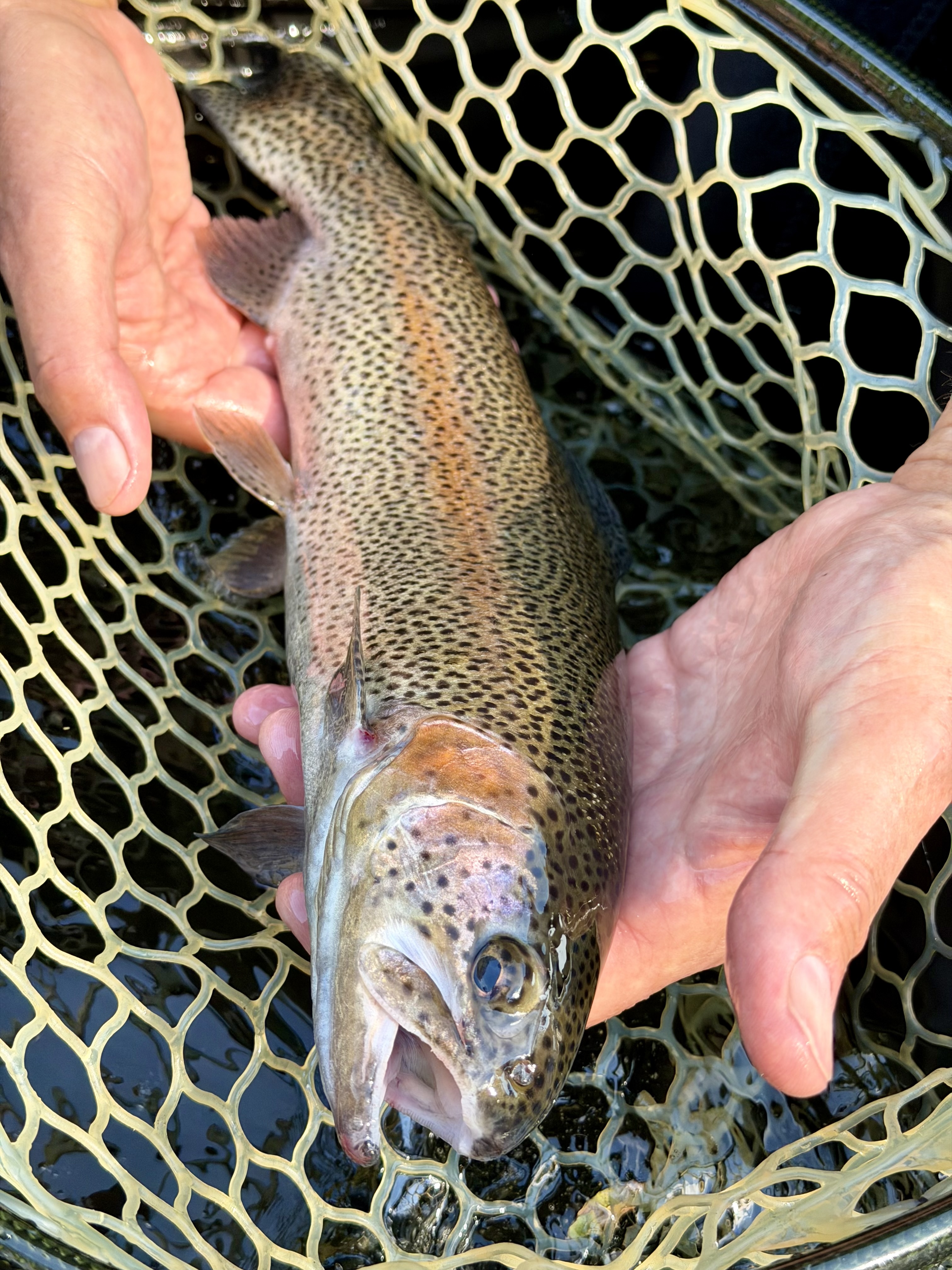
I was downstream with Andrew when Jeff stuck this quality wild brown. Once I saw it was a decent fish, I hustled up with the net so we could enjoy this photo op. Even when you’re in the STMA, you can still find places where wild browns like to hang out.

Last night I fished with surfcaster extraordinaire Toby Lapinski from about 4:45pm into dark, 9pm. We hit the same initial run I took Jeff and Andrew to, and the fish were cooperative. We stuck 8 between us, but I wanted to investigate some favorite water a little bit upstream. We had the entire run to ourselves, and were in position at 5:45pm. The water was significantly lower than Tuesday, 325cfs and dropping, and with the sparse release from the dam, the water reached 64 degrees on the thermometer. The trout seemed to love those conditions. I stuck fish after fish on wet flies, with the runaway favorite being the SHBHPT. I have no idea how many trout I landed — the fishing was that good. The rainbows, in particular, seemed to all believe that they were steelhead. I’ve never had so many fish leap so many times, some of them even after they’d spit the hook. Tremendous sport!

Meanwhile, Toby wasn’t having the same results. But it turns out that he was saving his chips for the dry fly action. At 7pm, while I was still poking around with wets in some faster water, Toby was fishing dries in some more languid pools, and seemingly hooking trout at will. His secret weapon was an Iso dry, and Isonychia were among the bugs we saw (caddis, midges, a few sulphurs, a couple BWOs). I made the switch to dry around 8pm, and once I found some risers, I too got in on the dry fly action. Usuals and Light Cahill dries were my producers.

Thus begins (almost here!) my favorite month on the Farmington.

Stocked brown, but he ate well at the hatchery, and gave me quite the battle. All of last night’s trout were full of piss and vinegar.

From the archives: Partridge and Light Cahill soft hackle

Another super simple tie that can be rendered with common materials. You can add a tail if you like. With creamy mayflies just around the corner, the Partridge and Light Cahill soft hackle is a must-have in your box!

When my roses bloom, creamy mayflies are here soon.

From the archives: LaFontaine’s Diving Caddis

As I predicted, this is a full week in the garden and yard. But that’s no reason why you shouldn’t be fishing — or tying. If Gary LaFontaine’s brilliant Diving Caddis winged wet isn’t in your arsenal, you are most definitely missing out. This fly is a must on your late afternoon into evening rig from now though the summer.

OLYMPUS DIGITAL CAMERA

Farmington River Mini-Report 5/18/26: Still slow on the wet flies, but holy caddis, Batman!

Tom is a long-time currentseams follower and an avid fly fishing show attendee and angler. He couldn’t have picked a finer day weather wise for a wet fly lesson: sunny, 85, 210cfs and 52 degrees water temp in the PTMA…and all those caddis! At one point I counted over 2 dozen of them crawling around his legs and backside: tan, black, and one funky darker one I couldn’t ID. Plus: micro caddis. Really small stuff that flitted around my forearms under the Church Pool bridge, enough of them to be a nuisance.

So where are all the trout? Not feeding near the surface. I saw just three rises in our four hour session. We stuck two, landed one, and that was two more fish than seven of the other nine anglers we watched or talked to had. One angler said he did very well nymphing, and so that spring trend has continued into mid-May despite the warm weather. Tom did an excellent job of managing his drifts, and he deserved far better than what the river gave him on this day. But he is certainly a dangerous wet-fly-machine in the making! Way to go, Tom.

Tom scores a lovely wild brown on his last cast — really! — in a top-secret location. The fish ate a size 14 Squirrel and Ginger.

How to find that fly, or article, or leader diagram on Currentseams

It seems at least once a week, I get the request. “Where can I find the recipe for the Magic Fly?” “Can you send me your wet fly leader formula?” “What was that article you wrote on fishing droppers for striped bass?”

While part of my personal brand is that I’m helpful, I’d rather teach you to fish than hand you a fish. So yes, I’m going to be helpful here. But you’re going to have to be part of the solution, because I want you to learn how to be your own self-service librarian. You’ll be happier. I’ll be happier. Like Hot Chocolate sang, “Everyone’s a winner, baby!” So here we go.

There are two best ways to find stuff on currentseams. Let’s use the example of the wet fly team. The first is to use the search function on the website. On my iPhone, it’s the little magnifying glass in the upper right corner on the screen:

The magnifying glass is your ticket to searching, whether it’s on your phone (above right)….
…or your laptop (above left).

Depending on your hardware, you simply tap or click the magnifying glass icon, and a “Search” field magically appears. I typed in “wet fly team” and was immediately directed to multiple articles and posts, many of which had the diagram on full display. How easy is that!?!

Or, you could use your favorite default search engine. Using Google and the “Wet fly team” as an example, the first two hits were direct links to my website. But if you add “currentseams” to the search verbiage, the entire results screen consists of article links and images from my website:

You are now officially cooking with gas! I really hopes this helps, and that you’ll take advantage of the vast treasure trove of material that is currentseams. From its inception, one of my goals for this site was for it to be an easily accessible storehouse of fly fishing information, and in particular an online library for all my articles, stories, flies, diagrams, etc.

So have at it. It’s a great way to spend a rainy day.

Farmington River Mini-Report 5/7/26: Wet Fly Woes Continue

Usually, by this time of year, I’ve given you at least one report headlined with words like “spectacular wet fly action.” But not in 2026. It continues to be cooler than normal and windy and blech. When hatch activity has been strong, the fish seem content to feed on the bottom. This, of course, will change. I feel like we’ll go instantly from early spring to mid-summer weather, the surface bite will pick up, and you’ll get your enthusiastic, superlative-laden wet fly report. But for now, it’s keep on-keeping on.

I gave Jason a wet fly lesson from 11am-3pm on Thursday, and he deserved way, way better than what he got, which was two hits in four hours. To be fair, one of them was a very good fish, although it was camera shy. Jason did an excellent job of casting and getting his team of three where it needed to be, then mending and presenting. Some time later this month or in June, he’s going to hit it right, and people are going to be following him off the water, asking him, “What fly were you fishing?!?”

It’s way too early for me to be thinking about grasshoppers, but I did see one on my driveway yesterday. This is my Hopper Hammerdown.

We had 310cfs in the PTMA and points south. Water temp was in the high 50s. When it’s windy, the seed pods that blow into the water (which look very much like soft-hackled flies) do us no good, and that was yet another factor. Oh, did I mention the cold front that came through the night before? We got into our fish because we moved aggressively through pools, looking for biters. Do likewise when the fishing is slow, and you’ll up your odds significantly.

And a reminder: May is caddis month on the Farmington.

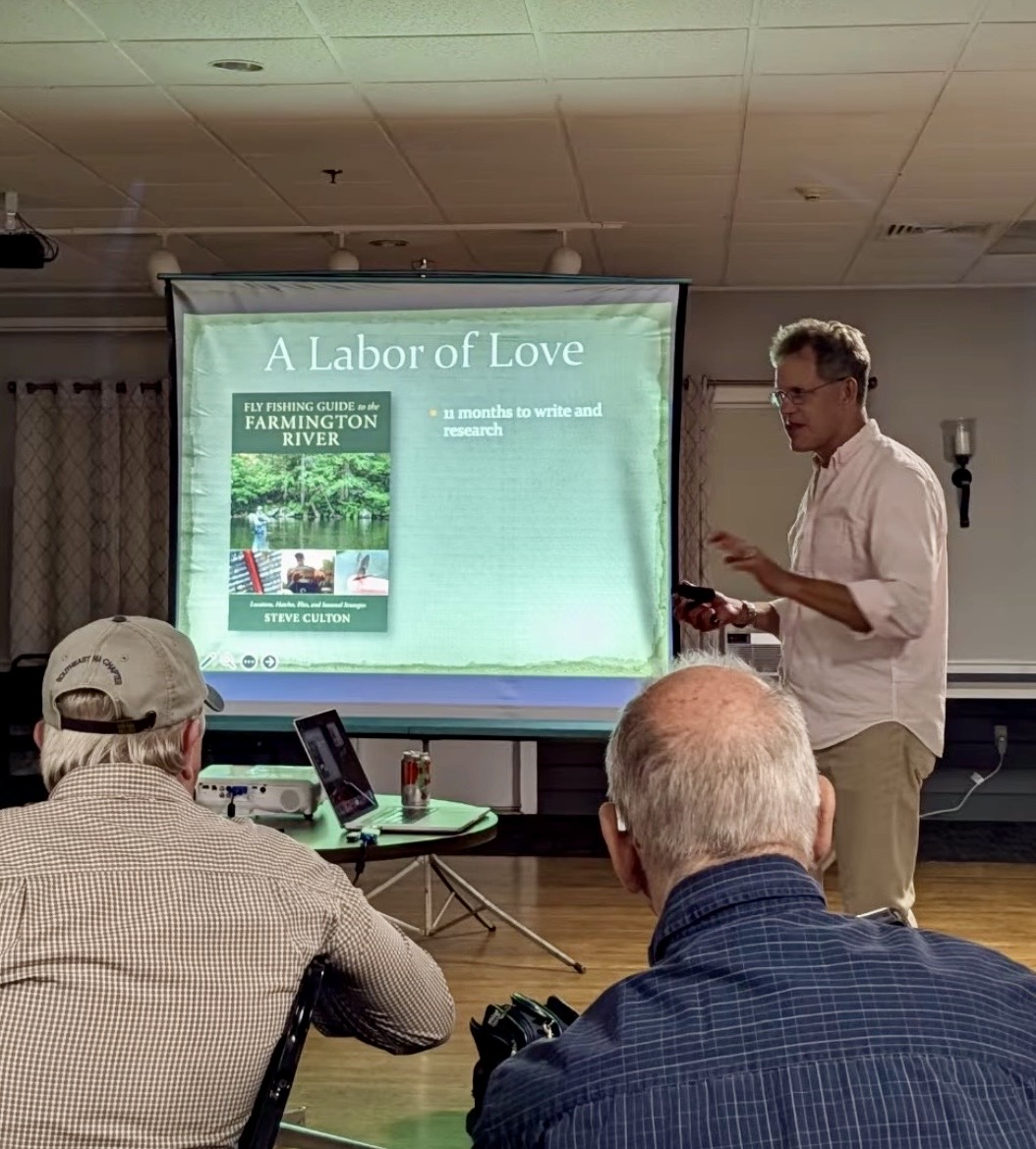
Steve Culton Interview on the Farmington River Book

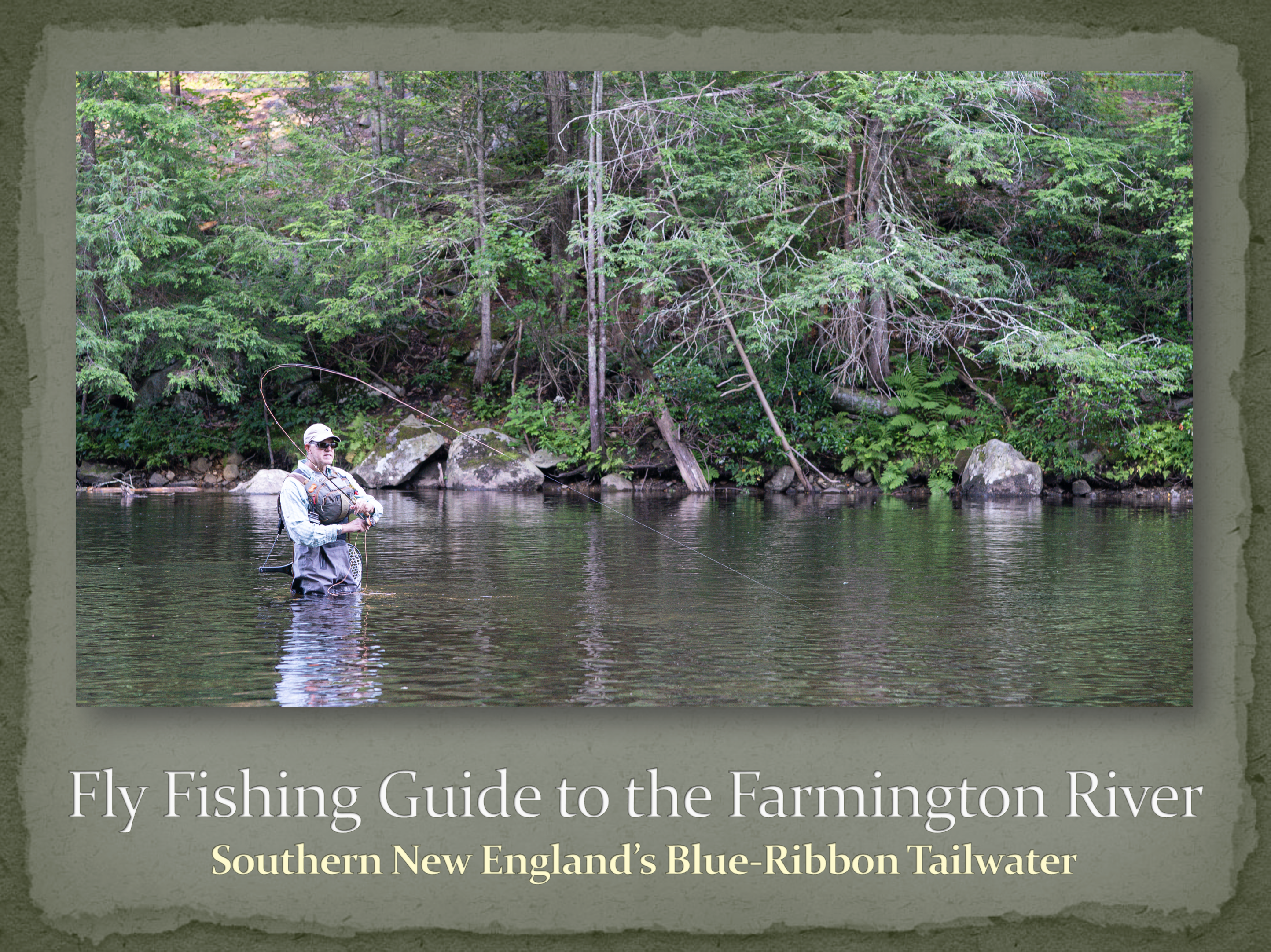
In late winter I sat down with Carl Ochnio to talk about my upcoming book, Fly Fishing Guide to the Farmington River. (There’s still time to put your name in for a personalized signed copy.) This is part of a the “Hooking Up” interview series Carl has been doing for the CFFA. With his kind permission, I’m able to share a pdf of the entire interview. You can find it in the link below the photo.

Please note that publish date is now August 4. Sorry for any confusion!

Farmington River Report: A slow wet fly start to spring, but beginning to come around.

This has been a cool spring with lower than average temperatures and not a lot of rain. While the hatches have been strong — this year’s Hendrickson showing has been far better than last year’s — I have yet to have a seems-like-a-fish-on-every-cast wet fly outing. (The river is usually good for at least one by month’s end.)

I gave James a wet fly lesson in mid-April, and we managed only one to net. We pounded several sections of river north of the PTMA, and managed only one bump. (Our lone fish came from within the PTMA.) I managed a day to myself during the Hendrickson hatch in the PTMA, and the number of rising trout fell far short of the bug volume. That certainly could be a function of me fishing where there weren’t many fish. Historically, though, the mark I fished holds a multitude of trout in April. On Tuesday, I did some advance scouting for Wednesday’s wet fly lesson. It was a fish here, a bump there, and none of it very impressive. I ranged from the lower river in Burlington up to the PTMA. I did manage to foul a beast mid-river; when the fish swam the leader over a rock, we parted ways.

Which brings us to yesterday’s lesson with Michael. We fished two marks, the lower end of the PTMA, and then mid-river. While the action wasn’t spectacular, we did find fish that wanted to eat in both locations. Our session began at 11am and we wound up at 3:30pm, a little over, but for a very good reason.

We had a decent caddis hatch at the first spot, but little was rising to it, and none of it on a regular rhythm. Lesson one: move around, cover water, find the fish. While I think everyone loves catching wild Farmington browns the most, the stocked rainbows more than make up for any lack of situational romance with power, urgency, and acrobatics. Because of the breeze, I had Michael fishing two flies instead of three. This beauty ate our point fly, a SHBHPT.

The second mark featured faster water, and it was a little deeper in spots. Even though it was a mid-river location, there were a surprising number of Hendricksons coming off. Nothing too wow, but there were a few trout rising in the frog water edges, and farther down from us in longer pool where the current slowed. We’d switched to a Dark Hendrickson BH soft hackle on point, and our next fish, a stocked brown, ate that fly. Even though it was close of business, I wanted to make a few casts at the fish feeding downstream.

We waded down and out as far as we comfortably could. Because the fish were rolling on mergers, I removed the BH point fly and replaced it with a Dark Hendrickson winged wet. Good call, because that’s what a gorgeous high teens wild brown hen decided to eat. Great job, Michael, fighting and landing that fish! If you head over to Instagram some time today, you can see a photo.

Hopefully, this is the beginning of better wet fly action. May is a strong caddis month, and caddis are a dish best served to trout subsurface.

Farmington River Report 4/23/26: One-half of Bob and Andy, Hendricksons galore, but where were the trout?

I fished the lower end of PTMA yesterday from noon to 3:30pm. Once got to the river, I ran into a group of wonderfully chill gentlemanly anglers, and we had a short gab-fest before I decided to head into the river for some pre-hatch prospecting. Bob, of Bob-and-Andy fame, was also there. I’d met Bob-and-Andy at this mark many years ago, and since then, it’s really not April unless we cross paths on the river.

The wind made it an unfavorable day for casting a team of three wets, but I managed to go almost the entire session without a fouled-up leader. After an hour that produced one lonely bump, I declared to the group that one or more of three things was true: there are not a lot of fish here; the hatch is going to be underwhelming; the trout are content to feed on the bottom. It turns out that options A and C were likely in play. When the hatch finally got going, around 2:15pm, there were bugs everywhere: in the air, on the surface — and precious few trout rising to them. I’d give this hatch volume an 8 out of 10; when you can count the rises per minute on a few fingers (instead of dozens) that’s not going to make for epic fishing. Normally, with this Hendrickson hatch volume, I’d bang up a good dozen fish or more fishing wets pre-hatch and during the emergence. Not today.

Hello, old friend. This would be a male Hendrickson; three tails, darker cast, large eyes.

What did follow script was the place in the water column where the fish were feeding. Pre- and during emergence, they took the wet, until the point where they didn’t, and then it was dry flies on the surface. This is a good time to talk about shadow hatches, which I do in the Farmington River book. In addition to Hendricksons, there were also caddis and BWOs in the mix. The savvy wet fly angler will want to have at least one of those other food groups represented. What do you know? Of the three trout I took on wet flies, two came on the caddis middle dropper (Hare’s Lug and Plover).

I managed two more on the surface, bringing my total to five. At the risk of sounding ungrateful, I was not impressed. Of course, I could have gone elsewhere. But with three anglers below me and five above me, real estate was scarce. So I stayed.

Today, writing about it, I have to scold myself for being so dour. It was a sunny, April day. The Hendricksons were out. There were some rising fish who wanted to eat. I got to reconnect with old friends and make some new ones. I didn’t put two dozen in the hoop or land a 20″ wild brown. But, yeah. That’s still a really good day of fishing.