The case for smaller (and fewer) fly boxes.

When the rest of the world zigs, Steve Culton usually zags. Nowhere is this more evident than in my fly fishing (wet flies, anyone?).

When I was researching the Fly Fishing Guide to the Farmington River, I spent a significant amount of time on and off the water with other guides and serious, highly skilled anglers. One thing they all had in common: they carried lots and lots of fly patterns. They also tended to have multiple fly boxes. Even a see-through plastic-lidded nymph box a little larger than a letter-size envelope has room for over a hundred flies, and many of those boxes they carried were filled. What they didn’t carry, they kept in more boxes in their vehicle. Out west, my good friend Pat Dorsey also has a — I think the scientific term is “shit ton” — of fly boxes stuffed with fly patterns. (He may have more midge patterns than I have total flies!) Pat’s one of the best guides on the planet, so he’s doing something right.
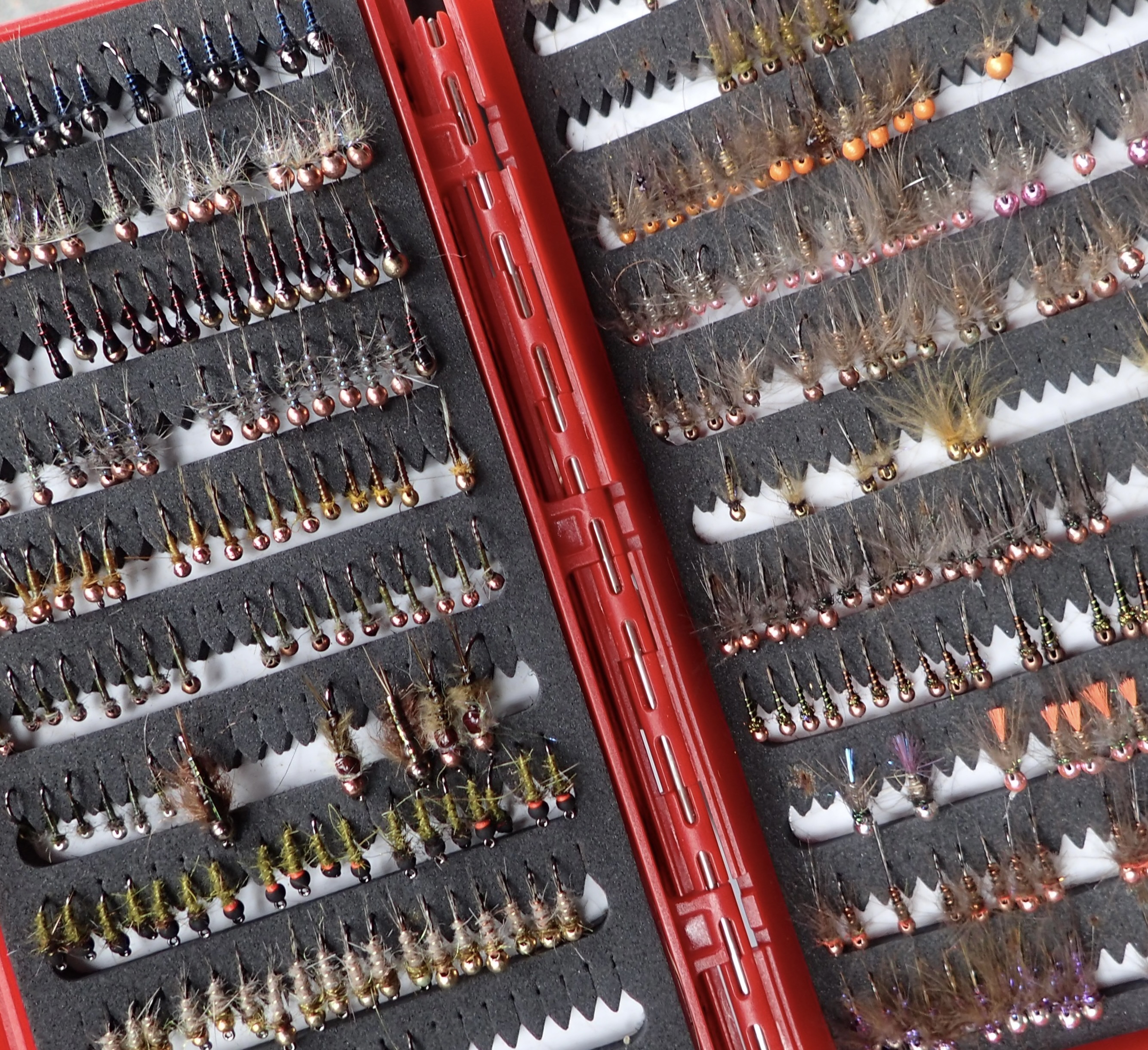
One of Joey Takeman’s many nymph boxes. I was impressed by the sheer volume of patterns he carries, and clearly, as a skilled Euro-nympher, he needs more variance in bead weights to match water speed and depth than a drop-shot nymph guy like me. But this cannot be understated: Joey has a system that works, and works very well for him.

There are two points of consequence that must now be stated.

The first is that clearly, these people have a system that works for them. They will likely be prepared for any situation with any number of patterns, variants, sizes, and colors. They believe in their system.

The second is that this approach is not for me (see “Steve Culton zags,” above).

I don’t want to carry that many patterns, let alone tie them. It’s not a matter of brain freeze, or fear of paralysis by analysis. Clearly, I do not suffer in the slightest from FOMO. It’s simply this: I have, over time, curated a selection of high confidence patterns that consistently produce. Yes, I do occasionally add new patterns into the mix. But many of the patterns I use on the Farmington have been in my rotation for decades: the Magic Fly, BHSHPT, and Squirrel and Ginger, just to name a few. I’m in good company. Legendary guide and Catskills trout angler extraordinaire Ed Van Put was famous for using precious few flies over the course of the season, even on highly technical rivers like the Delaware.
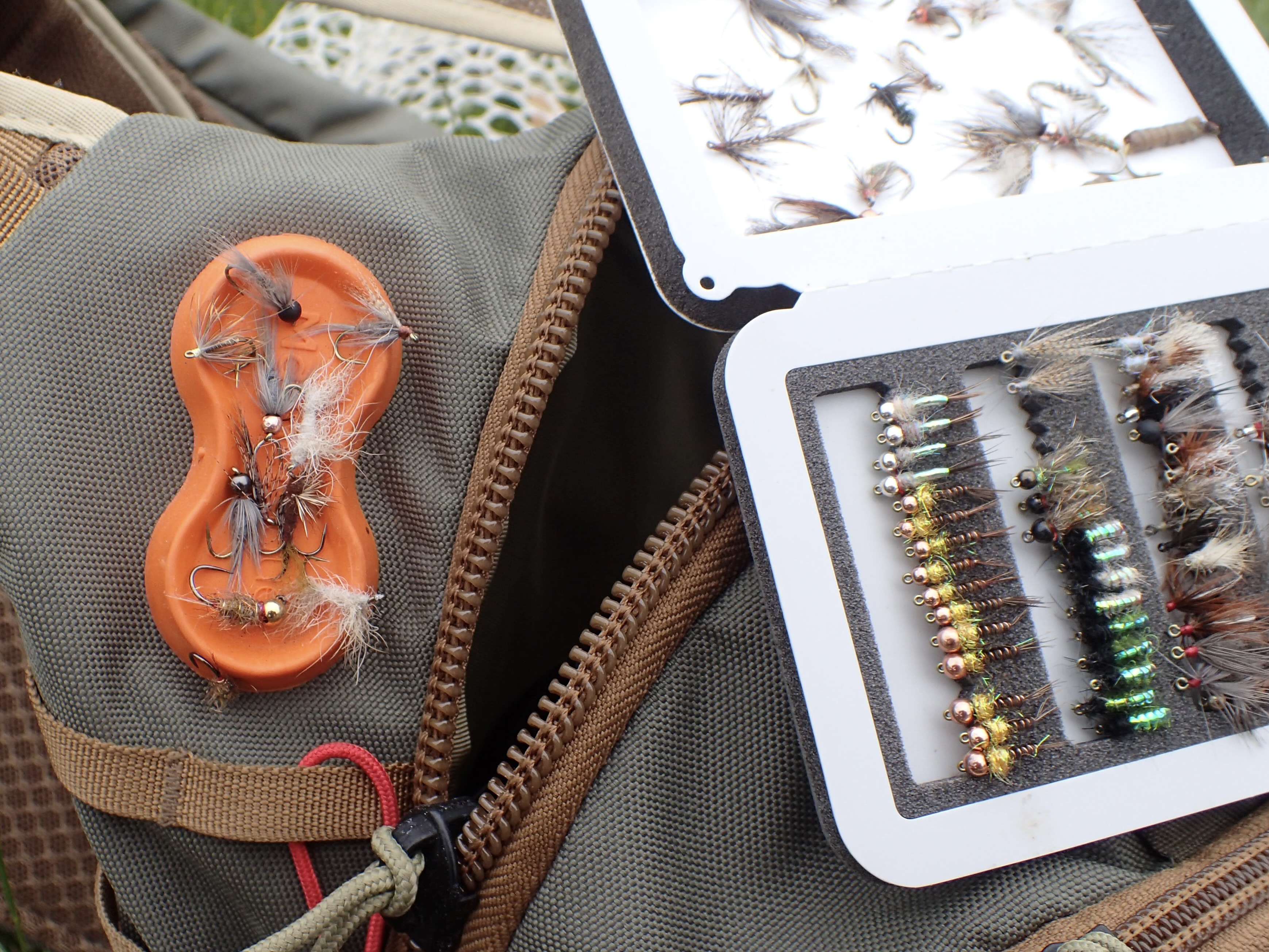
I’m a huge fan of this “day’s worth” size box, right, from C&F Design. I have several of them, each filled with seasonal patterns and fly types. This is my early season nymphs and wet flies box. Note the incredible lack of selection, though to be fair, some rows are out of sight. I’ve since migrated the nymphs to a more traditional nymph box, the kind with the see-through cover. I keep that in my pack 24/7, along with a few of these small C&F boxes, to keep me covered for various scenarios. I attach the C&F box to my pack with a Velcro patch; they’re easy to rotate in and out, so I have what I need at my fingertips, and right in front of my face. Photo from the “Fly Fishing Guide to the Farmington River,” coming August 4, 2026.

Use the system that works for you. Because this is true: confidence catches fish.

Farmington River Report and Tip of the Week

There are precious few absolutes – like gravity or the firmness of the earth – in fly fishing. But certainly this one is unimpeachable: wet flies in the water catch more fish. This is why I recommend that you keep your wet fly team in the water as much as possible, especially when you’re wading to a new position up or down or across stream.

The value of this practice, which I teach in every wet fly lesson, was driven home to me on Wednesday when I was out on shooting photos for the Farmington River book with Derrick Kirkpatrick and Joey Takeman. We’d just returned to the river after a thunderstorm delay, and were crossing a shallow (1-2 feet) riffle. I hadn’t fished yet, but this time I had my rod with me, and while I intended to take more photos, I couldn’t resist stripping out ten feet of line and dangling my team of three (16 Sulphur soft hackle, 16 Diving Caddis, 12 Isonychia soft hackle) in the current below me. Whack! I felt a sharp tug, and although the hook found no purchase, I’d already proven my point. It was a quality take, more like a loud foul than a swing and a miss.

An hour later, on another part of the river, we were walking upstream when I spotted a pod of rising trout across the stream. I told the guys that I had to take a few casts at them. I did, landed two, then began to cross back to the other side — team of three, naturally, dangling in the current below me. Wham! Another hit, and this time a hook set.

As dusk deepened, I left Joey and Derrick to return to the area where I’d seen the pod of trout. As I started to cross the river, a large trout delivered a thunderous hit on one of my flies. It immediately put itself on the reel, and peeled off 30 feet of line as by drag was not set for such a creature. In the gloaming, a spectacular aerial revealed that I had indeed hooked one of the FRAA-stocked 5-7 pound trophy rainbows. Another run, then another aerial, and as I tried to regain some line, yet another aerial. Tremendous sport! 

I wasn’t worried about the hook set as the fish clobbered the fly. I had fresh Maxima 4-pound as my tippet. I was going to land this mini-steelhead. I wish Chad a better picture for you, but I wanted to get her back to swimming. Besides, the light was lousy. And so, off she went.

Great rainbow trout, lousy photo. My net length is 19″ and she did not come close to fitting. I’d guess 22 inches or so. For those who want to know, she took the Diving Caddis. Now, repeat after me: flies in the water catch more fish…