This is a late report from last week, but it’s a report that I think is worthy of your attention. I fished the evening (virtually non-existent) rise with surfcaster extraordinaire Toby Lapinski at popular dry fly mark within the PTMA. We fished from 4:30pm-9pm. When we arrived, I was delighted to see that there were no other cars in the small dirt parting area; in hindsight, I wonder if it was because everyone else knew something I didn’t.
Here’s the bottom line: the sulphur hatch stunk like a salt marsh at low tide. I’d give it a 1 out of 10. So, that was disappointing. What was even more disappointing was the lack of fish over 8″ long. What was rising was, by and large, small wild fish, mostly brookies, with a few browns in the mix. Now, this could also be considered good news. In fact, I’ve never run into such a substantial pod of wild brook trout on the Farmington. Between us, we easily landed a dozen of them. Once, at dusk, I hooked one, and as it sped into the shallows in a desperate attempt to get free, a larger brown charged out of its hole in hot pursuit. I could see the bulge in the water as the predator neared its target; unfortunately at the last moment, the hunt was aborted. But that was cool to witness, and I wish you could have been there to see it, too!
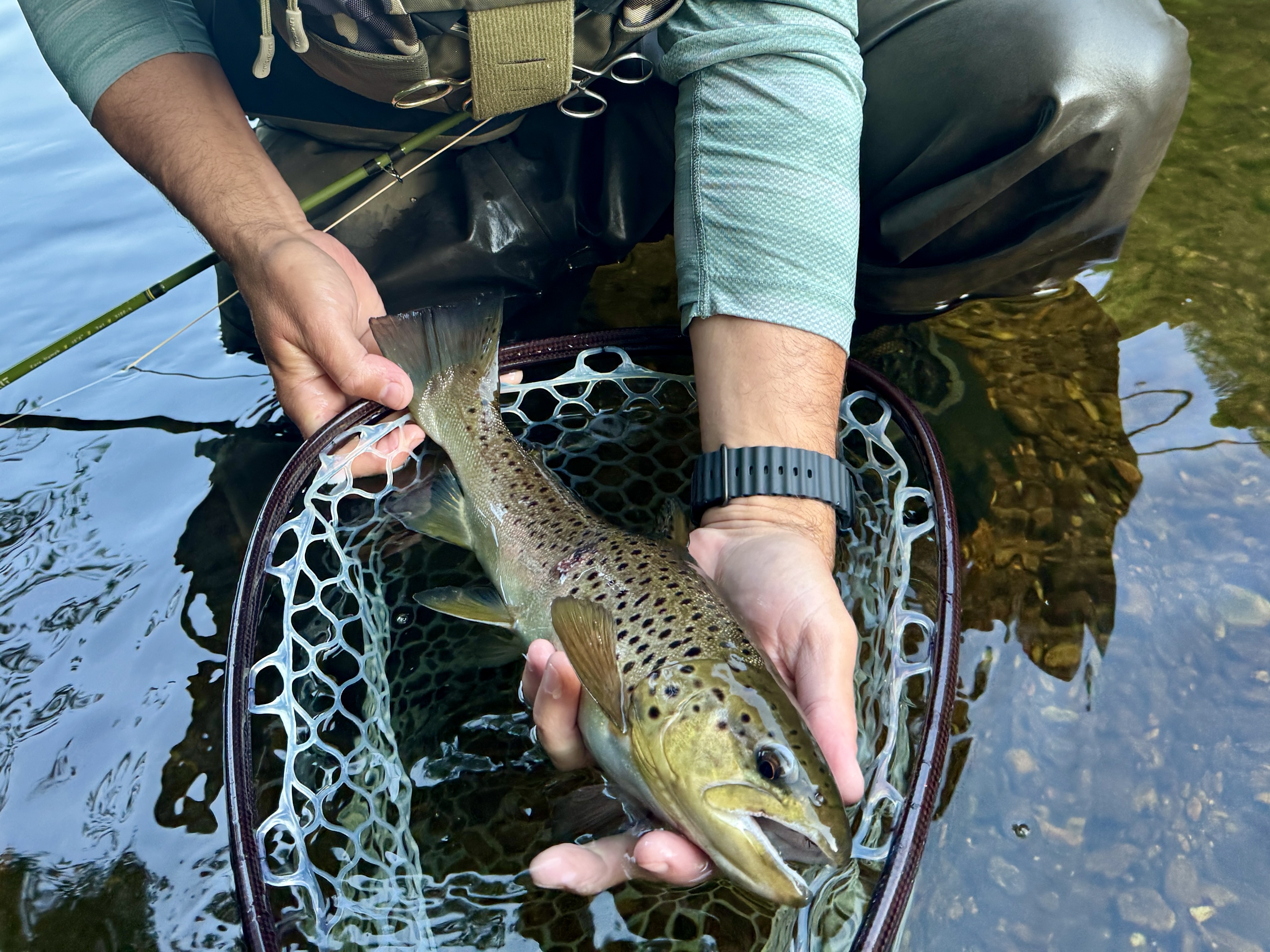
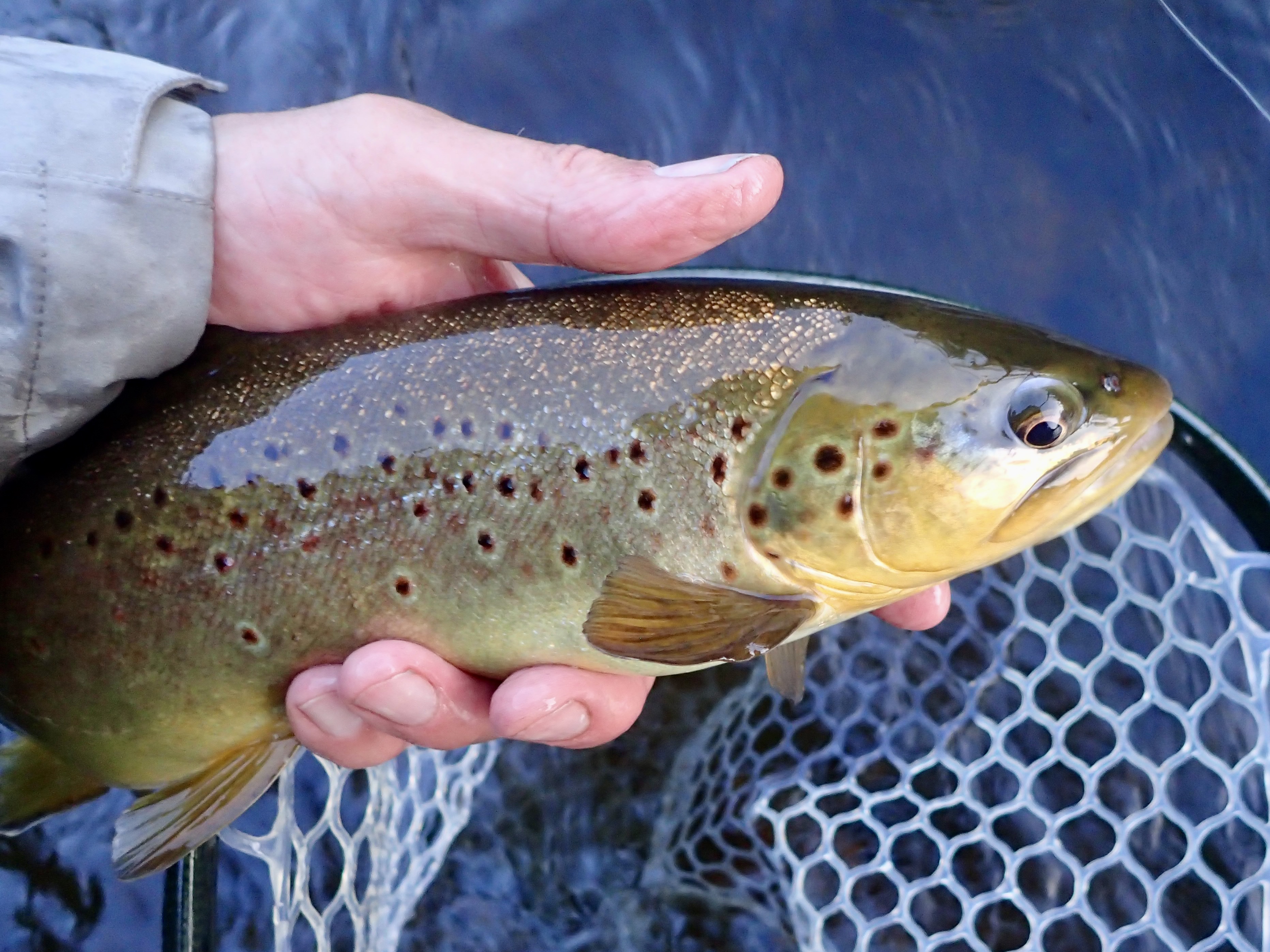
We only put one decent fish in the hoop, this some-teen wild brown by Toby. It had three bird wounds; you can see one of them on the midway point of the fish’s flank.
I’ve been so busy in the yard this spring that I haven’t been able to get out to the Farmington as much as I’d like. But the rest of the summer is still ahead, in all its lazy, hazy, crazy glory.
I had a really weird session on the Farmington last Thursday. Despite a robust sulphur emergence — 8.5/10 — the wet fly bite stunk. Turns out it was due to a lack of fish. By my best estimate, this long time favorite pool was holding about 1/4 of the normal trout biomass. I had duns in the air, on the water, cripples galore, then mats of spinners. Instead of a boiling surface, I had….a rise here….and there… and then nothing…and then a lonely rise. It was incredibly discouraging. The feeding was over by 8:45pm, unheard of in these parts. I’m usually picking my way out of the river well after 9pm, crouched over, casting to trout sipping spinners. Not on this night.
On the plus side, I met some very nice anglers, and we shared the water with a most civil energy. Joe was trying to fool this wild brown, but just wasn’t able to connect. When he left, he offered me his spot. Second cast, bang! About 16″. Taken on a size 14 classic Catskills Light Cahill dry.
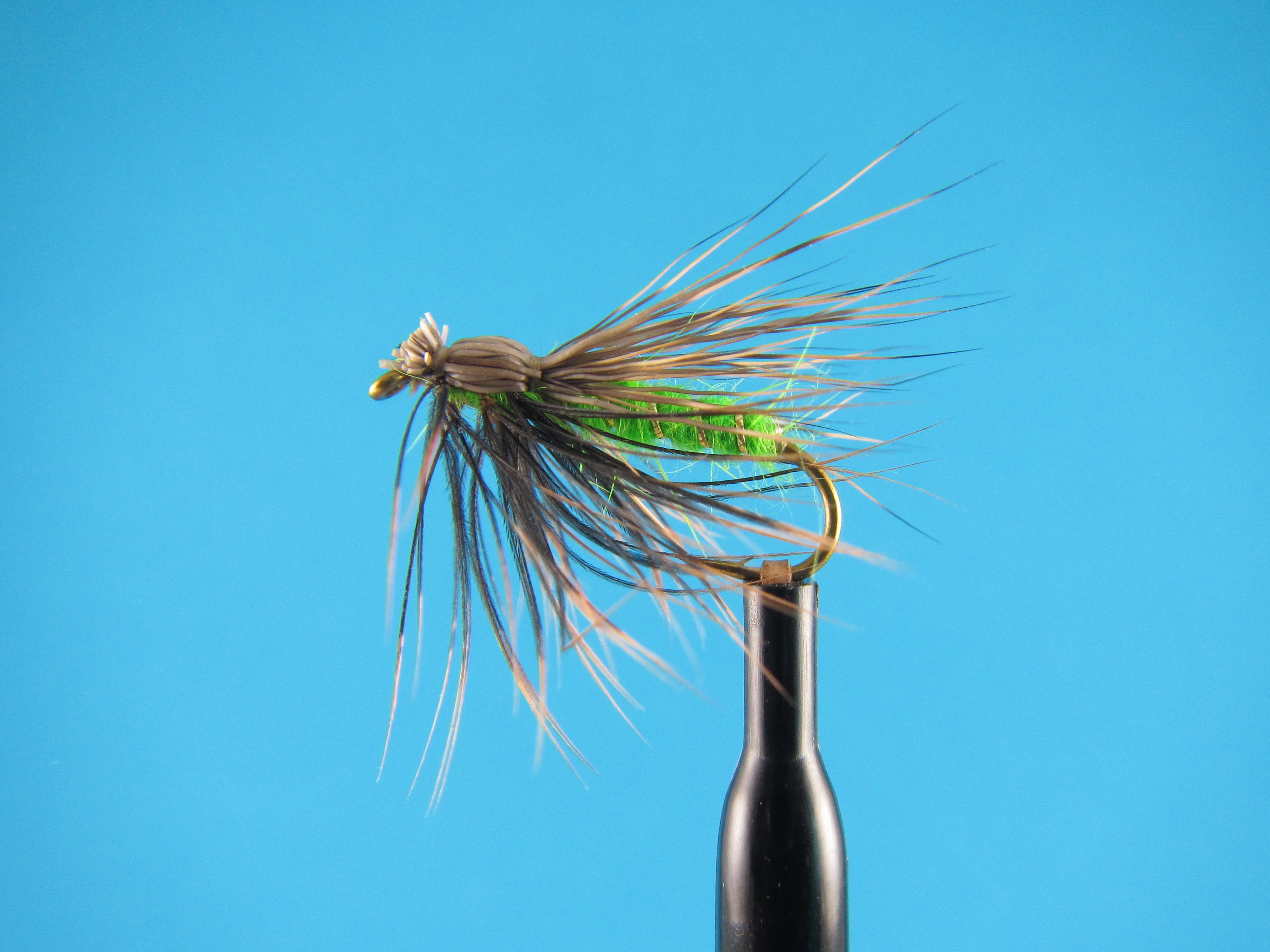
We are in prime sulphur time, which means you should have some soft hackles in your box. Here’s why:
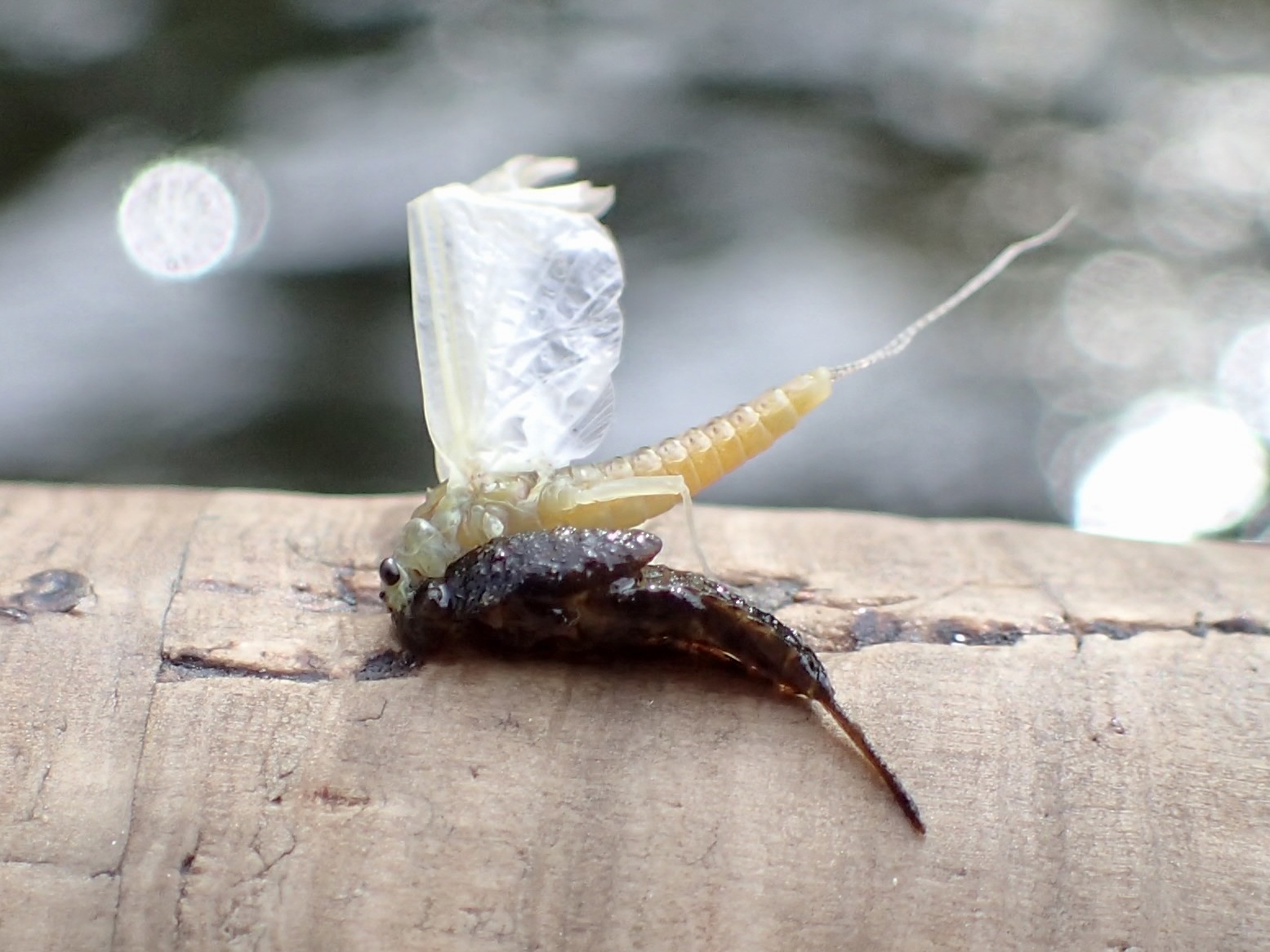
Sulfurs take a good, long time to emerge from their shucks — and then sometimes, not at all. The trout get a good, long look at the food source as it drifts near the film. I fished this invaria cripple out of the water, and it was one of hundreds that never made it out of its nymphal case. Wet flies and soft hackles are a perfect match and method for this situation, as are dry fly cripple patterns.
I’m going to be writing an article for an upcoming issue of Surfcasters’ Journal. The subject will be the importance (or unimportance) of color in fly patterns. To the keyboard I go!
Finally, I hope to get on my horse and get some info out to everyone who requested a signed copy of the book. I’d like to do that by the end of the month. So stay tuned!
Usually, by this time of year, I’ve given you at least one report headlined with words like “spectacular wet fly action.” But not in 2026. It continues to be cooler than normal and windy and blech. When hatch activity has been strong, the fish seem content to feed on the bottom. This, of course, will change. I feel like we’ll go instantly from early spring to mid-summer weather, the surface bite will pick up, and you’ll get your enthusiastic, superlative-laden wet fly report. But for now, it’s keep on-keeping on.
I gave Jason a wet fly lesson from 11am-3pm on Thursday, and he deserved way, way better than what he got, which was two hits in four hours. To be fair, one of them was a very good fish, although it was camera shy. Jason did an excellent job of casting and getting his team of three where it needed to be, then mending and presenting. Some time later this month or in June, he’s going to hit it right, and people are going to be following him off the water, asking him, “What fly were you fishing?!?”
It’s way too early for me to be thinking about grasshoppers, but I did see one on my driveway yesterday. This is my Hopper Hammerdown.
We had 310cfs in the PTMA and points south. Water temp was in the high 50s. When it’s windy, the seed pods that blow into the water (which look very much like soft-hackled flies) do us no good, and that was yet another factor. Oh, did I mention the cold front that came through the night before? We got into our fish because we moved aggressively through pools, looking for biters. Do likewise when the fishing is slow, and you’ll up your odds significantly.
And a reminder: May is caddis month on the Farmington.
I fished the lower end of PTMA yesterday from noon to 3:30pm. Once got to the river, I ran into a group of wonderfully chill gentlemanly anglers, and we had a short gab-fest before I decided to head into the river for some pre-hatch prospecting. Bob, of Bob-and-Andy fame, was also there. I’d met Bob-and-Andy at this mark many years ago, and since then, it’s really not April unless we cross paths on the river.
The wind made it an unfavorable day for casting a team of three wets, but I managed to go almost the entire session without a fouled-up leader. After an hour that produced one lonely bump, I declared to the group that one or more of three things was true: there are not a lot of fish here; the hatch is going to be underwhelming; the trout are content to feed on the bottom. It turns out that options A and C were likely in play. When the hatch finally got going, around 2:15pm, there were bugs everywhere: in the air, on the surface — and precious few trout rising to them. I’d give this hatch volume an 8 out of 10; when you can count the rises per minute on a few fingers (instead of dozens) that’s not going to make for epic fishing. Normally, with this Hendrickson hatch volume, I’d bang up a good dozen fish or more fishing wets pre-hatch and during the emergence. Not today.
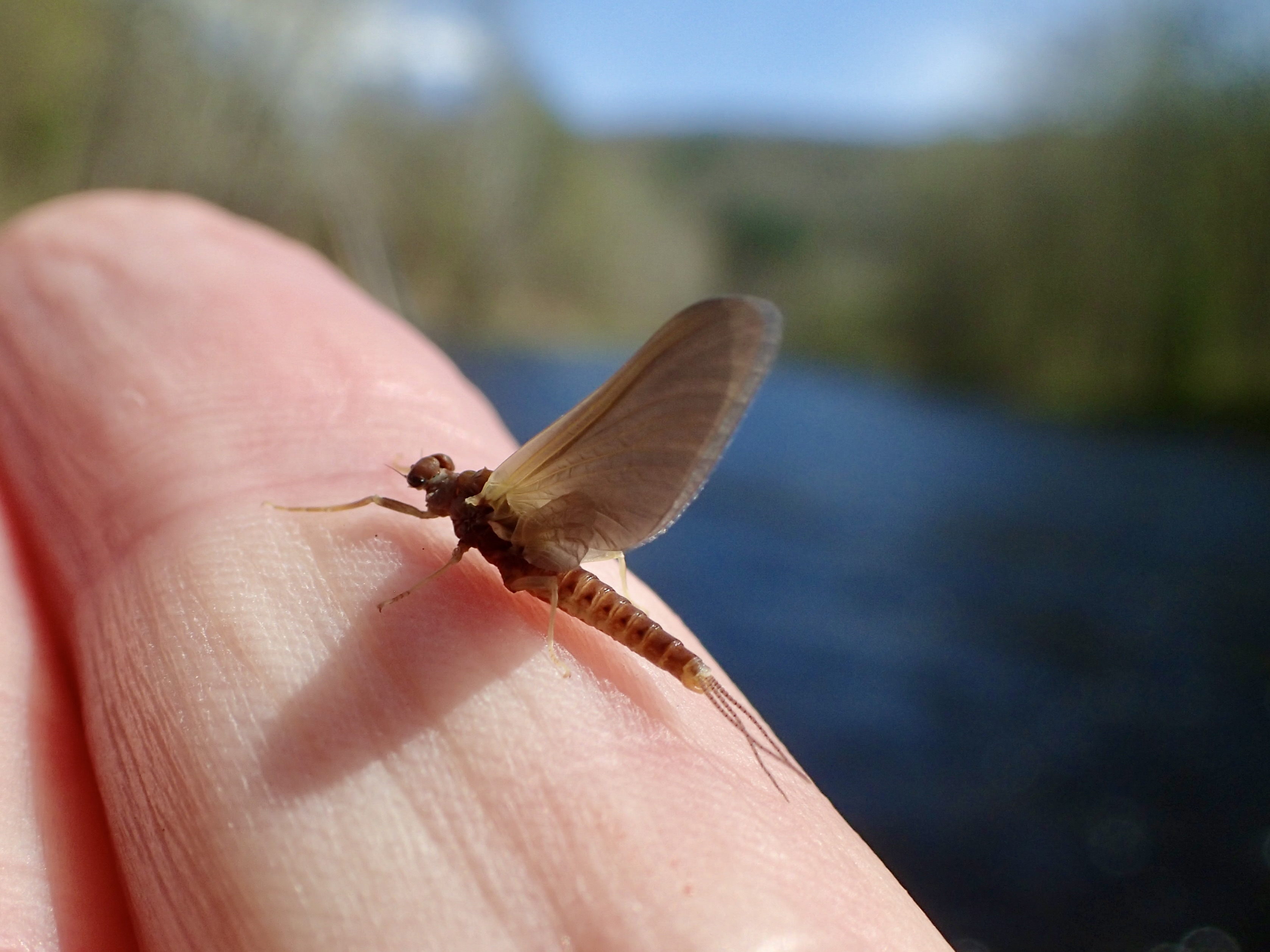
Hello, old friend. This would be a male Hendrickson; three tails, darker cast, large eyes.
What did follow script was the place in the water column where the fish were feeding. Pre- and during emergence, they took the wet, until the point where they didn’t, and then it was dry flies on the surface. This is a good time to talk about shadow hatches, which I do in the Farmington River book. In addition to Hendricksons, there were also caddis and BWOs in the mix. The savvy wet fly angler will want to have at least one of those other food groups represented. What do you know? Of the three trout I took on wet flies, two came on the caddis middle dropper (Hare’s Lug and Plover).
I managed two more on the surface, bringing my total to five. At the risk of sounding ungrateful, I was not impressed. Of course, I could have gone elsewhere. But with three anglers below me and five above me, real estate was scarce. So I stayed.
Today, writing about it, I have to scold myself for being so dour. It was a sunny, April day. The Hendricksons were out. There were some rising fish who wanted to eat. I got to reconnect with old friends and make some new ones. I didn’t put two dozen in the hoop or land a 20″ wild brown. But, yeah. That’s still a really good day of fishing.
Happy Tuesday. I’m sure we’re all chuffed that it’s April, with winter (despite subfreezing temps tonight) in the rearview mirror. The glorious promise of a new season is spread before us like an all-you-can-eat buffet. Since I haven’t written anything instructional in a while, here are some considerations for April fly fishing in the northeast, submitted for your approval.
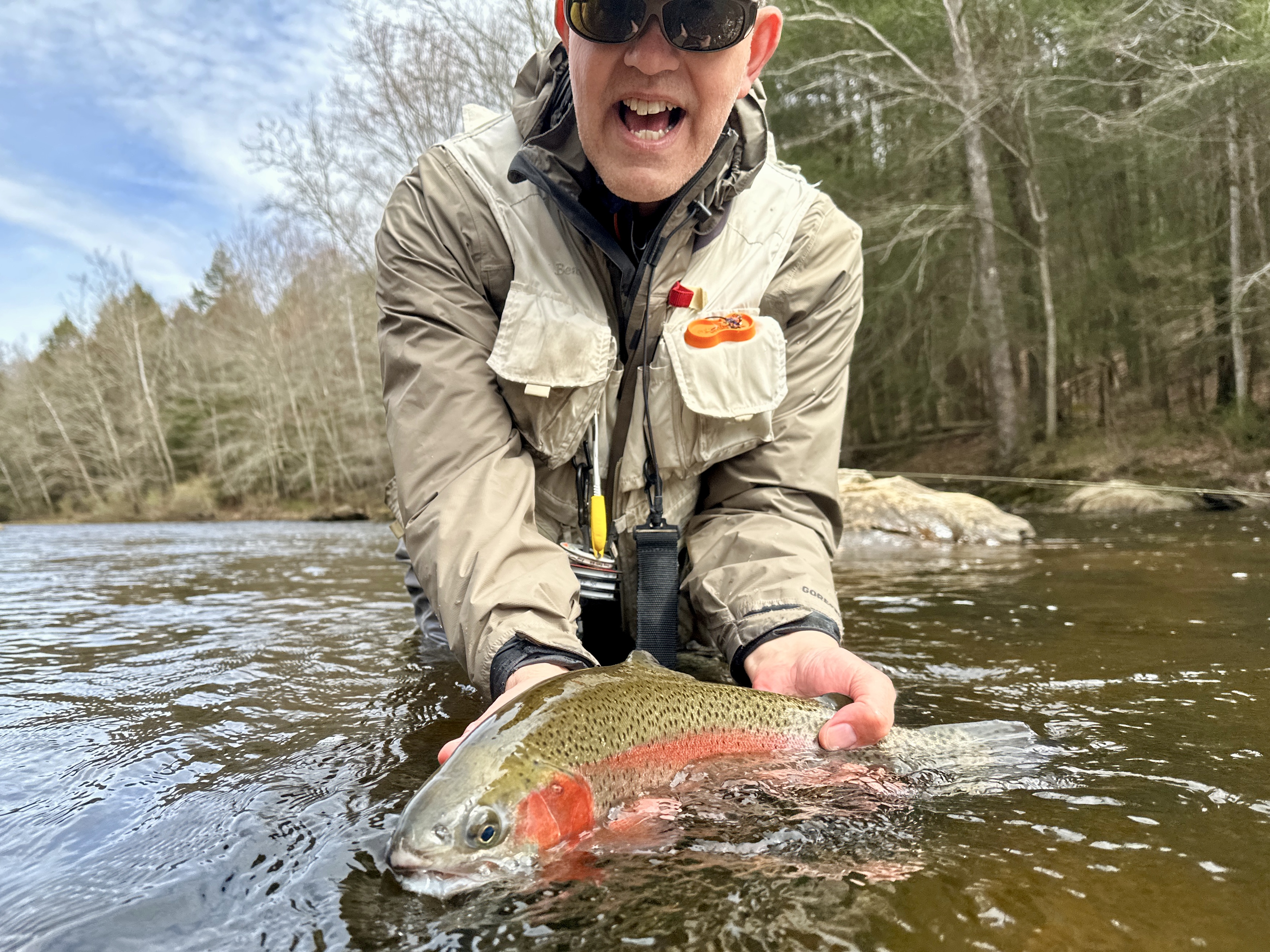
A handsome April rainbow, taken on a mini-jig streamer. Run silent, run deep.Photo by Toby Lapinski
Be prepared to go deep. The water is still plenty cold, and will be even on the warmest, sunniest April day. It may also be high. Which means that unless the trout have a reason to be active surface feeders, dries will be challenging. Your highest percentage plays are going to be dead-drifted nymphs and jig or traditional streamers, dead drifted, swung, or stripped.
The fish aren’t spread out. Generally speaking, the fish aren’t everywhere; rather, they will pod up. So where you catch one, you’ll likely catch another. An exception would be large, alpha wild browns. Look for them in the prime lies at the heads of pools, dump-ins, and even some whitewater.
Pick and choose your dry fly days. Just because it’s warm and sunny doesn’t mean the fish will be feeding on the surface. Rather, look for specific hatches and hatch windows. Hendricksons, caddis, and BWOs will all be hatching and, in the case of the mayflies, spinning and falling. If you must prospect with a dry, a nymph or wet fly dropper is almost never a bad idea this time of year. Of course, if there is hatch and feeding activity, rock on.
Don’t poo-poo junk flies. High water, off-color water, stupid stockers — these are all compelling reasons to fish Squirmy Works, Mops, and other ghastly creations.
Be (ware/aware) of shadow hatches. I write about this in greater detail in the book. Just because the Hendrickson are hatching doesn’t mean that the trout are eating Hendricksons. Know everything that is likely to be a food source and you’ll catch more fish.
Be courteous to other anglers. It can get crowded out there. Try to share the water when possible. Ask if you can fish near someone. Good fishing karma comes to those who are polite. And in a matter of weeks, the crowds will begin to thin out.
May comes next. Another topic that’s covered in the book. You think it’s going to be high 70s and sunny, and all too often it’s 50s and cloudy and windy. May is caddis month. So get those boxes filled on your April off days.
Is this a great time of year to be a fly fisher, or what?
A little random potpourri day on currentseams. I had written a post similar to this one, which was supposed to go live on Tuesday, but somehow WordPress ate my draft (don’t you just love when technology fails?). So here we are.
I received about two dozen requests for personalized copies of the book through me, and that’s enough for me to proceed. My next steps are to figure out how much all this will cost me (mailers, postage — probably media mail) so I can then pass the cost along to you. (How’s that for transparent business practice?) I’m hoping to have that information out by the end of the month, and if you want a signed copy from me, you still have plenty of time to let me know. I won’t ask for money until I get all those ducks in a row, and hopefully I can get books out to you before the official release day of August 4.
Fishing time has been scarce for me this spring, especially on the striper front. I didn’t go once from January through March. Normally, I’d go at least once a month in January and February. But every time I had a time and tide window, it was either sub-freezing cold front misery or a disgustingly high water. I’m really looking forward to being able to swing some flatwings in April. If the elements allow!
March can be a productive big-bass-on-the-fly-from-shore window. Not this year. At least, not for me.
On our local trout waters, it’s a tricky time of year. You basically have two options: targeting stocked trout or targeting wild and holdover trout. I must confess that playing the stocker game is fun for a while; however, I have a limited interest for that. Wild or stocked, the trout will tend to remain stacked up this time of year, even though it’s beginning to warm up and we’re seeing more bug activity. They’ll begin to spread out sometime in April. Bug-wise, think little dark stone flies and midges and caddis, which are plentiful food supplies. Of course, the Hendricksons will be the first big glamour hatch of the year, starting on the lower Farmington in about two weeks. But after last year‘s disappointing showing, that hatch remains a big question mark. We shall see.
Mrs. H, missing the middle fork of her tail.
I did get out to a small stream last week after the rains, but the water was high and cold. There were no bugs and the air temp in the 30s didn’t help. I went out this week in much warmer temperatures and a little bit lower water, and what a difference a week made. But I’ll give you more on that in a post next week.
As a newly minted member of the Regal Vise Pro-Staff, I’m working on a wet fly piece for their website (which is currently under reconstruction). I have no idea when it will post but I’ll let you know. Also look for a future blog post for me on the J. Stockard website, where I’m also a Pro Tyer.
Finally, many thanks to the Yale Fishing Club for hosting me on Tuesday night. It’s always a good time, and I’m a sucker for New Haven style pizza — well done, group! They’re going to fish the Salmon River in New York in a couple weeks, so we tied up some Blood Dot eggs which will serve them well.
It seems ridiculous to say — especially since I wrote the book — but yesterday was my first day in 2026 fishing the Farmington River. I was going to go last Friday, but I deemed it too cold, and decided to wait for more clement conditions. Turns out, the giddy sun and warmth had zero impact on the catching.
We (Farmington River guide Steve Hogan and I) decided to fish above Riverton based on two factors: the water would be warmest there (we took two readings and got 38.5 and 44(!) degrees), and it would be lowest and clearest due to it being above the Still River. As you can imagine, the false late spring weather drew crowds of anglers; I can’t remember the last time the Riverton town lot next to the bridge was jammed so full of vehicles. Nymphing was the game, and we hit multiple pockets and runs between the dam and the town. Parking wasn’t easy as there was still a substantial amount of snow lining Hogback Road.
I told Hogan that I grade myself when I’m fishing and not catching, and I gave me a B+/A-. I do this because If I’m not catching, I want to make sure that it’s not because I’m committing some fundamental error or missing strikes. Folks, I was on the bottom all day and I no longer have the flies to prove it. I dredged up several nice sticks. We saw midges and olives and couple other un-IDed bugs. What we didn’t see was a fish caught. Not us. Not anyone. But, better fishing is coming. A lot happens this month. We’re just three weeks away from April!
Early March is one of the toughest windows to fish on the Farmington. We gave it about 3 hours, then called it a day, which, given the sunshine and warmth and cigars, was not bad at all despite not having even a courtesy tap.
I don’t mean to sound greedy. But after potting 23 steelhead and breaking 300 on Tuesday, all I could think about was landing more.
Fair enough, but things don’t always work out the way you hope they would. How many times have you planned a fishing trip, only to see Mother Nature and the elements conspire to crush your dreams with cruel indifference? We were supposed to get 3-5 inched of snow overnight, which would mean slush-filled creeks for most of the morning. And with temperatures predicted in the upper 30s/low 40s, melting would follow, then runoff. I didn’t have a good feeling.
But forecasts change, weather people are notoriously often not right, and we got only an inch of snow, if that. We were so optimistic, we started the day an hour earlier than yesterday. There was a little slush in the system, but far less than the day before, and it was all gone within an hour. Best of all: no one was out fishing. We saw three other anglers all day, and then only for a couple hours. That meant I could bounce around the creek and fish wherever my little heart desired. (My phone later told me that I’d walked and waded nearly 3 miles).
The suckers are in! Or singular, if you like, as this was the only one I found over two days. It was a little early to be matching the hatch with sucker spawn or Crystal Meths, although the patterns absolutely work any time during the season.Despite the lamprey scar, a breathtakingly beautiful fish. The water was still barely above freezing, but on this day the steelhead had a lot more fight in them. We worked upstream, targeting likely holding areas, concentrating on the ones that held fish and presenting flies until the bite stopped. I went from one landed to a half dozen, and then a dozen by about 1pm. It was already a fantastic day.One tank of a hen steelhead. While there were several good battles, I had three over the course of the day that truly tested my landing skills. I really wanted to land this fish, as she kept bulldogging me and running and refusing to come civilly. By early afternoon, a front began moving through; it got gusty and noticeably colder, and while it didn’t shut down the bite, it definitely tapped the brakes. The water began to take on color. And then, there were no more eats. It was time for lunch and another section of river.As you can see, the final section of river had a tea-with-a-few-drops-of-milk opacity. My batting average was not the best in this last mark, as I went 2-for-5. But I have no right to kvetch. The hump day total was 17 steelhead in the hoop, giving me 40 for the two-day trip. Did this really happen? Wasn’t I trapped by hundreds of feet of deep, wet snow a few days before? Weren’t conditions supposed to be entirely unfavorable? This is the argument for, “You don’t know if you don’t go” — and this is steelhead number 322.
When I blocked out February 24-25 for steelheading in western PA, I was certain that it was a plan that would never see action. The creeks were an impenetrable wall of water in its solid state. Not happening. Then the thaws came. The ice released its lock on the creeks. And suddenly, by golly, we had optimism. This could happen. The trip is on.
Then came the blizzard. I can get pretty motivated when there’s something in the way of something that I want to do, and I figured that if the snow stopped early enough on Monday the 23rd, I could still make the drive and be fishing on Tuesday. However, I didn’t expect over 18″ of heavy, wet snow. But I was snowblowing the driveway at 11am, the snowflakes still flying. My neighbor, who has a plow, usually clears the shared driveway. But as time moved farther past noon, and it still wasn’t cleared, my worst fears became reality. My neighbor was away. If I wanted to fish, I would have to clear about 300 feet of that snow — the last horrible 6 feet, a pudding of heavy-as-wet cement glop, by shovel. Ugh. No way. The trip is off.
But no, dammit, it isn’t. I’m going steelheading tomorrow. So I fired up the blower, steeled my back, and had at it. And that’s how, at 4pm, I found myself heading north on I-91. I had wet roads until Albany, then lake effect snow on and off from Rochester into PA. Safely in bed, I was out like a light at 1:30am.
The silver lining to this tired angler cloud is that you don’t need to start early on a winter’s day, especially if there’s likely to be slush in the water. I was fishing by 10:30am — perfectly civilized — and while slush was a problem, it wasn’t a deal breaker. I got maybe one good drift out of 6 casts. I missed the first bite because he ate where I didn’t expect it. The second miss was a foul. Finally, I was on the board. This fish was the third of the day; I’m particularly captivated by the see-through tail. Already, yesterday’s shoveling horrors seemed worthwhile.By 11:30am, the slush was almost gone, and I was hooking fish in earnest. When I’d left CT, I was at 282 steelhead landed. I was hoping to drive home somewhere in the 290s. But the fish kept coming, and there came a point in the time-space continuum when I dared to think: I could break 300 today. Yes, I think I can. What happened next was a phenomenon that I only recognized several days later: I got into the zone. Nothing else registered — not the cold, not the ice, not my hunger, not the time. I was, as the colloquial expression goes, unconscious. Find fish, cast, mend, drift, adjust and mend, set, fight, land. Geez, the last time I looked at my watch it was 11am. Now, it was after 1pm. 299, baby! Ringo Starr sang, “It don’t come easy,” and he ain’t lying. We found a pod of steelhead in a whitewater plunge and run, including a couple huge dark horse bucks. But they were most uncooperative. So we moved down the run to another short stack of fish, their location belied by dark backs against the light green substrate. First cast. Big upstream mend. Dead drift. Indicator goes under. Sweeping set downstream. Fish on. It was a fine steelhead for number 300, a chunky hen in the 8-10 lb. class. Despite the barely-above-freezing water, she put up a fight worthy of her size. With pink and rose on her flanks and secondary and tertiary rainbow colors on her cheeks, she was an absolutely gorgeous creature. So, yeah. I kissed her. It was a little after 1:30pm.Over my steelheading career, I’ve noticed that the sudden arrival of a cold front has an immediate, negative effect on the bite. Around 2pm, the wind picked up, the water began to stain, and bites became a scarce commodity. We took a lunch break, and headed to a different mark, where the water was the color of tea with a drop or two of milk. We picked several pockets and runs and pools, but found diners in only one of them. I missed the first, landed the second, and called it a day at 305. Not in my wildest dreams did I think this would happen on this trip. Had I been in a different mindset, I would have brought a truly special cigar to celebrate the occasion. Tell you what: what I smoked tasted just damn fine.Madelaine’s is my go-to eatery, and I was ready for a celebratory dinner of their meatloaf and an IPA. What?!? Closed on Tuesdays?!? I ended up at The Barracks, which as you can see looks a little like a disco-casino-local bar mashup. The cheeseburger was excellent. The Yeungling draft most quenching. Yep. I was going to sleep well tonight.
If it weren’t for the weather, this might have been the best show ever. But you don’t get to decide on such things, and when a once-in-a-decade snowstorm is thrown at you, you deal as best you can. But I come not to bury this year’s show (certainly not under 18″ of snow!) but rather, to praise it.
The Edison show is the largest fly fishing show on the east coast, and, perhaps, in the world. It has it all: vendors from rods and reels and gear and fly tying and books to guides and shops and lodges and fishing/destination travel. It’s got dozens of some of the best fly tyers in the world. If you want education, you’re in the right place: you can partake in presentations and seminars and demos and classes put on by some of the best anglers in the world. (If you want to be a rock star, you can’t hang out with Aerosmith for a few hours. If you want to become a better angler or tier, you can take a small class with George Daniel or Tim Flagler.)
Seminars! Getcher seminars here! What an honor to be included on a list with such fly fishingluminaries. All seminars are included in the price of your admission ticket. That’s a win for everyone. Classes require an additional fee, but it’s money very well spent — I get people telling me years after they’ve taken a class how much it improved their fishing. Thank you to everyone who took a class with me this year.
As a presenter, the Edison show is, for me, a multi-faceted journey into fun. I get to speak to (hopefully) large groups of people; that’s something I love to do. I get to reconnect with old and distant friends, and make new ones. I get to wander the show floor and discover all the fly fishing and tying items I didn’t know that I needed. I get to be a fanboy. And, I get to teach classes and turn other anglers on to new concepts that will help them catch more fish.
I did multiple talks on the Farmington River and was delighted by the size and enthusiasm of the crowds. The book is generating a lot of excitement, which seems to be growing exponentially. The Fly Fishing Guide to the Farmington River is at the printer, with a projected release date of June 2026. Stay tuned here for release details as they come in.Fly fishing is serious business. Or not. A little pre-seminar festivity with Landon Mayer, Jason Randall, and Chuck Furimsky.My annual pilgrimage to Wu’s Shanghai Dumpling in Edison. This is THE place for authentic Chinese dumplings and udon. I always make sure I get enough to take home. Not exactly low-cal dining, but oh-so-scrumptious. My buddies Chris Steinbeck and Pat Dorsey from the Blue Quill Angler. The BQA booth is my safe haven in Edison; I can hang out between gigs, take a load off, and socialize with passers-by. If you’re going fishing in the Denver area, these are the people to see! I managed a little bit of shopping, coming away with four wet fly capes at a bargain price, and another pair of Renomed scissors. You’ll be hearing more about Renomed on this site soon, these scissors are, by far, the best I’ve ever used.
And then on Sunday, the snows came. But the show went on, as it always does. This year, I’m doing the Lancaster show, which is March 14-15. I’ll have a tying station. See you there!