As tradition dictates, I went fishing on Good Friday in honor of Simon Peter, the greatest fisherman of all time. However, I mixed it up a bit. I couldn’t see driving down to the mouth of the Hous, my usual haunt, for what would very likely be casting practice (although we all could use it, right?) Even though I was tantalized by the sound of the surf and the smell of sea salt. So the decision was made: Salmon River, CT. It was an easy call when I considered that it was the day before opening day. That’s the Friday I fished with my dad and sons on that river for so many years.
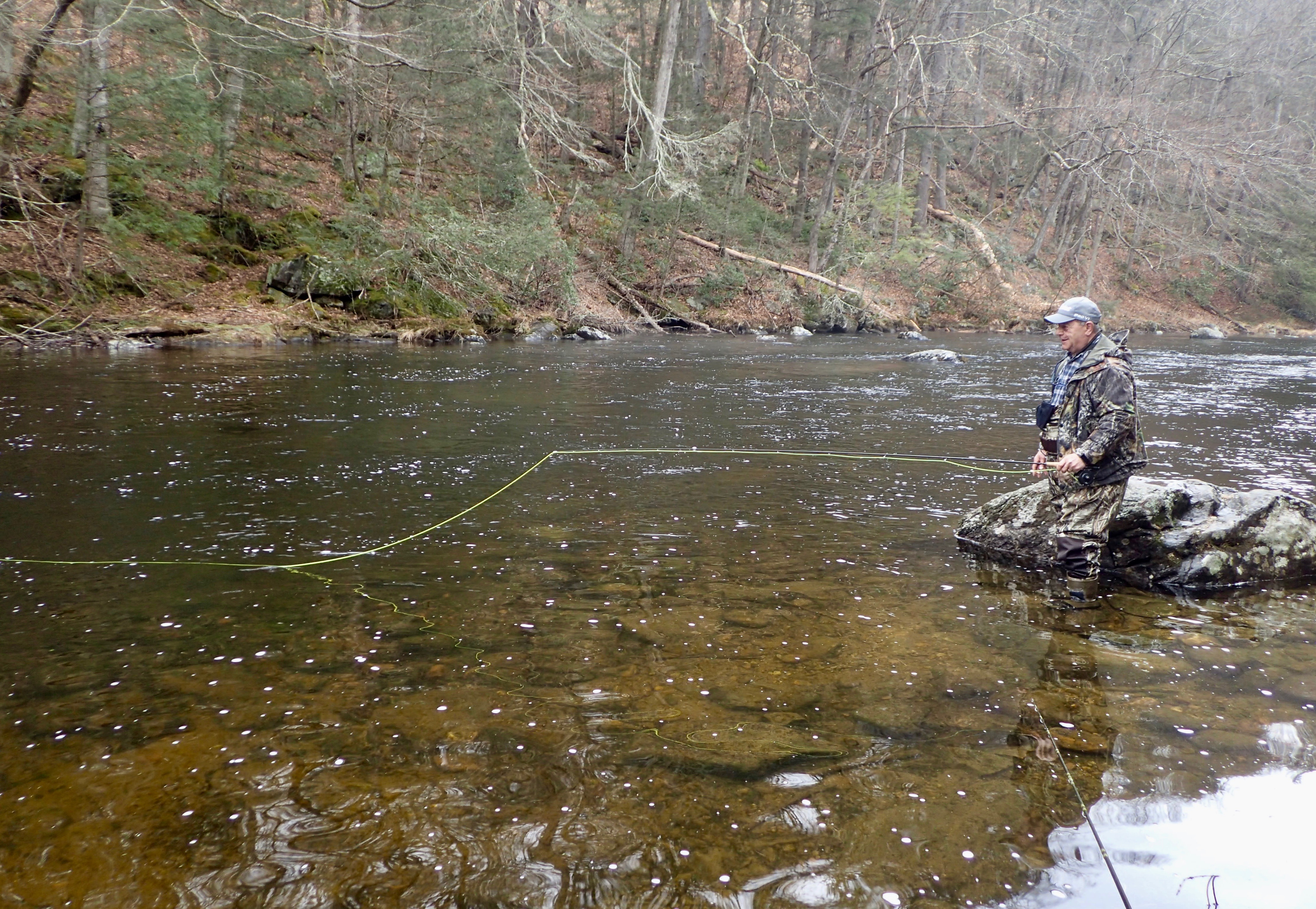
I was joined by surfcaster extraordinaire Toby Lapinski. The water was on the low side of medium, 180cfs. With the warmer weather and Good Friday, the crowds were out. The FFO section was infested with anglers; the TMA section above, not as much. We fished four marks from 11:30am-2:30pm and found willing fresh stockees in all of them. Toby fished a streamer and I went with a small jig streamer on a long leader. I dead drifted, swung, stripped and jigged and caught fish all four ways. We saw caddis and midges and olives, and even a few risers. What a fantastic day!
I hooked my first trout with my streamer dangling in the current while I stripped line off the reel. Once Toby got in, it was only a matter of moments before he hooked up. How sweet to become an instant expert, if only for a few brief, shining hours. I must admit I do enjoy it in small doses.Tight lines and bent rods was the theme of the day. It was mostly rainbows, but we did encounter a couple stray browns. I was surprised by the power of some of the fish. Maybe it was the water temperature, an ideal 54 degrees. (Photo by Toby Lapinski)
Part One: Sunday. My original plan was to hit the Upper Fly Zone on the Salmon River, but after kibitzing with steelhead guide extraordinaire Row Jimmy, gears were shifted. High but falling water, some color to it — yes. The creeks. Creek A was surging along, and in addition to a moderate stain its waters carried a fair amount of leafy debris. I targeted two very likely holding areas, but over the course of an hour the only thing I could hook was the bottom. The UFZ beckoned, but its siren song was drowned out by the call of Creek B, which, as it turns out, was the right choice. Creek B was also running high, but much clearer. I was astonished to find that my secret spot was devoid of anglers. Third cast, right down the gut, the indicator dips and I’m on. I stuck the fish good, but as I’ve learned, now years into this endeavor, you can do everything right and the fish can still come off. (The reader will want to make note of this statement for later reference.) It was a fresh, gleaming bright fish, about five pounds, and it immediately skyrocketed out of the water and spit the hook. My disappointment was salved by the knowledge that there were fish here willing to eat. I ended up going 2-for-5, not a great batting average, but two of those were never really on, coming off seconds after a perceived hook set. It was good to be on the board. It was Sunday. It was sunny. I was steelheading. It felt good.
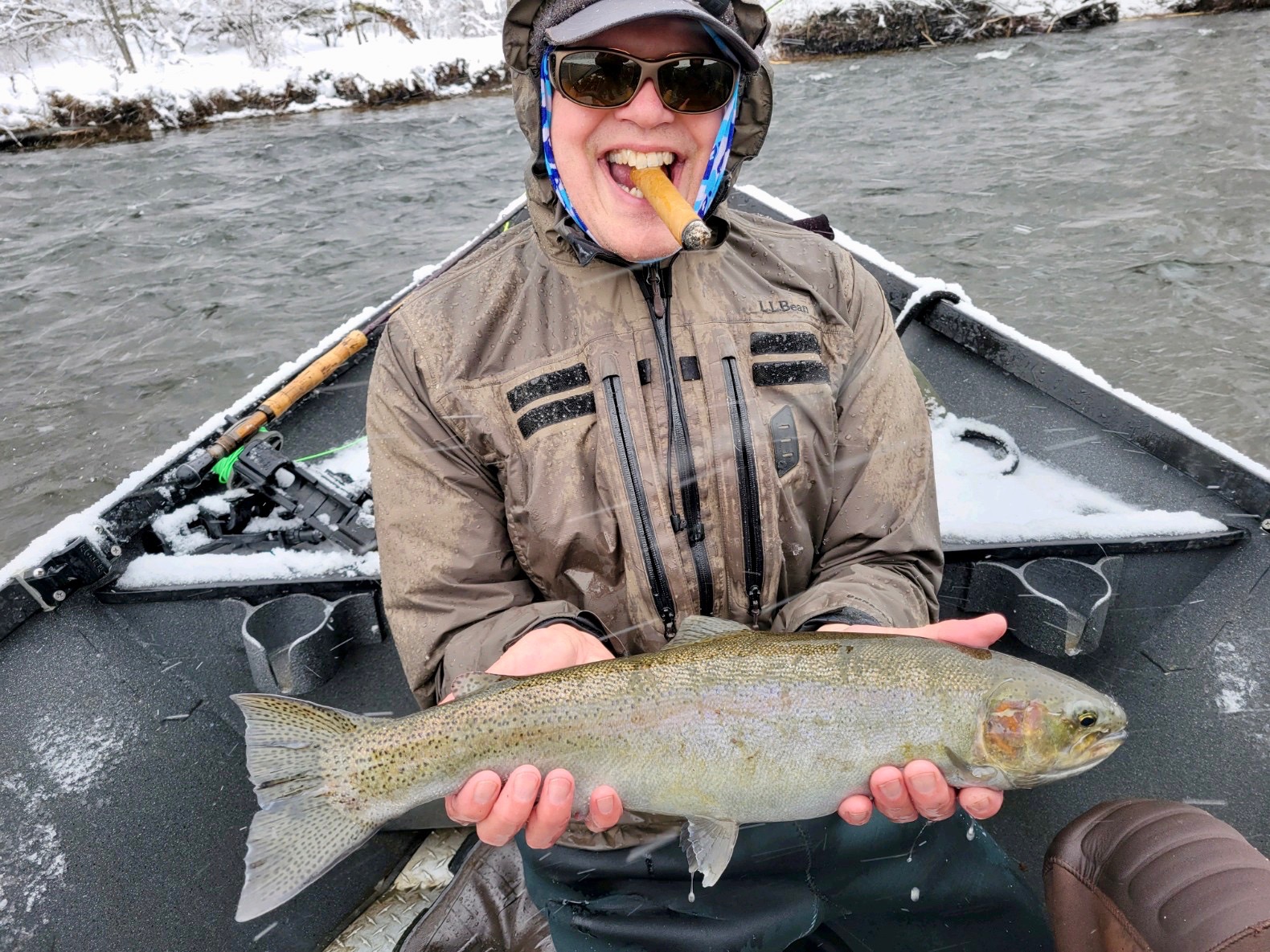
Our Lady of Blessed Blood Dot did not fail me. I set the hook so hard on this buck that I almost fell over. Being able to fish for steelhead in smaller water in relative solitude is a blessing. To show my appreciation, I made a burnt offering to the creek gods. Ok, so it was a smoldering cigar butt, and I was finished with it anyway. But it felt right.
Part Two: Monday Morning. The fishing on the Salmon River in Altmar stunk. We saw three steelhead hooked and landed. Despite the high flows (1.5K cfs) we were able to target known, proven holding areas (along with multiple other boats) and it just wasn’t happening. I’d been thinking it for a couple hours, but after we blanked in Ellis Cove, Jim suggested that we cut our losses and hit the creeks. It was 11:30am. Sold!
Part Three: Monday Afternoon. In what seemed like a flash, I was 2-for-4. The first one I stuck was a big ole’ fish that came up and planted itself in the main current. If it could think and determine a strategy — to bulldog and try to outlast me — I’d want to shake its hand or fin or however you congratulate a steelhead. Because as I steadily applied pressure to the fish, something gave and I was left wearing my leader around my body. By 1:30, Jim had to leave, so I decided to stay for a bit. I was glad I did.
Part Four: The Comedy of Battle. I was unfamiliar with much of this creek, so before Jim left I’d asked him for some advice on where to fish. One of his suggestions was a run under a dead tree whose branches extended down to just a few feet above the water. The target zone was a slot of deeper water, maybe 1 1/2 to 2 feet. This section of creek was so small that the surrounding trees and bushes would make casting difficult, to say nothing of a hook set. Landing a fish? We’ll deal with that if it comes. What’s more, its boulder and debris-strewn bottom was a snag fest, as I found out on my first few casts. But on the fourth cast, the bottom shook its head.
Steelhead on. Now what?
Twice, I whacked my rod against tree branches trying to set the hook. Things were so tight that I did my best to complete a hook set that was somewhere between a strip and a tip. The steelhead didn’t have too many places to go. Its first run was downstream. This fish had been in the creek for a while. Dark horse, spawning colors, and the biggest steelhead I’d stuck all trip. I decided the best chance of landing him was to strike fast. I spied an LZ across the creek, and charged into the river. Once I got to the shore, the steelhead had other plans. Ziiiiiiiing! Another downstream run. OK, so I gotta follow you. No, don’t swim into those submerged branches! But he did. I had to grab my line — usually the kiss of death in such matters — and free it from the snaking arms of a downed sapling, then pull the fish out of the maze of branches. Whew. Still on. I cranked the reel furiously, only to have the fish peel off another 20 feet of line. I dutifully followed it downstream, adrenaline and heart pumping. No! Not into more submerged branches! But that’s where he went. Again, I had to grab line and leader, fully aware that the tenuous connection between angler and steelhead could disappear at any moment. Again, I had to free the line from submerged branches. At one point I felt the leader go limp. But no. Salvation! Fish still on!
The last few moments were filled with exciting apprehension, if not terror. After all that went down, so many pitfalls avoided, how could I possibly lose the fish now? I eased it into the shallows. Twice, it would have nothing to do with my efforts. Keep the rod tip bent, Steven…drag just tight enough…easy. And then it was over. I made another burnt offering and decided that this was one of the best fights I’ve ever had with a steelhead. My prize earned, I slipped the fish back into the currents of its natal waters and watched it melt into the current.
It would be a good drive home.
Ooh. Ahh. Ohh. What colors! A brilliant display of nature. Well played, good sir. A valiant effort. Now, please, go make some baby steelhead.
I don’t have much to report about last night’s outing, other than I fished hard, and well, and intensely, and for those efforts I was rewarded with not…a…touch. Ye Olde Striper Spot is once again revealing its pattern. Either: there are no fish there yet. They never set up for the winter (this was my third blank in three trips since January), the herring aren’t yet in, so I’d be foolish to go back tonight. Or: fish congregate in this spot during the winter because it’s a good ambush point, there’s some bait, current, and deep water nearby. Sadly, it’s been all Option A. So, we’ll stay home tonight and hope for the best during the next tide cycle as I really don’t need to be climbing into bed at 3am for casting and mending practice.
I haven’t had an Arturo Fuente Canones in years, so I jumped on this one when I saw it. It was the highlight of the evening. A very pleasing, long-lasting double corona. (That’s a Rock Island flatwing for those who are interested.) Now, where dem strip-ed bass at?
I can’t remember the last time I had two consecutive blanks on the river. But there we are. To be fair, I only fished a couple hours on Tuesday, but yesterday I put in a full half day in five locations for not…a…touch. This was my first time to the Farmington since January. Tuesday was sunny and breezy and chilly. I’d planned on hitting the lower river, but settled for a few miles below the PTMA. Still, the water was about 800cfs. BWOs #20 flitting about. Headed up to hobnob with my friends at UpCountry, then with Sal at Legend’s, and then I re-hit the water. Observed airborne: tiny olives, small tan caddis, and early black stones #14. At my third mark, I stuck a fish, but it quickly became unbuttoned — we’re talking about two seconds of head shakes — which was too bad because it didn’t feel small. And that was it.
I should mention that over the two days, I was dedicated to the nymphing cause. I thought Thursday would be better with the warmer air and damp conditions — the olives loved it — but the Still River bumped up and we had over 600cfs in the PTMA. I nymphed the snot out of three marks, then hit two above the PTMA. Zero. Zip. Zelch. It wasn’t just me. Over the course of the two days, I saw one trout hooked among about a dozen anglers over six hours. In hindsight, I probably should have thrown streamers.
Fellow lefty Paul being bold and daring swinging wets in March. He was so kind and willing to share water, and I thank him for his giving spirit and positive energy. He even let me nymph the deep slot in front of him. Neither of us could believe that I blanked.
But what I really wanted to talk about are the new things I tried. I started with a different butt section for my indicator nymph rig. It’s 6′ long, and I flip-flopped the yellow sighter section with the clear section, making the sighter the bottom of two halves. I didn’t like it, so I’ll go back to my original configuration. (On a side note, everyone sees differently, and the yellow really pops to my eyes. Make sure you can see your sighter!)
The next thing I tried was a three-fly team for nymphing. I’d only done it once before, way out west on the South Platte, but the more I thought about it, the more it makes sense. I kept the bottom two patterns fairly close — about 16″ apart. The top dropper was a soft hackle. Obviously, this setup needs far more field testing with some willing subjects. It goes without saying that good casting form and minimal false casting is paramount to prevent tangles (which you will get).
And finally, I played around with some new flies — that early black stone I posted on Instagram, and a slightly larger version of Pat Torrey’s Little BWO. Once again, more field testing required.
Benjamin Franklin is famous for declaring the absolute certainty of death and taxes. I’d like to offer me with crappy weather for steelheading. It seems that no matter which days I choose months in advance, the conditions will suck.
I submit to the group this Tuesday and Wednesday. There are decent numbers of fish in the upper Salmon river, and the fly zones are absolutely polluted with steelhead. The bite has been, at worst, average. So what did we do? Dialed up a cold front and snow and wind for our two days. Thus endeth the bite.
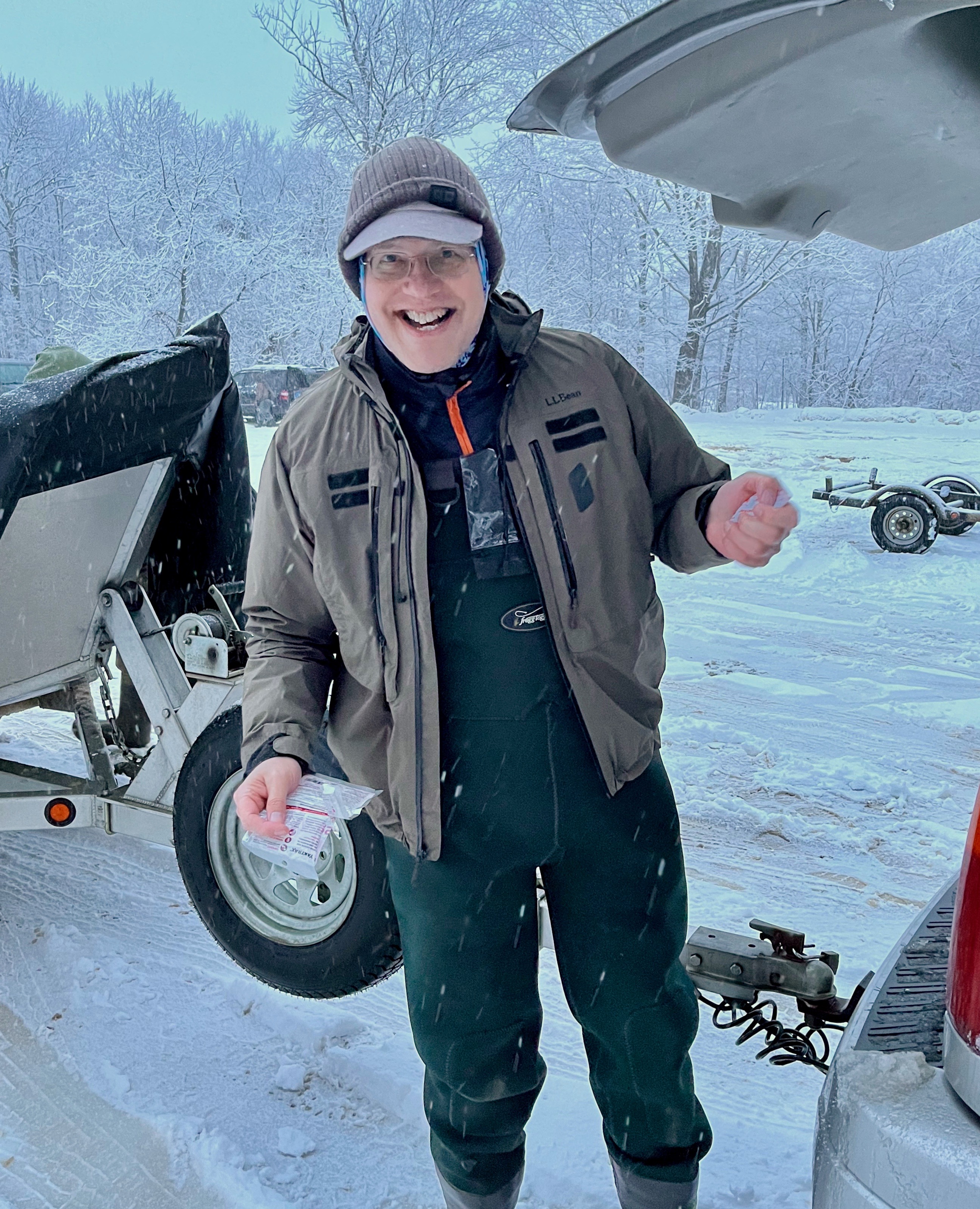
There is a Christian tenet that says, “This is the day that the Lord has made. Let us rejoice in it and be glad.” Whatever religion you follow (or don’t) it’s good advice, especially if you’re a can-do kind of angler. There’s nothing we could do about the weather, so better be prepared for it, and be ready to adapt to conditions. I must confess, however, that I was not this happy by the end of the day. Thus endeth the lesson. (Photo by Gordon Culton)Yes, that’s wet snow blowing sideways across my jacket. After blanking for most of the morning, I stuck this fish in a soft water seam several hundred yards below the Altmar bridge. In fact, I set the hook so hard that I fell over into Gordo’s lap. Poor Gordo! He hooked and dropped a fish in some faster water just above this mark, and that was his only touch of the day. But he stuck it out and never complained. About a half hour after I landed this hen, I also dropped a fish in the same place where Gordo had lost his. Like son, like father?Both of my hookups came on size 12 Blood Dot eggs. If you don’t know that pattern, you should. (Photo by James Kirtland)We were so miserably cold on Tuesday that we called it around 2pm. Given the slow action, it was decided that if there was any open water in the LFZ on Wednesday AM before launch, I’d give it a few drifts. I don’t normally say exactly where I fish, but the mark opposite the boat launch is no secret, and it’s typically loaded with fish. As there was only one angler there, I waded in. Now, I’ve never fished this mark before, and it didn’t take me long to realize that I’d made a classic rookie mistake of wading too far into the river, too close to where I should drift. Once I adjusted my position, I started hooking up along the soft water edge. The problem was, the fish weren’t eating. I fouled four fish here, one in the tail (“Northbound train hooked on the southern end,” cracked Jim) and one on the dorsal. I didn’t see the third, and the fourth left me a souvenir of a scale. I really don’t like fouling fish — others where having the same experience — and I wanted to get Gordo fishing, so we buttoned up and began our float. (A fond note to Tom who was fishing above me, and was courteous and friendly and matey, and a boo-hiss to the churls below me who waded right where I was drifting, then couldn’t be bothered to move when anyone who hooked up above them had a fish roar down to their position. This is the dark side of crowded water, and it remains astonishing how rude some people can be.) (Photo by James Kirtland)Gordo had another rough day. He drifted an egg bag over a run with no love. Then I stepped up to bat and hooked up on my first cast with a Copperhead Stone. I stuck the fish good (I was really happy with my hookset speed, power, and direction on this trip) but it came off. A couple hours later, skippy here put a smile on my face in a fast-moving shallow glide/riffle. And that was it. Two-for-four for me on the trip, which isn’t a bad batting average, but I’d sure liked to have had more opportunities. I shouldn’t complain — Gordo executed dozens and dozens of quality drifts and had nothing to show for it. I’m proud of him for his perseverance.
I just got back form two days of spring — uh, make that winter’s resurgence — steelheading on the world-famous Salmon River in Pulaski. The weather was dreadful and so was the bite. More on that tomorrow. But for now, I’ll give you an image that perfectly sums up our Tuesday. As for the striper report, I went Sunday night for 90 minutes to Ye Olde Top Secret Striper Spot and am excited to report…not…a…touch. So it goes…
This photo needs no caption. Bonus points if you know the mark. Courtesy of Row Jimmy Guide Service.
For the second consecutive year, our #1 slot goes to steelhead. Normally, my August trip out west would have been the runaway winner, but what I experienced over the course of two days in December in Ohio and Pennsylvania was nothing short of extraordinary. Let me tell you about it…
Saturday, December 17: Conneaut Creek, OH. This trip was years in the making. I’d originally booked a trip to Steelhead Alley with guide Bob Packey (you can find Bob at Solitude Steelhead Guide Service LLC) for a fall trip, but we got flooded out. We rescheduled for last spring, but when the date all the fish had returned to the lake. That left us with a long wait for mid-December 2022. But oh, my goodness, what a worthy wait.
My plan was to drive out to Wooster, OH, on Friday the 16th to pick up #2 Son Cam from college. What should have been a nine-hour drive turned into well over ten, thanks to a snow squall in the Poconos. By the time we had dinner and reached our lodging in PA, it was pushing 11pm.
Conneaut Creek reminded me of the Sandy Creeks north of NY’s Salmon River. A medium-sized creek, shale bottom, water with a peculiar greenish-brown tint, and fish that hold in its deeper pockets and runs. Cam, who could hardly be called a fly fisher — his only serious big river foray in the last decade was this summer in CO — was into three steelhead before I even had my rod set up. Such is the teaching acumen of Mr. Packey, who knew the water by rote and had Cam casting and presenting functionally in minutes. I was using Bob’s leader system with one of my yellow yarn indicators, which was a good choice for me since I had great difficulty seeing Cam’s indicator. (I learned and relearned many lessons on this trip, and the first was: always fish the way you are most comfortable/have the most confidence in.) I dropped my first hookup, but before long I was putting my first Erie trib fish in the hoop.
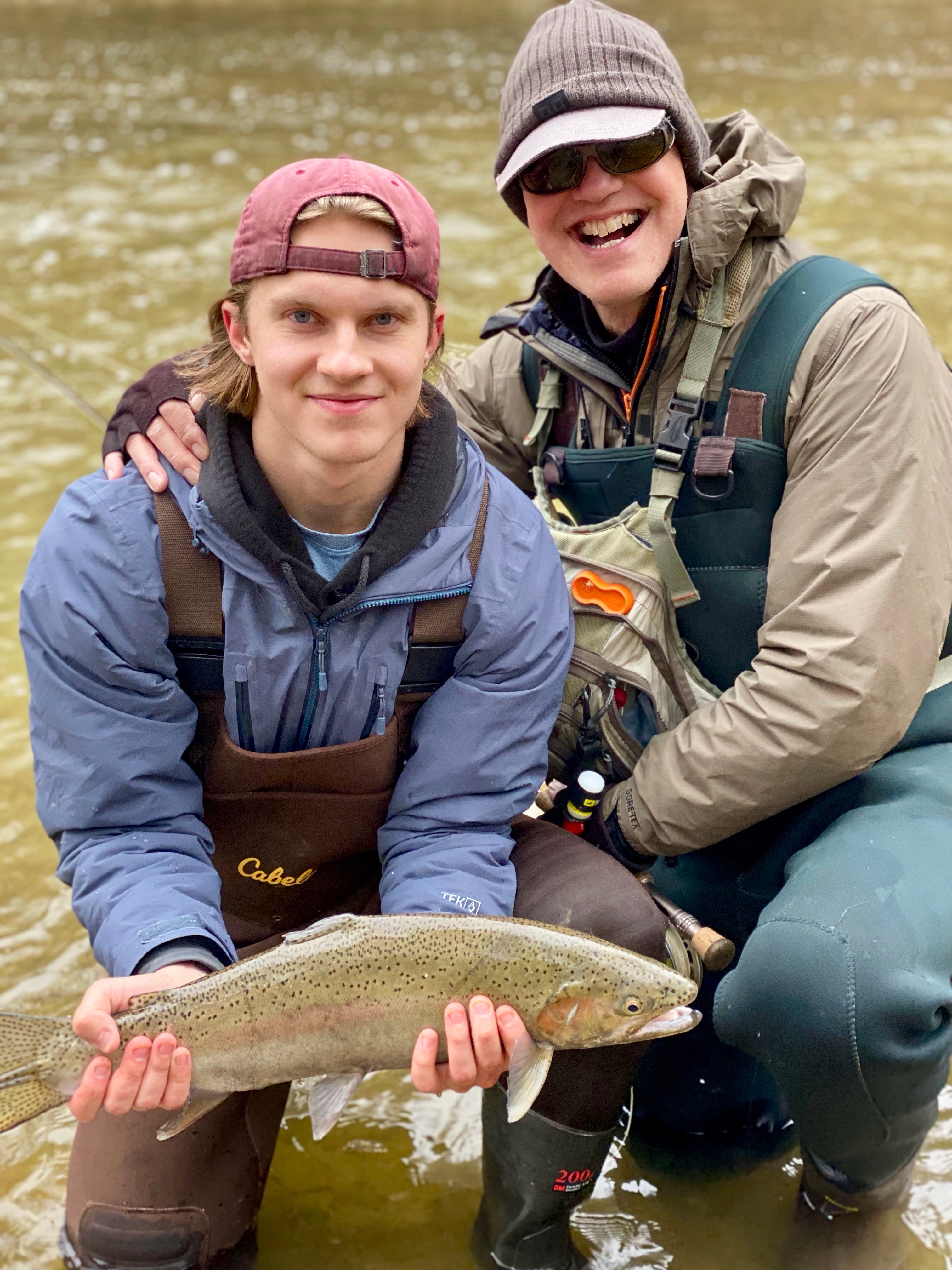
Giving my first Erie Mykiss a kiss. If this had been my only fish of the day — or, let’s get greedy and say the first of five — I would have left the creek a happy man. Little did I know the magnificent bounty that awaited us in the next pool. (Unless otherwise credited, all photos by Bob Packey.)We hiked/waded upstream several hundred yards to the next mark, a deep slot in the tailout of a faster moving pool. I’ve included this photo to show you the incredible shale walls that surround many of the Erie tribs. We were literally fishing from the ledges upon which you see each of my boots — backs to the wall — it’s only a few feet of wiggle room, and if you make a wrong step you’re into deep, 34 degree water. This mark was phenomenal; we had to alternate casts/presentations, and for the first several it was a hookup on every cast. After that, we took turns, the rule being you presented until you hooked up. We’d been using egg patterns — Bob’s favorite is the Blood Dot with an egg body and apricot supreme dot. I switched over to some of my bugs, and hooked up on a 60 Second Redhead and a Copperhead Stone. You can use two flies in both PA and OH, and that was the setup we fished with over both days.The third mark was an intriguing maze of ledges and submerged formations that created several fish-holding slots. I remember Bob suggesting we prospect in a mysterious looking pocket not far from our feet. Gold — or should I say chrome — was struck after a few casts. We fished a bit, ate some lunch, then went back at it. I’m good for at least one act of stupidity per trip, and on today it was a missed hook set that went straight over head and sent my leader cascading into the unreachable upper branches of a tree. While Bob was building a new leader for me, Cam hooked and landed this beauty with me handling net duties. We ended the day far downstream casting to a pod of steelhead that suddenly had lockjaw. My best guess was the cold front that was pushing through; the mercury had dropped, the wind had picked up, and it was a classic case of game over. My final tally for Saturday: 14 steelhead. After countless hours of disappointing fishing in near-freezing water and sub-freezing air in rivers and creeks long ago and far away, I had to ask myself: Was it all a dream? I fell asleep that night certain that it was not.
Now, before I continue, the reader must understand that it took me 40 hours of fishing time to land my first steelhead. It then took me over a decade to land 99 more. This will make what I am about to tell you seem positively magical.
Sunday, December 18, Elk Creek, PA. Bob had warned us that the water in Elk Creek was painfully low and clear. This would would make sight fishing easy; the tradeoff would be that the fish might be uber spooky, and their instinct for self-preservation could overpower any primal urge to strike. The weather had turned decidedly colder; air temperature in the 20s, buffeting wind gusts, lake effect snow squalls. We spent the entire day picking ice out of our guides.
The section of Elk Creek we fished is a hydrological wonderland. There are long sections that are literally only inches deep, and long glassy, glides that race over slippery, table-like pitches of shale. The bottom in other sections is a hodgepodge of skipping stones. Sprinkled throughout are small pockets only one or two feet deep; virtually all of them hold fish. Then there are deeper pools, veritable steelhead hotels with room for a hundred or more. Add in the clarity of the water and it’s an aquarium effect on steroids.
It was in the midst of this steelhead fantasyland that I decided to have one of my worst mornings, technique-wise, of my fly fishing career. Shoddy hook sets, late hook sets, hook sets in the wrong direction — it was embarrassing enough that I made Bob promise not to tell anyone. I wasn’t happy with my casting or my presentations, either. But sometimes you can do everything wrong and still land steelhead. Happily, it was that kind of day. I’m pleased to say that eventually, I got it together, and at one point it almost seemed like the steelhead were being delivered to my feet via conveyor belt. Figuring it all out put me in an even better mood, and I didn’t want to leave this paradise.
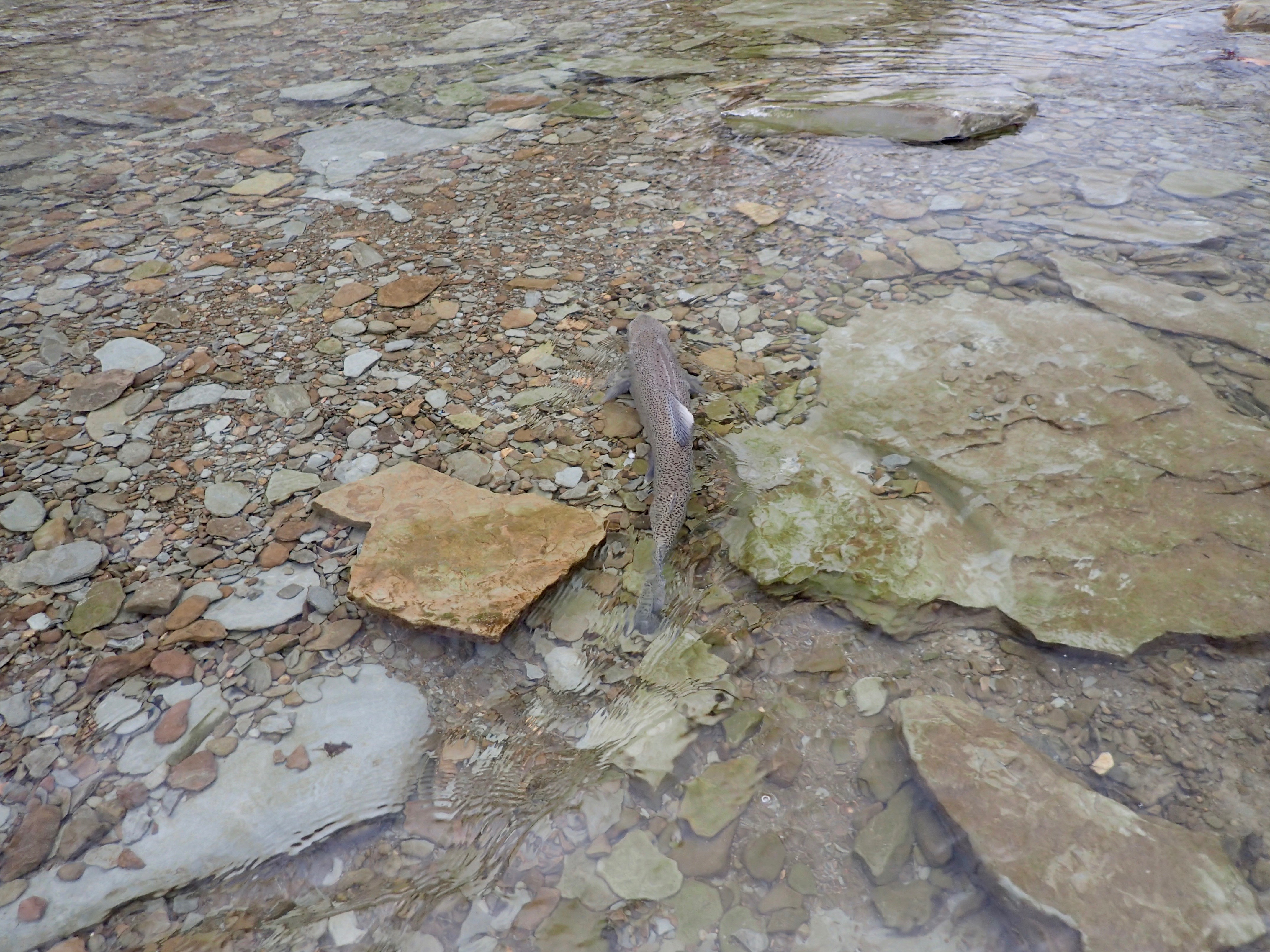
Holy aquarium, Batman! This just-released steelhead is 90% submerged, yet it looks like it’s high and dry on the rocks. The astonishing water clarity and cloud cover made for some exceptional sight fishing. I found this steelhead in a pocket the size of queen mattress. Nonetheless, you had to make a precision cast and presentation to get a hookup. At just over 33 degrees, the water had the fish firmly in winter lethargy mode. Thanks to Bob for letting me take this shot without revealing our location. Photo by Steve Culton.I mentioned a — ahem — less than stellar start. That improved during the morning, and by lunch time I was really dialed in. We were fishing a very slow moving, deep water pool that was loaded with steelhead. At Bob’s suggestion, I’d been using one of his tiny indicators, a mini-corkie in fluorescent yellow and orange. The takes were nearly imperceptible; the indicator didn’t go under. I didn’t even wobble or pause. It just slowed a tiny bit, a subtle enough deviation that you could only perceive it if you were simultaneously watching the tiny foam bubbles alongside it. In water this cold, a few fouls are unavoidable; I was delighted to see that these steelhead were indeed eating, as I hooked fish after fish, fly nestled firmly in the mouth every time.And that’s a wrap. Sunday’s score: Steve 21. Final tally: 35 landed over two days. Cam was also well into double digits. Well done, Bob Packey. Well done.
I fished the Salmon River in upstate NY on November 21-22 and I’m just writing about it today. Sloth? A little. Busy? Yessir. Late? Most definitely. So let’s get to it.
The drive up was a challenge; it was clear sailing from Connecticut until the Rome area, and then it was heavy lake-effect snow the rest of the way. (This was that system than buried Buffalo.) The roads weren’t plowed, and I passed numerous vehicles stranded in ditches. That’ll get you to slow down and pay attention.
Monday the 21st was a challenging day. We launched out of Altmar — I was floating with guide to the stars Row Jimmy — and although we found a pool with fish, the action wasn’t exactly red hot. We moved from one side of the pool to the other, and over the course of five hours we saw a dozen fish hooked, but only one landed. (I was responsible for three of the hookups and no landings.) Our best guess was that the takes were of a more subtle nature, and it didn’t help that I wasn’t on top of my game. None of the fish I touched were on for more than a few seconds; that tells me either a bad hook set or a very light take, or maybe both. Either way, you’ve got to be hard and fast and sure on your hook sets and I was certainly not.
James Kirtland is one of those guides who can tie knots quickly and efficiently and have you back in the water in no time flat. He’s also the kind of guide who will tell you when you’re doing something wrong, and offer suggestions to correct the issue. We all put our waders on one leg at a time, and I’m no different. Jim noticed that because I was using two hands to manage the line during the fly’s trip through the strike zone, I was losing precious micro-seconds on my hook sets. With one hand, excess slack eliminated, and the fly line gripped firmly against the cork, I could drill the hook point home with far greater efficiency. This is just one of the many things I’ve learned from Jim over the years, and it proved to be a difference maker on Tuesday.
We arrived at the Altmar boat launch Tuesday morning only to discover that I’d left my rod on top on my truck in Pineville. By the time we got back — whew, rod recovered! — we were late enough to not be able to get where we wanted to fish. That turned out to be a good thing, as Jim’s fellow guides reported the previous days’ pool was empty. (The river had come down to 500cfs from 750, and we figured the fish realized they had no depth of flow and skedaddled overnight.) So we set up shop in some fast water and spent the entire day in a few slots that took up no more than 50 yards of river. Right away we were into steelhead; I dropped the first, landed the second, and the third came off just as we were readying the net. But I was right on my hook sets, and it felt good even though the batting average was below .500.
Here’s the slick run we hit first. I’m always amazed at how many steelhead can fit into one little slot.We moved downstream and systematically carpet bombed a swift, churning run. After a morning egg bite, the steelhead got into my collection of small stoneflies: 60 Second Redheads, 60 Second Copperheads, and Copperhead Stones. I hooked 4 fish from late morning to early afternoon; this was the only one I landed. One came off right away. The second was a double-digit pound chrome beast that made a beeline for the Lake; I was into my backing so fast that I had no choice but to try and crank the handle. Doink! Broken off. It’s hard to get upset about episodes like that; when you’re in a boat, you can either lift anchor and follow the fish, or stay put and take your chances. You can’t undo the first option, so you accept a possible poor outcome and move on. The third one I dropped surprised me; I nailed him with my hook set, battled him hard and well, and then for no apparent reason, ploink! Sigh. Still, after Monday’s disappointment, two in the hoop felt like a bounty.
I had a brilliant plan to fish the Farmington yesterday, but it turns out I probably picked the wrong day. Wednesday would have likely been better, with warmer temps, total cloud cover, a little higher and more stained water, and no cold front moving through. But I couldn’t fish Wednesday, so there it is.
Water conditions were 540cfs in the PTMA and a very slight stain. I didn’t take a water temp, but I’m guessing about 40 degrees. I hit three marks in two hours, and blanked in all of them. A measly single bump would have been nice, but so goes the winter streamer game; it’s either on or it’s not, and this was an emphatic Not day. The first mark was a popular, large dry fly pool; the second another popular spot, albeit on a much smaller scale; then back to another large, popular dry fly pool for the third. I fished my full sink tip line with a 3-foot leader of 8-pound Seagar Red. I started with a Coffey’s Sparkle Minnow then switched to a Hi-Liter. I know I was fishing deep and slow enough because I brought over a dozen leaves to hand. Yes, I did switch up retrieves, varying from swing to dangle to slow to short, jerky and fast. I covered water, actively moving though each mark. Not happening.
At least I’m warm now.
No shelf ice yet. This is a Sparkle Minnow, which is a good all-around generic flashy streamer.
Lest you think I’m the kind of angler who can just show up on a river and conjure up fish, let me assure you that is not the case. We all put our waders on one leg at a time, and although I managed to do that quite handily, the rest of the outing didn’t go nearly as well.
The conditions were more than swell, in the upper 40s and overcast with the brook at a fine medium height and crystal clear clarity. I had four hours to work with, so I could take my time between covering water and switching up flies and methods. My cigar, a Montecristo 1935 Anniversary torpedo, was a delight. But this is the part of the story where things begin to go south.
My casts were constantly in the trees and bushes. F-bombs were dropped, oaths spat, curses invoked. Some of it was due to a longer than normal dry/dropper leader, but mostly it was a combination of operator error, bad luck, and ill-placed flora by Mother Nature. Hatch activity was minimal, which did not help. And the char that wanted to engage were few and far between. I did dry/dropper, jigged on the bottom, streamers — blanks all around, save for one half-hearted swipe at the surface bug. Worse, I could seem to find any residents longer than 3-4″. This concerned me, as I had no action in any of the deeper plunges, which is where you’d expect the larger brookies to be hanging out this time of year. I finally found one larger fish, but it was more interested in nosing the fly than eating it.
The main source of my disappointment is this: every time I think this brook is primed to make a comeback, it fails to meet expectations. It used to be infested with brook trout. Over the last 15 years it has experienced a dramatic decline in numbers. I saw dozens of char in here in late September. Where did they all go? Did they finally succumb to the drought? Were they in such weakened state that the spawn did them in? Poachers? Environmental factors (two major droughts in three years)?
I’ll keep going back until nature can’t find a way.






 currentseams.com