Thank you, Mianus Chapter TU

A heartfelt shout out to my friends at Mianus TU for hosting me last night. Good crowd, lots of familiar faces, and a very positive energy in the room made the evening a success. I’m really liking how “The Little Things 2.0” is being received, and it’s a fun presentation for me to make.

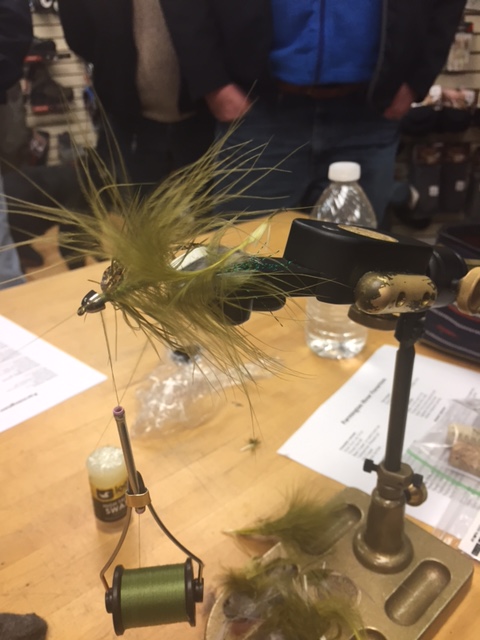
My favorite question was, “When are you going to do some more tying videos?” The answer is yes. Keep on bugging me. Sooner or later I will bow to the pressure.

See you tomorrow night, Thursday, October 13, 6:30pm at the Hammonasset Chapter TU, “The Little Things 1.0”. The original “Little Things” presentation, packed with tips, tricks, and strategies to help you catch more fish. Quinnipiac Watershed Association Building, 540 Oregon Road, Meriden, CT. For more information and directions, visit hctu.org.

Remember, don’t be a meatball. Red light at night.

ElectricSmoke

Four things striper anglers could learn from wet fly anglers.

Wednesday night I fished for stripers in the kind of water that I love: current, structure, and bass feeding on station. The bait was silversides, and the stripers had them cornered. All the predators had to do was wait for the meal to come to them. I did very well; the spinning guy to my right with the plug did poorly (wrong presentation, wrong size lure) and the guy to my left with the intermediate line and the stripped sinking fly did poorly (wrong presentation, fishing in the wrong part of the water column) as well.

After they left, I started thinking about how I approached the situation. I realized that all I had been doing was fishing wet flies. If more striper anglers applied wet fly principles to their fishing, they would surely catch more bass. Here’s where anglers using wet fly tactics have an unfair advantage:

Wet fly anglers know that they can master the current with a floating line. The simple act of mending slows the swing of the fly to a speed that is far more agreeable to fish — especially those unwilling to chase. By casting to the outer edges of the bait ball, and mending, I was able to make my flies swim along its periphery, moving at the same pace as the naturals.

Wet fly anglers know the value of sparse, impressionistic, unweighted patterns. The Partridge and Orange. The Starling and Herl. The Pale Watery Wingless. None of them look exactly like what they’re supposed to imitate. None of them are bulky. But they can be fished anywhere in the water column, particularly just below the surface where the fish are feeding. The flies I was fishing looked and did likewise.

Wet fly anglers know that droppers are the fastest way to find out what the fish want. I was fishing a team of three. Top dropper was an Orange Ruthless. Middle dropper was The Tick (small isopod/crab larva/shrimp). Point was a September Night or a Morning Glory. The bass eagerly took the top dropper and point flies. And I was covered in case they switched to something small.

Wet fly anglers know that sometimes the best retrieve is no retrieve. I’m lazy. So are predators. I didn’t catch any fish on the stripped fly. It was all on the swing, mended swing, or dangle. Explosive hits generated by fish feeding in confidence. Why would a fish chase bait when it is being delivered to them by the current?

Where’s the beef? Nowhere on this sparse, impressionistic single-feather flatwing, the Morning Glory. (You can find the recipe by doing an internet search for “Morning Glory striper fly”.)

OLYMPUS DIGITAL CAMERA


“Block Island Stripers from the Shore” in the Oct/Nov/Dec 2016 issue of Mid Atlantic Fly Fishing Guide

It’s the Destination Issue of MAFFG, and we’re all heading to Block Island! A nifty little primer on the island, its structure, flies, gear, and more. While this past year was (ahem) a bit of an off-year for stripers on the fly from the shore, the Block remains one of my favorite places to fish — and write about.

While I truly love answering your questions, let me head you off at the pass: no, I don’t know where you can find a copy of MAFFG. You can try contacting them through their Facebook page. And of course, let them know you enjoy my writing.

Hot off the presses.

OLYMPUS DIGITAL CAMERA


The fall 2016 appearance schedule is shaping up

Greetings, fellow fly enthusiasts and pursuers of all things piscatorial. I hope you all had as good a Labor Day family picnic as I did. Incredible food, some stellar wines, a My Father Le Bijou Box-Pressed Torpedo — not to mention some ruthless hands of setback (you don’t want to mess with Aunt Jennie). We’ve been right busy in the currentseams calendar hub. Thanks to all the clubs and shows who have reached out, and if you haven’t yet, but intend to, please do because the slate is filling up. Here’s what’s going on so far:

Wednesday, September 28: Narragansett Chapter TU 225, “The Little Things 2.0.” Coventry-West Greenwich Elks Lodge, 42 Nooseneck Hill Road, West Greenwich, RI. For more information and directions, visit narragansett.tu.org.

Tuesday, October 11: Mianus Chapter TU, “The Little Things 2.0” Waveny House, New Canaan, CT. For more information and directions, visit mianustu.org.

Thursday, October 13: Hammonasset Chapter TU, “The Little Things 2.0” (pretty sure we settled on this — if not, it will probably be LT 1.0). Quinnipiac Watershed Association Building, 540 Oregon Road, Meriden, CT. For more information and directions, visit hctu.org.

Saturday, November 5: Catskill Fly Fishing Center & Museum 10th Annual Art of the Angler Show, “Wet Flies 101.” I’ll be speaking at 1pm, and tying before and possibly after. Since wet flies is the subject, that’s probably what will be on the vise, though as always I am happy to take requests. The show is two days, but I’m swinging Saturday only. For more information, visit cffcm.com/programs-events/art-of-the-angler-show/.

Looking forward to 2017, I have one local gig scheduled, and I plan on presenting again at The Fly Fishing Show in Marlborough, MA, January 20-22. Subjects, dates and times are still TBD, and I’ll let you know as soon as I do.

Thank you all for your kind words, your enthusiasm, your questions, and for reading currentseams.

All this talking is going to make me thirsty.

EinBeer

Fly fishing club guest speaker coordinators, have I got a presentation for you!

Please forgive the shameless immodesty — it’s all meant in good fun. I really am excited about this one, though. It’s a follow-up to The Little Things — hence the highly imaginative title, The Little Things 2.0. You can read more about it here.

LittleThings2.0

Friends, Romans, Fishermen (and women) or: Upcoming stuff you might be interested in

For some reason I’ve had Julius Caesar running around in my head for the last few days, hence the bastardized title reference. I really just wanted to update you on a few things. So, with apologies to the Bard, lend me your ears. (Or eyes, as it were.)

I’m working away in my lonely writer’s garret on a new presentation, The Little Things 2.0. I’m really liking how this one is unfolding. Lots of good stuff, and it will be ready in September for the fall presentation circuit.

I’m very likely going to be tying and making a presentation at the 2016 Art of The Angler Show. Details to come.

Still trying to finalize some appearances at the 2017 Fly Fishing Show in Marlborough, MA. Ditto details.

Gadzooks! The writing pipeline appears to have gone dry. (That’s not entirely true — I should have a conservation piece in American Angler any issue now.) Not to worry. I have several pitches already accepted by editors, and just need to take fingers and brain to keyboard. Subjects will include floating lines in the salt, streamer fishing basics, and perhaps a few essay-type story pieces.

Finally, I see a lot of new names on the followers list. Why not stop in and say hi? In fact, I’d like to hear from everyone. Tell us about your fishing this summer, flies you’ve been tying, questions you may have — it’s all good.

And as always, thanks for reading and following currentseams.

Please stay out of the writing room when the red lamp in on.

IMG_1791


Stuff I Use: the Eagle Claw 253 Hook

The Eagle Claw 253 hook is the traditional choice for tying the flatwings, bucktails, and soft hackles made popular by Ken Abrames. It is a 1x short, O’Shaughnessy style spinnerbait hook with a non-offset point.

Ken didn’t choose that hook by accident. In Striper Moon, he writes of the 254 1x short, a similar hook, “The wire is light and does not cause the hook to sink unnaturally…the shank of this hook is one size short…this does two things: first, it makes the hook lighter and second it makes the point longer in relationship to hook size. I believe this gives me a mechanical advantage when fighting  a fish.” Those same attributes apply to the 253, which is the dominant hook in his book of fly patterns, A Perfect Fish.

“To fashion a fly from tradition is an honorable practice.” — KA. I did my best to honor that practice with the Rock Island, tied here on the Eagle Claw 253, size 3/0.

Rock Island Flatwings

The Eagle Claw brand holds a special place in my heart. It was the snelled hook we used when my father taught me how to fish for trout in the early 1970s. For years now, I’ve been tying most of my striper flies on the Eagle Claw 253. I usually buy them in lots of 100, readily available at any number of online retailers. Most of those 100 are sticky sharp right out of the box; those that aren’t are easily sharpened with a few strokes of a mill file. Eagle Claw makes a version of the 253 called “Lazer Sharp.” Ironically, I’ve found many of the Lazer Sharp hooks to be pencil-eraser dull, and difficult to sharpen. Stick with the regular 253 hook.

The biggest striper (probably between 30-35 pounds) I ever caught on the fly from shore took this Razzle Dazzle flatwing, below, tied on an Eagle Claw 253. At the time of the catch, the fly was at least 3 years old, and seen multiple seasons of use. I had sharpened the hook the night of the outing, as I had done many times before with Eagle Claw 253s, making sure it had enough sticking power to hold a junior cow.

IMGP2600

Most of the Eagle Claw 253s I use are size 1/0 and 3/0, although I will tie some of my larger flatwings on 4/0s. A word of caution: on larger stripers, I’ve had the 1/0s begin to open (I tend to put a lot of pressure on a fish when fighting it) although I have never lost a striper to an opened hook. If I suspect there are bigger fish around, I’ll go with a 3/0 and up. I have never had an issue with those sizes.

My favorite hooks for flatwings, bucktails, and soft hackles, fresh from a 100 count bag, ready for the vise.

OLYMPUS DIGITAL CAMERA


Ray’s Fly Featherwing: A simple, sparse flatwing

Many years ago, I was having trouble with some bass that were feeding on silversides in a Rhode Island breechway. The fish were active, but I couldn’t get them to bite. Ken Abrames recommended that I try the Ray’s Fly Featherwing, a dressed-down flatwing version of Ray’s Fly. I remember him telling me that it was, at the least, another arrow  in the fly box quiver.

That was a long time ago. I remember tying some up, but I don’t know what became of them. I know I caught stripers on them. I think I lost my last one to a bluefish.

Recently, someone on one of the forums asked about a “Ray’s Fly flatwing.” I think the Ray’s Fly Featherwing is the fly he was referencing. I haven’t tied in a couple of weeks, so I went down to the bench this morning and churned out a few. So simple. And sparse. I’d be as inclined to use these for a sand eel as I would a silverside.

All saddles are tied in flat — flatwing style, as they say. Note that the olive saddle is tied in at the head. All you need to do now is add water.

Ray’s Fly Featherwing flatwing

OLYMPUS DIGITAL CAMERA

Hook: Eagle Claw 253 1/0
Thread: White
Tail: 30 strands white bucktail under white saddle under 4 strands pearl flash under yellow saddle
Body: Pearl or silver braid
Wing: Olive saddle
Topping: Peacock herl

Housy Smallmouth Report: Gluttons for punishment

It would be safe to say that smallmouth on the fly is a current addiction. Back for more last night, a shorter session at three hours (6pm-9pm), and quite different from Monday’s.

For starters, the water was up a wee bit (180 cfs and rising) and perhaps had a bit more color. While not Africa hot, the air was rain forest humid. I got soaked just walking from the truck to the river. And the overall action was off, in terms of general size and numbers. But yessiree Bob, it was still good.

How to tell it’s summertime by the river. We get these along the Farmington, too.

OLYMPUS DIGITAL CAMERA

~

The surface action window was brief, about a half hour, and I didn’t even bother trying to fish with classic dry flies. I saw a few caddis and a handful of white flies (and the ever-present midges) — clearly the smallies were keyed on emerging bugs. I sat on a rock, enjoying my cigar, and as it got dark I went to work on some risers with a size 6 olive Zoo Cougar. That was fun, but for me the main event would be testing a prototype surface bug I’ve been working on, a floating/neutrally buoyant version of the Deep Threat, size 4. (More once I get it ironed out.) On it went, and….nothing. And more nothing. Finally, a respectable bass. Then another, a little bigger. I saw a splashy rise down the pool and parked the fly over it on my next cast.

KA-BLAM!!! It was one of those takes where you knew you had a good fish on from the moment the transaction went down. As soon as I came tight to the bass he went airborne. I cackled out loud, which you can do with impunity when you’re alone on a river. Thrust and parry, thrust and parry, my forearm burning with fatigue. (This is surely why God created 0x leaders.) And there he was. A smallmouth you could measure in pounds instead of inches. (Yeah, I know, low pounds, but please let me have my moment of glory unmolested.)

I’ve now landed a mid-teens Housy smallmouth and a mid-teens Farmington wild brown, and I gotta tell you, with all due respect to Salmo trutta, that it’s not even a contest when it comes to battle skills. 

OLYMPUS DIGITAL CAMERA

~

So, the new fly works.

It’s probably not a wise decision to do an impromptu victory dance while you’re wading out of a river in the dark. But I couldn’t resist.


The best streamers for smallmouth bass are…

If you do a search for “best” or “top ten” streamers for smallmouth bass, you are presented with an eclectic mix of patterns, typically opaque, with big googly eyes and using all kinds of new-agey materials — often accompanied by seductive promises of fish-catchess prowess. And oh, by the way, you can’t have the recipe, but here’s where you may purchase the wonder fly.

Ahem.

I can’t claim to be an expert on the lesser pie-holed cousins of the bucketmouth, but when I sat down at the vice this weekend to tie some smallmouth streamers I kept things pretty basic. I have a strong suspicion this selection will be met with approval by the target audience — the key word being selection. Some will ride topwater. Some will swim just below the surface. Some will plumb the depths and jig on the retrieve. They feature colors that range from earth-tones to fluorescents. You know the drill: give the fish a choice.

Now, I just gotta get them wet.

Clockwise from bottom left: Gartside Gurgler variants (size 2), three sets of Woolly Bugger variants (sizes 4-6), Deep Threat variants (sizes 4-6), and in the center, some neutral buoyancy thingy I tied on a whim.

OLYMPUS DIGITAL CAMERA