A wee video sampler of flat wing streamers for striped bass, also part of my new presentation, “Trout Fishing for Striped Bass.”
Tag Archives: fly tying
Some striped bass soft hackles for your viewing pleasure
This is a short video sampler of soft-hackled flies for striped bass. It’s going to be part of my new presentation, “Trout Fishing for Striped Bass.”
Rare find for flatwing fans: R.L.S. Extra Long Saddle Hackles available
A selection of Ken Abrames R.L.S. Extra Long Saddle Hackles was recently put up for sale online. These are the genuine item — “New Old Stock” as we’d call them in the vacuum tube world — as originally sold by the creator of the modern flatwing. The saddles are in their original packaging and are in excellent condition. Many are unused; some are missing only a few feathers, leaving you hundreds of hackles to work with.
I want to make this very clear: I am not selling these, nor do I have an interest other than helping the seller offer these to people who may be passionate about tying and fishing flatwings.
The saddles are priced from $45-$50 depending on color, which I believe is a very fair price (shipping cost varies). Available colors include — this is current to my best knowledge but of course will change as he sells these off — Claret, Off White, Off White Variant, Natural Black, Umber Brown, Ginger Olive, Olive (seller’s comment: “The same name on pkg but looks more like Emerald Green to me.”) and Eggplant Harlequin.
If you’re interested, please email georgejjohnson@gmail.com.
This was the original lot. Many of the colors shown are gone; jump on the remaining ones while you can.

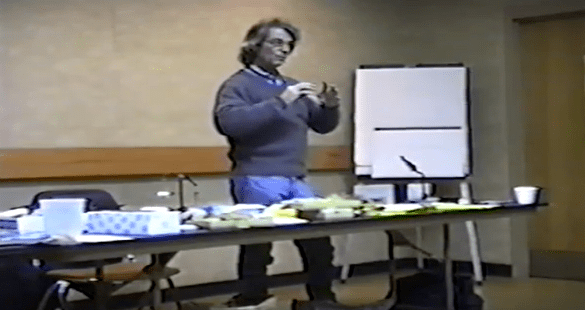
Ken Abrames 1994 Striper Fly Tying Presentation Video
I discovered this gem just yesterday: archival footage of Ken Abrames making a presentation on striped bass fly tying to the Rhody Fly Rodders, circa 1994. Now you too can watch, listen, and learn from the grandmaster as he covers striped bass fly design, materials, color, and traditional tying methods. While I’ve had detailed conversations with Ken on all these topics, it’s still a special treat to be able to see him in action over 20 years ago.
Recorded long before the days of home HD, the video is perfectly watchable — certainly, its content far outweighs any video washout or digital artifacts. You can find it on YouTube in three parts; here’s the link to part one.
What happens when you mix water and bucktail (and other secrets of the art of tying the sparse fly) revealed.
Coming soon to a stream near you
Tied for a client, this neat little collection will drive smallmouth bass (and trout) out of their minds. We have the subtle (size 12 August White soft hackles), the traditional (size 12 Black Magics, tied as a 14-16), the horrible (size 4 TeQueelys), and the noisy (Gartside Gurglers, size 2 and 4).

Smallmouth bass streamers: TeQueely and Home Invader
I spent some time at the bench last week on two dramatically different smallmouth patterns, the TeQueely and the Home Invader. Neither of them are the kind of streamer that I’d typically fish. The TeQueely is, in a word, horrible. What a mashup of flash and garbage! But smallies love it, so I’m more than willing to suspend my principles in the interest of cartwheeling bronze. You’ll find it on several “best streamers for smallmouth bass” lists.
At first glance, Doug McKnight’s Home Invader is far too opaque for my tastes. And I’m no big fan of dumbbell eyes. Again, allow me to move past those objections and point out what there is to love about the Home Invader, namely marabou, fox fur, and hackle tips. And this fly knows exactly what it wants to be: a big meal for a hungry or uber-aggressive fish. You can read more about the Home Invader and find tying instructions here. Tying instructions for the TeQueely are listed below.
So ugly, they’re beautiful. The TeQueelys are tied on a size 4, the Home Invaders on a size 2 TMC 1710 (1x strong, 2x long). The Home Invader second from bottom is an all marabou variant. All flies pictured are at least 4″ long.
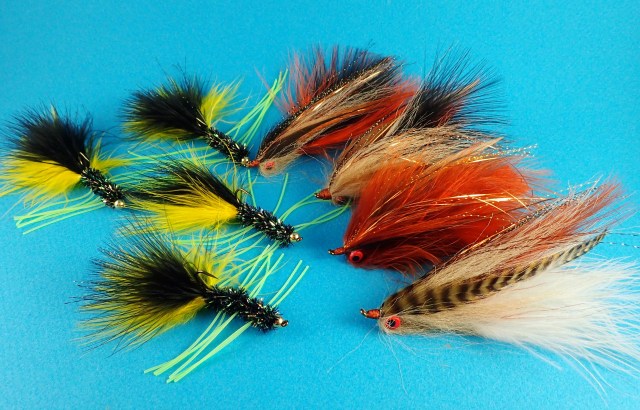
TeQueely tying instructions:
Hook: TMC 2220 size 2-6
Thread: Black 6/0
Bead: Gold
Tail: Black marabou under black Krystal flash under yellow marabou
Legs: Chartreuse rubber or silicone
Body: Medium black cactus chenille
Long Island Flyrodders awarded the Legion of Cookout Merit
Many thanks to the members of the Long Island Flyrodders for their generous, welcoming spirit. What an impressive crowd — I believe it was nearly 60 — on a fine summer’s evening. The Long Island Flyrodders know that a fed presenter is a happy presenter, and I must say that my cheeseburger, dog, beans, and — bonus! — bag of Cheetos really hit the spot. (The beer was tasty, too.) Thanks again for hosting me, and I look forward to a return engagement.
These folks know how to hold a meeting. Good spread, good people, good energy — the bar has been set to a new height.

Contest swag is on its way!
All good things to those who wait (and my apologies for the delay). The 500 followers contest winners are getting their flies shipped today. Coming to a mailbox soon near you:
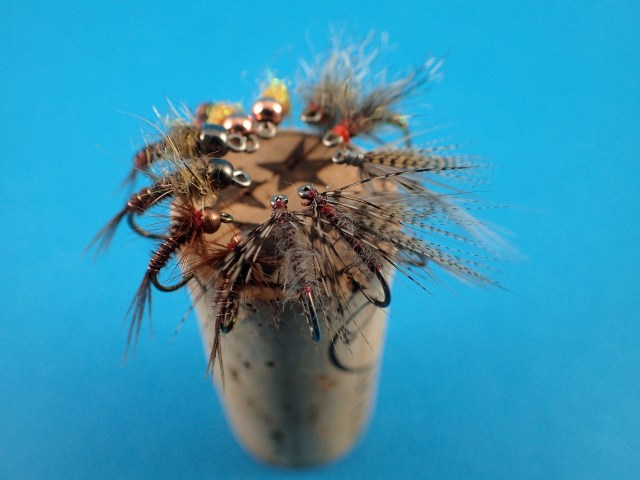
Drew gets this section of early season bugs. Clockwise from 7 o’clock: SHBHPT, Hare and Copper variant, Frenchie variant, Squirrel and Ginger, Dark Hendrickson winged wet, Hendrickson spider.
~
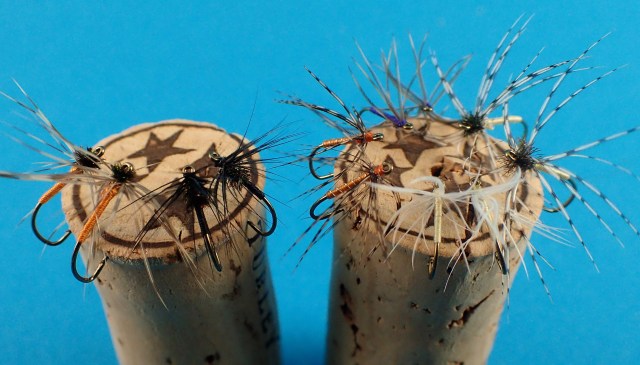
Pete wins the classic North Country spiders, tied on light wire hooks with Pearsall’s Gossamer silks. Left cork: Winter Brown, Black Magic. Right cork, clockwise from 3 o’clock: Orange Partridge, Snipe and Purple, Grey Partridge, Poult Bloa.
~
Greg gets this selection wet flies for the Farmington and Housasontic. Clockwise from noon: Pale Watery wingless (Magic Fly), Drowned Ant, Squirrel and Ginger, BWO spider, SHBHPT, Partridge and Light Cahill.

Tight lines, gentlemen. And thanks to everyone for reading and following currentseams. Another 60 or so followers and we’ll do it again!
“The Little Things” tomorrow night at the HFFA and IFFF screening in Branford
Come one, come all. This is my last gig before the summer hiatus kicks in:
“The Little Things,” Thursday, May 4, Housatonic Fly Fishermen’s Association, Wallingford, CT. St. Paul’s Episcopal Church, 65 North Main St, 7pm. For more information, visit the HFFA Facebook page.
There’s also the IFFF screening at the Stony Creek Brewery in Branford, 6pm.
Me or beers & movies. Tough call.
How I’d rate the 2017 striper season so far
~
What else is going on?
— I’ve been working on (and testing) a new large flatwing design/color scheme. I’ll publish it this spring.
— Just got back from a steelhead trip with youngest son Gordon. Report (meh, but fun) coming soon.
— Contest winners! Some of your flies have been tied, others are still bare hooks. I’ll try to get those out by the end of the month.
— Just finished a feature on summer smallmouth for Field & Stream. You can read it in a few months. Lots of other stuff in the publishing pipeline!
— Finally, while I don’t mind (and even appreciate) last minute guide requests, the best thing to do if you want to fish with me is book well in advance. (The people I’m taking out this week booked me moons ago.) Basically, my weekends are filled from now through June, so weekdays are best.
As always, thanks for reading currentseams.
 currentseams.com