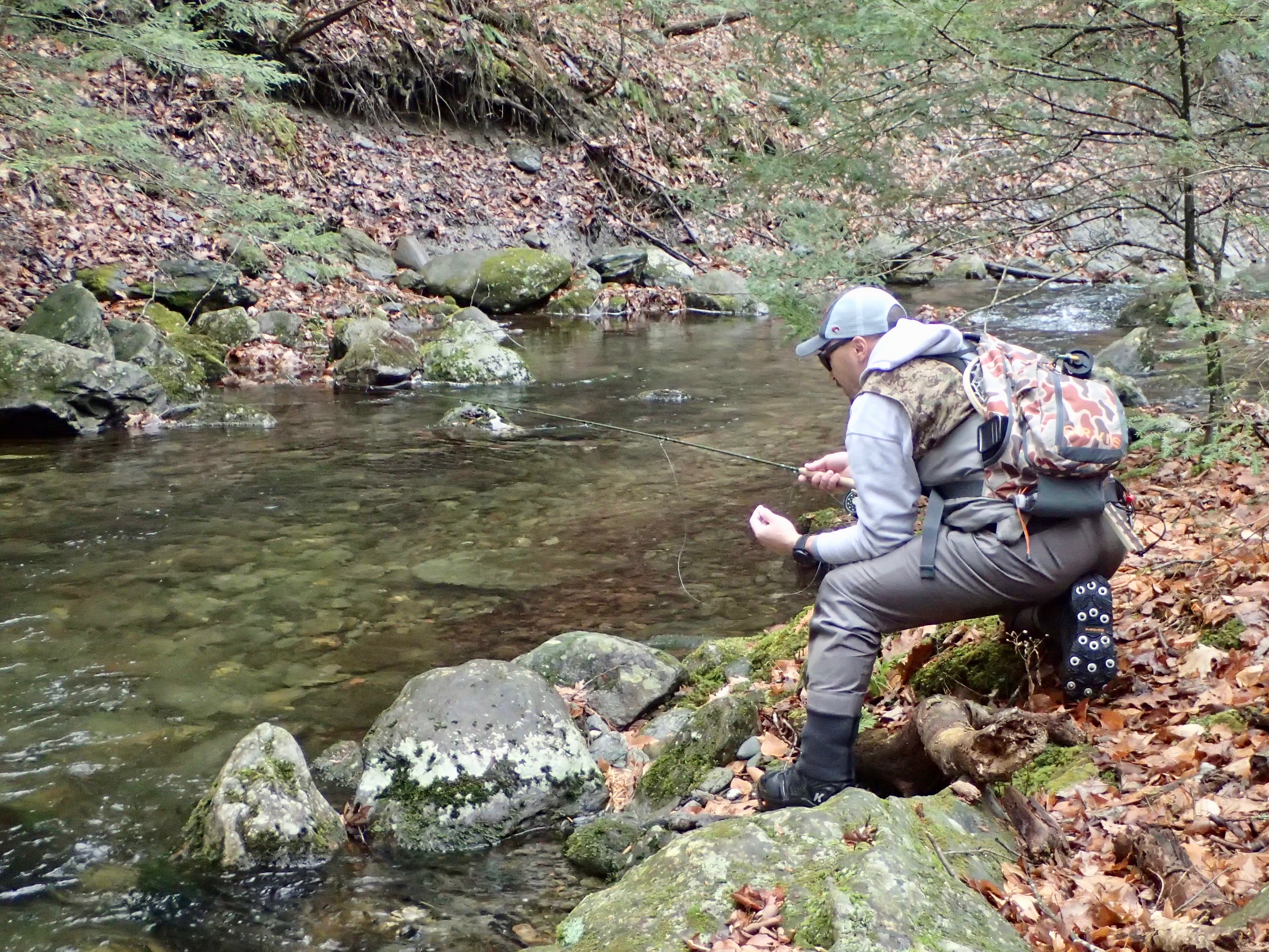
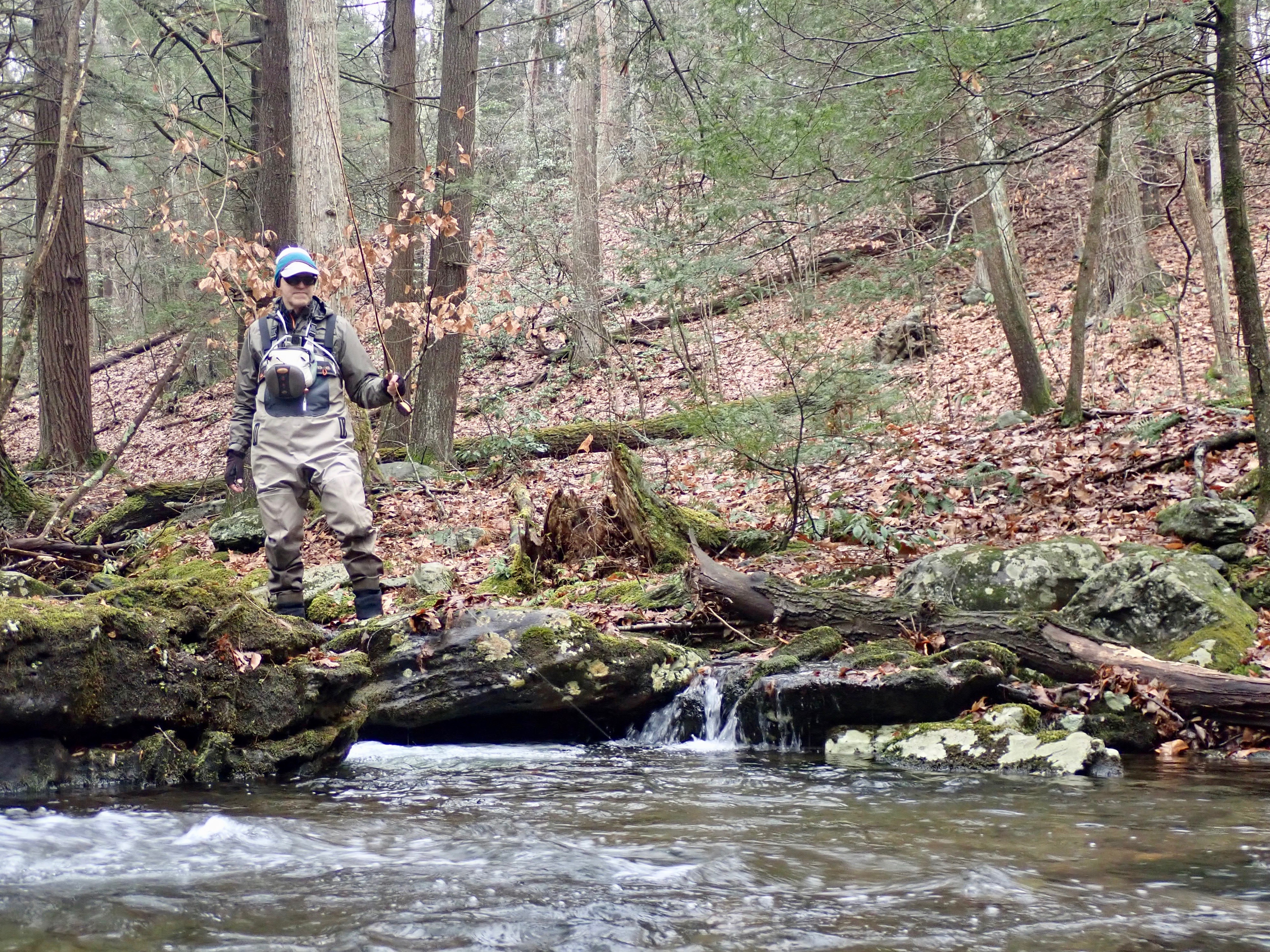
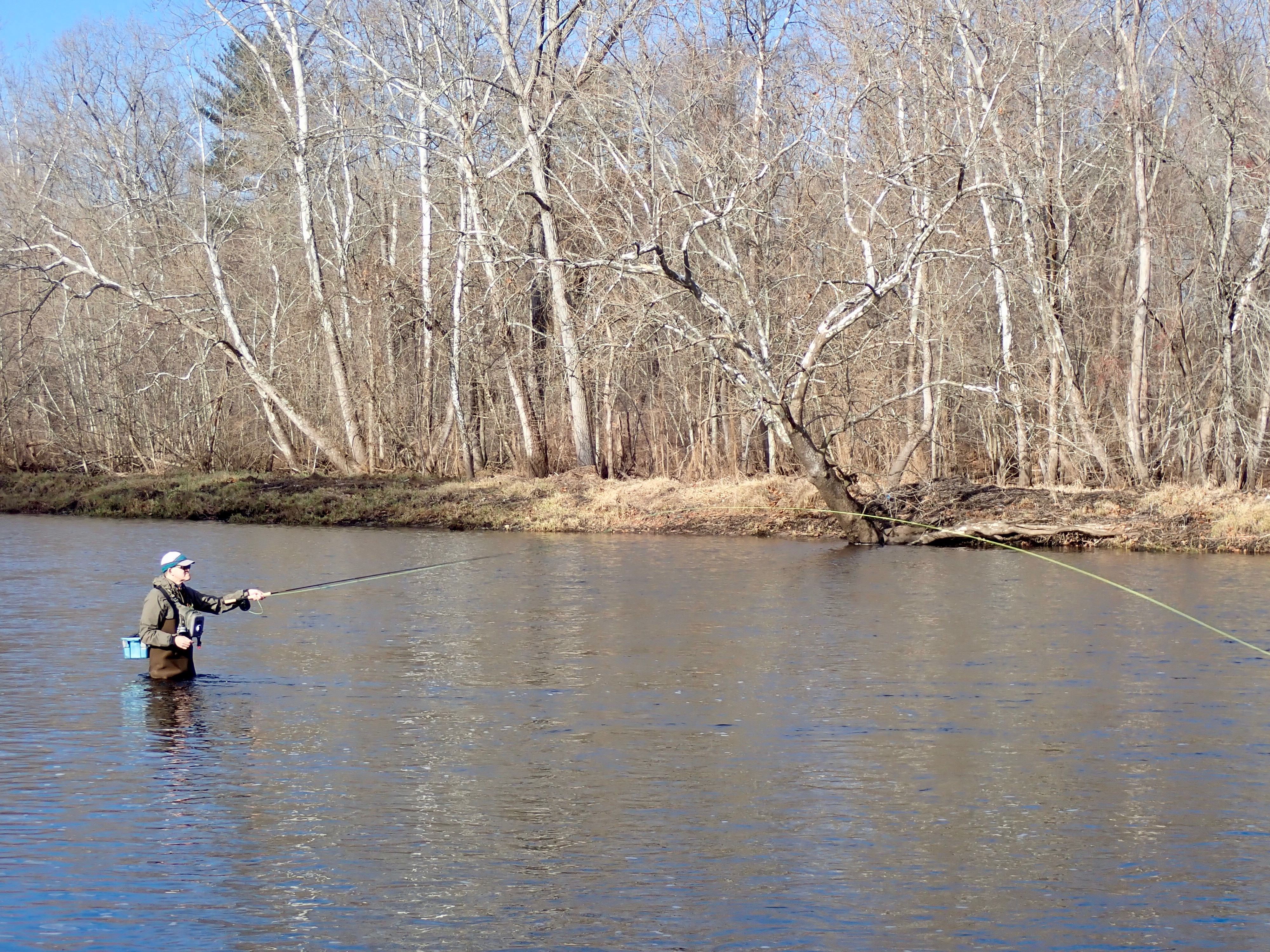
I guided Gerry and Sam today, and while Gerry did most of the fishing, a splendid time was had by all. The subject of today’s lesson was wet flies. We spent about 45 minutes on a bench for some streamside classroom, then Gerry and I went to work. Our first mark was in the upper end of the Permanent TMA. Flow was a reasonable 360cfs, but the water is still very cold, and we had rain showers that seemed to bring what little feeding activity there was to a screeching halt. (This was to be today’s pattern: active fish, then stop. Wait a bit. Then more feeding, or no feeding at all. Wait for it.) We managed one hookup, then decided to seek our pleasure elsewhere.
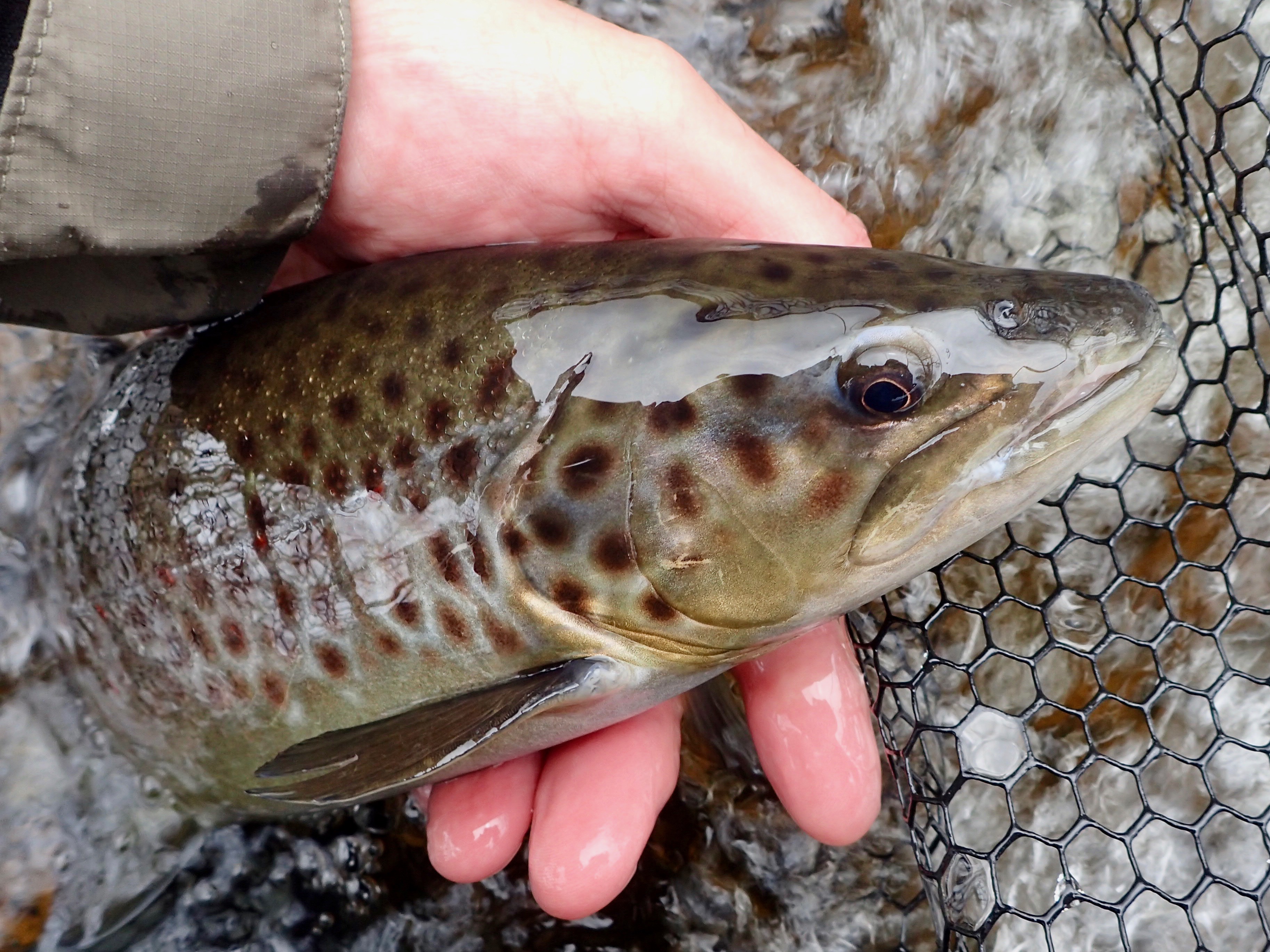
Mark #2 was in the lower end of the TMA. By now, the rain had stopped. There were no Hendricksons that we saw, and a few size 16 BWOs here and there. Nothing much was going on in terms of visible feeders — and then, as so often happens, suddenly it was on. A rise here. A boil there. Gerry was fishing a team of a size 12 Squirrel and Ginger, a size 12 Dark Hendrickson winged wet, and a size 14 Old Blue Dun. Fish on! Then another. And another. The fish, a mix of rainbows and browns, ate all three flies. A half dozen trout in an hour doesn’t suck, and we gleefully took our bounty and ran.
Another satisfied customer. Gerry is now officially on the path to becoming a dangerous wet fly machine. Even though the fishing was off today, he kept at it, trusted the method, and was repeatedly rewarded with bend rod syndrome. Way to go, Gerry!
I fished the lower end of the Permanent TMA yesterday afternoon and we had much better flows (under 400cfs) for swinging wet flies. So much, in fact, that after a while I replaced my tungsten bead head soft hackles with non-weighted bugs, the better to target all the slashing risers. Atmospheric conditions were as they have been: chilly, windy, and uncomfortable.
I arrived late, about 1:30pm, and as I approached the mark, I recognized the faces of the two anglers who had beaten me to it. It was Bob and Andy. I’d seen them here last year, introduced myself, and we shared the water. These guys are very giving, and a pleasure to fish next to. I’d like to thank them again for being so matey and kind.
Right away, I was into fish. I’d made the comment earlier to Torrey Collins at UpCountry that if you hit this hatch right, fishing with wets is almost unfair. I took them on the swing. I took them on the Leisenring Lift. I took them dead drifted deep on a short line. Active feeders almost always hit on the first cast. I even managed my first double of the year.
Then, the bugs came. Lots and lots of Hendricksons. I’d give this hatch an 8 out of 10. The point where the trout would no longer take the wet came at 2:45pm. Once I figured out what they wanted — it wasn’t, to my surprise, The Usual, with which I usually do boffo box office — I managed a bunch on the surface. (The winning fly was a Comparadun.) Dry fly was very much a challenge in the fierce gusts. But it’s supposed to moderate, so tight lines to those brave souls venturing out this weekend. I expect the hatch to continue to ramp up and move upriver. Enjoy!
‘Nuff said.
To this week’s mystery bug. I appreciate everyone’s input and guesses. My first thought when I observed them was some kind of early BWO. They were clearly too small for Hendricksons. After I captured a couple specimens, I was able to see that they all had only two tails. I ended up going to two people who have a far deeper technical knowledge of these things than I, and they both independently identified the creature as a Baetis. That’s good enough for me! (In case you’re wondering, my panel of experts consisted of Torrey Collins and Derrick Kirkpatrick. Those guys have forgotten more about Farmington River hatches than I currently know.)
Another unseasonably cold, windy afternoon on the river. I decided to check out the lower section below Collinsville, mostly out of Hendrickson curiosity. The water was higher than I’d like for wet fly (755cfs is still chugging; sub-500 would be best) but you don’t know if you don’t go. I began in a faster, snottier boulder-studded section; not surprisingly, it was a wet fly blank. I didn’t nymph it, which might have produced a different result.
Bug activity was, at first, minimal. Ubiquitous midges, then a mystery mayfly (see below), and then a few precious H-words. The mystery mayfly far outnumbered the Hendricksons, probably 10:1 or so. When the sun peeked out, the hatch ramped up. And when the clouds took over, the hatch stopped in its tracks. I managed a good half dozen trout on wets — this was in slower moving water — catching them blind and also by targeting active feeders. While few and far between, the active feeders all pounced on a well-placed wet fly. I fished the same team as Monday, a Squirrel and Ginger on top, followed by two tungsten beadhead Hendrickson soft hackles. I had an accident trying to land a trout by hand, and lost the middle dropper; when I re-tied, I exchanged the point fly for a tungsten SHBHPT.
I wasn’t satisfied with the surface activity, so I did a bit of nymphing. Normally I would use a traditional drop shot nymph rig, but this time I kept the three fly team and added a drop shot section to the point fly and one of my home-brew year indicators to the tapered butt. It worked just fine, and some of the takes were highly aggressive, almost bordering on frantic. After 2 1/2 hours, I’d had enough. I tried for one more trout on a swung wet, and, once successful, headed for the warmth of the car.
The mystery bug, about a size 14-16. Some kind of olive? Quill-something? Whatever it is, it far outnumbered Hendricksons. I don’t stress when I can’t ID a bug; if you try to match the general size, color, and profile with a wet fly or nymph, you’ll tend to do well. This is why it’s a smart idea to carry soft hackled Pheasant Tails in various sizes, beaded and unbeaded. That pattern looks like a lot of things in general, and almost always like something that’s alive and good to eat.
Hoping for Hendricksons, I was on the water before noon. I chose a mark near the bottom of the Permanent TMA. Although ’tis the season, the weather has been most unseasonable; the flows higher (627cfs) and colder than I prefer; and the Hendrickson hatch non-existent. Still, there were mucho midges — signs of life — and there were trout.
I’d decided on a three-fly team of a Squirrel & Ginger on top dropper, with black tungsten beadhead Hendrickson soft-hackles in the middle and on point. The plan was to cast slightly upstream or across, and mend like crazy to help sink the rig before coming tight on the dangle. That worked well enough, although a proper hatch and active feeders (I saw only two rises during the session) would have made the catching easier. The highlight of the outing for me were the two trout I fooled using the Leisenring Lift. I don’t often use that presentation, but there are times when it is lethal. It’s an arrow any serious wet fly angler should have in their quiver.
On a whim, I drove a good ways downstream, below Collinsville, to see if there were any H-Bombs flying around. Negative. I took a couple what-the-heck-I’m-here casts, but at over 1,000cfs it’s a most decidedly wet fly-unfriendly flow. It’s supposed to remain cold this week, so we’ll see how the hatch unfolds.
A hefty 16″ buck that crushed the fly, a beadhead Hendrickson soft hackle, on the Leisenring Lift. He provided fantastic sport in the over 600cfs flows.
The Salmon River in Colchester holds a special place in my heart. It’s where my dad taught me to fish for trout. It’s the first place I ever fly fished. And, it’s just about the prettiest little big river around. I used to fish it all the time; the general plan was to hit the Salmon early season, then switch to the Farmington by late spring. Gradually, the pull of the Farmington and its bigger, wild trout took over, to the point where before yesterday, I couldn’t remember the last time I fished the Salmon for trout.
The day I chose to make my triumphant return was chilly, breezy, with a mix of sun and clouds. The water was crystal clear, and running about 300cfs, which I consider to be the perfect height for that river. There was a decent caddis hatch, about a size 14-16, and some 14-16 BWOs. And, to my delight, there were piles of fish to be caught. I fished from 12:15pm-3:30pm, all within the Fly Fishing Only section. While catching trout after freshly stocked trout holds a limited interest to me, I decided I’d just go with the flow and enjoy the moments. And so I did.
I had originally planned to nymph, but then decided to try the tight line long leader micro streamer thing. I wasn’t connecting, but I figured there were trout near the bottom of the run, so I tried a little cast-and-strip, et voila! Casting that long leader with a heavy fly is a bear, but it can be done once you figure out how to wrangle the setup. I ended up catching many fish at another mark on the tight-line hop-and-drop presentation, as well as the strip. Rats! I forgot I only had 5x tippet on the rig, and a broodstock beastie surgically removed the fly. Here’s a chunky low-teens brown that gave me a fine battle for a truck fish.Some pretty nice haloing for a non-wild char. I’d say my action was 50% browns, 30% rainbows, and the rest brookies. (The high percentage of brook trout surprised me.) I supposed a hat trick is worthy of mention, but you know, I was only a dace or a sucker or even a smallmouth away from the salami. Once I got tired of bailing fish on streamers, I decided to rig for wet fly. Unfortunately, surface activity was sporadic and limited, so no tugs were forthcoming. However, Hendrickson time is coming. Thanks to everyone who took the time to say hello. It’s great to be able to put faces and voices to screen names.
Two weeks ago, Gordo and I floated the Salmon River with guide to the stars Row Jimmy, aka James Kirtland. Conditions weren’t great, nor were they dreadful, and that’s about as good as you can hope for in mid-March in upstate New York. That time of year can be a real mixed bag in terms of action: pre-spawn fish, spawning fish, largely indifferent fish, stale fish, fresh fish, cold or high water. You just never know what you’re going to get. We floated mid-river both days. Here’s what went down.
Monday: We started off below freezing, and we had to do the clearing-ice-from-the-guides dance until very late morning. Although Gordo and I fished hard and well, we had nothing to show for our efforts. The dam release was 1.2K, dropping to 900 at noon; the water was lightly stained and very cold at 34 degrees. Around noon we anchored in some fast, surging water, and I was stunned when my indicator dipped; this was the last place I expected to find fish. I never got a hookset, but it was definitely a bite. A few casts later I hooked up proper. So proper, in fact, that I was stunned when the steelhead came unbuttoned about 20 seconds into the fight. (Insert heavy sigh here.) A couple casts later, I was on again. We could tell it was a good fish because it ran upriver in a blazing 1.4K flow. But we realized something was amiss when the fish turned downstream and ran…and ran…and ran…I was far into my backing when I finally pointed my rod tip at the fish and terminated the connection. (Insert second heavy sigh here.) I reminded myself that the nice thing about multi-day steelheading trips is that there’s always tomorrow…
A low-res capture from video that shows — I think — the speed and chop and power of the current where I had those three touches. That was our action for entire day. We carpet bombed the bottom of several higher-percentage pools where Jim had been finding fish, but there was to be no love. I was exhausted and hungry; wings and pizza and Yeungling from Stefano’s took care of the latter, and a 9pm lights out the former.
Tuesday: “@#$% guides make you get up so &^%$ early.” Those were my words to Jim, uttered in mock disgust (but not inaccurate) as we sat in the boat in the dark and rain at 5:30am. Jim wanted us to lock down a prime spot, hence our early start time. Even though I’d already had my coffee, I felt like I could easily nod off. The fishing began as a duplicate of Monday: good drifts over worthy water, with nothing to show for it. Then, I had a strike. It was a big, chrome steelhead, but the take was 60 feet downstream of me. I set the hook as best I could, and began to clear my line in preparation for the battle. The thing about being tired and cold — 36 degrees and raining is, in my opinion, far more chilling that 20 and not raining — is that you might not have your A-game dexterity. The line fouled against my fingers, the fish surged, and then I was forlornly reeling in a limp line to check my hook point.
Our perseverance was rewarded at the next mark. Gordo landed one, then lost a beast of a steelhead inches short of the net when the leader snapped. So go the accidents of war when you’re steelheading.
Big fish + strong current = a good bend in the rod. Gordo was bummed that we didn’t get this one in the hoop, but he got his money’s worth with the fight. In another time and place, he’d have better luck. I’m so fortunate to be able to enjoy moments like this with my sons. Maybe the equation is: Fishing + your sons = treasure.
Then, it was my turn. I’d just finished giving myself a pep talk that went along the lines of: You’re a good angler. You’re fishing in a spot that holds steelhead. You’re fishing with a high-confidence pattern (Copperhead Stone). You can catch a steelhead. The very next cast was a hookup, and a few minutes later I was releasing her 50 yards downstream. Jim did a great job getting into a position where he could net her — they’d been fishing about 75 yards below me — and since all I need is one to make my happy, you can understand the smile on my face.
All I need is one steelhead. She’s a beauty, this one. Thus sated, we fished about one more hour, blanked, declared victory, and headed home.
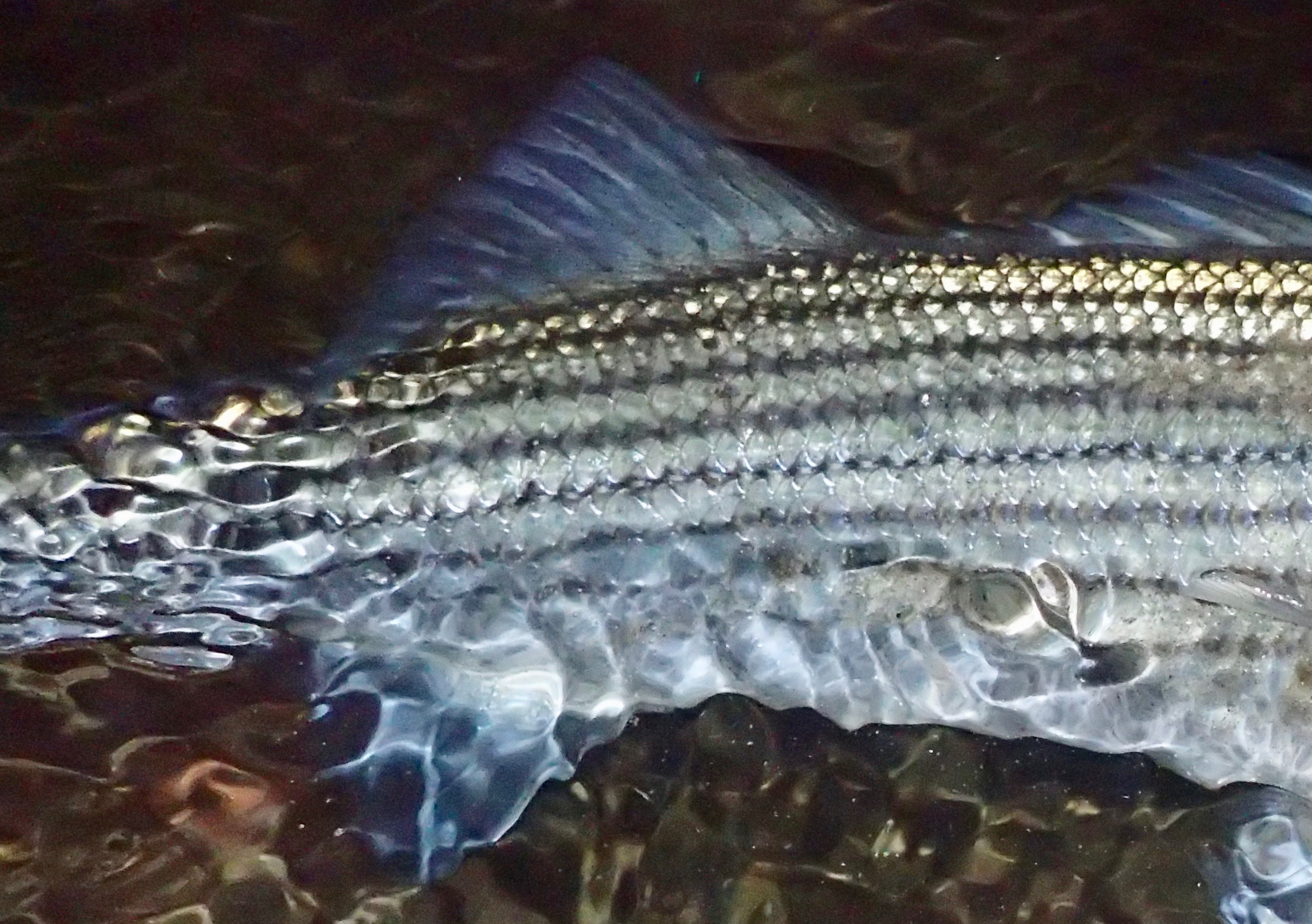
…I was catching my first striped bass of 2022. The conditions weren’t great — rising barometer, gusty winds, cold, rain showers — brrrr! But you don’t know if you don’t go, and she was right where she was supposed to be. She hit the Rock Island flatwing like a ton of bricks and gave me a couple powerful, short runs. The presentation was a greased line swing, and the hit came about halfway through the delivery.
Not huge, but 10 pounds is 10 pounds. This is the first slot fish I’ve taken in a long time.
I fished the Farmington yesterday from 1pm-4pm, dedicated to the streamer cause. We had bright sunlight and seasonal temperatures; the water in the Permanent TMA was 480cfs and clear. While there were a few bugs in the air (midges and and a very small dark un-IDed mayfly) I didn’t see any surface activity. Angler traffic was moderate; there were people fishing in two of the three pools I visited.
The first mark was a riffley dump-in to a larger pool; the method was long-leader jigged mini-streamers. That was a blank. I had the second mark to myself. Again, I went the jigged streamer route with no love. I switched over to a more traditional streamer (Coffey Sparkle Minnow) and my full-sink integrated line and hammered up zero-point-zero trout. Not one measly touch.
The third mark was by now in the shade, which I hoped would work to my advantage. I worked downstream in a long pool with the same results. A walk upstream a 150 yard through the woods warmed me up a bit, and I cycled through again. Finally, a dull thud, a hookset, and soon a chunky rainbow was in the hoop. This is tough time of year to fish (I did not see another trout hooked all afternoon). Happy with one, I called it a day.
Capture! It felt so good after 2 hours and 55 minutes of blankness. Pre-celebrated with a San Cristobal Quintessence Churchill.
I don’t remember when I started doing it, but at some point I got into the habit of fishing a small stream on New Year’s Eve day. There’s a lot I like about it, not the least of which is tradition. But to end the fishing year on a small stream seems romantic, poetic, and just generally good for the soul. It’s arguably fly fishing at its most innocent. Not every year has worked out — youth hockey tournaments have been a primary culprit — but I’ve managed to do it quite a bit.
This year I took a fishing buddy, Toby Lapinski. We hauled out into the deep, dark woods on a day that had no right to be the last few hours of December. We did a brisk brookie business (say that three times fast!) once we figured out where they were willing to eat. Add a celebratory pre-New Year’s cigar, and we sent 2021 off in fine form. Don’t forget to get your 2022 license!
Why is Toby bottom bouncing in one of my favorite dry fly pools? Because we devised a brilliant plan to find out what the fish wanted. Toby started with a tungsten bead-head micro Squirmy Worm thingy, while I fished a bushy dry/glass bead dropper. The char voted overwhelmingly for the bottom. Toby was nearing double-digit hookups before I even got a sniff on the dry. Even my tiny midge nymph dropper went largely unscathed. I do love making them come up, but with the water on the upper side of perfect and running very cold, I switched to running deep mode. And that simple move was the difference between fishing and catching.Me being stubborn with the dry. Alas, ’twas not to be, although I did get one to latch on in this lovely little bit of water. I made what passes for a cast, then dangled and waked the fly while making a rough figure-8 with my rod tip. There’s an awful lot of green for the day before January 1! Tightest of lines to all of you in 2022. Photo by Toby Lapinski.
Every once in a while, you gotta do something different. Even if you’re a creature of habit. No, especially if you’re a creature of habit.
Before Tuesday, I’d never gone fishing for broodstock Atlantic salmon. It’s a little curious that I hadn’t, even more so since I enjoyed it immensely, and that was after freezing my toes off and catching…nothing. You can try for Atlantics in moving water in the Naugatuck and Shetucket Rivers; the Shetucket is where I fished. Striper angler extraordinaire Toby Lapinski graciously offered to show me the ropes. We basically went out and had at it for four hours. Unlike much of what I write here, this little piece isn’t intended to be a detailed guide or even a primer. If you want more information, you can check out the CT DEEP site. Another great resource is Atlantic salmon aficionado Ben Bilello’s website.
So. To the fishing. I used my Ken Abrames #3 Salmo Sax in switch mode with a floating line. Leader was about 12′ long, tapering down to 10″ P-Line. I used a bunch of different flies, from classic Atlantic Salmon flies like the Same Thing Murray and Mickey Finn to soft hackled streamers like the Hi-Liter. I did have a few touches; several were from smaller fish that were not salmon. I might have had one salmon touch, but it was not a big boil or roll or even a sharp tug; it almost felt like a striper taking the fly into into its mouth. In any case, no adrenaline rush. The method was the greased line swing and dangle, which if you’ve read my stuff you already know I love. I hated when the clock said we had to go. Folks, I need to do this again.
Cast…upstream mend…upstream mend…another mend…then let the current and the fly and primal attack instincts do their thing. I like to teach big mends, which I call “mending like you mean it.” You actually pick the line up off the water and place it where you want it. A longer rod helps the cause. Photo by Toby Lapinski.