Organizing and replenishing my summer striper box is an annual ritual. I thought you might like to see how I do it. The left side of my box is the busiest, in terms of number of flies and how often I’m dipping into it. This is the left side, the sand eel side, and I’m covered for both matchstick sand eels and larger ones up to about 5″. Let’s start with the box: it’s a C&F Design Permit Box, completely waterproof, four rows of slit foam, 7 3/4″ x 4 1/2″ x 1 2/3″. I’ve had this box for years, and I love it.
The top two rows are for sand eel patterns, so I start by removing every fly and taking inventory: what stays, what goes, what needs to be replaced? The bottom two rows are mostly small stuff, like shrimp, crustaceans and isopods, clam worms, and tiny baitfish. Then, I fill in the third row with smaller sand eels. Left to right, The Golden Knight, Ray Bondorew’s Marabou Sand Eel, and Ken Abrames’ Eelie on various hooks and in different color schemes. These smaller sand eels are most likely going to used as part of a dropper rig team of three.Now I’m ready to fill in the top row with Big Eelies. Note that I carry multiple color combinations (and I have more in reserve at home that I can use to fill in the blanks). I’ll choose a pattern based on conditions, light, bottom structure, ritual, tradition, and — most importantly — feeling. It’s easy to lift up the tail to see what’s beneath; this system allows me to maximize available space. I also carry a few extra Big Eelies in a baggie. I hand these out from time to time to people I meet on the beach. Right, John?
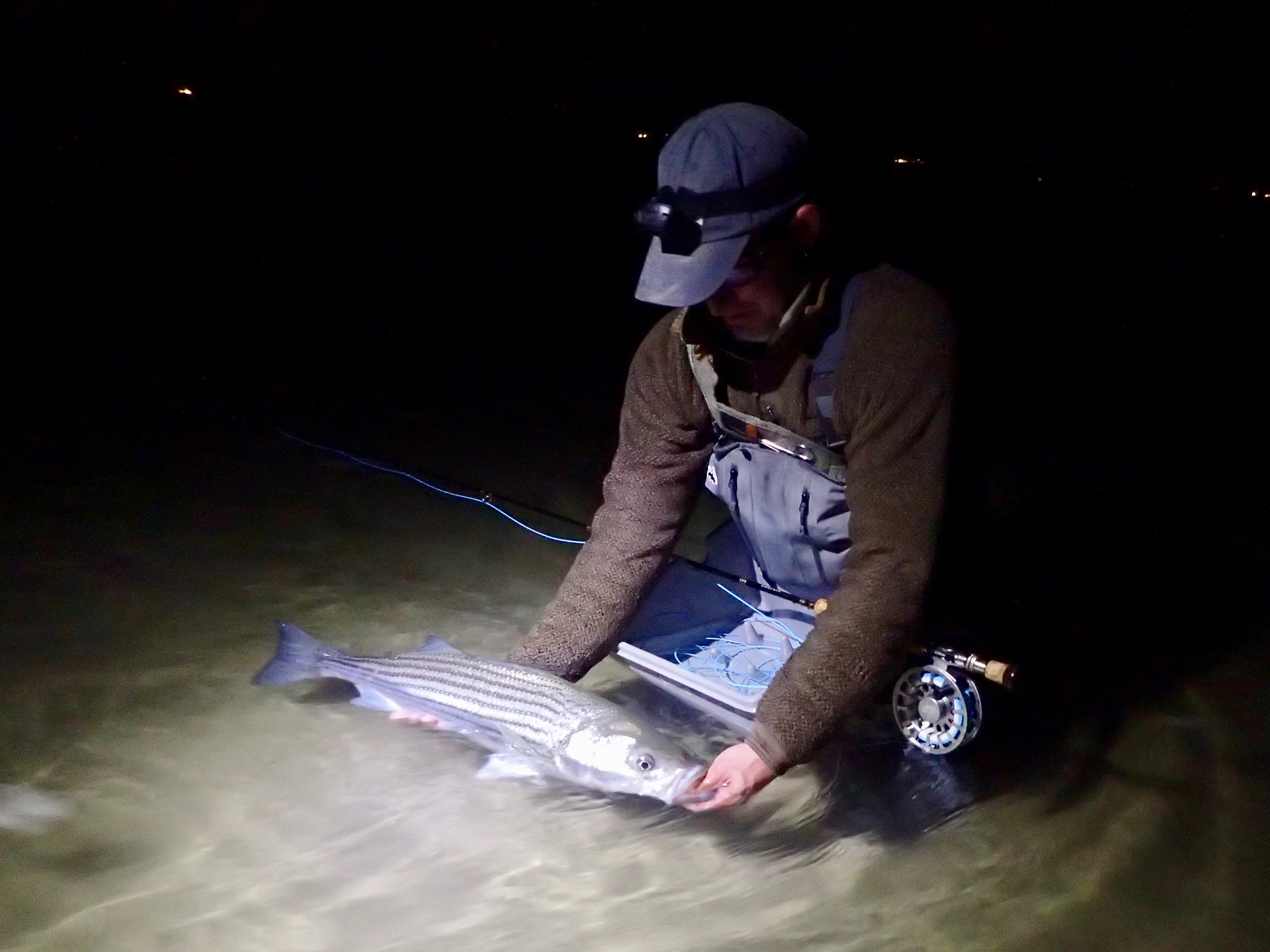
If you live in southern New England, right now is one of the better times to try to catch a large striper. Herring are coming in to spawn, and the stripers know it. I’ve already taken three slot bass this year, one of them 15 pounds. My implements of destruction are a long rod, a floating line, and large flatwings fished on the greased line swing. You can read about how I’m getting it done in this new piece, “Deadly Elegance or: How I learned to stop stripping and love the greased line swing.” You’ll find it in the current issue of Surfcasters Journal. Issue #72 to be exact.
Surfcasters Journal is an e-zine, and the current periodical bible for serious striper anglers. Whether you’re a surfcaster or a fly angler, it’s loaded with information you can use to catch more bass — and bigger bass. Some of the best striper anglers I know are contributors.The opening spread of Deadly Elegance, sans copy. You need a subscription to read the article, and you can get one on the Surfcasters Journal homepage. Those are my Bombardiers, a nine-feather flatwing of my creation and a darn good fly for tempting bass that are feeding on herring.
Once again, those of us who love striped bass have a chance to make our voices heard. The ASMFC is currently conducting public hearings; Connecticut’s virtual meeting is being hosted by DEEP, and it happens on Tuesday, March 22, 6pm-8pm. As our friends at the ASGA have said: Get involved. Do what is right for the stock. Do what is right for future generations.
Contact: Justin Davis 860.447.4322
Register for the webinar here. Make sure you select the correct date/location. You can attend any meeting you would like, just make sure to include your home state in your comment.
Please note that in order to comment during virtual webinar hearings you will need to use your computer or download the GoToWebinar app for your phone. Those joining by phone only will be limited to listening to the presentation and will not be able to provide input.
Finally, if you (like me) can’t attend a hearing, the public comment period ends on April 15, 2022. Individual emails are what counts the most. Form letters count the least. Send your comment to comments@asmfc.org with the subject line “Draft Amendment 7.” ASGA will be running a raffle again this time. There will be awesome prizes from our best sponsors. Just copy stripercomments@gmail.com in your email to ASMFC and you are entered. It does not matter if you agree with our positions or not. We just want folks to participate in this process.
Don’t be bashful. Open your mouth and let your voice be heard!
It’s easy to tell I’ve been steelheading. All you need to do is look at my right thumbnail.
That’s where I test the sharpness of my hook points. (You do know that a sharp hook is the single most important thing in fly fishing, yes?) There’s nothing more important than a sharp hook. This becomes self evident with any bottom-style presentation. The fly tumbles downriver, bumpety-bump, over sand, rocks, boulders, sticks, and whatever other things might be lurking down below. Contact — especially repeated contact — with any of them can result in a dull hook point.
So when I snag the bottom, the first thing I do before the next cast is check my hook point. Even without a snag, I am constantly checking my hook points. Every ten casts should be a no-brainer. Maybe you want to check after every five. Do it every three or two or even one and I still won’t call you crazy. Au contraire. You, dear sir or madame, are being a savvy angler.
You’ve heard of striper thumb? This is steelhead thumbnail. To check sharpness, you drag the hook point across your nail. The point should stick to your nail like Scotch tape. If it doesn’t, the hook isn’t sharp. Off it comes. Most steelhead are won and lost at hook set. Be ruthless about the sharpness of your hooks and you’ll catch a lot more fish.
Steelheading isn’t fair. You can do everything right and still drop fish. I know I am going to lose steelhead due to an occasional sloppy hook set. I know I will lose steelhead because sometimes the fish bests me. I know I will lose steelhead for no other reason than plain bad luck. But I will never lose a steelhead because my hook points aren’t sharp.
With single digit temperatures again in the forecast, this seems like a good time to talk about cold weather catch-and-release best practices. When the temperature is so low that you’ve got ice forming on your waders, or your line and leader sports frozen droplets the moment they hit the air, you should be thinking about what could happen to a fish’s gills or eyes if exposed to that same frigid air.
When it’s Everest summit cold out there, try to keep fish in the water as much as possible. Absolute best practice would be to never remove the fish from the water. If you must take a picture, keep the fish in the water (in your fish-friendly landing net) until you’re ready to shoot. Then it’s 1-2-3, lift, shoot, and get that fish back in the water ASAP. Limit your number of shots. Please remember that damage time is measured in seconds.
It was in the teens when this picture was taken. We probably shouldn’t have done it. On the plus side you can see water still dripping from my hands, which indicates the shot came moments after the steelhead was lifted from the net.Photo by Peter Jenkins.Option B is much safer for the fish. I know, it’s not the same, but Arctic air can be cruel on your favorite gamefish’s gills. How cold is it? You can see droplets and sections of ice already forming on my waders. Photo by Peter Jenkins.
As you may know, I am currently occupied with getting ready for my oldest son’s wedding. In lieu of new material, I’m recycling some of my favorite posts from years past. Let’s continue on the steelhead kick (man, I really want to tie into some fresh chrome!). Six years after its publish date, Soft Hackles for Winter Steelhead remains relevant; I still use these flies, and whether swung or dead drifted along the bottom, they still catch fish.
Ever notice how 36-degree water doesn’t feel as cold when you’re releasing a steelhead?
November means steelhead. At least it does for me. This year, though, the steelhead adventures will have to wait a few weeks. In the meantime, here’s an oldie but goodie from the archives: Ten Things Every Beginning Steelheader Should Know. Even if you’re an experienced steelheader, you might find a useful nugget within. Enjoy the read — and enjoy the ride.
A man, a steelhead, and a cigar. Gotta love November!
On the difficulty scale, keeping current with how the ASMFC plans to manage (I’ll be kind and not place quotes around manage) striper stocks is somewhere between Calculus II and Organic Chemistry. Flux and fast and fluid also come to mind as good descriptors. (And as always, alliteration.) But thanks to our friends at the American Saltwater Guides Association (ASGA) it’s become easier.
Next up will be draft Amendment 7. Public comment will be open later this year, and I’ll be sure to get you the links. To help you understand what’s going on before then — no degree in Chaos Theory required — here are some helpful links.
If it looks like a moratorium proposal, is it really? Nope. Here’s why.
If you’re finding this stuff helpful, and you really care about stripers, you should join the ASGA. You can do that here. And of course, any donation you can make helps them continue their outstanding work.
Fly anglers are always looking for the next best thing. Especially when it comes to fly patterns. But often, “new” doesn’t translate to “better.” Some of these patterns are decades old, but they still get eaten because the stripers haven’t gotten any smarter. So if you want to see what’s in my fly box this fall — and at the end of my leader — read “These Old-School Striper Patterns are Still Deadly During the Fall Run,” brought to you by our good friends at Field & Stream.
The Magog Smelt Bucktail didn’t make the article, but it’s another fall favorite of mine. You can find out more about this pattern here.
You can read my newest piece, “8 Flies Smallmouth Bass Can’t Resist,” right now at Field & Stream online. Even if you’re more of a trout person, I’d recommend giving it a read as many of the patterns translate to the Salmo family. Naturally, I’ve included a few of my own bugs, like the August White and the Countermeasure. Besides, it’ll give you something to do while waiting for all this water to recede…
I’m pretty sure this guy ate a TeQueely, one of the featured patterns in “8 Flies Smallmouth Bass Can’t Resist.”




 currentseams.com