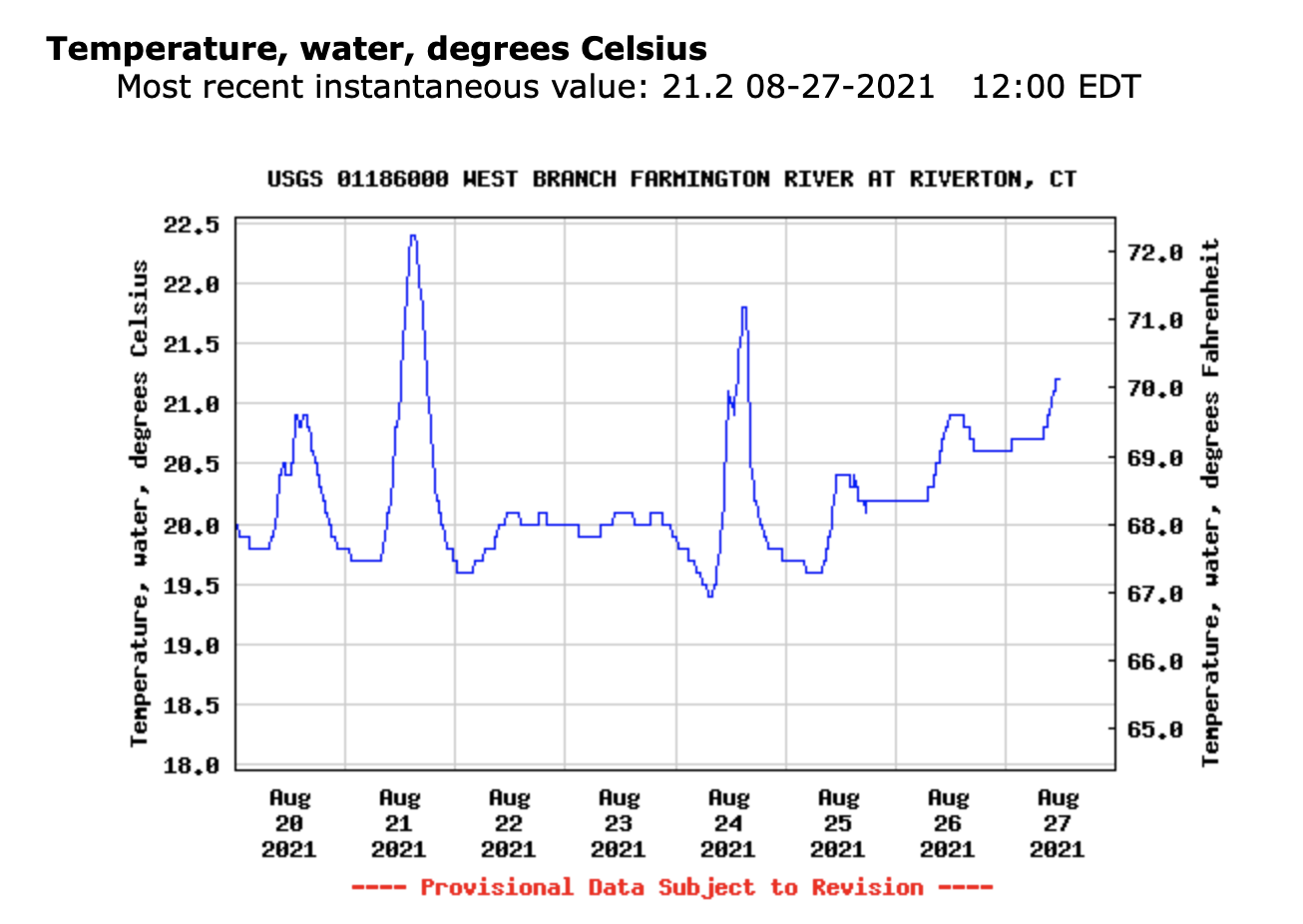
What a disaster summer this has been for major river fishing in Connecticut. Pity the poor Farmington: too much rain, too much flow, too much warm water. Its current story is best told by these USGS Waterdata graphs.
They’ve jacked up the flow again. At this rate, we may not have any stratification of reservoir water for weeks…or perhaps months.Water coming out of the dam is already at a trout-unfriendly — and that’s sugarcoating it — temperature. Who knows what heated horrors exist downstream below New Hartford? Nature will find a way for some trout. Many will not be so lucky.
I regret being the messenger of such dire tidings, but it is what it is and there’s nothing we can do about it. Suffice to say, please don’t fish for trout. And hope those tropical systems out there right now stay away from Connecticut.
In case you’re wondering why the water is so warm, this article by yours truly may help.
My newest article, “Everything You Need To Know About Fly Fishing in Small Streams” is now live in the Fishing section of the Field & Stream website. This primer will help you get geared up, review basic flies, tell you how to find viable water (no spot burning!) and cover fundamental small stream tactics. I’ll ask you all to do me (and the resource) a favor: Please go barbless, keep photos to a minimum, and keep those precious wild fish wet. Thank you, and thanks for reading.
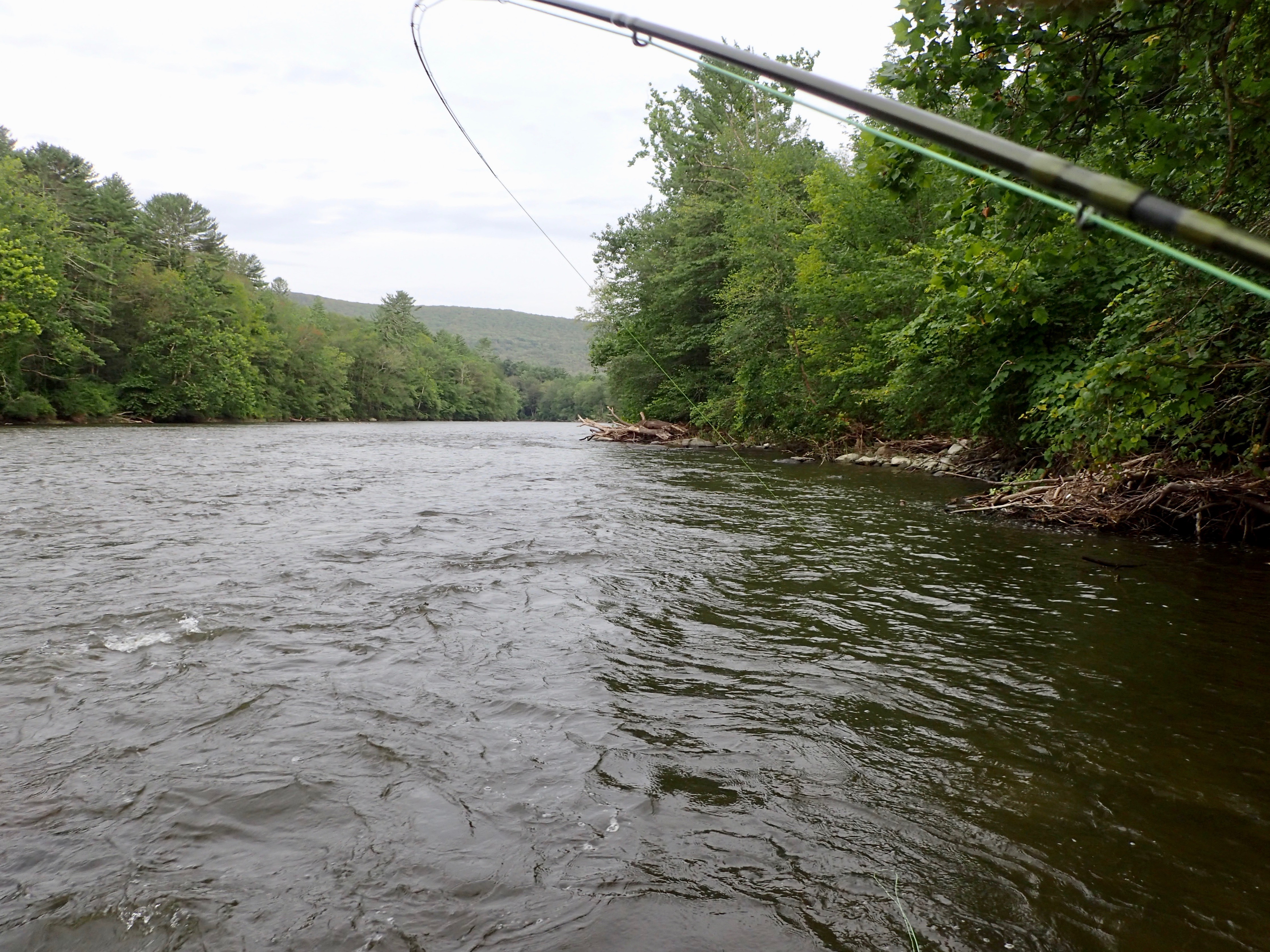
Small stream pro tip: when I’m fishing a long, languid run with a dry fly, I like to take position well upstream. By feeding line into the drift, I can cover likely holding areas, and not have to worry about spooking fish with a line slap or the movement of the fly rod. While it wasn’t possible in this run, I also like to stay out of the water as much as I can. Photo credit to Cam Culton!
Feast or famine. Flood or drought. It’s the new normal on rivers. But you don’t have to stay home when the conditions are less than perfect. Check out my latest article, “How To Catch Trout in Extreme High- and Low-Water Flows.” You can read it in the fishing section of Field & Stream Online.
Fishing the softer sections along the banks in high water can be highly productive.
I’ve been getting a lot of questions about Farmington River water temps. The basic outline is, “I thought the Farmington is a tailwater. Why is the river so warm?” The answer is pretty simple.
In case you don’t know, a tailwater is a river with a dam release. The flow of the Farmington River West Branch is controlled by water that comes out of gates from the base of a reservoir dam (Colebrook Reservoir and Hogback Dam). If you’ve ever gone swimming in a pond or lake, you know that the water is warmer near the surface and colder near the bottom. This is called thermal stratification. In a larger reservoir, you have three different thermal layers: the epilimnion (the warmer upper layer; the metalimnion (or thermocline, the middle layer); and the hypolimnion, the coldest bottom layer. But I said this was simple, and there I go throwing all kinds of hifalutin hydro-science terms at you.
Ideally, there’s a happy medium of bottom release flows on a tailwater: cold water is never released in amounts that cannot be quickly replenished. But there are two situations that screw everything up.
The first is severe drought. Water that flows into the Colebrook Reservoir is reduced to a warm trickle. The volume of the reservoir shrinks from evaporation. The temperature of the water rises, especially if it’s hot, which decreases thermal stratification. As a result, what comes out of the bottom of the dam is warmer than ideal. (By agreement with the CT DEEP, the MDC must maintain a minimum release of 50cfs.) Because the flow is so low, water downstream warms quickly, trout get stressed, and it’s a bad scene all around. (This was the case in 2016. It was so bad that the DEEP took the unprecedented step of declaring thermal refuges on the Farmington.)
But that’s not what happened this year. This year, we had too much water. All that rainfall in July meant that the MDC needed to bleed water, and lots of it — so much, in fact, that it wiped out any meaningful thermal stratification in the reservoir. They’re still running such a high volume of water that there’s no chance for the stratification to re-establish — at least not in the heat of August. So that’s why at noon today the water was coming out of the dam at a very trout-unfriendly 69 degrees.
Eventually, it will get better. But right now, the best thing you can do for Farmington River trout is play the waiting game.
Taken this winter when the water was very, very, cold. Hang in there, buddy!
Good Monday afternoon! A bit of a late start for me today as I was out chasing fish last night and didn’t get to bed until the wee hours. August is traditionally viewed as a prime vay-cay month, but here at currentseams we are busy-busy-busy. First up: I have three new articles in the pipeline for Field & Stream Online. In no particular order (these are just working titles): Tactics and Strategies for Fishing High and Low Water; Seven Best Flies for Smallmouth Bass; Small Stream Fly Fishing 101. As I have not yet begun to write, I have no pub date other than ASAP. I’ll get that information out to you when I know it. In the meantime, it’s not all chained-to-my-writer’s-desk energy. I still have fishing — lots of fishing — to do.
To the Farmington River. August is typically an active guide month for me, but I’ve had to make the difficult decision to suspend lessons on the Farmington until further notice. The issue is one of elevated water temperatures, which begets limited time and access. This graph of the water temp out of the gate at Hogback says it all:
A short week ago, you had just a shade over 64 degrees out of the gate, with a spike of a still trout-friendly 66. Today we’re already over 68 degrees (keep in mind that this is Riverton) and it’s not even a scorcher kind of day. With a heat wave projected for this week, it doesn’t take a degree in environmental science to recon that the trout will be experiencing stressful conditions. So please: give the trout a break. Protect the resource. It sucks, but it’s the right thing to do. And, as with gravity, what goes up must come down.
Fish Untamed is website that’s run by Katie. She is self-described as “obsessed with chasing fish” — so right away, we like her! Katie also does podcasts, and yours truly is the subject of her current offering. Or, more specifically, the broad concepts of what I call “trout fishing for stripers.” We talk about that and lots of other things. But enough rambling; you want to listen. Here’s Fish Untamed Podcast Episode 55: Trout Fishing For Stripers With Steve Culton.
A floating line, a striped bass, and a very happy angler.
In case you missed it, last month two Congressmen introduced an act to re-authorize Magnuson-Stevens. Briefly, “Mag-Steve” governs fisheries management in U.S. Federal waters. Given the ASMFC’s dismal track record, this act is desperately needed, and if you love striped bass and the concept of creating bountiful stocks, its title is sweet music: “Sustaining America’s Fisheries for the Future.” Here’s an excellent summary of the Sustaining America’s Fisheries for the Future Act from our friends at the ASGA.
Surfcaster’s Journal 68 is live right now — it’s an online-only ‘zine — and within its fantastic digital walls you can find my latest story, “Sensei Elmer & The 50-Fish Nights.” This is a piece I wrote a long time ago, revisited, rewrote, re-edited — and now, instead of hiding on my hard drive, it can be yours to read and enjoy. You get to see some decent photos taken by me, and some extraordinary shots from my immensely talented brother David . (You can see more of David’s work on Instagram @theplayoflight.) “Sensei Elmer” is about two memorable fly fishing nights I had one October. Or is it about something far deeper than catching fish?
Most of what I write eventually ends up here, but this piece won’t — so if you want to read it, you’ll have to subscribe to the Surfcaster’s Journal. It’s only $20 a year and you get six issues. Tell ’em Steve sent ya.
The best system for organizing your fly tying hooks and beads is the one that works for you. In the case of my ever-growing collection of such stuff, that means storage compartment boxes. But not just any boxes. They need to be adjustable, stackable, and easily transportable. Since I’m not fishing this week, I’m using the time to organize the disaster area that is my tying space. I thought I’d share my process of sorting and storing hooks and beads with you.
Let’s start with the storage boxes. I’m a big fan of the 3700 Series Plano Prolatch(TM) Stowaway(R) and 3600 Series Deep Prolatch(TM) Stowaway(R) bulk storage containers. I’ve been using them for years. You can find them at many hardware and big box retailers, and you can also order them directly from Plano. They’re very reasonable priced, and they’re a quality product. I like these boxes because they allow custom configuration; you can create numerous different-sized compartments within each box. The boxes stack neatly atop one another. And if I’m doing a show or a class on the road, I just latch the box and toss it into a larger container for transport. (Plano offers many more options in the way of fishing hardware/lure storage — it’s worth browsing their site if you’re looking for ideas.)
This is the Deep Prolatch: 11″ x 7.25″ x 2.75″. I’m using this one for my freshwater streamer hooks. Everyone will have their own system of organization; for example, I’ve got hooks of different sizes and makes and models in the middle two compartments. But all the 3x long hooks are on one side, and the 4x long hooks are on the other. Stingers and other shorter shank hooks are in front. Large jig and Atlantic Salmon hooks in the back. Works for me!
I can’t tell you how to organize your boxes –that’s up to you — but I can tell you how I organize mine. I have one box for beads and dumbbell eyes, sorted by color and/or material. For example, I have one compartment for brass copper beads and another for tungsten copper beads. But there’s only one compartment for gold beads, regardless of material, because I don’t have a lot of gold beads. There’s a box for freshwater streamer hooks, and a box for saltwater streamer hooks. My smaller hooks box is organized by hook type, with compartments for light wire hooks, heavy wire hooks, shrimp/scud hooks, heavy steelhead hooks, egg hooks, etc. Again, there may be many sizes and different makers within a compartment, but I can easily find the right hook for a size 14 North Country Spider (light wire hooks section) or a size 12 Dark Hendrickson winged (heavy wire hooks section). Easy-squeezy.
The Beads Box, a 3700 Series Prolatch Stowaway, 14″ x 9.13″ x 2″.Saltwater Hooks, 3700 series. I use fewer types of hooks for salt than other endeavors, hence the extra space at the rear. (Those are spare dividers you see. Each Plano box comes with a set of dividers so you can customize your box.) To be fair, I sometimes use freshwater hooks in the salt, such as Atlantic salmon hooks, and those are kept in the streamer box.My workhorse freshwater box, also 3700 series.Stack ’em up! It’s also very cool to be able to grab a box, toss it into a large container, and hit the road without having to worry that I’ll open the box to find a thousand mixed beads rolling around. Everything stays in its own little space.
Twelve stripers to hand, and not a single picture of any of them? It’s true. We’ve all seen enough cookie-cutter bass photos; the one striper that was photo-worthy escaped into the waves; and several of them were landed in very fish-photo-unfriendly conditions. So, you have to settle for this (slightly) humorous photo essay of my week on the Block. Oh! You may also learn something…
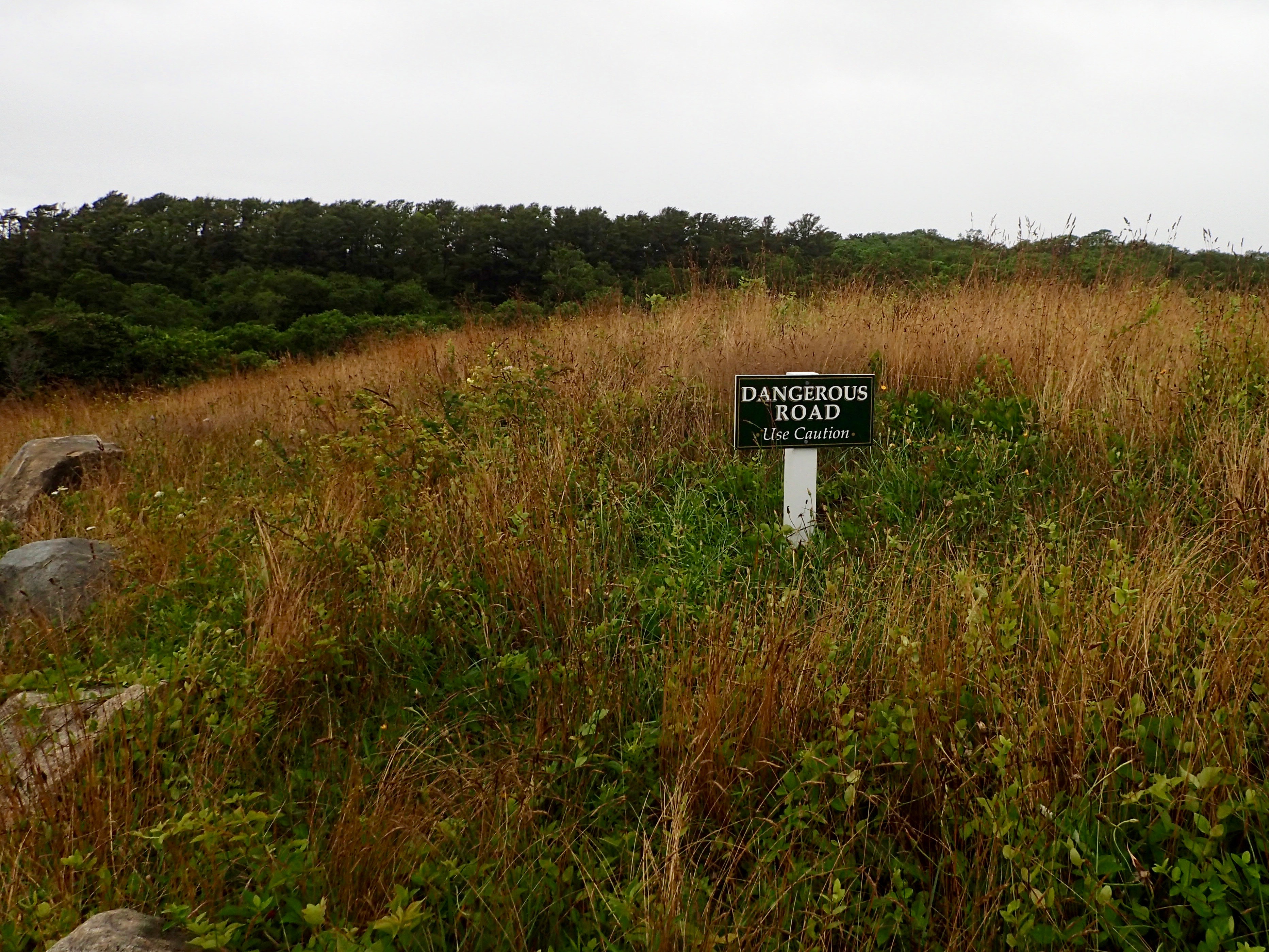
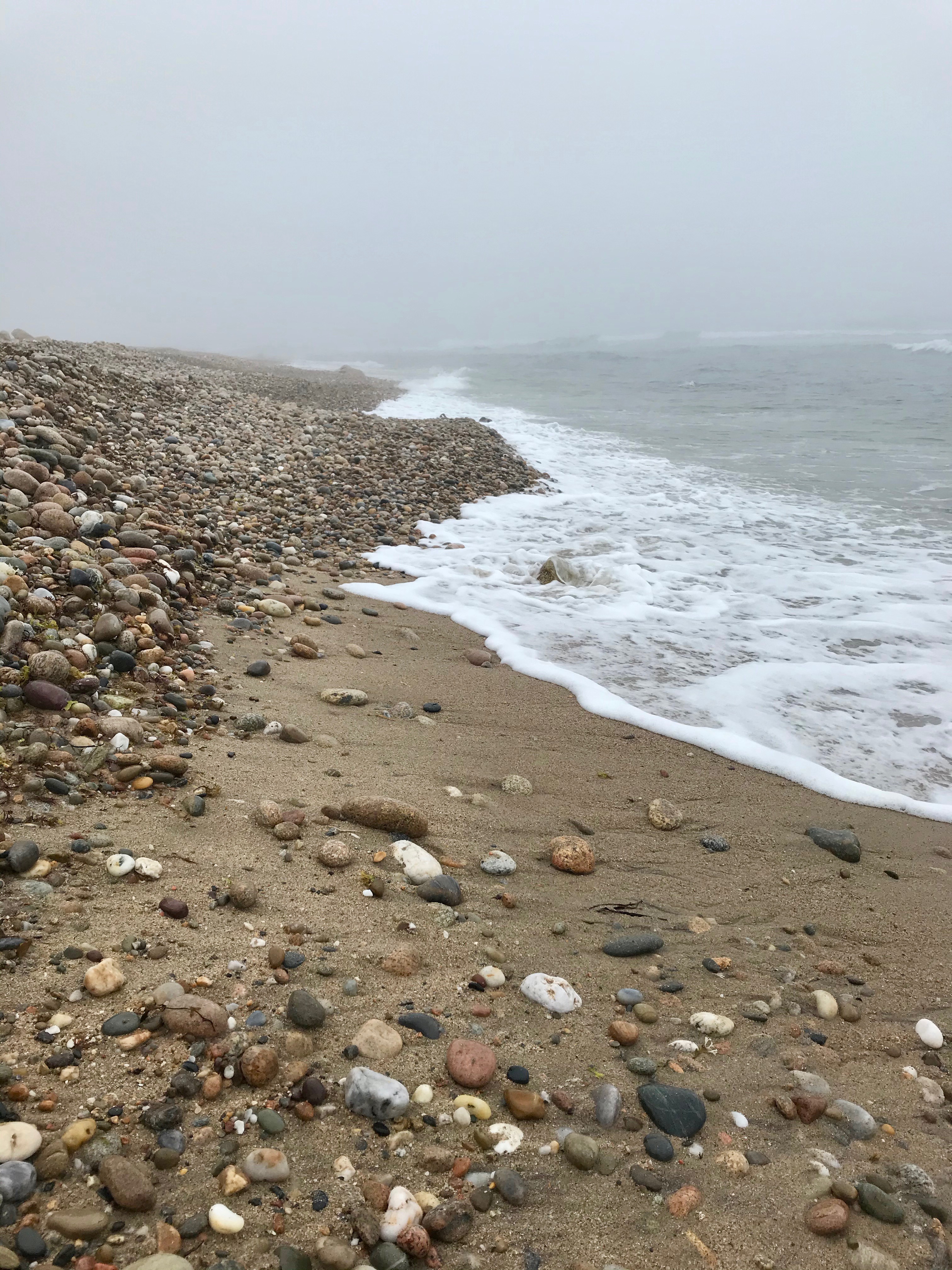
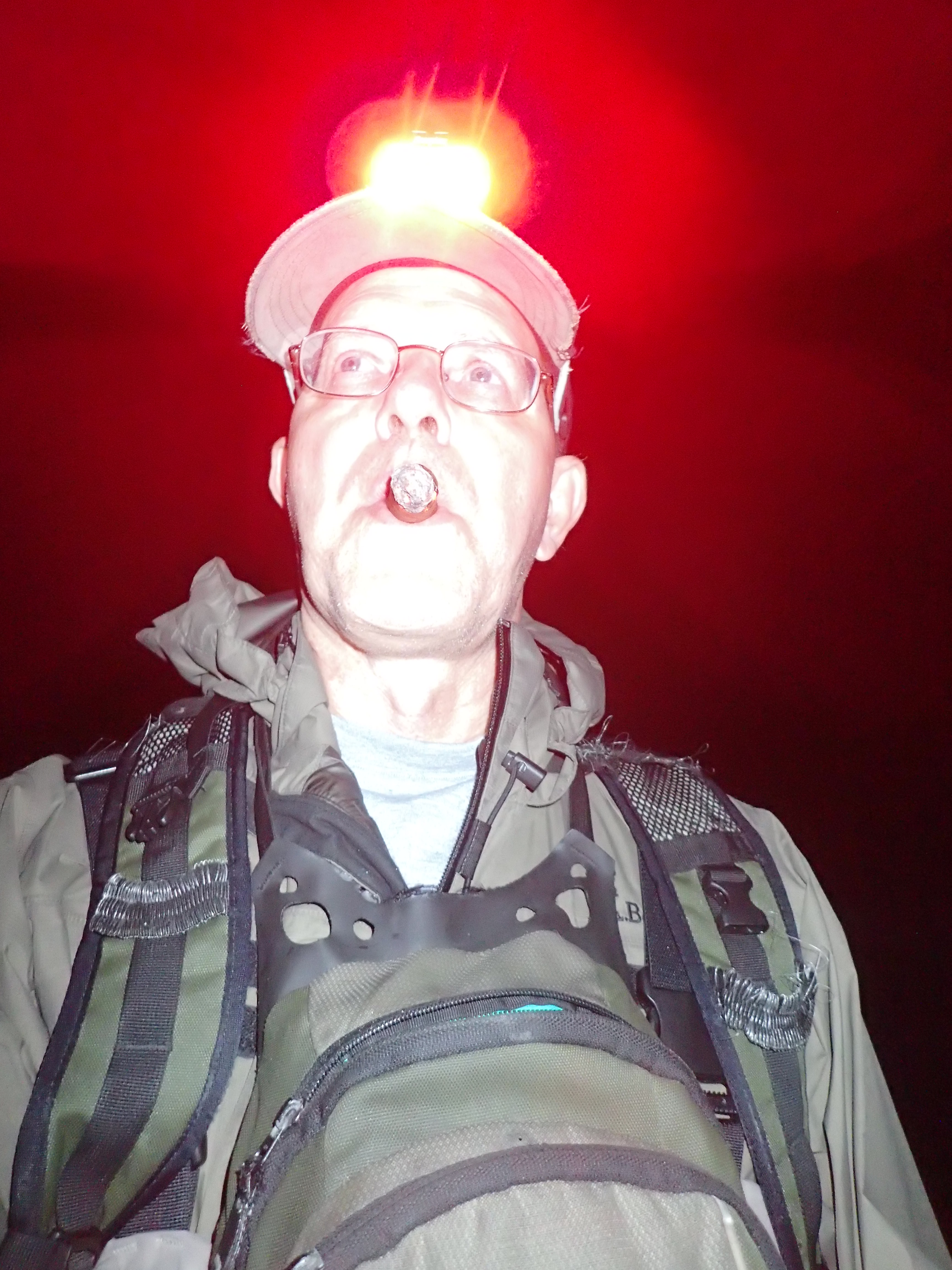
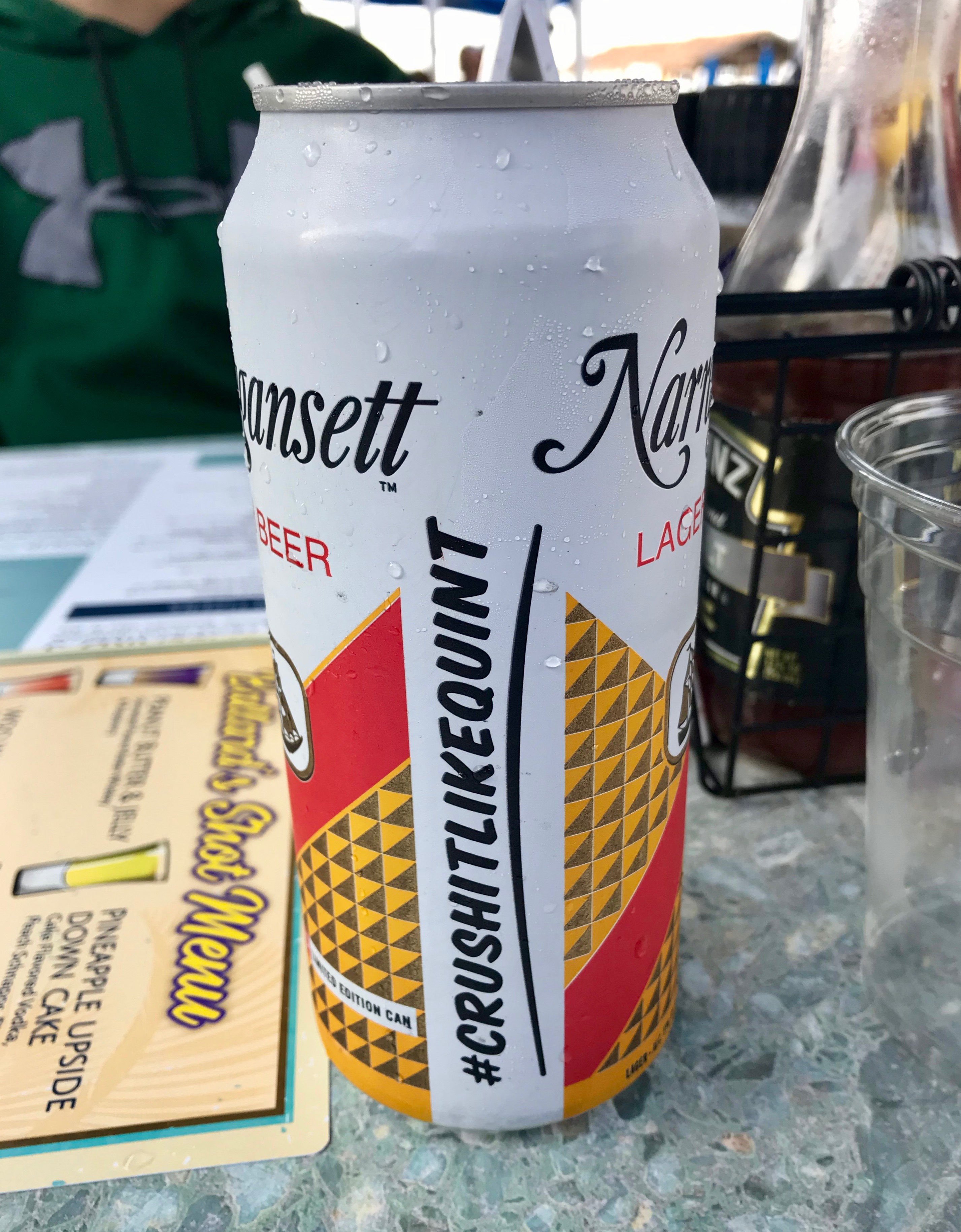
It helps to have a 4WD vehicle on Block. Some of the better fishing can be found along the dirtier of its many dirt roads.Here’s a little lesson in scouting a new mark. This is a section of beach on the south side. I planned to fish it at high tide, so I first visited it at dead low. This gives me an opportunity to see what and where the structure is that will be covered by water. (Of course, I also visited it in daylight at the corresponding tide I’d be fishing). Also, note the tremendous drop-off between where I’m standing and the rock pile-of-a-beach lip at the left. Where I’m standing will be filled at flood, creating a trough through which stripers can cruise for bait. It also tells me two more critical pieces of information. First, I won’t have to cast far to reach viable water. And two, under no circumstances do I want to get too close to the edge, or wade into this trough. Sadly, the surf was too big for the fly rod when I actually fished it, but I believe this mark will produce bass for me in the future.Fine, but I just caught a bass after four hours of banging all over this island, and now I’m going home to have a late night beer.Elsa’s remnants produced some impressive surf. To give you some perspective, those waves are hundreds of feet away and well overhead high. In my experience, an approaching tropical storm/hurricane on Block can turn the bass on big time the night before (nope, didn’t happen this time) and then completly mess up the fishing the next night (yep, that did happen). To be fair, the fishing stunk all week, so it made little difference.Electrical storms were an almost constant threat that week. Here I am keeping my eye on a system that was moving over the mainland. I’m also celebrating my only bass of the night, which is always a cigar-worthy occasion.“Here’s to swimmin’ with bow-legged women.” I remember these retro-cans from the 70s. To Block Island: you’re a truly special place to fish.






 currentseams.com