“Smuts — I welcome smutting trout.” So writes J.C. Mottram in his book Thoughts on Angling. I don’t have the book, but I do have Syl Nemes’ second edition of The Soft Hackled Fly and Tiny Soft Hackles. In that book, Nemes devotes a chapter to Mottram and his collection of soft-hackled smuts. (“Smut” is a colloquial British term for a very tiny fly, such as a midge, and trout that are “smutting” are delicately feeding on those miniature bugs.)
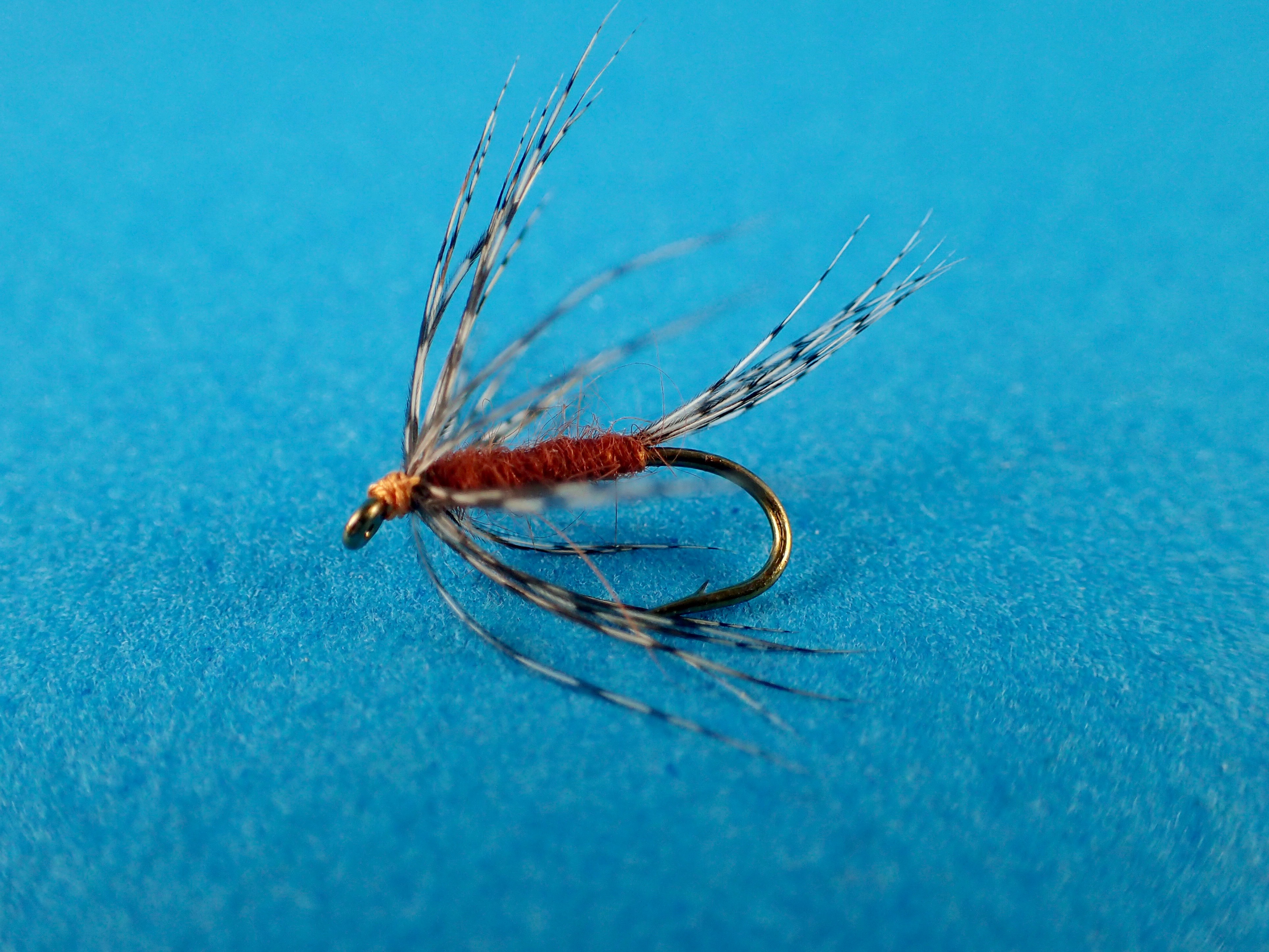
There are six Smuts listed by Nemes. I’ve only tied one, the Number 1 (shame on me for not exploring further). I revisit it today because I happened to have Nemes’ book out, and this is a great time of year to fish midges. (Midges are a major, consistently available food source for trout in the winter.) I’ve mostly fished Smut Number 1 as a dry fly, but I’ve also used it subsurface. The wise winter nymph angler will no doubt want to include this tiny soft hackle as the top dropper in their nymph rig.
Nemes includes a photo of the Smut Number 1, and it bears only a faint resemblance to what I tie. His looks like the body is entirely constructed of working thread; mine uses the specified wool. (UNI makes a nice wool yarn thread on a spool.) His hackle is wound wingless wet style, covering the front third of the body; mine is wound at the head. I suspect the wingless wet style would be very appealing to trout. Worth the price of admission alone is the blank stare you’ll get from the angler who will inquire, as you hook trout after trout, what fly are you using? “Smut Number 1,” is your response. Soak in that moment. And here it is, J.C. Mottram’s Smut Number 1.
Thanks to everyone who joined me for last night’s Currentseams Tuesday Night Zoom. We had nearly 60 people, which doesn’t suck, and a splendid time was had by all. I’m sorry about the muting issues — I will have it figured out for next time. Speaking of next time, we’ll do it again next Tuesday, January 12. I’ll be talking about winter fly fishing, and winter fly tying — so be there or be square! I’ll post a reminder early next week.
As John Cleese would say, “And now for something completely different.” I’m going to do my first winter fly tying pay-per-Zoom event on Saturday, January 16 at 1pm. This will be about 90 minutes of fly tying/tie-along instruction. The cost is $10. To “register,” you send 10 bucks to me at PayPal (ID is swculton@yahoo.com) and I’ll send you the link to the meeting. Our first session will be Tying the Soft-Hackled Fly. This will cover some basic, useful patterns, and will include the North Country Spider template. It would be ideal if everyone had every kind of hackle, but I know that’s not possible, nor is it necessary. But you should have some basics, like different color threads, different hooks, tools, etc. You should have a partridge skin or at least partridge feathers. Starling would be good to have. If you have any kind of hen cape soft hackle, have that handy. The point is, if you don’t have a specific kind of hackle, you can find it later. This is all about tying basics and templates. Oh! I’d like to show you the Squirrel and Ginger, so please find ginger Angora goat, green Krystal flash, Squirrel fur, and high-tack wax. If you don’t have the goat, you can use another kind of dubbing. Wire can be substituted for Krystal Flash. Questions? You know where to find me.
By popular demand, fly tying classes by Zoom! The first will be two Saturdays from now, January 16th, 1pm, and the subject will be Tying The Soft-Hackled Fly. See above for materials list.
When I give a wet fly lesson, I always tell my clients this: “If you hit a hatch just right, you can have one of those days you’ll never forget.” And it so it was for me on a cool afternoon in April. Hendrickson season can be tough on the Farmington, especially if you’re looking for an unoccupied mark. But sometimes luck smiles upon you, and on this day it was so. The run I wanted to fish was on lockdown, but just as I arrived, an angler left, leaving a prime lie open. Armed with a three fly team of wets, I proceeded to wreak havoc upon the residents. This was one of those days where I quickly lost count of fish, but it was easily in the multiple dozens range. (Fresh fish + epic Hendrickson hatch + wet flies = stupid good.) I had doubles galore. I finally quit because it was so ridiculous for so long. Really. You can read about it here.
I had several evenings of spectacular wet fly action during the sulphur hatches of 2020, but nothing that equaled the craziness of this day of Hendrickson mania! If the water is 450cfs+, or if you want to sink your team a little more, try this tungsten bead head Dark Hendrickson soft hackle on point.
When people ask me about my fishing job, I break it down into three parts: guiding/tying/teaching, writing, and presentations. I love all three, but I think my favorite is presenting. I get to teach fly fishing (I’m passionate about doing so, and I believe that’s reflected in my energy and delivery) and I get to meet people and talk about fly fishing face-to-face. That last bit may sound strange coming from an introvert. I feel blessed to have this site, and Zooms are then next best thing to being there, but no computer interface can replace a handshake (elbow bump these days) and a smile.
At the time we had no way of knowing that the 2020 Marlborough and Edison Fly Fishing Shows would be the last for a while. (There’s talk about doing some parts of those shows remotely in 2021, but at this time I don’t have any information to share. If you want to re-live the 2020 shows, here are my 2020 Marlborough and 2020 Edison recaps.) I think I made the most of it, with big room seminars, Destination Theater presentations, and something new for me, a wet fly tying class. Thank you to everyone who came out to meet, greet, and listen. Thanks to my industry friends for your kindness and giving energy. I’m looking forward to resuming in 2022!
Fly fishing is so serious….or not. I love these guys: Jason Randall (partially obscured by Ed Engle) and George Daniel. If you haven’t read their stuff or seen them speak, you should.
…In which we count down a series that recaps my favorite fly fishing moments of 2020…
Marines are trained to improvise, adapt, and overcome obstacles. OK, so I’m not a Marine. But my oldest son is, and I’m going use that as license to borrow this mantra. This spring, with our nation in the grips of the pandemic, speaking in person to fly fishing clubs wasn’t an option. Lockdowns and social distancing in general were challenging for so many of us. And even though I’m an introvert, I dearly missed the chance to interact with other fly fishers. The idea of doing a regular Zoom seemed like a good one. Best if we keep it to the same night every week. But which night? In an homage to one of my mentors, Ken Abrames, I decided on Tuesday. And thus was born the Tuesday Night Currentseams Zoom.
While not as detailed and rehearsed as my paying gigs, I believe these presentations were still loaded with good advice and included a strong entertainment factor. Your reaction and support was overwhelming. There’s nothing worse than presenting to an audience of ten when you were expecting a hundred. Well, I never cracked the century mark, but we got over 75 more than once, and we were almost always over 50. While I intended these simply as a way to get us all to connect through fly fishing, some of you generously offered donations. So: thank you. Thanks for showing up. Thanks for so many great questions. And thanks for your enthusiasm. You gave me something to look forward to every week for a couple months.
As the pandemic continued, some fly fishing clubs discovered that if they held their meetings remotely, members could safely attend. This fall I got back to presenting to clubs via Zoom. In fact, I have a bunch scheduled for 2021 that I’m looking forward to. Many of you have asked that I do some pay-per-view tying Zooms this winter. Those are in the works. And we may still do a freebie now and then. So stay tuned…
This was my last Zoom, back in early June. At its close, I asked everyone to go out and fish and have an adventure this summer. Maybe next time we could talk about how you all did with your homework. I know I did a ton of exploring (new water, new flies, new techniques) for smallmouth. If you’re looking for a full, detailed presentation for your club, here’s my current presentation menu.
I got a late start today, and there’s so much to do: plow the driveway, catch a workout, pre-Christmas prep, a virtual wine tasting tonight (been looking forward to that for weeks!). I started the day proper by building a fire, an old Culton snow day tradition. I’ve also got lots of writing to do, but won’t get to it today: for Dennis Zambrotta’s followup to Surfcasting Around The Block, for my year-end wrap-ups for currentseams…plus Santa brought me an early gift of a new video camera. Gotta figure that out and hopefully make some even spiffier tying videos.
But for now, here’s a piece I did last year on the best nymphs for winter fly fishing. (Understand that “best” means my favorite, high-confidence patterns.) Also, remember that I don’t Euro nymph, so add weight and jig hooks to these patterns as you see fit. Enjoy the snow day.
We don’t need no stinking fake logs and propane fire!
I’m currently reading Dennis Zambrotta’s Surfcasting Around The Block. As you may have read a few days ago, Dennis has asked me to contribute a chapter to his upcoming followup. It’s a little crazy to me that I’ve known about Dennis’ book for years, but I’ve never read it until now. While the focus of the book is on spin fishing the Block with plugs in the surf — and frequently surf under hardcore conditions — there are plenty of secrets that the fly angler keen on building his or her knowledge base will be able to use for their next outing, whether on Block Island or elsewhere. Here are some of my thoughts.
Color matters to needlefish pluggers. The needlefish is a primary choice for pluggers when sand eels are the bait, and the most popular color is fluorescent green. On Block I fish Big Eelies the vast majority of time, in all kinds of colors, and have never found that the stripers have a preference. But now my mind is wandering in to places of color and length. The Big Eelie in L&L Special colors is one of my favorite, high-confidence Block flies. It’s got a lot of chartreuse. Hmmmm….maybe a longer version, seven inches long, with more bright greens?….one way to find out…
Or, maybe the L&L in a Soft-Hackled Flatwing, tied about 7″ long. I really like fishing this color scheme over sandy bottom structure, like Crescent Beach...or on the Cape…
Location matters…and there are so many locations. I like to think that there aren’t too many anglers that know Block Island on the fly like I do, and then I read a book like this and realize how very little I really know — especially when it comes to locations. Part of it is that I’m a creature of habit. Part of it is that I like to fish flats and skinny water more than surf. Part of it is that it can be challenging to fish certain marks with a fly rod in wind and waves (almost constant companions on Block). But I’ve really got to explore more of these boulder fields (check out Gerry Audet’s talk on boulder fields sometime) and the mysteries they hold. In a way, Dennis hasn’t written a book as much as he’s built a roadmap. Follow it to find your own secret spot.
Tides matter. Once you’ve figured out where you’re going to fish, pay attention to the tides. There are certain marks on Block that I fish on universal tides, and others that I’ll only hit at a certain tide. Pay attention to the details in Dennis’ book and you’ll have the code cracked for you on your next outing.
Put in your time. And move around. If the bass aren’t biting where you are, give them a chance to move into the area you’re fishing. If that doesn’t work, move. One of the beauties of the Block is that everything is accessible and everything is short drive from where you are.
Okay, so the days of the multiple 30, 40, and 50+ pound bass blitzes from shore are over. (Dammit! I can’t believe I missed that. Oh, to have been a striper fly fisher on Block in the early to mid 1980s…) It’s been a slow last couple years for me for slot fish and above on Block, the opportunity still exists. Here’s a very respectable double-digit pounder on the fly from two years ago. Miss you, sweetheart.
As promised, here’s a pre-currentseams oldie but goodie. The events took place in December 2009, my first real winter steelheading trip. It’s amusing now to read this over a decade later, recalling how raw I was and little I knew about hooking and landing steelhead. I’ve included a link to a video old fishing buddy Todd Kurht made where you can see the battle and the beast. I hope you enjoy this little slice of steelhead dreaming,
“That Boy is a P-I-G pig!” With apologies to Babs from Animal House (and the steelhead involved) he truly was.
We started out on a beautiful winter morning with moderate temperatures and plenty of sunshine in a pool I had never fished before. The water was low (>350cfs), cold (33 degrees), and crystal clear. I had high hopes for this trip, my first winter steelheading venture, and I thought the conditions would only help us out. I sparked up a churchill to start enjoying on the walk down to the river. An hour later, I was still puffing on it, fishless. Bob had moved to spots elsewhere, and Todd and I were beating the water thoroughly. I just didn’t know this spot well. I spent a half hour around a really sexy-looking stump tangle before wading over to discover that the water was much shallower than I thought.
Then, I waded though a deeper channel that I didn’t know was there, and realized that that was where I should have been fishing (later confirmed by Trapper, one of the good guides, who shared the pool with us and his client). But, such is the learning curve on new waters.
I had tied on an Opal Blue Estaz egg and was fishing a current seam along the far bank when the indicator paused. I set the hook like I had already done dozens of times today, only this time the rig didn’t come flying out of the water. It stuck. And then the water boiled up 50 feet away from me.
I could see it was a good sized fish, but I didn’t have the full picture until the first run. Criiiiiiiiiiiiiiiiink! The drag sang out in the warm December air. The fish rolled again, and I could see once more that it was a good fish. Todd was on the scene by now, and confirmed it was a sizeable steelhead. And that’s when the line went slack.
Well, I told myself, that’s why they’re called “steelhead.” At least I had hooked a big fish, and at least I had my adrenaline rush for the day. Can’t win them all.
So why is my fly line moving upstream at a very rapid pace?
You must understand that I have a minimal corpus of knowledge when it comes to steelhead. “Rookie” would be accurate. I had forgotten how quickly they can turn on a dime and shoot upstream. The last time this happened was the first steelhead I hooked over a year ago. I lost that fish. Frantically, I stripped and reeled line as the fish passed me. Yes! Still on. I reset the hook as hard as I dared, and the fish dashed downstream at a breakneck pace, peeling line off the reel like I’d never experienced.
Again, understand that my experience base of fighting a fish like this on single digit test tippet is nil. The steelhead melted through the flyline in a matter of seconds. I was into the backing good. Of course, Todd is kibitzing the whole time, providing moral support, and telling me this is a great fish. I kept thinking, “Todd, you just put the whammy on me.” I decided nothing ventured, nothing gained. I was uncomfortable with well over a hundred feet of line out, so I started to reel in. Every time I felt weakness on the other end, I reeled in more. I regained the majority of the line before the fish blistered off on another long run. But all this oxygen-burning fury was taking its toll. And for the first time, cigar clenched in my teeth, puffing away, I felt good about landing this beast.
Finally the end was in sight. I had the fish in the shallows. At this point I felt if it broke off, I had at least achieved a moral victory. Todd came up behind the fish, tailed it, and a prize that was measured in pounds, not inches, was ours.
Talk about good fortune: the egg fly was dangling from a paper thin section of tissue in the steelhead’s mouth. We took some pics then released it, watching it porpoise as it skulked back to its lie. Not a bad steelhead to be your first on a fly you tied. And here it is.
This caption was not part of the original piece, but the photo was. I believe this is still the largest steelhead I’ve landed, and I’d estimate it to be about 15 pounds. You can see the fly dangling by a thread of tissue — such is the case when planets align and good fortune is in the forecast.
I went and sat on the bank to savor the rest of the cigar. I was shaking. I think I giggled out loud for a half hour.
The battle preserved on video. Maybe I’m being too hard on myself, because I think I at least look like I know what I’m doing. The main even is from about 0:23 through 1:03.
I’ve received several emails in the last week asking about doing pay-per-view fly tying Zoom lessons — so now I’m throwing the concept out to the subscription base. Is this something you’re interested in, too? I don’t have any details ironed out, but I imagine it would work something like this: I pick a topic/fly, like North Country spiders or sparse striper bucktails or getting started with flatwings or high-confidence nymphs — you get the idea. I’d set up a class date/time — probably an hour-long session — and send the link to everyone who sends me a small fee via PayPal — $10? $20? We’ll have to see how many players we have to make it work. If this is something you’re interested in, please respond in the comments section, and it wouldn’t hurt to list the types of stuff you’re interested in tying. I should also say that if you want me all to yourself, I do private tying lessons for $65/hour. So now, ladies and gentlemen, it’s up to you…
It’s been a tough streamer bite my last two outings — another blank, with only two bumps today compared to half dozen on Wednesday. The river is in fine shape, 500cfs and clear, just in time for tomorrow’s deluge. I hit four marks today, all within the Permanent TMA, and had a bump in each of the first two, but neither felt like a good fish. I played around with size, color, and presentation, but whatever I was throwing, and how I was throwing it, the trout just weren’t that interested. So goes the battle. Just a note that if you’re going to fish the Boneyard, there is an active shotgun season, so be safe and wear some blaze orange.
I lost a Barr’s Meat Whistle to the bottom gods in a very deep pool of the Farmington. Even though it’s tied on a jig hook, this happened when my full sink line got tangled around an obstacle.