Yesterday I wrapped up some drone footage with Director Matthew Vinick for his upcoming film “Summer on the Farmington.” Elevated flows (650cfs in the Permanent TMA) and leaves were an issue, but we got it done. Adverse conditions didn’t discourage the legions of anglers I saw out enjoying the river and weather. I had 30 minutes to fish for pleasure after the shoot, so I hit a favorite mark for some tight line nymphing. Sadly, every stall of the sighter or tangible bump turned out to be either bottom or debris. I was not alone — of the dozen or so anglers I shared water with, I did not see a single trout hooked. On a positive note, the water is noticeably cooler than it was a week ago. Things can only get better, right?
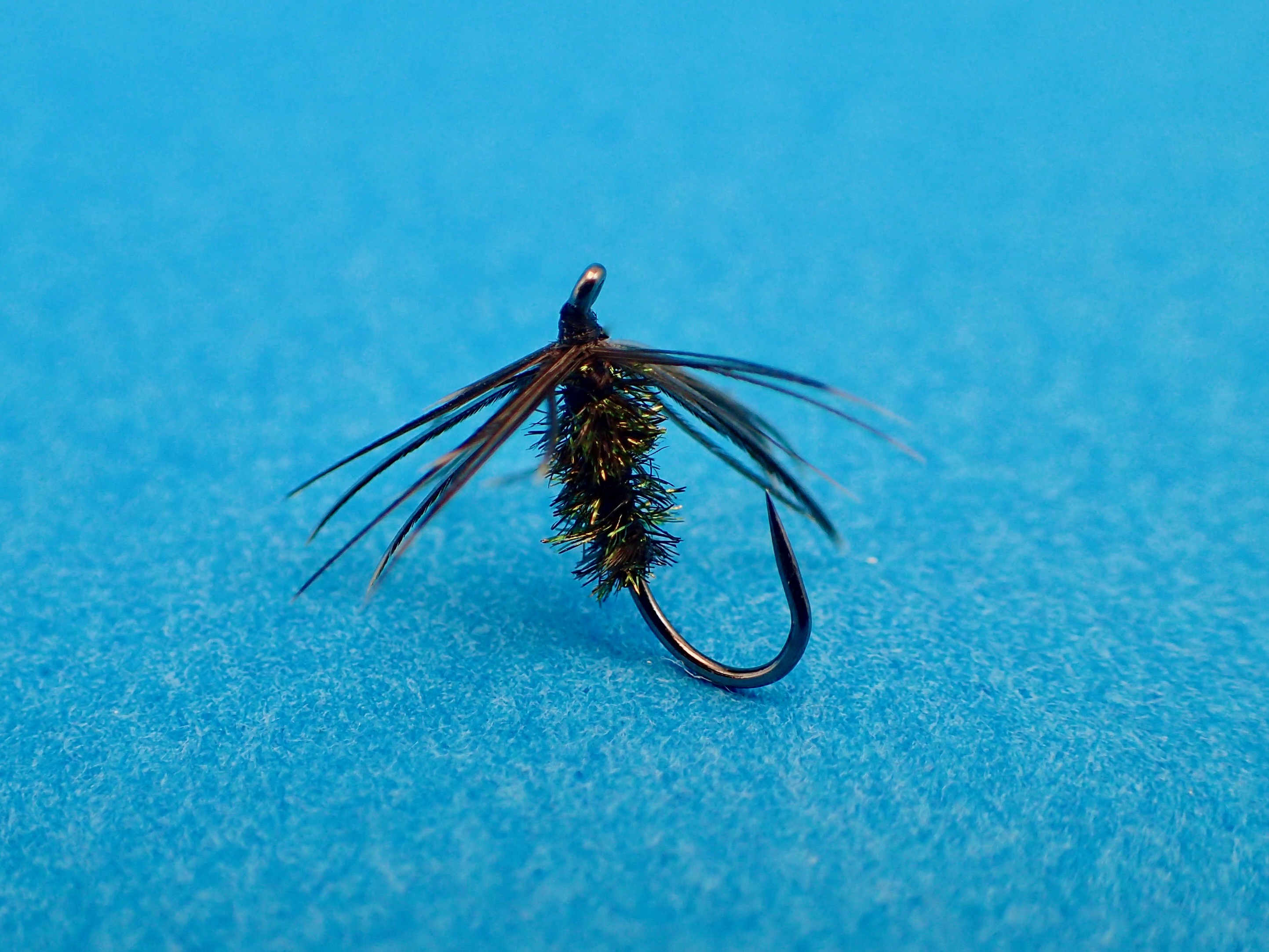
Pro tip: when there are so many orange/yellow/red leaves in the water, try going dark or white with streamers — and make sure one of your nymph droppers is small and dark (it’s tiny BWO season). A small Starling and Herl soft hackle would be a fine choice.
I had big plans for this summer. I was going to go on smallmouth fishing binge the likes of which I’ve never experienced. I was going to conduct a bunch of experiments with presentation and techniques and different flies. I was going to find and learn some new water, and I was going to do some in-depth study of water I discovered last year.
And then the rains came. And came. And came. And kept coming. It was one of the wettest summers on record. The Housy was stuck on a black or blue dot on the USGS page for the entire month of July. August wasn’t much better.
But I’m a stubborn sort and I wanted to fish for smallmouth. I was damned if little things like flood stage and water the color of chocolate milk was going to stop me. So I went fishing. I managed well over a dozen outings, for which I am giving myself a gold star. I mostly had fun. I even got into fish. Here are some of the things I learned and re-learned.
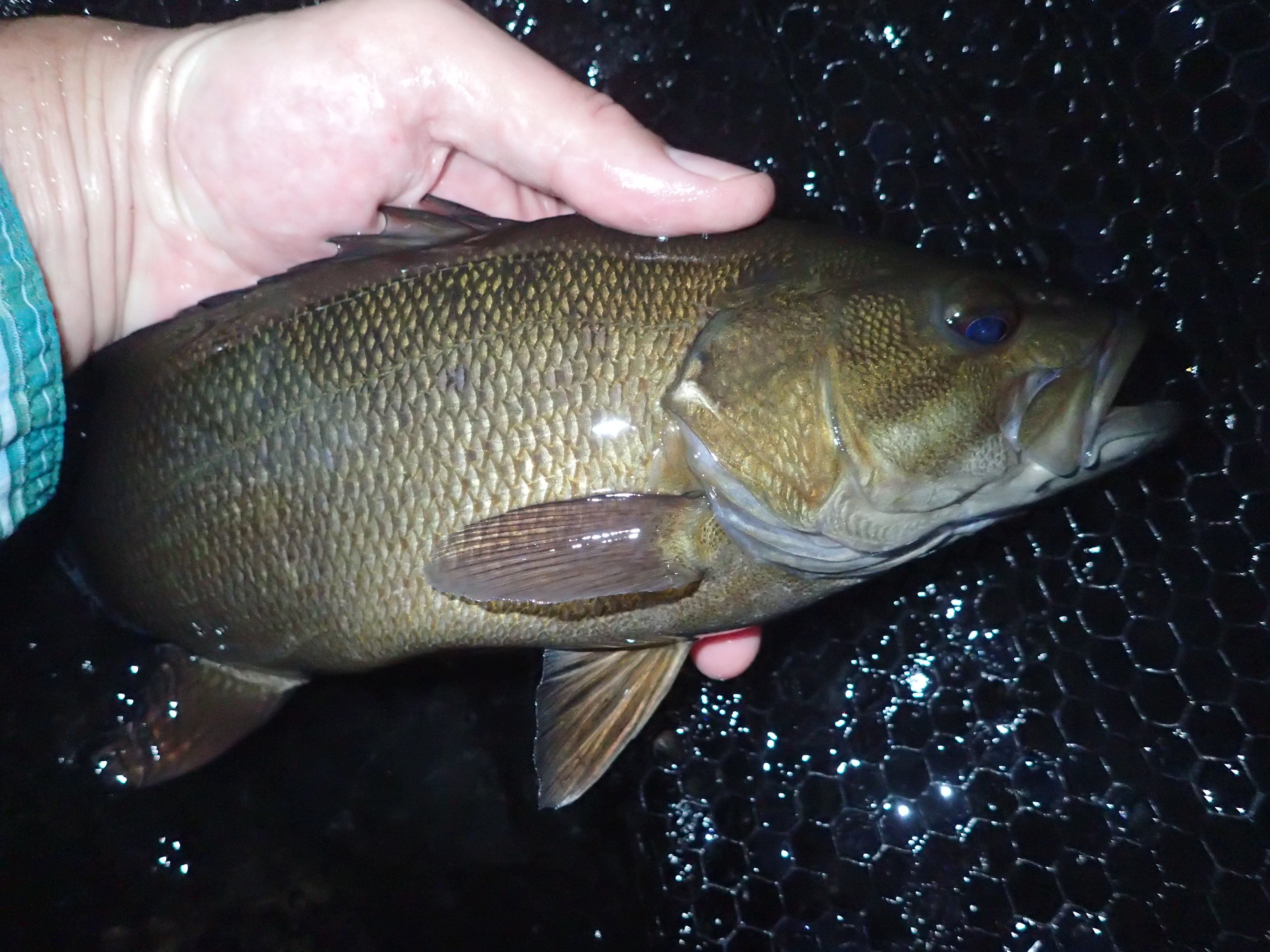
Not only can you catch fish in high, heavily stained water, you can catch some big fish in high, heavily stained water. This slob could be measured in pounds. It was one of three fish in the 16″ or bigger class that I landed, on — get this — surface bugs in a 2,300cfs flow. As it turns out, it was my biggest Housy bass of the summer. All fish were taken in water about three feet deep about a rod’s length from shore. I highly recommend that you don’t wade in water that you’re unfamiliar with if you can’t see the bottom. And don’t forget the wading staff! My apologies for the substandard photo. But it’s a nice smallie.I’d rather fish in very high or very low water than in medium-high to high flows. In the latter, there is no consistency to where the fish are from day to day, as they have enough water to virtually go anywhere. So one evening, I’d bang up a dozen quality fish in a pool. And the next, in the same mark, I’d blank or only get one or two. It’s also frustrating to have the river at a level where you just can’t wade into certain very fishy areas due to depth and current speed. I still managed to go exploring, and I fished two brand new marks with varying degrees of success. Pro tip: whether you’re fishing in high or low flows, structure is your friend, as are current breaks between faster water and slower water. Here’s the proof.In high water, hatches go on. Not only did this’s years White Fly hatch happen, it was one of the stronger showings I’ve witnessed, and it went well into August. Sadly, the surface action was virtually nil, although I did manage a few bass on dry flies over the course of the summer. Wet fly action was a little better, but if you know there’s likely to be a strong hatch, fishing well under it — AKA nymphing — will put a very big smile on your face. I didn’t see that many black caddis this summer, but there were a bazillion sedgy-white caddis, size 18, most afternoons and evenings. The bass liked them a lot. Some things didn’t change. There continued to be a shutdown moment right as dusk transitioned to darkness. And the Countermeasure continued to produce quality fish at that moment. I had several foot-plus bass on that fly as my last bass of the outing. Here’s to better conditions in 2022!
Fly anglers are always looking for the next best thing. Especially when it comes to fly patterns. But often, “new” doesn’t translate to “better.” Some of these patterns are decades old, but they still get eaten because the stripers haven’t gotten any smarter. So if you want to see what’s in my fly box this fall — and at the end of my leader — read “These Old-School Striper Patterns are Still Deadly During the Fall Run,” brought to you by our good friends at Field & Stream.
The Magog Smelt Bucktail didn’t make the article, but it’s another fall favorite of mine. You can find out more about this pattern here.
You can read my newest piece, “8 Flies Smallmouth Bass Can’t Resist,” right now at Field & Stream online. Even if you’re more of a trout person, I’d recommend giving it a read as many of the patterns translate to the Salmo family. Naturally, I’ve included a few of my own bugs, like the August White and the Countermeasure. Besides, it’ll give you something to do while waiting for all this water to recede…
I’m pretty sure this guy ate a TeQueely, one of the featured patterns in “8 Flies Smallmouth Bass Can’t Resist.”
The best system for organizing your fly tying hooks and beads is the one that works for you. In the case of my ever-growing collection of such stuff, that means storage compartment boxes. But not just any boxes. They need to be adjustable, stackable, and easily transportable. Since I’m not fishing this week, I’m using the time to organize the disaster area that is my tying space. I thought I’d share my process of sorting and storing hooks and beads with you.
Let’s start with the storage boxes. I’m a big fan of the 3700 Series Plano Prolatch(TM) Stowaway(R) and 3600 Series Deep Prolatch(TM) Stowaway(R) bulk storage containers. I’ve been using them for years. You can find them at many hardware and big box retailers, and you can also order them directly from Plano. They’re very reasonable priced, and they’re a quality product. I like these boxes because they allow custom configuration; you can create numerous different-sized compartments within each box. The boxes stack neatly atop one another. And if I’m doing a show or a class on the road, I just latch the box and toss it into a larger container for transport. (Plano offers many more options in the way of fishing hardware/lure storage — it’s worth browsing their site if you’re looking for ideas.)
This is the Deep Prolatch: 11″ x 7.25″ x 2.75″. I’m using this one for my freshwater streamer hooks. Everyone will have their own system of organization; for example, I’ve got hooks of different sizes and makes and models in the middle two compartments. But all the 3x long hooks are on one side, and the 4x long hooks are on the other. Stingers and other shorter shank hooks are in front. Large jig and Atlantic Salmon hooks in the back. Works for me!
I can’t tell you how to organize your boxes –that’s up to you — but I can tell you how I organize mine. I have one box for beads and dumbbell eyes, sorted by color and/or material. For example, I have one compartment for brass copper beads and another for tungsten copper beads. But there’s only one compartment for gold beads, regardless of material, because I don’t have a lot of gold beads. There’s a box for freshwater streamer hooks, and a box for saltwater streamer hooks. My smaller hooks box is organized by hook type, with compartments for light wire hooks, heavy wire hooks, shrimp/scud hooks, heavy steelhead hooks, egg hooks, etc. Again, there may be many sizes and different makers within a compartment, but I can easily find the right hook for a size 14 North Country Spider (light wire hooks section) or a size 12 Dark Hendrickson winged (heavy wire hooks section). Easy-squeezy.
The Beads Box, a 3700 Series Prolatch Stowaway, 14″ x 9.13″ x 2″.Saltwater Hooks, 3700 series. I use fewer types of hooks for salt than other endeavors, hence the extra space at the rear. (Those are spare dividers you see. Each Plano box comes with a set of dividers so you can customize your box.) To be fair, I sometimes use freshwater hooks in the salt, such as Atlantic salmon hooks, and those are kept in the streamer box.My workhorse freshwater box, also 3700 series.Stack ’em up! It’s also very cool to be able to grab a box, toss it into a large container, and hit the road without having to worry that I’ll open the box to find a thousand mixed beads rolling around. Everything stays in its own little space.
In his classic Stripers and Streamers, Ray Bondorew serves up an unimpeachable truth: fly tyers tend to overcomplicate things. Nowhere is this more true than in striper fly tying, where realism is king. Sand eels, also known as sand lances, are pretty basic — slender body, pointed snout, lighter on the bottom, darker on the top. Yet, as Ray observed, “Many sand eel patterns have been devised over the years, and many seem to involve much work to copy such a slender, simple bait. Complex bodies with Mylar tubing, Corsair, and epoxy have evolved. Several patterns require tandem hooks.” He doesn’t mention my pet peeve: eyes, which do a fantastic job of catching anglers. But I digress. I’ll let the man continue.
“I have always thought,” Ray said, “that there must be a way to formulate a simple, quickly tied, and effective pattern, especially for sand eels less than four inches long.” So Ray went forth and prospered at the vise. Ray’s Marabou Sand Eel is another favorite of mine, along with Ken Abrames’ Eelie, for imitating small sand eels, three inches long or less. Like Ken, Ray has some very specific thoughts on how best to tie this pattern.
“The trick here,” he says, “is to use as little marabou as possible.” Any thicker than a paper match width is, as Ray calls it, “overdressed.” Wet your fingertips and run them along the length of the completed fly to see if you’ve achieved your goal. Those who channel their inner sparse, impressionistic fly artist shall be rewarded with fat, cantankerous stripers.
Ray’s Marabou Sand Eel. Thread: Light green monocord. Hook: Eagle Claw 254 size 1 or 1/0. Body: Pearl braid. Tail: Several wisps of long white marabou over which are tied two strands pearl Flashabou and a few wisps of olive marabou. Wing: A few wisps of olive marabou topped by 2-3 strands of peacock herl.
Tying notes: As with Ken Abrames’ Eelie, I use the Eagle Claw 253 or other light, wide gap hook. No monocord for me, so I use Olive UNI 6/0. Leave a 3″ tag of thread near the hook bend; use this tag to bind down the wing. (Ray says if you choose to go the non-bound wing route, the pattern makes a fine silverside fly.) The pearl flash should extend beyond the wing by 1/2″. Use high quality marabou quills, and keep it sparse. What’s pictured here is as heavily dressed as I go.
If you tie Ray’s Marabou Sand Eel and it looks too thin, you probably tied it right.
Many of you know that Ken Abrames’ Big Eelie is my favorite sand eel fly. I use it primarily when the bait is at least 3″ long, or when I’m fishing an open beach or need a sand eel searching pattern. Oh, did I mention that it’s my favorite fly for Block Island? But smaller bait requires a smaller fly. Enter Ken’s Eelie, little brother to the Big one. The Eelie is basically a Big Eelie minus a saddle and the soft hackle. I rarely tie the Eelie longer than 4″; 3″ seems just about right. I love this fly as part of a three fly team; that’s how I most often fish it. Like the Big Eelie, the Eelie lends itself to all manner of color variations (try white, chartreuse, and olive, with a chartreuse body).
The Eelie is an exercise in sparse construction (some bucktail and a few hackles), simplicity (it’s a fast, easy tie), and impressionism (no eyes). The key to the Eelie is its thinness. I’ll quote Ken from Striper Moon: “The secret of tying effective sand eel flies is how thin you make them. Sometimes, an eighth of an inch thick is too heavily dressed.” You’ve been so advised by the master himself.
Ken Abrames’ Eelie. Hook: Eagle Claw 254 sz 2-1/0. Tail: White bucktail, then a white saddle, then pearl flashabou, then a yellow saddle, then an olive saddle. Body: Pearl mylar tubing. Wing: None
Tying notes: Ken’s original recipe is listed above. I make a few changes when I tie the Eelie. For years, I’ve been using the Eagle Claw 253 1/0 and some smaller hooks from brands like Gamakatsu; the key is to find hooks that are short shank, wide gap, light and strong. I match thread color to body color (here I used UNI 6/0 white). Instead of tubing, I use pearl braid for the body. Follow Ken’s instructions for thinness, and you’ll make the bass — and yourself — very happy.
For sand eel flies like the Eelie, thin is always in.
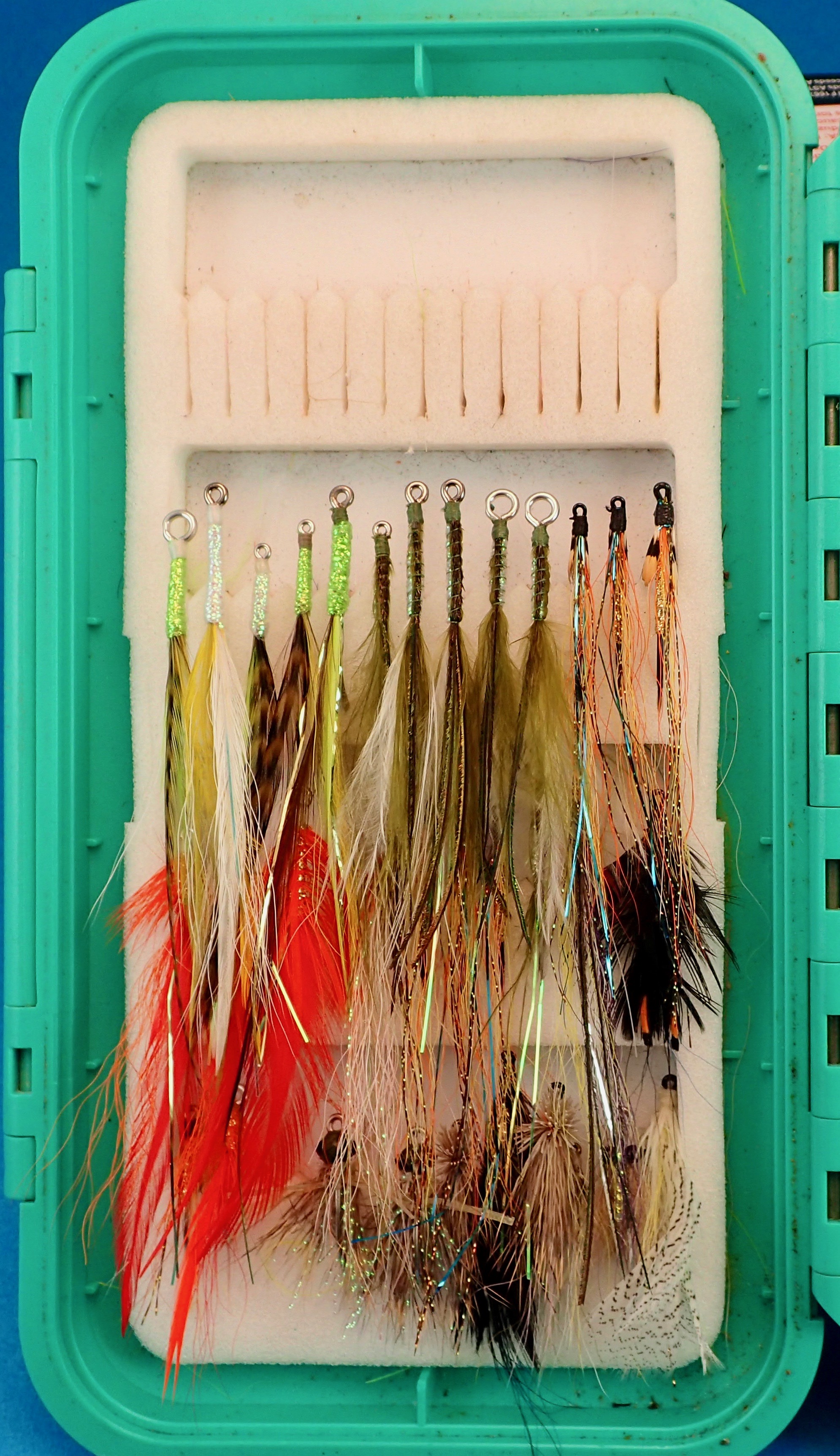
I received so many comments and emails about my recent post on my striper fly box that I thought it deserved a follow-up. Having taken to the vise, my next step was to fill in the blanks. The box is sand eel-heavy, and that’s by design since I like to fish summer marks where sand eels are the primary forage.
I populated the third row with small stuff like clam worms, shrimp, and mostly small baitfish and sand eels. The second row gets all sand eels, from left to right: Eelies and Eelie variants, Ray’s Marabou Sand Eel, and the Golden Knight bucktail. Those flies are all 2 1/2″-3″ long. The big-eye hooks were gifted to me by some friends in Europe; I’m not sure of the name or size, but they look strong, have a wide gap, and are very light.To the main event! Big Eelies get top billing since they are my workhorse (and favorite) pattern. The original is far left, followed be all kinds of variants: Olive Fireworm, Crazy Menhaden, a couple as yet un-named, L&L, Bruiser. (You can find recipes for most of these on my site.) Spares will go on the right side, along with squid and some experiments I’ll be test driving this summer and fall.
I fished a different section of the lower river yesterday, from late afternoon into dark. The water was clear, cool, running at 460cfs — just about right. As is my my custom, I arrived rigged for wet fly, anticipating a typical very late spring pre-hatch wet fly bonanza. ‘Twas not to be. The early evening hatch never materialized. Well, it did if you count three sulphurs and four spotty rises in 90 minutes. But I was sorely disappointed with the lack of activity. I managed a measly four bumps, and only one of them resulted in a hookup. (Then again, the prime wet fly water in the run was occupied.)
At 7:30 I re-rigged for dry fly. It took a while for things to happen, but when they did, it was fast and furious. Observed: sulphurs size 16, tiny BWOs, Isonychia size 12, dark gray stoneflies size 12, and mats of midges. I focused on the yellow stuff, and threw Magic Flies, Usuals, and Catskills Light Cahills, all of which were eaten. Noteworthy: the world’s longest refusal (drifting over a gravel bank into a drop-off, and this guy rose and shadowed the fly for a good fifteen feet, nearly taking it several times before saying no); an epic 50-foot drift where I had three(!) different trout commit to the fly with a splashy take, none of which resulted in a hookset; and a comical take where a brown blasted the fly like it was going to hurt him, which, as it turns out, it did — in his haste to dine he fouled himself in his pectoral fin.
I was fishing in some fairly technical water, which I often prefer with dry fly because of its challenges. (We’re talking longer leaders, precision mends, and tricky drift management.) I didn’t connect as many times as I would have liked to, but I did hook fish from as far away as 45 feet and a close as a rod’s length. The frenzied feeding really didn’t begin until 8:30, and when I dragged myself away at 9:15, I’d just hooked a trout on a drift I couldn’t see.
A strange but pleasant evening. The first outing with the cane pole is always a treat.
This one’s worth repeating. There comes a stage late in the hatch where trout are feeding on both duns and spinners. Then, it transitions solely to spinners. You don’t need to stress about which stage they’re eating if you’re using a Catskills style dry like this Light Cahill. Trout will eagerly take it even when they’re on spinners. Every year, some of my biggest dry fly trout come on this pattern when the only feeding tell is the gentle, subtle spinner rise ring. Pro tip: you can upsize the fly so you can see it in the gloaming.
Another year, another appearance in On The Water magazine‘s “Guide Flies” column, written by Tony Lolli. You’re familiar with he concept of a guide fly — a pattern that is typically simple to tie and is a consistent producer. I’d like to introduce the Grass Shrimp Solution as Exhibit A: some bucktail, a few wraps of braid, palmered wet fly hackle, and then you’re fishing. You can see the wet fly influence in its construction. I like this pattern at night when the grass shrimp are forming mating swarms, and are being carried out of an estuary on current. Make it part of your three fly team, and hang on! This pattern was originally published in the old American Angler magazine, Nov/Dec 2015, “Soft Hackles For Striped Bass.”






 currentseams.com