Stripers en Espanol

Last week I had the pleasure of guiding Asier and Moncho. They wanted to learn more about linea engrasada (greased line) fishing for striped bass. What was remarkable about the session was that they came all the way from Spain to do it. I’d like to tell you we slayed legions of bass, but we saw only one fish caught in the two hours we were on the water.

But if there ever was an outing where catching was truly secondary, this was it. Moncho speaks limited English (and I know even less Spanish), so Asier served as an able translator. We talked fishing, greased line, Ken Abrames, asked and answered questions, drew diagrams in the sand, exchanged flies and hooks and cigars, laughed at our communication gaps — what an appropriate way to spend the the day after Thanksgiving.

Asier recently posted this in the comments section of my guide service link. I am both honored and humbled by his words. “We come from Spain to learn with Steve, we only spend two hours with him… much more than enough to convince me he is the kind of guide always wanted, the knowledge, the philosophy, attitude, positivism, and of course the way he teach… How much he teach us in two hours in the sea, I can´t imagine how much he can teach in the river…. I really would like to come back and…. let’s try… more!!!!! Thanks Steve, people like you make sense to fishing.”

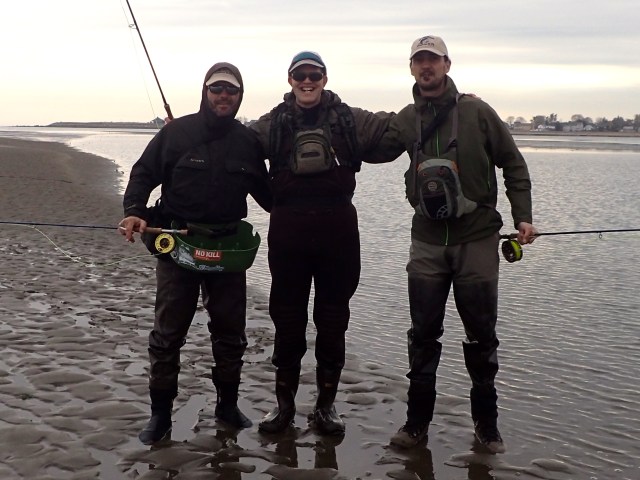
Three amigos. Moncho is on the left, Asier on the right.
OLYMPUS DIGITAL CAMERA


Farmington River Report 11/30/16: What’s all that wet stuff?

Not since the heady days of July have we seen this much water in the Farmington. 240 cfs! I fished in and out of the permanent TMA for 3 1/2 hours today. The water was somewhat stained — the closer to the Still, the greater the color — and 40 degrees. I saw midges and some really small BWOs, and even a few risers in some of the classic dry fly water. Streamers were the plan today, and things began well with several bumps and one mid-teens wild brown to hand. Then it got slow. Real slow. The last three places I fished were all blanks. I must confess to being a little surprised, given the warmth of the day, the height and color of the water, and the deep overcast. But such is life on the streamer edge.

For those who care about these things, I celebrated blowing off responsibility with an El Rey Del Mundo Flor de Llaneza. Like the fishing, it did not suck.

More rain is on the way, so whatever rain dances you’ve been doing, please carry on. I had most of the water to myself, but I would think that will change this weekend.

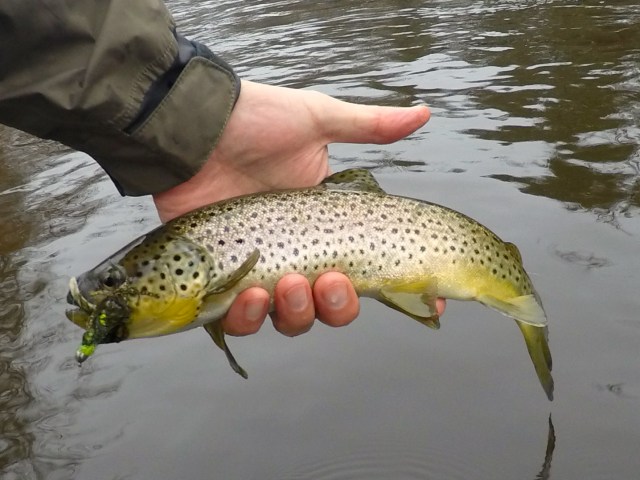
Excuse me, do I have something on my lip? The Deep Threat in olive/grey comes through again. The trout hit the fly three times over the course of two casts before delivering the kill shot.

DCIM100GOPROG0013600.

Reacquainting Yorkshire with Pulaski

It’s been another one of those steelhead seasons. Call it what you will — slow? Or maybe just a down year. But those years are now coming in bunches. That’s why I’m going with the Great Steelhead Recession. We’re chasing a fish that, in the best of times, is hard-earned. But the last three years have raised the emotional stakes to levels that will test an angler’s resolve. You can see it in the beleaguered eyes of the skunked. Hear the bitter tinge in their words (“Three days. Nothin’.”). The parking lots from Altmar to Pineville bear mute testimony to the current state of the fishery. November 9. Afternoon. Prime time. Three cars in the Ellis Cove lot, one at Lower Sportsman’s, none at the Refrigerator.

But, when you’ve booked a trip, you go. Prepare for the worse. And hope for the best.

~

I didn’t get a good hook set on the first steelhead. Fresh chrome — that was evident even in the tea-stained waters. But steelheaders live by their drag, and some die by it, like me, who had it screwed down way too tight for that first run. Pop! Stonefly thus liberated from metallic mouth. Hot, burning ownership of blame consumed me. And now I had to live with the thought that that might be my only touch of the day.

Into the seventh hour of fishing. The sun was out now, and I noticed a few whispy midges freeing themselves from their watery prison. Since it was time to change flies, I rummaged around in my box for the smallest, midgeiest, most emergerly fly I could find. There it was. Snipe and Purple, soft hackle, size 10. I’d tied it up years ago, then stuck it into a corner of my fly box. And there it sat, forgotten, waiting patiently for this moment.

I turned to Jim, my guide, and announced, “I’ll bet none of your clients have ever caught a steelhead on a Snipe and Purple soft hackle.”

There comes a time during every drift when the angler decides it’s over. On this particular one, I began to lift the rod just at the moment when the fly would have started swinging up from the bottom. The steelhead had been holding there, perhaps feeding on nymphs, when he saw the bug coming at him suddenly dart toward the surface. He made a decision. I want that.

Jim saw the flash just as I felt the sharp tug. Even has he was saying, “What?!?” I was driving the point of the small wet fly hook home. This time I remembered to set my drag.  Multiple runs, two dramatic aerials, then the net. And in the midst of hard times, we were celebrating our newfound wealth.

Sun reflecting off cold, hard cash, not too long from Lake Ontario.

sr11_10_16

~

Purple silk, gold rib, and a land bird hackle. That’s the actual fly at lower right. You can find the full article I wrote about these Yorkshire-inspired steelhead patterns here.

Steelhead Spiders

Meanwhile, up north in Pulaski…

…my spies tell me it’s good news/not-so-good news. The good: after a couple very down years, the 2016 salmon run has been strong. Here’s a quote from a local guide: “I thought that it would be a good run this year but it has far exceeded expectations.” More good: the watershed received several inches of much needed rain last week. The river jacked up to 2K; current level at Pineville is just over 700cfs. Everyone’s different, but I like higher water for this fishery. A strong salmon run means more eggs and rotting carcasses in the system, so right now is a good time to be tying up some egg and flesh patterns (and of course your favorite nymphs).

Now to the not-so-good: where are the steelhead? Those of us who remember the cruel disaster than was last year’s “run” are eager to return to the halcyon days of prodigious numbers of pre-spawn chrome. So far, that has not happened. Hopefully the next few weeks will see a big push of fish. Otherwise, we may be in for another long, cold, lonely winter.

Come back, baby!

OLYMPUS DIGITAL CAMERA


Midnight on the Water in Rhode Island

No sightings of the ocean’s daughter. But I did spend some time watching a small pod of stripers move and feed on the tide change. We’ll get to that in a minute.

In the space of three hours, I managed to fish: skinny water on the incoming and outgoing; under a bridge (I love shadow lines at night); the inside of a salt pond; an estuary on a ripping incoming tide; and a snotty beachfront from a jetty. I fished hard and I fished well, and I dearly wish I could tell you that I slayed ’em, but all I could manage was one dink and a few courtesy bumps.

The outside beach continues to vex me. Conditions off the jetty last night were just about perfect:  a good SSW breeze, substantial breakers, surging whitewater wash. But no predators. This particular spot is a serial disappointment; it used to be an I-need-to-catch-a-striper-so-I’ll-fish-here destination. 2016 makes it 4 consecutive years I’ve blanked at it.

The bridge, the estuary, and the salt pond were good places to fish if you wanted to hook weeds. I did not want to, but managed a prodigious haul of vegetal flotsam.

My only bass came on my second cast of the evening on the incoming. After, I drove around to explore the other places, then spent the last hour alternately casting to and watching a small pod of school bass drift into position at the turn of the tide (it was easy to see them in the bright moonlight). But the bait wasn’t there in any volume, and the stripers didn’t bother to stick around.

And once the clock hit the wee small hours, neither did I.

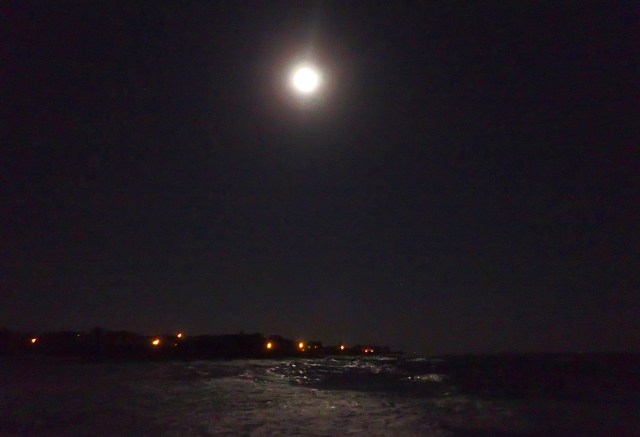
There. That’s what I’m talking about. Failed experiment in night photography aside, that whitewater wash bottom center is prime real estate for casting your fly. The jetty allows you to fish into the pocket formed by the rocks and sand, not to mention a good parallel shot to the trough just off the beach. When the bass are in there, you find yourself in tight line territory pretty fast.

OLYMPUS DIGITAL CAMERA

Farmington River Report: Nature finds a way

In the interest of some informal field research for the DEEP — not to mention my own curiosity — I did a little recon yesterday on a part of the river where the fish would have faced significant stress in the last 50 days. I purposefully went in the afternoon, when the water temperatures would be highest. I wanted to know if, on an unseasonably warm September day, the water temps would be below 70. If they weren’t, I would not fish. Most of all, I wanted to know if anyone made it through the long, hot summer. I visited three locations, staggered downstream at varying distances. Spot A was 67 degrees; Spots B & C were a hard 68.

I found active, healthy fish in all three places. I nymphed up a nice, fat brown, over a foot long, in the first location. He was in the net before he knew what hit him. One quick digital shot and back he went. There were two trout actively feeding on emergers in the second spot; I gave them a few quasi-wet presentations with un unweighted nymph rig, had a bump, and left them to their feeding. Ironically, the spot farthest downstream had the most action: three active feeders. Wanting to err on the side of caution, I didn’t bother trying to catch them.

To be safe, I would wait another week before venturing below the permanent TMA. We’re supposed to have some cooler temps, both day and night, after today. Most of all, a week will give the trout a chance to restore their vigor.

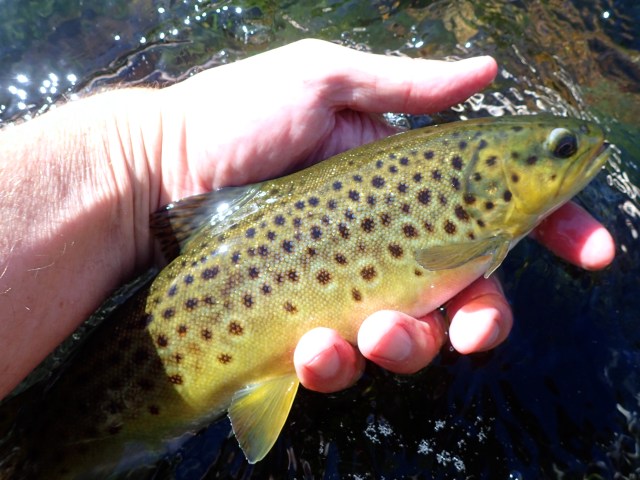
Looks like we made it! This guy was hanging out in about 18″ of whitewater right below a boulder. He took a size 18 soft-hackled Pheasant Tail.

OLYMPUS DIGITAL CAMERA


Farmington River sampling, stocking, and spawning, or: we really, really need rain

Yesterday’s rain was nice for the garden, but it was statistically insignificant for the Farmington River. Our favorite trout water continues to be battered by low flows (60cfs out of the dam as of this morning) and unseasonably warm temperatures. If you decide to fish, please use common sense.

To the trout: DEEP crews sampled the river last week. They extracted 99 browns from the permanent TMA for Farmington River Survivor Strain broodstock. These aren’t all necessarily big, wild fish — the goal is genetic elasticity, so there is a mix of sizes covering both wild and holdover fish. I spoke with Fisheries Biologist Neal Hagstrom today, who said there were “a fair number of wild fish. The holdover Survivors didn’t look as plump as I would have liked, but not as bad as I had feared.”

In past years, the post-spawn Survivor Strain broodstock have been reconditioned, then returned to the river. But Neal told me there is some discussion about keeping those fish in-house for genetic insurance until flows become more stable. (If I may editorialize, that sounds like a damn good idea.) There is also concern that the current low flows will inhibit natural spawning this fall. Likewise, a spike in flows would be bad, as it might cause the fish to create redds in unsustainable locations. How this all will play out, only Mother Nature knows.

Once water temperatures enter more trout-friendly strata, the DEEP will restock the lower river with yearling trout (7″-9″). “Hopefully, this will help rebuild the lower river trout population,” says Neal.

Kudos to the DEEP for everything they do for the trout and the river. 

Likewise to the MDC, who have done everything they can to maintain flows. Let’s not forget that the MDC’s first priority is to supply potable water to the community. That we still have cold water and healthy trout in an officially severe drought is a blessing.

So, go out and do a rain dance when no one’s looking, and remember — it’s only stupid if it doesn’t work.

Hang in there, dude. Help is on the way.

Brown release


Shocking news from the DEEP (2016)

The DEEP will be conducting its annual electroshocking/brood stock collection tomorrow, Tuesday, September 13. The following, in italics, is from an email I received from Fisheries Biologist Neal Hagstrom:

Housy Smallmouth Report: And then there were none

That inflammatory title doesn’t refer to the fish — plenty of Micropterus dolomieu to go around — but rather to the number of big, classic Connecticut fly fishing rivers currently with flows in the triple digits of cfs.

While neither extreme is preferable, I really don’t enjoy fishing in low water. Like the Farmington, the Hous (96cfs, 75 degrees) is rapidly becoming a featureless rock garden. Unfortunately, it doesn’t look like Hermine is going to give us even a temporary respite (I understand that going back to 2015, our state is at a 14-inch rain deficit). And so we carry on.

But enough of the negative waves.

Yesterday was a good day for a little father-sons wet-wading fly fishing for smallies expedition. Here are a few shots from Dad’s brag book.

Cam’s on! Cam says: “These things fight like little steelhead.”

OLYMPUS DIGITAL CAMERA

~

Gordo’s on! Gordo says: “Why do they keep jumping out of the water?” This smallie gave us two spectacular aerials.

OLYMPUS DIGITAL CAMERA

~

Today’s special: Crayfish. Half-off.

OLYMPUS DIGITAL CAMERA


Housy smallmouth: The hits just keep on coming

The Farmington continues to struggle with low flows. I spoke with an angler today who fished it recently, and he said he was so discouraged by the water levels that he left after 20 minutes.

Meanwhile, in another part of the state, the upper TMA section of the Hous was flowing at just over 200cfs, and 74 degrees. Fine conditions for an evening of wading and casting for smallmouth bass. Things started off slow — I began at 6:45pm in a section I’ve hit repeatedly, but has not produced numbers or size. I’m at a loss to explain why. It’s deep, it’s got moving water, and lots of boulders. All that’s really missing is a sign that says “Get Your Smallies Here!” Nontheless, two unremarkable bumps were all I could manage.

However, Honey Hole 1 (my name for it) continues to impress. It’s a fairly nondescript run, but it has held a good number of decent sized bass every time I’ve fished it. By 8pm I was working my way downriver to Honey Hole 2 (see parens above). HH2 fished a little differently in the higher water — the fish were more widely spread out than in previous trips. Here are a few notes from last night:

Unlike trout, smallies rising to flies will crush a big streamer thrown in their general direction. I caught countless bass last night at dusk by simply aiming for rise rings.

A larger fly doesn’t necessarily cull the smaller fish. I’m still trying to understand how some of the little guys I landed got a 4x long size 2 streamer hook entirely into their mouth.

Like with trout, the action seems to taper off at dark. Hatch over, time for a feeding break? I’d like to stay well past dark one of these nights and see if the action picks up.

Housy smallies love sunken streamers as well as waking surface flies.

I’m continuing to test a prototype of a floating version of the Deep Threat. (Once semi-perfected, I’ll post it.) So far, so good. Wait. Make that very good.

“Is that the foot-long?” “And then some.” (Bonus points if you can name the cheesy 80s comedy those lines come from. Hint: it stars a future Oscar winner.) This was my best bass of the night, coming in at 13 inches, a very respectable size for this river. He threw acrobatic leaps and generally obstreperous behavior into the bargain.

OLYMPUS DIGITAL CAMERA