Farmington River Mini-Report 7/13/16: 1-for-90

I had 90 minutes to fish mid-day today. Sunny, hot, and a gusty south wind, so I figured the terrestrials-blown-into-the-water energy might work in my favor. Fished a three fly team of (from top to point) a drowned hopper, Drowned Ant, and SHBHPT. The venue was a long, snotty run that would be a very manageable wade at 240cfs (59 degrees at 3pm if you’re keeping score at home).

Didn’t I feel like a genius when a fat rainbow jumped on on the second cast. But, it was on the PT. And it was the only fish to net today. So that proves how little I know.

On the other hand, while much of the east coast was working, I was standing in a gorgeous river, fishing.

Maybe I’m not so dumb after all.

Block Island report: Three steps forward, one giant leap back

Block Island used to be the the place I’d go to restore my faith in the ocean. The late spring striper fishing in Connecticut would inevitably fade, and mainland Rhode Island would become a crap shoot. But Block Island would be as reliable as sunrise in the east.

Over the course of a week, I could expect between 60 and 100 bass, with a healthy percentage of legal fish in the mix. Many were the years when my largest striper would be a summer resident of the Block. And while there might be a night of skunking, the Island would always quickly repay me with an off-the-charts outing. (I still fondly recall the night in the mid-two thousand oughts when my friend John and I encountered a school of 15-25 pound bass within casting range. John took a striper on 11 consecutive casts — work that out in your head — and I managed the largest fish of the night with a junior cow that went nearly 40 inches. I don’t think the drags on our reels were ever the same after that.)

Then came 2011. I landed eight stripers over the course of a week. Incredibly, 2012 was worse: four bass over seven nights. 2013 was much better, albeit spotty, 2014 better still and more consistent, and then last year I surpassed the 75 fish mark without a single skunk.

Sadly, the resurgence was short-lived. A paltry ten bass this year, four in one night. (This  indicates a dearth of schools of feeding bass. Instead, you get lone wolves, which means you need to be in the right place at the right time. Certainly some of that is calculable, but much of it is left to the whims of chance.) I had to work my butt off for those stripers, too — a typical night had me bouncing around the island hitting multiple spots. On of my two single-fish nights, my striper came on the last cast. I saw less than a dozen sand eels all week. The family goes to the beach nearly every day, yet I could only find one bass cruising the shore break. Even more telling was the hardcore-wetsuit-plugger who relayed his tale of woe. Fishing on his favorite boulders from the southeast to southwest sides, he managed a single bass over four nights.

My local spies tell me that the beach bite never materialized this year (the second half of June/first half of July is typically prime time), and the boat bite has likewise been poor. The big question is: why? For one, no bait, indicated by a paucity of shore birds scavenging the beach on the receding tides. Some locals are pointing to the wholesale wanton slaughter of larger bass at the Ledge over the last half-decade as a contributing factor. Meanwhile, Cape Cod has been en fuego this year. Could it be that for some reason, large numbers of bass ignored the right turn to the Block and continued on to the cozy confines of Chatham?

One thing is certain. A new normal for fly fishing Block Island from the shore has been established. And it is:  you pays your money and you takes your chances.

Good times on the first night. This fish was part of the only school (if you can call a half dozen bass a school) of actively feeding fish I found all week. What he lacked in size — this is a 24-incher — he made up for in ferocity. My presentation was short strips across a slow current, and he hammered the fly with such power that I put him on the reel. The Big Eelie in various color schemes accounted for all my bass. One constant on Block Island remains: the remarkable clarity of the water. 

OLYMPUS DIGITAL CAMERA

~

Iron meets water and air. Oxidation ensues. Taken on the northwest side.

OLYMPUS DIGITAL CAMERA

~

Darkness falls across the land. (And sea.) I took this shot while perched on a rock as the waves rolled in at my feet. I was sure I was going to score a 15-pounder here — there was a nice rip line moving across the current — but I blanked. A bit of a tricky wade as this flat is a weed-covered boulder field, so I was thankful to make it back to shore on the incoming tide.

OLYMPUS DIGITAL CAMERA

~

I saw you, feeding noisily near that boulder pile. The best striper of the trip, and my only keepah. I had to reposition myself to properly present to this fish. On the second cast, bang! What? I couldn’t believe I missed him. So I ripped my line in to make another cast. In the moment it took to raise the rod tip, slack formed in the line. When I lifted the line off the water, the fish was on. To reiterate: I’d rather be lucky than good.

OLYMPUS DIGITAL CAMERA


Things to do in your Jeep during an electrical storm

I had a brilliant plan for last night’s striper expedition. Really. It would have been perfect. Unfortunately, Mother Nature decided to fire up some major thunder and lightning action just as I pulled into the spot. Not wanting to be a statistic, I cooled my heels in the truck with a Liga Privada No. 9 Double Corona (a cigar of immense depth and power) while the storm raged overhead. I turned on the Mets game, and since they were murdering the Cubs, it made the 90 minutes of prime lost tide slightly more bearable. I decided to amuse myself by trying some artsy no-flash-in-the-dark selfies. Here’s a trippy Jimi Hendrix acid light show rendering of your humble scribe:

ElectricSmoke

As soon as the storm passed, I raced to the beach where I managed two stripers in the last gasp of the outgoing tide.

A reminder that no fish is worth chasing in an electrical storm. Please get off the water and take cover when you hear thunder.


A follow-up to the 6/21 Farmy report

On the way home from the river, I stopped by my friend Sal’s place (Legends, a gorgeous B&B/lodge on the banks of the river — see the icon/link in the right hand column). Sal was fishing Greenwoods (right outside his back door) that evening and reported finding ants in the water. When he tied on an ant pattern, his hookup rate shot skyward.

Don Butler wrote, “ants is good food.” Sal’s experience is a reminder that it’s that time of year. Once we near fall, look for wet/humid days to produce swarms of flying ants, too.

One of my favorite summer wets is the Drowned Ant.

Drowned Ant head-on

Farmington River Report 6/21/16: Cane and able

Gadzooks! Can it be June 21st and I have not yet fished the Farmington with my beloved cane pole during my beloved Sulphur hatch? Begone, oh evil scheming time-space continuum! Here are some notes:

Fished the upper TMA. Water was 313cfs, clear, and cold. So cold, that I was shivering. Got to remember the fleece next time.

Hatches: Excellent! Sulphurs (16-18), caddis (18), a few small BWOs (18-20) and the ubiquitous midge. When I arrived at 5:00pm, there were sulphur duns on the water and the trout were enjoying them immensely. I find emerger patterns like the Usual and the Magic Fly to be less effective when the trout are eating duns, and that was the case last night. A classic Catskills-style dry worked nicely. By 7pm, the duns were off the water and the trout were on a second sulphur emergence (splashy rises) and spinners or something smaller (gentle porpoising). Small comparaduns and the Magic Fly size 20 worked for me.

A summer evening, a bent rod, and a My Father Le Bijou 1922 box-pressed torpedo. For one shining hour, all is right with the world.

DCIM100GOPROG0062824.

~

My tastes in dry fly water vary, but I think what I enjoy the most is technical water that requires tricky mends. You know the kind — nasty cross-currents and variable speeds, and if you get one good, natural drift out of ten casts, you’re doing well. My first dry fly session of the year usually exposes the rust — from presentation to hook set — and last night was no exception. I stuck six fish that I lost moments after the strike. I had another dozen quality rises to my fly that came up empty. Still, I landed enough browns and rainbows to keep me chuckling.

I still don’t understand why people leave the river at 8pm. As I point out in the current issue of American Angler, the last hour of twilight in the summer is when the fish go nuts — and get reckless. The rise activity was steady and solid from 5pm-8:15pm, but in the next hour it went off the charts. And I had 75 yards of prime water all to myself. I like a size 10-12 Light Cahill Catskills dry during this time.

Once I can no longer see the fly, I use the bucket method (look it up) of strike detection. That is, unless my line suddenly comes tight because a mid-teens wild brown slaughtered the fly and is now swimming upstream with fierce conviction. Note the kype, haloed spots, white edges and full adipose.

OLYMPUS DIGITAL CAMERA


Observations from yesterday’s Farmington River outing

I nymphed in and out of the permanent TMA for several hours and found trout in every spot. Water was around 320 cfs, 56 degrees, and clear. Not much in the way of hatch activity, although there were some caddis and midges. Four things stood out to me.

— My fish were evenly divided between the top dropper (sz 14 March Brown wingless wet) and bottom fly (sz 12 BHSHPT). So it’s good to give the fish a choice.

— One of the fish was a juvenile salmon. When I was stripping him in, a big brown gave chase and bailed just as I was lifting the salmon out of the water. I think it’s time to tie up a JV salmon flatwing.

— The last fish, a substantial wild brown in the high teens, took the fly on my first cast after I witnessed a smaller fish clear the water and another boil at the surface. Clearly, there was a caddis emergence in that brief window, and I was not surprised that he took the top dropper (which looks very caddis-y — see point number one.)

— In one spot, there were several anglers fishing in the run above me. All of them blanked. It could have been that it was just a slow day, or it could have been that they were all standing in the same place, fishing the same water for 45 minutes. If you’re not catching, move and find the fish.


Back on the striper night shift

Last night’s striper adventure returned me to some favored waters along the Sound. There were grass shrimp and mummies, and as the tide began to pull back toward the sea, the estuary suddenly came alive with the random staccato of carnivores on the prowl. The assembled diners were only in the 12″-18″ range, but what they lacked in sized they more than made up for in gusto — and in eagerness to jump on the fly.

I fished a three fly team last night, and caught stripers on all three patterns (top dropper = sz 10 Deer Hair Shrimp, middle dropper = sz 6 pink Crazy Charlie, point fly = 2″ Orange Ruthless clam worm). The bass favored the top dropper and point fly. I caught them on the strip, the swing, and the dangle.

We went low budget (but thoroughly enjoyable) on the cigar, a JR Cuban Alternate Cohiba Esplendido.

Now begins the internal debate: do I get a good night’s sleep tonight? Or do I venture out into the very wee small hours again?

Droppers are the fastest way to find out what the fish want.

StriperShrimpDropperRig

~

How to tie a dropper rig for stripers. (Just in case you missed it the first time.)

OLYMPUS DIGITAL CAMERA


Cape Cod striper mini-report (and a good lesson learned)

Up at the Cape this weekend for a soccer tournament, and after family duties were fulfilled I got the chance to wander out. Saturday night at my secret spot was a bust. The good news was twofold: I now have some intel on how the channel has shifted, and I did not sit on that big driftwood log that turned out to be a seal carcass (always confirm your landing zone before you park your butt).

Last night I met up with some people I know from Stripersonline.com. We fished a spot that was new for me, and I liked it for its moving tide and structure. The action wasn’t anything to get excited about, but most of the group managed to touch a fish. I’m quite sure my second striper will be the smallest one I will catch this year. How he managed to eat a 3/0 hook is a question for marine biologists to ponder.

I hope you had a good holiday weekend, and please be sure to pause a moment and remember those who made the ultimate sacrifice in the service of our great nation.

Farmington River Report: “I usually get skunked.”

That was Wayne’s general assessment of his Farmington River experiences.

Of course, that was before Thursday. Wayne put on a wet fly clinic, hooking nearly double-digits in trout and landing most of them. I had Wayne fishing a traditional three-fly team, and he saw action on both the top dropper (Squirrel and Ginger size 12) and the point fly (SHBHPT size 12). We fished three locations within and outside of the permanent TMA, and found customers in all of them. Caddis, midges, and in the afternoon some Light Cahills and smaller BWOs. Water a terrific wet fly height, 350cfs, and a cool 54 degrees. Hats off to Wayne for an outstanding day.

“Are you still there?” Yes,  he was, and as a result we have this bent rod to deal with. 

OLYMPUS DIGITAL CAMERA

~

Wayne admires his handiwork.

DCIM100GOPROG0022674.

~

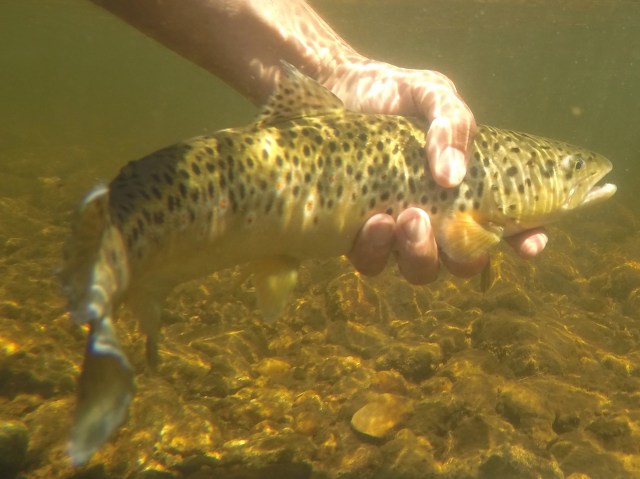
A different perspective on the release.

OLYMPUS DIGITAL CAMERA


That’s AM. Very AM.

Getting home from a fishing trip when the birds are just starting to sing is significant.

It can mean the fishing was so good you lost track of time. It can also mean you were stupid enough to leave your home before midnight and stay out long past where good sense should have compelled you to stop.

And sometimes it’s a little of both.

A bleary camera eye stares blankly at the microwave oven clock. 

VeryAM

We’ve been working the striper night shift here at currentseams for the past three weeks. While it’s been a mixed bag, it has been better than last year (pretty much a blank repeated ad nauseum), with only one skunking in the mix and my first keeper of the year. Most of the fishing has been wonderfully meditative greased line presentations with large flatwings. And I’ve had the chance to reconnect with my beloved five-weight.

The best striper of the spring so far, a 30-incher who found my Rock Island flatwing to her liking. I was lucky to catch this fish — she came at the end of the drift on my last cast of the evening, and saved me from the dreaded polecat. Loads of fun, and quickly landed on the five-weight.

OLYMPUS DIGITAL CAMERA