FRAA Awarded the Order of Pizza with NEIPA Clusters, and other late October musings

Many thanks to the FRAA for hosting me last night. I’m beyond giddy with all the positive feedback I’m getting about the book — it’s truly gratifying to hear that people are digging not only the content, but also the writing. There will be no dull textbooks from this author! We had a strong turnout last night at Brewery Legitimus, and I helped myself to several slices of pizza, washed down with a delicious Dr. Strangehaze NEIPA before hitting the floor to speak. The book tour continues next week, October 27 at the Crossroads Anglers in Foxboro, MA.

We’ve reached peak foliage time on the Farmington, and that means two things. First, the leaves will soon be brown and tumbling down, which can muck up a fly presentation. You may want to avoid breezy days, which can produce whirlwinds of vegetal matter in the air and then on and in the water. Second, the browns are now firmly in pre-spawn, if not actual spawn mode. Be on the lookout for redds, the cleared out gravel beds where browns like to deposit their eggs. Think smaller gravel, and shallower, moving water. Redds are usually easy to spot; if you see a light oval patch surrounded by dark substrate, that could be a redd. The presence of trout holding on or nearby, doing some kind of canoodling dance, is another indicator of spawning activity.
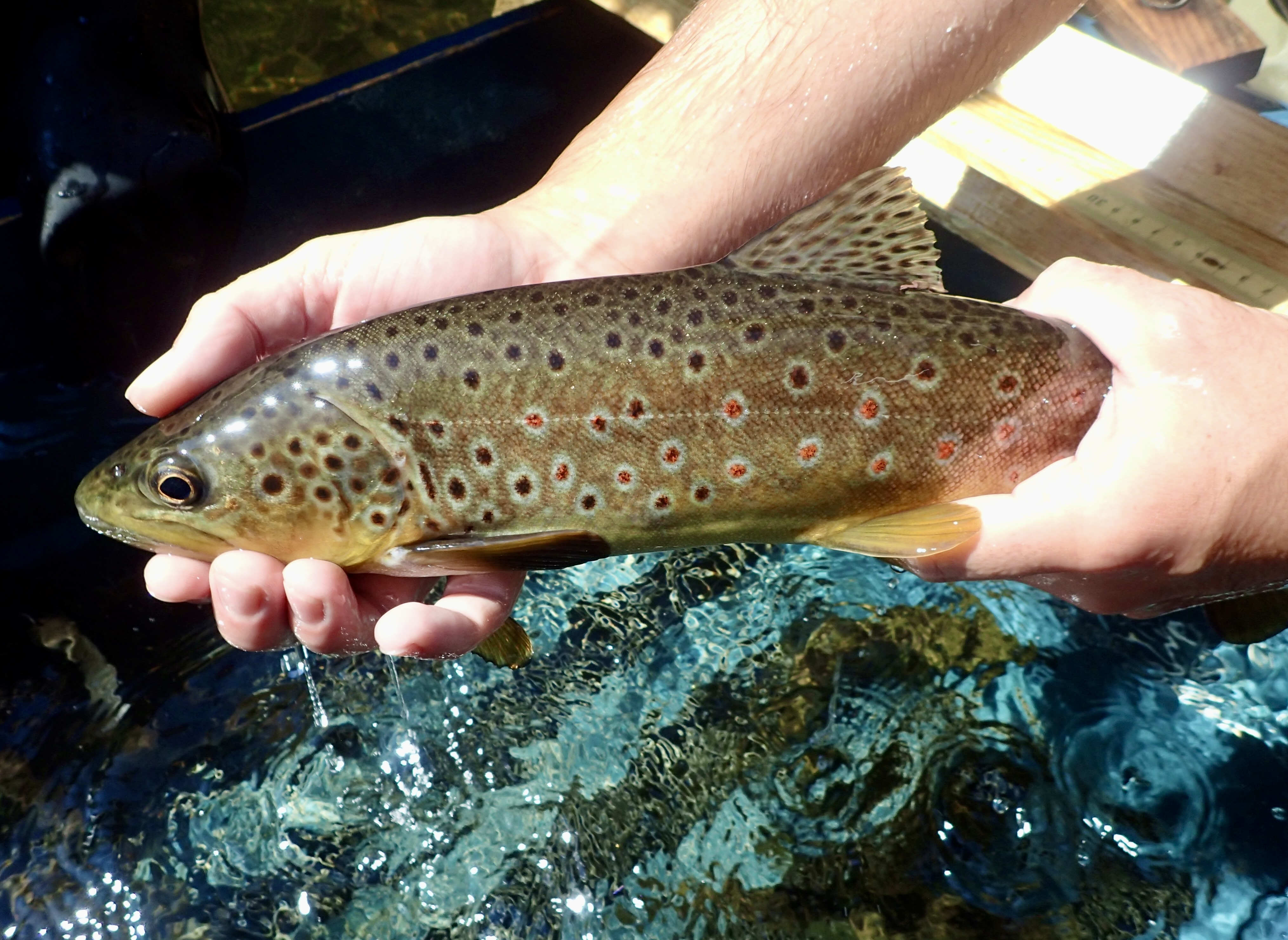
Wild fish come from somewhere, so it’s important to leave that somewhere — and its procreating inhabitants — alone to do their thing. This dramatically spotted brown was sampled from the PTMA in September 2024.

Note the locations of these redds for future reference. You don’t want to be walking over an egg bed in January. Crushing the next year class of wild fish is disastrous and avoidable. It goes without saying that you shouldn’t be targeting spawning fish. That’s unsporting and plain bad form. Sometimes non-spawning fish will set up a few dozen feet below a redd to pick off stray eggs. Targeting those fish with egg patterns can be productive, but please take care to watch where you plant your feet — and please leave those active spawners alone.

Farmington River Report 9/30/21: Nature finds a way

Yesterday was supposed to be a shooting day for a film and some personal projects, but the wind was most uncooperative, so we bailed. Already on the river and two hours to kill…what’s an angler to do? If you said, “fish,” you are correct! I decided that absent any consistent rises, and with the gusty wind, indicator nymphing would be my best bet for hooking up. I fished three marks and found players in two of them. I was asleep at the switch for one of the hits, and dropped the fish as I fumbled and bumbled the late hook set. But I did connect with evidence that even in harsh, trout-stressy warm water, nature finds a way. Believe it or not, this was my first outing on the Farmington since June.

This YOY wild brown fought like a tiger and almost refused to sit still for a portrait. Taken on a size 18 soft-hackled pheasant tail. It’s always gratifying to discover that even seemingly fragile creatures have the genetic programming to make it through the most challenging conditions. See you in a few years, OK?

Farmington River Sampling/Survivor Strain Broodstock Collection This Week

As I write this, the Farmington is chugging along at a low 120cfs or so within the permanent TMA. Cooler-than-normal temperatures have been a blessing during these extended low flows.

The MDC will be cutting the flow to double digits on Tuesday August 27-Thursday August 29 so that DEEP crews can sample the Farmington River and collect broodstock for the Survivor Strain program. (Here’s another nifty article on the Survivor Strain program, complete with elastomer color codes.) They will be focusing their attention on some popular pools and runs within the permanent TMA. You can still fish the river — you are merely asked to yield to the crews as they work. Better still, volunteer to work on  the crew — there’s no better way to discovery where the lunkers live! You can contact the DEEP here.

She’s a big mamma jamma. Just as fine as she can be. Not a Survivor Strain (note intact adipose) but a fine example of the potential of the Farmington River.

DCIM100GOPROG0013068.


Shocking news from the DEEP (2016)

The DEEP will be conducting its annual electroshocking/brood stock collection tomorrow, Tuesday, September 13. The following, in italics, is from an email I received from Fisheries Biologist Neal Hagstrom: