A Tardy Mid-March Steelhead Report

Two weeks ago, Gordo and I floated the Salmon River with guide to the stars Row Jimmy, aka James Kirtland. Conditions weren’t great, nor were they dreadful, and that’s about as good as you can hope for in mid-March in upstate New York. That time of year can be a real mixed bag in terms of action: pre-spawn fish, spawning fish, largely indifferent fish, stale fish, fresh fish, cold or high water. You just never know what you’re going to get. We floated mid-river both days. Here’s what went down.

Monday: We started off below freezing, and we had to do the clearing-ice-from-the-guides dance until very late morning. Although Gordo and I fished hard and well, we had nothing to show for our efforts. The dam release was 1.2K, dropping to 900 at noon; the water was lightly stained and very cold at 34 degrees. Around noon we anchored in some fast, surging water, and I was stunned when my indicator dipped; this was the last place I expected to find fish. I never got a hookset, but it was definitely a bite. A few casts later I hooked up proper. So proper, in fact, that I was stunned when the steelhead came unbuttoned about 20 seconds into the fight. (Insert heavy sigh here.) A couple casts later, I was on again. We could tell it was a good fish because it ran upriver in a blazing 1.4K flow. But we realized something was amiss when the fish turned downstream and ran…and ran…and ran…I was far into my backing when I finally pointed my rod tip at the fish and terminated the connection. (Insert second heavy sigh here.) I reminded myself that the nice thing about multi-day steelheading trips is that there’s always tomorrow…

A low-res capture from video that shows — I think — the speed and chop and power of the current where I had those three touches. That was our action for entire day. We carpet bombed the bottom of several higher-percentage pools where Jim had been finding fish, but there was to be no love. I was exhausted and hungry; wings and pizza and Yeungling from Stefano’s took care of the latter, and a 9pm lights out the former.

Tuesday: “@#$% guides make you get up so &^%$ early.” Those were my words to Jim, uttered in mock disgust (but not inaccurate) as we sat in the boat in the dark and rain at 5:30am. Jim wanted us to lock down a prime spot, hence our early start time. Even though I’d already had my coffee, I felt like I could easily nod off. The fishing began as a duplicate of Monday: good drifts over worthy water, with nothing to show for it. Then, I had a strike. It was a big, chrome steelhead, but the take was 60 feet downstream of me. I set the hook as best I could, and began to clear my line in preparation for the battle. The thing about being tired and cold — 36 degrees and raining is, in my opinion, far more chilling that 20 and not raining — is that you might not have your A-game dexterity. The line fouled against my fingers, the fish surged, and then I was forlornly reeling in a limp line to check my hook point.

Our perseverance was rewarded at the next mark. Gordo landed one, then lost a beast of a steelhead inches short of the net when the leader snapped. So go the accidents of war when you’re steelheading.

Big fish + strong current = a good bend in the rod. Gordo was bummed that we didn’t get this one in the hoop, but he got his money’s worth with the fight. In another time and place, he’d have better luck. I’m so fortunate to be able to enjoy moments like this with my sons. Maybe the equation is: Fishing + your sons = treasure.

Then, it was my turn. I’d just finished giving myself a pep talk that went along the lines of: You’re a good angler. You’re fishing in a spot that holds steelhead. You’re fishing with a high-confidence pattern (Copperhead Stone). You can catch a steelhead. The very next cast was a hookup, and a few minutes later I was releasing her 50 yards downstream. Jim did a great job getting into a position where he could net her — they’d been fishing about 75 yards below me — and since all I need is one to make my happy, you can understand the smile on my face.

All I need is one steelhead. She’s a beauty, this one. Thus sated, we fished about one more hour, blanked, declared victory, and headed home.

Last night, while you were sleeping…

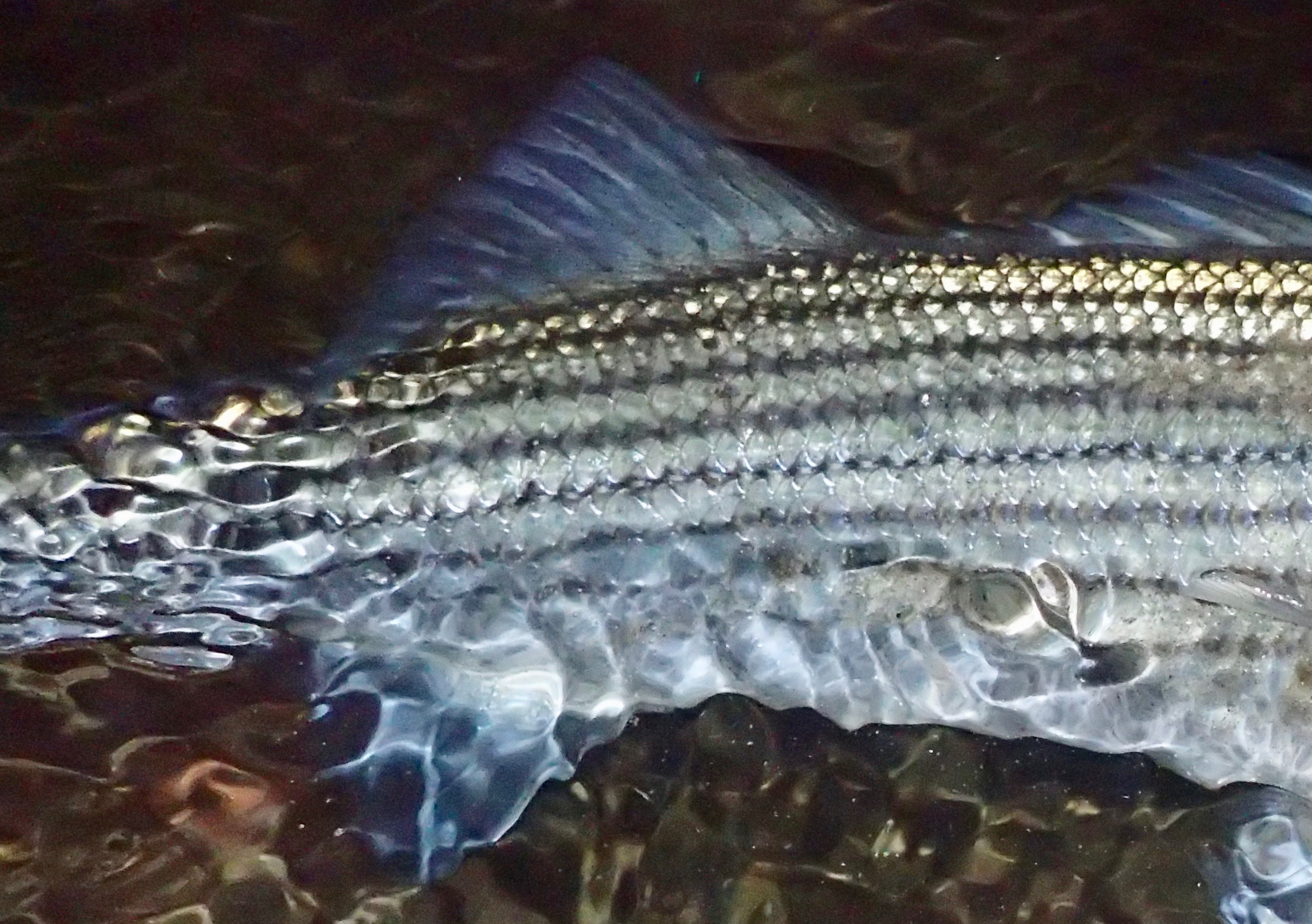
…I was catching my first striped bass of 2022. The conditions weren’t great — rising barometer, gusty winds, cold, rain showers — brrrr! But you don’t know if you don’t go, and she was right where she was supposed to be. She hit the Rock Island flatwing like a ton of bricks and gave me a couple powerful, short runs. The presentation was a greased line swing, and the hit came about halfway through the delivery.

Not huge, but 10 pounds is 10 pounds. This is the first slot fish I’ve taken in a long time.

Farmington River Report 3/10/22: Slow she goes

I fished the Farmington yesterday from 1pm-4pm, dedicated to the streamer cause. We had bright sunlight and seasonal temperatures; the water in the Permanent TMA was 480cfs and clear. While there were a few bugs in the air (midges and and a very small dark un-IDed mayfly) I didn’t see any surface activity. Angler traffic was moderate; there were people fishing in two of the three pools I visited.

The first mark was a riffley dump-in to a larger pool; the method was long-leader jigged mini-streamers. That was a blank. I had the second mark to myself. Again, I went the jigged streamer route with no love. I switched over to a more traditional streamer (Coffey Sparkle Minnow) and my full-sink integrated line and hammered up zero-point-zero trout. Not one measly touch.

The third mark was by now in the shade, which I hoped would work to my advantage. I worked downstream in a long pool with the same results. A walk upstream a 150 yard through the woods warmed me up a bit, and I cycled through again. Finally, a dull thud, a hookset, and soon a chunky rainbow was in the hoop. This is tough time of year to fish (I did not see another trout hooked all afternoon). Happy with one, I called it a day.

Capture! It felt so good after 2 hours and 55 minutes of blankness. Pre-celebrated with a San Cristobal Quintessence Churchill.

The 2021 Last Blast: Going out small

I don’t remember when I started doing it, but at some point I got into the habit of fishing a small stream on New Year’s Eve day. There’s a lot I like about it, not the least of which is tradition. But to end the fishing year on a small stream seems romantic, poetic, and just generally good for the soul. It’s arguably fly fishing at its most innocent. Not every year has worked out — youth hockey tournaments have been a primary culprit — but I’ve managed to do it quite a bit.

This year I took a fishing buddy, Toby Lapinski. We hauled out into the deep, dark woods on a day that had no right to be the last few hours of December. We did a brisk brookie business (say that three times fast!) once we figured out where they were willing to eat. Add a celebratory pre-New Year’s cigar, and we sent 2021 off in fine form. Don’t forget to get your 2022 license!

Why is Toby bottom bouncing in one of my favorite dry fly pools? Because we devised a brilliant plan to find out what the fish wanted. Toby started with a tungsten bead-head micro Squirmy Worm thingy, while I fished a bushy dry/glass bead dropper. The char voted overwhelmingly for the bottom. Toby was nearing double-digit hookups before I even got a sniff on the dry. Even my tiny midge nymph dropper went largely unscathed. I do love making them come up, but with the water on the upper side of perfect and running very cold, I switched to running deep mode. And that simple move was the difference between fishing and catching.
Me being stubborn with the dry. Alas, ’twas not to be, although I did get one to latch on in this lovely little bit of water. I made what passes for a cast, then dangled and waked the fly while making a rough figure-8 with my rod tip. There’s an awful lot of green for the day before January 1! Tightest of lines to all of you in 2022. Photo by Toby Lapinski.

Fishing for broodstock Atlantic salmon in CT

Every once in a while, you gotta do something different. Even if you’re a creature of habit. No, especially if you’re a creature of habit.

Before Tuesday, I’d never gone fishing for broodstock Atlantic salmon. It’s a little curious that I hadn’t, even more so since I enjoyed it immensely, and that was after freezing my toes off and catching…nothing. You can try for Atlantics in moving water in the Naugatuck and Shetucket Rivers; the Shetucket is where I fished. Striper angler extraordinaire Toby Lapinski graciously offered to show me the ropes. We basically went out and had at it for four hours. Unlike much of what I write here, this little piece isn’t intended to be a detailed guide or even a primer. If you want more information, you can check out the CT DEEP site. Another great resource is Atlantic salmon aficionado Ben Bilello’s website.

So. To the fishing. I used my Ken Abrames #3 Salmo Sax in switch mode with a floating line. Leader was about 12′ long, tapering down to 10″ P-Line. I used a bunch of different flies, from classic Atlantic Salmon flies like the Same Thing Murray and Mickey Finn to soft hackled streamers like the Hi-Liter. I did have a few touches; several were from smaller fish that were not salmon. I might have had one salmon touch, but it was not a big boil or roll or even a sharp tug; it almost felt like a striper taking the fly into into its mouth. In any case, no adrenaline rush. The method was the greased line swing and dangle, which if you’ve read my stuff you already know I love. I hated when the clock said we had to go. Folks, I need to do this again.

Cast…upstream mend…upstream mend…another mend…then let the current and the fly and primal attack instincts do their thing. I like to teach big mends, which I call “mending like you mean it.” You actually pick the line up off the water and place it where you want it. A longer rod helps the cause. Photo by Toby Lapinski.

Small Stream Report 12/9/21: Speaking of wild trout…

I really felt that I should go to the Farmington River and throw streamers. There was snow on the ground, courtesy of the previous night’s cold front dusting, and it was just around freezing. The trout would be holding deep, but they might not mind moving for the right protein payoff. What’s more, in my mind I could feel the dull thud of streamer hook point meeting kype, and the thought was gaining traction.

But, no. I’d also been picturing this lovely snow-covered woodland with a thin almost-black line snaking its way through. Here the char would also likely be deep, but I might find a player who wanted to come up for a dry. Cigar smoke drifting though the bare tree limbs, not another person in sight, gentle murmur of water flowing over rock…yes. This was where I was meant to be.

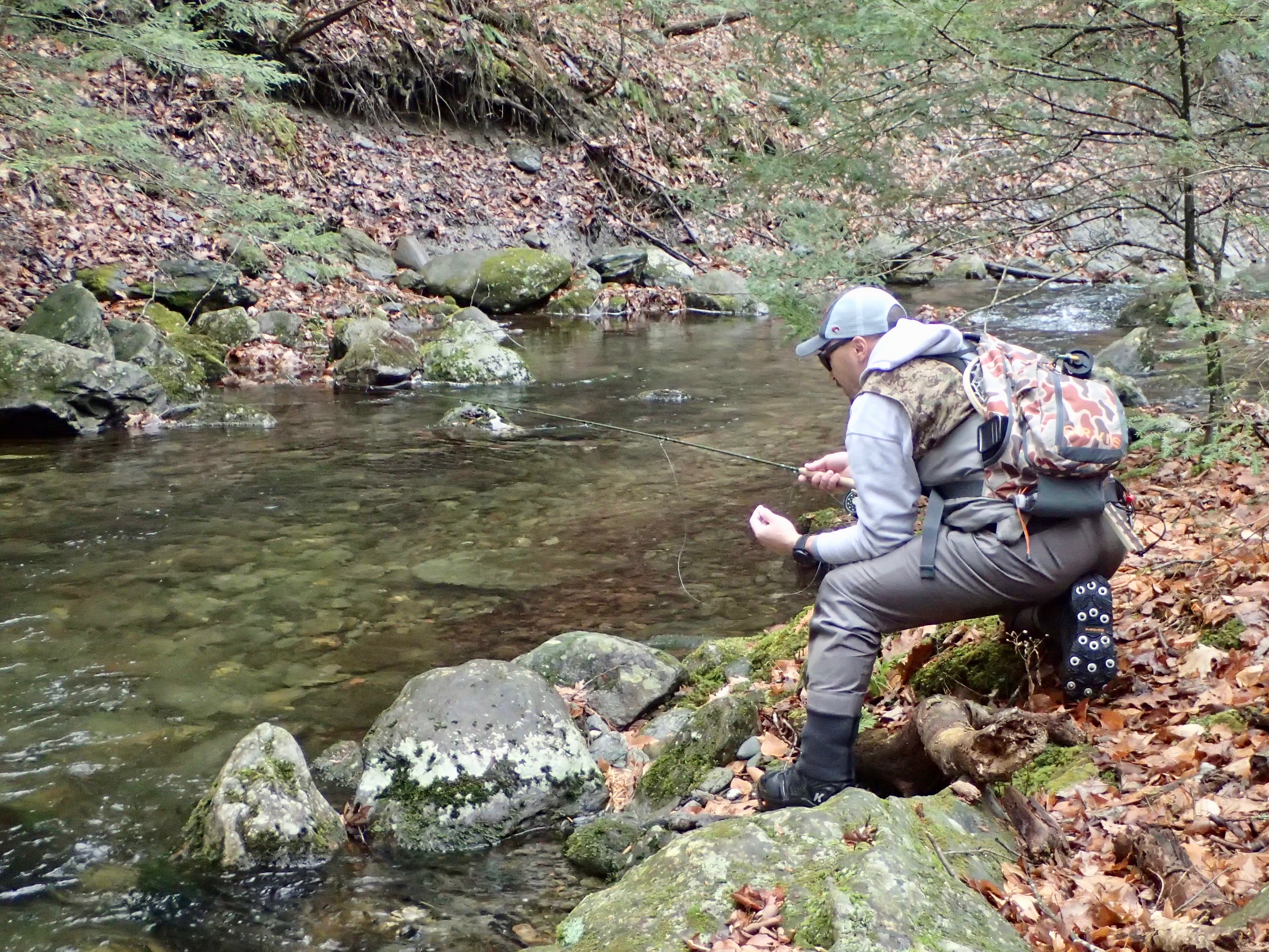
Hiking through the snowy woods will generate some body heat, but my extremities were cold for much of the outing. The scene was even prettier than I’d imagined, and although the action was slow, I knew I’d made the right decision. I was also hoping to shoot some footage for a small stream presentation I’m currently building — and I was pleased to come away with a few good shots. As I suspected, the fish have moved off the spawning beds and into their winter lies. Which brings us to this logjam hole. Now, doesn’t this mark scream ambush point? You’ve got a pooling of water, cover, current, and structure. The logjam is recent — maybe two or three years old — and although I hit it every time I’m here I’ve never caught anything. Not even a courtesy swipe. I’m trying hard not be bitter, but come on. Really?
Make ’em come up! I started out dedicated to the dry fly cause, but as the minutes ticked by, I began to suspect that deep was the way to go. I tried jigging some tungsten bead-head soft hackles in the deeper plunges and runs, but no joy. Then I decided to go with a dry/dropper setup. The dropper was a G-R Blue Bead Midge. I was drifting the rig down a slow seam when the dry simply disappeared from the surface. The take was so subtle, I was a little late on the set. I needn’t have worried — the char was a good one and the barbless hook was impaled in its upper jaw. This was my only fish of the day; I had a smaller fish twice bump the dry a few hundred yards downstream but there was no tug forthcoming.

Salmon River Report 11/22-23: Definitely NOT the Everglades

The pre-Thanksgiving Salmon River steelhead float trip is traditionally for myself and my middle son, Cam. But Cam was away at school. Gordo had school and hockey. Yup. Solo road trip! Coming off my Everglades experience, I was mentally prepared (but still dreading) the inclement weather I was sure to encounter. So, armed with my trusty Ken Abrames Salmo Sax #3, neoprene waders, and a pile of hand warmers, I headed northwest.

I have a knack — no, really, it’s a talent of mine — for picking days months in advance that are (ahem) un-ideal for fishing. This year I chose high water (1,500cfs out of the gate) and the coldest two days in the 10-day forecast. I can deal with both, but jeez Louise…again? The first day was the warmest, although it was mostly cloudy and we had long, frequent spells of “Salmon River Sunshine,” aka lake-effect snow. We did the Altmar-to-Pineville run both days, with the bulk of the fishing in the Altmar area. I would call the angler traffic moderately low, as higher water tends to keep the shore anglers away. Early on, we found an open hole that was deep, dark, and mysterious. My leader butt was 10 feet long, and I had four 3/0 shot on, but I still wasn’t getting down — I could tell by the lack of indicator chugging and dipping. So I asked my guide, Jim Kirtland, to build me a butt section of about four feet or so. That little adjustment was everything, as three casts later the indicator dipped, I set, and steelhead on hijinks ensued. It was a chrome skipper in the 16″18″ class, and I was thrilled to be on the board. My 1-for-1 was short-lived, though, as I dropped my next four touches. To be fair, I had no chance for a hook set on two of them as they occurred as I was lifting the rig at the end of very long drifts; one was totally operator error; and, maddeningly, one was a clean tippet break mid-battle. Not the best luck, but surely that can change.
Persistence pays off. I tried not to let the previous misses get me down. We’d moved to a long, swift-flowing glide where I had the comfort of knowing that at 1.5K, any take would be amplified by the indicator. I’d been on my hook sets pretty good, and I tried to remain vigilant. I stuck this guy firmly, which was a good thing given his size, freshness, and propensity for hystrionics. One thing I haven’t mentioned yet was the unique problem we’d created by lengthening the leader. The position of the indicator on the leader system meant that I could only reel up so much line — not enough to lift the fish’s head to the net in a normal fashion. (I was using plastic Thingamabobber-type indicators because of the amount of weight, and those can be notoriously difficult to adjust, let alone in the middle of a battle with a steelhead.) To have a chance at landing the fish, I would need to navigate my way to the stern of the boat, reel the indicator to the rod tip, then lift the rod, arms completely extended over my head while trying to steer the fish to the front of the boat, where Jim would be waiting with the net. Easy enough with a skipper, but a challenge with a chrome buck like this. As you can see, we were successful! The first fish came on a Copperhead Stone. The second came on a small nymph called the Spider. Photo by James Kirtland.
I wish I was signaling that I’m currently engaged with my fifth steelhead of the day, but it’s just a simple “Hi, Mom!” Tuesday was substantially colder than Monday — temperatures never got above freezing — and wind and iced-up guides were a constant scourge. Because of the cold front, the fishing was noticeable slower, and the only touch I had all morning was a certainly foul-hooked fish that began to roar upstream with unbridled speed before suddenly coming off. I also re-discovered that it’s a really good idea to crimp those shot down tight on the leader, as once they start wandering along its length, casting becomes a chuck-and-duck nightmare. On the positive side, I’d like you to notice the angle of attack of the rod. I’ve got the tip low to the water and the fish is being fought off the reel and the butt section. To be hyper-critical, I should probably have the cork of the rod pointed more upstream. Don’t let them breathe, put the screws to them, and you’ll get ’em in fast. Speaking of hyper-critical, we witnessed a steelhead being played to death. The battle lasted well over 15 minutes (not an exaggeration) and may have pushed past 20. You bet that it featured plenty of high sticking and long stretches of the steelhead holding in the current without reel handle being cranked. Inexcusable. Video still by James Kirtland.
Victory is mine. After my success the day before with black and copper nymphs, and little to show for it today, I tied on a fluorescent chartreuse Crystal Meth, and boom! Sometimes you get lucky. I was right on this fish with my hook set, but I dropped one a few minutes later when I was slow on the draw. So, 1-for-3 on the day, which isn’t great, but all I need is one steelhead to make me happy. Photo by James Kirtland.

The Everglades, Part 4: Bill and Dad Ride Again!

Before this trip, I’d had only one Everglades fishing experience. That was four years ago, and it was a single day excursion with my oldest son, Bill, who was graduating from law school. Our target on that May day was snook and tarpon, but I never even got a taste of a tug. Sure, the jacks and ladyfish and sea trout were fun, but I was disappointed. The highlight of the day was a fine snook Bill grabbed out of a shallow tidal flat.

And so it came to pass that Bill and I were heading out again. I’d already gotten my snook, and then some, and had an all-too-brief encounter with a tarpon, so in a sense this was a gravy day for me. Bill was getting married in three days, and at the very least we’d soak up some sunshine and enjoy some cigars.

Wednesday turned out to be the warmest of the three days, but there was still an early morning chill that was amplified by the boat slicing through the pre-dawn canals. I wore fleece pants all three days — I’m generally always inclined to be cold — but later on this day I almost broke the shorts seal. I knew what was coming in a couple weeks, and I kept reminding myself that regardless of the action, this wasn’t steelheading — and I should enjoy the blessing of actually being able to feel my toes and fingers.
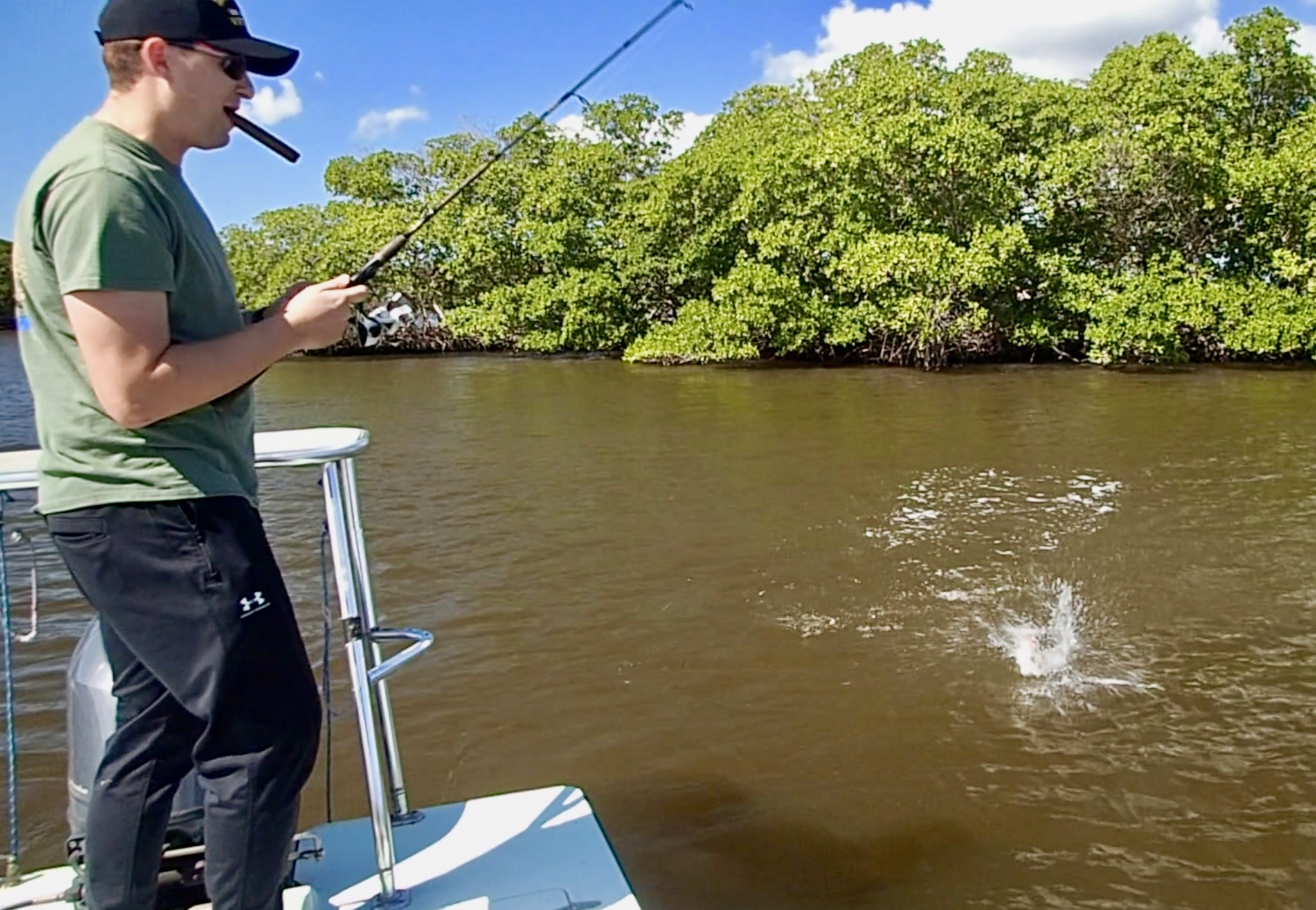
A left-handed fly caster on the bow and a right-handed spin guy on the stern makes it easy to do double duty. However, as we drifted past this island, I wanted to get some footage of my Marine doing battle. Bill found a pod of sea trout and had at them. These are beautiful fish, and they can be highly aggressive with their follows and takes. We liked this spot so much that we asked Mark to do another pass around. we never saw another boat until the very end of the day.
We made a run to where the Everglades dumps into the Gulf, and I loved this mark: current, loads of structure, and all kinds of birds and mammals and reptiles to eyeball. We actually fished hundreds of yards of shoreline. By now, I felt like my presentations and hook sets had come light years from my first trip. As we drifted past a downed tree within a pocket channel, I thought I saw a shadow. One cast, a couple strips, snook on! A decent fish for sure, but sight casting him in lightly stained water made me feel on top of my game. Bill and I each took multiple smaller snook at this mark. Of course, just when you think you’re all that, a baby tarpon in a cove near a creek mouth will remind you that you aren’t. And so, having touched two tarpon on the trip, I am resolved to get one on my next. Like Boss Rojack said in My Favorite Year, “The fighting is rounds…this is round one”

The Everglades, Part 3: Win some, lose some.

The first time I fished the Everglades with Mark I was green. This is a specialized type of fly fishing, and by the time I felt like I was getting the hang of it, the day was over. What’s more, it was one of those days where the shots at fish weren’t plentiful. I’d gone down with the intention of catching snook and tarpon, but we had no opportunities at the latter and only a couple with the former.

So you can imagine that on this trip, I was raring to go. But, there’s always something conspiring against you, isn’t there? Wind, rain, cold fronts, pandemics…the list of potential villains is endless. Add to that that I have an uncanny talent for picking lousy fishing days months in advance. And so it was that Mark informed me that the Everglades bite had been slow. Very, very slow. But you go and you fish and you do your best, and that’s all any of us can ask.

A few hours in I’d landed ladyfish and sea trout and jacks, but no precious snook, let alone even a sighting of tarpon. Mark, being the guide extraordinaire that he is, thought we might have better luck in some of the more intimate creeks and ponds. Getting to some of these spots is an experience. You use the electric motor or the Evinrude on its lowest setting, and start down these labyrinthine waterways, some of which are not much wider than the boat. Mangrove branches and leaves try to smack you in face, and they’ll swat away anything on deck that isn’t lashed down.

Once inside the pond or cove, you assume a ready position on the bow. There’s no chatter, only hushed tones that are essentially a loud whisper. If we don’t see any cruisers, we systematically attack the mangrove-choked shoreline. In particular, you look for structure, like downed trees and especially little notches in the shoreline or micro-creek mouths. It’s a precision cast — the closer to the mangrove roots the better, and watch out for those overhanging branches that want to eat your fly — then short, fast strips the moment the fly touches water. I didn’t know it yet, but if there are snook or tarpon lying in wait, they will race to the fly with breathtaking speed.

I was working one of those little notches in a shaded corner when it happened. The water bulged, I felt a bump, and I saw a large shadow turn and melt away into the tobacco-stained water.

Snook. A good one.

There was no hook set, no point-finding-purchase, no sense that the fish was spooked. So I made the same cast.

The bulge re-appeared, moving at attack speed, and the snook slammed into the fly. I’ve screwed up plenty of hook sets in my life, but not this one. Rod tip down and dirty, hard strip back and to the right, and the Everglades exploded.

Right from the start, I felt like I had this fish. (A strong set and 20-pound test is good for confidence.) Still, when you’ve never caught a species before, you don’t know how it’s going to behave. This fish did everything in its power to screw me up, like repeatedly trying to find refuge in the submerged roots and sounding under the boat. I never put it on the reel; it was all hand stripping. “Don’t let him breathe!” was constantly running through my head, and Mark did a great job of kibitzing during the battle. Then, the inevitable. Snook landed.

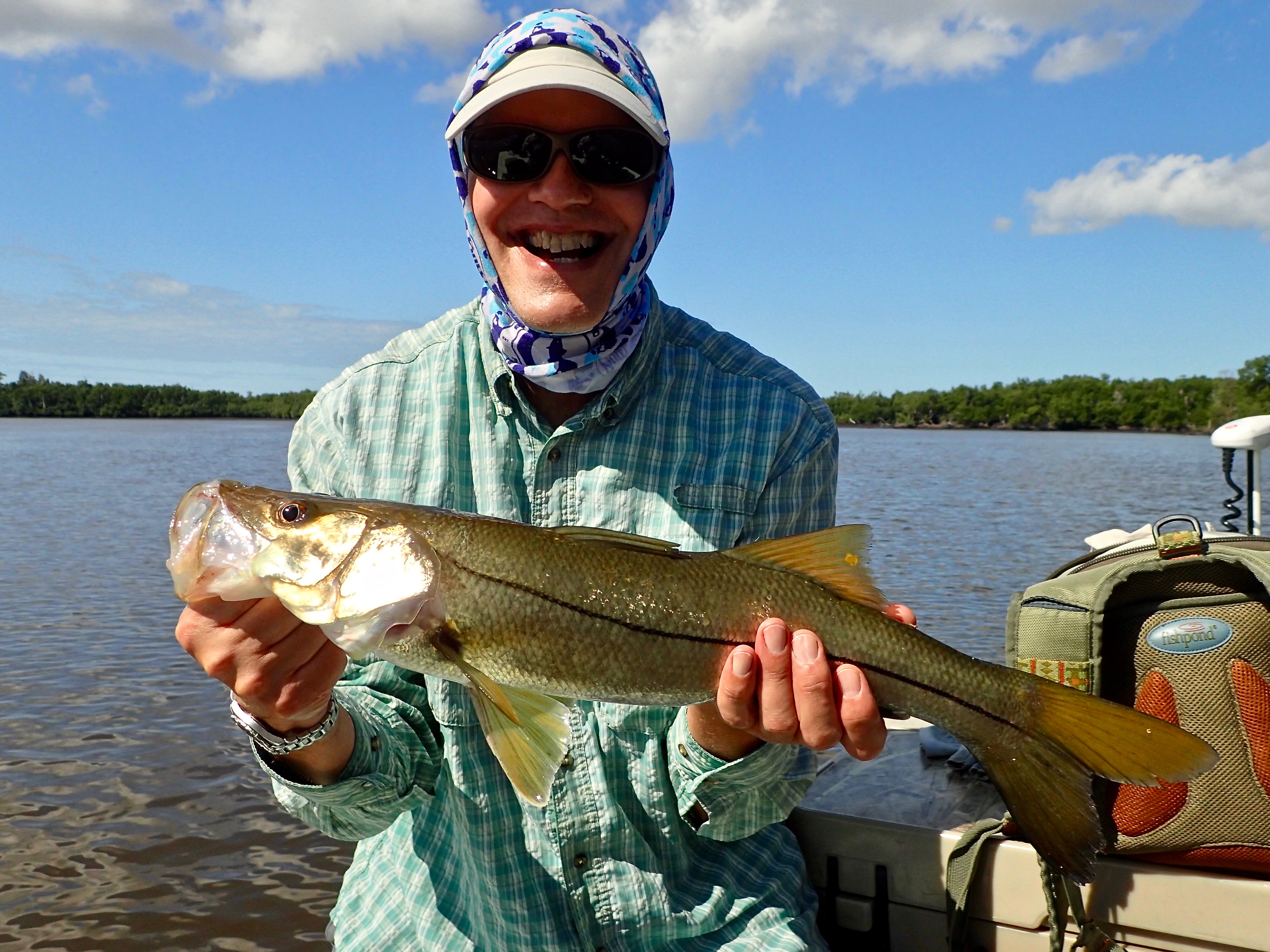
Time for a victory cigar. My first striper on the fly went 30″. My first snook was in the same ballpark. What a magnificent beast! Snook will color to match their surroundings, and this one is perfectly camouflaged for the dark bottom of its home. Taken on Mark’s Blue Claw streamer. Photo by Mark Giacobba.

Most of the rest of the day was anti-climatic. We found another stretch of shoreline, this time in the sun, that was infested with smaller snook, 12″-16″. It was a great opportunity to observe how snook ambush feed. The speed with which they move to their target is impressive. We didn’t count, but it had to be at least a dozen more snook to hand.

While fun, these smaller fish can lull you into a false sense that you are infallible. I remember losing a pig of a striper on the Cape a few years ago. Dink after dink after dink — then when a really good bass hit, I was unprepared and dropped the fish. You can see where this is going. All of a sudden, I rolled a tarpon. I was so surprised that I was late on the set. I still thought I had him, but after a moment of wild spray and boiling water, it was gone. I stood alone on the front deck, the heat of regret and embarrassment crawling up the back of my neck. You gotta set the hook, Steven. You gotta set the hook.

Still, it was hard to let that moment trump the victory of the morning. I had my snook, and then some. And I also had tomorrow.

The Everglades, Part 2: Float like a butterfly, sting like a…peacock?

I don’t mean to complain, but whenever a guide tells me, “Let’s meet at so-and-so place at 5:30am,” and it involves an hour drive to get there, and I gotta set the alarm for 4am (an hour I’m far more familiar with as a return time) I know two things for sure: I’m going to get a crappy night’s sleep, followed by a bleary start to the fishing. Call it the curse of the night owl. I’d been telling myself that this Florida trip would be a nice change from November steelheading, what with me actually being able to feel my toes and not be shivering (wrong about that, as I’ll soon explain). But the fact is, when it comes to depriving me of sleep, my Florida guide Mark is every bit as sadistic as my steelhead guide Jim.

Tarpon and snook in the Flamingo area of the Everglades was the original plan, but when you’ve got a guide as good as Mark, and he tells you he doesn’t like the conditions down south – and his backup plan is catching peacock bass, which you, Mr. Culton-Who-Loves-Smallmouth, he says, will totally dig – you go with it.

So that’s how I ended up shivering in a boat in a Florida canal at 5:45am.

I’d brought mostly warm weather fishing clothes, but I figured with enough layers I’d be OK. Zipping around canals before sunrise in a powerboat with added wind and a cold front changes the game a little. I had the solace of knowing that dawn would come soon, and perhaps Florida would live up to its nickname. Still, I tightened my arms in a bear hug around my jacket.

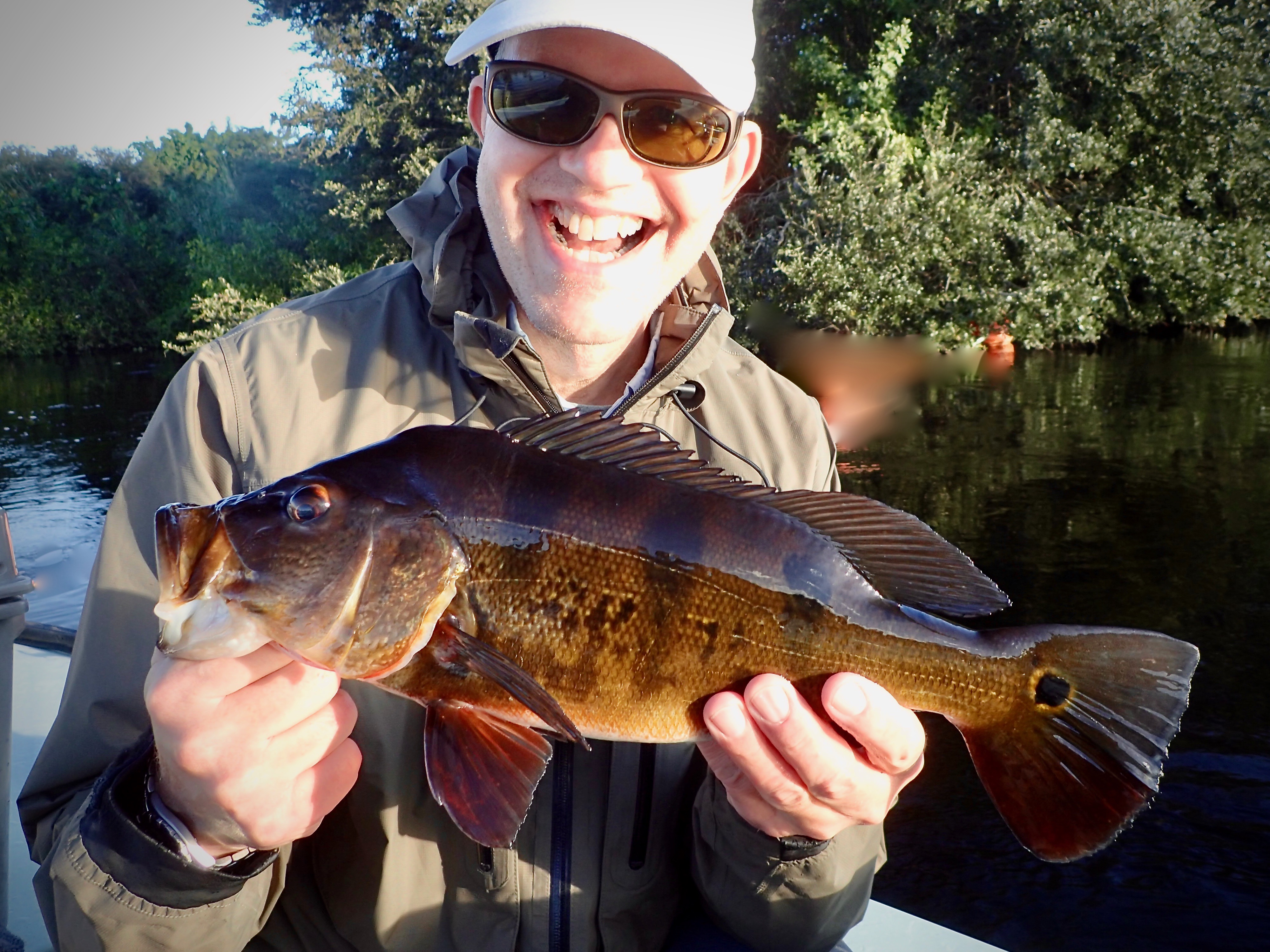
My first peacock bass was very respectable. The first light bite was slow; we started with a Gurgler-type fly, but the cold morning had the fish in a mood to stay deep. Absent current, we switched to an intermediate line (yes, you heard correctly) and a pattern of Mark’s, the Blue Claw, which fish that live in the Everglades adore. Fish on, hook set, and we were off to the races. I couldn’t possibly tell you how many peacocks we landed. If you’re puzzling about the title of this post, peacock bass are an introduced species in Florida. The state stocked butterfly and speckled peacock bass. The speckled have not done well; the butterly, pictured here, have flourished. Oh, and they’re not bass. They’re a chichlid. Photo by Mark Giacobba.
The comparison to largemouth or smallmouth bass is not inappropriate. Like smallmouth, peacocks don’t like being hooked, and you can expect them to sound and bulldog as well as cartwheel and tail dance. They’re ambush predators, and I spent a lot of time giggling and cackling at the micro-tsunamis of water that would follow and close on my fly as I stripped it. Photo by Mark Giacobba.
This first day was menagerie day. In addition to peacock bass, I caught a bluegill, an Oscar, several gar (very needlefish-like, but they fight twice as hard) and to my delight, three largemouth bass (above). I love any kind of bass on the fly. At one point, I decided I wanted to make one come up to eat, so I tied on the Gurgler and had at it. It took some time, but it wasn’t long before I was rewarded. Photo by Mark Giacobba.
One more for the road. Crushing hits, highly aggressive – what’s not to like? The ride out was significantly warmer than the trip in. Turns out, I was getting warmed up in more ways than one. Photo by Mark Giacobba.