Director Lorri Shankar’s film about Ken Abrames, “Striper Moon: A Legacy” is now online. You can see the original film poster here. The link to the film, on Google Drive, is here. Enjoy!

Director Lorri Shankar’s film about Ken Abrames, “Striper Moon: A Legacy” is now online. You can see the original film poster here. The link to the film, on Google Drive, is here. Enjoy!
Congratulations to Glenn, Zak, and Steve. As I write this, their flies are en route, and should be in their hot little hands by Monday. In case you’ve never won, I thought this would be a good time to tell you a little bit about the process of how you get your swag.

Once I notify the winners, I ask them what they’re most interested in receiving. Not all requests are doable, but I try my best. A good case in point would be Zak’s flies. He wanted flies for sea-run cutthroat trout. After rummaging through my hook stash, I reckoned I could make it work. So even though I’ve never tied up flies for sea-run cutthroat trout, I was happy with where I ended up. I hope Zak is, too.
Which brings us to volume. All winners do not necessarily receive the same number of flies. This is a function of time, labor, and materials cost. So, if you’re like Glenn, and asked for soft-hackles and wets for trout, you’re probably going to get a dozen flies. Steve wanted some early season striper patterns; those are more involved and the materials harder to source, so I sent him a half dozen. If someone wanted a complex pattern like the Countermeasure, it might be as little as three. As one of my kids’ teachers used to say, “You get what you get and you don’t get upset.”
Enjoy your weekend, and catch ’em up!
The Salmon River in Colchester holds a special place in my heart. It’s where my dad taught me to fish for trout. It’s the first place I ever fly fished. And, it’s just about the prettiest little big river around. I used to fish it all the time; the general plan was to hit the Salmon early season, then switch to the Farmington by late spring. Gradually, the pull of the Farmington and its bigger, wild trout took over, to the point where before yesterday, I couldn’t remember the last time I fished the Salmon for trout.
The day I chose to make my triumphant return was chilly, breezy, with a mix of sun and clouds. The water was crystal clear, and running about 300cfs, which I consider to be the perfect height for that river. There was a decent caddis hatch, about a size 14-16, and some 14-16 BWOs. And, to my delight, there were piles of fish to be caught. I fished from 12:15pm-3:30pm, all within the Fly Fishing Only section. While catching trout after freshly stocked trout holds a limited interest to me, I decided I’d just go with the flow and enjoy the moments. And so I did.


It’s a busy month for me, between fishing and writing and speaking about fly fishing. Here are the details:
Monday, April 11: “The Little Things” with the Miami Valley Fly Fishers. This is a members-only Zoom. I mention it in case you’re the person in charge of finding a a speaker for your fly fishing club. Thanks to the wonders of technology, we can meet up even if we are geographically undesirable. Here’s a link to my current presentation menu. I’m really looking forward to making some new fishing friends in Ohio.
Tuesday, April 12: “The Little Things 2.0” with SEMASS TU, at the Mitchell Memorial Club in Middleboro, MA. This meeting is open to the public, so if you’re in the area, stop in and enjoy the show.
Thursday, April 21, “Tactical Advantage: Angler vs Trout” with FVTU, at the Back Nine Tavern in New Britain, CT. Another meeting that is open to the public, and a presentation that most people have not seen.
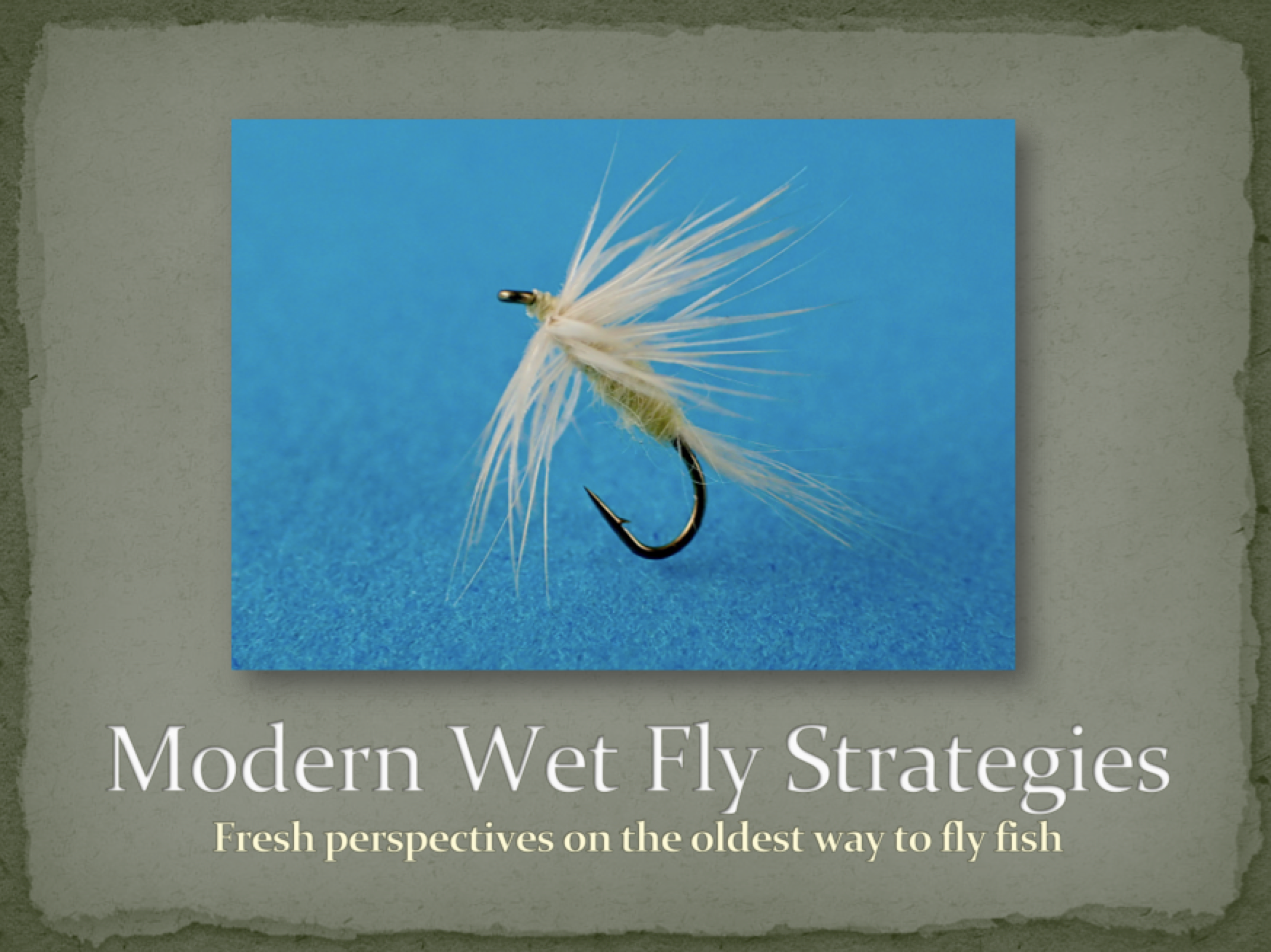
Friday-Sunday, April 22-23-24, The Fly Fishing Show, Marlborough, MA. On Friday 4/22 at 2:30pm, I’ll be the Featured Fly Tier. Come watch me tie up Spiders, Winged & Wingless Wets. (I had a blast doing this in Edison!) Don’t go away, because at 4:30pm I’m presenting my new seminar, Modern Wet Fly Strategies. I think this is my best program to date, and I’m counting on you to be there. Both are included with the price of your admission ticket. On Saturday 4/23 I have a class, Tying and Fishing Wet Flies. This is a chance to get some basic tying instruction, along with tips on rigging and presentation, geared toward making you a dangerous wet fly machine. This is paid class; you have to pre-register to attend. I’m hoping to see plenty of currentseams readers at the show — please come say hello!
As we bid farewell to March and say hello to April, I’d like to personally thank the CT DEEP for eliminating the closed season trout fishing rule. The old reg made it illegal to fish for wild trout in non-WTMA streams from March 1 though Opening Day. Enough with that nonsense! And let’s go fishing.
Since I had no previous experience fishing the day’s mark this time of year, I was curious about might be happening. As I mentioned in my last post, this not winter/not spring netherworld can be a tricky period. My random conditions drawing got me a low-side-of-medium, crystal clear flow; a mix of sun and clouds; and temperatures that struggle to get into the low 40s. I did see a few stray midges, but nothing that could be considered a proper hatch.

The method was bushy dry/tiny bead head nymph dropper and the jigged micro streamer/nymph. If it was a deeper plunge, I did the latter. Everything else got the dry/dropper. I was pleased to find a wild char in a mark that has disappointed me no end. It’s really fishy, with plenty of cover and a big boulder that borders a deeper slot. The fish hit the dropper, but there was no hook set. Much farther upstream , I also had some repeated swipes at the dry, but again no hook set. Tug-tug-tug!!! Someone in a roiling plunge really wanted the jiggy thingy, and — stop me if you’ve heard this one before — there was, again, a failure to seal the deal.
I wish I could tell you that it turned on at some point, but those three touches were all I could manage. I wasn’t surprised, but I was disappointed. I suspect further research will need to be conducted this month.
But that’s not where the story ends.
I decided to drive to another mark, the place where I caught Alan last month. (Yes, I’m weird enough that I name fish. Sometimes I name them after real people, like Alan. Other times they’re just fictional , like Gus in this story.) I wasn’t sure if I was hoping for a Hail Mary or just didn’t want to end the session. I drifted the dry dropper through some deeper plunges and runs, then walked upstream.
And there it was. The place where I’d caught Alan. I spent a few minutes observing its wonderfulness. It’s at the head of a longer run. There’s a good, small cut bank with an overhanging tree that will one day fall into the brook. A deep cut runs parallel to the cut bank, and it’s evident why this a prime mark for an alpha fish: cover, current, and the head of the cafeteria line.
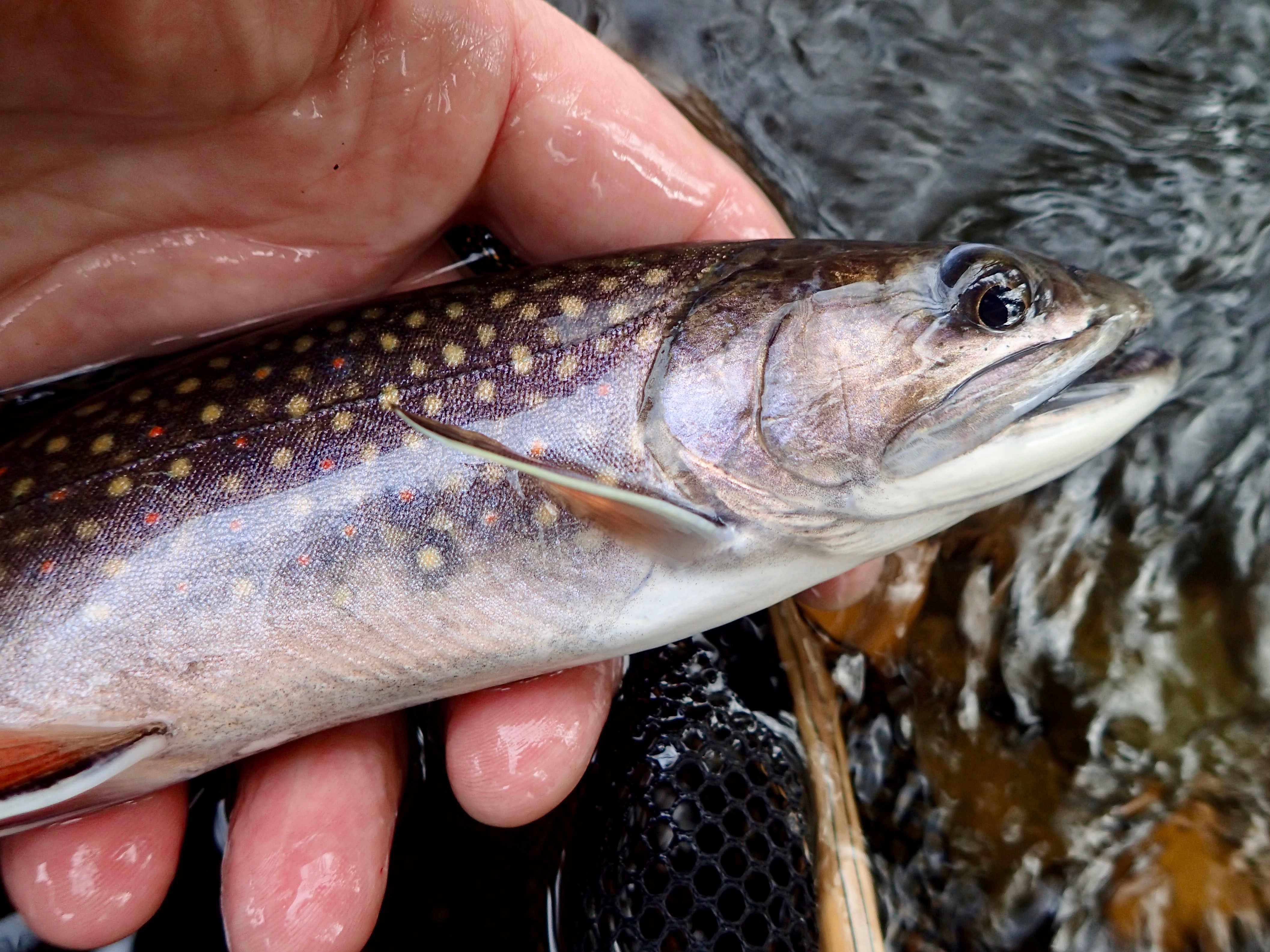
This time it took only one cast. The dry vanished from the surface, and when I raised the rod tip I could see that the nymph had been the target. It was a good brookie, and I immediately assumed it was Alan. Into the net, camera readied, shot taken, release completed.
Last week, I went exploring on X Brook. It wasn’t a great day for fishing small streams; windy, cold front, brilliant sunshine and no canopy. Until recently, X Brook was completely off my radar. Access isn’t easy; you’ve got to do a bit of walking, and it’s surrounded by fairly dense woods and bushes. I thought you’d like to hear how I went about reconning some new water.
First, I hiked through the woods, heading upstream, taking care not to walk with heavy footfalls, and never getting close enough to the water to spook any fish. I made mental notes of potentially fishy areas, like long, glassy pools, and plunges. I wanted to be prepared for them for when I worked the brook downstream.
I kept the fly selection simple. We’re into the netherworld of not spring, not winter, so fish could be hanging out in cold water lies (think maximum depth in any given brook) as well as snottier runs and plunges. A bushy dry with a beadhead nymph dropper would cover two sections of water on any given drift. I also had a tungsten beadhead attractor nymphy/streamery thing to jig in the plunges. I felt like that had me covered for whatever water I encountered. I switched rigs up a few times, but the answer was always the same — no one home, or no one interested.

One of the things I like to do when I get no hits in a pool or run is see if I missed anything. What I mean is, if there’s a particularly sexy bit of water, and I blank, I like to find out if there were any fish. I start by standing up and making myself large in full view of anything that may be hiding. Sometimes I’ll wave a stick through the water to try to and spook fish. It’s a good idea to take great care when wading in a small stream, especially from fall through mid-spring — you don’t want to disturb any redds or crush unhatched eggs. I was a little surprised (not to mention bummed) that I didn’t see a single darting shadow in any of the runs I disturbed.
Finally, there was a decision to be made: is this stream worthy of another visit? In this case, I think it is. There is enough structure, flow and potential canopy. What’s more, I only explored a small section. It may very well be that where I was is more of a late spring/summer/fall environment, and that the best winter water is elsewhere.
I’ll keep you posted.
Two weeks ago, Gordo and I floated the Salmon River with guide to the stars Row Jimmy, aka James Kirtland. Conditions weren’t great, nor were they dreadful, and that’s about as good as you can hope for in mid-March in upstate New York. That time of year can be a real mixed bag in terms of action: pre-spawn fish, spawning fish, largely indifferent fish, stale fish, fresh fish, cold or high water. You just never know what you’re going to get. We floated mid-river both days. Here’s what went down.
Monday: We started off below freezing, and we had to do the clearing-ice-from-the-guides dance until very late morning. Although Gordo and I fished hard and well, we had nothing to show for our efforts. The dam release was 1.2K, dropping to 900 at noon; the water was lightly stained and very cold at 34 degrees. Around noon we anchored in some fast, surging water, and I was stunned when my indicator dipped; this was the last place I expected to find fish. I never got a hookset, but it was definitely a bite. A few casts later I hooked up proper. So proper, in fact, that I was stunned when the steelhead came unbuttoned about 20 seconds into the fight. (Insert heavy sigh here.) A couple casts later, I was on again. We could tell it was a good fish because it ran upriver in a blazing 1.4K flow. But we realized something was amiss when the fish turned downstream and ran…and ran…and ran…I was far into my backing when I finally pointed my rod tip at the fish and terminated the connection. (Insert second heavy sigh here.) I reminded myself that the nice thing about multi-day steelheading trips is that there’s always tomorrow…

Tuesday: “@#$% guides make you get up so &^%$ early.” Those were my words to Jim, uttered in mock disgust (but not inaccurate) as we sat in the boat in the dark and rain at 5:30am. Jim wanted us to lock down a prime spot, hence our early start time. Even though I’d already had my coffee, I felt like I could easily nod off. The fishing began as a duplicate of Monday: good drifts over worthy water, with nothing to show for it. Then, I had a strike. It was a big, chrome steelhead, but the take was 60 feet downstream of me. I set the hook as best I could, and began to clear my line in preparation for the battle. The thing about being tired and cold — 36 degrees and raining is, in my opinion, far more chilling that 20 and not raining — is that you might not have your A-game dexterity. The line fouled against my fingers, the fish surged, and then I was forlornly reeling in a limp line to check my hook point.
Our perseverance was rewarded at the next mark. Gordo landed one, then lost a beast of a steelhead inches short of the net when the leader snapped. So go the accidents of war when you’re steelheading.

Then, it was my turn. I’d just finished giving myself a pep talk that went along the lines of: You’re a good angler. You’re fishing in a spot that holds steelhead. You’re fishing with a high-confidence pattern (Copperhead Stone). You can catch a steelhead. The very next cast was a hookup, and a few minutes later I was releasing her 50 yards downstream. Jim did a great job getting into a position where he could net her — they’d been fishing about 75 yards below me — and since all I need is one to make my happy, you can understand the smile on my face.

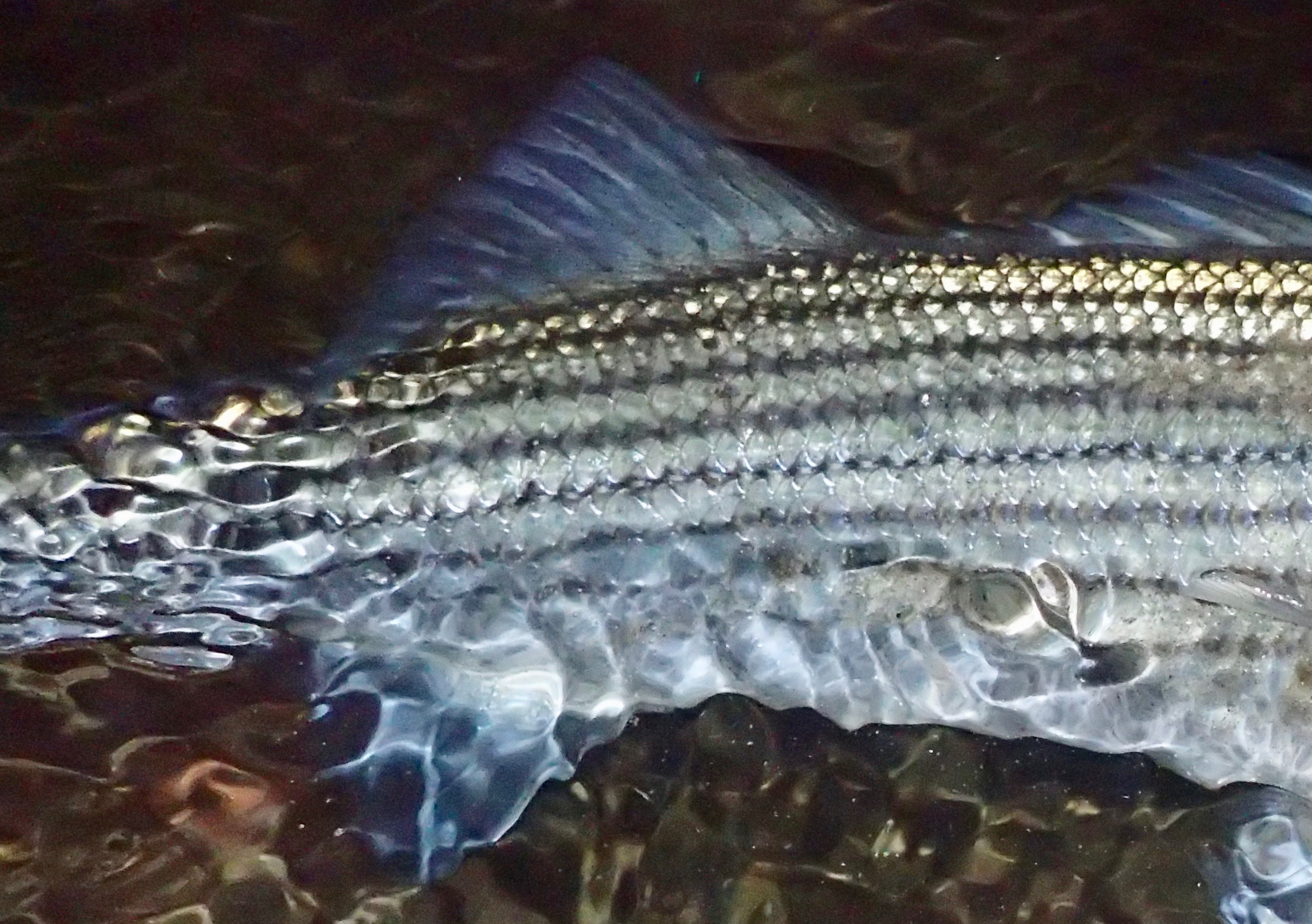
…I was catching my first striped bass of 2022. The conditions weren’t great — rising barometer, gusty winds, cold, rain showers — brrrr! But you don’t know if you don’t go, and she was right where she was supposed to be. She hit the Rock Island flatwing like a ton of bricks and gave me a couple powerful, short runs. The presentation was a greased line swing, and the hit came about halfway through the delivery.
Once again, those of us who love striped bass have a chance to make our voices heard. The ASMFC is currently conducting public hearings; Connecticut’s virtual meeting is being hosted by DEEP, and it happens on Tuesday, March 22, 6pm-8pm. As our friends at the ASGA have said: Get involved. Do what is right for the stock. Do what is right for future generations.
Contact: Justin Davis 860.447.4322
Register for the webinar here. Make sure you select the correct date/location. You can attend any meeting you would like, just make sure to include your home state in your comment.
Please note that in order to comment during virtual webinar hearings you will need to use your computer or download the GoToWebinar app for your phone. Those joining by phone only will be limited to listening to the presentation and will not be able to provide input.
Here are the main issues for Amendment 7, along with the AGSA’s thoughts on what’s best for the fishery.
Finally, if you (like me) can’t attend a hearing, the public comment period ends on April 15, 2022. Individual emails are what counts the most. Form letters count the least. Send your comment to comments@asmfc.org with the subject line “Draft Amendment 7.” ASGA will be running a raffle again this time. There will be awesome prizes from our best sponsors. Just copy stripercomments@gmail.com in your email to ASMFC and you are entered. It does not matter if you agree with our positions or not. We just want folks to participate in this process.

As the demand for my guide services increases, I’m trying to figure out how to make things easier for everyone. So I created a “Preparing for Your Guide Trip” checklist/infographic and added it to the menu bar at the top of the homepage:

The checklist, shown below, is also available as a pdf under the “Guide Trips/Lessons” link. I’m hoping that you find it helpful!

 currentseams.com