Summer Presentation: “The Little Things” at the Long Island Fly Rodders, Tuesday, August 1

Most fishing clubs go on summer hiatus. Not the Long Island Fly Rodders. In fact, they’ve booked yours truly to kick off their fall meeting season with “The Little Things.” I’ve heard rumors of a pre-meeting barbecue, so how can I resist?  Tuesday, August 1, 6:30pm, at the Levittown VFW Hall, 55 Hickory Lane, Levittown, NY. For more information, visit liflyrodders.org.

Speaking of presentations, I’m currently working on “The Little Things 3.0” and an as yet untitled one on how I fish for striped bass.

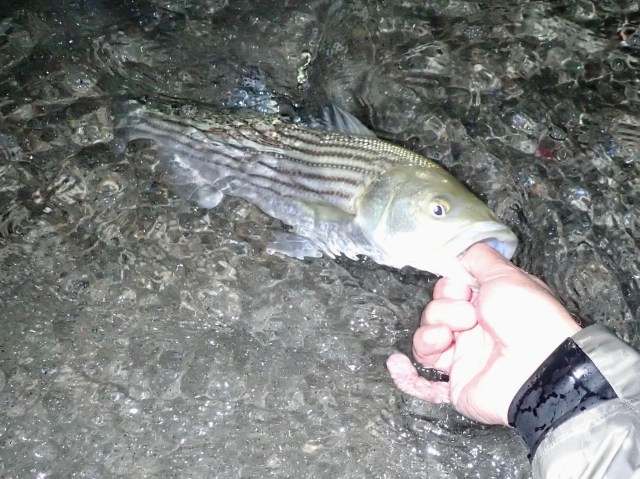
If you want to catch big stripers like her, pay attention to the little things. (Using a floating line and learning the greased line swing doesn’t hurt, either.)

OLYMPUS DIGITAL CAMERA

Block Island striper report: small is the new black

Another year, another seven days to chase linesiders in one of The Last Great Places. What each new season brings is always a mystery until you get out there, and then you can toss all the reports you’ve been hearing because they’re either spot on, nothing like that at all, or varying points of somewhere in between.

In 2017, I’d been hearing credible talk of voluminous schools of sand eels inshore and the Bass-O-Matic running on high. That sounded swell, but there were two x-factors to consider: we were coming out of the new moon into first quarter with a waxing gibbous and its bite-killing light; and the weather. Good news/bad news on both fronts. On the plus side it was cloudy most nights, so moonlight was not a factor. On the down side, it was windy. Like small craft warning windy: 20 knots sustained with higher gusts that pushed the limits of what is reasonable with a fly rod. And wind usually changes everything on the Block.

Like last year, I caught stripers every night. But the bargain of two consecutive years without a skunk was a preponderance of small fish. This was the first time in a decade that I didn’t take a legal bass out here, and I found myself longing for those schools of 15-pounders that would sit off the beach for 90 minutes, having their way with sand eels. I had two double-digit nights, then a six, then three singles, and wrapped it up with another half dozen. But 27″ was the largest bass I could muster.

Sight fishing from the beach during daylight was tough due to wind, but mostly to the clouds that made finding those elusive shadows a chore. What’s more, on the sunny days I spotted very few cruisers. I did get two fish to follow my fly, one of them a good 20-pounder, but in the end they both broke off the chase.

And then there were the Meatballs. I had enough nights where I enjoyed blissful solitude, but there were a few sessions where the Meatballs were out in force and in rare form. I’m usually the quiet sort on the water, but at one point on a certain night I was blasted so often by so many hundreds of lumens that I finally turned and barked, “Please stop shining that light on me NOW!” They left shortly after. I had a cigar to celebrate.

And that’s the thing about Block. Even when it’s bad, it can be very, very good.

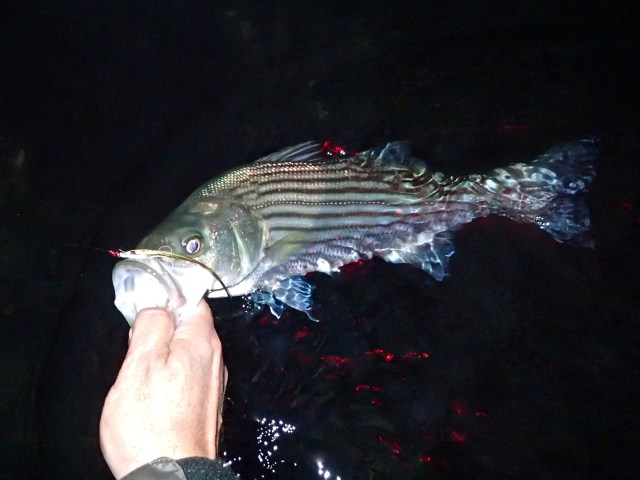
I had high hopes for this fish — he went on the reel — but the tape measure didn’t lie and he came up an inch short. I mostly stuck with my usual eclectic mix of Big Eelies. This fish thought the Crazy Menhaden color scheme looked tasty. Kind of a neat stained glass effect going on in the water around him, too.

OLYMPUS DIGITAL CAMERA

~

Unless there’s a specific hot spot, I always try to mix it up on the Block. I fished the east side and west side beaches, southeast side, off some jetties, in the Great Salt Pond, and — regrettably — the North Rip. I say this only because the Rip had been producing a consistent good bite if you had a spinning rod. The night I slogged out there was about the worst night for fly fishing you could imagine. The wind was rain jacket whipping-fast, and I had to cast my line backhand over my right shoulder (I’m a lefty) to shoot it into the rip, then feed line into the left to right current. So far so good. But, rats. Mung. Every cast. I took this shot when I got back to the truck. Yes, it was that hot and that humid and that foul. I love the Block, but walking a mile and a half in the sand for nothing will make anyone dour.

OLYMPUS DIGITAL CAMERA

~

I discovered that striped bass have great camo against the sand and rocks — even when they’re dead.

OLYMPUS DIGITAL CAMERA

~

A public service message brought to you by the National Spell Check Society.

OLYMPUS DIGITAL CAMERA

~

On the last night I caught bass two ways. First, off the beach, where I found a school of hungry fish feeding in the moonlight; then, inside the Pond on a flat with a team of three flies suspended in the film. (Floating line, of course, for both methods.) My last two fish of the trip came as the flies dead-drifted across the flat. That building pressure I felt let me know a striper was flaring his gills to suck in one of the small sand eel flies, in this case a 3″ Eelie in olive and chartreuse. See you next year, when one of us has put on a few more pounds.

OLYMPUS DIGITAL CAMERA


Farmington River Report 7/12/17: Jungle Boogie

It was positively tropical on the river today. The only relief from the heat and humidity was provided by the random cooling waves of fog that swept across my face and arms. The method was wet flies — and the trout weren’t having it. I fished three “gotta have a fish” spots and I blanked in all of them. (Well, kind of. We’ll get to that in a minute.)

Spot A was a run in the upper reaches of the permanent TMA. It’s a long stretch that features shade, structure, boulders, depth, and riffles. Today it offered a couple courtesy taps from a JV salmon. Ugh. Off to Spot B, a ways downriver but still in the PTMA. This is a dump-in to a larger pool. It’s loaded with trout. Not a touch. Ugh squared. Off to Spot C, the snotty riffles, swift current and treacherous footing above B. There’s always a fish behind that rock, or in that black hole tight to the bank. Blanks, both of them. Do I hear a third ugh?

So I got stubborn and walked down to B, attached a BB shot above the middle fly of my team of three (S&G, Drowned Ant, Hackled March Brown) and bounced the flies along the bottom. Second cast, fish on the Drowned Ant. Then one on the March Brown. Suddenly, things were looking up.

All because I decided to get down, get down.


Farmington River Report 7/9/17: Swell fishing. Catching? Ummmm….

My Wet Flies 101 class won the weather lottery yesterday. Sadly, the price of the ticket was one of the worst bites I’ve seen all season on the Farmy. (I’m going with the cold front coming through the night before theory.) There was enough hatch activity (Isos and caddis) to keep our hopes up, and a few splashy risers here and there, but folks, it was tough sledding. The guys did a most excellent job of staying positive and refining their newly learned craft. Keep at it, gents, and you’ll have enough days that will make you chuckle when you think of yesterday. (Really.)

As an instructor, I find sessions where everyone blanks as frustrating as the students. So I fished the lower river on the way home. The run I targeted was located in a section that got annihilated by last summer’s drought. Yet, I took two beautiful wild browns in 30 minutes. The water was swift and snotty (not well-suited for a class) so maybe that was the difference.

Nature finds a way. This is the first fish. He clobbered the Squirrel and Ginger on the dead drift in a deep pocket. Love the way the wild ones hit and battle, and you just don’t get coloration like this at the factory.

OLYMPUS DIGITAL CAMERA

Celebrating summer

July is a darn good month to be an angler in these parts. I just returned from a week on Block Island, and while the fishing wasn’t great (spotty action and smaller fish) I did get into bass every night. Detailed report and pics to come.

I’m really looking forward to getting back to the Farmington, in particular to swinging some wets. The spring’s cool temps and voluminous water supply should make for some terrific wet fly outings over the next several weeks. Speaking of wet flies, there’s one more opening in Sunday’s UpCountry Wet Flies 101 class. Jump on it and become the envy of all your trout angling friends. You can’t sign up with me; you have to do it through the store here.

Speaking of jumping on things, if you’re planning on booking a lesson/outing/trip with me, best to inquire now. My days are filling up (two gigs next week) and I am going to jealously guard my personal fishing time. You know where to find me.

Client John with a fine example of what is possible on the Farmington River at noon on a sunny day in July.

Jon21%22er

Big Eelies and Banana Squid, or: striper soft hackles galore

I went on a wee tying binge, and when the feather dust settled I was left with an 8-pack of Big Eelies. Some are old favorites, and a few sport new color combinations. That’s one thing I love about this pattern: it lends itself supremely well to all manner of color experimentation, and the stripers almost always seem pleased with your work.

Big Eelies hot off the press. Clockwise from lower left: pink/chartreuse/olive, grey/olive, Crazy Menhaden colors, Olive Fireworm colors, black/chartreuse, pink/olive/brown, then the two of the original classic. I can already feel that forceful tug at the end of a twitching strip.

OLYMPUS DIGITAL CAMERA

~

The Banana Squid, another classic from Ken Abrames. It’s different from most other squid patterns, and it looks nothing like what books would lead you to believe  a squid should be. Add the magic ingredient of water, and it transforms into a living, breathing organism than looks good to eat. Fished slowly and deliberately, it relies on organic movement and impressionism to fool the fish.

OLYMPUS DIGITAL CAMERA

Hook: Eagle Claw 253 3/0
Thread: Black 6/0
Platform: 30 hairs grey bucktail
Tail: Three white saddle hackles tied in flat, then four ginger saddles (I used golden tan) to veil the white saddles, then sparse purple Krystal flash on both sides, then a short badger hackle on both sides, then a webby grey saddle tied in flat, then a full plume of amber marabou
Body: Purple braid tied to 3/8″ from the hook eye
Collar: A sparse layer or yellow bucktail one hair thick to extend to the end of the amber marabou, then a sparse layer of blue bucktail one hair thick, then a sparse later of red bucktail one hair thick
Hackle: Brownish marabou tied in near the butt of the stem, then wound and doubled 3-4 turns

Farmington River Report 6/21/17: A strange start to summer

The official start of summer isn’t beholden to calendars or warmth or maximum daylight. For me, it begins with liberating my cane rod from the confines of its storage tube and tying a Magic Fly to the end of a 12-foot leader. That this all happened on the 21st of June was a happy coincidence.

Monday’s storm left a swath of destruction in the People’s Forest area. Downed trees and limbs everywhere. The river soared a few hundred cfs, and Grady Allen told me the action Tuesday night was not so good. When I drove through New Hartford yesterday, the roads were wet and steaming from a late afternoon squall. Random piles of hailstones in the woods made me glad that I missed it. The river was down to 450cfs, but still carried a stain and some debris.

Not a lot in the way of catching for me, but I did get a low teens wild brown to hand on a size 18 Usual. I also rose fish to the Magic Fly size 18, Catskill Light Cahill size 14 and 16, and size 10 Convertible (look it up).

To the strangeness. Nothing so odd about the hatches proper: Sulphurs came off like clockwork and 5:30 and 7:30, first the bigger size 16 mayflies, the size 18s following, with the usual 6:45-7:00 lull. A few caddis and Isos here and there. The hatch strength was average. Normally this time of year, the Farmington lights up from 8pm to dark. Last night it was a dimpled surface wasteland. No spinner fall, no straggler hatch, no water boiling with feeding trout. How bad was it? I counted seven total rises during the witching hour (I might expect to see that many in 30 seconds on a good night).

I finished the evening by tossing a size 4 Olive Zoo Cougar into the gloaming. A few bumps and one stuck fish, but that’s not a fly made for cane.

Welcome, summer, even if your entrance was a little oddball.

And the heavens parted and a light shone from above, and a voice seemed to say. “Cast thy flies to the bank, Steve, where the current is softer and many trout are lying in wait.”

OLYMPUS DIGITAL CAMERA

Farmington River Report 6/14/17: Confidence catches fish, Sulphur City

I guided Keith on Thursday and his goal was to leave the river with more confidence than when he arrived. I think we accomplished that. Where to fish, how to fish, which flies to use — keeping it simple is usually a good place to start. So we headed of to a spot below the permanent TMA for some nymphing basics. Spring mornings are almost always a good time to nymph. We did both short line and indicator, and on this day indicator was the more successful method. We took fish on both the dropper (size 18 2x short Starling and Herl) and the point fly (BH Squirrel and Ginger).

Next up: Wet Flies 101. I was disappointed with this second location, downriver from the first. Our drifts were good and we covered some fishy water, but you can’t catch what doesn’t want to eat — or what isn’t there — so we headed off to trout central, AKA the permanent TMA.

Good call. As we worked our way downstream into some slower water, we saw active feeders. Even though the water was better suited for dries, properly presented soft hackles can be deadly during a hatch. Caddis was the bug, and we had two caddis patterns on our team of three (S&G top dropper and Winter Brown on point) with a dark fly (Drowned Ant) in the middle.  It wasn’t long before Keith’s line came tight to beautiful brown.

Keith shows us how it’s done, much to the delight of his instructor.

OLYMPUS DIGITAL CAMERA

~

We took fish on all three flies, but only one on the dark middle fly. We got nearly into double-digit numbers, a mix of stocked browns, rainbows, a Survivor Strain brown and a few wild ones. I was intrigued by the parr marks on this rainbow. He wasn’t all that delicate, though, putting on an impressive aerial display during the fight.

DCIM100GOPROG0024412.

~

Finally, I fished from 5pm-7:15pm way downstream in an area that got torched by last summer’s drought. I wanted to see what the Sulphur hatch was like, and, more important, was anything taking advantage of it? Good news, bad news: tremendous sulphur hatch (I’d give it an 8 out of 10) with swarms of yellow bugs everywhere. Bad news: like my experience in April in the same area with Hendrickson, precious little surface activity. Sure, there were a few trout that were feeding, but the rises were infrequent and seemingly random. I rose three trout but failed to get a hookset. Also witnessed were caddis, tiny BWOs, and a few Isonychia. I think we’ll have to wait another year or two for the trout to re-establish.

Hello, old friend. Always happy to see your face.

OLYMPUS DIGITAL CAMERA


Wet Fly 101 class, articles, and guiding trips

Busy as usual, but I think there’s some fishing light at the end of the tunnel! Sulphurs, grass shrimp, Block Island sand eels, evening spinner falls, walking some snotty water swinging wets….these are all on my mind right now. And tying. I don’t know about you, but my fly boxes need some serious attention. But first…

Sunday, July 9, 9am-2pm, Wet Flies 101 class through Upcountry Sportfishing. This is both a stream side and an on-the-water class. It’s intended as a basic intro to wet fly fishing. Given our early season water levels, I think this will be a dynamite summer for wets on the Farmington. If you want to catch more fish, the art of the wet fly is a skill set you should have. Please note: you cannot sign up for this class here. You have to do it through UpCountry. For more information, click this link.

Taken on a soft-hackled March Brown on a hot August afternoon. The lengthwise opening of the net is 17″. As your GPS would say, “recalculating…”

20" brown on a soft-hackle

~

I recently saw the galley proof for my summer smallmouth article. It’s titled, “Hot Bronze,” and you can read it in the August 2017 issue of Field & StreamMultiple articles coming up in American Angler, too. And if you’re in charge of booking speakers for your club, some new presentations as well.

Finally, if you’re planning on doing a guide trip with me, its a good idea to get out the calendar and pick some date options. Summer is as time-space continuum-challenging for me as the school year, with multiple sports camps/tournaments for the boys and me mostly doing pickup/dropoff. For more information on my philosophy, rates, and contact info, click here.

And as always, thanks for reading currentseams.


Why I love fishing for stripers with big flatwings on the greased line swing

After three very slow springs, things turned around a bit in 2017. It wasn’t as good as the old days. (Is it ever?) But the skunks were few, and the keepers more plentiful than in recent years. I wish I could say the baitfish were making a comeback. Sadly, I saw precious few swirls of mating herring. But enough with the negative. This is a celebration  of elegant flies fished with a traditional method — and the brute force of striped bass that can be measured in pounds.

The Rock Island flatwing saw plenty of swim time. It may not look it, but this is a legal fish, one of three I took that night.

OLYMPUS DIGITAL CAMERA

~

Another old favorite, the Razzle Dazzle. The Razzle Dazzle is responsible for my biggest striper on the fly from the shore, 30 pounds. This one is a wee bit less than that. Still, a good keeper bass on the long pole.

OLYMPUS DIGITAL CAMERA

~

We’re getting there. 15 pounds of power. I landed her at 1:00am after two hours of fishing without a touch. Since it was raining, I decided to end on a high note. A JR Cuban Alternate Cohiba Robusto was lit in celebration, and smoked on the long walk back to the truck.

OLYMPUS DIGITAL CAMERA

~

I don’t handcuff myself to the dogma of black flies at night. But occasionally, I do fish them. This spring I prototyped and tested a large, mostly black multi-feather flatwing (patience — recipe and photos to come). My intent was to have a big fly to silhouette against the dark of the moon sky in stained water. Here are my test results — all 20 pounds of it.

OLYMPUS DIGITAL CAMERA

~

Following the tides is a tough job, but some damn fool needs to be out while the rest of the world is sleeping.

401AM