Farmington River Report 8/4/17: “To play him long is to play him wrong.”

The quote is from Stu Apte. Before we get to its relevance, a quick Farmy report.

I fished the Farmington from 8:15am to noon, dedicated to the nymphing cause. The action was spotty. I started on the lower river, and the first run produced two trout. Spot B was a blank. Up to the permanent TMA. Same deal: the first spot was a two fish pool, the second run a blank.

But why I remember most about the outing was the gross overplaying of a trout I witnessed within the permanent TMA.

I was wading into position when the angler across from me, who was nymphing, hooked the fish. My first notion that this was going to not go well was when I realized that several minutes had passed and he still hadn’t landed the fish. So I set my watch and began timing. Nine minutes later — that’s an accurate time — and the fish had still not been landed! The longer you play a fish, the more things can happen — and most of them are bad. This manifested during minute ten of the timing when the fish popped free. The end result was two very frustrated anglers — and very likely, a dead trout.

Clearly, this gentleman was ill-equipped to battle a large trout. (I saw it at one point, and it appeared to be a brown in the 20-inch class. Big, but certainly manageable and landable.) So, enough criticism. What would I have done differently?

  1. Don’t let him breathe. (The fish, not the angler. Though I was tempted.) This guy spent extended periods with his rod tip high in the air and the trout lounging in the current. All a Mexican standoff does is give the trout a steady supply of oxygenated water. I repeat, don’t let him breathe. If the fish wants to run, let him. When he stops, crank that reel.
  2. Find a better LZ. This guy chose to play the fish in the hot water where it was originally hooked. He completely ignored the plentiful frog water below him, which was a much better place to attempt to net the fish.
  3. Fight the fish with the butt and the reel. The angler had his rod way too high the entire time. Get the fish off balance by arcing the rod in a plane from side to side. That can help move a stubborn fish.
  4. Use a tippet you trust. I never nymph with anything less than 5x. That’s strong enough to handle anything I’m likely to hook.

Finally, keep cool. Fish can’t think. You can.

Housy Smallmouth Report: White Nights

I fished the Hous last night from 6pm-9pm. Things began slowly. The water was up (300cfs and lightly stained) and I’m not sure if that meant the fish were a little more spread out or just hanging on the bottom. I covered some prime runs, long since out of the sun, and only found a few dinks willing to eat. Even once the sun was well below the hills, there was very little surface action, and even fewer fish willing to jump on a surface/film bug. At 7pm I saw two white flies in the space of five minutes. Perhaps the start of something good?

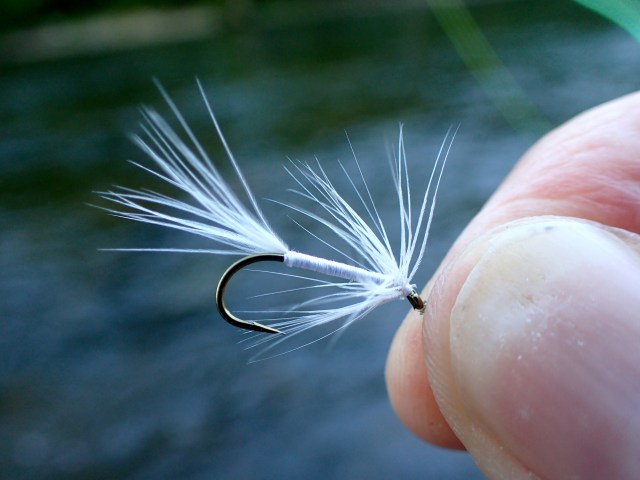
I kept thinking that the pool would light up around 7:30pm. 8:00pm passed and still nothing, nada, bupkis. Then, the first rise ring appeared. I fished a size 8 Convertible on the surface with a size 12 Partridge and White dropped off the bend. The bass liked both flies: dead drifted, swung/waked, and very slowly retrieved. By 8:30 the air was alive with bugs, the water surface cluttered with fluttering white masses (as a fine contrast, there was also a good showing of black caddis, size 16.) I took my last fish at 8:45, and shot the video from the previous post on the wade out.

Some notes: the bass were keyed solely on the hatch. I could coax no interest in a surface bug or streamer. Also, the mosquitoes were fierce once my cigar went out. Bring bug spray or an extra stick. With warming and dropping water levels, I would expect tonight’s action to be excellent.

Best bass of the night, just over a foot long. He took the soft hackle as I performed a slow hand-twist retrieve in some frog water. A really good battle from this fish — he sounded after hookset, bulled and raced, and I didn’t see him until he reached the net.

OLYMPUS DIGITAL CAMERA

The Housatonic River white fly hatch is on

Two lonely white flies at 7:00pm, then at 8:15pm the main switch was thrown.

Details to follow.

White flies here. White flies there. White flies, white flies, everywhere!


Smallmouth bass streamers: TeQueely and Home Invader

I spent some time at the bench last week on two dramatically different smallmouth patterns, the TeQueely and the Home Invader. Neither of them are the kind of streamer that I’d typically fish. The TeQueely is, in a word, horrible. What a mashup of flash and garbage! But smallies love it, so I’m more than willing to suspend my principles in the interest of cartwheeling bronze. You’ll find it on several “best streamers for smallmouth bass” lists.

At first glance, Doug McKnight’s Home Invader is far too opaque for my tastes. And I’m no big fan of dumbbell eyes. Again, allow me to move past those objections and point out what there is to love about the Home Invader, namely marabou, fox fur, and hackle tips. And this fly knows exactly what it wants to be: a big meal for a hungry or uber-aggressive fish. You can read more about the Home Invader and find tying instructions here. Tying instructions for the TeQueely are listed below.

So ugly, they’re beautiful. The TeQueelys are tied on a size 4, the Home Invaders on a size 2 TMC 1710 (1x strong, 2x long). The Home Invader second from bottom is an all marabou variant. All flies pictured are at least 4″ long.

OLYMPUS DIGITAL CAMERA

TeQueely tying instructions:
Hook: TMC 2220 size 2-6
Thread: Black 6/0
Bead: Gold
Tail: Black marabou under black Krystal flash under yellow marabou
Legs: Chartreuse rubber or silicone
Body: Medium black cactus chenille


Long Island Flyrodders awarded the Legion of Cookout Merit

Many thanks to the members of the Long Island Flyrodders for their generous, welcoming spirit. What an impressive crowd — I believe it was nearly 60 — on a fine summer’s evening. The Long Island Flyrodders know that a fed presenter is a happy presenter, and I must say that my cheeseburger, dog, beans, and — bonus! — bag of Cheetos really hit the spot. (The beer was tasty, too.) Thanks again for hosting me, and I look forward to a return engagement.

These folks know how to hold a meeting. Good spread, good people, good energy — the bar has been set to a new height. 

LIFlyrodders

Housy Smallmouth Report 7/31/17: lukewarm bronze

We can endeavor for hot, but sometimes you’ve got to take what nature gives you. I fished the TMA from 5pm-8:45pm last night, dedicated to the smallmouth cause. I started off with a white/chartreuse conehead bugger in a mix of sun and shadows and caught a bazillion smallies from 4-6″. That was fun, but it really wasn’t why I was there. So I headed to another spot that would be completely in the shade.

This second run was a bona fide honey hole for me last summer, with plentiful bass, and some pushing the foot-long mark. On this evening, it was a bittersweet reminder that every year is different. One dink was all I could manage.

In fact, it took a while for things to get going. The best fishing really didn’t happen until full dusk, with the typical it’s-dark-now shutoff. The big one eluded me, but I took several fish that pushed 12″. Most of the smallies were keyed on emergers, and unlike last year there were stretches where they ignored the streamer. (And several instances where they pile-drived the bug the moment it hit the water.)

And you can’t make this up: around 7:30pm, I was swinging a Zoo Cougar through a pocketed run. Bump….BUMP. Fish on. As I was stripping it in, I said out loud, “You think you’ve got an 18″ brown, but it’s really an 8″ smallie.” A few moments later, I realized that it was a trout — a big old rainbow. Once I knew what I had hooked, I hauled it in quick. The fish was in great shape, high teens, fat, intact fins, deep pink band. I was going to take a photo, then thought better of it, and released the fish, which swam off in seemingly great spirits.

Water was 296cfs and 69 degrees. No white flies yet.

Handsome fish. This guy took the bug on the dangle near the surface, and treated me to several frantic aerials. I like the translucency of the pectoral fin.

OLYMPUS DIGITAL CAMERA

Farmington River Report 7/26/17: “Get out the chapeaus!”

Or so Jack Edwards might have said if were calling my fishing game. An odd Farmington River hat trick, consisting of browns, a rainbow, and…what? Smallmouth bass? Read on…

I value my fishing solitude as much as anyone. Many days, I choose where I fish as much for alone time as I do for fish-catching potential. I started off yesterday at 6pm on the lower river in a stretch where I might expect to see a dozen anglers all season. Holy mob scene, Batman! Six cars and ten anglers later, I was dragging my horrified self to parts less populated.

For a guy who’s fairly well-known for wet fly fishing, I haven’t done a lot of it in the evening. Most summers, I’m content park myself in some dry fly water and wait for the evening rise. I’m doing things a little differently this week, swinging wets as afternoon transitions into night. Same three fly team as yesterday: S&G, Magic Fly, hackled MB. The hatch activity in this second location was about a 3 on the 10 scale. Sulphurs were the prominent bug. Very little bird activity and even fewer risers. The smallie came first, plowing into the March Brown on the dangle. A few aerials for my viewing pleasure, and for a moment I thought that maybe I was on the Hous. A few minutes later, I was saying out loud to myself (it’s OK, I do that) “There’s really nothing going on here,” when WHACK! Also on March Brown.

I had been dead-drifting the wet fly team through some water better suited for dries when my line came tight with a vengeance. You could count the spots on this guy, and the pattern is about as linear and symmetrical as I’ve seen on a brown. 12″ long and the parr marks have yet to vanish. Full adipose.OLYMPUS DIGITAL CAMERA

~

Next, I fished a steep riffle that rushes into a deep, compact pool. No bugs, nothing rising, and I was thinking that maybe I should rig for depth charge when a stout rainbow clobbered the fly as it swirled near the surface. Here’s a trippy low-light shot that begs the question: Is this what C&R looks like at a rave?

DCIM100GOPROG0024644.

~

I‘ve said it before and I’ll say it again: dusk can be a magic time. The trout went bonkers on the surface just at the moment when you could no longer see your fly. This brown measured 17″. Full adipose, and look at the size of the anal fin and tail.

OLYMPUS DIGITAL CAMERA


Farmington River Report 7/25/17: The method and the madness

Let the binge fishing begin!

I started fishing at 6:30 last night in a run I usually reserve for mornings and afternoons. The hatch activity was immense: sulphurs, small BWOs, caddis, Isos — and the cedar waxwings and swallows were going to town on the duns and spinners. I’ve never seen so many birds over the river. It was like being an observer in WWII dogfight. I lost count of the number of birds that flew so close I could hear their wings.

The method was wet flies. Given the amount of bug activity, I was expecting to catch 20 trout in this 300 yard stretch. The final number was a bit more modest, but I found plenty of fish willing to jump on. One of them was a camera-shy, low teens rainbow that had been in the river a while: dense spotting, intact fins, wide pink lateral band. I found players on all three flies (Squirrel & Ginger, Pale Watery wingless, hackled March Brown).

Dry was the next method, practiced from 8pm to dark. I rose a half dozen fish on tiny rusty spinners and Magic Flies, but my hook points found no purchase. Back to the truck for the streamer kit, and I walked out of the pool drifting/swinging a mouse, then a conehead Woolly Bugger. A few bumps, but no takers.

I was disappointed with the dry and streamer action. This may have had something to do with the fact that we had October temperatures; hopefully things will pick up as we get into a warming trend. At least we have water! Speaking of which, 340cfs and 54 degrees.

Swinging a team of wets in pocket water during a hatch is like this handsome brown: butter. He chose the Magic Fly, fished subsurface.

OLYMPUS DIGITAL CAMERA


Are you ready for some summer smallies? Read “Hot Bronze” in the August 2017 issue of Field & Stream.

“Hot Bronze” is a primer on summer smallmouth on the fly. It’s my second piece for Field & Stream, and you can read it in the August 2017 issue, on newsstands right now.

OLYMPUS DIGITAL CAMERA

Block Island Stripers From The Shore


“Block Island Stripers From The Shore” first appeared in the October/November/December 2016 issue of Mid Atlantic Fly Fishing Guide — sadly, the last issue of this regional gem. I consider Block Island to be sacred fishing ground. Some of my favorite fly fishing memories have been created along its shoreline.

My grandparents had an old map of Block Island in their basement. To my young eyes, it looked like a pirate treasure map from a story book. (I wasn’t too far off – the notorious Captain Kidd was known to frequent the island and its waters.) Then, there was the curious name. Why Block? It was shaped more like a pork chop than a cube. (I would later learn the island was named for Dutch explorer Adrien Block.) It was small enough to be charming (7 miles long and 3 miles wide, situated 13 miles off the coast of Rhode Island) yet substantial enough to have been around since the last ice age.

Then there were the magical names of its shoreline and landmarks: Pots and Kettles. Rodman’s Hollow. Black Rock. It all sounded like a fanciful netherworld inhabited by wizards and elves.

The wondrous reality is that from May through November, Block Island is home to Morone saxatillis. And if the year, moon, and tides align, you can reasonably expect an unforgettable encounter with a striped bass on the fly from the shore.

A feisty Block Island school bass taken on a dead drift using a small, sparse sand eel pattern.

OLYMPUS DIGITAL CAMERA

~

Where to fish. Finding a place to fish on Block Island is a good news-good news scenario: many possibilities, ample public access. You can find most of these spots on an online map. Note that there is no camping on Block Island, and no sleeping in vehicles.

Crescent Beach stretches several miles north from the ferry landing in town to Mansion Beach. The sandy bottom makes it a popular place for sight fishing. Some people bring ladders, but most anglers are content to walk and wet wade. Mornings – the beach crowds start building around 11am – and late afternoons are the best times to try your hand at stalking a cruising fish. If you see a substantial number of bass during the day, it usually means they’ll be around at night, too.

You’ll find structure, waves, and current like this along much of the island’s shoreline.

OLYMPUS DIGITAL CAMERA

~

Sandy Point is the spit that juts out from the northern tip of the island. Currents from Long Island Sound and Cow Cove smash together, creating the dangerous – and sometimes deadly – North Rip. This is the place where Block Island angling legend Ben Lubell lost his life in the early 1980s. Take a lesson from Ben, and never wade in the North Rip. Stay out of the water and the wash at Sandy Point.

Those same lethal currents can also make for great fishing, acting as a conveyor belt that delivers helpless bait to waiting mouths. Local historians will tell you that Cow Cove got its name when the island’s first settlers forced their cattle to swim ashore there. Noted author and fly tyer Ken Abrames says with a smile that the name really comes from the size of the stripers that have been taken there over the years.

The Great Salt Pond was once a brackish, landlocked lake. A channel was dug in 1895. The pond offers the fly fisher a rich diversity of angling opportunities, from shallow flats to deep water drop-offs to pinch-points to river-like currents. The channel at the Coast Guard Station, also known as the Cut, is the most popular fishing spot on the island. However, popular doesn’t always mean best, and parking is often limited.

West Side. Charlestown Beach runs along the middle of the west side of the island. When it’s on, gird yourself for a bad case of striper thumb. The largest blitzes I’ve experienced on Block Island – both in numbers and pounds per fish –have taken place along Charlestown Beach. The West Side is also home to Grace’s, Dorie’s, and Cooneymus Coves. All are rocky bars that are in fly rod range at high tide.

South Side. The stretch from Black Rock Beach to Mohegan Bluffs features the kind of rocky structure that stripers like to frequent. However, both surf and prevailing winds can be a challenge to fly casters.

Some final words of advice and caution: never fish an area you’re unfamiliar with at night. Reconnoiter it first in daylight at the same tide you’ll be fishing. Don’t venture out in rough surf. And fish with a friend.

Flies and gear. Sand eels, squid, and silversides are the predominant inshore baits, so bring plenty of flies that match their action and profile. Sand eels start out small – 2” or less in early June – and grow as the summer progresses. I favor sparse, impressionistic patterns like Ken Abrames’ Eelie and Big Eelie. I tie the Big Eelie in a wide range of color combinations, from the original white/yellow/olive/blue to blue/black/purple. I make them about 4 ½” long, and stripers relish them all. It’s hard to go wrong with any simple, slim-profile baitfish pattern.

I’ve caught more Block Island stripers on the Big Eelie than any other pattern. This is the fly’s original color scheme.

Culton_Block_BigEelie

~

It’s not uncommon to find both smaller (2”-3” long) and larger squid in the Great Salt Pond. And while I’ve never done very well using big flies on the Block, I always bring some foot-long eel patterns, because one day I’m going to find that 50-pounder. Crab and shrimp flies designed for bonefish will also work quite well on Block Island’s flats.

Bring your favorite one- or two-handed rod. As with any island, expect windy conditions, and match your rod accordingly. The water I fish is typically 2 to 8 feet deep. A floating line gives me the option of presenting from the surface to the bottom in most places. I always bring my full-sink integrated line in case it’s insanely windy or I want to fish a deep channel.

Waders and studded boots are essential gear for navigating the rocky shores and jetties of Block Island. Lightweight and comfortable boots will make that one-mile slog down the beach a little more endurable. Keep in mind that Block Island is surrounded by cool water for much of the summer; you’re probably going to need a jacket at night. Use a personal flotation device and carry a compass – Block Island can get Transylvania horror movie foggy.

And for those rare nights when the wind lies down and the air is still, make sure you have a generous supply of effective bug spray. The no see-ums on Block Island are torturous.

When to fish. Every year is different, and as east coast striper stocks have ebbed and flowed, so has the fishing on Block Island. In the previous four years I have caught as many as 75 bass over 8 nights, and as few as 4. There’s no way to predict which island you’re going to get.

While you can certainly catch Block Island stripers in daylight, Ray Charles put it rather eloquently when he sang, “night time is the right time.” Because most of the water I fish is shallow, I favor the dark of the moon or cloud-covered nights. Of course, the best time to go fishing is when you can. Catching or merely fishing, Block Island is a unique and beautiful location – and you’ll quickly understand why it was named by the Nature Conservancy as one of the “Last Great Places.”

Why I love fishing at night. This striper was part of a school of 10 to15-pound fish that set up on a shallow cobble-bottomed bar to ambush bait.

Culton_Block_Striper2