Block Island striper report: small is the new black

Another year, another seven days to chase linesiders in one of The Last Great Places. What each new season brings is always a mystery until you get out there, and then you can toss all the reports you’ve been hearing because they’re either spot on, nothing like that at all, or varying points of somewhere in between.

In 2017, I’d been hearing credible talk of voluminous schools of sand eels inshore and the Bass-O-Matic running on high. That sounded swell, but there were two x-factors to consider: we were coming out of the new moon into first quarter with a waxing gibbous and its bite-killing light; and the weather. Good news/bad news on both fronts. On the plus side it was cloudy most nights, so moonlight was not a factor. On the down side, it was windy. Like small craft warning windy: 20 knots sustained with higher gusts that pushed the limits of what is reasonable with a fly rod. And wind usually changes everything on the Block.

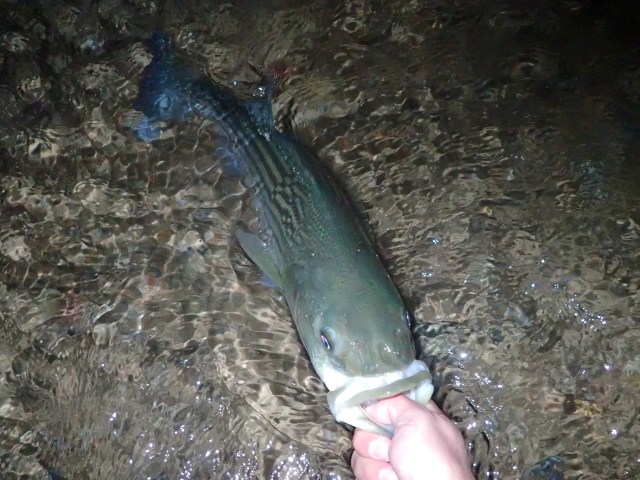
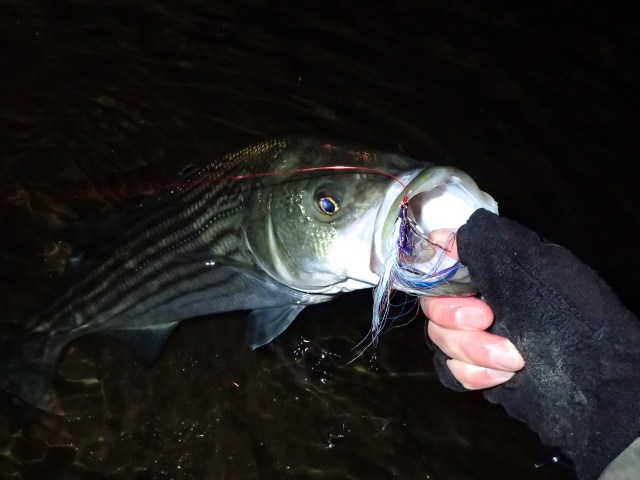
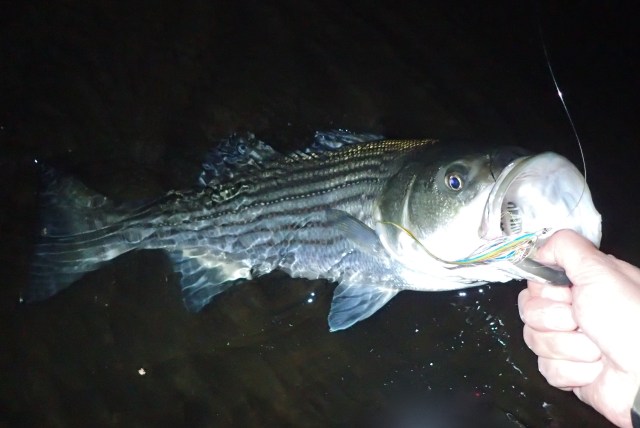
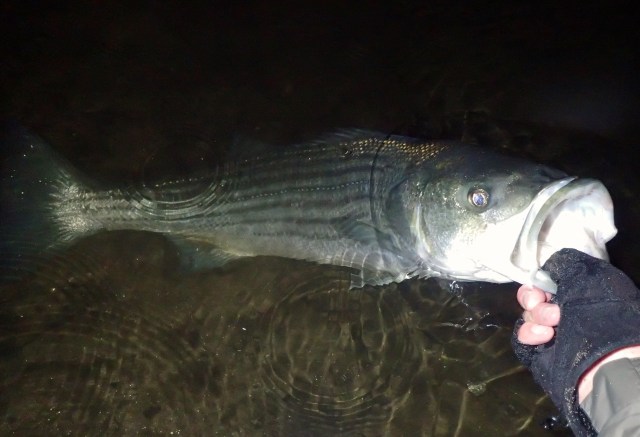
Like last year, I caught stripers every night. But the bargain of two consecutive years without a skunk was a preponderance of small fish. This was the first time in a decade that I didn’t take a legal bass out here, and I found myself longing for those schools of 15-pounders that would sit off the beach for 90 minutes, having their way with sand eels. I had two double-digit nights, then a six, then three singles, and wrapped it up with another half dozen. But 27″ was the largest bass I could muster.

Sight fishing from the beach during daylight was tough due to wind, but mostly to the clouds that made finding those elusive shadows a chore. What’s more, on the sunny days I spotted very few cruisers. I did get two fish to follow my fly, one of them a good 20-pounder, but in the end they both broke off the chase.

And then there were the Meatballs. I had enough nights where I enjoyed blissful solitude, but there were a few sessions where the Meatballs were out in force and in rare form. I’m usually the quiet sort on the water, but at one point on a certain night I was blasted so often by so many hundreds of lumens that I finally turned and barked, “Please stop shining that light on me NOW!” They left shortly after. I had a cigar to celebrate.

And that’s the thing about Block. Even when it’s bad, it can be very, very good.

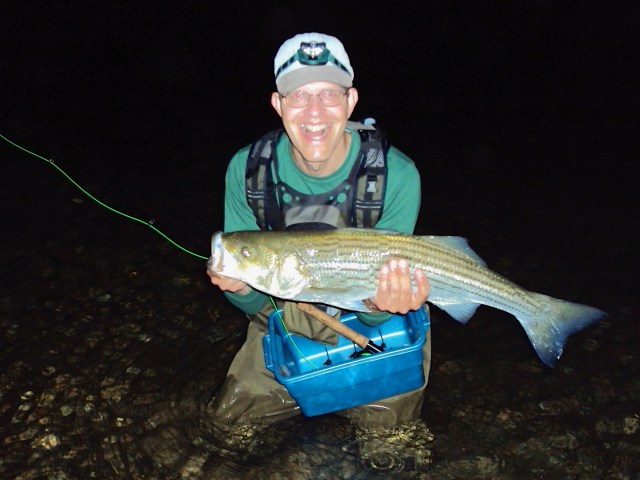
I had high hopes for this fish — he went on the reel — but the tape measure didn’t lie and he came up an inch short. I mostly stuck with my usual eclectic mix of Big Eelies. This fish thought the Crazy Menhaden color scheme looked tasty. Kind of a neat stained glass effect going on in the water around him, too.

OLYMPUS DIGITAL CAMERA

~

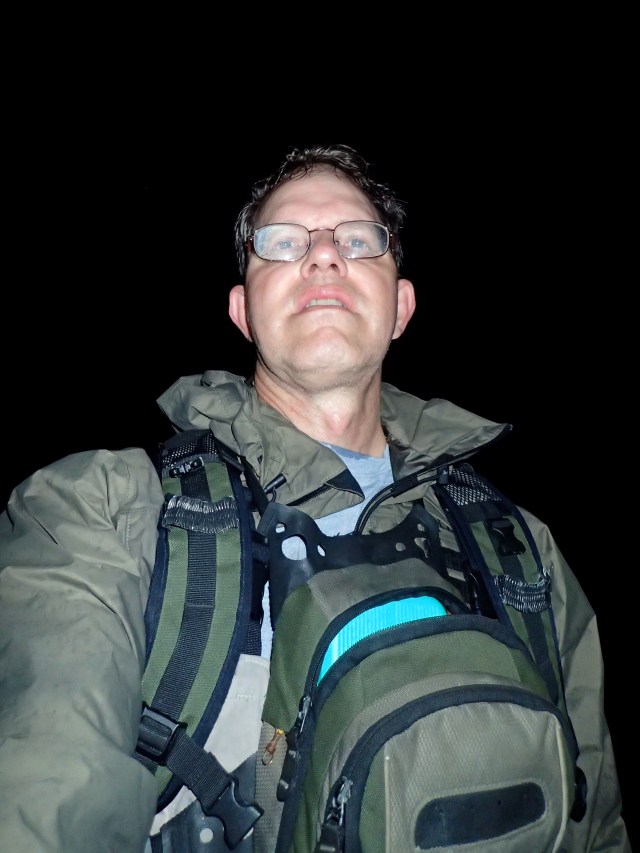
Unless there’s a specific hot spot, I always try to mix it up on the Block. I fished the east side and west side beaches, southeast side, off some jetties, in the Great Salt Pond, and — regrettably — the North Rip. I say this only because the Rip had been producing a consistent good bite if you had a spinning rod. The night I slogged out there was about the worst night for fly fishing you could imagine. The wind was rain jacket whipping-fast, and I had to cast my line backhand over my right shoulder (I’m a lefty) to shoot it into the rip, then feed line into the left to right current. So far so good. But, rats. Mung. Every cast. I took this shot when I got back to the truck. Yes, it was that hot and that humid and that foul. I love the Block, but walking a mile and a half in the sand for nothing will make anyone dour.

OLYMPUS DIGITAL CAMERA

~

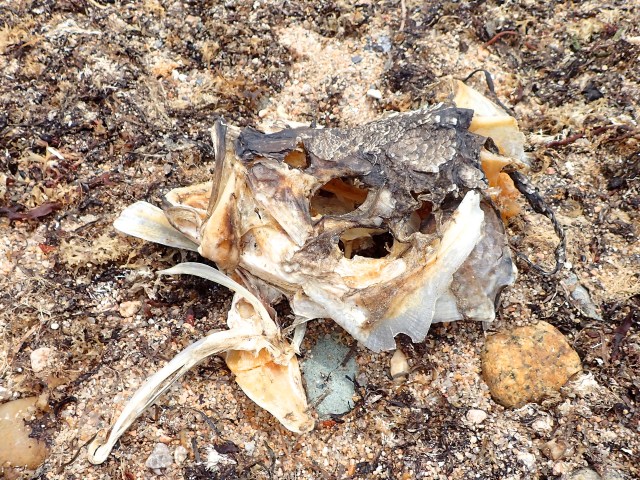
I discovered that striped bass have great camo against the sand and rocks — even when they’re dead.

OLYMPUS DIGITAL CAMERA

~

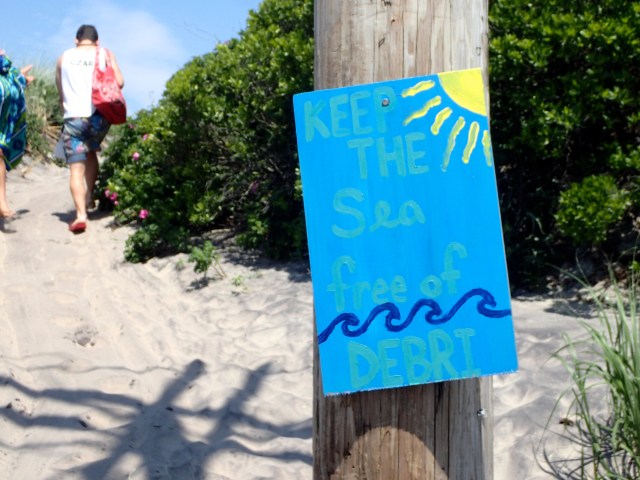
A public service message brought to you by the National Spell Check Society.

OLYMPUS DIGITAL CAMERA

~

On the last night I caught bass two ways. First, off the beach, where I found a school of hungry fish feeding in the moonlight; then, inside the Pond on a flat with a team of three flies suspended in the film. (Floating line, of course, for both methods.) My last two fish of the trip came as the flies dead-drifted across the flat. That building pressure I felt let me know a striper was flaring his gills to suck in one of the small sand eel flies, in this case a 3″ Eelie in olive and chartreuse. See you next year, when one of us has put on a few more pounds.

OLYMPUS DIGITAL CAMERA


Big Eelies and Banana Squid, or: striper soft hackles galore

I went on a wee tying binge, and when the feather dust settled I was left with an 8-pack of Big Eelies. Some are old favorites, and a few sport new color combinations. That’s one thing I love about this pattern: it lends itself supremely well to all manner of color experimentation, and the stripers almost always seem pleased with your work.

Big Eelies hot off the press. Clockwise from lower left: pink/chartreuse/olive, grey/olive, Crazy Menhaden colors, Olive Fireworm colors, black/chartreuse, pink/olive/brown, then the two of the original classic. I can already feel that forceful tug at the end of a twitching strip.

OLYMPUS DIGITAL CAMERA

~

The Banana Squid, another classic from Ken Abrames. It’s different from most other squid patterns, and it looks nothing like what books would lead you to believe  a squid should be. Add the magic ingredient of water, and it transforms into a living, breathing organism than looks good to eat. Fished slowly and deliberately, it relies on organic movement and impressionism to fool the fish.

OLYMPUS DIGITAL CAMERA

Hook: Eagle Claw 253 3/0
Thread: Black 6/0
Platform: 30 hairs grey bucktail
Tail: Three white saddle hackles tied in flat, then four ginger saddles (I used golden tan) to veil the white saddles, then sparse purple Krystal flash on both sides, then a short badger hackle on both sides, then a webby grey saddle tied in flat, then a full plume of amber marabou
Body: Purple braid tied to 3/8″ from the hook eye
Collar: A sparse layer or yellow bucktail one hair thick to extend to the end of the amber marabou, then a sparse layer of blue bucktail one hair thick, then a sparse later of red bucktail one hair thick
Hackle: Brownish marabou tied in near the butt of the stem, then wound and doubled 3-4 turns

Why I love fishing for stripers with big flatwings on the greased line swing

After three very slow springs, things turned around a bit in 2017. It wasn’t as good as the old days. (Is it ever?) But the skunks were few, and the keepers more plentiful than in recent years. I wish I could say the baitfish were making a comeback. Sadly, I saw precious few swirls of mating herring. But enough with the negative. This is a celebration  of elegant flies fished with a traditional method — and the brute force of striped bass that can be measured in pounds.

The Rock Island flatwing saw plenty of swim time. It may not look it, but this is a legal fish, one of three I took that night.

OLYMPUS DIGITAL CAMERA

~

Another old favorite, the Razzle Dazzle. The Razzle Dazzle is responsible for my biggest striper on the fly from the shore, 30 pounds. This one is a wee bit less than that. Still, a good keeper bass on the long pole.

OLYMPUS DIGITAL CAMERA

~

We’re getting there. 15 pounds of power. I landed her at 1:00am after two hours of fishing without a touch. Since it was raining, I decided to end on a high note. A JR Cuban Alternate Cohiba Robusto was lit in celebration, and smoked on the long walk back to the truck.

OLYMPUS DIGITAL CAMERA

~

I don’t handcuff myself to the dogma of black flies at night. But occasionally, I do fish them. This spring I prototyped and tested a large, mostly black multi-feather flatwing (patience — recipe and photos to come). My intent was to have a big fly to silhouette against the dark of the moon sky in stained water. Here are my test results — all 20 pounds of it.

OLYMPUS DIGITAL CAMERA

~

Following the tides is a tough job, but some damn fool needs to be out while the rest of the world is sleeping.

401AM


“Mainly Misunderstood — Five Myths and Realities About Using Floating Lines For Striped Bass” in the current issue of American Angler

Why are floating lines so underused for striped bass fly fishing? Are intermediate lines  truly versatile? These questions and more are answered in “Mainly Misunderstood,” and you can read all about it in the current (May/June 2017) issue of American Angler. If you’re looking to open the door to a whole new world of presentation options, the floating line is the antidote to the mind-numbing metronome of cast-and-strip.

If you want to catch keeper bass like this with flatwings fished on a greased line swing, you’re gonna need a floating line.

OLYMPUS DIGITAL CAMERA

~

I love fishing floating lines in surf around structure.

OLYMPUS DIGITAL CAMERA

Stuff I Use: the Eagle Claw 253 Hook

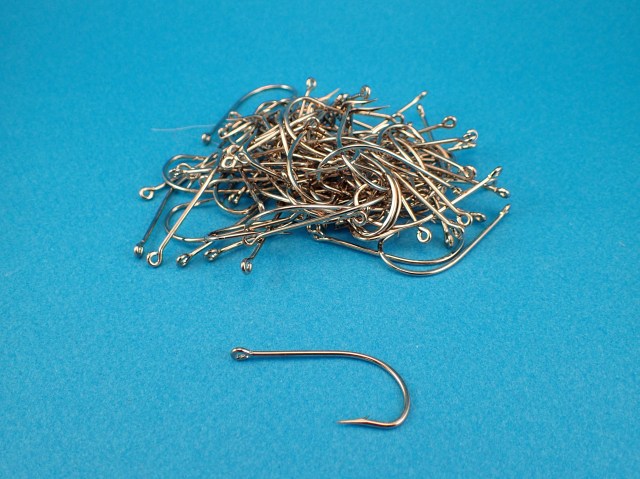
The Eagle Claw 253 hook is the traditional choice for tying the flatwings, bucktails, and soft hackles made popular by Ken Abrames. It is a 1x short, O’Shaughnessy style spinnerbait hook with a non-offset point.

Ken didn’t choose that hook by accident. In Striper Moon, he writes of the 254 1x short, a similar hook, “The wire is light and does not cause the hook to sink unnaturally…the shank of this hook is one size short…this does two things: first, it makes the hook lighter and second it makes the point longer in relationship to hook size. I believe this gives me a mechanical advantage when fighting  a fish.” Those same attributes apply to the 253, which is the dominant hook in his book of fly patterns, A Perfect Fish.

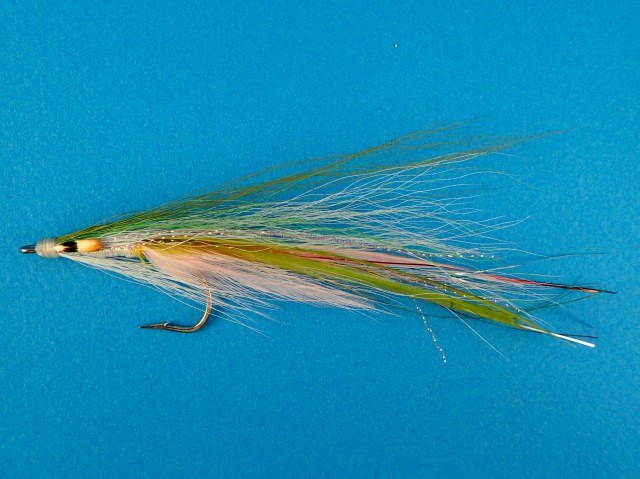
“To fashion a fly from tradition is an honorable practice.” — KA. I did my best to honor that practice with the Rock Island, tied here on the Eagle Claw 253, size 3/0.

Rock Island Flatwings

The Eagle Claw brand holds a special place in my heart. It was the snelled hook we used when my father taught me how to fish for trout in the early 1970s. For years now, I’ve been tying most of my striper flies on the Eagle Claw 253. I usually buy them in lots of 100, readily available at any number of online retailers. Most of those 100 are sticky sharp right out of the box; those that aren’t are easily sharpened with a few strokes of a mill file. Eagle Claw makes a version of the 253 called “Lazer Sharp.” Ironically, I’ve found many of the Lazer Sharp hooks to be pencil-eraser dull, and difficult to sharpen. Stick with the regular 253 hook.

The biggest striper (probably between 30-35 pounds) I ever caught on the fly from shore took this Razzle Dazzle flatwing, below, tied on an Eagle Claw 253. At the time of the catch, the fly was at least 3 years old, and seen multiple seasons of use. I had sharpened the hook the night of the outing, as I had done many times before with Eagle Claw 253s, making sure it had enough sticking power to hold a junior cow.

IMGP2600

Most of the Eagle Claw 253s I use are size 1/0 and 3/0, although I will tie some of my larger flatwings on 4/0s. A word of caution: on larger stripers, I’ve had the 1/0s begin to open (I tend to put a lot of pressure on a fish when fighting it) although I have never lost a striper to an opened hook. If I suspect there are bigger fish around, I’ll go with a 3/0 and up. I have never had an issue with those sizes.

My favorite hooks for flatwings, bucktails, and soft hackles, fresh from a 100 count bag, ready for the vise.

OLYMPUS DIGITAL CAMERA


Ray’s Fly Featherwing: A simple, sparse flatwing

Many years ago, I was having trouble with some bass that were feeding on silversides in a Rhode Island breechway. The fish were active, but I couldn’t get them to bite. Ken Abrames recommended that I try the Ray’s Fly Featherwing, a dressed-down flatwing version of Ray’s Fly. I remember him telling me that it was, at the least, another arrow  in the fly box quiver.

That was a long time ago. I remember tying some up, but I don’t know what became of them. I know I caught stripers on them. I think I lost my last one to a bluefish.

Recently, someone on one of the forums asked about a “Ray’s Fly flatwing.” I think the Ray’s Fly Featherwing is the fly he was referencing. I haven’t tied in a couple of weeks, so I went down to the bench this morning and churned out a few. So simple. And sparse. I’d be as inclined to use these for a sand eel as I would a silverside.

All saddles are tied in flat — flatwing style, as they say. Note that the olive saddle is tied in at the head. All you need to do now is add water.

Ray’s Fly Featherwing flatwing

OLYMPUS DIGITAL CAMERA

Hook: Eagle Claw 253 1/0
Thread: White
Tail: 30 strands white bucktail under white saddle under 4 strands pearl flash under yellow saddle
Body: Pearl or silver braid
Wing: Olive saddle
Topping: Peacock herl

Ken Abrames returns online

Many of you have been wondering, “What happened to Ken Abrames’ Stripermoon website?” Well, the old forum is no more.

Ken has moved on to two Facebook pages. The first is called JK Abrames Stripermoon, and you can find it here.

The second is called Stripermoon Blog. That is located here.

Please join me in welcoming Ken’s return to the web.

Hello, old friend.

Ken Abrames Portrait


“Bill Peabody’s Flat-Wing Patterns”

A few years ago, Capt. Ray Stachelek gave me a copy of an article Bill Peabody had written in the May-June 1998 issue of Fly Fishing In Salt Waters. I mentioned it here, then mostly forgot about it. A few weeks ago, one of you asked if I could share the piece. With my Compleat Angler flatwing demo tomorrow, this seemed like a good time to do it.

Below is a pdf of “Bill Peabody’s Flat-Wing Patterns.” The quality is as good as I can make it, this being photos of a photocopy. I want to be clear that I did not write this piece. Bill Peabody did.  Enjoy!

Bill Peabody’s Flat-Wing Patterns

My rendition of Bill Peabody’s Flat-Wing Bay Smelt. The fly has not yet been shaped under water.

OLYMPUS DIGITAL CAMERA

How To Tie And Fish Dropper Rigs For Stripers

“How to Tie and Fish Dropper Rigs for Stripers” first appeared in a 2010 issue of Mid Atlantic Fly Fishing Guide

Not every day is April on the lower Housatonic when the stripers are ready to pounce on your fly with reckless abandon. No, this was an August evening in Rhode Island, and while the bass were open for business, hookups were few and far between.

I was fishing a spot where a rocky bar merged with a shallow sand flat before dropping off into a deep channel. Pop! Tock! Every few minutes, I could hear the distinctive tells of feeding fish, all within casting range. The water was loaded with dense schools of silversides. Peanut bunker were in the mix, and I had even seen clamworms earlier in the week. But what were the stripers feeding on tonight? Within a few minutes, I would have my answer. I cast my dropper rig into a surface seam, and started mending for a greased line swing.

As the flies swam across the current, the water exploded. I set the hook, and soon a fine striped bass was in my hands. With the dropper rig, he had three fly choices: a clamworm, a small bucktail menhaden, and a Ray’s Fly. He chose the menhaden. A few casts later, bap! Another striper on the menhaden. Satisfied, I clipped the other flies off the leader. Once again, droppers had proven to be the fastest way to find out what the fish wanted.

Dropper rigs take a little more effort than store-bought tapered leaders, but they’re easy to tie and the rewards can be great. A dropper rig is a terrific searching tool, giving the bass multiple targets, and letting you present at different depths on a single drift. I’ve always been the curious sort, and I like the surprise a dropper rig provides when I discover which fly fooled the fish. And, as an angler who embraces traditional methods, the dropper rig has proven itself — you’ve heard of a brace of wet flies — over the course of hundreds of years.

The original article had an illustration of a three fly team by Ken Abrames;  I’m replacing it with a detailed rigging diagram. It’s a simple leader — you’re basically making a triple surgeon’s loop and then tying two triple surgeon’s knots.

OLYMPUS DIGITAL CAMERA

Here’s a pdf: Striper Dropper Rig

A basic dropper rig is about seven to eight feet long, with two dropper flies and one fly on point. The flies are spaced 18 to 24 inches apart, and the dropper flies are tied on tags that extend a few inches out from the leader. I use 20, 25, or 30 pound mono to build my dropper rigs. Start with a length of mono a little over four feet long. Tie a loop about the circumference of a baseball at one end; this will be the butt of the leader. I use a triple surgeon’s knot, but you can use the knot of your choice. Always wet the mono before you tighten your knots, and remember the wisdom that no knot is worthy of your trust. I test every knot I make before I fish any leader system.

Next, take a three-foot section of mono and attach it to the butt section with a triple surgeon’s or double uni-knot. The tag of the butt section will form the first dropper, so be sure to leave plenty of material (about 8”) for it. Snug that knot up good and tight, then repeat the process to form the second dropper. You should now have a length of mono with two tags, spaced about two feet apart, extending toward the point fly end of the leader. All you need to do now is tie on some flies. I like them between four and six inches away from the leader.

What flies? Think different: Different sizes. Different colors. Different species. Give the fish a choice. They will tell you when you’ve made the right one. In my experience, this rig fishes and casts best with the largest fly in the point position. Don’t be afraid of fouling or tangles. You can cut down on their incidence by slowing down your casting stroke, and making sure the line straightens out on your back cast before making the forward stroke.

Here are a few simple guidelines to help you decide if a dropper rig is a good idea. Use one when:
• You’re searching for fish.
• There are multiple baits in the water and you’re not sure what the stripers are feeding on.
• There is an abundance of small bait in the water, i.e. anchovies, grass shrimp, clam worms, sand eels.

A dropper rig might not be the best choice if:
• There are bigger fish about (landing multiple large fish on a single leader can be a dicey proposition).
• You’re having difficulty casting into a strong wind (use a shorter leader and a single fly).
• You start consistently hooking doubles or triples.

Droppers aren’t a magic bullet solution. But if you want to catch more fish, they are an excellent arrow to have in your quiver.

“Soft Hackles For Striped Bass” in American Angler

The November/December 2015 issue of American Angler hit the newsstands and fly shops last week. “Soft Hackles For Striped Bass” covers some salty soft hackle basics, and features six patterns: three from Ken Abrames, and three from yours truly.  I interviewed Ken for this piece, and there are plenty of good quotes to dig into. As always, I try to go beyond straight how-to and inject a little fun into things. I hope you enjoy reading it.

You can find “Soft Hackles For Striped Bass” by Steve Culton in the Nov/Dec 2015 issue of American Angler.

Nov/Dec 2015 American Angler