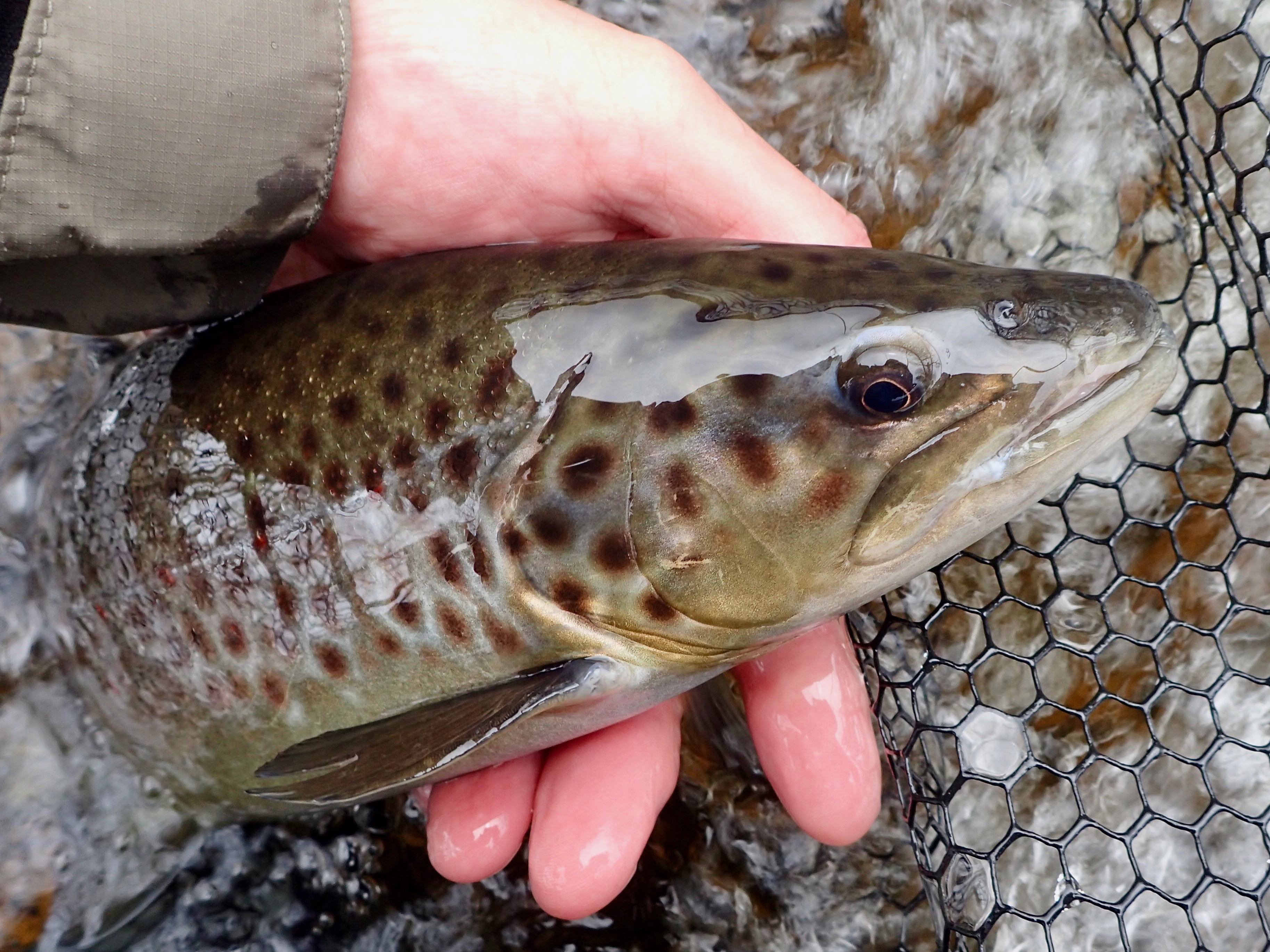
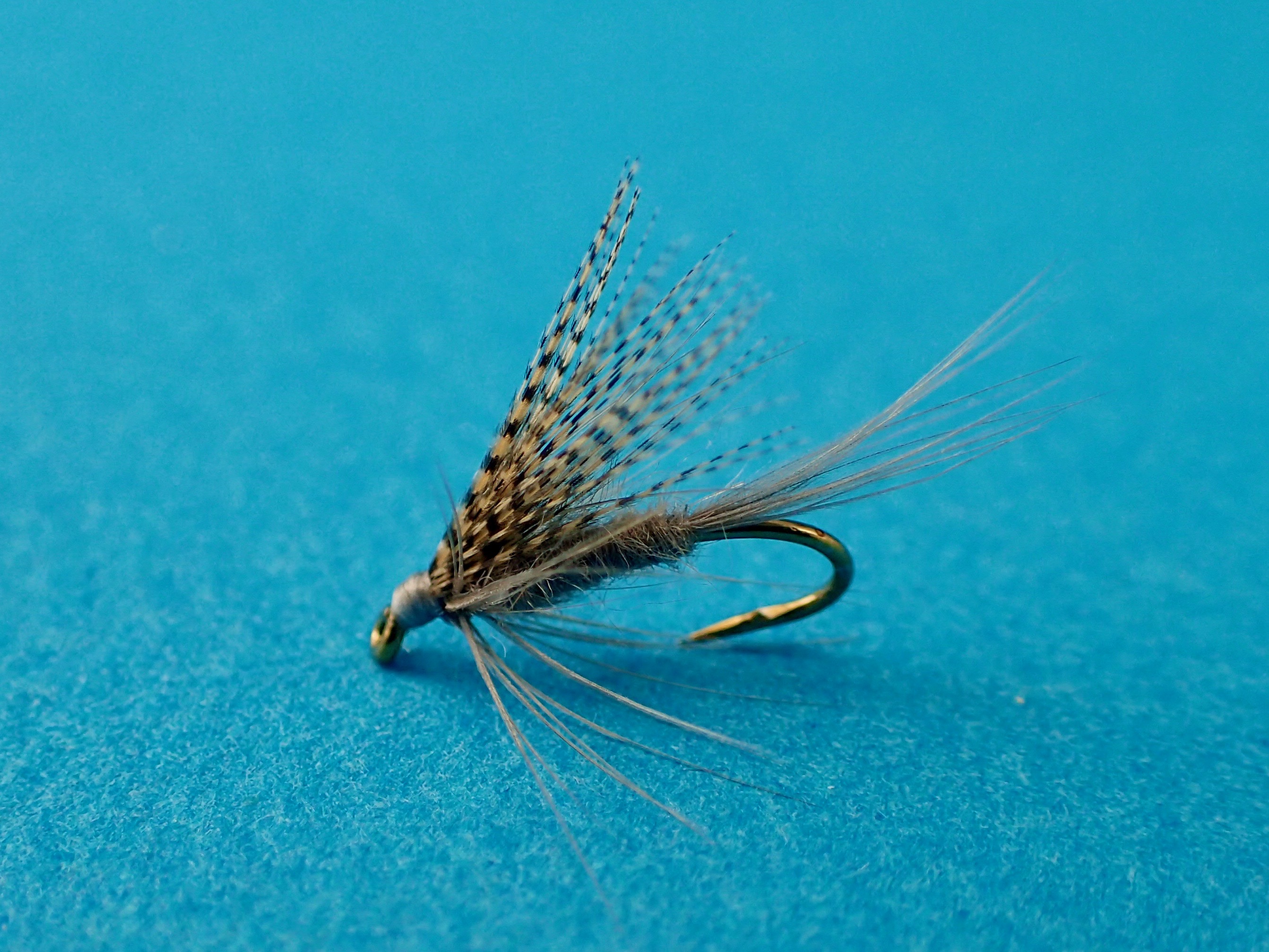
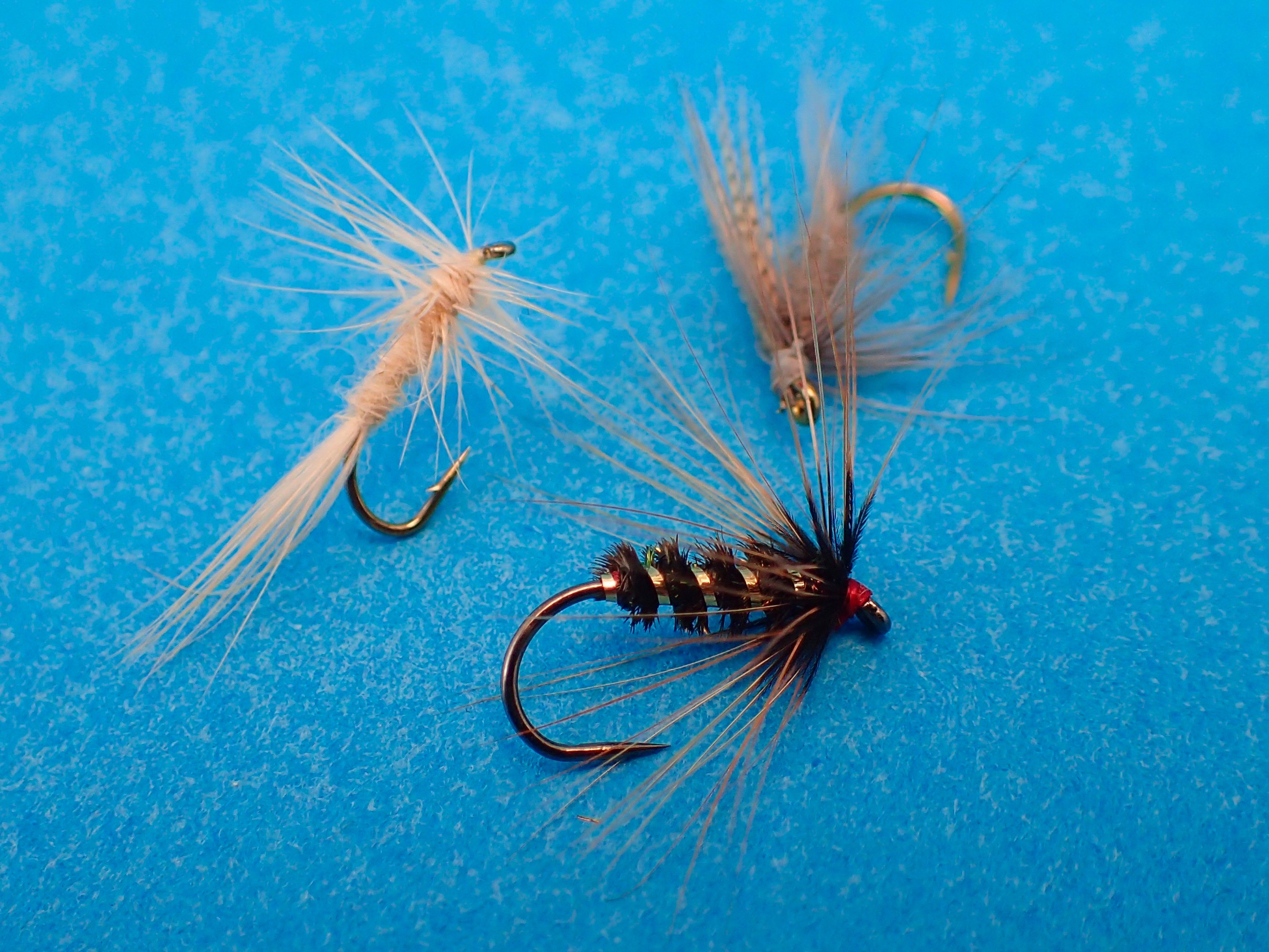
The Soft Daddy is an impressionistic, soft-hackled streamer that imitates the rusty crayfish. It’s currently featured in On The Water magazine‘s “Guide Flies” column, written by Tony Lolli. (Thanks, Tony, for letting me play!) The concept of a guide fly is twofold — it’s a pattern that is typically simple to tie, and is also a consistent producer. Like most of my flies, The Soft Daddy starts as an idea; is rendered on the vise; and goes through extensive field testing. Tweaks are made as needed, and the end result goes into the rotation. Like many of my patterns, you can see the wet fly influence in its construction. Smallmouth eat this fly like candy…or is that crawdads…or crawdaddies…?
Grady just bought someone’s collection of tying materials, and I’m happy to tell you that it includes Pearsall’s Gossamer Silk. Pearsall’s is no longer made, and nearly impossible to find, so this is a treat for those looking to tie classic North Country spiders with traditional materials. These spools are bargain priced, and as of Friday there were still plenty in stock. Naturally, I helped my self to a bunch, but I played nice and kept my silk gluttony down to a dull roar. Get ’em before they’re gone.
This photo was taken Friday afternoon. As you can see, there’s Pearsall’s Marabou silk as well.
You might also want to rummage through the bins — they’re in the room next to the parking lot — from this collection. Again, I can’t vouch for current inventory, but there were all kinds of game bird skins and other soft hackle delights at bargain prices. As always, please support your local fly shop!
I fished the lower end of the Permanent TMA yesterday afternoon and we had much better flows (under 400cfs) for swinging wet flies. So much, in fact, that after a while I replaced my tungsten bead head soft hackles with non-weighted bugs, the better to target all the slashing risers. Atmospheric conditions were as they have been: chilly, windy, and uncomfortable.
I arrived late, about 1:30pm, and as I approached the mark, I recognized the faces of the two anglers who had beaten me to it. It was Bob and Andy. I’d seen them here last year, introduced myself, and we shared the water. These guys are very giving, and a pleasure to fish next to. I’d like to thank them again for being so matey and kind.
Right away, I was into fish. I’d made the comment earlier to Torrey Collins at UpCountry that if you hit this hatch right, fishing with wets is almost unfair. I took them on the swing. I took them on the Leisenring Lift. I took them dead drifted deep on a short line. Active feeders almost always hit on the first cast. I even managed my first double of the year.
Then, the bugs came. Lots and lots of Hendricksons. I’d give this hatch an 8 out of 10. The point where the trout would no longer take the wet came at 2:45pm. Once I figured out what they wanted — it wasn’t, to my surprise, The Usual, with which I usually do boffo box office — I managed a bunch on the surface. (The winning fly was a Comparadun.) Dry fly was very much a challenge in the fierce gusts. But it’s supposed to moderate, so tight lines to those brave souls venturing out this weekend. I expect the hatch to continue to ramp up and move upriver. Enjoy!
‘Nuff said.
To this week’s mystery bug. I appreciate everyone’s input and guesses. My first thought when I observed them was some kind of early BWO. They were clearly too small for Hendricksons. After I captured a couple specimens, I was able to see that they all had only two tails. I ended up going to two people who have a far deeper technical knowledge of these things than I, and they both independently identified the creature as a Baetis. That’s good enough for me! (In case you’re wondering, my panel of experts consisted of Torrey Collins and Derrick Kirkpatrick. Those guys have forgotten more about Farmington River hatches than I currently know.)
Another unseasonably cold, windy afternoon on the river. I decided to check out the lower section below Collinsville, mostly out of Hendrickson curiosity. The water was higher than I’d like for wet fly (755cfs is still chugging; sub-500 would be best) but you don’t know if you don’t go. I began in a faster, snottier boulder-studded section; not surprisingly, it was a wet fly blank. I didn’t nymph it, which might have produced a different result.
Bug activity was, at first, minimal. Ubiquitous midges, then a mystery mayfly (see below), and then a few precious H-words. The mystery mayfly far outnumbered the Hendricksons, probably 10:1 or so. When the sun peeked out, the hatch ramped up. And when the clouds took over, the hatch stopped in its tracks. I managed a good half dozen trout on wets — this was in slower moving water — catching them blind and also by targeting active feeders. While few and far between, the active feeders all pounced on a well-placed wet fly. I fished the same team as Monday, a Squirrel and Ginger on top, followed by two tungsten beadhead Hendrickson soft hackles. I had an accident trying to land a trout by hand, and lost the middle dropper; when I re-tied, I exchanged the point fly for a tungsten SHBHPT.
I wasn’t satisfied with the surface activity, so I did a bit of nymphing. Normally I would use a traditional drop shot nymph rig, but this time I kept the three fly team and added a drop shot section to the point fly and one of my home-brew year indicators to the tapered butt. It worked just fine, and some of the takes were highly aggressive, almost bordering on frantic. After 2 1/2 hours, I’d had enough. I tried for one more trout on a swung wet, and, once successful, headed for the warmth of the car.
The mystery bug, about a size 14-16. Some kind of olive? Quill-something? Whatever it is, it far outnumbered Hendricksons. I don’t stress when I can’t ID a bug; if you try to match the general size, color, and profile with a wet fly or nymph, you’ll tend to do well. This is why it’s a smart idea to carry soft hackled Pheasant Tails in various sizes, beaded and unbeaded. That pattern looks like a lot of things in general, and almost always like something that’s alive and good to eat.
Hoping for Hendricksons, I was on the water before noon. I chose a mark near the bottom of the Permanent TMA. Although ’tis the season, the weather has been most unseasonable; the flows higher (627cfs) and colder than I prefer; and the Hendrickson hatch non-existent. Still, there were mucho midges — signs of life — and there were trout.
I’d decided on a three-fly team of a Squirrel & Ginger on top dropper, with black tungsten beadhead Hendrickson soft-hackles in the middle and on point. The plan was to cast slightly upstream or across, and mend like crazy to help sink the rig before coming tight on the dangle. That worked well enough, although a proper hatch and active feeders (I saw only two rises during the session) would have made the catching easier. The highlight of the outing for me were the two trout I fooled using the Leisenring Lift. I don’t often use that presentation, but there are times when it is lethal. It’s an arrow any serious wet fly angler should have in their quiver.
On a whim, I drove a good ways downstream, below Collinsville, to see if there were any H-Bombs flying around. Negative. I took a couple what-the-heck-I’m-here casts, but at over 1,000cfs it’s a most decidedly wet fly-unfriendly flow. It’s supposed to remain cold this week, so we’ll see how the hatch unfolds.
A hefty 16″ buck that crushed the fly, a beadhead Hendrickson soft hackle, on the Leisenring Lift. He provided fantastic sport in the over 600cfs flows.
Many thanks to the FVTU gang for hosting me last night. This dedicated, passionate group of anglers has been supporting me for a long time, so it’s always a pleasure to return — especially since they embrace the concept of, “A fed presenter is a happy presenter.” (Sounds like something B. Franklin would have written in Poor Richard’s Almanac.) Fortified with a sumptuous burger and a lovely DIPA draft, I presented “Tactical Advantage: Trout vs. Angler,” followed by an engaging Q&A session. Thanks again, FVTU!
And now I’m off to Marlborough for the Fly Fishing Show. Today at 2:30pm, I’ll be the Featured Fly Tier. Come watch me tie up Spiders, Winged & Wingless Wets. (I had a blast doing this in Edison!) Don’t go away, because at 4:30pm I’m presenting my new seminar, Modern Wet Fly Strategies. I think this is my best program to date, and I’m counting on you to be there. Both are included with the price of your admission ticket. On Saturday 4/23 I have a class, Tying and Fishing Wet Flies. This is a chance to get some basic tying instruction, along with tips on rigging and presentation, geared toward making you a dangerous wet fly machine. It’s a paid class; you have to pre-register to attend. I’m hoping to see plenty of currentseams readers at the show — please come say hello!
Many thanks to the Miami Valley Fly Fishers and Southeastern Massachusetts TU for hosting me this week. Thanks to the wonders of technology, I was able to be in Ohio Monday night from the comfort of my home office. I had the pleasure of presenting “The Little Things” to an enthusiastic, receptive audience. It was great to meet everyone — I hope we get the chance to do it again! Tuesday I was a road warrior, traveling to speak to SEMASS TU. This is another passionate group of anglers, and I enjoyed getting reacquainted with old familiar faces. I did “The Little Things 2.0,” followed by a most excellent Q&A session, including a long discussion about floating vs. intermediate lines in the salt.
Don’t forget about the Marlborough Fly Fishing Show next weekend. On Friday 4/22 at 2:30pm, I’ll be the Featured Fly Tier. Come watch me tie up Spiders, Winged & Wingless Wets. (I had a blast doing this in Edison!) Don’t go away, because at 4:30pm I’m presenting my new seminar, Modern Wet Fly Strategies. I think this is my best program to date, and I’m counting on you to be there. Both are included with the price of your admission ticket. On Saturday 4/23 I have a class, Tying and Fishing Wet Flies. This is a chance to get some basic tying instruction, along with tips on rigging and presentation, geared toward making you a dangerous wet fly machine. It’s a paid class; you have to pre-register to attend. I’m hoping to see plenty of currentseams readers at the show — please come say hello!
If you live in southern New England, right now is one of the better times to try to catch a large striper. Herring are coming in to spawn, and the stripers know it. I’ve already taken three slot bass this year, one of them 15 pounds. My implements of destruction are a long rod, a floating line, and large flatwings fished on the greased line swing. You can read about how I’m getting it done in this new piece, “Deadly Elegance or: How I learned to stop stripping and love the greased line swing.” You’ll find it in the current issue of Surfcasters Journal. Issue #72 to be exact.
Surfcasters Journal is an e-zine, and the current periodical bible for serious striper anglers. Whether you’re a surfcaster or a fly angler, it’s loaded with information you can use to catch more bass — and bigger bass. Some of the best striper anglers I know are contributors.The opening spread of Deadly Elegance, sans copy. You need a subscription to read the article, and you can get one on the Surfcasters Journal homepage. Those are my Bombardiers, a nine-feather flatwing of my creation and a darn good fly for tempting bass that are feeding on herring.
Congratulations to Glenn, Zak, and Steve. As I write this, their flies are en route, and should be in their hot little hands by Monday. In case you’ve never won, I thought this would be a good time to tell you a little bit about the process of how you get your swag.
Wets, soft hackles, striper flies, and striper/steelhead flies adapted for sea-run cutthroat trout. Good stuff, all of it. Clockwise from far left: shrimpy fare, Ray’s Fly Featherwings, two sets of Soft-Hackled Flatwings, doubles of the Ruthless and the Eelie, and center, some of my favorite, most productive soft-hackles.
Once I notify the winners, I ask them what they’re most interested in receiving. Not all requests are doable, but I try my best. A good case in point would be Zak’s flies. He wanted flies for sea-run cutthroat trout. After rummaging through my hook stash, I reckoned I could make it work. So even though I’ve never tied up flies for sea-run cutthroat trout, I was happy with where I ended up. I hope Zak is, too.
Which brings us to volume. All winners do not necessarily receive the same number of flies. This is a function of time, labor, and materials cost. So, if you’re like Glenn, and asked for soft-hackles and wets for trout, you’re probably going to get a dozen flies. Steve wanted some early season striper patterns; those are more involved and the materials harder to source, so I sent him a half dozen. If someone wanted a complex pattern like the Countermeasure, it might be as little as three. As one of my kids’ teachers used to say, “You get what you get and you don’t get upset.”
The Salmon River in Colchester holds a special place in my heart. It’s where my dad taught me to fish for trout. It’s the first place I ever fly fished. And, it’s just about the prettiest little big river around. I used to fish it all the time; the general plan was to hit the Salmon early season, then switch to the Farmington by late spring. Gradually, the pull of the Farmington and its bigger, wild trout took over, to the point where before yesterday, I couldn’t remember the last time I fished the Salmon for trout.
The day I chose to make my triumphant return was chilly, breezy, with a mix of sun and clouds. The water was crystal clear, and running about 300cfs, which I consider to be the perfect height for that river. There was a decent caddis hatch, about a size 14-16, and some 14-16 BWOs. And, to my delight, there were piles of fish to be caught. I fished from 12:15pm-3:30pm, all within the Fly Fishing Only section. While catching trout after freshly stocked trout holds a limited interest to me, I decided I’d just go with the flow and enjoy the moments. And so I did.
I had originally planned to nymph, but then decided to try the tight line long leader micro streamer thing. I wasn’t connecting, but I figured there were trout near the bottom of the run, so I tried a little cast-and-strip, et voila! Casting that long leader with a heavy fly is a bear, but it can be done once you figure out how to wrangle the setup. I ended up catching many fish at another mark on the tight-line hop-and-drop presentation, as well as the strip. Rats! I forgot I only had 5x tippet on the rig, and a broodstock beastie surgically removed the fly. Here’s a chunky low-teens brown that gave me a fine battle for a truck fish.Some pretty nice haloing for a non-wild char. I’d say my action was 50% browns, 30% rainbows, and the rest brookies. (The high percentage of brook trout surprised me.) I supposed a hat trick is worthy of mention, but you know, I was only a dace or a sucker or even a smallmouth away from the salami. Once I got tired of bailing fish on streamers, I decided to rig for wet fly. Unfortunately, surface activity was sporadic and limited, so no tugs were forthcoming. However, Hendrickson time is coming. Thanks to everyone who took the time to say hello. It’s great to be able to put faces and voices to screen names.