I don’t mean to sound greedy. But after potting 23 steelhead and breaking 300 on Tuesday, all I could think about was landing more.
Fair enough, but things don’t always work out the way you hope they would. How many times have you planned a fishing trip, only to see Mother Nature and the elements conspire to crush your dreams with cruel indifference? We were supposed to get 3-5 inched of snow overnight, which would mean slush-filled creeks for most of the morning. And with temperatures predicted in the upper 30s/low 40s, melting would follow, then runoff. I didn’t have a good feeling.
But forecasts change, weather people are notoriously often not right, and we got only an inch of snow, if that. We were so optimistic, we started the day an hour earlier than yesterday. There was a little slush in the system, but far less than the day before, and it was all gone within an hour. Best of all: no one was out fishing. We saw three other anglers all day, and then only for a couple hours. That meant I could bounce around the creek and fish wherever my little heart desired. (My phone later told me that I’d walked and waded nearly 3 miles).
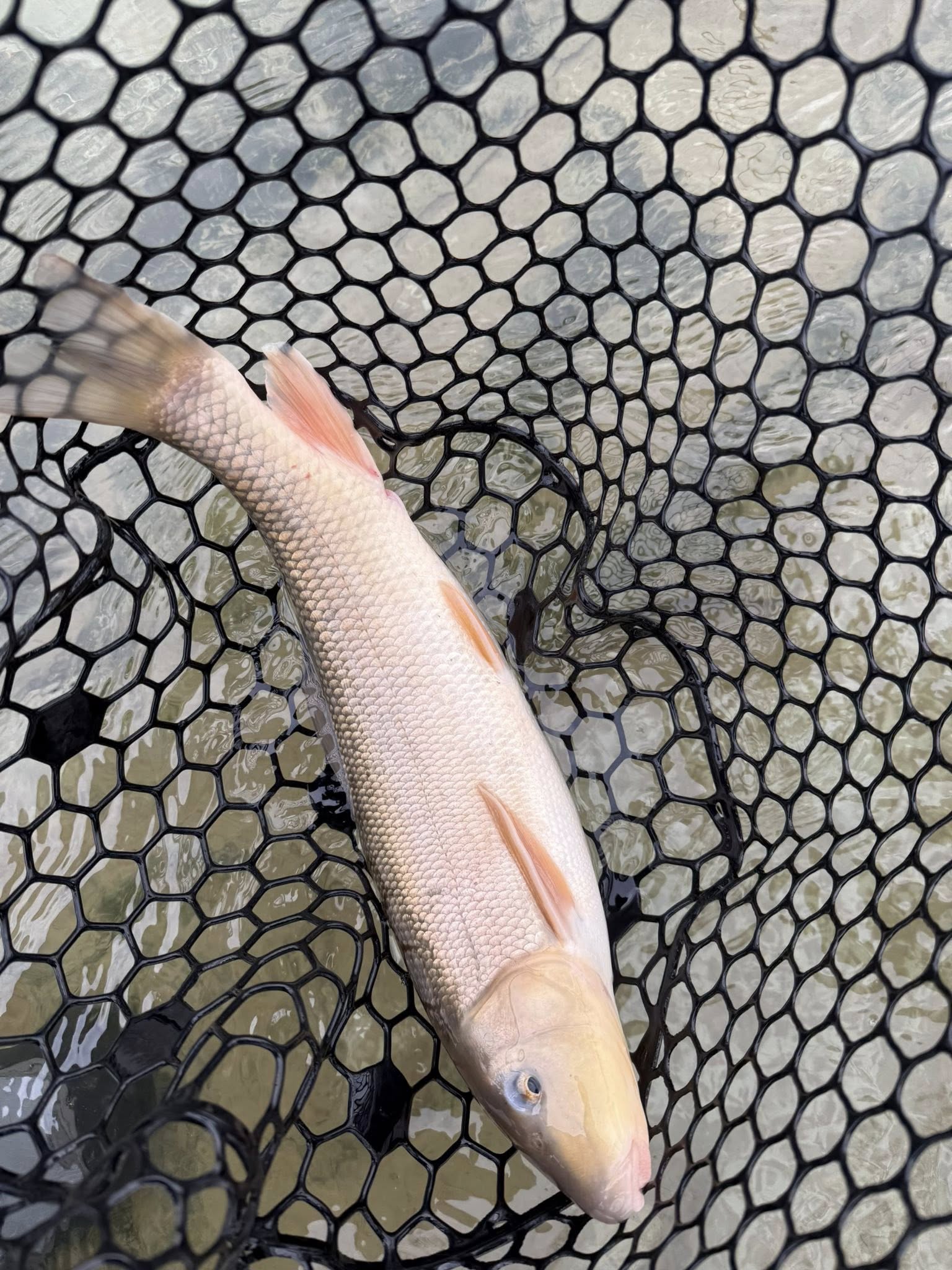
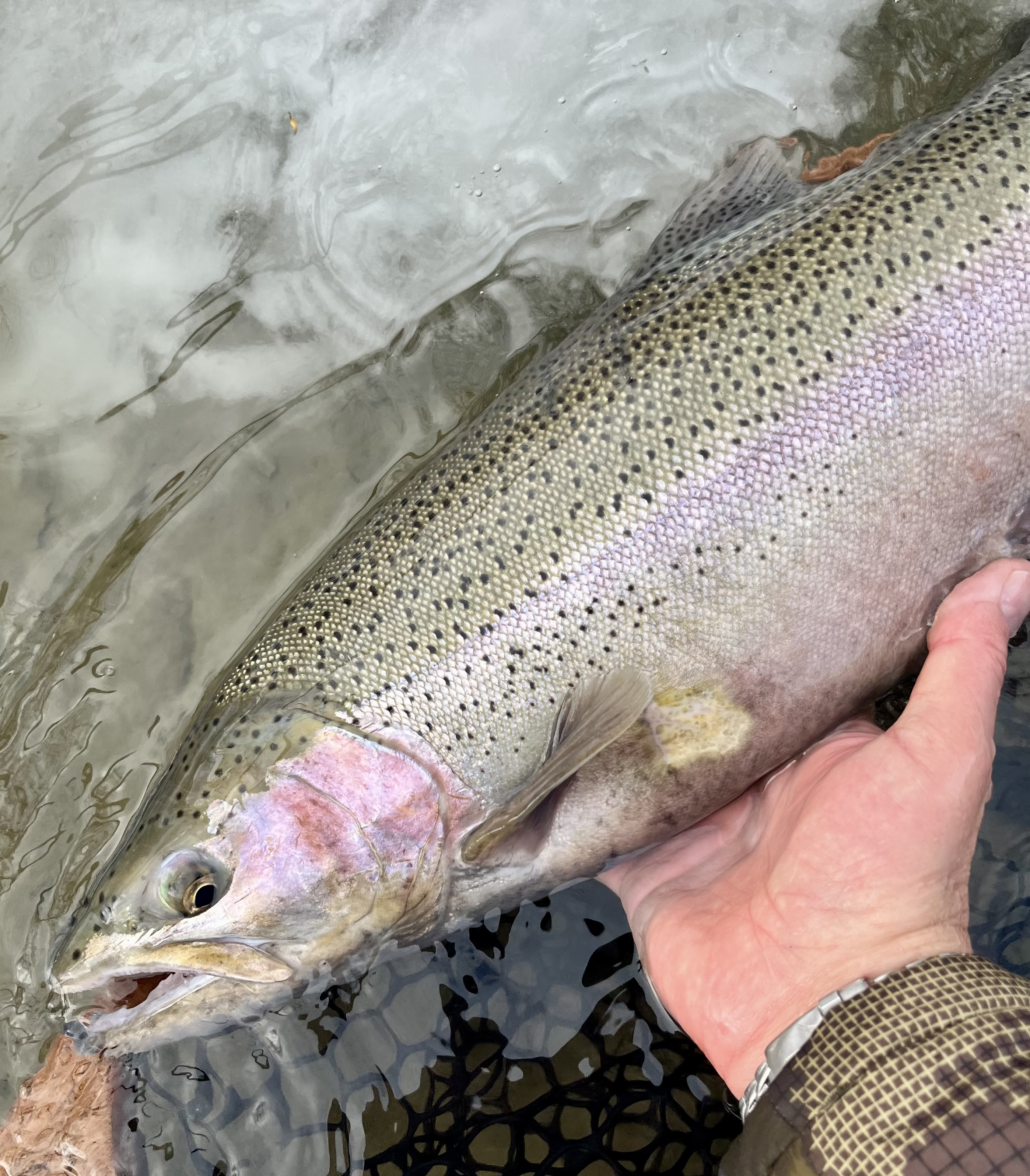
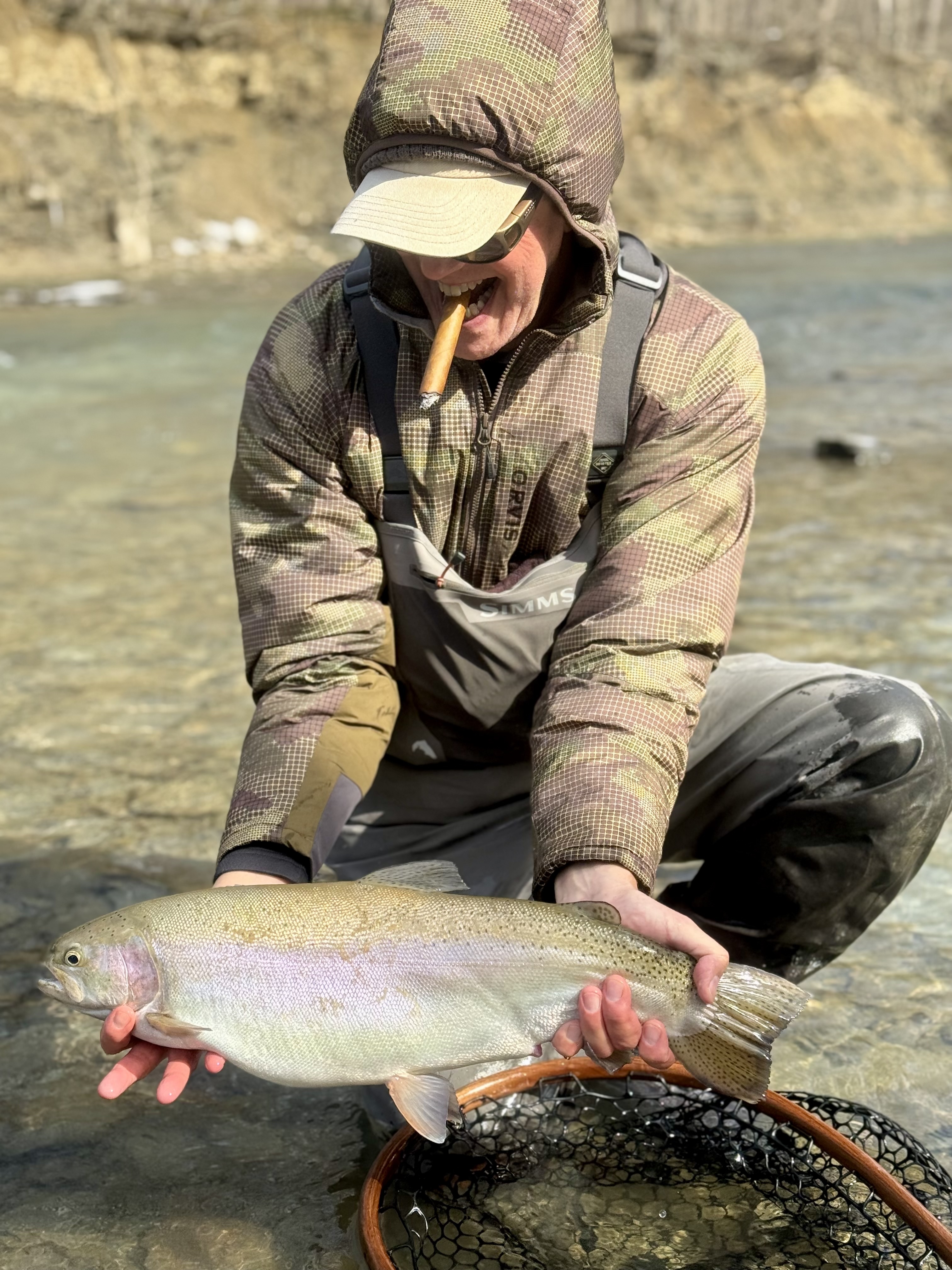
The suckers are in! Or singular, if you like, as this was the only one I found over two days. It was a little early to be matching the hatch with sucker spawn or Crystal Meths, although the patterns absolutely work any time during the season.Despite the lamprey scar, a breathtakingly beautiful fish. The water was still barely above freezing, but on this day the steelhead had a lot more fight in them. We worked upstream, targeting likely holding areas, concentrating on the ones that held fish and presenting flies until the bite stopped. I went from one landed to a half dozen, and then a dozen by about 1pm. It was already a fantastic day.One tank of a hen steelhead. While there were several good battles, I had three over the course of the day that truly tested my landing skills. I really wanted to land this fish, as she kept bulldogging me and running and refusing to come civilly. By early afternoon, a front began moving through; it got gusty and noticeably colder, and while it didn’t shut down the bite, it definitely tapped the brakes. The water began to take on color. And then, there were no more eats. It was time for lunch and another section of river.As you can see, the final section of river had a tea-with-a-few-drops-of-milk opacity. My batting average was not the best in this last mark, as I went 2-for-5. But I have no right to kvetch. The hump day total was 17 steelhead in the hoop, giving me 40 for the two-day trip. Did this really happen? Wasn’t I trapped by hundreds of feet of deep, wet snow a few days before? Weren’t conditions supposed to be entirely unfavorable? This is the argument for, “You don’t know if you don’t go” — and this is steelhead number 322.
About ten years ago, there was a phenomenon experienced by football fans known as “Patriots fatigue.” Always on TV, always the darling of analysts, hard to like, frequently winning in ways that defied mathematical probability or opposing coach logic (Super Bowl LI, anyone?).
I have ASMFC fatigue.
Another draft addendum, another public comment period, another chance for the rogue states of New Jersey, Maryland, and Delaware to behave stupidly, blah-blah-blah-blah-blah. (Insert heavy sigh here.)
If the bass closes its eyes, will it look like it’s yawning?
Nonetheless, we must do our duty and voice our opinion. The goal of all of this is to improve the SSB, or Spawing Stock Biomass. No SSB, no future stripers. Here are the two simple things you need to do. It’ll take you 15 minutes.
First, go to the ASGA website for the conservation-based opinion on what to comment. (Look for the heading “Proposed Management Options in Addendum III). Two, email your comments to the ASMFC. The following is from their website: “The public is encouraged to submit comments regarding the proposed management options in this document at any time during the addendum process. There are four ways to submit comments, written comments via this page or the comment@asmfc.org email below, the public comment form, mailed written comments, or attend a public hearing. The final date comments will be accepted is Friday, October 3 at 11:59p.m. EST.“
In case you didn’t get the email, DEEP is considering the expansion of the PTMA on the Farmington River. There is no specific timeline for this; rather, it’s information gathering only. Here’s their text and then the survey link:
“The Connecticut Department of Energy and Environmental Protection (DEEP) Fisheries Division is collecting information on a possible expansion of the year-round catch and release section of the West Branch Farmington River Trout Management Area (TMA). No immediate plans to expand catch and release regulations are in place as this is only an information gathering period. Please take time to answer each question below as your opinion matters, and please also provide comment. These same questions were asked of anglers on the Farmington River as we conducted a yearlong survey from the Goodwin Dam in Barkhamsted down to Route 177 Bridge in Unionville in 2024.
Your participation in this survey is encouraged and appreciated. Thank you!”
Anyone can luck into a big fish. Way back when, when I was just starting out, I wanted no part of that. I wanted to be able to consistently catch big stripers.
If you want to catch big bass — and make it repeatable — you don’t need a casting lesson. You don’t need to be able to reach 90 feet. You don’t need the latest in intermediate line technology. You don’t need a huge monstrosity that looks more like a plug than a fly.
You need to study. And ask questions. Why would there be a big striped bass where I’m fishing? Is there current, cover, and food? Is it pre-spawn? Is it migration time? Is the bait spawning (and therefore gathering in large numbers)? Is it dark, so the fish feels comfortable coming in close? What’s the barometer doing? Which way is the wind blowing? What’s the tide, and how is it moving? These are all part of the equation.
Then, you need the right fly. Something that looks like the bait, or what the bait should be at this time and place. Does the fly look alive and like something good to eat, even when at rest?
Don’t forget presentation. You need to learn that, too. Big fish are lazy, and frequently unwilling to chase. How can you present the fly in a way that makes it easy for the striper to eat?
Last but not least, you need to put in your time. There is no substitute for time on the water. You can do all of the above, check all the boxes, and still blank. (Ask me how I know.) Nevermind, I’ll just tell you. Last year, I fished the mark I fished last week six times and had only two tiny bass nibbles and no bass to hand for my efforts. But every year is different, and this is what I found on a greased line swing with an 11″ Bombardier flatwing in March of 2024:
Miss Piggy went 25 pounds and taped 39 inches. This was one of the best fights I’ve ever had with a bass, and I hope to write about it sometime soon. I am humbled and grateful for the chance to hook, land, and release this fish. I’ve been doing this for years, folks, and I was so pumped with adrenaline that my hand was shaking as I took this photo.
I didn’t really have the time yesterday, but since my default setting is when in doubt, go fishing, I did. The venue was a small woodland stream, and the time frame was 3:45pm-5:30pm. It was mostly cloudy and very warm for February, with a water temp of 48 degrees. The stream was running medium-low and clear. No hatch activity, although I did see one lonesome sz 600 midge flitting about.
I’ve written before that I’m a massive creature of habit, but on this outing I decided to explore about 100 yards of new water. I was glad I did, as that turned out to be my most productive stretch. I fished mostly subsurface with the Squirmy Worm Jiggy Thingy, but I did get a hysterical swing and miss on a bushy dry for the 5 minutes I fished it. All told, I pricked about 18 and brought probably a third of them to hand. I did catch the same beautifully spotted hen I took in January at the same hole. She really clobbered the fly.
A few of my favorite things: a cigar, a glass rod, and a small stream, and if I can get them all at once that’s even better. What a glorious day to play hooky for a few hours and lose myself in a babbling brook.
On Thursday I had the opportunity so spend a couple hours on small stream so I jumped on it. I hadn’t fished here since April and boy, did the heavy rains of the summer alter the streamscape. Entire pools were missing, and others were created. The fish were well spread out, and I did not see any signs of redds, nor of fish staging to spawn. Hatch activity was light with some lonely midges and a few stray small caddis. I fished downstream, subsurface, using a Squirmy Worm jig. I did tie on a bushy dry at the end just for fun.
It’s a good time to revisit some basic small stream best practices. First, learn to ID redds. It’s a good idea to stay our of the water from around now through mid-April. The lives you same may be the future of the brook you love to fish.
Please mash down your barbs or fish barbless hooks. You can also fish hook size that’s just a little too big, like a 12 or 14. This will self-eliminate smaller fish from eating the fly, and you’ll still have the sport of seeing them whack it and feeling their aggressive tugs.
Handle fish as little as possible. Keep them in the water if you can. The less exposure to air, the better. Reduce potentially damage to fish by taking the Wild Trout One Photo Challenge.
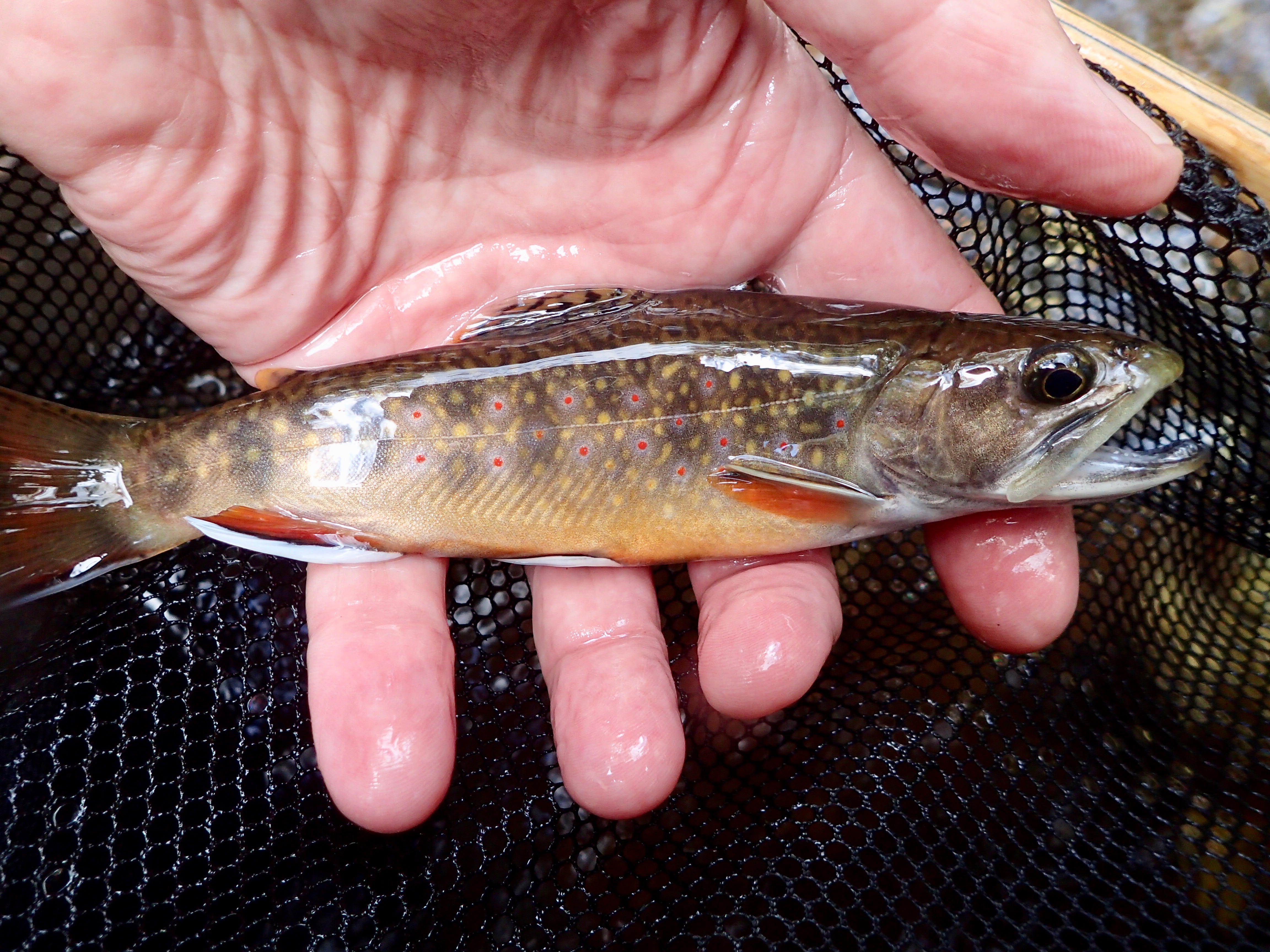
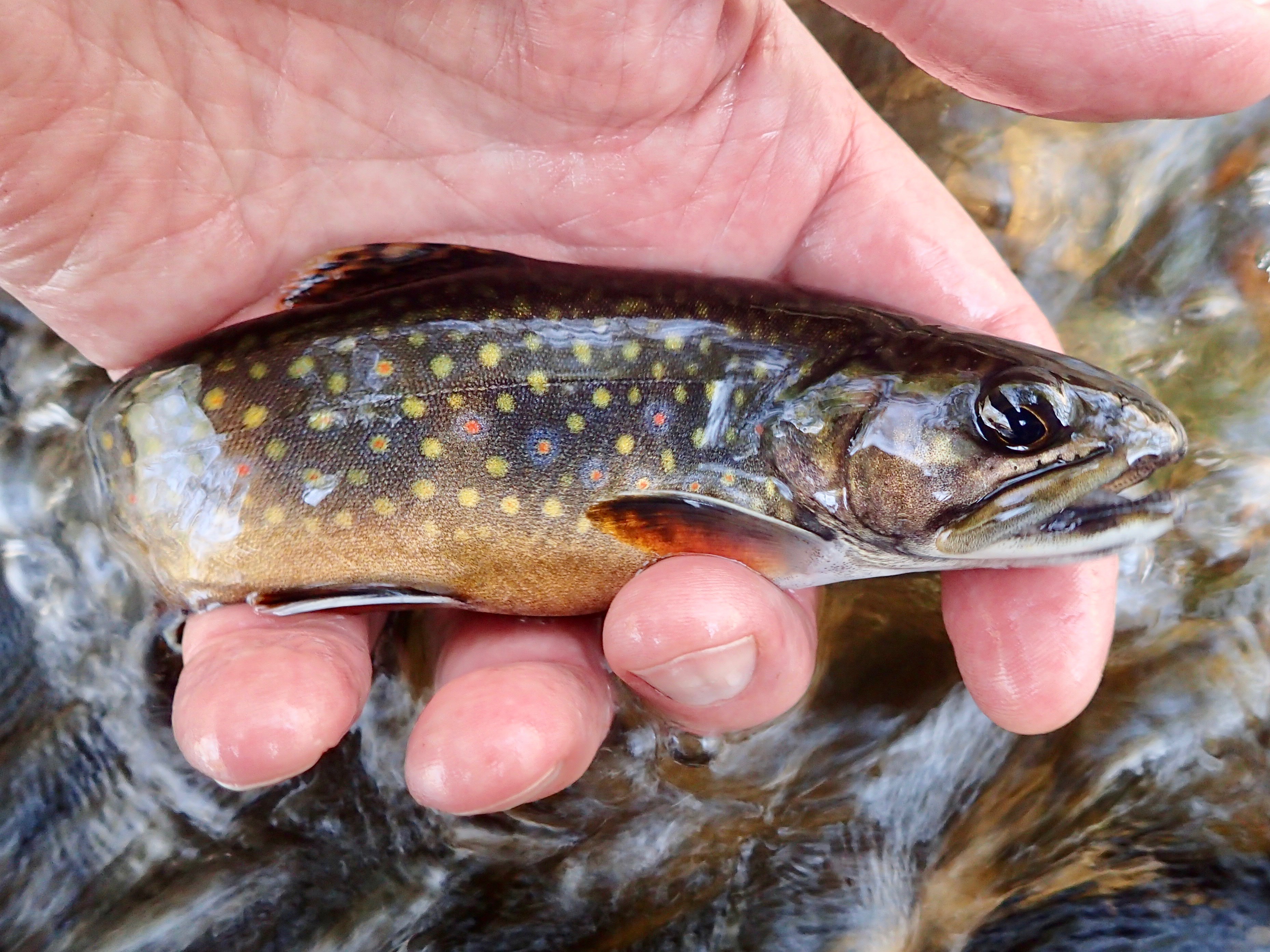
This was my first brookie to net, and it was an easy decision to make this my One Photo Challenge fish. I’m telling you, those blue haloed dots were positively glowing! I lost a few char bigger than this one, and a bunch of smaller ones, and that’s all just fine with me.
As tradition dictates, I went fishing on Good Friday in honor of Simon Peter, the greatest fisherman of all time. However, I mixed it up a bit. I couldn’t see driving down to the mouth of the Hous, my usual haunt, for what would very likely be casting practice (although we all could use it, right?) Even though I was tantalized by the sound of the surf and the smell of sea salt. So the decision was made: Salmon River, CT. It was an easy call when I considered that it was the day before opening day. That’s the Friday I fished with my dad and sons on that river for so many years.
I was joined by surfcaster extraordinaire Toby Lapinski. The water was on the low side of medium, 180cfs. With the warmer weather and Good Friday, the crowds were out. The FFO section was infested with anglers; the TMA section above, not as much. We fished four marks from 11:30am-2:30pm and found willing fresh stockees in all of them. Toby fished a streamer and I went with a small jig streamer on a long leader. I dead drifted, swung, stripped and jigged and caught fish all four ways. We saw caddis and midges and olives, and even a few risers. What a fantastic day!
I hooked my first trout with my streamer dangling in the current while I stripped line off the reel. Once Toby got in, it was only a matter of moments before he hooked up. How sweet to become an instant expert, if only for a few brief, shining hours. I must admit I do enjoy it in small doses.Tight lines and bent rods was the theme of the day. It was mostly rainbows, but we did encounter a couple stray browns. I was surprised by the power of some of the fish. Maybe it was the water temperature, an ideal 54 degrees. (Photo by Toby Lapinski)
Anglers wielding cameras have killed more small stream wild trout — intentionally or not — in the last 10 years than in the previous 100. You can blame it on the convenience and portability of digital devices. You can blame it on social media. You can blame it on anglers. Or narcissism. Or all of the above.
Whatever the root cause, I still see far too many images on social media of mishandled wild trout. Fish being held in dry hands. Fish thrashing around in landing nets, airborne, nowhere near the water. Fish photographed laying on grass, twigs, leaves, rocks, and other substrate no wild trout that’s going to be released should ever touch.
Let’s assume for a moment that I’m not talking about you. You’ve visited keepfishwet.org. You know the drill for ensuring more favorable catch and release outcomes. I applaud you. And now, I’d like to ask you a small favor.
Stop taking so many pictures of wild trout.
We all agree: wild trout are beautiful. The delicate parr marks, breathtaking halos, and butter-yellow hues of wild browns. The intricate, Faberge Egg-like designs and vivid colors on wild char. They’re all a wonder, and a marvel to look at. But do we need to see a photo of 2…4….6…and more… wild fish from your most recent small stream outing? The answer, I believe, is no.
So next time you’re on your favorite brook, take the Wild Trout One Photo Challenge: You photograph one fish, and one fish only. That’s it. All the others go quickly back into the stream, and you get bonus points if those non-photo subjects never leave the water. Think of how many wild fish you’re not subjecting to additional stress. It’s a win for you. It’s a win for the next angler. And most of all, it’s a win for the fish. Remember, the stocking truck isn’t coming back to replace what wild fish we kill, accidental or not.
I truly thank you for your consideration.
I don’t know how many wild brookies I landed on this day, but I do know that this was the only one I photographed. 1-2-3-lift-shoot, then back into the water. Less isn’t always more, but it usually is when it comes to small streams and wild trout.
As we bid farewell to March and say hello to April, I’d like to personally thank the CT DEEP for eliminating the closed season trout fishing rule. The old reg made it illegal to fish for wild trout in non-WTMA streams from March 1 though Opening Day. Enough with that nonsense! And let’s go fishing.
Since I had no previous experience fishing the day’s mark this time of year, I was curious about might be happening. As I mentioned in my last post, this not winter/not spring netherworld can be a tricky period. My random conditions drawing got me a low-side-of-medium, crystal clear flow; a mix of sun and clouds; and temperatures that struggle to get into the low 40s. I did see a few stray midges, but nothing that could be considered a proper hatch.
Spring must be close. Always a comforting sight, the skunk cabbage are popping everywhere, a clue that warmer days will soon be upon us.
The method was bushy dry/tiny bead head nymph dropper and the jigged micro streamer/nymph. If it was a deeper plunge, I did the latter. Everything else got the dry/dropper. I was pleased to find a wild char in a mark that has disappointed me no end. It’s really fishy, with plenty of cover and a big boulder that borders a deeper slot. The fish hit the dropper, but there was no hook set. Much farther upstream , I also had some repeated swipes at the dry, but again no hook set. Tug-tug-tug!!! Someone in a roiling plunge really wanted the jiggy thingy, and — stop me if you’ve heard this one before — there was, again, a failure to seal the deal.
I wish I could tell you that it turned on at some point, but those three touches were all I could manage. I wasn’t surprised, but I was disappointed. I suspect further research will need to be conducted this month.
But that’s not where the story ends.
I decided to drive to another mark, the place where I caught Alan last month. (Yes, I’m weird enough that I name fish. Sometimes I name them after real people, like Alan. Other times they’re just fictional , like Gus in this story.) I wasn’t sure if I was hoping for a Hail Mary or just didn’t want to end the session. I drifted the dry dropper through some deeper plunges and runs, then walked upstream.
And there it was. The place where I’d caught Alan. I spent a few minutes observing its wonderfulness. It’s at the head of a longer run. There’s a good, small cut bank with an overhanging tree that will one day fall into the brook. A deep cut runs parallel to the cut bank, and it’s evident why this a prime mark for an alpha fish: cover, current, and the head of the cafeteria line.
This time it took only one cast. The dry vanished from the surface, and when I raised the rod tip I could see that the nymph had been the target. It was a good brookie, and I immediately assumed it was Alan. Into the net, camera readied, shot taken, release completed.
It wasn’t until I got home and saw the photos that I realized that this wasn’t Alan. Wonderful thing, unique spotting! I’ve dubbed this guy “Alan’s Brother.” It all makes sense now. When I was taking this shot, I was thinking that I’d over-estimated Alan’s size. This was certainly an exceptional char for this size brook, but I remembered Alan being bigger. So, it’s good news all around: there’s more than one big old brookie in this town. I hope they made lots of whoopee last fall.
With single digit temperatures again in the forecast, this seems like a good time to talk about cold weather catch-and-release best practices. When the temperature is so low that you’ve got ice forming on your waders, or your line and leader sports frozen droplets the moment they hit the air, you should be thinking about what could happen to a fish’s gills or eyes if exposed to that same frigid air.
When it’s Everest summit cold out there, try to keep fish in the water as much as possible. Absolute best practice would be to never remove the fish from the water. If you must take a picture, keep the fish in the water (in your fish-friendly landing net) until you’re ready to shoot. Then it’s 1-2-3, lift, shoot, and get that fish back in the water ASAP. Limit your number of shots. Please remember that damage time is measured in seconds.
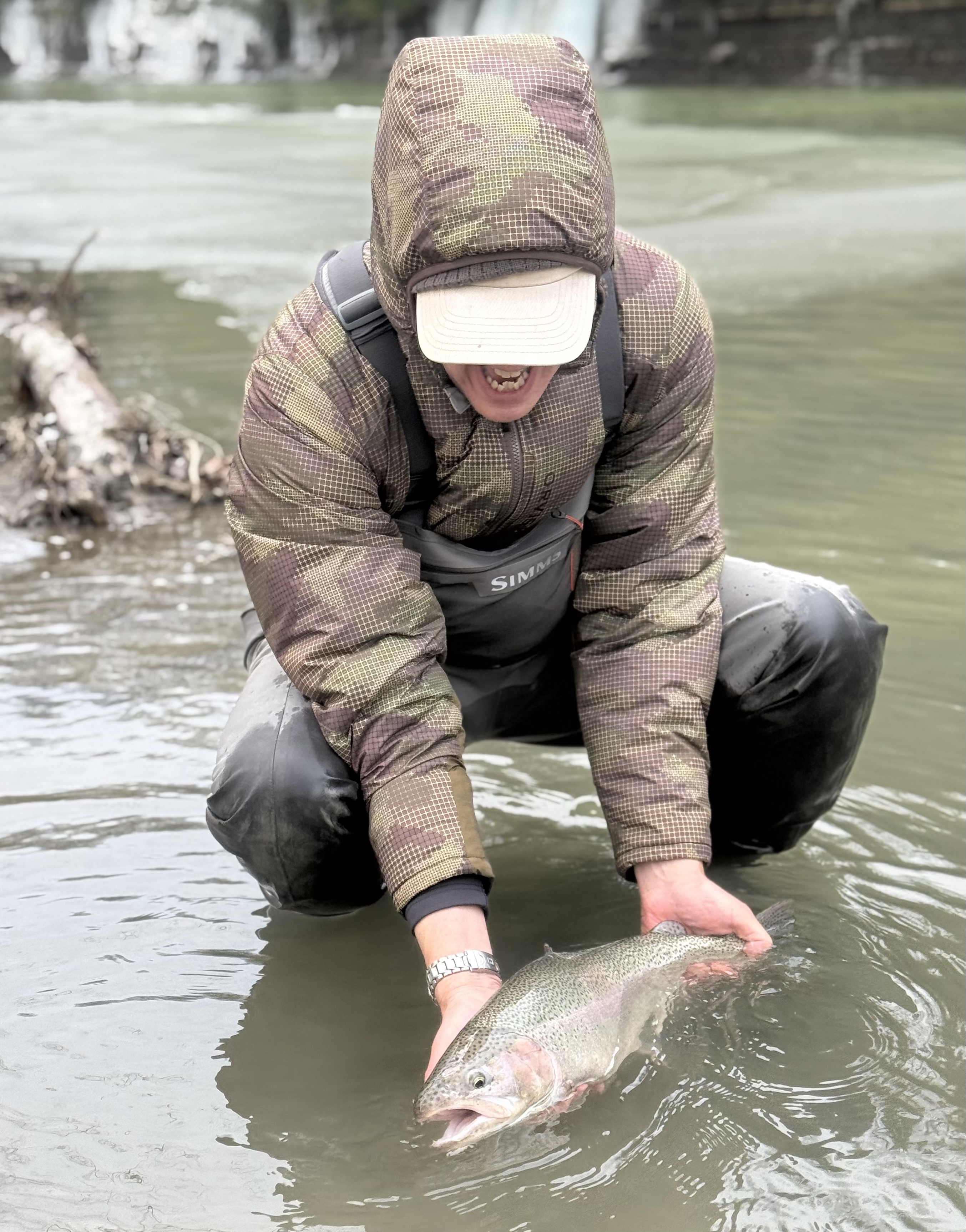
It was in the teens when this picture was taken. We probably shouldn’t have done it. On the plus side you can see water still dripping from my hands, which indicates the shot came moments after the steelhead was lifted from the net.Photo by Peter Jenkins.Option B is much safer for the fish. I know, it’s not the same, but Arctic air can be cruel on your favorite gamefish’s gills. How cold is it? You can see droplets and sections of ice already forming on my waders. Photo by Peter Jenkins.







 currentseams.com