Farmington River Report 5/24/21: finding fish with wet flies

I guided Eric yesterday and we had a mix of sun and clouds and moderate, cold flows (380cfs in the Permanent TMA and 445cfs on the lower River). We fished two marks with mixed success. At the first, there was very little hatch activity and we observed no fish rising. One bump was the best we could do, so we decided to seek our pleasure elsewhere.

And that’s one of the best pieces of advice I can give you if you want, like Eric, to learn how to fish wet flies: if one spot isn’t producing, find one that is. And, once you get there, work the water. Cover as much of it as you can. Determine where you think the trout will be holding and feeding. We fished a three fly team of a Squirrel and Ginger on point, a dark soft-hackle of Eric’s creation in the middle, and a BHSHPT on point. All of our action came on the point fly. Eric did a great job of navigating some not-that-easy-to-wade water (sometimes it pays to get into those more difficult areas). While the second mark was not as productive as I’d hoped — the caddis hatch was disappointing, and there were no regular, active feeders — Eric managed to stick four nice trout.

The answer to the question, “Why is this man smiling?” can be seen in the foreground. Great job, Eric! You’re on your way.

Striper Report: All you can eat (grass shrimp)!

Last week, while you were asleep — certainly some of you were, as the tide widows crept into the wee hours — I was banging around several marshes and estuaries looking for stripers feeding on grass shrimp. I found substantial numberqs of grass shrimp in every mark I visited, and varying numbers of bass. Grass shrimp are present year round, but they spawn when the water warms, and it’s getting to be that time of year. You can find grass shrimp swimming around if you shine your light in the shallows, but they mostly prefer to skulk along the bottom. They’re translucent creatures, so they’re not as easy to see as, say, a green crab. Their eyes reflect your headlamp beam, so that’s an easy way to spot them.

I see your beady little eyes. These guys are in less than six inches of water.

I almost always fish the grass shrimp swarm with a team of three. The patterns vary, and sometimes I’ll throw a clam worm like the Orange Ruthless into the mix, but last week I fished a deer-hair head on top dropper, a black General Practitioner on middle dropper, and Micro Gurgling Shrimp on point. I took fish on all three flies, although I was intrigued that I only caught bass on the black GP on the one night when I had bright moonlight. (The lessons are never-ending.) The fish weren’t very large — 20″ was the best I could manage — but I could tell from some of the feeding pops that there were bigger bass around.

My most recent three-fly grass shrimp team. L-R: Black GP, Caddis Shrimp, Micro Gurgling Shrimp. This gives you a good idea of the size of the naturals, which are the size of these flies or smaller. Note that none of these flies attempt to be a carbon-copy of the actual bait. They’re simply designed to match size and profile, to look alive, and create a favorable impression on the stripers. Ultra-realistic flies are to be admired for their craftsmanship, but not necessarily for their fish-catching ability.

Farmington River Report 5/17 & 5/18/21: Caddis, Cold Water & Red Hot Wet Fly Action

Mark contacted me over the winter about learning the ways of the wet fly. He booked two half day sessions, a brilliant move on his part, as we experienced a mixed bag of weather and catching on the first day, and then the Farmington River at its finest today. We fished both days from 11am-3pm. Water was 425cfs in the Permanent TMA, and 600cfs below it. The water is a little colder than usual, due to not only the weather but also the greater percentage influx of water from the dam. Caddis is king right now, and we saw good numbers both days, particularly today. Midges, too, and some tiny olives on Monday, par for the damp day course.

Monday 5/17: We started out with brilliant sunshine, then got poured on. Our first mark had the dreaded guide-catches-on-the-demo-cast (I’d rather the client do that), but we eventually connected with a couple fish, though none of them made it to the hoop. There was a decent amount of bug activity, but little in the way of consistent risers.

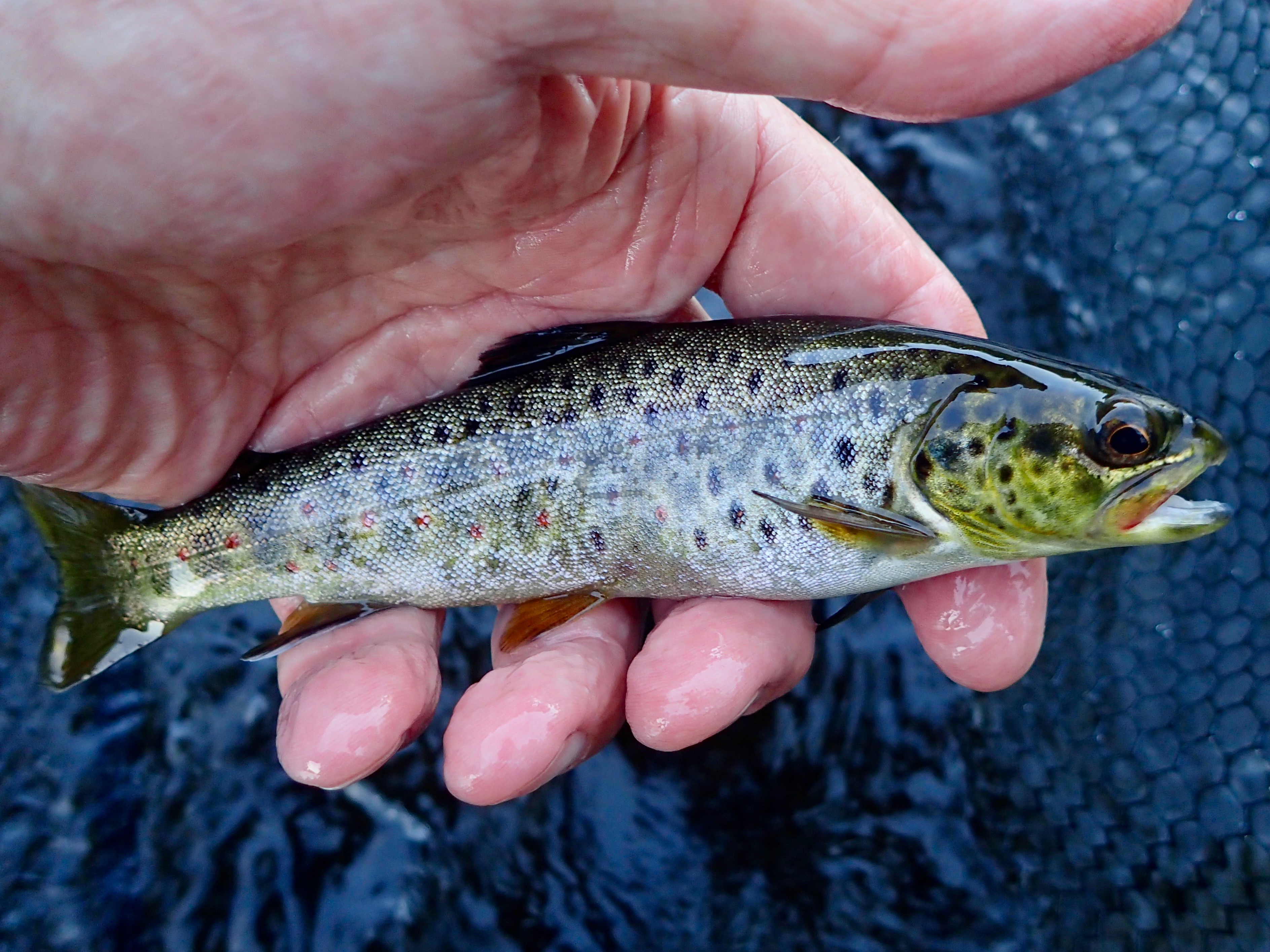
We had our first taste of success at Spot #2 with a gorgeous little wild brown. I never get tired of these jewels, or the way they attack a wet fly with primal fury.

Thunder eventually drove us off the water. Rather than wait it out, we solved the problem by driving miles away from it. We finished up below the Permanent TMA, and this set the stage for Tuesday. We found some trout that were willing to eat, and even though the numbers were not what I expected, the day absolutely qualified as a good one. Mark was a solid caster, a dedicated student, and best of all, a strong wader. That meant we could get into some areas that many anglers would find a challenge to navigate.

This is how we do it. One of the biggest challenges a new wet fly fisher faces is how to let the trout do the hook-setting work. After dropping a few fish Monday, Mark began to figure it out. By the time we finished up on Tuesday, he was sticking every trout. Awesome job, Mark! I spent Monday night ruminating where we should fish Tuesday, and decided that on…

Tuesday 5/18, we would pick up at the same mark where we left off Monday. I wanted to see if the warmer air temps and sunshine would kickstart the hatches –and the trout — and that’s exactly what happened. Caddis, caddis, everywhere, size 12-14 — and then huge swarms of micro caddis. We didn’t fret about those, since the trout were more than eager to jump on the bigger flies. We took them on Squirrel and Gingers (top dropper), Starling and Herl (middle dropper), and generic bead head gray soft hackles on point. We took them on the dead drift, the mended swing, the dangle, and with upstream presentations. I lost track of how many trout, which is always a good day on the river. On Monday, I had kept telling Mark, “You’re doing everything right. You just need to find some cooperative trout.” I’ve made that speech to numerous clients, so it was gratifying to be there when the cooperative trout showed up. We played through the run, then walked 500 yards upstream where Mark — now a dangerous wet fly machine — connected with a spunky rainbow. Great job, Mark!

Mark’s best fish of the trip was this mid-teens wild brown that we witnessed repeatedly slashing at caddis in a feeding lane. Or, as Mark said: See the fish. Present to the fish. Catch the fish. He did just that, and his instructor couldn’t have been prouder. A Squirrel and Ginger did the trick.

Striper mini-report 5/5/21: Last night, while you were sleeping…

…I was standing in a river, practicing my greased line swings with a floating line and a 10″ Rock Island flatwing. My casting was good enough. My presentations were spot on. The bass were…not there. At least not in any numbers. We saw some wakes and swirls made by herring, but nothing to suggest that they were present en masse. We heard a couple reports of bass crashing bait, but they were in the first 30 minutes of our 2+ hour session, and then nothing. So it goes. This is why it’s called putting in your time.

In between casts, I found my mind wandering toward Block Island: plans and schemes and hopes and dreams. I could use a striper rainbow right about now.

Farmington River Report 5/4/21: North, Miss Teschmacher

I guided Andrew and Brett yesterday and they wanted to focus on wet flies. Monday’s rain was more than I expected, and I didn’t like the height or the color of the Permanent TMA. So we headed north to the friendly confines of WBATSR (West Branch Above The Still River. I just made that up.) This was a good call as the water was running a crystal clear and very wadeable 200cfs. I really liked that height, and I thought there were dozens, if not hundreds of pockets and seams and slots and riffles that would hold trout. Sadly, the trout didn’t get the memo, and we had a very slow day. (We didn’t see any angler other than our group hook and land a fish.) It was the kind of day where I find the next great piece of water, and think to myself, “this is going to be it,” and then nothing happens. These episodes make me throw up my hands and say, “I quit.” Of course, I don’t really mean it, and of course we don’t quit, but I get frustrated just like everyone else.

Andrew had fished with me before, and on that day we had far more active fish than today. Brett is a relative newcomer to fly fishing, and once we smoothed out a few wrinkles he was swinging like a pro. I alternated between both anglers, and we worked downstream, covering several hundred yards of water. Bug activity was very light, with two confirmed Hendricksons and a handful of BWOs, but that was it. As you can imagine, angler traffic was heavy, especially with that section of river the only clear water game in town. With today’s rain and increased flows, I would guess that streamers and nymphing will be, by far, the most productive methods for a few days.

Andrew doing battle with a chunky rainbow. He scored two trout, both on the bead head soft hackle I had tied on in the point position. In my experience, wet fly can be challenging in high flows, so I’d wait for the water to get down to 500 or less before swinging. Great job, Brett and Andrew, for persevering though some tough fishing conditions!

Farmington River Report 4/27/21: trading numbers for size

Monday’s Hendrickson hatch in the lower end of the Permanent TMA was a solid 8 out of 10. (The pre-hatch bite was slow, and the duration of the duns-on-the-surface feeding frenzy was brief, otherwise I would have graded it higher.) So I headed back yesterday to see what secrets the river would reveal. Crowds continue to be a factor; if you’re looking for solitude within the Permanent TMA, you will be disappointed. I chatted up my new buddies from yesterday, Andy and Bob, who were likewise back for more, and when some water opened up — people do leave — I jumped on it. Conditions were as nice as you could hope for, with a clear flow of 275cfs and hazy sun and far less wind than Monday.

The section I fished was perfect wet fly water: moving at a brisk pace, mottled, multiple current seams. Wet fly continues to be a highly productive method for fishing under the Hendrickson hatch, especially when it appears as though nothing is going on. While many other anglers are lounging on the river bank, or standing mid-stream like statues, I am working the water with a team of three wet flies. Wet fly anglers will always discover that something is afoot subsurface before dry fly anglers, and that was proved again yesterday. Around 1pm, I had an intense flurry of activity for 15 minutes, including hits on four consecutive casts. Then the action slowed.

This 16″ Survivor Strain brown crushed my BH Hendrickson soft-hackle on the mended swing. In heavier current, trout will set the hook if you let them; you feel the hit, wait, and ask “Are you still there?” The answer will always be yes.

Then, just like that, it was over. I added a shot above my middle dropper to see if I could tight line nymph up some trout, but they weren’t having it. (This is something I teach my clients: when you walk into a pool, you simply don’t know what’s been happening. The trout may have had the feed bags on for the previous hour, and now they’re simply just done.) So I got out of the river to warm up a bit. With the pool rested and my legs a little less frozen, I waded back in around 2pm.

Since I was hoping to find the fish that were already looking up, I switched out the bead head on point for a fly I’d never fished before. It was the Old Blue Dun, one of Leisenring’s favorite twelve. I’d always thought it would make a fine Hendrickson, and since to this point I’d seen more olives in the air than Hendricksons, it seemed like a proper why not? moment. It was a good decision, as a rugby ball-shaped survivor strain brown hammered the fly on the dangle.

With superabundance of meat on his flanks, this 16″ Survivor Strain brown gave me a challenging battle in the swift, cool waters of the Farmington River.

On Monday, the Hendrickson duns were on the surface thick by 3pm. That was not the case yesterday; we probably had about two-thirds less mayflies. Still, I brought several trout to net on Hendrickson Usuals and Comparaduns, two patterns I like in choppy water as they provide a good profile when viewed from below. I had to be off the water by 3:30, so reluctantly, I pulled myself away from pleasure and headed off toward responsibility.

Farmington River Report 4/26/21: fun with the Hendricksons

On Monday I fished from 11:30am to 3:30pm. It was cold and crisp and the wind was honking. I started off on the lower River, swinging a team of three wets (Squirrel and Ginger on top, Dark Hendrickson winged middle dropper, tungsten bead head Hendrickson soft hackle on point. I fished both faster pocket water and slower, deeper pools. Both produced, despite the lack of hatch activity (I saw only two Hendricksons and no other bugs.) The takes were savage, all the them from recently stocked rainbows. It never ceases to amaze me how quickly these fish adapt to their new home. While I can’t get super excited about them, I have to say that these fish are quite powerful, not to mention great leapers. But with no signs of a hatch, I decided to head to the Permanent TMA.

Good call. By the time I arrived, the emergence was over, and two anglers, Andy and Bob, graciously allowed me a quick spin through their mark just to be sure. Wet flies are great way to determine the stage of the Hendrickson hatch; if you see fish rising, and you feed them the wets, and they mostly or completely ignore the flies, you know they’ve switched to the dun. (This is why you can be pounding up fish on Hendrickson wets, and then suddenly, despite visual evidence that the fish are still feeding, your catch rate slows dramatically. You’re fishing in the right place at the right time, just the wrong way.) I connected with only one fish on the wet, but I could also see the adults on the water, and the trout began snapping them up. So I hastily rigged a dry fly leader and had at it with some Hendrickson Usuals. Boom! All you had to do was mark a rise, then drift over it. There were so many trout rising, I was cackling with glee. By the time I left, the activity was waning. I wonder how the spinner fall was with this wind?

Despite cold and medium high water, I had plenty of takers on theSquirrel and Ginger top dropper. If you hit it right, this is a fantastic time of the year to swing a team of wets.

Striper mini-report 4/24/21: Slow she goes

Toby Lasinski and I spent a few hours Saturday night banging around the shores of LIS looking for stripers. It was a slow night, with only one fish to hand, silvery sub-slot bass that nailed Toby’s surface swimmer. Not a touch for me, fishing a Rock Island flatwing/bucktail, and then a deer hair head whatchamacallit. There’s not much for me to tell, other than I saw some new water and got in some casting practice. (OK, the company and the cigar were pretty swell, so that counts for something.) Every day is different, and at some point this slowness will surely change. At least that’s what I keep telling myself.

It felt good to taste saltwater on my fingertips. After a briny session like this, everything — rod, reel, flies — gets a good rinsing with tap water, then an air drying. Some of the water we fished reminded me of the Cape and Block Island, and I’m looking forward to fishing those places again.

Farmington River Mini-Report 4/21/21: First wet fly fish of the year

I only had 90 minutes to fish, so I chose the lower Farmington because it was closer to my house, and also to where I needed to be at 2pm. Plus, there was that front bearing down on us. Didn’t want to get stuck in that mess, especially after witnessing a foreboding fork of lightning slicing through the sky. After waiting for the dark clouds to disperse, I was on the water a little before noon. The plan was to swing wets and see if there was any Hendrickson action. Conditions weren’t great — 600cfs is a little high on the Farmington for wet fly, so I used a tungsten bead head Pheasant Tail soft hackle on point to sink things a bit. Still, the water I fished was fast and heavy, and if I was interested in numbers, nymphing would have been the way to go. I had a half dozen whacks in the fast water, with no hook sets, before I connected in a deeper slot. The wind was also a factor — forget roll casting for any distance — and I had to be vigilant to keep the rig from tangling. But by the end of the outing, I had three trout to hand, two on the BHSHPT and another, the biggest, on the top dropper, a Squirrel and Ginger. A My Father Le Bijou 1922 Gran Robusto proved to be a fine companion. Speaking of fronts, I can’t believe how much the temperature has dropped.

It always feels good to land the first wet fly trout of the year, even if it is a stocker rainbow. This one treated me to two aerials. The last two were fatter, and took a bit of forceful coaxing to come to net. I didn’t see any Hendricksons or caddis, but then again I only fished until 1:30pm. My wet fly box desperately needs a restocking!

Salmon River Report 4/13-4/14: Reaching the steelhead century mark — and beyond

I’m not in the habit of counting fish. But steelhead, being what they are — well, they’re just different. Trying to catch them is also different. I’ve been through all this with you before: you can do everything right and drop the fish. You can do (most) everything wrong and land the fish. Life isn’t fair, and neither is steelheading. The conditions you’re fishing in can be demanding, if not downright brutal. So when you get a decent flow and warm sunshine and bluebird skies and, most of all, a little luck, you thank the steelhead gods very much and you certainly don’t question any of it. I’d been stuck on steelhead #97 since November — my March trip was a blank — so here I was a month later, hoping something good would happen.

Tuesday April 13. I got to the river around 3pm. My float trip was scheduled for the next day, but I figured I should take advantage of the opportunity to fish. I hit a popular mark on the lower end of the river, one I was familiar with. As I was walking down the path, I saw an angler playing a steelhead, so this gave me hope. That was short-lived. For the next two-and-one-half hours, a total of eight anglers on the run hooked zero fish. I had a touch at one point, but my hookset didn’t even produce a head shake. I decided to save my chips for the next day, so I left disappointed, but clinging to the hope that sooner or later my lousy luck had to change.

If you need something spell-checked, you’re on your own.

Wednesday April 14. At first I thought it was the bottom, but it didn’t quite figure. No head shake, and I came away with air, but the more I thought about it, the more I realized that it had to be a steelhead. A dozen casts later, indicator down, hook set, fish on. It was a nice-looking drop-back, holding in some faster water, and now ripping line off the reel. True to form, the fish stopped at the bottom of the pool. I regained line, then another run and some aerials, too. Line regained, process repeated, and now this fish is whipped. Reel cranking, cork upstream, rod bent, steelhead just about 20 feet from the boat, Jim with the net ready. Here comes number 98. Doink! There goes number 98. This is the type of loss that vexes me no end. I had a good hookset, and I played this fish no differently that the last 50 I’ve landed. A few four-letter words provided only a moderate salve to this grievous wound. Is this how today is going to be?

An hour or so later, we bagged number 98. This relieved some of the pressure, even more so after 99, pictured here, went into the hoop. Now I felt like this was really going to happen. And if it didn’t, at least I’d made a significant dent — two steelhead was twice the number I’d landed in my last four days. The conditions were pretty darned good: water temps in the upper 40s, a little color to the water, flow 350cfs, and, best of all, a warm sunny day to help me forget that day in March when I was flicking ice out my guides for eight hours.
Then, suddenly, it was over. I landed my 100th steelhead. Cue Howie Rose saying, “Put it in the books!” Not the prettiest specimen, but beautiful and perfect in his own way. What an eventful journey. I’d like to thank everyone who encouraged me, shared water, helped wrangle and land or net a steelhead, and especially my guide James Kirtland who has provided me with so many pro tips over the years. I’ve learned so much from him.
Jim’s ClackaCraft was a great choice for low water. Jim’s a skilled oarsman, not to mention a pro with a landing net. This also seems like the appropriate time to give a shout out to Ken Abrames. Ken’s Salmo Saxatillis rod, taking a break after doing yeoman’s work, is a truly exceptional steelhead rod.
The final tally for the day was five-for-nine. We also landed four steelhead smolt and a brown trout. We saved the best steelhead for last, this pug-nosed double-digit-pounds hen we nymphed up fishing western style. To revisit the “steelheading isn’t fair” theme: I had a lousy hookset, I mishandled my line, the run was laden with submerged logs and I still landed her. I’ll take all the luck I can get! And so, dear reader, if you’re counting along, this is number 102. Only 98 more to get to 200.