Tying Demo: “Small Stream Flies for Wild Trout,” March 1, 2014 at The Compleat Angler

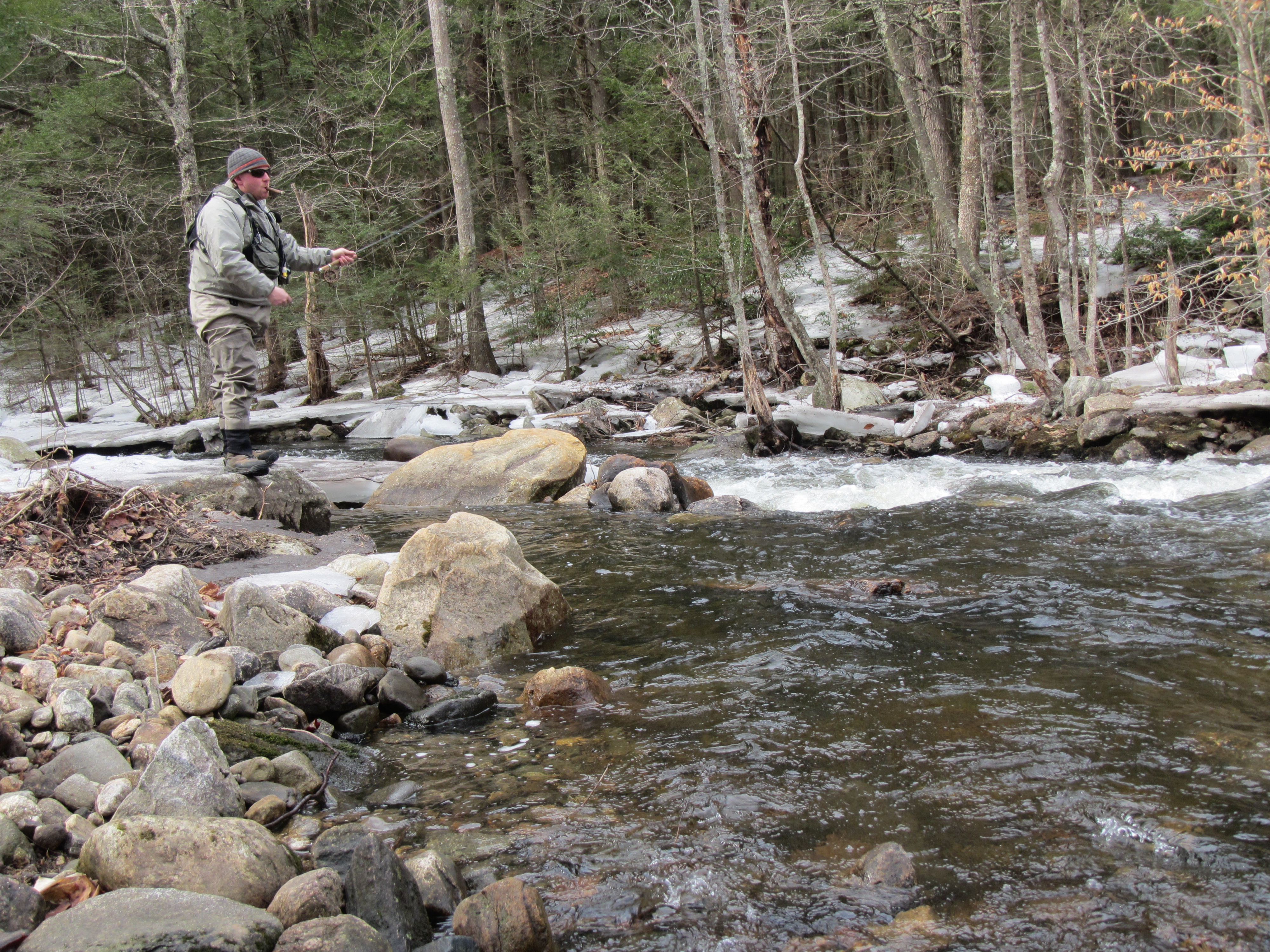
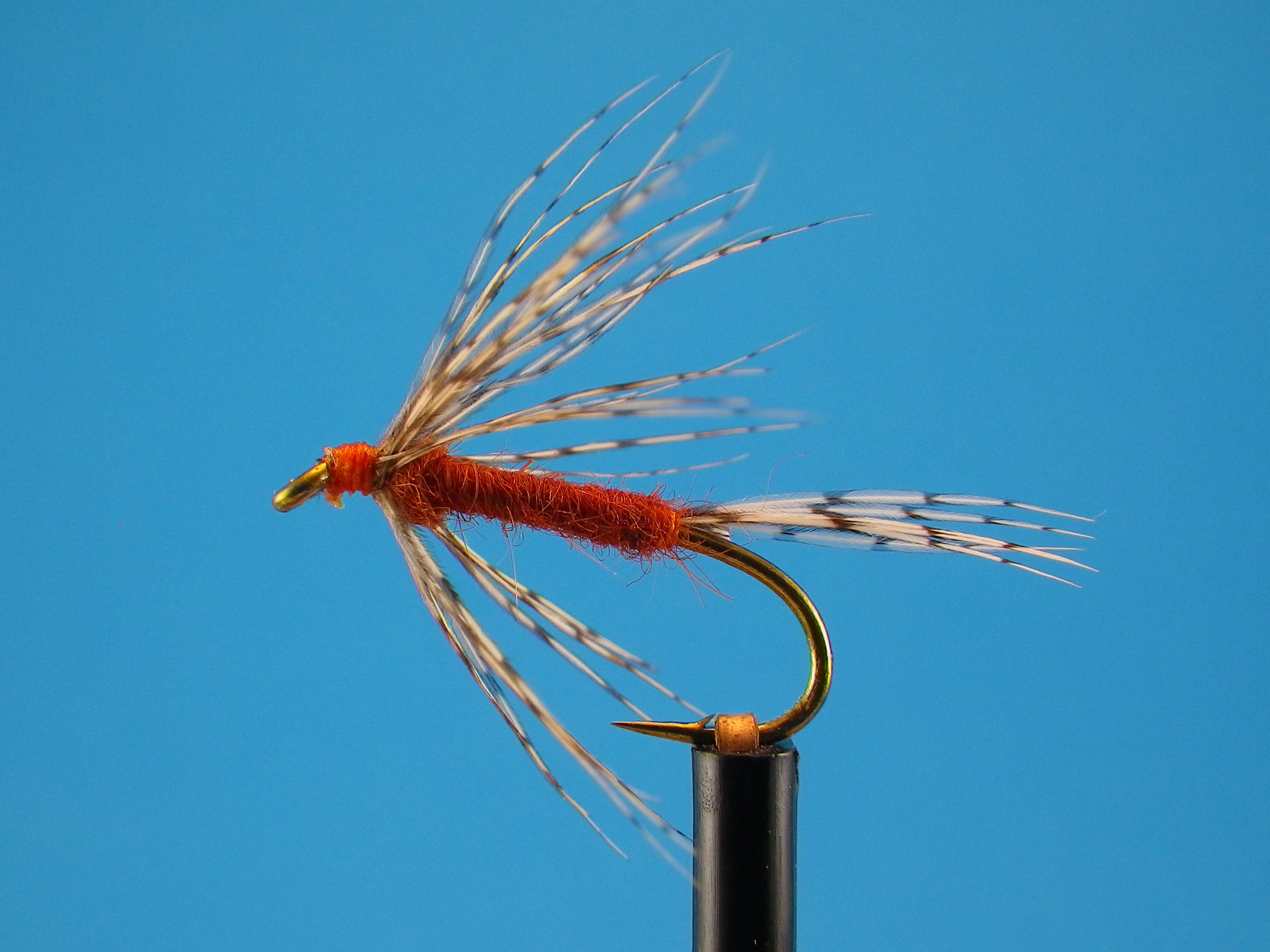
I’m pleased to announce my first event for 2014: I will be returning to the Compleat Angler in Darien, CT for another tying demo. This year’s subject will be flies for small streams. Fishing small streams presents a unique set of challenges to the fly angler – and sometimes, fly selection (and size) is the difference maker. “Small Stream Flies for Wild Trout” will cover dries, wets, nymphs, and streamers that will help you build a basic kit for all kinds of waters, from shallow riffles on woodland brooks to deep plunge pools on high-gradient mountain streams. I’ll also discuss tactics and presentation. My demos are highly interactive, whether we’re doing Q&A or just talking fishing. Hope to see you there!

Where: The Compleat Angler, 541 Post Road, Darien, CT, 203-501-1713, compleat-angleronline.com

When: Saturday, March 1, 2014, 10am-2pm

This breathtaking beauty liked the look of a tan caddis skittering across the surface of a remote mountain stream. One of the things we’ll talk about is fly selection — dry or subsurface — and whether to fish up or downstream.

Image

Merry Christmas from Currentseams

I’d like to take this opportunity to thank all my loyal readers for hanging in there with me over the last couple months. Now that the holidays are winding down, the big kitchen project is almost finished, and there is light at the end of the work tunnel. I’m hoping to get back to posting more reports (this would mean actually getting to go fishing — yes!), stories, articles, and fly patterns on a regular basis this week. I have some appearances to tell you about, and I’m about a third of the way through my fall 2013 steelhead story. I think you’re going to like it.

I hope everyone had a very happy and safe Christmas day.

Image

Two. For Two.

I don’t know about the rest of you dads, but it annoys the hell out of me when I try to give my boys a life lesson and life teaches them the exact opposite.

That’s what happened last year when I took Cameron steelheading for the first time. I grimly outlined the 40 hours it took me to land my first steelhead; explained that you can do everything right playing the fish and still lose him; how the lake effect weather is dicey at best. So what happens? We get 50 degrees in late November, bluebird skies, and the kid hooks and lands a 10-pound chromer in the first 30 minutes of the trip.

But not this year. I told him that on this trip, we’d find out if he was cut out to be a steelheader. A cold front was blowing in as we drove up. We awoke to a couple inches of fresh powder and the mercury in the teens. This was going to be a baptism in ice.

What’s more, these sudden temperature changes – especially downward – are usually bad for business. Sure enough, what had been a consistent bite over the previous week was almost nonexistent. Five hours after floating under the Altmar Bridge, we still hadn’t had a single take. It wasn’t for lack of trying. Or giving the fish a choice. I had been carpet-bombing the bottom with everything from egg flies to nymphs. Cam was throwing an egg sack under a float. The steelhead weren’t having any of it.

But, I kept telling Cam that he had to be ready, because the next cast could be the one that you get a strike. And you’ll hate yourself if you miss it.

I was getting enough false positives to keep me focused, but even those became adventures in bad luck. As we floated between holes, my indicator disappeared. I set the hook on the bottom, pulled, and then watched as my rig sailed over my head – into the only tree for 200 feet. It got worse. Drift boats are like trains; they take a while to stop. As Jim furiously back rowed, my line stretched tight, and the top section of my rod came loose. Now it was sliding along the no man’s land between the rest of my rod and the tree. If the leader or line snapped, it would be gone. Fortunately, I am over six feet tall. By standing on one of the boat’s benches, I was able to just reach the leader with an outstretched arm and a hunting knife. Tip was reunited with rod, much to its owner’s relief.

Meantime, Cam was patiently earning his winter steelhead stripes. Five hours is a long time to go without a strike for a grown man, let alone a ten year-old. If he was discouraged, he wasn’t showing it. Jim (Kirtland, our guide, of Row Jimmy Guide Service fame. This was the third time I’ve floated with Jim. Highly recommended. Nice guy, knowledgeable, and if you have a child you want to introduce to steelheading, he’s terrific with kids) made the observation that Cam was now a member-in-good-standing of the Frozen Chosen.

The indicator went under, and this time the bottom thrummed with energy. Fish on. I could tell it was a good one by the fact that the steelhead did not surface. His first run was deep and upstream. I have a love-hate relationship with upstream runs. They’re good because they force the fish to burn a tremendous amount of oxygen. Bad because those big steelhead turn on a dime and shoot back downstream faster than you think any fish has a right to. Meanwhile, you’re flailing away at your reel or the slack, trying to regain line and keep that precious hook set. But this was a most obliging creature. Once he turned, he came back slowly and wallowed deep, even with the boat. I didn’t want to give him the opportunity to breathe, so I pressed him. Now I could see him a few feet below the surface. Fresh chrome. Double-digit pounds.

At the midpoint of the fight, steelhead can loll you into a false sense of security. You just need to remind yourself that the fish has probably got a few more good runs in him. And off he went, bulling his way downstream. While I admired his power, something didn’t feel quite right. Simultaneously, I realized the fish must be fouled. As he rolled near the far shore, I called out to another angler to confirm my suspicions. He did. Reluctantly, I pointed the rod at the fish and snapped the tippet.

My adventure seemed to energize Cam, who had been warming himself by the heater. (Wonderful thing, propane heaters in drift boats. Best invention in steelheading since 5mm neoprene integrated boot foot waders.) Five minutes later, he was on. This was another good fish, one that doggedly refused to come to net. Every time Cam got him close, the steelhead found a reserve of energy and bolted. I finally picked Cam up by the waist and moved him to the center of the boat so Jim could get a better angle from the bow. Steelhead netted. A long, lean dark horse of a buck.

What a miserably cold ten year-old looks like after sitting in a boat for seven hours without a strike. All it takes is one fish. Well done, Cam. Your father couldn’t be prouder.

Image

Cam was now two-for-two in his steelheading career. We took some photos of him brandishing his prize, grinning, as Ridley says in The Right Stuff, “like a possum eating a sweet potato.” Any father-son steelheading trip where the son hooks and lands is, by any definition, a good one. Smiles populated the boat.

But the sun was getting perilously close to the treetops, and we hadn’t even made Ellis Cove. So in the interest of time and fishing, we decided to fish western style, until we reached Pineville. I was surprised how empty the riverbanks were; we only saw three other people. The fishing mirrored the scarcity of anglers; whatever was swimming under the boat wasn’t eating.

On top of that, I had been shivering in my waders for a few hours now. Desperate for a tactile advantage on any potential hookset, I had made the decision to spend large chunks of the day gloveless, an unheard of practice for me in cold weather. Any useful feeling I had in my fingertips had long since vanished. When I lost my rig at the tailout of the Hemlocks, I declared my day over.

Seconds later, I thought the better of it. What if the next run held that hungry fish? With shaking fingertips, I clumsily lashed some tippet material to the swivel and forced on a pink Steelhead Hammer. If I was going down, I was going to go down fishing.

As we drifted through the Refrigerator, I made a cast downstream toward the head of the pool. The indicator disappeared. The bottom was moving. Upstream. It was another chrome fish, not as big as the one Cam hooked, but this beggar was not going to unconditionally declare for choosing. A few cartwheels and frantic bursts later, the fish was ready to come to net. I gave my salvation a faux peck on the snout and released it into the snow-capped shallows.

This is my “Look, I pulled a steelhead out of my butt in the last five minutes of the trip” face. 

Image

“Dad,” Cameron said on the ride home, “you were really happy after you caught that fish.”

I was, too.

Book review: 50 Best Tailwaters To Fly Fish

So one day in October I got an email from Robert D. Clouse, Publisher at Stonefly Press. He wanted to know if I would review Terry and Wendy Gunn’s new book, 50 Best Tailwaters to Fly Fish, what with currentseams being a website Stonefly follows and enjoys. Well, heck, Robb, flattery will get you everywhere. Besides, it’s good for writers to make nice with editors and publishers.

After I thought about it, I said sure. On one condition: it would have to be a totally honest review. Happily, we can all breathe easy now, because I really liked this book.

Image

Despite its name, there are 56 tailwaters within its covers. Bonus rivers, if you like. Cool! In case you didn’t know, tailwaters are rivers that flow out of dams. The dam regulates the flow, and the benefit is a consistent year-round supply of trout-friendly water. The authors divvied up the country into four geographic regions: West, Rockies, South, and East. Very logical. Most rivers get four pages of attention, starting with an easy-to-read full-page map of the river with turnouts and access points. There’s a basic overview of the fishery, followed by hatches, regulations, and tackle. Each chapter concludes with a handy listing of where-tos, like fly shops, outfitters/guides, campgrounds, hotels, and superlatives like “Best place to get a cold, stiff drink.”

How could the authors possibly know enough about all these rivers to write intelligently about them? Well, they couldn’t. So they’ve wisely called upon local guides and outfitters to present a topline view of their home waters. (I’m still getting over the sting of not being asked to write the Farmington River section, but since my good friend Grady Allen, owner of UpCountry Sportfishing, did the honors, it eases the pain a bit. Although – ouch – I also didn’t get a mention as a local guide. All good-natured kidding aside, Robb, perhaps in the second edition?) Naturally, with so many authors, the writing is a bit of a mixed bag. But this isn’t high literature. It’s how-to/where-to reference. Most everyone brings something to the party with their writing, and there are plenty of insightful tidbits sprinkled throughout:

“A good rule of thumb: If it looks like you are going to die climbing down to the river, that is likely a good spot to fish!” (Deschutes River)

“If you give the river permission to intimidate you, it will.” (Upper Delaware River)

“Here are two helpful hints: Pick one section of the river and get to know it. Bring a reasonable expectation.” (Madison River)

There are the requisite ooh-ahh streamscape photos, enchanting those of us who’ve never been to River X. Among the many shots that captivated me is one of the Madison wending through a golden valley. Threatening clouds loom overhead, and mountains majesty stand watch from a safe distance. I am so there in my head right now. Truth be told, I’m a homebody, and I don’t do a lot of traveling to fish. But some of these chapters have gotten the ramblin’ fishing dudes in my brain working overtime. Western road trip, anyone?

A few quibbles. Too many chapters are dependent on fish porn for visual support. I get it, everyone wants to catch a big trout. But several pages into the book, I’m already overloaded by grin-and-grab lunker imagery. What’s more, each chapter ends with a quarter page devoted to the guide who wrote it, often accompanied by a photo of them brandishing a big fish. Too much for this reader. While I recognize that perhaps this was the price of admission for the contribution, might that real estate have been used to give us a few more words on the fishery?

In the end, though, 50 Best Tailwaters To Fly Fish proves to be a tremendous resource for the traveling angler. (Or the dreaming-of-traveling-angler, for those of us with kids.) Its greatest strength is that it gives you enough information about a river to whet your appetite – then leaves you wanting more. Or at least, wanting to make a pilgrimage there.

That’s a good destination fishing book by anyone’s standards.

Here’s the url to the promo video: https://vimeo.com/69999267

December Dinks

The most difficult part of striper fishing in December isn’t the cold. It’s finding the fish. Once you do, you can pretty much get out the tally sheets.

So I headed south to see who might be out and about. Save for a multitude of sea birds and one other fly angler, I had the beach all to myself. This being a powerful moon tide, there was no shortage of sexy rips and seams to cast into. I was two-handing it with a floating line, a six-foot section of T-11, and a three-foot leader of 20-pound mono. A four-inch long September Night seemed like a fine choice of a fly, although I spent considerable time debating the merits of throwing a sparse bucktail like the Magog Smelt.

I fell into the meditative rhythm of cast, mend, mend, swing, slow retrieve. I was ready for the pull of a hungry fish.

The answer was no.  All I was catching was sea lettuce and marsh grass. The other angler across the way was likewise blanking. Then he got into a small striper. And another. I kept waiting for the hits that never came. Since I had a limited time slot — I was slagging off work — I reeled in and headed for another spot. The distance and brisk pace I kept made me sorry I had put on that extra layer of fleece.

New venue, same results. There comes a point in every skunking where you make peace with the fact that you’re not going to catch anything. So I reminded myself that while most of the world was working, I was fishing. The sun was out. I had the pleasure of a peppery, earthy Churchill. But, I asked, could I please get just one fish? I raised the question out loud, because I find that when you’re alone, that works a lot better than just thinking it. How else to explain the strident bap! at the end of the next swing?

These stripers didn’t know there weren’t any mullet around. Not to worry, for the September Night worked quite nicely on this December afternoon.

Image

And that was the start of the Bass-o-Matic. All small fish, but each of them fresh from the ocean,  flawless and gleaming bright.

With great discipline, I peeled myself away from the frenzy five minutes before my hard stop. So much to do. So little time.

At least now I could cross “catch December stripers” off my list.

Happy Thanksgiving from Currentseams

Among the many blessings in my life is the opportunity to have an audience for my writing. So, thanks to all of you who subscribe to currentseams. Thanks to those of you who simply pop in now and then. I am truly grateful for your readership.

Thanks also for bearing with me during what has been a slow November post-wise. It’s been one of those busy-with-life months. After a very slow fall, my freelance writing business has ramped up again. Great for the ledger, not so much for fishing. On top of that, we’re in the middle of a big home improvement project where yours truly is the painting contractor. I did make two steelhead trips this November that I have yet to write about; those will be coming (hopefully) soon.

I’m looking forward to a winter filled with fly tying and fishing stories, so stay tuned.

Salmon River Steelhead November 2013

Just got back from four days on the Salmon River in New York, and I’m here to tell you, friends, that the fishing was off the charts. After a painfully slow 2012-13 season, the steelhead gods saw fit to shine their benevolent light upon me. (The entire group — there were four of us — got into an embarrassment of steelhead riches.) Still basking in the glory of over 50 steelhead hooked, and nearly half of them landed. Here’s a short film that my friend and co-conspirator Todd Kuhrt put together. Eventually I’ll write up a proper story, but until then, enjoy this little gem.

Baby, I’m howling’ for you indeed.

What am I gonna do with all those corks?

1) Drink wine

2) Save the cork

3) Tie flies for the next steelhead trip

4) Stick flies in cork as they roll off the production line

5) Catch steelhead

All kinds of eggs, egg masses, stoneflies, soft-hackles, leeches and a few odds and ends that defy description. Dinner, anyone?

Image

God, I hope #5 happens.

Steve Culton

The 60 Second Redhead

It’s easy to tie. It’s a fast tie. It catches steelhead. ‘Nuff said.

I found this fly a while back on Randy Jones’ Yankee Angler site and was intrigued by its simplicity. The fly got its name (Randy calls it “Tom’s 60 Second Red Head,” Tom being Tom Wilson) because you can supposedly crank them out at the rate of 60 per hour. I’m no speed tyer, but I can get pretty close to a minute on this one if I hustle. Part stone fly/nymph/larva buggy bug, part egg, the pattern certainly lends itself to all kinds of color variations.

The 60 Second Redhead

Image

Hook: 2x strong scud/shrimp, sz 10-12
Thread: Red
Body: Black Krystal Dub
Head: Red Ice Dub

I tied up a bunch of these, and they sat in my box until one fine Saturday afternoon. On my very first cast with the 60 Second Redhead, I hooked a steelhead. That was years ago, and this fly is now a core pattern in my steelhead box.

Tying notes: The original recipe calls for medium red copper wire as the tying “thread.” This adds a tad more weight to the fly. I find the medium diameter difficult to work with, so I use small red copper wire when I’m not using thread. High-tack wax like Loon’s Swax ensures the dubbing sticks to the wire. The original also calls for a complex mixture of furs and flash: for the body, a mix of beaver, angora goat, and black flash. Since speed is in its name, I figured why not just be done with it and use black Krystal dub? Ditto the head, where the original calls for beaver, angora goat, and red flash. Buy a pack of red Ice Dub and you’re cooking with gas. Last year, I met Randy on the Salmon River at the Pineville Boat launch. We had a detailed conversation about the Red Head. I thanked him for introducing me to this fly, and told him it was now an old standby. Randy said to make sure not to tie it with a thick profile, but added if you’re catching fish on it, you’re doing something right. Wise words. What you see here is my standard issue tie.

Also, play around with other colors and materials. Here is the 60 Second Copperhead:

Image

Hook: 2x strong scud/shrimp, sz 10-12
Thread: Red
Body: Black angora goat
Head: Metallic copper Ice Dub

~

60-Second Copperhead Rogues’ Gallery:

Chrome hen, Salmon River, 11/9/14

Big Steel 11:14

Big Steelhead Spiders

I’ll admit it: I’m a fly nerd. I love poring through books, looking for new patterns, old patterns, and flashes of inspiration. Trey Combs’ Steelhead Fly Fishing is a terrific resource for the steelhead aficionado, with a significant number of pages devoted to flies. That’s where I found these first two spiders. A more elegant offering than the average steelhead fare, and doubtlessly just as yummy. Flies that can be drifted along the bottom, then left to swing up and hang in the current, tantalizing any nearby fish. Combs attributes the Gold Spider and the Purple Spider to Karl Hauffler. I like his use of multiple birds for the hackles. These flies are tied on Tiemco 7999 size 6 hooks with 6/0 Hot Orange thread, save for the Purple Spider which uses red. Of course, you could tie these as large as you like.
~
Gold Spider
Image
Butt: Peacock herl
Body: Rear half flat silver tinsel (I used Lagartun mini braid), front half golden yellow angora goat
Hackle: One wrap golden pheasant flank behind two wraps brown pheasant (I used Coq de Leon). Finish with one wrap lemon wood duck.
~
Purple Spider
 Image
Tail: Fuzzy purple hackle barbules
Body:
Rear half flat silver tinsel (I used Lagartun mini braid), front half purple angora goat
Hackle:
Two turns deep purple hackle followed by several turns black pheasant rump

Thus familiarized with the template, here’s my own creation:
~
Ginger Spider
Image
Tail: Hot Orange golden pheasant crest
Body: Rear half gold braid, front half ginger angora goat
Hackle: One turn golden pheasant flank behind two turns grouse behind two turns teal flank