Many thanks to The Fisherman magazine New England Region Editor Toby Lapinski for giving this piece a home. This was originally intended to be part of my series of “Little Things” articles in American Angler. But with that pub’s demise, I’m happy to call The Fisherman its new home. “Stacking the Deck: The Little Things” continues the theme of seemingly insignificant things that can have a huge impact on your fishing success. Stay tuned as there will be more from me in future issues of The Fisherman.
“Stacking The Deck: The Little Things” can be found in the February 2021 issue of The Fisherman or online here.
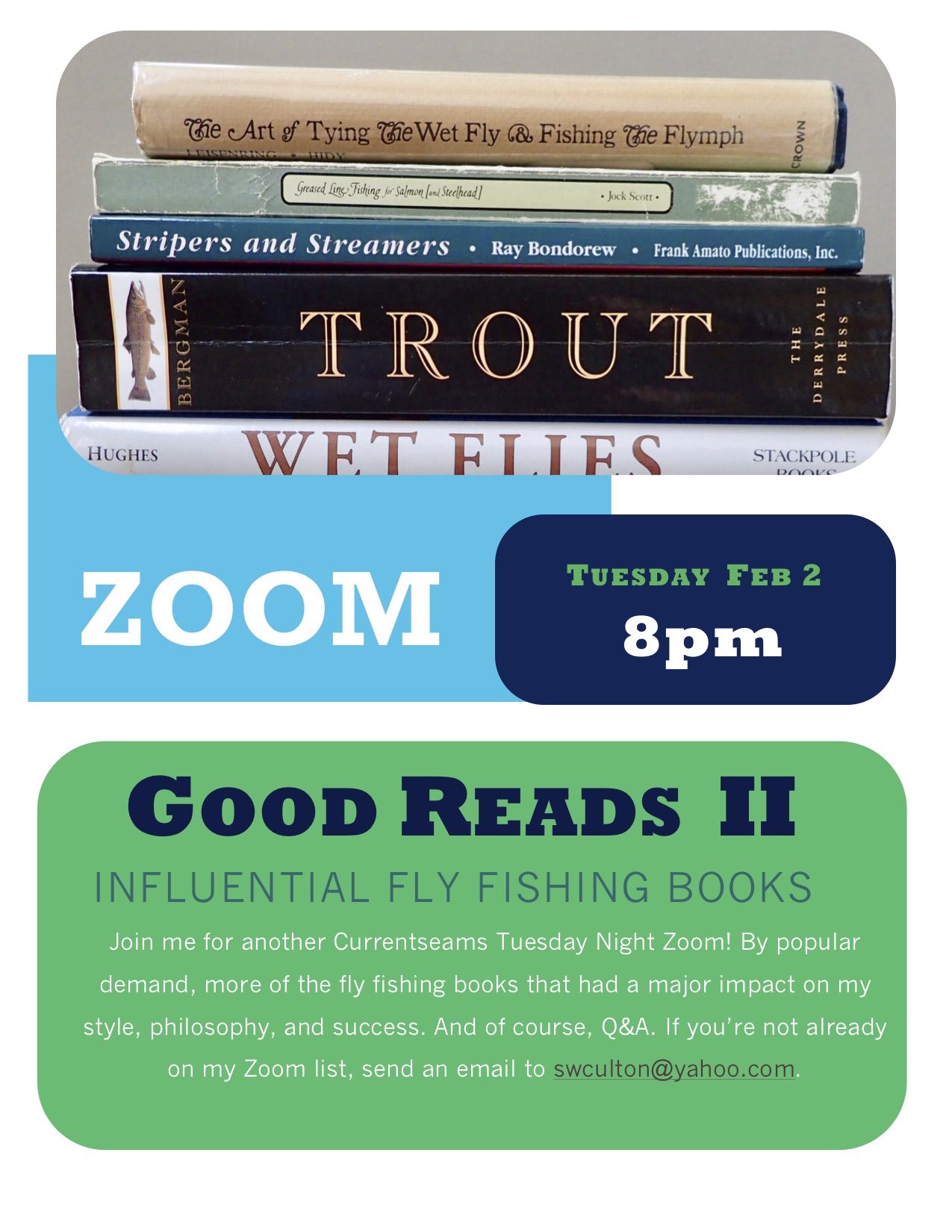
How is it Monday already? It must be, because tomorrow’s Tuesday, and that means another Currentseams Tuesday Night Zoom. By popular demand, I’ll be discussing more books that had a major impact on my fly fishing. Shake off the the snowy winter blues, join in the fun, and perhaps find a hidden gem of a good read.
I’m still getting sign ups and questions (“Is tomorrow’s class still on?” Yes. “Is this a pre-pay event?” Yes. $10.) about tomorrow’s tying class, Tying Winged and Wingless Wet Flies. There’s still room if you want to join in: tomorrow, Saturday, January 30, 1pm. You can literally sign up for it any time before then (but I’d appreciate it if you’d do it sooner rather than later). Here are the details.
A hunk-hunka burning love of wet fly goodness awaits.
Currentseams subscriber Paul Gross left a comment in yesterday’s post thread about Callahan and Company booksellers as a good place to find old fly fishing books. I don’t have any experience with the company, but I didn’t want Paul’s comment to go unnoticed. So here it is: “If you are looking for hard-to-find fishing books, Callahan & Co booksellers in Peterborough, NH has an unbelievable collection. 603 924-3726. I don’t believe they have a website, unfortunately. If you visit in person, it’s completely overwhelming. Make sure you have a limit on your credit card!”
A good virtual crowd last night for my Tuesday Night Zoom, “Good Reads.” In case you missed it, I shared a dozen books that have had a major influence on my fly fishing approach/philosophy/success. I had several requests for the list, so here it is: Trout Fishing by Joe Brooks. Trout by Ray Bergman. The Soft-Hackled Fly and Tiny Soft Hackles by Sylvester Nemes. Wet Flies by Dave Hughes. Two Centuries of Soft-Hackled Flies by Sylvester Nemes. Trout Lessons by Ed Engle. Striper Moon and A Perfect Fish by Ken Abrames. Steelhead Fly Fishing by Trey Combs. Steelhead Dreams by Matt Supinski. Nymph Fishing by George Daniel. Tactical Fly Fishing by Devin Olsen.
Some of the language in Trout is a little moldy, but Bergman still nails certain truths that have withstood the test of time.
It occurs to me that each of these books deserves its own review. I’ve already formally reviewed some of the newer ones on these pages, but I’ll be starting a series featuring the others very soon. Last night’s Zoom was so well received that I’m going to do another on Good Reads (Son of Good Reads? Good Reads II? Attack of the Good Reads?). The well of influential material is deep!
There’s still room in Saturday’s (January 30) class, Tying Wingless and Winged Wet Flies. We start at 1pm, and you can literally sign up for it any time before then. Here are the details.
We’re keeping the Currentseams Tuesday Night Zoom ball rolling. I’ll be talking about some of the fly fishing books, old and new, that had a major impact on me, from how I fish to my general fly fishing philosophy. Autodidacts like me just can’t get enough of a good read, and I hope to turn you on to some books you might find invaluable. See you Tuesday Night!
I was a little disappointed with the number of people who showed up for the most recent Tuesday night Zoom. Not from an ego standpoint. But rather from one of “we need this now more than ever.” One interpretation of the lower turnout would be that people already know C&R best practices. A casual scroll though Internet forums and social media shows this is far from the case: fish being held with dry hands. Striped bass (a stressed stock, remember?) being hefted vertically from their lips or laid onto boat decks. Wild brook trout being landed and photographed on rocks and twigs.
So please. Learn and practice safe catch and release principles: Barbless hooks. Land fish fast. Keep handling to a minimum and then only handle with wet hands. Ask yourself, “Do I really need a photo of that fish?” Keep fish totally submerged in your net, in current if possible, until you’re ready to shoot. For pics, it’s 1-2-3-lift-shoot. Then back into the net. (Ideal shot, we see water dripping from your hands and from the fish.) Consider underwater photography where the fish never leaves the water. Revive the fish if needed before release.
I know most of my readers already know this. I thank you. The fish thank you. The next angler who catches that fish thanks you. Please share this information with others as you see fit. And here’s a great catch-and-release best practices resource: keepfishwet.org.
We’re back with another Tuesday Night Zoom, baby! Proper catch-and-release principles and technique is a subject we should all be taking seriously. Yes, fishing is ultimately a blood sport, but there are ways to hook, land, photograph, and release fish before they know what hit them. Join me tomorrow night and we’ll talk about it. If you’re not already on my Currentseams Zoom email list, send me a request at swculton@yahoo.com. Link goes out Tuesday late afternoon. Check your spam box if you don’t get it.
Many thanks to those who attended yesterday’s class, Tying The The Soft-Hackled Fly. Good group, good questions, and we made it through a few minor technical glitches in fine form. I was very pleased with the new camera for the closeup tying action — it was exponentially better than the stock cam on my Mac laptop. There will be another class, very likely on Saturday January 30th, 1pm, Tying Wingless & Winged Wet Flies. I’ll formally announce that class in a couple days. There will also be a Tuesday Night Zoom this week — check out the site tomorrow for the topic. Enjoy your Sunday — you deserve it!
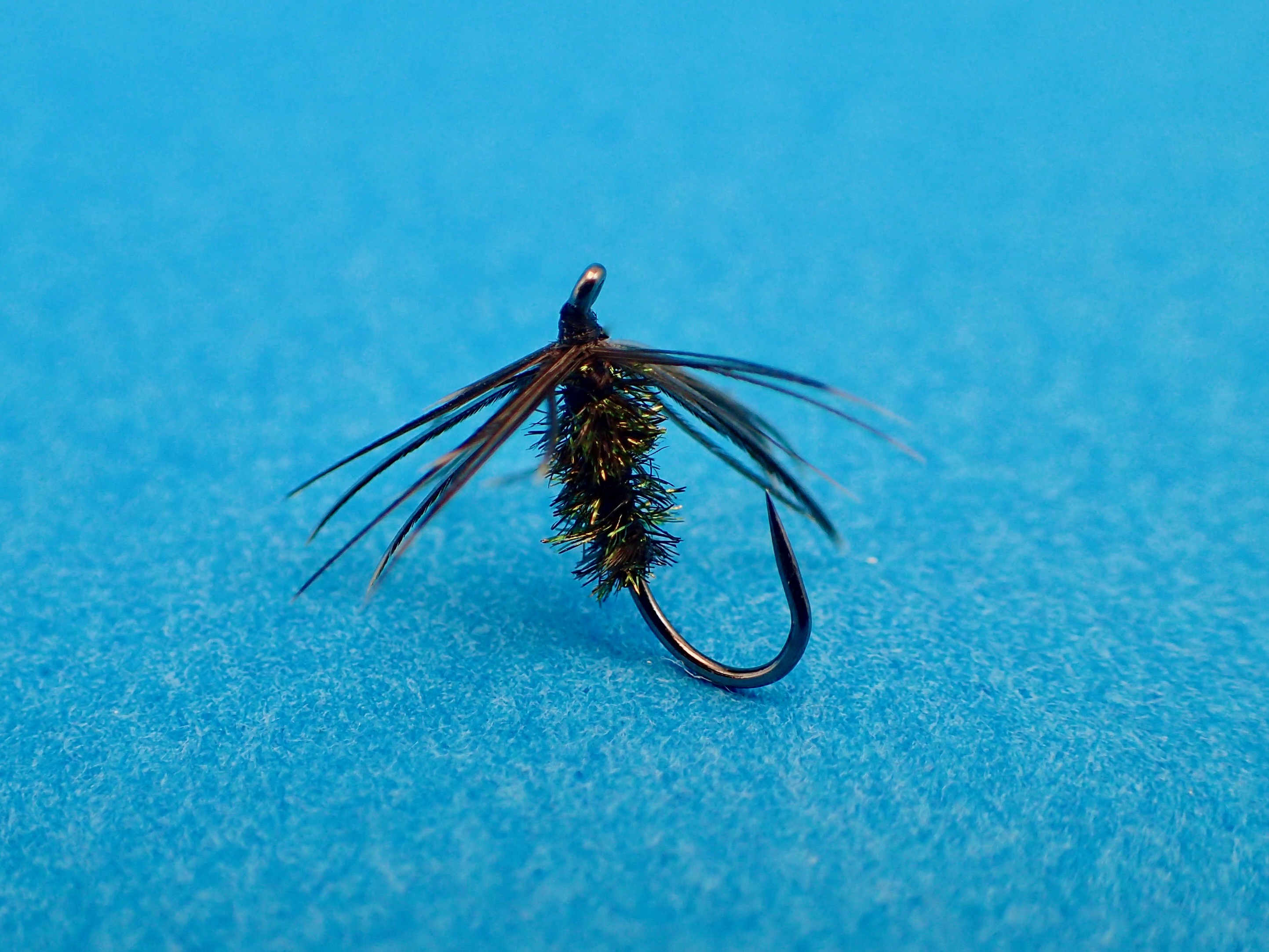
Yesterday’s question of the day was, “What soft hackle can I tie that I can fish right now?” My answer was this, the last fly we tied, the Starling and Herl. Perfect for the top dropper on your nymph rig. This is a size 14; I’d go with a 16-18, and especially a size 18 2x short scud hook. It’s a great match for all the tiny bugs that are prevalent on our cold northeast rivers right now. Make your body more durable by making a herl rope; you can see that technique in my video for the Drowned Ant Soft Hackle.
Another fun Tuesday Night Currentseams Zoom last night! In case you missed it, we talked about winter fly fishing, from gearing up to dressing to when, where, and how. There will be more of these public Zooms throughout the winter. Thanks to the 50+ attendees for hanging out with me for an hour.
I’ve also seen a spike in Currentseams subscribers since the holidays and I’d like to say welcome. I appreciate your readership, and going forward I’ll try to provide you with far better fly fishing content than today’s material. But this is a writing day, and so I must take fingers to keyboard lest my editor jump ugly upon my personage. And with that, off I go.




 currentseams.com