Currentseams Tuesday Night Zoom email stuff and a second wet fly tying Zoom

Some of you didn’t get last Tuesday’s Zoom link email — that is, the mass email I send out to my Zoom contact list, not the new post alerts that you get from this site. Actually, you did get it. It just went to your spam folder. So please make sure your Tuesday Zoom link email is going to your inbox. (I’ll be sending tonight’s out around 5pm.) Also, if you’re on the Zoom email list, you’re on the Zoom email list. You don’t need to ask every week to be placed on it. I hope all this helps, and I’m looking forward to a good crowd tonight (Winter Fly Fishing).

Due to popular demand I will be doing a second wet fly tying Zoom class. This one will focus on wingless and winged wet flies. I haven’t decided on a date, but it will likely be Saturday the 23rd or Saturday the 30th. Same great value price ($10). Please stay tuned!

You too can learn to tie old school wet flies that trout cannot resist.

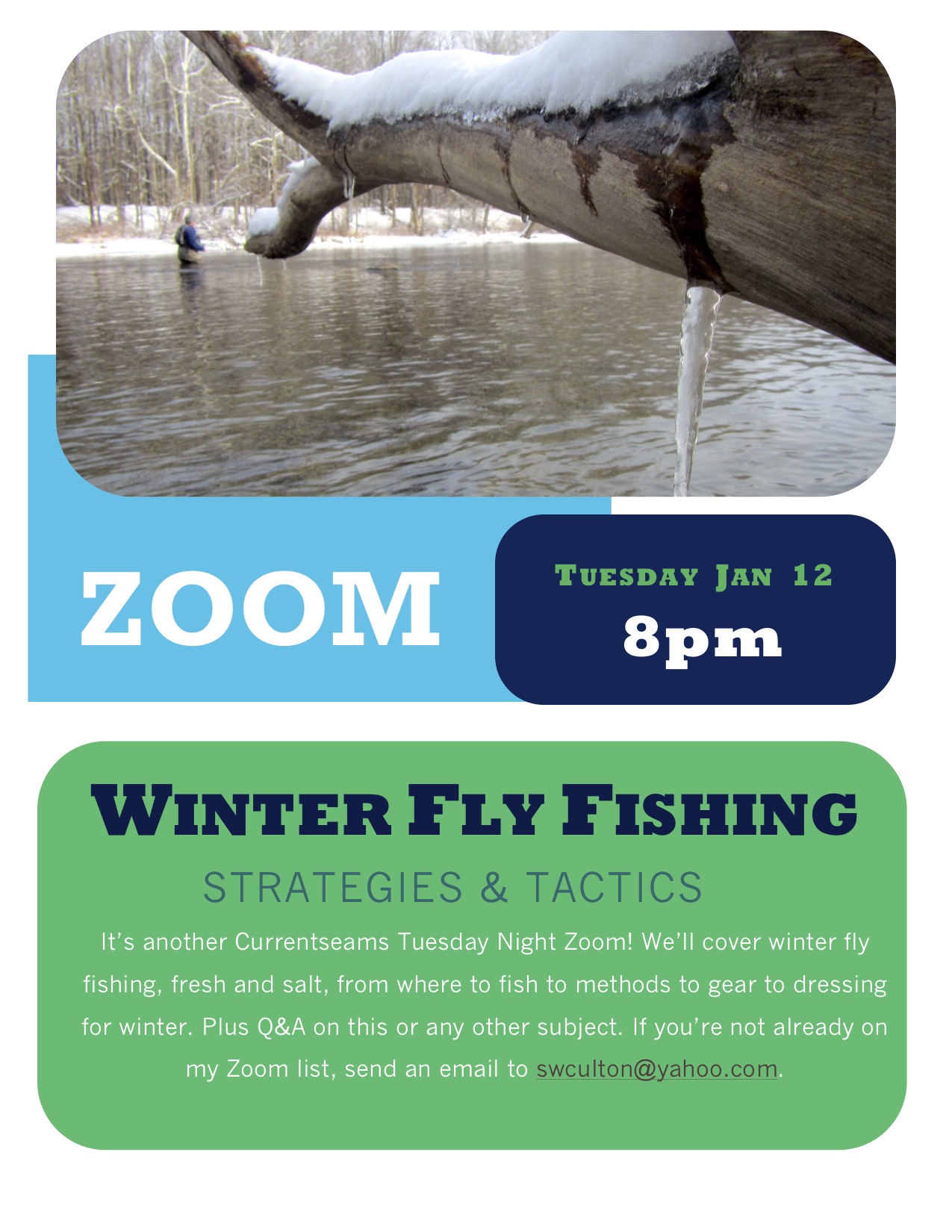
The Next Currentseams Tuesday Night Zoom: “Winter Fly Fishing” Jan 12, 8pm

I’m pleased to declare war on cabin fever with another free Currentseams Tuesday Night Zoom, tomorrow, January 12 at 8pm. The subject will be winter fly fishing, and you can read all about it on the poster below. Hope to see you there!

Plus, if you haven’t done so already, there’s still time to sign up for my first winter fly tying Zoom class, Tying the Soft-Hackled Fly, this Saturday January 16th. This class is a pay-to-play event, and the cost is a very reasonable $10.

J.C. Mottram’s Smut Number 1

“Smuts — I welcome smutting trout.” So writes J.C. Mottram in his book Thoughts on Angling. I don’t have the book, but I do have Syl Nemes’ second edition of The Soft Hackled Fly and Tiny Soft Hackles. In that book, Nemes devotes a chapter to Mottram and his collection of soft-hackled smuts. (“Smut” is a colloquial British term for a very tiny fly, such as a midge, and trout that are “smutting” are delicately feeding on those miniature bugs.)

There are six Smuts listed by Nemes. I’ve only tied one, the Number 1 (shame on me for not exploring further). I revisit it today because I happened to have Nemes’ book out, and this is a great time of year to fish midges. (Midges are a major, consistently available food source for trout in the winter.) I’ve mostly fished Smut Number 1 as a dry fly, but I’ve also used it subsurface. The wise winter nymph angler will no doubt want to include this tiny soft hackle as the top dropper in their nymph rig.

Nemes includes a photo of the Smut Number 1, and it bears only a faint resemblance to what I tie. His looks like the body is entirely constructed of working thread; mine uses the specified wool. (UNI makes a nice wool yarn thread on a spool.) His hackle is wound wingless wet style, covering the front third of the body; mine is wound at the head. I suspect the wingless wet style would be very appealing to trout. Worth the price of admission alone is the blank stare you’ll get from the angler who will inquire, as you hook trout after trout, what fly are you using? “Smut Number 1,” is your response. Soak in that moment. And here it is, J.C. Mottram’s Smut Number 1.

Hook: TMC 100 18-22

Thread: UNI Black 8/0

Abdomen: Black wool

Thorax: Black wool

Hackle: Long white

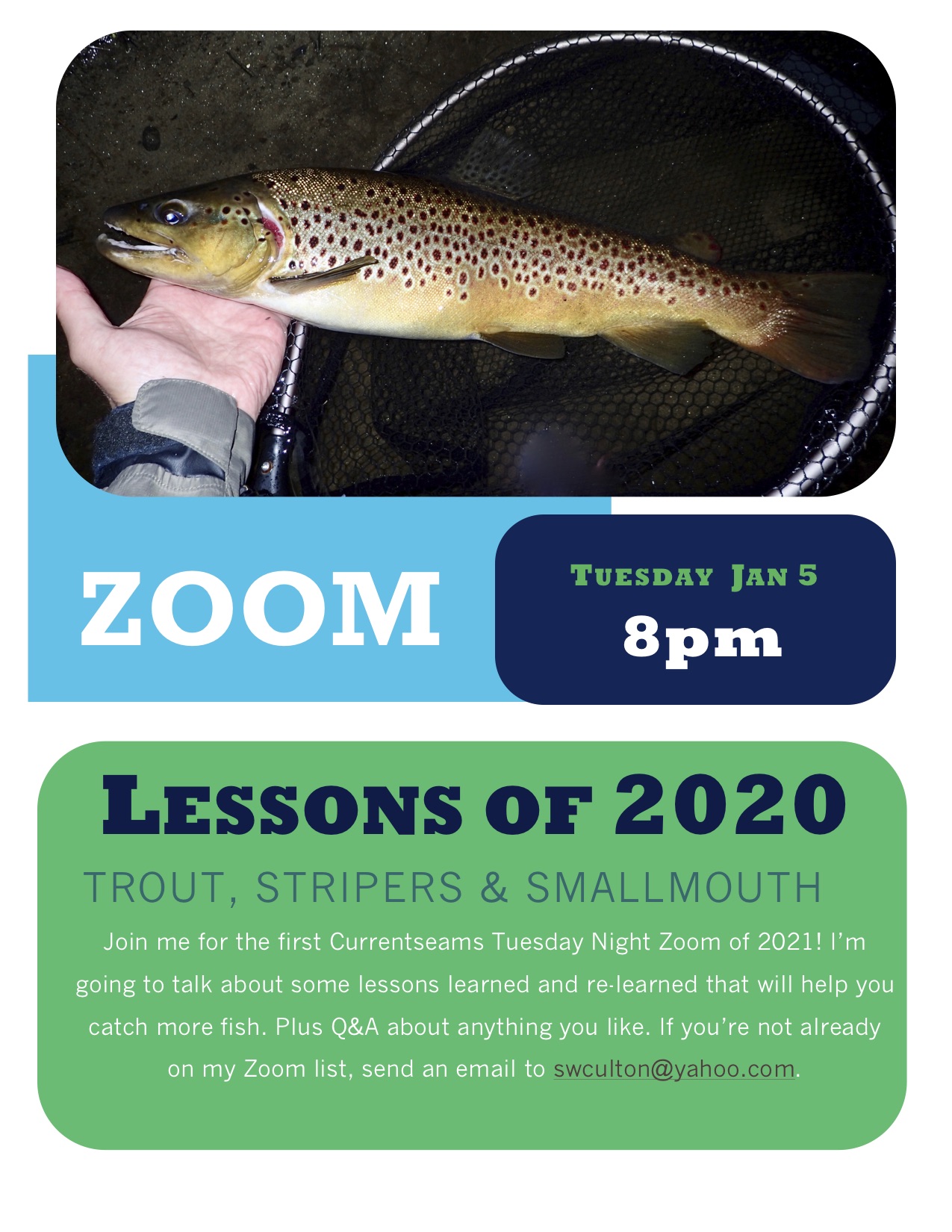
The Return of the Currentseams Tuesday Night Zoom! “Lessons of 2020” Jan 5, 8pm.

I’m excited to announce the first Currentseams Tuesday Night Zoom of 2021: tomorrow, January 5, 8pm. This is a free event. I want to talk about some of the lessons I learned and re-learned last year, and how you can use that information to catch more fish. I’ve got some cool video to share, so you don’t want to miss this one. Feel free to share with your friends or on social media. See you Tuesday night!

If you’re already on my Zoom email list from last year, you know the drill. I’ll send out the Zoom link tomorrow. If you’re new to currentseams and want to get on the Zoom email list, please send me a request at swculton@yahoo.com.

Best of 2020 #1: The Triumphant Return of the Block Island All-Nighter!

You may think it would be easy to pick out a top ten fishing memories of the year list. But it isn’t. Sometimes it’s especially difficult to choose one event as the single best moment of the year. What made that particular fish better than another? Is size the only determining factor? What about frequency of catching? Is an epic day of constant action more worthy than a single big fish? These are the questions for which I struggle to find answers. In the end, I chose my tenth Block Island All-Nighter as the #1 Best of 2020 for several reasons. First, the company: old friend Peter Jenkins of The Saltwater Edge. It was Jenks’ first BIAN, and after a slow start he killed it. While there weren’t any slot fish or better, the action was consistently good all night (I’m told by my Island spies that this was the first really good night of the season). Finally, I hadn’t done a BIAN in five years, and it was soul-restoring to get back to this treasured tradition. Cap it off with a highly satisfying breakfast at Ernie’s, and that, and Jenks would say, “makes it a win!”

I know this was a challenging year for everyone. I hope you found some solace, if not downright joy, on the water. Here’s to the great moments of 2020, and to the hope that 2021 is even better. Thanks for reading currentseams. I value your comments, questions, and passion for this wonderful sport of ours. Cheers!

Skunk’s off. Most of the stripers we caught on BIAN X were in the 20″-24″ class, but Block Island bass are a treat on the long rod at any size .

Best of 2020 #4: The filming of “Summer on the Farmington.”

When director Matthew Vinick asked me if I’d like to appear in his upcoming film on dry fly fishing the Farmington River, I didn’t think twice. Crew and angler assembled on a gorgeous afternoon in late June for my segment. The trout were gathered too, although they were most uncooperative. Sadly, we’d caught them in between feeds, and rises were few and far between. Finally, we got the shot — and the fish — we were looking for, a healthy 17″ Survivor Strain buck, taken on a size 16 Light Cahill Catskills dry. Wouldn’t you know it? After we broke the set, the river lit up and it was trout after trout from 7:30pm till dark. We had a follow-up interview shoot in October. Now all we have to do is wait for director and editor to do their thing.

I don’t have a projected release date for the film, but when I hear more, I’ll let you know.

Best of 2020 #6: The Last Blast Live Presentation

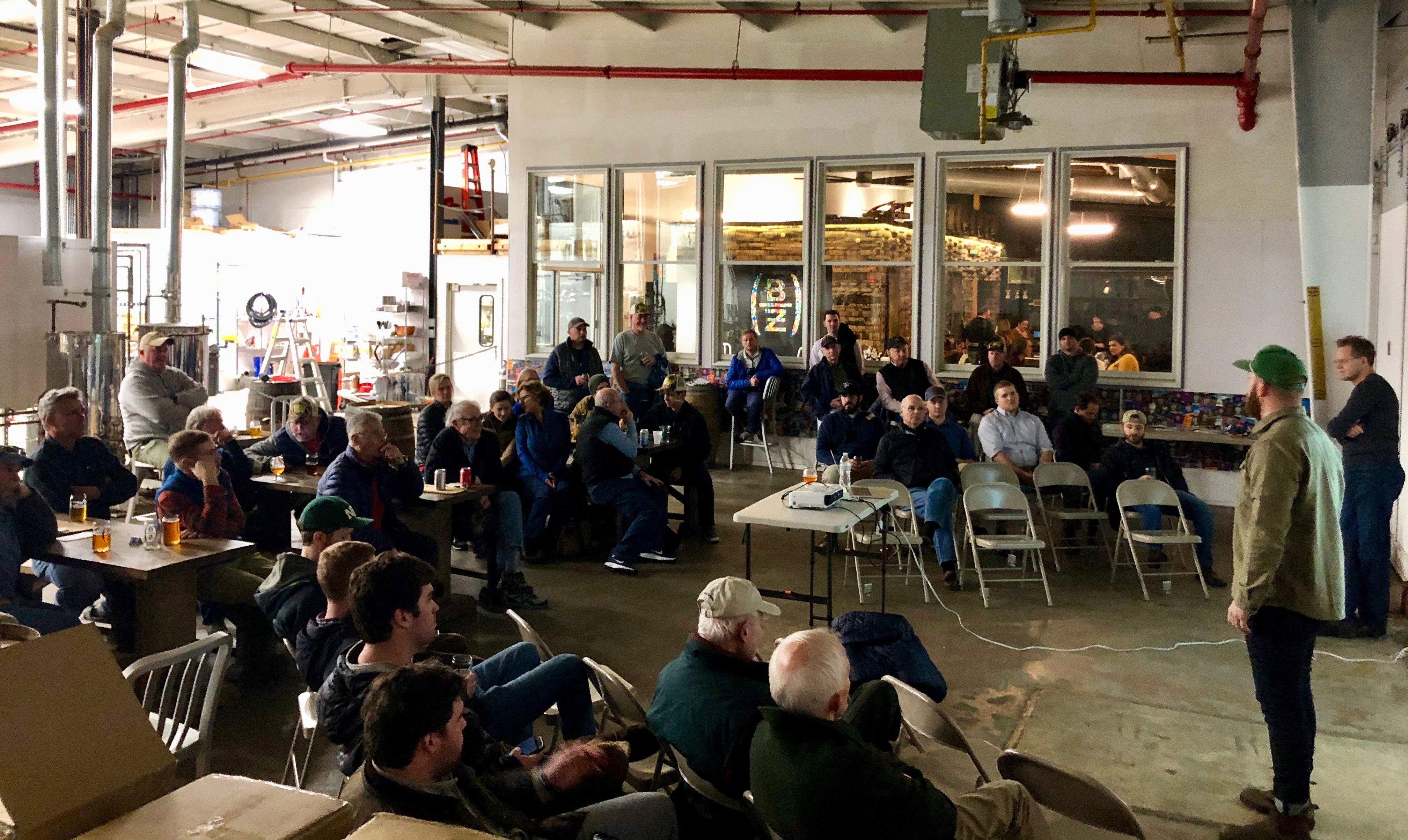
As the pandemic began tightening its grip on America, none of us could predict what was coming — or how much our daily lives and routines would be changing. So I had no way of knowing that my presentation of “Trout Fishing For Striped Bass” (here’s the SWE podcast) to the South Shore Fly Casters near the end of February would be my last live presentation of 2020. The evening was both a pleasure and a challenge. The group meets in a brewery (yay!) and the turnout was excellent; at the opposite end, I was battling a miserable sinus infection and thus was lathering on hand sanitizer and keeping social distance before I knew social distancing was going to be all the rage. Here’s the link to my report on the talk. It includes some striper Q&A, so give it a read.

Man, I miss going out and talking to groups live! We’re making do with Zooms, and I’m able to present to a wider geographic range of fly fishing clubs, but there’s nothing like a live audience. Hang in there. Once we get though this madness, we’ll all gather for a beer and some quality face-to-face fly fishing conversation.

Best of 2020 #7: Silver Linings Smallmouth

Feast or famine is the new normal for stream flows. In the summer of 2020, we were left wanting for water. After a soaking spring, precious rainfall eluded us through the start of fall, creating harrowing drought conditions across Connecticut. Thankfully, we have smallmouth bass.

It’s no secret to readers of Currentseams that I am a smallmouth addict. So even though the Hous was low and warm, it was still within the acceptable range for targeting Micropterus dolomieu. So I went at it hard. The challenges were many. Low water meant fewer places to find fish, and sometimes what was there wasn’t in the mood to play. This was clearly an off year on the Hous, with an exponentially smaller class of larger fish (this was by far my worst year in the last five for bass you could measure in pounds) and fewer fish in general (I witnessed one epic white fly hatch with hardly any bass on the bugs). Parking and crowds were a concern; there were times when I saw more angler traffic in a day than I normally do all summer. So what did I do?

I explored. I walked. I tried new water and new methods and new flies. I learned so much that I’m going to be writing an article about it in a future edition of The Fisherman magazine. It may be winter, but I can still feel the humidity falling over my shoulders like a coat, sweat collecting along my brow, as the dragonflies buzz around my head at dusk. Maybe one more cigar for the walk back to the truck?

This summer I tried to use multiple methods when learning a new piece of water. So in a typical outing, I might strip and swing a streamer, pop a Gurgler, swing wets, or dead-drift a surface bug. Here’s a nifty shot of a decent smallie blowing up on a Wiggly.

Random thoughts on a snowy day (and a good short read on winter nymph patterns)

I got a late start today, and there’s so much to do: plow the driveway, catch a workout, pre-Christmas prep, a virtual wine tasting tonight (been looking forward to that for weeks!). I started the day proper by building a fire, an old Culton snow day tradition. I’ve also got lots of writing to do, but won’t get to it today: for Dennis Zambrotta’s followup to Surfcasting Around The Block, for my year-end wrap-ups for currentseams…plus Santa brought me an early gift of a new video camera. Gotta figure that out and hopefully make some even spiffier tying videos.

But for now, here’s a piece I did last year on the best nymphs for winter fly fishing. (Understand that “best” means my favorite, high-confidence patterns.) Also, remember that I don’t Euro nymph, so add weight and jig hooks to these patterns as you see fit. Enjoy the snow day.

We don’t need no stinking fake logs and propane fire!

Stuff I Use: UnderArmour Primaloft(R) Ridge Reaper Hunt Beanie

Yep. I’m picky about the stuff I wear and the stuff I use when I’m fly fishing. I have very little patience for gear that doesn’t do what it’s supposed to do, or makes me uncomfortable, or just generally sucks (like this awful lamp). A winter hat seems like something that’s so simple, it shouldn’t require much thought. Therein lies the beauty of the UnderArmour Primaloft Ridge Reaper Hunt Beanie: it’s warm. It’s comfortable. It does what I want it to do.

For starters, I like to wear a ball cap when I’m fishing, even in the winter. The visor keeps the sun out of my eyes and precipitation off my glasses. On those really cold days, I like to wear a ski-type hat over the ball cap. My issue with previous hats was that they were too snug or too small or not warm enough. The last thing I want to be doing out on a river when it’s 20 degrees is be futzing with my hat. So the Ridge Reaper, even though it’s one size, is stretchy and roomy but snugs down nicely around my head and ears with no fuss.

New hat: the UnderArmour Primaloft Ridge Reaper Hunt Beanie.

Cosmetically, I like that the logo is understated. I’m not a fan of high-visibility, high-contrast logos, and as an outdoors person, you can understand wanting to blend in. According to the UA website, the yarn in this hat is breathable and water resistant, and it has a double layer knit lining. Sounds perfect. Like most UA products, this is more than I’d like to pay. $40 for a hat? But, as with so many other things, my eventual cost-per-use will make me forget the price, as will the hat’s performance and comfort.

Price: $40

Rating: *****

A post-steelhead-landed victory shot, hat under the hood. A warm angler is a happy angler.