It recently occurred to me that many, if not most, of my currentseams audience hasn’t seen any of the stuff I wrote and/or tied before I started this site. I came to this realization when I was trying to find the recipe for the Steelhead Cameron, a west coast marabou wing-style streamer that was part of a series of patterns named for each of my three sons. Since I’m always looking to give you fresh, interesting, and useful content, I thought that this might be a worthy project: to go through my archives and find the old stuff that doesn’t suck. I know I did a whole series on legacy saltwater patterns. There are stories to re-tell. I’d likely need to re-tie and shoot any fly patterns. Stay tuned while I go digging….
The Steelhead Cameron, part of the “My Three Sons” series. All of them work. You’ll have to wait to see the Gordon and the William, and to get the recipes for all three.
The best steelhead nymphs are the ones in which you have the most confidence. After all, “best” isn’t measurable. But if you buy into the old saw that the proof of the pudding is in the eating of it, I’d like to offer up five steelhead nymphs that have proven their worthiness on New York’s Salmon River.
So, what qualifies a steelhead fly as a nymph? For the purposes of this list, I’ve kept it to flies that are size 8 or smaller; flies that feature predominantly muted colors (hot spots, contrast points, and bead heads are allowed); and flies whose basic construct is at least 50% actual invertebrate driven. So, no bigger stoneflies here. No Steelhead Hammer types. And no black-light poster colors. Here we go, in no particular order. As a bonus, some of the patterns have links to my tying video.
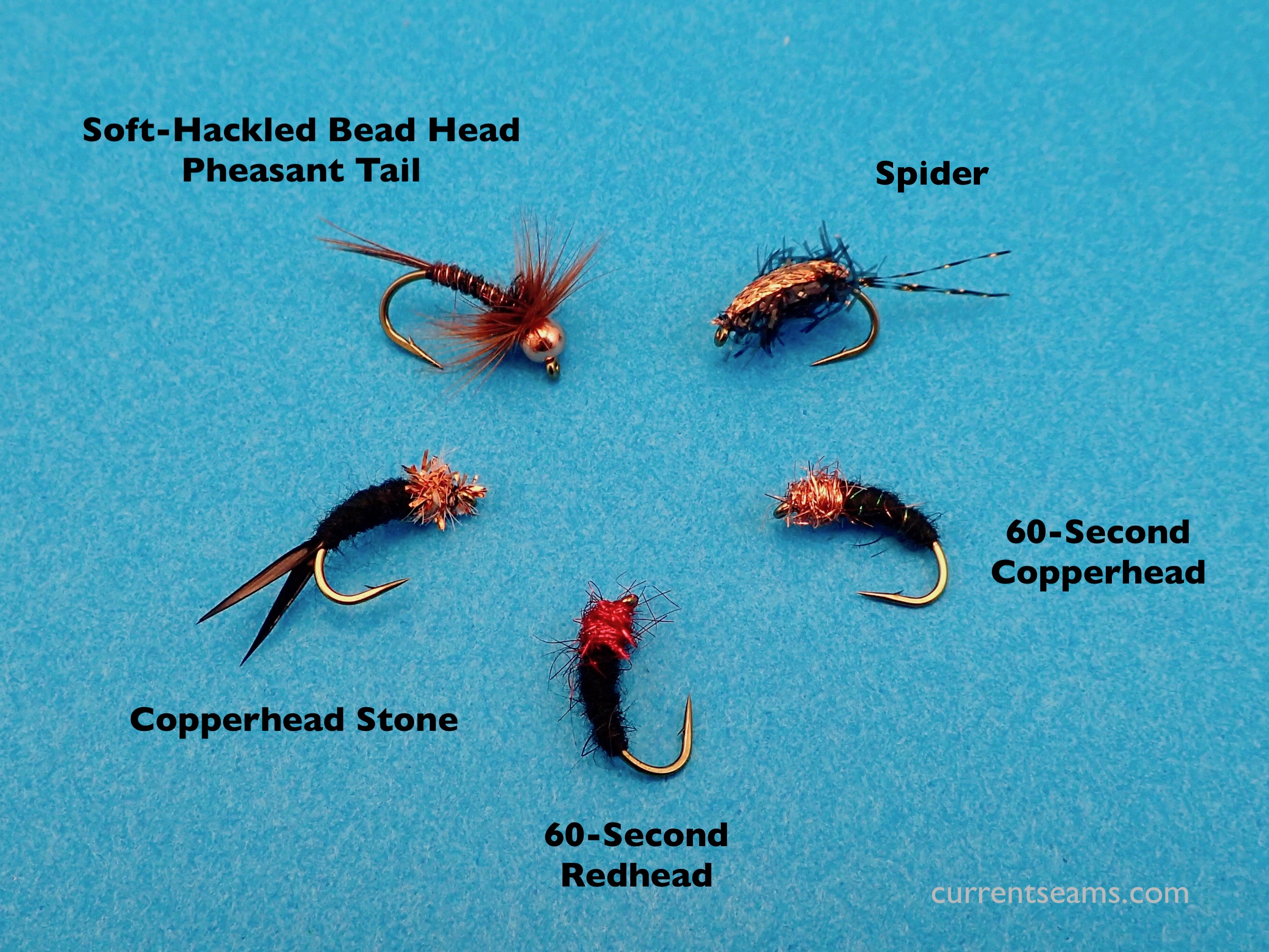
Soft-Hackled Bead Head Pheasant Tail. I was pleased no end to discover that Salmon River steelhead would eat this rather muted pattern. I’ve done really well with this fly in winter.
60-Second Redhead. The beauty of this fly isn’t that if you lose one to the bottom gods, you’re not depressed because they’re so fast and easy to tie. It’s that this fly, which would never catch your eye in a retail bin, is like candy to steelhead when they’re eating bugs.
60-Second Copperhead. After pounding up so many steelhead on the redhead, I wondered if they’d like a version with a copper Ice Dub head. A wise old Salmon River veteran once told me, “It’s hard to go wrong on this river with black and copper.” He was mighty right.
Copperhead Stone. I landed my first steelhead on this fly, and years later, it still works. I remember one morning in the Lower Fly Zone when I was handing them out to everyone who wanted to know, “What fly are you using?”
Spider. Another ridiculously simple tie (notice a pattern here?): size 12 hook, black Krystal Flash tail, black Estaz body, copper (the original calls for olive or pearl) braid flashback. Designed by Clyde Murray for Erie fish, the Salmon River steelhead like it just fine.
My top five steelhead nymphs for the Salmon River in Pulaski, NY, are all very simple ties. Note that they all have some kind of contrast, flash, or hot spot. These are all high-confidence patterns for me, all proven producers, and it’s hard to go wrong with any of them when you suspect the steelhead are eating nymphs.
To be fair, it was only a few hours — I fished from noon to 3pm — but the going was glacially slow. I hit four favorite nymphing marks below (450cfs) and within the TMA (390cfs), and I found a trout willing to jump on in only one of them. I used a combination of tight line and indicator nymphing methods, and I even switched out my point fly and dropper — none of it seemed to make any difference. The angler traffic continues, with nine other folks sharing the water with me during my travels. Mine was the only fish I saw hooked all day, which is not to brag, but rather to illustrate how slow the fishing was. I stopped at UpCountry on the way home to do some shopping, and Torrey Collins said that nymphing has been slow for him lately, too. So it goes.
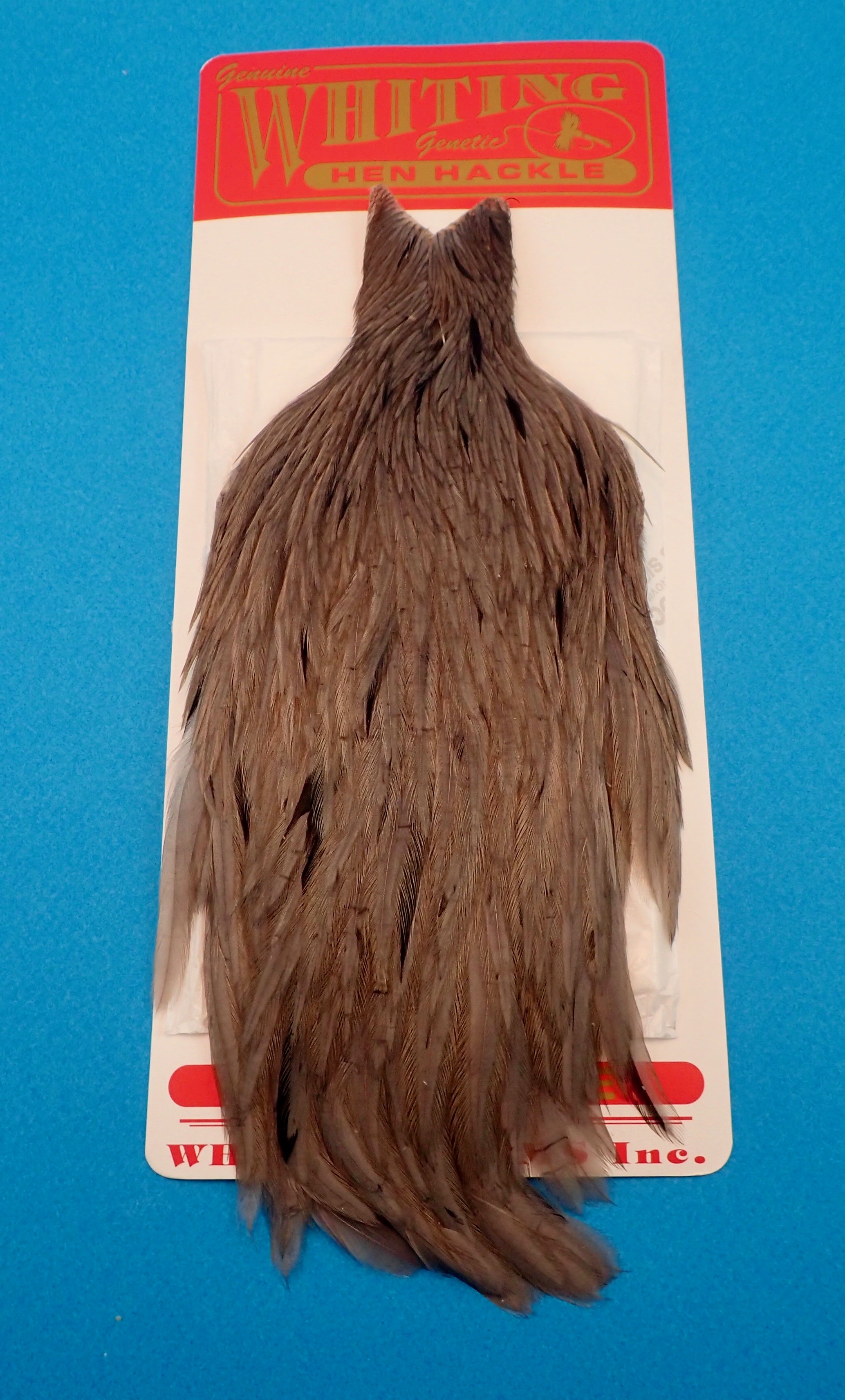
The day wasn’t a total loss. I scored this beautiful, webby dark dun hen cape at UpCountry. Just what I need for my next batch of Dark Hendrickson winged wets.
Much to do today, and in between projects and responsibilities I’m trying to make a dent in my 800 Followers contest winner swag. Here’s a Hackled March Brown in progress.
As you can see, my tying bench trends toward messy. There’s something mad scientist/struggling artist that I like about materials and tools scattered everywhere…
Happy Monday to everyone. Late start for me today. No big news or hot presentation tips or must-have fly patterns, so consider this a simple hello and let’s-catch-up missive. This is fish-related: as I write this, I have two salmon filets on the smoker, a present for my parents and my aunt. They (the filets, not my relations) spent two days pickling in the fridge, and now they’re taking a gentle bath of apple wood smoke.
Normally I’m steelheading this week, but low water and spotty reports have me at home playing the waiting game. I’m going to try to amuse myself with some other species instead.
800 Followers contest winners: I have one set of flies done, and I’ve started on another. Sloth is my flaw; patience is your virtue. I’ll notify you by email when I ship your goodies.
Wow, another birthday! Thanks so much to everyone who sent birthday wishes. I had a great day with my family, outside and socially distanced, and I made merry with some wine, whisky, and an absolutely delicious Cuban Romeo y Julieta Short Churchill.
Last year at this time it was Everest Base Camp-cold on the Salmon…and with quite a bit more water.
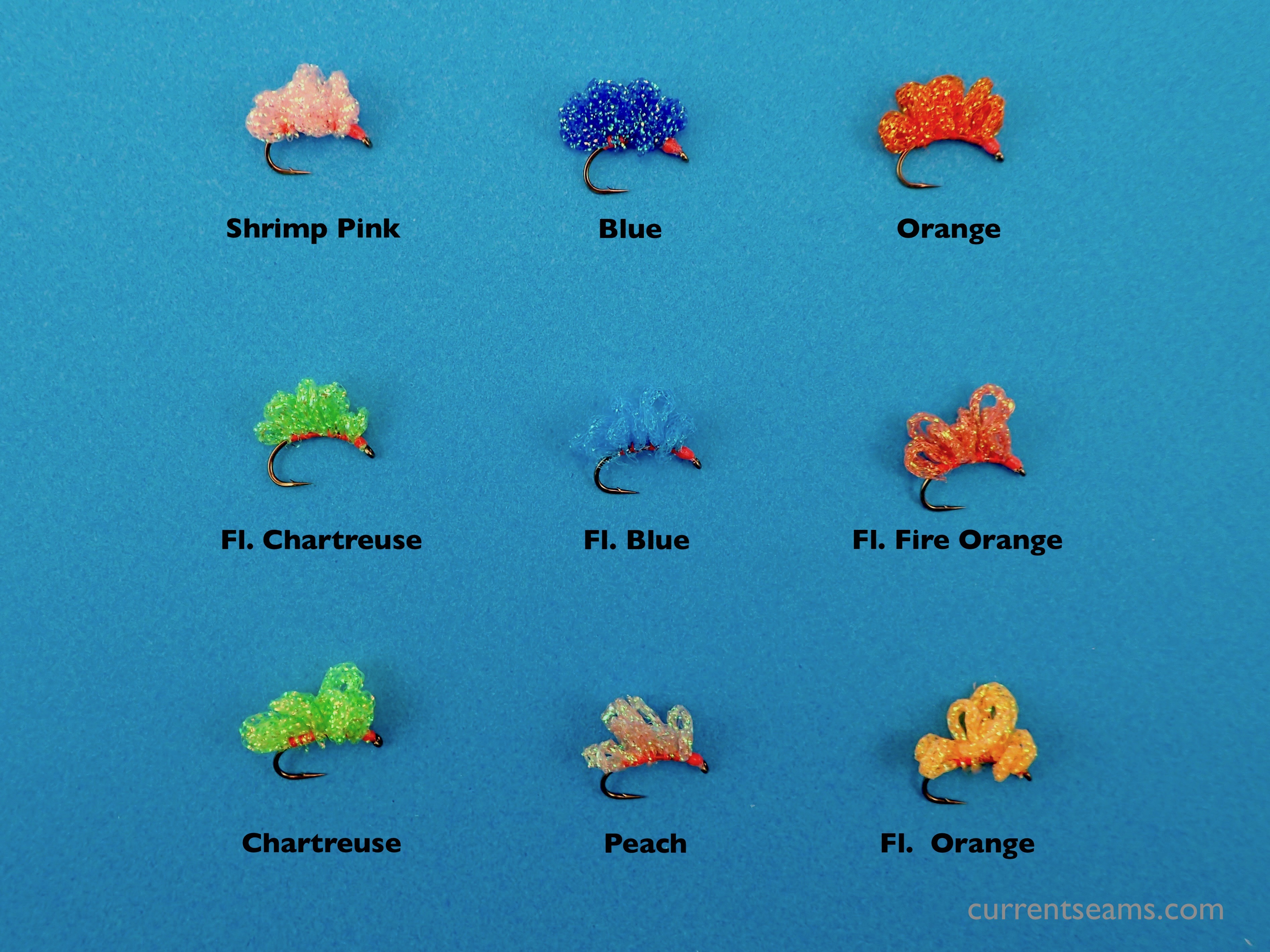
The best colors for the Crystal Meth fly are the ones the steelhead want to eat…or the ones in which you have the most confidence.
Debates on the best color for Crystal Meths, egg patterns, and beads for steelhead and trout are never-ending. Everyone has their theories. Everyone has their favorite colors. Everyone can prove you wrong. So I stand by my opening statement. In case you don’t know what a Crystal Meth is (besides one of the best fly names ever, right?) it’s a sparkled-up version of a Sucker Spawn. You can tie them with or without a bead and a Krystal Flash tail. When the steelhead are feeding below salmon redds — and even when they’re not — the Crystal Meth can be a very productive fly. And since they’re firmly in the junk/guide fly category, you don’t fret when you lose one to the bottom gods.
Our Lady of Blessed Crystal Meth — chartreuse — accounted for my only fish on this painfully slow day.
So, what are my favorite colors for the Crystal Meth? Here’s a handy-dandy photo reference chart. I use them all, but if I had to choose a top three, I’d go chartreuse, fluorescent blue, and fluorescent fire orange. YMMV.
You’re now at Countermeasure Central on currentseams! Here you can watch the tying video (below); see the original post/recipe; and read the Guide Flies feature piece from On The Water magazine. In case you’re new to this pattern, the Countermeasure is a riff on several proven streamer designs (like the Zoo Cougar and Zonker). It’s loaded with bite triggers, and it’s one of my favorite smallmouth bass bugs. Oh! Big trout love it, too.
One of my goals with currentseams is to help you become a better angler — and hopefully catch more fish. So if I could somehow distill a “Top Ten Tips” out of my brain’s fly fishing storehouse, one of them would certainly be: Learn presentations other than cast and strip. Especially if you want to catch more stripers.
When I see questions like, “How fast do you retrieve the fly?” or “Do you strip with one or two hands?” — and I see these questions a lot — I despair. Rarely does anyone ask the question, “Does it have to be a retrieve?” The answer would open many doors to greater fish-catching glory.
Even if you were going to fish for stripers using only retrieves — and there are many outings over the course of a season where I do just that — there are an abundance of retrieve options that are rarely used or discussed. For example, for sand eels, I like a hyper short (1-2″) rapid pulsing strip. For a large squid fly like the Mutable Squid, I like a slow hand-twist retrieve. Last week I fished a large deer-hair head fly with a fast strip-strip-strip-strip….pause….wait for it….then strip action. And there’s always the surface popper trick of landing the fly with a splat….then doing nothing. Once the landing rings dissipate, give that bug a twitch. You could present in randomly timed, spaced, and distanced strips, creating the drunken action of wounded prey. The list goes on. And the stripers will always tell you when you get it right.
Ultimately, you’ll need to learn presentations other than cast-and-strip for those outings where the stripers will not chase. One of my recent trips included a puzzle where school bass were cruising and feeding, but would not move to a stripped fly. The answer was found within traditional salmon presentation tactics. Those willing to invest in the floating line — I’m not talking money, but rather in taking the time to learn how to harness its power and master a few basic presentations — will see their catch rates soar. And while you’re at it, pick up a used copy of “Greased Line Fishing for Salmon [and Steelhead] by Jock Scott.
Fly fishing is all about line control. So take charge. Presentation is not difficult to learn. Remember that a fly rod and line is only, as Ken Abrames once observed, “a stick and a string.”
Learn presentation and start bringing your fly to the fish — not vice versa.
The hunt for big bass continues…slowly. I’ll make this brief. I fished last night with Toby Lapinski for about two hours at mark in southeast CT. Toby was on spin gear, I had the big two-hander. Not a touch for me, and Toby managed a single hello tap from a smaller fish. And that’s about all I have to say about that, other than this: the more you put in your time, and the more you learn the particulars of a potential big bass spot, the more big bass you’re going to catch. Looking forward to round three.
The water was a little milky due to surf/sand/wind, but plenty of visibility; certainly enough to see a fly like this. Mmmmmm. Squidcicle.
It’s fall on the Farmington, and that means it’s time for tiny Blue-Winged Olives. Depending on your point-of-view, this hatch can be a blast or a scourge. The flies are small (20-26), but when conditions are right (frequently overcast, damp days), the trout will line up and sip them for hours.
So, what do you do when you’ve got the hatch matched, the right leader/tippet (12-15 feet is a good length to start), your presentation is spot on a feeding lane, drift is drag-free, and you get…nothing? Or worse, a refusal? It might be that you’ve got the wrong fly. Experience has taught me that sometimes the same size fly in a different style makes all the difference. So carry a bunch of different style dries, and enjoy the tiny BWOs of fall.
My tiny BWO dry fly arsenal includes, from left, comparadun, comparadun with Z-lon shuck, parachute, Pat Torrey’s Tiny BWO soft hackle, and foam wing. The trout sometimes favor one of these over another, and the only way to figure it out is to cycle through patterns. By the way, this concept applies to other tiny hatches, like midges.





 currentseams.com