We interrupt our Everglades story — there are a couple more chapters to go — with breaking news. Director Matthew Vinick has just announced the premier date for his film, “Summer on the Farmington,” (featuring yours truly, among others)! It’s Wednesday, January 12, 2022, at the Legitimus Brewery in New Hartford. That’s all I have for now, other than we should have a trailer to share sometime in the next couple weeks. In the meantime, here’s a very low-res, ultra brief teaser.
I don’t mean to complain, but whenever a guide tells me, “Let’s meet at so-and-so place at 5:30am,” and it involves an hour drive to get there, and I gotta set the alarm for 4am (an hour I’m far more familiar with as a return time) I know two things for sure: I’m going to get a crappy night’s sleep, followed by a bleary start to the fishing. Call it the curse of the night owl. I’d been telling myself that this Florida trip would be a nice change from November steelheading, what with me actually being able to feel my toes and not be shivering (wrong about that, as I’ll soon explain). But the fact is, when it comes to depriving me of sleep, my Florida guide Mark is every bit as sadistic as my steelhead guide Jim.
Tarpon and snook in the Flamingo area of the Everglades was the original plan, but when you’ve got a guide as good as Mark, and he tells you he doesn’t like the conditions down south – and his backup plan is catching peacock bass, which you, Mr. Culton-Who-Loves-Smallmouth, he says, will totally dig – you go with it.
So that’s how I ended up shivering in a boat in a Florida canal at 5:45am.
I’d brought mostly warm weather fishing clothes, but I figured with enough layers I’d be OK. Zipping around canals before sunrise in a powerboat with added wind and a cold front changes the game a little. I had the solace of knowing that dawn would come soon, and perhaps Florida would live up to its nickname. Still, I tightened my arms in a bear hug around my jacket.
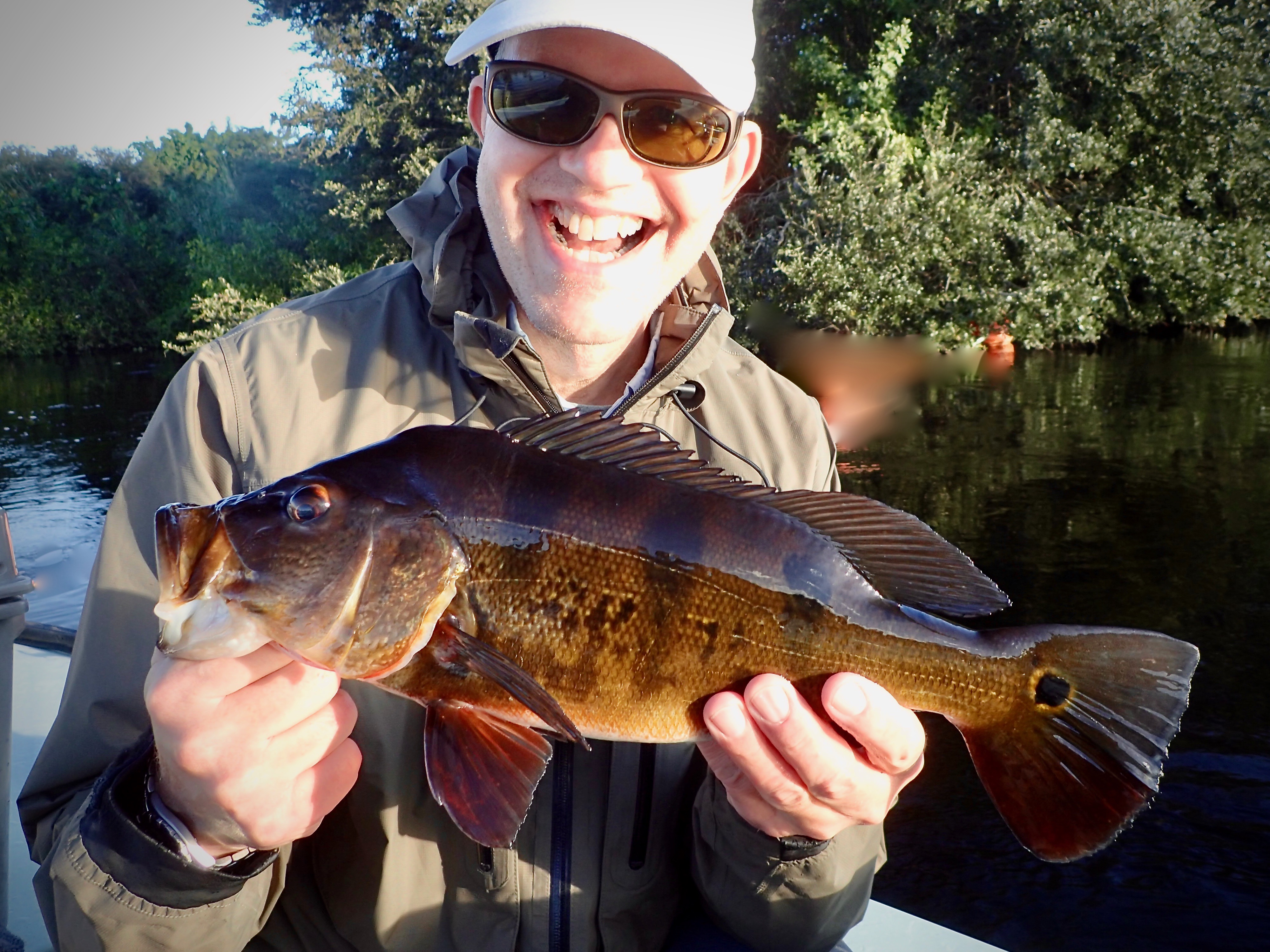
My first peacock bass was very respectable. The first light bite was slow; we started with a Gurgler-type fly, but the cold morning had the fish in a mood to stay deep. Absent current, we switched to an intermediate line (yes, you heard correctly) and a pattern of Mark’s, the Blue Claw, which fish that live in the Everglades adore. Fish on, hook set, and we were off to the races. I couldn’t possibly tell you how many peacocks we landed. If you’re puzzling about the title of this post, peacock bass are an introduced species in Florida. The state stocked butterfly and speckled peacock bass. The speckled have not done well; the butterly, pictured here, have flourished. Oh, and they’re not bass. They’re a chichlid.Photo by Mark Giacobba.The comparison to largemouth or smallmouth bass is not inappropriate. Like smallmouth, peacocks don’t like being hooked, and you can expect them to sound and bulldog as well as cartwheel and tail dance. They’re ambush predators, and I spent a lot of time giggling and cackling at the micro-tsunamis of water that would follow and close on my fly as I stripped it. Photo by Mark Giacobba.This first day was menagerie day. In addition to peacock bass, I caught a bluegill, an Oscar, several gar (very needlefish-like, but they fight twice as hard) and to my delight, three largemouth bass (above). I love any kind of bass on the fly. At one point, I decided I wanted to make one come up to eat, so I tied on the Gurgler and had at it. It took some time, but it wasn’t long before I was rewarded. Photo by Mark Giacobba.One more for the road. Crushing hits, highly aggressive – what’s not to like? The ride out was significantly warmer than the trip in. Turns out, I was getting warmed up in more ways than one. Photo by Mark Giacobba.
The Everglades is big and wild and intimidating. It’s also intimate and beautiful and serene. I know, this sounds like the beginning of a middle schooler’s essay. But it’s truly a challenge to describe the place. One thing’s for sure: we don’t have anything like it at home.
In case you’ve never been, the Everglades is an enormous subtropical wetlands that ranges from Lake Okeechobee to the southernmost Florida mainland. You see things like palm trees and sawgrass and mangroves, and it’s evident that you’re in a warm, wet climate. But when you’re out in a boat in the middle of one of the expansive watery areas, a glance at the distant verdant shores could make you believe you’re on a lake in Minnesota. The only clue that you’re not is that there are no houses dotting the landscape. The lack of ego in the form of architecture definitely adds an allure of mystery.
But you’ll see birds and fish and reptiles…and mosquitos. Fortunately, my experience this time was mosquito light. (Not so four years ago in May, when those bloodsucking flesh drillers were so aggressive and relentless that I literally had to sprint from my car to the visitor center in Everglades National Park to find sanctuary.)
Parts of the Everglades have an extensive canal system, and on the first day we fished one of them for peacock bass. I managed to hook ten different species over the course of three days. Some of them were old friends from Connecticut like largemouth bass and bluegill. Others were recent acquaintances from a few years ago, namely jack and ladyfish. But six of them were brand new to me: gar, oscar, peacock bass, speckled trout, snook, and tarpon. To get to the Flamingo boat launch in the southern end of the Everglades, you need to travel a two-lane road that cuts a straight edge for most of its 50 miles. Once you launch, you head along a canal much like the one in the first picture, then out into what I call “the lake.” There are all manner of rivers and creeks and islands and coves to explore off the lake, and this is where the massive Everglades can reach that wonderful state of intimacy. Here’s a still from a video I shot. We’re water bushwhacking — those are mangrove trees — though a creek that’s not much wider than the boat. You had to parry the branches away from your head and body. It leads, as many of them do, to a small cove that resembles a New England salt pond flat. You go into stealth mode — whispering and hand signals only — and you look for cruising fish or travel lanes or little pockets against the mangroves to cast into. We blanked in most of these, but a few of them produced, and in a week where the bite was considered to be slow, you take those moments and don’t ask questions.Air plants are epiphytes, meaning they grow on other plants, in this case a mangrove. These look like the dried tops of pineapples. They draw their water from the humid air and from rainfall. One of the best parts of fishing in the Everglades is that you get to see and hear and sometimes even touch plants and animals that aren’t ever found where you’re from. Speaking of humidity, it wasn’t very warm or humid the first two days on the boat, but by the third the layers were getting peeled off as sunrise transitioned to mid-late-morning.Bon appetit! Monday’s quarry was peacock bass. This gator beat me to this particular fish, but I’ll tell you all about my first experience with peacocks next. Spoiler alert: there were lots of them, they provide great sport, and I want to catch more. Photo by Mark Giacobba.
Whew. It’s been a hectic — albeit very pleasurable — couple of weeks. (Spending a chunk of time in Florida in November will always introduce an element of pleasure. Not to mention, skin that isn’t horrifically New-England-in-late-fall dry. And, with my eldest son now married, we can all shout out a hearty woo-hoo!) So, time to get back to one of the things I enjoy the most: providing original, meaningful content on currentseams. It will come as no surprise to you that I arranged to spend several days fishing. I managed to hook ten different species, including my first snook and peacock bass, and my first tussles with tarpon. I think the best way to tell you about it all is to divvy it up by days. So tomorrow I’ll be writing about day one. Stay tuned…
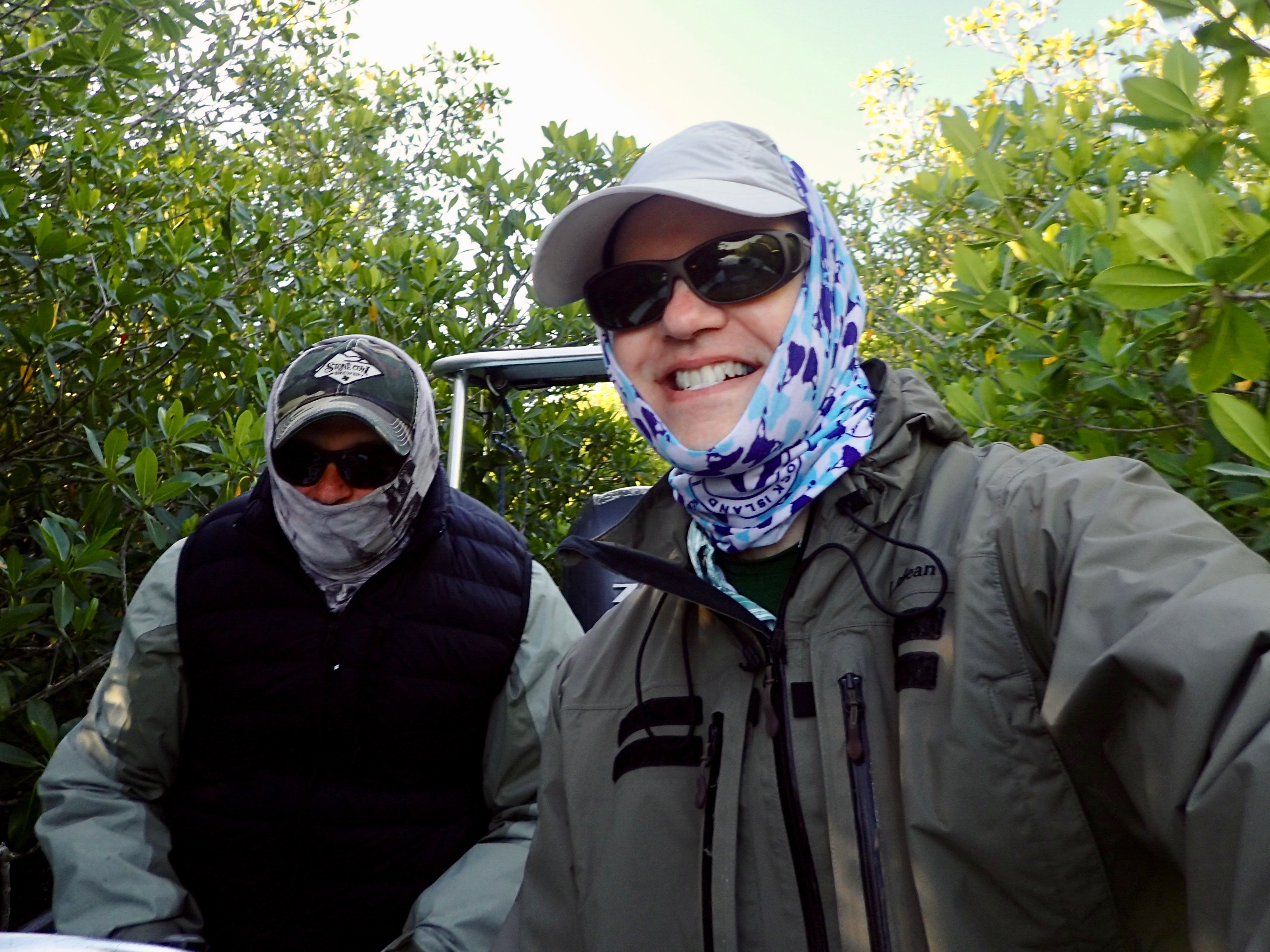
My guide, Capt. Mark Giacobba, and me burrowing our way through a mangrove-choked creek deep within the Everglades. Mark is an exceptional guide, and I’ll be writing more about him in detail. If it looks like we’re dressed for steelhead, not quite — but we did have chilly starts to our days.
As you may know, I am currently occupied with getting ready for my oldest son’s wedding. In lieu of new material, I’m recycling some of my favorite posts from years past. Let’s continue on the steelhead kick (man, I really want to tie into some fresh chrome!). Six years after its publish date, Soft Hackles for Winter Steelhead remains relevant; I still use these flies, and whether swung or dead drifted along the bottom, they still catch fish.
Ever notice how 36-degree water doesn’t feel as cold when you’re releasing a steelhead?
November means steelhead. At least it does for me. This year, though, the steelhead adventures will have to wait a few weeks. In the meantime, here’s an oldie but goodie from the archives: Ten Things Every Beginning Steelheader Should Know. Even if you’re an experienced steelheader, you might find a useful nugget within. Enjoy the read — and enjoy the ride.
A man, a steelhead, and a cigar. Gotta love November!
Where did the week go? I wish I could tell you that I was out pounding the rivers and shoreline, but sadly I haven’t wet a line since last week’s Housy TMA run. That section of river is currently under 3,000cfs of water, while the Permanent TMA in the Farmington is taking a luxurious bath at 1,400cfs. (Sigh.) Small streams or salt, anyone?
Unfortunately, I cannot partake. Even finding the time to write about fishing has been challenging. This is mostly due to a good thing — my eldest son is getting married next month, and I’m busy with prep work and other hosting duties. Normally, I try to get in 2-4 posts of original content every week, and that just hasn’t been possible. So, I ask for your patience. In the meantime, I may go through the archives and look for a few golden nuggets to re-post, as I’m only going to be getting busier. I appreciate your readership, and your comments and questions.
In the meantime, here are two things to keep you busy. Where We Are With Striped Bass And Amendment 7 was written by John McMurray, a member of the ASMFC (don’t let that fool you — John’s one of the good guys). It’s a good summation from someone who was there.
Hard Lined is a short (15 minutes and change) film about stripers and their current plight. I haven’t seen it yet, but like you, I’m going to watch it this weekend.
Oh, to be able to find the time to sit on a mossy bank and reflect on this wonder called nature.
Happy Monday, fellow currentseamsers. I hope everyone had a good weekend. My highlight was going 9-3 against the spread; in this crazy NFL season, I’ll take that and run. I was going to go fishing today, but decided that I had too many other pressing things to get done. Absent urgent matters, I think this is important to share: If you’re ever ambivalent about going fishing — you know, that “I feel like going fishing but I’m lazy/not sure I want to” kind of energy — make your factory default setting “Go Fishing.” You’ll be glad you did.
I see we are dangerously close to 900 email followers, and you know what that means: a fly giveaway celebration to follow! But first, we need to get there. If just ten of you got a friend to follow currentseams, we’d be having call for entries…very soon. Just sayin’!
Here’s a review from our good friend Charles Witek on last week’s ASMFC striped bass meeting. As far next action steps for concerned anglers, we are in a holding pattern.
No details yet on my appearances/classes at the 2022 Fly Fishing Shows in Marlborough and Edison, but I will of course post those here when I get them. I’m hoping to see many of you there.
And as if we didn’t have enough water in local rivers and streams, there’s a ton more rain on the way. Wait until next drought when we’re parched and praying for rain. Is it too much to ask for a happy medium?
The trip didn’t start out like I’d hoped. While I was gearing up, I discovered that I’d forgotten my wading staff. (With flows over 1,300cfs, that would have come in handy.) Then, I realized I’d forgotten my streamer reel and line. Since I was dedicating the session to the streamer cause, I lined up with something I had remembered: my integrated full sinker. It was a classic case of, “somehow, it all works out,” because there were so many leaves in the water. By using a full sink and a tungsten-head streamer, I was generally able to avoid vegetation hits.
First cast with a Mickey Finn soft-hackle, and whack! I hadn’t even begun my strip cadence. It was a quartering cast downstream, and as I fumbled for the line, the streamer sank and began to move down and across. That’s when the hit came. It was a lovely holdover brown, about a foot long, and I thought this was going to be the start of a day where you land a pile of fish just by showing up. ‘Twas not to be. I didn’t see another angler hook a fish over two hours, and there were plenty of people out and about on this fine fall day.
The night before, I tied up two old Housy favorites, the soft-hackled Mickey Finn and Black Ghost. This is an old, crappy photograph, but essentialy the flies have a template of marabou tail, then a contrasting marabou hackle and some black Ice Dub for a collar. There’s flash, too; sometimes I use Krystal Flash and sometimes Flashabou. I’ll try to put together a complete recipe and shoot some better photos of the steamers.
A few minutes later, I stuck what I thought was going to be my biggest trout of the year. I’d felt a solid bump on the cast before; I repeated the cast, and the fish did not miss the second time. It sounded and bulldogged and I realized I might have hooked into a trophy brown. When I finally got its head up, surprise! Smallmouth. A good one, too, mid teens and fat, with dramatic fall camo colors. That’s the latest in the season I’ve ever caught a decent smallie on the Hous.
I visited a second mark and managed a courtesy tap, but with the clock ticking I moved to the last spot. This section was moving faster than the previous two pools, and with a well-defined slot I made the decision to switch to the long-leader jigged mini-streamer. Slow going, but I was rewarded with a fat stocker rainbow on my last cast. And that, I thought, is the perfect way to bookend a two-hour streamer set.
In case you missed it, the Maryland DNR just released their 2021 striped bass survey, and the news ain’t good. It’s actually pretty dire, as this chart shows.
You have to go all the way back to the disaster years of 1979-80-81 to find a worse three-year period on this chart.
In an article published by Chesapeake Bay Magazine, the DNR’s view of the recruitment situation is alternately described as “optimistic” and “concerned.” Huh? Which is it? Better still, why isn’t it “alarmed to the point of hyperventilation”? This is merely further evidence that some of the people in charge of striped bass conservation are at best fools, and and at worst, grotesquely incompetent.
Speaking of incompetent, the ASMFC Striped Bass Management Board is preparing to meet to discuss Amendment 7. Public comments will be needed in the next couple months, so stay tuned here for further information. We’ve got to keep hammering away, folks. The gods may not be able contend against stupidity, but perhaps a well-organized, highly motivated striped bass fan base can.