Of small streams, stripers, and stockers

I’m getting my money’s worth from the jolly old yo-ho-ho State of Connecticut this week. Monday I went small streaming. Tuesday was our semi-annual grandfather-father-son Salmon River outing followed by a little late night striper (non) action. Here’s how it went down.

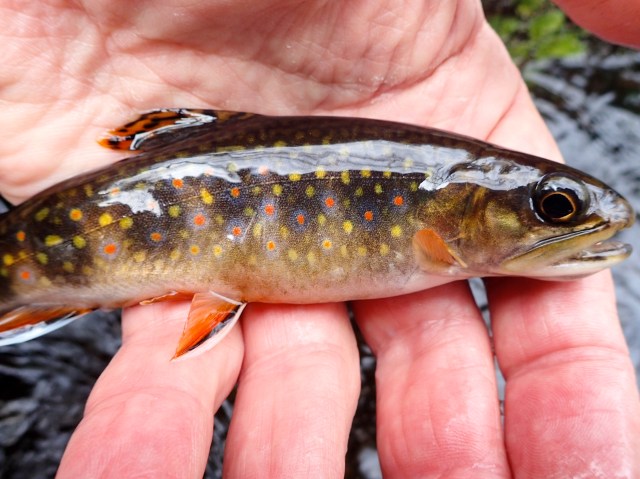
Monday’s flow in the brook was medium-high, perfect for this time of year. I didn’t get a water temp, but it was enough to make the locals highly active. I saw charcoal gray stoneflies (size 16, and a few size 12), caddis (16), and Quill Something-or-Other spinners (10-12). No char were observed feeding on the surface, but they drilled the dry (size 16 Improved Sofa Pillow) as well as the nymph (Frenchie variant size 18) and the micro-streamer (ICU Sculpin size 14). This parr-marked beauty took the dry.
OLYMPUS DIGITAL CAMERA

~

You can’t see the kype on this buck, but at 7-8 inches he surely is an old fish on this stream. He swung and missed at the dry, then crushed the dropper. I took two fish in the last pool I fished on the ICU Sculpin. The fly had barely slipped beneath the surface before each fish struck.

OLYMPUS DIGITAL CAMERA

~

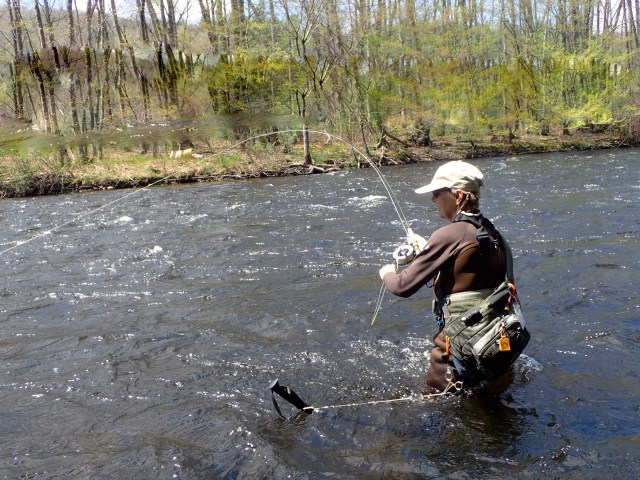
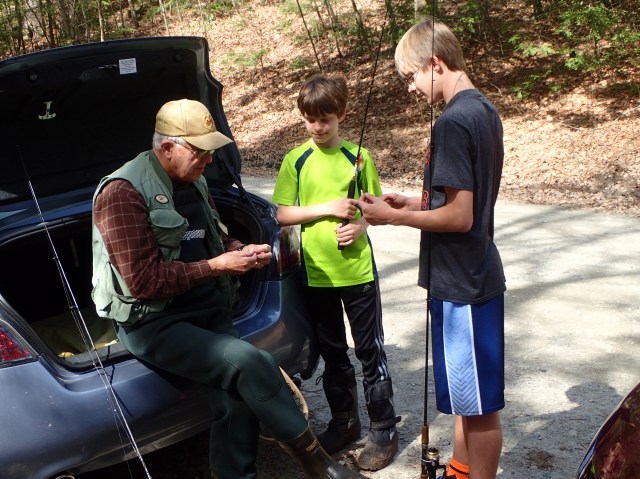
Tuesday was one of the ten best weather days of the year: 75 degree air filled with blazing, brilliant sunshine. The Salmon was running clear and at a perfect height, and there were a lot of other anglers out taking advantage of the conditions. Here, the man who taught me how to fish reminds my sons that knots are not worthy of their trust.
OLYMPUS DIGITAL CAMERA

~

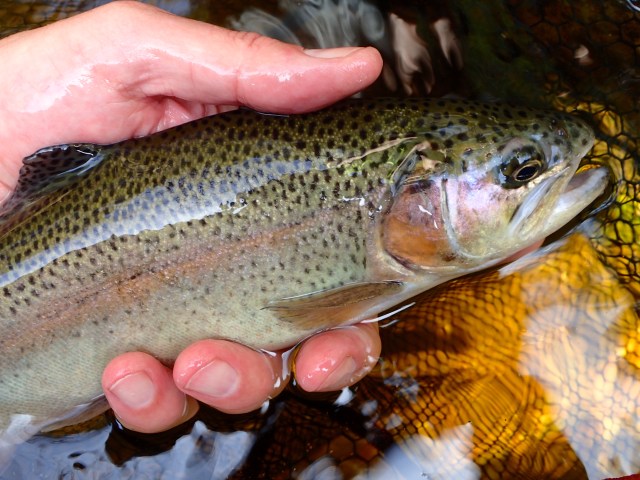
Gordo was fishing a Hi-Liter streamer with a couple BB shot on the leader when I saw his rod tip dip. I asked him if it was a rock or a fish. “Fish, I think,” he said. I told him that it’s a fish until proven otherwise. Next cast, bang! Hello, Mr. Recently Stocked Rainbow.
OLYMPUS DIGITAL CAMERA

~

I think if I were going teach a weekend-long class in nymphing, I might start by having everyone bounce worms along the bottom. I hadn’t caught a trout on a worm in decades, but I got back to my roots when my dad took a break and handed off his rod to me. Here’s my prize sulking on the bottom after release.

OLYMPUS DIGITAL CAMERA

~

All things must pass, including good fishing. So I finished off my piscatorial binge last night with a proper striper skunking. Lines were greased and flatwings were swung, but commotion near the ocean ’twas not to be. It must’ve been around this wee hour or so when I climbed into bed. Tired and happy is a most excellent way to fall asleep.
IMG_1858

Fly Tying Video: Frenchie Nymph Variant

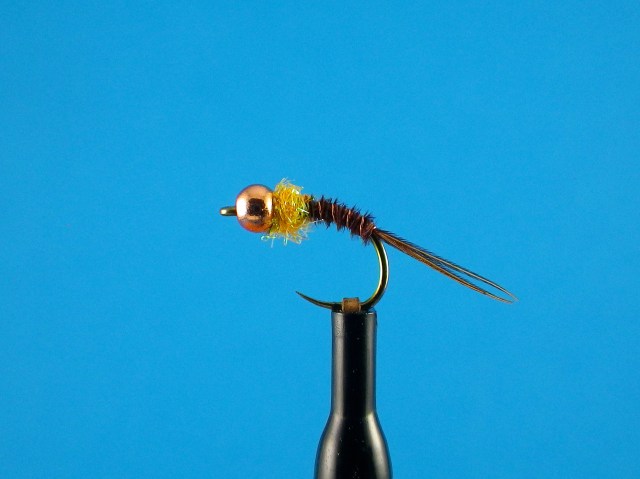
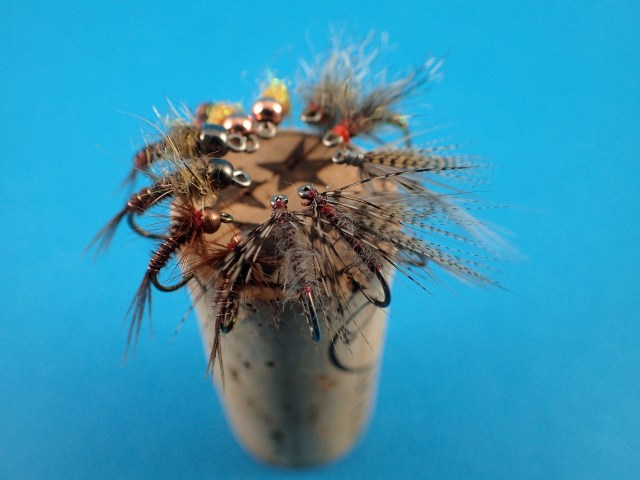
Totally different but the same. Howzat? Curved shank instead of straight. Copper instead of gold. Brass instead of tungsten. Pheasant tail tail and no red thread collar. I like this bug as the bottom fly on my drop-shot nymph rig. What do you know? The trout like it there, too.

~
FrenchieOrange
~
Hook: TMC2499SP-BL size 10-18
Bead: Copper (brass)
Thread: UNI 6/0 red
Tail/Abdomen: Pheasant tail fibers
Rib: Small copper wire
Thorax: Orange Ice Dub
~

Frenchie Variant Rogues’ Gallery:

Farmington River wild brown, 12/28/16:

OLYMPUS DIGITAL CAMERA

~

Farmington River wild brown 3/20/17:

DCIM100GOPROG0013788.

~

20+” Farmington River Survivor Strain, April 2020:

DCIM100GOPROG0013613.


500 Followers Contest Winners

Drew landed as first seed. He passed on the North Country Spiders and will get a selection of early season Farmington River bugs.

Old pro Pete Simoni took the second slot and snapped up those NoCo Spiders like hot cakes. Smart man.

Greg Tarris, where are you? I sent an email to the address I have on file but have not heard back from you. You are the third lucky winner!

Thanks to everyone who entered. Thanks for your readership. And thanks for your loyalty. It’s much appreciated. And now, on to 600.

Second place swag. Picture any of them seated perfectly in the corner of a trout’s mouth.

OLYMPUS DIGITAL CAMERA


FCF&GPA Awarded the Legion of Hot Dog Merit

Many thanks to the Fairfield County Fish & Game Protective Association for hosting me last night. One of the larger crowds I’ve presented to, and their clubhouse is a great venue. FCF&GPA understands that a fed presenter is a happy presenter, and since I thoroughly enjoyed my monster dog and chili, I hereby award them the currentseams Legion of Hot Dog Merit.

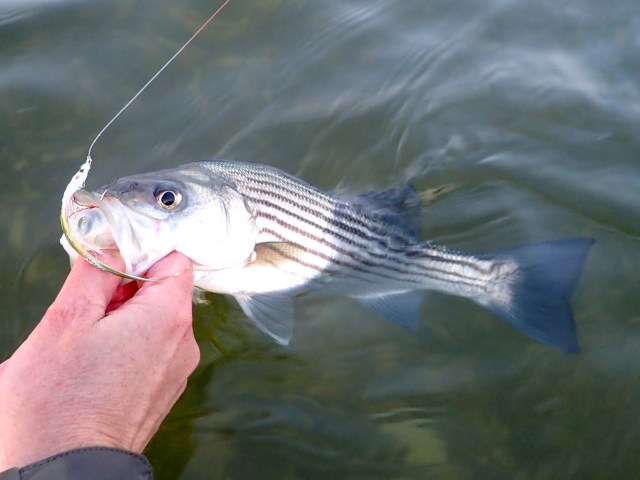
Much later, I went striper fishing. It’s a new spot I reconnoitered last year, and it looked fishy as hell in the daylight. It was a little creepy in the rain and the dark, and there wasn’t much sign of any activity, bait or predator. But I was standing in water throwing a Rock Island flatwing and fishing it on the greased line swing, and life was good. It got even better when I landed my first striper of the year, all 34 inches of her. Nothing like starting the season off with a bang — or in this case, a massive thud.

Gadzooks! The contest! I’m going to try to announce the winners in the next 24 hours.

The Rock Island flatwing continues to produce big bass. It’s become one of my confidence  patterns for stripers.

OLYMPUS DIGITAL CAMERA


Contest closed. April is wide open.

Thanks to everyone who entered the 500 followers contest. The winners will be chosen at random in a few days. I hope the new group of followers who signed up will stick around — currentseams is more about content than contests.

To April. This weather system may suck for outdoor activities, but it’s a blessing for our poor drought-wracked state and fisheries. Water in the reservoirs and woods is a very, very good thing. As the water temps rise and more sunlight penetrates the depths, stripers will be on the move. It’s an embarrassment of riches for the Connecticut angler, and there never seems to be enough time to balance Hendricksons and herring runs. (Not to mention a shot up to the Ontario tribs for drop-back steelhead.)

I’m appearing at the Fairfield County Fish & Game Protective Association on Monday, but that’s a members only meeting. Next public event is “The Little Things,” Thursday, May 4, Housatonic Fly Fishermen’s Association, Wallingford, CT. St. Paul’s Episcopal Church, 65 North Main St, 7pm. For more information, visit the HFFA Facebook page.

See you on the river.

April showers, yada, yada, yada. Spring will come. Really.

OLYMPUS DIGITAL CAMERA


Five Hundred Faithful Followers. Let’s celebrate!

TGIF, fellow Currentseamsers. And thank you for being part of the Faithful Five Hundred! To celebrate, we’re doing our customary flies-tied-by-Steve giveaway. Here are the contest rules:

1) No purchase necessary.

2) You must be a follower of currentseams to enter. (If you’re not one already, you become a follower by clicking on the “Stay current with currentseams” button on the home page.)

3) To enter, leave a comment on this thread saying you wish to enter AND share with us the name of a favorite fly pattern. One entry per person. Deadline for entering is 11:59pm March 31, 2017 (no foolin’). Three winners will be chosen at random. The winners will be notified in the comments section of this thread or by email, and will be responsible for sending me their address so I can ship the flies out. Sorry, I can only ship to U.S. addresses.

4) All decisions by me are final.

Thanks again for reading and following currentseams.

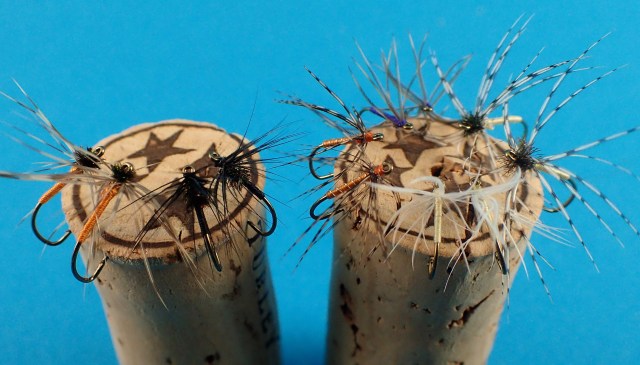
A dozen classic North Country spiders — and they could be yours. One lucky winner will get to swim these in a river this spring. They’re tied on light wire hooks with Pearsall’s Gossamer silks. Left cork: Winter Brown, Black Magic. Right cork, clockwise from 3 o’clock: Orange Partridge, Snipe and Purple, Grey Partridge, Poult Bloa.

OLYMPUS DIGITAL CAMERA


Variations on a Dark Hendrickson theme

Some subsurface bugs for next month. The four with the wood duck wing are classic Dark Hendrickson wets. Clockwise, we have pairs of tungsten beadheads on a scud hook with the traditional tail, hackle, and body; black bead with Delaware River Club Spectrumized Hendrickson dubbing and a brown partridge hackle; and black bead with the traditional muskrat body and brown partridge hackle. I’ll fish the winged wets as the middle dropper and the beadheads on point. I can almost feel the frantic tugging right now.

OLYMPUS DIGITAL CAMERA

Farmington River Report 3/21/17: Trout on the move

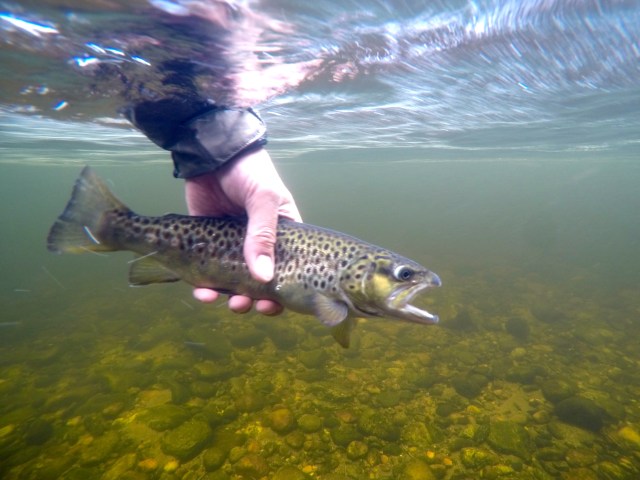
The fish didn’t feel that big, so I was surprised when I saw that it was a mid-teens brown. Almost immediately, its lackluster fight, dull colors, and ragged, undersized fins registered: this was a recently stocked fish that had already travelled several miles up or downriver. You see, I was standing in the middle of the permanent TMA, an area that hasn’t yet been visited by the DEEP tanker truck.

I fished two spots. I shared the first with another angler (thank you, kind sir!); he was Euro nymphing, and I went with a mix of tight line and indicator presentations with my trusty drop-shot rig. Despite the sexy water and a decent midge hatch, we both blanked. Off to spot two, where I hooked Mr. Recent Ward Of The State followed by two long-time residents. All fish came on the bottom dropper, a size 14 Frenchie variant.

The takes of the two wild fish were odd. The indicator made a little nudge, immediately followed by a dip. It was as if the nudge was the actual take, and the dip the trout retreating with the prize. I’m constantly trying to refine my technique: playing around with indicator positioning, drift speed, trying to figure what’s bottom and what’s not, ditching the indicator and seeing which takes I can feel and which I can merely see. Every day is different; once I knew what to look for with the indicator, I was ready for that little nudge, and on that second trout I was in the process of setting the hook after the nudge when the yarn went under.

The TMA was packed for a Tuesday in March. Most of the anglers I spoke to said the action was fair to slow. Water was 233cfs and 37 degrees. Runoff may have impacted the bite. Many road entrances and dirt pulloffs (like Greenwoods and Woodshop) were still inaccessible.

That’s more like it. An equinox wild brown with an impressive power train. Note the deep gold coloring from the underside of the mouth to the gill plate.

DCIM100GOPROG0013788.

Tying video: Snipe and Purple North Country Spider

The Snipe and Purple (sometimes called the Dark Snipe) is a classic North Country spider. North Country spiders aren’t particularly hard to tie, but there are some techniques you can use to help create the classic umbrella shape of the hackle fibers and keep the body neat and trim. This Snipe and Purple is often referred to as a good match for the Iron Blue Dun. The Iron Blue is frequently mentioned in older texts, from numerous Yorkshire anglers to Pennsylvania’s  James Leisenring,  but you hardly ever hear about it today. I like the Snipe and Purple for small, dark stoneflies and especially midges. I also tie this fly on a 1x short, 2x stout hook, add a gold rib, and fish it for steelhead.

Currentseams Q&A: Of droppers, drop-shot, and indicators

Currentseams reader Steve M. asked this question on the Farmy Report post below. I thought the answer deserved its own thread. Thanks for asking, Steve.

Q: How about a refresher on your dropper nymphing method? Specifically how you use/position the indicator? 

First, some semantics. Dropper nymphing setups and indicator nymphing are two different things. You can nymph with droppers and not use an indicator. Or do you mean drop-shot? Same deal: you can fish a drop shot rig without an indicator. “Droppers” refers to flies that are attached to the rig by tags of leader material. “Drop shot” is a method that uses split shot suspended by a tag below the bottom fly. A drop-shot rig can have droppers or just one fly. Hope that clarifies rather than confuses!

How I use and how I position the indicator are also different things. Generally, I use an indicator when:
I want to cover water/get longer drifts;
It’s cold and the takes might be subtle;
I want to fish the bottom in deeper holes;
I don’t want to feel like my arm is going to fall off after keeping it raised above my shoulder for hours.

I use my own yarn indicators, dense, bushy creations, and I’m fairly dialed in to their nuances. The indicator need not go under for me to want to set the hook. (Look for a reason to set the hook on every drift and you’ll catch more fish.)

The general rule of thumb is to set the indicator at 1.5 times the estimated water depth away from the bottom fly or shot. I’m not sure I follow that so much as I estimate the greatest depth I’ll be fishing and place the indicator on the leader where I reckon the drop shot will be ticking the bottom. It’s more feeling than formula. Specifically, I want to find this equilibrium: the shortest distance between the shot and the indicator, and enough distance to make a natural drift along the bottom. I want to see that indicator bouncing along. If you’re not catching fish and you’re not seeing those bottom return tells, you’re not fishing deep enough. Adjust your indicator (which you can now refer to as a depth regulator) accordingly.

I often check my indicator. “Checking” means that if I feel the indicator is leading or dragging the nymphs downstream at an unnatural pace, I’ll mend the indicator upstream, literally lifting it off the water and placing it where I want it. Remember that current at the surface moves faster than current at the bottom.

Finally, a word about weight. I like to use as little shot as possible. But sometimes you’ve got to go heavier. In winter, the water’s cold, and things slow down, trout included. I’ve been using two BB shot on my drop shot rig this winter — not because the water’s deep or fast, but because that extra weight slows the drift to a pace where a trout has to move less for the fly.

Hope that helps.

Steve’s secret weapon: home brew indicators made from acrylic macrame yarn and a #36 o-ring. I build them dense, and treat them with Gink or Loon Fly Spritz 2 before each use. This is a color I can see easily, and this indicator is about as big as I’d ever use on the Farmington. I know, you want a video tutorial on construction. The answer is yes — I just need to figure out the when.

OLYMPUS DIGITAL CAMERA