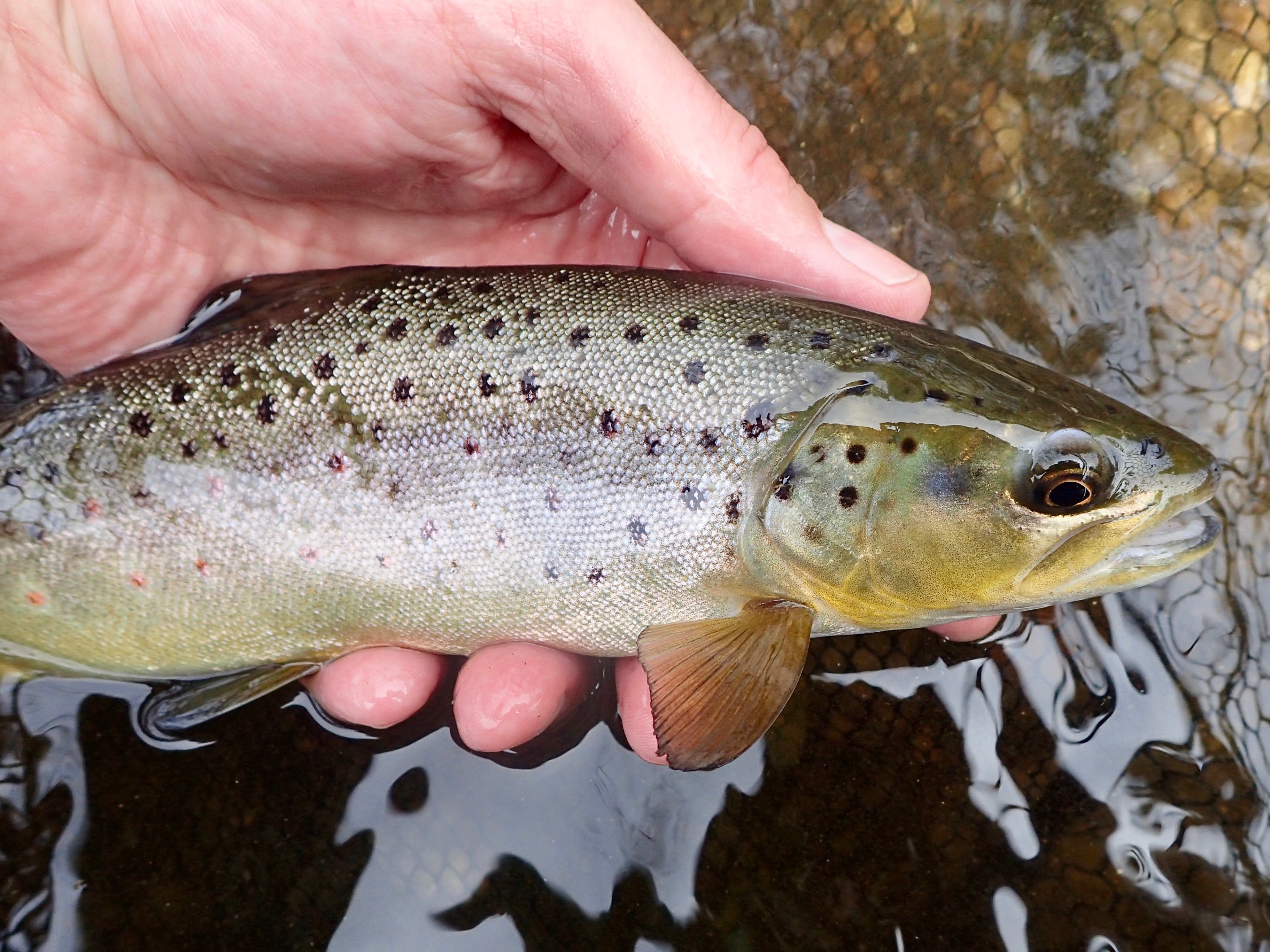
Farmington River Report 6/2/21: Hard wet fly times

I guided Larry yesterday and we fished from 2pm-6pm within the Permanent TMA. The river was a very manageable 500cfs, with good water clarity. Angler traffic was light, so we had our pick of pools. Unfortunately, hatch activity — and especially feeding activity near the surface — was also light, and we struggled to find fish that were willing to jump on. We fished three different marks and managed only one hookup. So I had to give Larry the speech that I hate to give. It goes something like this: “You’re not doing anything wrong. Those are fish-worthy drifts. If you do these same things on another day, you will be a wet-fly fishing catching machine.” Kudos to Larry for sticking with it and maintaining a positive attitude! I’m looking forward to getting that email from him where he tells me he hit it right and it all came together. It’s going to happen.

After our session, I ventured upriver to inspect the evening rise. It was a slow wet fly experience there as well (that should make you feel better, Larry!) as I could only manage one trout from 6:30-7:30pm. Hatch activity was solid, with midges, small caddis, and sulphurs, but again the surface activity was not where I would have liked it to be. I switched to dry flies at 7:30 and fooled fish on a mix of Magic Flies, Usuals, and Light Cahill Catskills dries. My two best fish came very late in the game during the spinner fall, both on the Light Cahill, both chunky mid-teens wild browns. A fine finish to a challenging day.

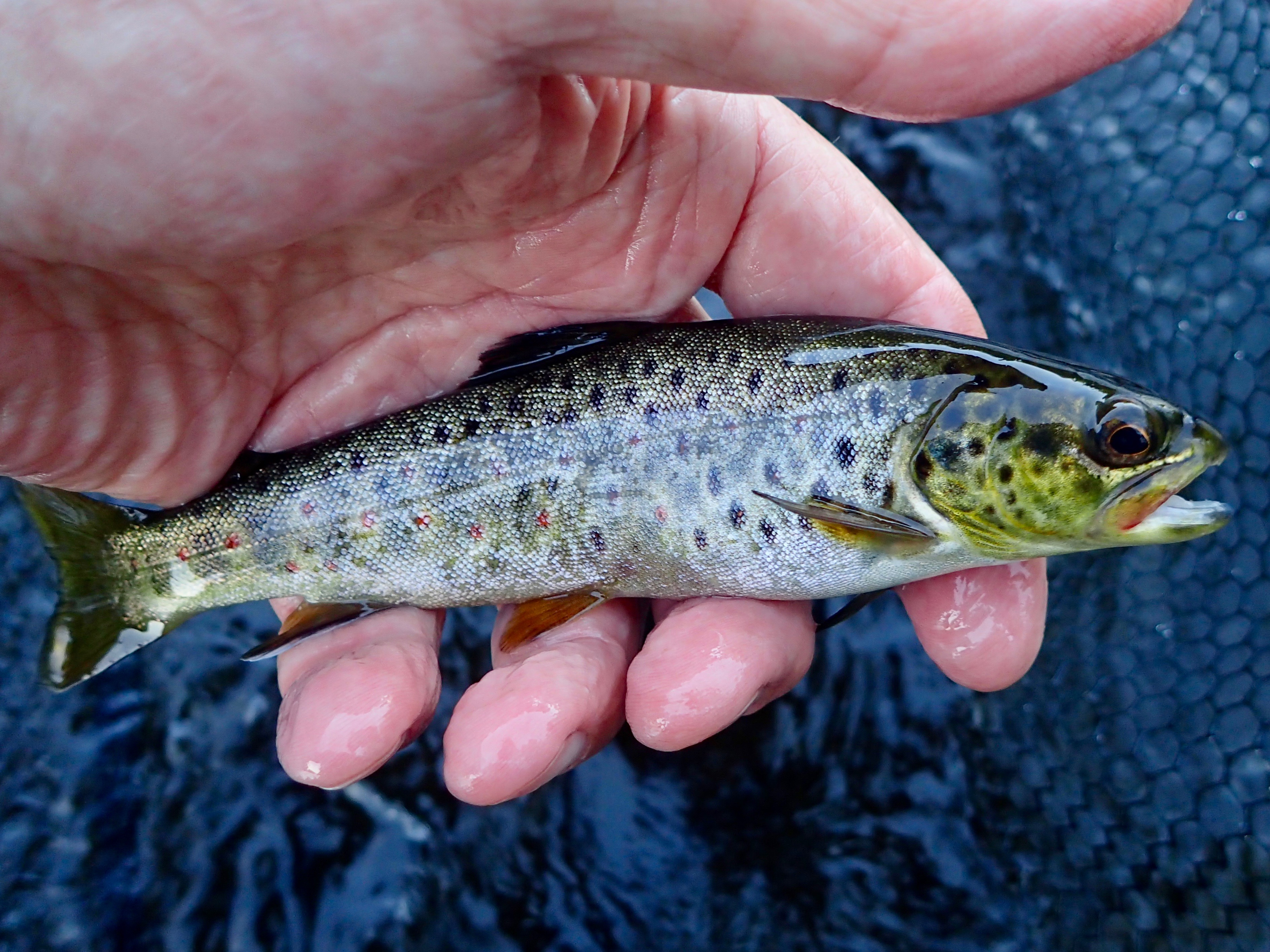
There comes a point in the battle where I wonder, “Is this one of those fat stocked rainbows, or a big wild brown?” No disrespect to the rainbows, but I am highly pleased when the answer is the second choice. Here’s the last fish of the evening. I saw him sipping spinners in some frog water along the opposite shore. Both of these last two browns were hefty, spirited, and refused to come quietly to net. You know you’ve got a decent fish when it sounds and heads for the deepest part of the run. See you soon, fellas.

Farmington River Report 5/27/21: Mother Nature hits the reset button

On the heels of Tuesday night’s red-hot wet fly action, I returned to the scene of the crime. We’d had a little rain Wednesday night, so the flow was up 100cfs to 550cfs, which is still a very average flow for the lower Farmington this time of year. I fished from 6:30pm-8:30pm. Despite a warm, sunny day, neither the caddis nor the Light Cahills came off in any numbers. Rather than being surrounded by trout eagerly taking emergers, I experienced a boil here, a boil there, but nothing steady and rhythmic. Whereas all I had to do on Tuesday night was drift my team over a fishy area or target an active riser, on Thursday I had to work hard just to reach a half dozen trout. Not that I mind that. It’s just fascinating to me how unknown factors can have such a dramatic impact on the day-to-day fishing. I also went for my first swim of the season. It’s not an awful time to experience the sensation of water spilling down your waders and soaking into your drawers, but it’s still mighty unpleasant. As I write this today, the lower Farmington has topped 1600 and is no doubt the color of chocolate milk. More rain is on the way. Reset. Pause. Then we’ll start again.

I took a mix of stocked rainbows and wild browns. My first fish came in some pocket water along the bank. Squirrel and Ginger was the winning fly. Parr marks, halos, a never-say-die fighting ethos — man, I love these wild jewels!

Farmington River Report 5/24/21: finding fish with wet flies

I guided Eric yesterday and we had a mix of sun and clouds and moderate, cold flows (380cfs in the Permanent TMA and 445cfs on the lower River). We fished two marks with mixed success. At the first, there was very little hatch activity and we observed no fish rising. One bump was the best we could do, so we decided to seek our pleasure elsewhere.

And that’s one of the best pieces of advice I can give you if you want, like Eric, to learn how to fish wet flies: if one spot isn’t producing, find one that is. And, once you get there, work the water. Cover as much of it as you can. Determine where you think the trout will be holding and feeding. We fished a three fly team of a Squirrel and Ginger on point, a dark soft-hackle of Eric’s creation in the middle, and a BHSHPT on point. All of our action came on the point fly. Eric did a great job of navigating some not-that-easy-to-wade water (sometimes it pays to get into those more difficult areas). While the second mark was not as productive as I’d hoped — the caddis hatch was disappointing, and there were no regular, active feeders — Eric managed to stick four nice trout.

The answer to the question, “Why is this man smiling?” can be seen in the foreground. Great job, Eric! You’re on your way.

Farmington River Report 5/4/21: North, Miss Teschmacher

I guided Andrew and Brett yesterday and they wanted to focus on wet flies. Monday’s rain was more than I expected, and I didn’t like the height or the color of the Permanent TMA. So we headed north to the friendly confines of WBATSR (West Branch Above The Still River. I just made that up.) This was a good call as the water was running a crystal clear and very wadeable 200cfs. I really liked that height, and I thought there were dozens, if not hundreds of pockets and seams and slots and riffles that would hold trout. Sadly, the trout didn’t get the memo, and we had a very slow day. (We didn’t see any angler other than our group hook and land a fish.) It was the kind of day where I find the next great piece of water, and think to myself, “this is going to be it,” and then nothing happens. These episodes make me throw up my hands and say, “I quit.” Of course, I don’t really mean it, and of course we don’t quit, but I get frustrated just like everyone else.

Andrew had fished with me before, and on that day we had far more active fish than today. Brett is a relative newcomer to fly fishing, and once we smoothed out a few wrinkles he was swinging like a pro. I alternated between both anglers, and we worked downstream, covering several hundred yards of water. Bug activity was very light, with two confirmed Hendricksons and a handful of BWOs, but that was it. As you can imagine, angler traffic was heavy, especially with that section of river the only clear water game in town. With today’s rain and increased flows, I would guess that streamers and nymphing will be, by far, the most productive methods for a few days.

Andrew doing battle with a chunky rainbow. He scored two trout, both on the bead head soft hackle I had tied on in the point position. In my experience, wet fly can be challenging in high flows, so I’d wait for the water to get down to 500 or less before swinging. Great job, Brett and Andrew, for persevering though some tough fishing conditions!

Farmington River Report 4/9/21: Nature (quickly) finds a way

Just a quick two-hour session on the lower River last Friday. The sun was shining, the air was warm, the water was low and crystal clear, and there was a strong caddis (size 16-18) hatch. I fished three marks and found acton in only one. I purposely stayed away from areas that I knew had been stocked as I wanted to try to find the Salmo that had made it through the winter. I tried several techniques, each to match the conditions and marks I was fishing: tight/long line micro jig streamer, tight line drop shot nymphing, and then indicator nymphing.

Funny thing! I had just landed my first fish, a tiger of a wild brown, when lo and behold, Ye Olde Stocking Truck showed up. What I found fascinating — and I’ve witnessed this before — was that within minutes, the fresh fish were porpoising and snapping at caddis emergers in a back eddy. It doesn’t take long for them to discover where their next meal is coming from. It’s genetic programming at its finest.

Love these holdover/wild fish. They just refuse to come to net without a furious argument. This guy fought way above his weight class.

Farmington River Report 2/18/21: Icy cold (and not just the streamer bite)

I fish the way I want to fish, and sometimes that means I go fishless. I’m OK with that. When it lines up, I may be doing battle with multiple high-teens browns. When it’s a day like yesterday, I get the not-a-touch trudge through the snow back to my car, wondering if my feet will ever be warm again.

Not that I’m complaining. I had a blast. Due to the inclement weather, angler activity was almost at its Farmington River-winter-ten-years-ago level. You still can’t access the majority of dirt pull-offs (they’re currently snowplow pile pull-offs) so you’re stuck with the major parking areas. That didn’t prevent me from going for a walk to find solitude. I fished three marks within the Permanent TMA (no slush, 370cfs). I started off tight-lining jig mini-streamers, but that was a problem with the 24-degree air temp; frozen beads of river clinging to the exposed leader. So I switched locations and did the traditional full-sink line. I did catch a lot of the bottom. Sadly, it never fought back.

Then, I decided to experiment. What would happen if I fished the mini-jig under an indicator? I could bounce it along the bottom, or suspend it near the bottom. I had one of my bigger home-brew yarn indicators with me, so I re-rigged and had at it. I tried it in different kinds of water, from fast-moving glides to languid dry-fly pools. In the faster water, I had to constantly check the indicator upstream and mend to prevent the fly from moving too quickly, but the rig proved to be the answer to the iced-up leader problem. Just because I didn’t connect doesn’t mean it won’t work on another day. More research to come…and I encourage you to try new things when you’re on the river.

Farmington River Report 1/8/21: Fun with long-leader jigged streamers

Every once in a while I need a new project. Since I’ve been on a streamer kick, this seemed like a capital idea: try fishing small jig streamers on a long leader. This video featuring Lance Egan had piqued my interest. The point is not to cover vast stretches of river, but rather to work in close and target likely holding areas, tempting trout with a protein payoff. I’d fished in a similar manner for smallmouth on the Hous, bouncing dumbbell eyed streamers or larger jig streamers (like Barr’s Meat Whistle) along the bottom, but I wanted to try the longer leader thing with a smaller bug.

I reached out to fly fisher extraordinaire Devin Olsen for a quick leader formula. He suggested a basic construct like the one in his book Tactical Fly Fishing: 12 feet of 15# or 20# Maxima, 3 feet of 12# Amnesia, 18″ of 0.012 sighter material, tippet ring, then 6′-10′ of 4x or 5x tippet. I kept fly selection simple with this basic black and silver jig streamer, tied on a size 8 hook. Total length is about 2″.

So I hit the water. The winter crowds continue to astonish. I saw more anglers out yesterday than I do during an entire previous typical winter. I stayed within the Permanent TMA, with was running cold and clear at 450cfs. I shared the first mark with four other anglers; I blanked, and the only trout I saw taken came on bait.

I scored a lovely mid-teens wild brown in Spot B. This fish hammered the fly on the drop. This is a video still so the shot really doesn’t do the fish justice. I thought I had a trophy brown in Spot C, but two-thirds through the fight I could tell that something wasn’t quite right. My suspicions were confirmed when I netted a large sucker, foul-hooked in a pectoral fin.

The last two marks I hit were also blanks, but I counted the day as an unequivocal success. I’ll be working on this technique some more this winter, and will also be using it at times for smallmouth. It’s certainly best for in-close work, not only in terms of presentation, but casting as well. (The rig is an absolute bitch to cast; you’re not so much casting as you are lifting, loading, and lobbing.)

Farmington River Mini-Report 12/4/20: What streamer bite?

It’s been a tough streamer bite my last two outings — another blank, with only two bumps today compared to half dozen on Wednesday. The river is in fine shape, 500cfs and clear, just in time for tomorrow’s deluge. I hit four marks today, all within the Permanent TMA, and had a bump in each of the first two, but neither felt like a good fish. I played around with size, color, and presentation, but whatever I was throwing, and how I was throwing it, the trout just weren’t that interested. So goes the battle. Just a note that if you’re going to fish the Boneyard, there is an active shotgun season, so be safe and wear some blaze orange.

I lost a Barr’s Meat Whistle to the bottom gods in a very deep pool of the Farmington. Even though it’s tied on a jig hook, this happened when my full sink line got tangled around an obstacle.

Farmington River Report 12/2/20: The high water streamer tease

One question I get a lot is, “How do you determine how you’re going to fish the Farmington?” The answers can be complicated, but sometimes it’s simply dictated by conditions and, especially yesterday, what I feel like doing.

First, conditions. We had a high water event Monday night, the river spiked, and now it was coming down. 875cfs in the Permanent TMA is not for novice or foolish waders, especially in very late fall. That water is moving and it’s cold. You need studded boots and a wading staff, and especially you need to stick to wading slower, shallower stretches (that’s often where you’ll find the fish).

I liked yesterday’s overcast, and we even had a few snow showers to boot. Or is that to glove?

Next, method. I felt like swinging streamers. I fish for my own pleasure, and even though winter streamers on the Farmy can be dicey — the trout are either biting or they’re not — when it’s on, it’s good. And fun. I was using an integrated full-sink tip line with a short (3 feet) leader and a mix of weighted and neutrally buoyant streamers. I also played a bit with different colors.

So, how was the fishing? It started off great, with a bump on my first cast. I made the same cast and the fish hit it again. But no real grab. Sadly, this was to be the pattern of the two-hour session: lots of bumps, but no real takes. I fished two marks hard, then packed it in around 4:30pm.

Props to a keen student of wet fly fishing

Don took a wet fly lesson with me in July, and while the bugs and trout weren’t very cooperative, we still had enough action to make things interesting. I always tell my students that if they keep on with this wet fly thing, good things will follow. Don has been in touch since then, asking questions, practicing and tying, and most importantly, spending time with a team of three on the water. That’s how you become a better wet fly angler.

In my report from that day, I stated that if Don learned wet flies, he would become a dangerous fish-catching machine. Although conditions have been challenging in the last couple months, Don has kept at it. Last week he scored this gorgeous brown on a Squirrel and Ginger. I think it’s a Survivor Strain broodstock — that looks like a left-eye elastomer and clipped adipose. Way to go, Don!