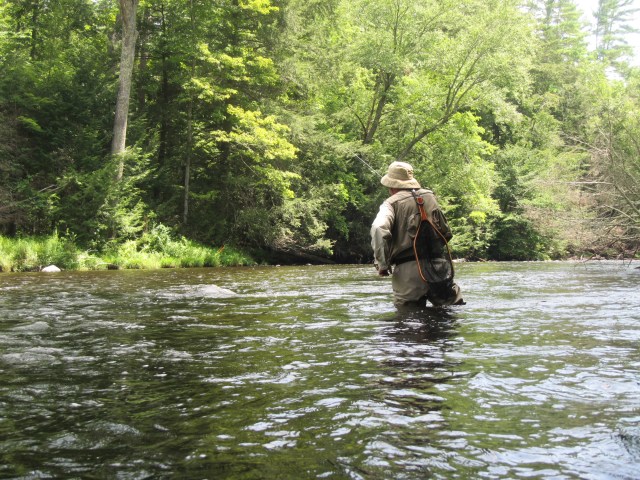
Steelheading: A Tragedy in Several Acts

“Steelheading: A tragedy in several acts” first appeared in the Fall 2015 issue of The Drake. The photo here is different from what accompanied the piece in the magazine, and this is my original text, rated R for some adult language. What if The Bard wasn’t writing about Danish princes, Roman emperors, and star-crossed Italian lovers? Let the curtain rise on…

Steelheading: A Tragedy in Several Acts

If there is another angling endeavor that matches the rapturous highs and soul crushing lows of steelheading, I’ve yet to experience it. One day, you are the Most Exalted Ruler of the Kingdom of Chrome. The next, a lowly knave scraping in fishless dirt. That you willfully participate in this theater suggests that you are either a masochist, an addict, or at the very least, innately damaged. William Shakespeare understood. Even if he never wrote a scene about losing a fifteen-pounder fresh from the lake.

“There is nothing either good or bad, but thinking makes it so.”  Hamlet

It’s a river. Some days it is blown out. Some days it is perilously low. There are steelhead in the river. Some days they eat. Others, they do not. I’ve blanked on perfect days and hooked immodest numbers of fish in water the color of mocha java. The river doesn’t hate you. Nor do the steelhead or the weather. You have no control over any of it. Try to stay positive.

~

“Sit you down, father; rest you.” King Lear

I took my nine year-old steelheading for the first time. In the days leading up to the trip, I hectored him: It’s not like when we go to Day Pond to catch bluegills. It took daddy forty hours of fishing to land his first steelhead. You will hook them, son, and you will lose them. A half-hour into the trip, Cam ties into a twelve-pound chromer and proceeds to land it. On four-pound test. He has zero experience with any fish that size, let alone an alcohol-fueled dragster of a fresh steelhead. On the outside, I’m cheering wildly. On the inside, I’m trying to calculate how many extra hours of yard work that little punk will be doing come spring.

~

“But, soft! what light though yonder window breaks?”  Romeo And Juliet

For a dedicated steelheader, rising with the sun is sheer fantasy. If you’re fishing popular water, you’re up and out long before daybreak. You’re not the only one doing this. For proof, check the alarm clock in your room at the cabin next time you’re there. Bet it’s set for five a.m. – or earlier.

~

“Hell is empty and all the devils are here.”  The Tempest

How agreeable it would be if everyone you met on the river were Roderick Haig-Brown incarnate. Many anglers are indeed pleasant and welcoming. Others, not so much. See if any of these characters sound familiar: The bozo who wades in so tight you could take his eye out with your rod tip. The jamoke who dashes into your spot as you battle a fish downstream, then glares at you for wanting your place back. The douche bag who keeps his line in the water while your fish roars past, oblivious to your screaming reel. The lout who drops drift boat anchor on the exact coordinates you’ve been casting to. Damn them, every last one.

~

“Now is the winter of our discontent.”  King Richard III

If you’ve ever stood in a river in sub-freezing temperatures and swirling lake effect snow for three consecutive days without so much as a single fucking touch, well, you know from whence I speak.

~

“Parting is such sweet sorrow.” Romeo and Juliet

There must be some mischievous spirit tasked with devising cruel and unusual ways of making you lose steelhead. How else to explain a 3x strong hook that snaps at the bend; a leader that tangles on a drift boat’s anchor rope; line that wraps around a reel handle mid-fight; a good Samaritan’s clumsy technique with a landing net? All resulting in lost fish. All in the space of two hours. I’m trying hard not to be bitter. Really, I am.

~

“Things rank and gross in nature.”  Hamlet

You don’t ever get used to the pernicious stench of decaying salmon flesh. Or the realization that the squishy thing spewing unholy pinkish-gray plumes from under your boot is a rotting carcass.

~

“Men at some time are masters of their fates.” Julius Caesar

You’ve been at this spot since before sunrise. You were rewarded with the prime lie, but there was no first-light bite, and now it’s close to nine a.m. Do you wait for steelhead to arrive? Or do you roll the dice and head elsewhere? Assuming the bite is on, how do you know if there will even be room to fish? Whatever you decide, know this: there is a strong probability that you will be wrong.

~

“The deep of night has crept upon our talk, And nature must obey necessity.” Julius Caesar

I relish the bonhomie of the evening scotch-and-bull session as much as anyone. But I’m wiped out, guys, and I want to be fresh for tomorrow’s ass kicking. Good night.

~

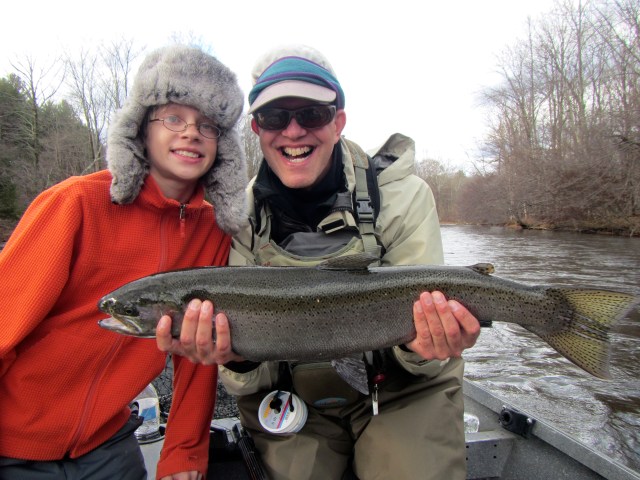
The nicest thing I can say about this particular day is that I got a decent photo.

Christmas 12:13


Farmington River Report: Nature finds a way

In the interest of some informal field research for the DEEP — not to mention my own curiosity — I did a little recon yesterday on a part of the river where the fish would have faced significant stress in the last 50 days. I purposefully went in the afternoon, when the water temperatures would be highest. I wanted to know if, on an unseasonably warm September day, the water temps would be below 70. If they weren’t, I would not fish. Most of all, I wanted to know if anyone made it through the long, hot summer. I visited three locations, staggered downstream at varying distances. Spot A was 67 degrees; Spots B & C were a hard 68.

I found active, healthy fish in all three places. I nymphed up a nice, fat brown, over a foot long, in the first location. He was in the net before he knew what hit him. One quick digital shot and back he went. There were two trout actively feeding on emergers in the second spot; I gave them a few quasi-wet presentations with un unweighted nymph rig, had a bump, and left them to their feeding. Ironically, the spot farthest downstream had the most action: three active feeders. Wanting to err on the side of caution, I didn’t bother trying to catch them.

To be safe, I would wait another week before venturing below the permanent TMA. We’re supposed to have some cooler temps, both day and night, after today. Most of all, a week will give the trout a chance to restore their vigor.

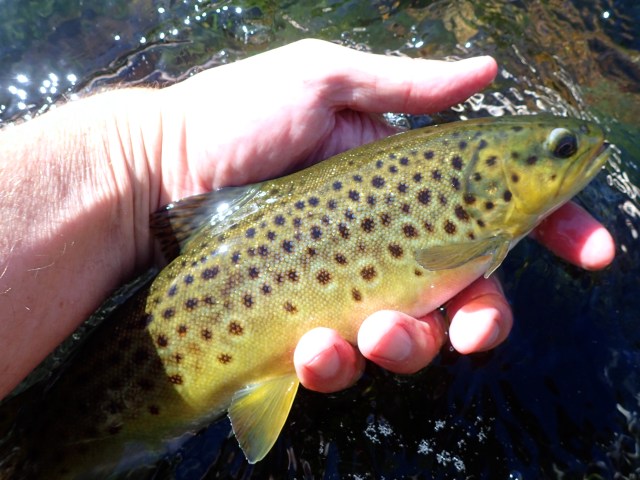
Looks like we made it! This guy was hanging out in about 18″ of whitewater right below a boulder. He took a size 18 soft-hackled Pheasant Tail.

OLYMPUS DIGITAL CAMERA


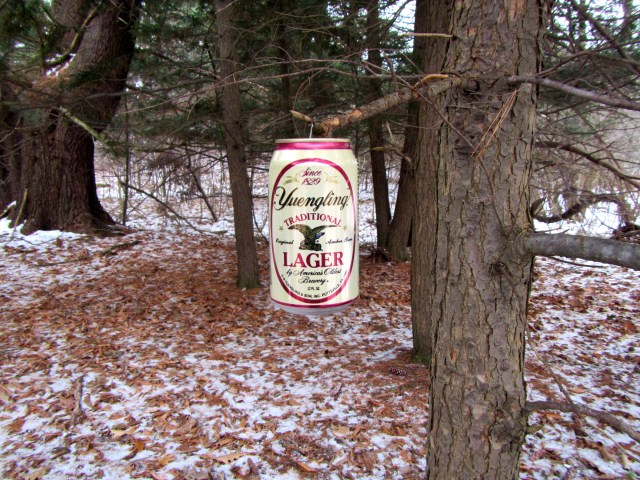
North Jersey Chapter of TU awarded the Order of the Pepperoncini Cheeseburger with Yeungling clusters

We began the fall 2016 presentation circuit in fine fashion. A fed presenter is a happy presenter, and a beer for dessert is always welcome. The members of the North Jersey Chapter of TU treated this road warrior with great kindness, and I’m grateful to them.  The best part was that they let me go on before the business end of their meeting, knowing that I had a long drive home. How thoughtful, and again, very much appreciated. A good crowd turned out to hear all about the Farmington River, and we had a strong followup Q&A. Now all we need is rain.

The Pulaski Christmas Tree, stumbled upon in the woods near Pineville, December 2014.

IMG_2628

Farmington River sampling, stocking, and spawning, or: we really, really need rain

Yesterday’s rain was nice for the garden, but it was statistically insignificant for the Farmington River. Our favorite trout water continues to be battered by low flows (60cfs out of the dam as of this morning) and unseasonably warm temperatures. If you decide to fish, please use common sense.

To the trout: DEEP crews sampled the river last week. They extracted 99 browns from the permanent TMA for Farmington River Survivor Strain broodstock. These aren’t all necessarily big, wild fish — the goal is genetic elasticity, so there is a mix of sizes covering both wild and holdover fish. I spoke with Fisheries Biologist Neal Hagstrom today, who said there were “a fair number of wild fish. The holdover Survivors didn’t look as plump as I would have liked, but not as bad as I had feared.”

In past years, the post-spawn Survivor Strain broodstock have been reconditioned, then returned to the river. But Neal told me there is some discussion about keeping those fish in-house for genetic insurance until flows become more stable. (If I may editorialize, that sounds like a damn good idea.) There is also concern that the current low flows will inhibit natural spawning this fall. Likewise, a spike in flows would be bad, as it might cause the fish to create redds in unsustainable locations. How this all will play out, only Mother Nature knows.

Once water temperatures enter more trout-friendly strata, the DEEP will restock the lower river with yearling trout (7″-9″). “Hopefully, this will help rebuild the lower river trout population,” says Neal.

Kudos to the DEEP for everything they do for the trout and the river. 

Likewise to the MDC, who have done everything they can to maintain flows. Let’s not forget that the MDC’s first priority is to supply potable water to the community. That we still have cold water and healthy trout in an officially severe drought is a blessing.

So, go out and do a rain dance when no one’s looking, and remember — it’s only stupid if it doesn’t work.

Hang in there, dude. Help is on the way.

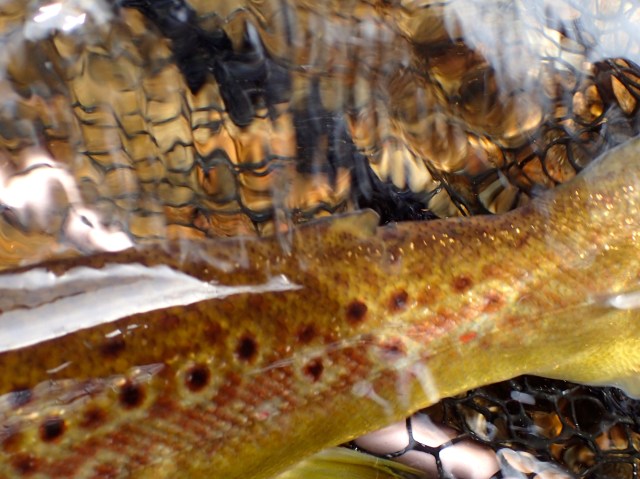
Brown release


“Block Island Stripers from the Shore” in the Oct/Nov/Dec 2016 issue of Mid Atlantic Fly Fishing Guide

It’s the Destination Issue of MAFFG, and we’re all heading to Block Island! A nifty little primer on the island, its structure, flies, gear, and more. While this past year was (ahem) a bit of an off-year for stripers on the fly from the shore, the Block remains one of my favorite places to fish — and write about.

While I truly love answering your questions, let me head you off at the pass: no, I don’t know where you can find a copy of MAFFG. You can try contacting them through their Facebook page. And of course, let them know you enjoy my writing.

Hot off the presses.

OLYMPUS DIGITAL CAMERA


Farmington River presentation at North Jersey Chapter of TU Wednesday, September 21

Gadzooks! In last week’s fall appearances post, I failed to mention my kickoff presentation: Wednesday, September 21, 7:30pm, at the North Jersey Chapter of Trout Unlimited. The topic is The West Branch of the Farmington River. Location is the Sparta VFW, 66 Main St., Sparta, NJ. For more information, click here.

As always, everyone is welcome, and if you’re in the area, come on by.

Farmy Sign


Shocking news from the DEEP (2016)

The DEEP will be conducting its annual electroshocking/brood stock collection tomorrow, Tuesday, September 13. The following, in italics, is from an email I received from Fisheries Biologist Neal Hagstrom:

Ten Things Every Beginning Steelheader Should Know

“Ten Things Every Beginning Steelheader Should Know” first appeared in the October 2015 issue of Mid Atlantic Fly Fishing Guide. I had a lot of fun with this piece, as it mixes humor with practical advice. Even if you’re an old hand, you might find something useful here. Many thanks to MAFFG for allowing me to share it on currentseams.

So, you’ve decided that you’re going to take up fly fishing for steelhead. I don’t know whether to congratulate you or console you. No other form of fly fishing produces such soaring emotional highs or soul-crushing lows. But, the least I can do – as someone who was once in your bright-eyed position – is prepare you for what lies ahead.

Stop. Turn back now before it’s too late. Steelheading is an addiction. And once you’re hooked, dealers in the form of social media fishing reports, grip-and-grins, river conditions, dam release schedules (not to mention endless discussions about rods, reels, flies and gear) will have you at their command. “Obsession” is not too strong a word. Work, social, home life – will all suffer for the pursuit of fresh chrome. You think I’m writing this tongue-in-cheek. I am not.

Expect harsh weather. Great Lakes steelheading is largely a fall, winter, and early spring game. Be prepared for some of the most unforgiving conditions you’ve ever experienced: single digit (or lower) temperatures; lake effect snow; more lake effect snow; really, any and all forms of frozen precipitation. Truthfully, plain cold isn’t that bad. It’s the thirty-four-degrees-and-raining days that cut to the bone. Dressing like you’re going on an expedition to Everest is rarely a bad idea. Fleece is your friend. Think multiple, breathable layers. And those hand and toe warmers they sell in convenience stores? Buy many, many packs.

Prepare yourself for the demanding conditions of a big river. A skunking can be the least of your worries, as this sign along the banks of New York’s Salmon River warns.

srsign

~

Find a tippet you can trust. The most obvious dichotomy in steelheading is that you’re using a light tippet to land a very big fish. So your tippet material must be small enough to remain unnoticed by the steelhead, and strong enough to withstand a heated battle. Here are two such materials: Drennan six-pound fluorocarbon and Maxima Chameleon six-pound nylon. Be ruthless about the condition of your tippets. Check them frequently for abrasions or wind knots. If you find problems, replace the tippet. You’ll be happy you did when you’re fighting that fifteen-pound hen fresh from the lake.

The flies are a little strange. You can catch steelhead with a tuft of Day-Glo yarn tied to a hook, or a few turns of Estaz wrapped around the shank. You may hesitate to call these things flies. Nonetheless, they work. Don’t be afraid to experiment with more traditional patterns and color palettes. Small, simple black stoneflies (like the 60-Second Redhead) and bead-head Pheasant Tail-types account for a significant number of my Great Lakes steelhead every season.

Fluorescent colors dominate a typical steelhead fly box. While egg patterns, gaudy bead heads and brightly accented stoneflies like these certainly catch fish, so do flies in muted, natural colors.

steelhead-flies

Life is not fair. Neither is steelheading. You can do everything right, from presentation to hook set to managing leaps to applying pressure, and still lose the fish. You can do all those things wrong and then land the fish. You can stand in a lineup while every angler above and below you hooks multiple fish and you blank. The spot where you caught a dozen one day is a barren steelhead wasteland the next. I gave up trying to figure it all out years ago.

Sometimes steelheading makes no sense. On this warm late November day, the river was high from snowmelt, the color of chocolate milk, with visibility of less than a foot – and we still had a tremendous day of fishing.

Steel Cam and Me

~

Be prepared to put in your time. It took me forty hours of fishing to land my first steelhead. (It took my nine year-old son only thirty minutes. That was three years ago, and I’m still bitter about it. See “Life isn’t fair” above.) Experience will be your greatest teacher. Pay attention to factors like water temperature and water levels. For example, if the river is low, I know to head for what I call the hot water – snotty whitewater riffles and pockets. Learn where steelhead hang out in the cold winter months. Watch how other people fish. Note the methods of successful anglers. Most of all, get out and fish. You can’t catch steelhead from behind a desk.

Go find the fish. Don’t get lulled into thinking that because steelhead are migratory, they could show up at your feet any minute now. I’ve spent far too many hours – if not days – waiting for something to happen that never did. If you’ve blanketed a run with presentations and have come up empty, move. The fish that want to eat are somewhere else. And it is often true that where there is one hungry steelhead, there are many others.

Tom’s 60 Second Redhead, so named because it only takes a minute to tie. In this version, the abdomen is black Krystal Dub; the head red Ice Dub. This simple pattern excels in rivers with little black stonefly populations.

60Second RedHead

~

Hook set is everything. I suspect that more steelhead are lost to poor hook sets and dull hook points than any other factors. Most of the steelhead I lose come unhinged in the first few seconds of the fight. Get in the habit of checking your hook points early and often. If they aren’t sticky sharp, replace them. If you’re presenting under an indicator, watch it like a hawk. Look for a reason to set the hook on every drift. Set hard with a downstream sweep. Get tight to that fish fast, and set the hook again. Then, hang on. This is where the fun begins.

Don’t let them breathe. It’s easy to get caught up in the hype of a steelhead being in charge of any fight (though it’s true to some extent). Still, don’t let the fish intimidate you. Once your steelhead realizes that it’s hooked, it will want to run. Let it. It may want to leap and cartwheel. Enjoy the spectacle. But when it stops its histrionics, point the cork of your rod handle upstream, and crank that reel fast and hard. The fish stopped running because it’s exhausted. Don’t let it catch its breath. With a good hook set and a reliable tippet, you can put far more pressure on a fish than you think. Let the fish run again if it wants. Same drill: don’t let him breathe. Find that perfect equilibrium on your drag that makes the steelhead work hard for every foot of line without popping the tippet. Your goal is to land the fish as expeditiously as possible. The longer you play a steelhead, the more things can happen – and most of them are bad.

5mm neoprene insulated boot foot waders. In my opinion, this is the single greatest development in fly fishing for winter steelhead in the last 50 years.

Why we steelhead. Brilliant chrome from Lake Ontario, taken in two feet of whitewater during low flows on a black and purple North Country Spider Egg.

Fresh Chrome, November 2014


What fly anglers can learn from Chili Davis

If you’re not a baseball fan, Chili Davis played in the 80s and 90s. (He’s currently the hitting coach for the Boston Red Sox.)

Back in the day, when getting a single hit off Doc Gooden was a feat in itself, Davis was asked how he managed to bat .500 against the young flame-thrower. Davis’ classic reply was,”He ain’t God, man.”

The same goes for famous fly fishing authorities. Just because Righty or BillyBang or whoever says you should use this, that or the next thing, or you should fish this way, or this is the way to tie that fly, or has written a book, or a bunch of magazine articles, does not necessarily make it so. They’re just people. And like you, they put their waders on one leg at a time.

By all means, read, listen, watch, and learn. Be open to new ideas. Try for yourself. But above all, channel your inner hippie and question authority.

And you can start with me.

The best anglers are often those who explore many ways, and discover what works for them. 

TROUTI


The fall 2016 appearance schedule is shaping up

Greetings, fellow fly enthusiasts and pursuers of all things piscatorial. I hope you all had as good a Labor Day family picnic as I did. Incredible food, some stellar wines, a My Father Le Bijou Box-Pressed Torpedo — not to mention some ruthless hands of setback (you don’t want to mess with Aunt Jennie). We’ve been right busy in the currentseams calendar hub. Thanks to all the clubs and shows who have reached out, and if you haven’t yet, but intend to, please do because the slate is filling up. Here’s what’s going on so far:

Wednesday, September 28: Narragansett Chapter TU 225, “The Little Things 2.0.” Coventry-West Greenwich Elks Lodge, 42 Nooseneck Hill Road, West Greenwich, RI. For more information and directions, visit narragansett.tu.org.

Tuesday, October 11: Mianus Chapter TU, “The Little Things 2.0” Waveny House, New Canaan, CT. For more information and directions, visit mianustu.org.

Thursday, October 13: Hammonasset Chapter TU, “The Little Things 2.0” (pretty sure we settled on this — if not, it will probably be LT 1.0). Quinnipiac Watershed Association Building, 540 Oregon Road, Meriden, CT. For more information and directions, visit hctu.org.

Saturday, November 5: Catskill Fly Fishing Center & Museum 10th Annual Art of the Angler Show, “Wet Flies 101.” I’ll be speaking at 1pm, and tying before and possibly after. Since wet flies is the subject, that’s probably what will be on the vise, though as always I am happy to take requests. The show is two days, but I’m swinging Saturday only. For more information, visit cffcm.com/programs-events/art-of-the-angler-show/.

Looking forward to 2017, I have one local gig scheduled, and I plan on presenting again at The Fly Fishing Show in Marlborough, MA, January 20-22. Subjects, dates and times are still TBD, and I’ll let you know as soon as I do.

Thank you all for your kind words, your enthusiasm, your questions, and for reading currentseams.

All this talking is going to make me thirsty.

EinBeer