And you can put your weeds in it

One of the more agreeable aspects of fishing salt pond outflows on a dropping tide is the conveyor belt effect: everything that was inside comes rushing past you on its way to the sea. Bait. Stripers. And sometimes, sadly, weeds. Lord, did I have my weeds Saturday night. Two of them were quite pleasant, a Cabaiguan Guapos on the drive down, then a Saint Luis Rey Corona Gorda for the trip back. The middle, not so much.

From an old, not-so-famous poem: “But all the outgoing tide decreed, was piles and piles of stringy weed.”

Image

Jon and I started out at dusk at Salt Pond A. We could see multitudes of bait in the water. But the only predators feeding on them were jellyfish, ranging in size from a salad plate to a more ominous-looking small platter. Off to Salt Pond B. Jammed with silversides, smaller unidentified baitfish, pods of worried mullet, needlefish, and — alas — precious few stripers. Jon managed a few small hickory shad, while I experienced a first: a mullet on a fly. I was fishing a team of three small bucktail baitfish patterns, ranging from two to three-and-a-half inches. Oh. I also caught weeds. Lots and lots of weeds. Dropper rigs excel at finding weeds. A 3/0 shot above the middle dropper provided a partial remedy, but I still got my limit of aquaflora.

On the way to Salt Pond C, disaster. Clumpthumplit! “What was that?” Jon asked, and immediately answered his question: he had left his rod on the roof of the car. A more fortuitous tumble might have kicked it into the breakdown lane, or even the grassy median. Positive waves were sent as Jon went off into the night to retrieve the fallen warrior. But no. DOA, including the reel. Last rites were given to both roadside, and Jon’s car, now playing the role of hearse, began the long, sorrowful journey back to Connecticut. But not without a detour. Salt Pond C still needed to be investigated. I made quick work of backing up the pool along a short channel. No fish. Several weeds. And lots of biolume.

So, it didn’t happen for us. Don’t bum out, man. Soon, those ponds will be holding.

Farmington River Report 8/18/13: Crash, Bang, Wallop

If you put in enough time, eventually you’re going to cross paths with a big fish. Yesterday was my turn.

I’m in the middle of working on a wet fly piece for American Angler, and I wanted to try to get some photos of trout-with-soft-hackle-in-mouth. Right off the the bat, I was into a good brown. Then things slowed a bit.

Conditions were perfect: 75 degrees, overcast, showers, water running at 400cfs and a cool 65 degrees. What the bugs lacked in numbers, they made up for in variety: small BWOs, light-colored caddis, midges, and a few stray Isonychia. The bird were working industriously overhead. I was fishing a team of a March Brown soft-hackle as the top dropper, a Drowned Ant soft-hackle in the middle, and a bead head Squirrel and Ginger on point.

Near the end of a mended swing, she hit the fly with untamed ferocity. I’ve encountered enough of these larger trout now that I can tell immediately there’s a big’un at the end of my wet fly leader. The surface erupts in swirling upheaval, and line is bulled from the reel. That’s the last glimpse I’ll have of the trout for a while. Bigger fish almost always go deep, and this one was no exception.

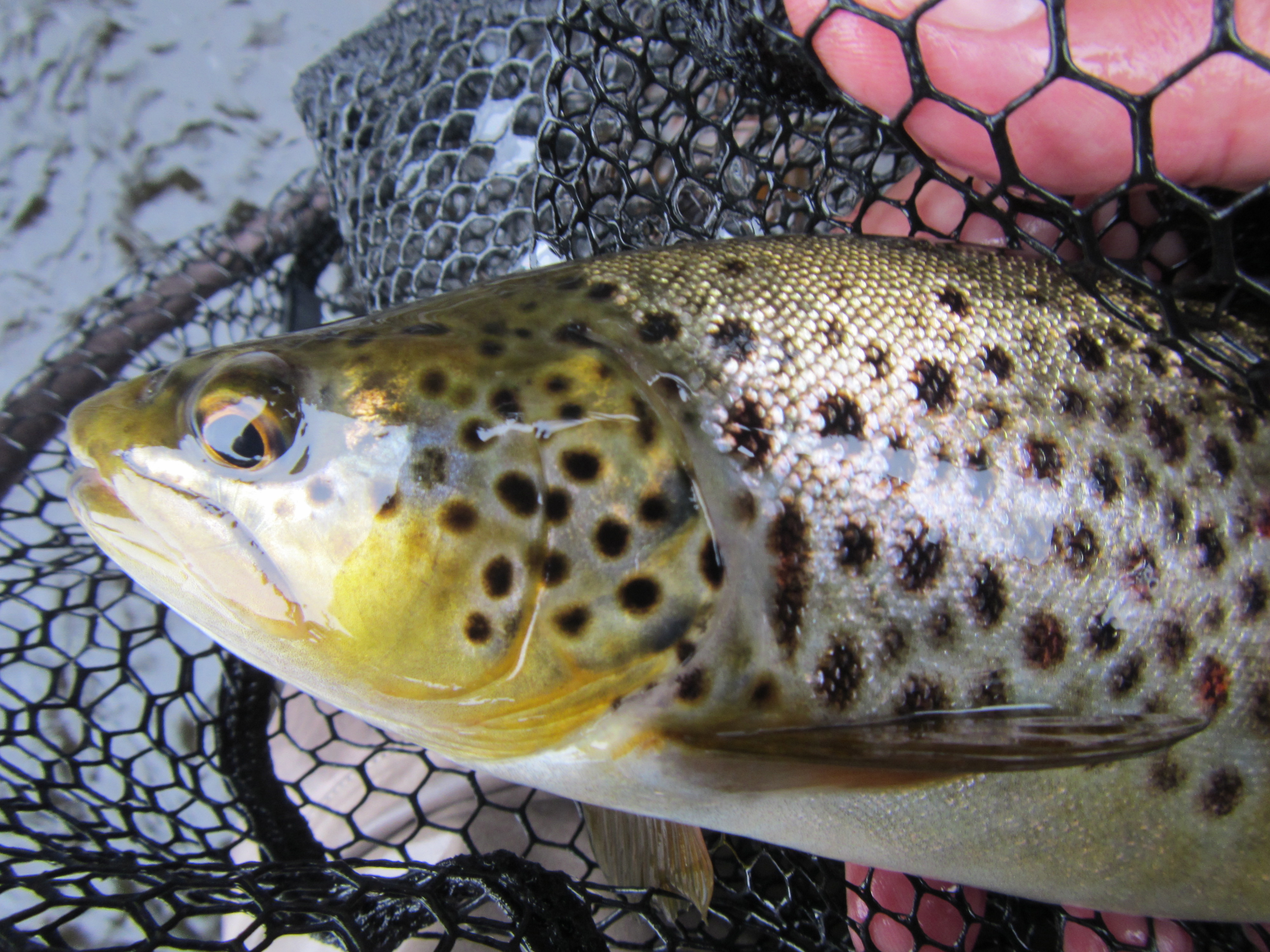
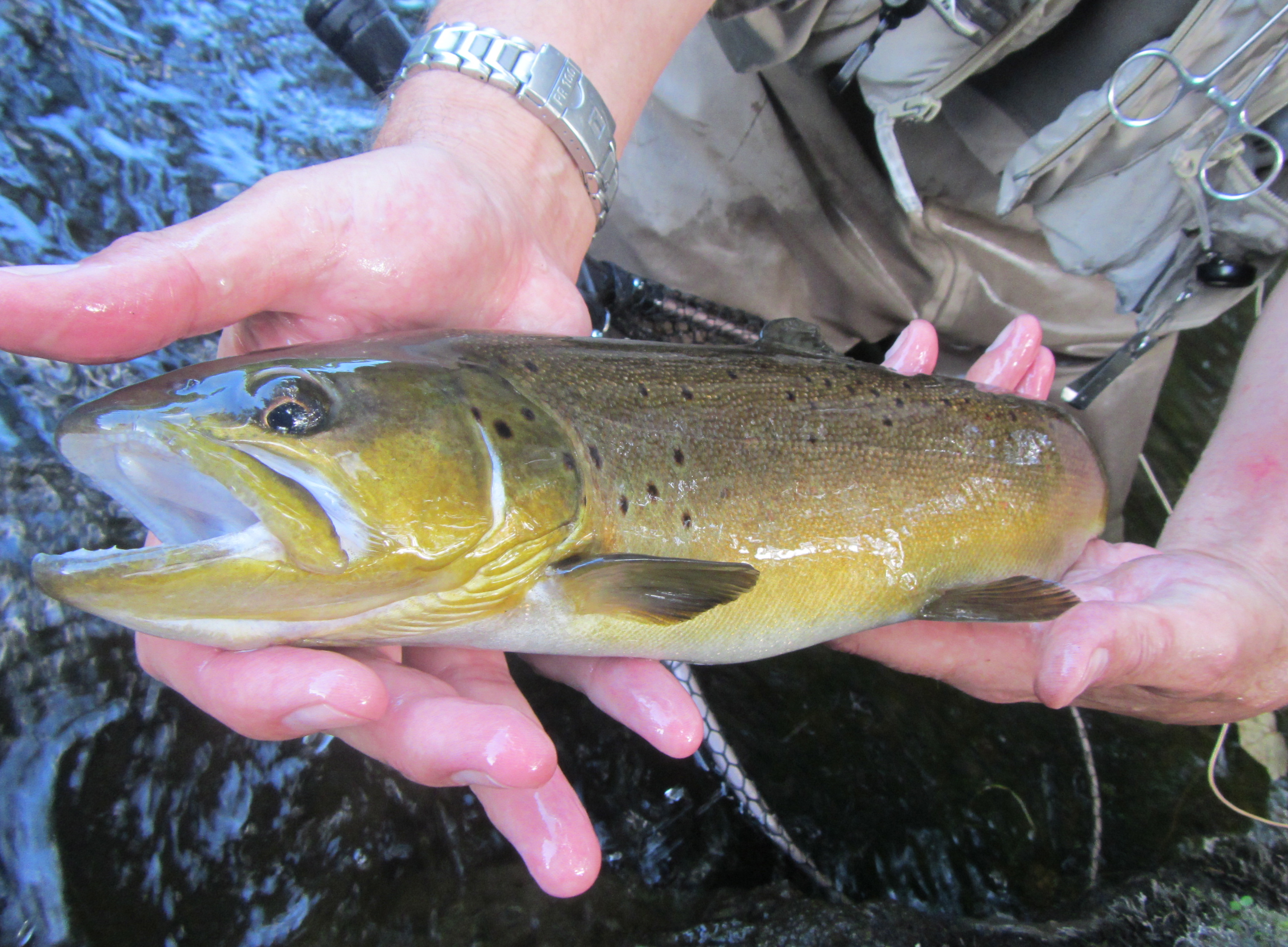
Now, I was faced with the predicament of where to land her. I was surrounded by treacherous pockets and swift currents. I had to manage both wade and battle — this was the kind of fish you really wouldn’t mind falling in for — but I finally  made it to a calmer section to claim my prize. And here she is.

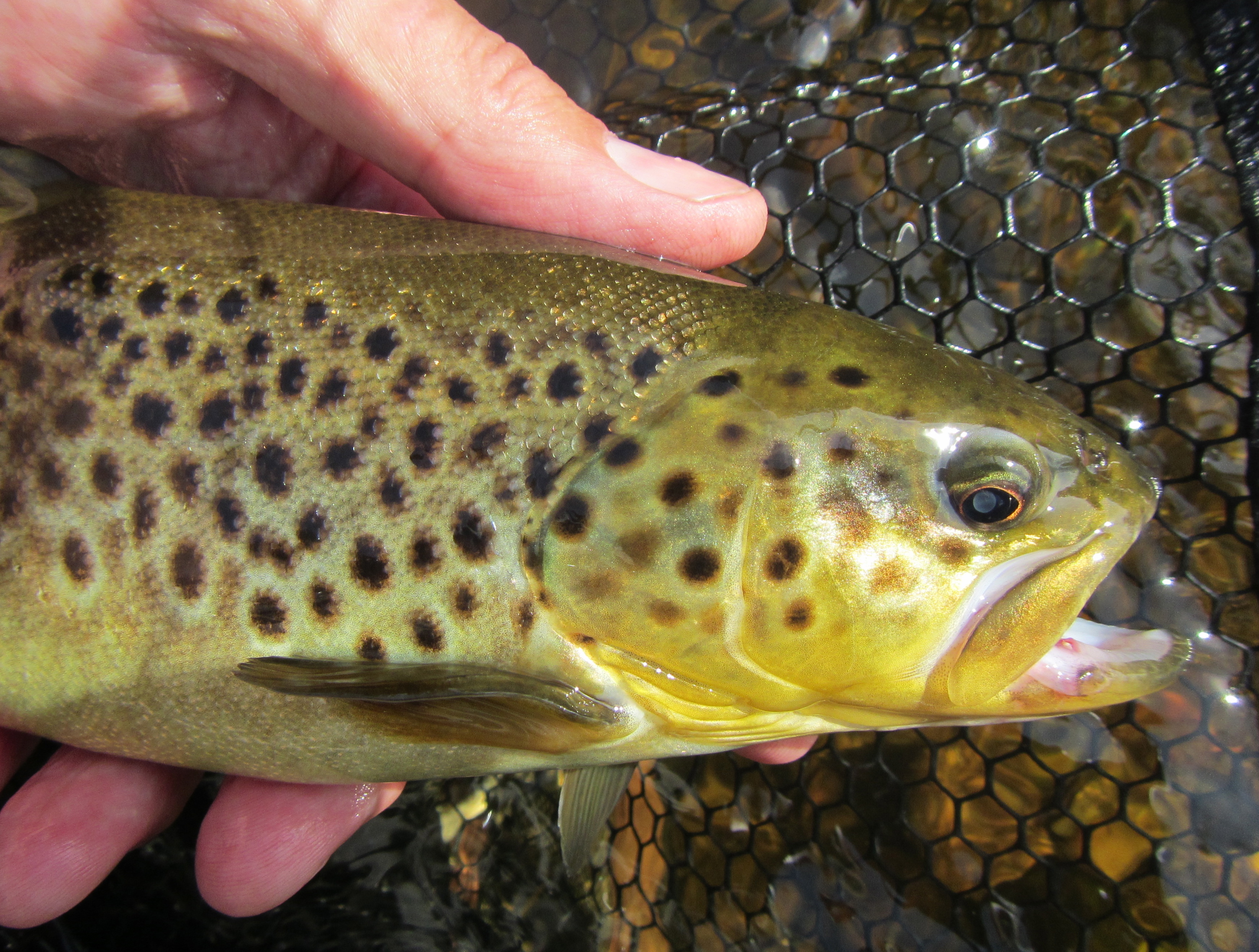
What a gorgeous creature. It would have been nice to get a full-length shot, but I was flying solo, and I wanted her swimming freely in the water ASAP. A quick measurement against my rod placed her at just over 20″.  Clearly this trout could also be tallied in pounds.

Image

This was the kind of fish that, after you release it, compels you to sit on a rock mid-stream and contemplate your fine fortune in the scheme of the universe. So I did. And I smiled.

I took a few more fish, including one of the larger wild brookies I’ve caught on the Farmington this year, then headed to another spot. Juvenile salmon city, but at the end of the run I saw a splashy rise in the shallows. One cast, a partial swing, and whack! An eight-inch wild brown took the Squirrel and Ginger. I took a few more pictures, then headed home for dinner.

Nice work (if you can get it).

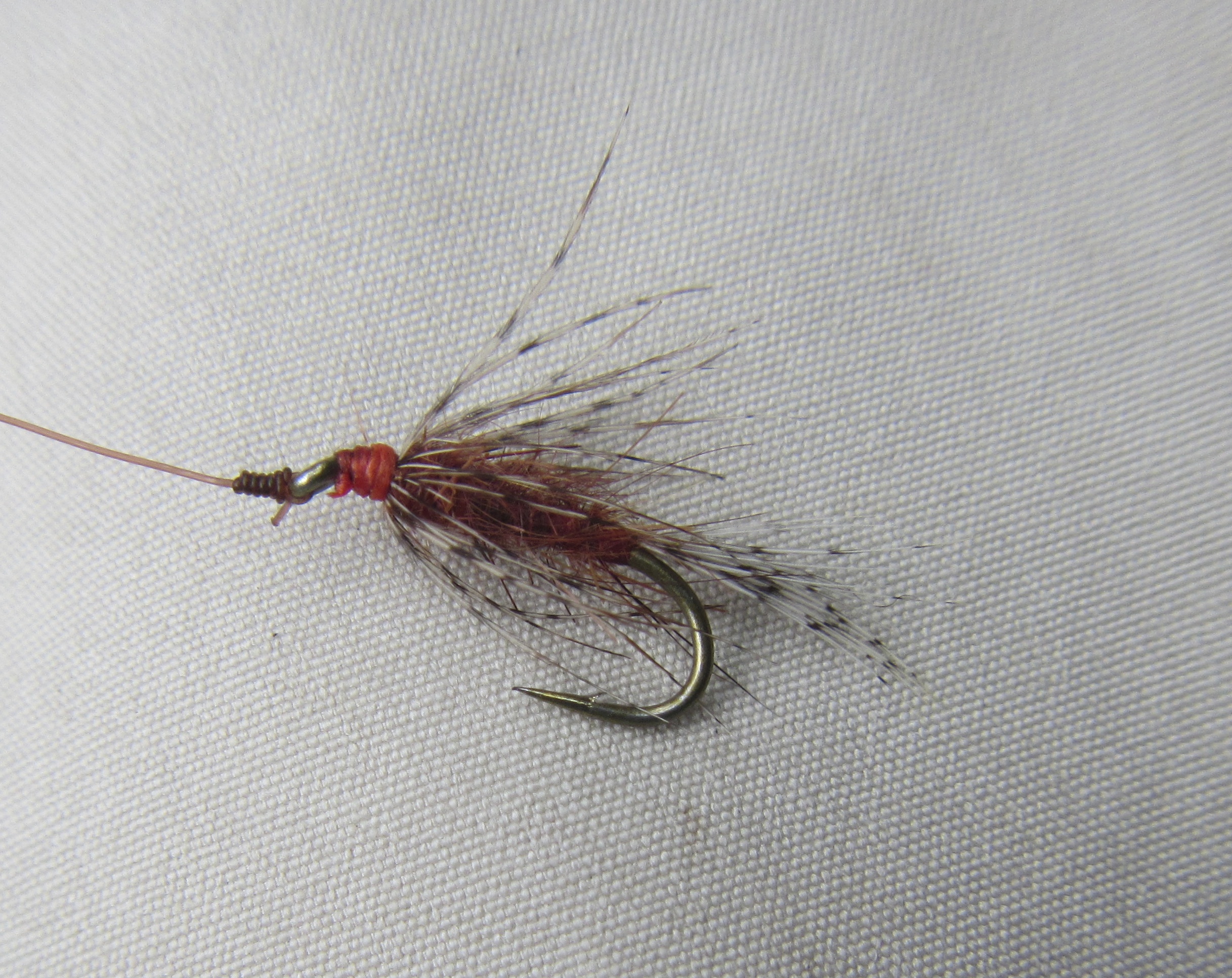
The winning fly, a Hackled March Brown. It comes from an English book published in the 1930s. Makes a fine Isonychia imitation.

Image

8/14/13 Farmington River Mini-Report

It was a slow day on the river for most of the anglers I spoke to. We were likely done in by the sudden shift in weather and the noon spike of the dam flow (the Upper TMA jumped from 370 to 480cfs; water was lightly stained and 65 degrees). Still, my friend Pete and his brother got into some very nice larger browns in the Upper TMA. As for your humble scribe, I had to be content with a mob of juvenile Atlantic salmon and one lonely rainbow trout. I was committed to the wet fly cause today — I just got an article assignment from American Angler on wets and was hoping to get some good fly-in-trout-mouth shots. Instead, you’ll have to settle for this simple flora-at-dusk portrait:

Image

Farmington River Report 8/7/13: Foul language and rank stupidity. Plus some trout.

“Hey, you gotta move your @#$%ing truck!”

Clearly, this fishing trip was not starting well.

I had just turned into one of the many dirt pulloffs that border the Farmington River. This particular one holds at least three vehicles. There already was a car in it, facing south. I had been heading north, so the fronts of our respective vehicles were pointing at each other. To leave, we’d each have to back out the way we came in. You know, like you’d do at any gas station.  Rudimentary Driver’s Ed stuff.

I got out and started gearing up. The occupant of the other car was on his cell phone, and from what I could overhear, he wasn’t having a happy conversation. He ended his call, and that’s when he shouted out his unpleasant greeting.

“Excuse me?” I said.

“Move your @#$%ing truck!”

“Really? Are you telling me you can’t back out of here?”

More wrathful profanity, and that’s when I realized: disengage. Now. What if he has a gun? What if he comes back with some friends? What if he vandalizes my truck? Sad to say, but that’s the world we live in. I could back out of the pulloff — and potentially, an even uglier scene — simply by acquiescing. Politely. And keep my dignity in the bargain. So I did.

Still, once I got in the water, I couldn’t enjoy it. I kept looking up at the road, waiting to see if my new friend was coming back to look for trouble. Every sound of an approaching car elevated my heart rate. Thankfully, he never returned.

So, what about the fishing? A slow day for swinging wets. Very little hatch activity, but the water was a perfect height at 321cfs and a delightful 64 degrees, ten out of ten for August. I was fishing a Squirrel and Ginger on point, a Drowned Ant in the middle, and a clumsy deer hair wing/head soft-hackle that suggested a drowned hopper or a big stone fly on top. I had several swirls at the big fly, but no takes.

Finally, on the dead drift, the line stalled, I came tight to the fly, and I had a good fish on. I was hoping for something approaching 20 inches, not only from the size of the fly, but from the fact that the fish immediately went deep and sulked on the bottom. A powerful surge up a whitewater channel, and he went on the reel. In the end, it was a mid-teens rainbow. It was the only trout I took in the 90 minutes I walked the run.

My best trout of the day took this monstrosity, still wet and fresh from the fish’s mouth.

Image

I decided on the spur of the moment to rig for indicator nymphing. The section I fished is a deep run below some riffles. I gave it 15 minutes, and the only trout I took came on the second cast.

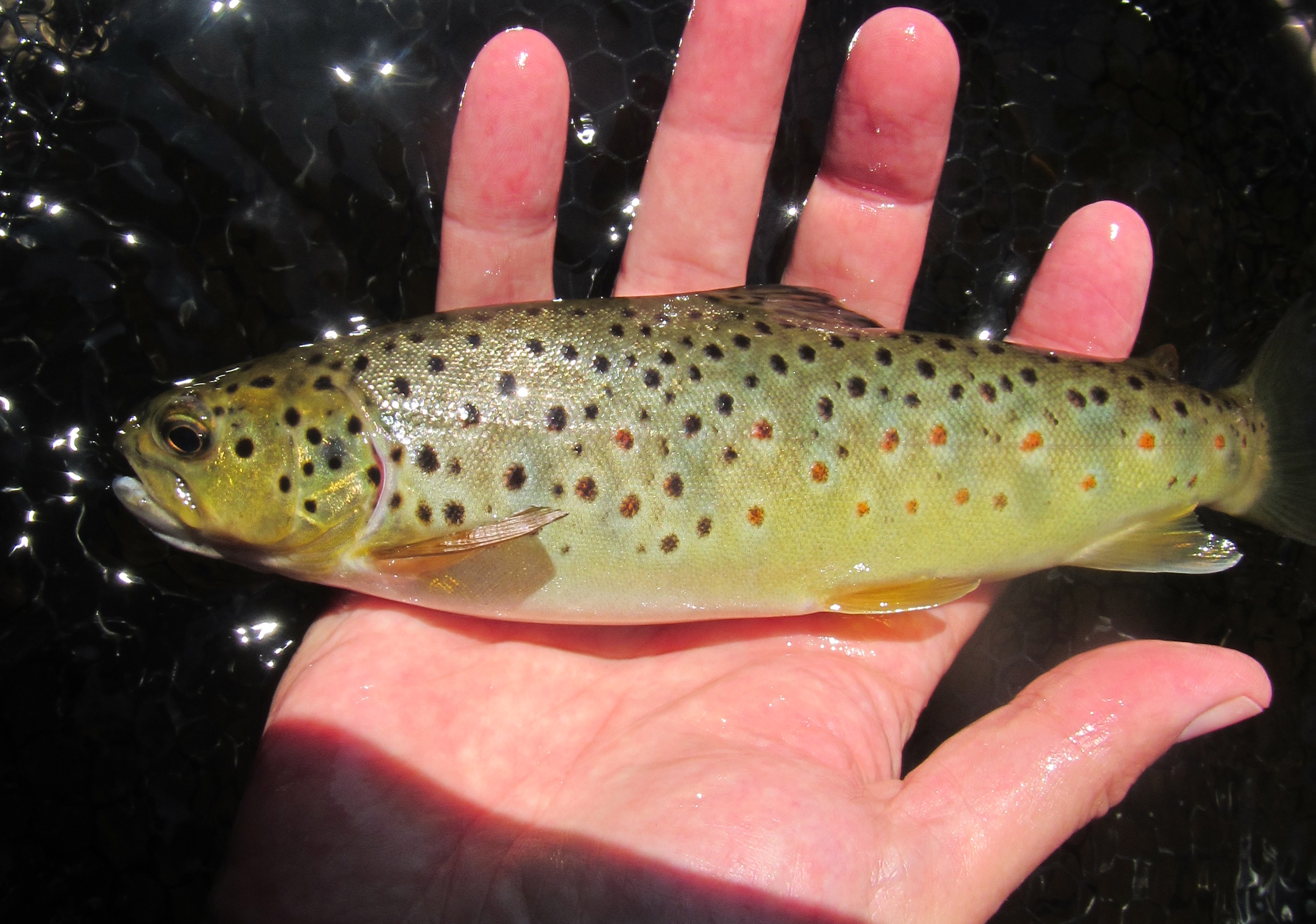
A nice little brown who liked the look of Yerger’s Miracle Nymph, size 16.

Image

The day ended far downstream, where I took my largest juvenile Atlantic salmon of the year, about nine inches long. Bright silvery flanks, and fat. No wonder. When I was taking the hook out, I peered down his throat. It was loaded invertebrates to the point of overflowing. It reminded me of a bluefish spitting up bait. Off he went. Then off I went.

I had to get @#$%ing home.

Farmington River Report 8/6/13: Are you still there?

I guided Steven today and we had about the nicest August weather you could hope for: sunny, about 80 degrees, and low humidity. The fishing was pretty fair, too. The river was crystal clear, 324cfs in the Upper TMA, and 64 degrees. Not much in the way of hatch activity, but you take what you get and make soup.

Steven had missed my most recent “Wet Flies 101” class at UpCountry Sportfishing, so we spent the day covering the curriculum. He did an outstanding job. Funny thing: the first run we fished, there was a guy swinging wets. We watched him hook and land a nice trout. Turns out it was Ted, who took my class in May this year.

After Ted left, we waded in and took several fish, including this lovely wild brown that was rising on the edge of a shade line in less than two feet of water:

Image

Next, we headed off to the lower river. Slimmer pickings, with only one juvenile salmon to show. We finished the day in the upper TMA. We fished several very sexy seams and pockets with no love, but then things picked up in the last hour.

“Are you still there?” When my students are fishing wets on the dangle and they feel a strike, I tell them to ask that question before they set the hook. (When swinging flies for Atlantic salmon in the UK, you say, “God save the Queen.”) One of the biggest challenges for a new wet fly fisher is not setting the hook when they feel the tug. It’s a highly challenging reflex to overcome, and failing to do so usually means pulling the hook out of the fish’s mouth. Steven was struggling with it as much as anyone does early on, but by the end of the day, he was proudly announcing, “I waited that time!”

And every time he did, the trout was still there.

7/31/13 Farmington River Report: “So a guy who can’t hear and a guy who can’t talk walk into a river…”

As Woody Allen said, sometimes 80% of success is just showing up. Pete had gone downstream, and I went to the head of the run. It was a-quarter-to-noon, but the bank was already in the shade. First cast, BANG! The wet flies had barely settled into the water. I saw the splashy rise and felt the weight of the fish. A bantamweight wild brown had delivered a roundhouse right to the top dropper, a Squirrel and Ginger.

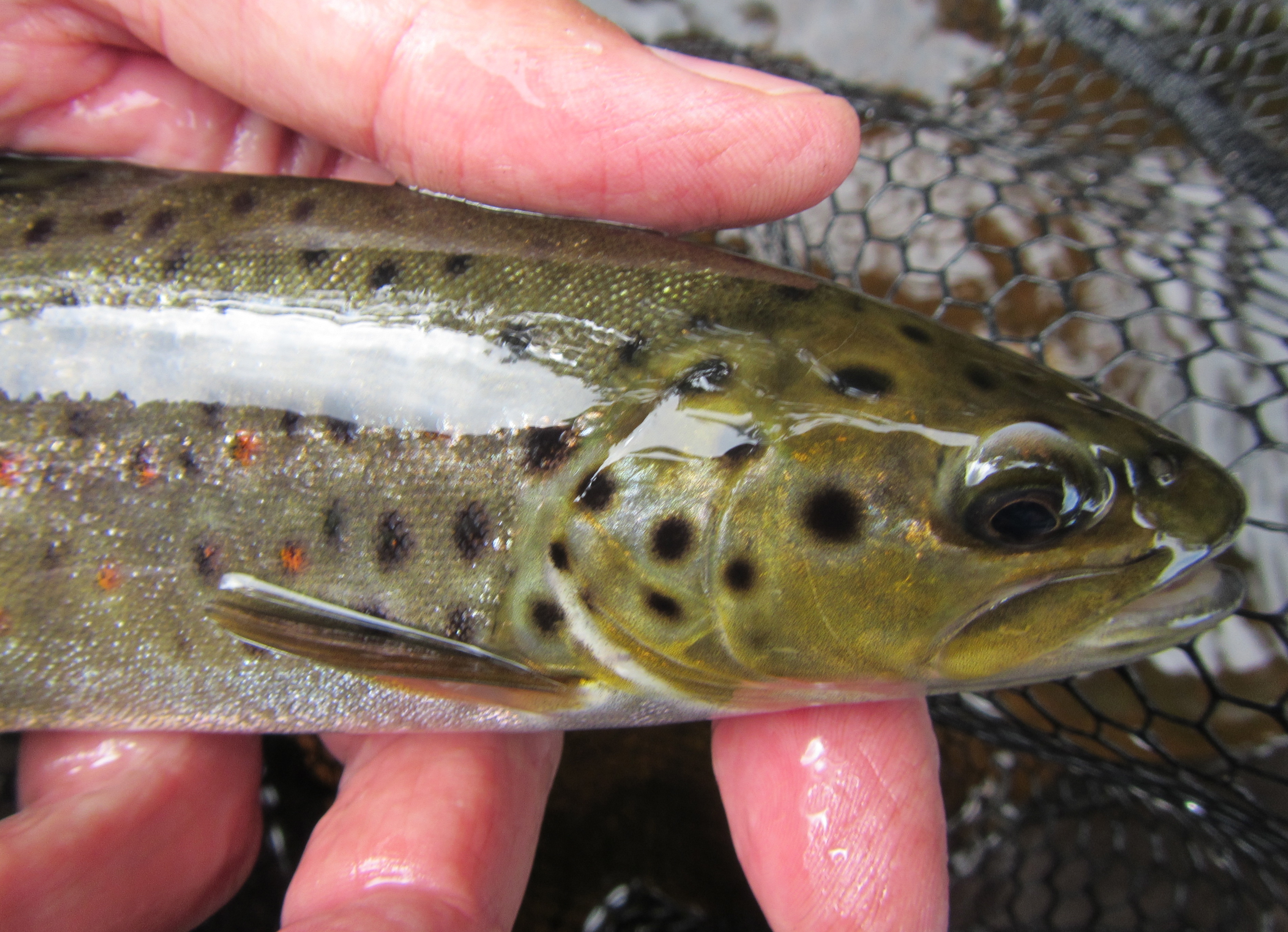
A feisty pug of a wild Farmington brown. This fish had an almost perch-like shape, with a tubby midsection that tapered dramatically before the tail.

Image

I took two more wild browns on the way down to where Pete was fishing. He was also doing well with a combination of wet flies and nymphs. (I was dedicated to the wet fly cause all afternoon.)

What pair we made. I’m partially deaf in one ear. Pete had his vocal chords compromised by recent surgery and can only speak in a whisper.  After my tenth, “What?!?” we decided on a policy of sign language and close-quarters conversation.

After our fast start, though, things slowed. Dramatically. We walked well over a half mile of prime water in the upper TMA with only one dropped fish to show for it. “What?!?” indeed. Very little hatch activity, and the water was running clear and cold.

Pete left around 2:30, so I took a flyer on a spot I hadn’t fished since May. I started off in some snotty water above it and was rewarded with a nice little brown and a few juvenile salmon. Then, in the run proper, I took a beautiful holdover brown on a mended swing. The water was clear enough to see the whole transaction, from the flash of gold as the trout darted out from behind a rock, to its striper-like thrashing on the surface at hook set. Another (dis)satisfied customer on the Squirrel and Ginger (this fly has become an automatic as my top dropper). I took two more smaller fish, then called it a day. A damn fine day. Thanks, July. Ya done good.

This could be a wild fish, but whether it’s stream-born or not, it had large pectoral fins that it used to repeatedly glide into deeper parts of the run.

Image

Thanks to today’s Wet Flies 101 Class/Farmington River Report

Many thanks to John and Matt who attended today’s Wet Flies 101 class. We were blessed with outstanding weather, and the river was in terrific condition: clear, 64 degrees in the upper TMA,  and running at just under 400cfs. Although bugs were few and far between, we did find a bunch of fish that were willing to jump on. It’s exciting to witness someone landing their first trout on a wet fly. Well done, gentlemen.

A wild brookie that fell to the charms of a Light Cahill winged wet. Been catching more of these gems this year than in recent memory.

Image

Friday, I fished the river with friend Jon from 4pm-9pm. We found trout everywhere, first on wets, then on wets and dries. Jon took an assortment of browns and an exquisitely parr-marked wild brookie. He also put on a wet fly clinic, catching two fish in a pod of rising trout in just a few minutes. I, on the other hand, chose to be tortured by trout feeding on emerging Summer Stenos (this hatch has yet to pick up any steam where I’ve been fishing). I spent over an hour stubbornly trying to catch this one fish that was holding hard up against an obstruction — not to mention the triple black diamond current seams I had to mend across. I’d say maybe one in six presentations was good. You can probably still hear the echoes of my hoot when he finally took.

I ODed on the Farmington this week, five days on the water. What a way to go.

This may look like a big honking stonefly, but it’s actually a cleverly disguised top-secret NSA drone. (Joke courtesy of Matt.)

Image

Tip of the Week: Whitewater

You know all those snotty, pocketed riffles on the Farmington that were impossible for you to fish during the rains and high flows of June and early July? Well, no one else could fish them either. But now you can. And they’re loaded with trout that haven’t seen an artificial fly in weeks. I know, because I waded one of those runs today.

In just two hours, idly swinging and dangling wets, I caught over a dozen fish. I fished four flies — a deer hair head/wing soft-hackle, a BH Squirrel and Ginger, a March Brown soft-hackle, and the Drowned Ant — and caught trout on all of them.

Regardless of June rains, this time of year is a good time to focus on riffly water. As water temps rise, trout move into these oxygen factories. You’d be surprised at how big some of the fish are, even though the water’s not even knee high. Wet fly, nymphing, even bushy dries like a Stimulator will all take fish.

Here are some of today’s customers.

Several smaller wild browns like this one. They fight like tigers.
Image
All the really cool stoneflies hang out on this rock to smoke cigarettes and shed their exoskeletons.
Image
The last fish of the day, taken on a size 12 March Brown soft-hackle.
Image
On the Drowned Ant, size 14. This one had some shoulders, and really clobbered the fly.
Image

Cheeseburger after paradise

There are 365 or so days every year when you can fish the Farmington. I manage, on a good year, to do it about 40 times. But of all those days, none is more important than July 21.

I’ve made a pilgrimage to the Farmington on that day for four consecutive years now. It’s not by accident. July 21 is the day the Summer Stenos come out. Whether they appear earlier or later isn’t important; the Stenonema have their schedule, and I have mine. There’s a certain place I go to greet them, and since it’s an evening hatch, a certain time I like to be there. Admittedly, I have an unhealthy relationship with Summer Stenos. At times I hold them in starry-eyed adoration. Others, I view them with extreme disgust and intolerance. No other hatch on the Farmington so charms me that I have the date burned into my mental calendar months in advance. No other hatch baffles me with its rise-to-hookup ratio that frequently exceeds 10:1 – even though I’ve found the perfect fly for fooling the trout.

On Sunday night I got my first three trout of the year on Summer Stenos. But first, there was some swinging to be done.

I hadn’t fished with Jon in almost two months, and for our reunion outing we agreed that wet flies and riffly pocket water were in order. At 630cfs the run was quite wadeable. Jon took the first fish, a smallmouth bass, but after 45 minutes all we had to show for our efforts was a couple of juvenile Atlantic salmon. While it’s nearly impossible to get down on the bite when you’re swinging wets with an old friend on a delightful sunny day in July, I suggested we move to another spot, upstream. I guaranteed Jon he’d catch a trout there.

Such predictions are a minefield. I had second thoughts about opening my big mouth from the time we piled into our vehicles until he took his first trout a half-hour later. I was still swinging wets, working below Jon, while he had switched over to short-line nymphing. Just as my three-fly team made the transition from swing to dangle, I felt a herky-jerky tug. The fish made two quick micro-runs, peeling a small amount of line off the reel. I thought nothing of it at the time, as the take came in the heaviest section of current. No need to get this fish on the reel.

A big ol’ wild Farmington brown. These fish with a scarcity of spots are intriguing. Check out that tummy. Someone’s been eating well. He took a size 14 Drowned Ant soft-hackle.

Image

Each fight has the potential for comedy, drama, or tragedy – sometimes all three – but this one quickly declared itself a drama. The trout is usually a good one when you never see it during the encounter. Big fish have a way of hugging the bottom and using the current against you. By the time I had negotiated the trout into calmer waters, I could see that I had underestimated its size. A wild brown with an odd scarcity of spots and, despite his length, only the suggestion of the beginning of a kype.

How can you tell that you should buy a lottery ticket that day? You’re just standing in the water, savoring the moment, line dangling harmlessly beneath you, and you hook another trout. Moments later, a Cedar Waxwing lands on your rod as you hold it over the water like some conjurer’s wand. He waits there. Eyeballs you. Looks as if he’s about flee. Then stays long enough for you to call out to your friend to be your witness.

This rainbow looks like it’s been in the river a while. Jon took him short-line nymphing not too far from where he was standing.
Image

But, lest you think we have forgotten about the Summer Stenos, rest assured. We have not.

Shortly before 7pm, we were wading into a pool where friend Todd was already fishing. Jon spotted a trout rising against the far bank. Since I was already rigged for dry, he suggested I have a go at it. As I began my false casting, Jon predicted that I would stick him on the first drift. I was thinking the same thing almost as he said the words. After all, it was a day where I could do no wrong. But, after my sixth cast, we agreed I had most expertly put the trout down. There’s nothing like fly fishing to keep a man grounded.

While the hatch hadn’t gained any steam, there were a few trout feeding sporadically on the edge of a pocket. The current seam they were rising in demanded a precision cast perilously close to an obstruction. Then a rapid series of mends to keep the fly from looking like it was on the Scrambler carnival ride. I saw a few size 18 creamy mayflies come off, and switched over to my Pale Watery wingless wet variant that I fish as a dry. With a twelve-foot leader that tapers down to 6x, the line hits the water well before the fly. I was beginning to mend even as the fly was slowly settling onto the surface.

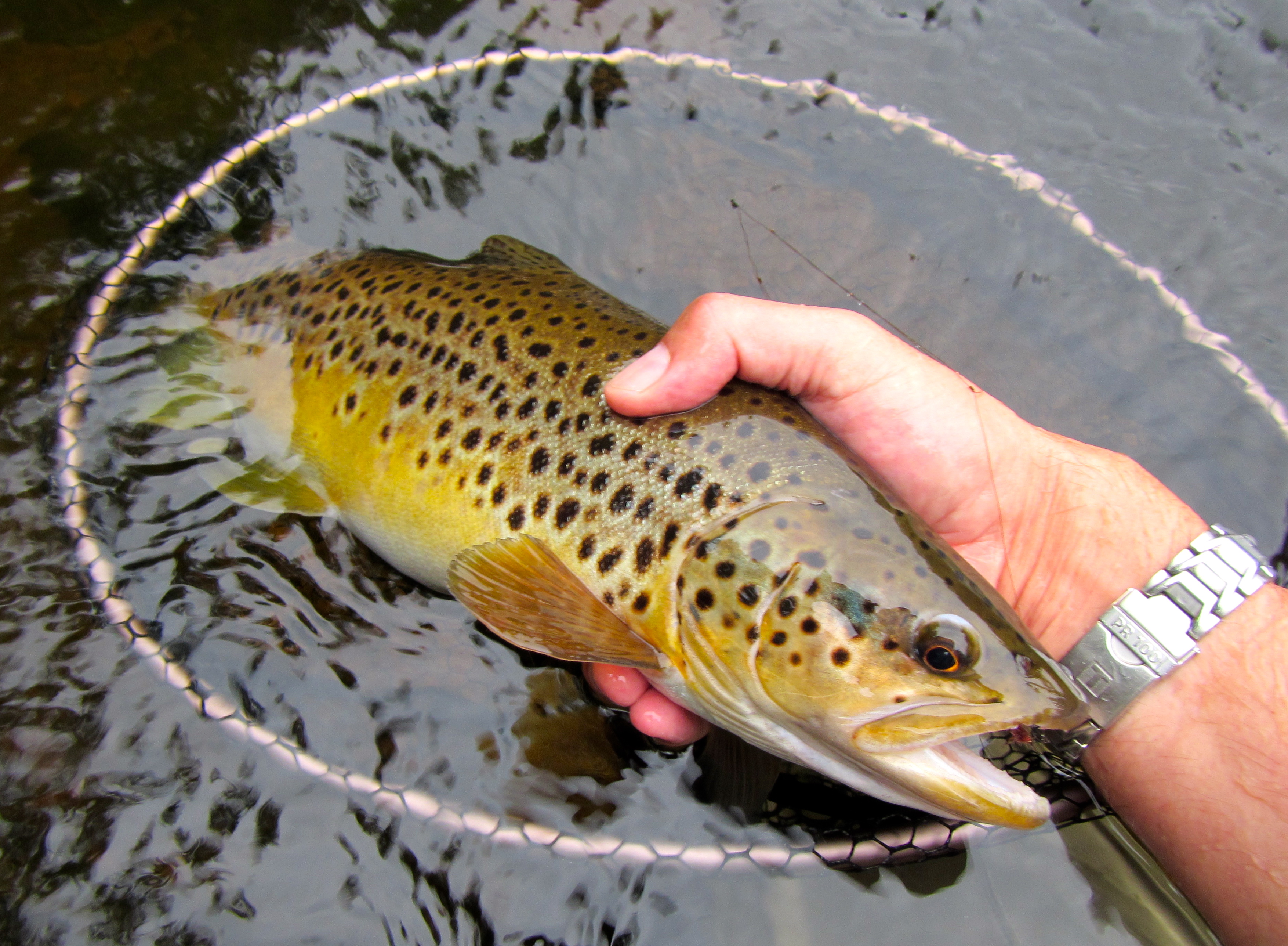
I rose trout several times, but came away with nothing but air. Then, in a glassy plate of water three feet from the shore, I saw another active feeder. This trout obliged on the first cast. A fine Farmington brown, probably not stocked. My first Summer Steno trout of the year. July 21st. The universe is in balance. A half hour later, another beauty, lower in the pool, again on the first cast.

Time races when you’re dry fly fishing. Probably because you’re so keenly attuned to the rhythm of the rises, and the limited opportunities presented by a waning hatch. Evenings, there’s also the looming specter of darkness. Can’t see your fly, can’t dry fly fish. Or at least, not easily. Dusk was just crossing the no-man’s-land into night when I hooked my last trout. I had been repeatedly casting to a small riser – or so I thought. The splashy feeding tells were slight enough to suggest a juvenile salmon. But like that big brown, I underestimated the size of this brute, a well filled out rainbow that ignored several entreaties to come to net.

A good day on the river longs for a happy ending. So I am pleased to report that if you leave the Upper TMA, waders off, rod broken down, gear stored, by 9:20, you can make it to Five Guys in Farmington before their 10pm closing. With several minutes to spare.

Yoram’s excellent wet fly adventure

I guided Yoram for a half-day today on the Farmington. Conditions were tough due to the rain. The upper TMA was 790cfs and the color of coffee ice cream. So we headed up to Riverton, where it was a more manageable 350cfs, with only a light stain. We fished streamers and the going was slow. Schizo weather with brilliant sunshine one moment and tropical downpours the next.

The last hour, we switched over to wet flies. That got us a few hits and an almost catch, but sadly we were well into overtime for our session. I saw a trout rise along the far bank, and told Yoram he had five casts to catch him. It wasn’t an easy cast to make, cross-river and just beyond the clutches of a fly-eating downed tree, then a quick mend to get a good drift. But Yoram nailed it the first three casts, and on that third cast the surface erupted. Yoram set the hook. And moments later we had a beautiful wild brown to net. He took the Drowned Ant soft-hackle on the top dropper. No picture, as Mr. Brown slipped away during his photo op. But I wanted to give props to Yoram for coming through in the clutch.