Farmington River Report: Not as low, still a bit slow

I guided Glenn and Magnus yesterday from 10:30-2:30. The river was uncharacteristically quiet within the Permanent TMA — we saw only three other anglers the entire day. It was cool and damp and cloudy, perfect for tiny BWOs, but the only bugs appearing in numbers were caddis. Water was 160cfs and leaves were a factor. We fished a combination of indicator nymphing/drop shot and streamers, and although we stuck several fish on both methods, it was not a good day for getting trout to the hoop. Nonetheless, a pleasure fishing with you, gentlemen. (For those fishing streamers, white was the hot color yesterday. I like white when there are colorful leaves in the water.)

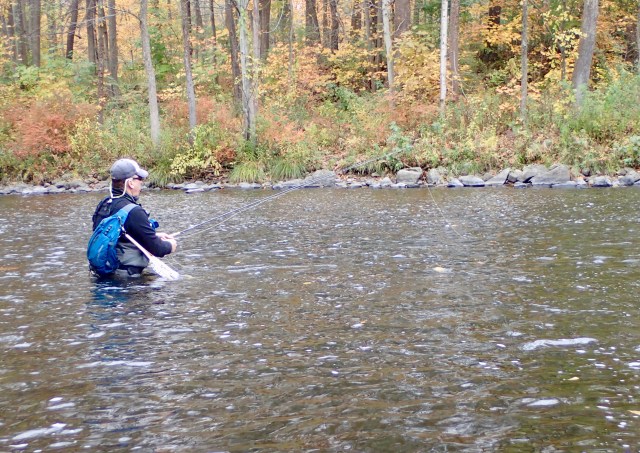
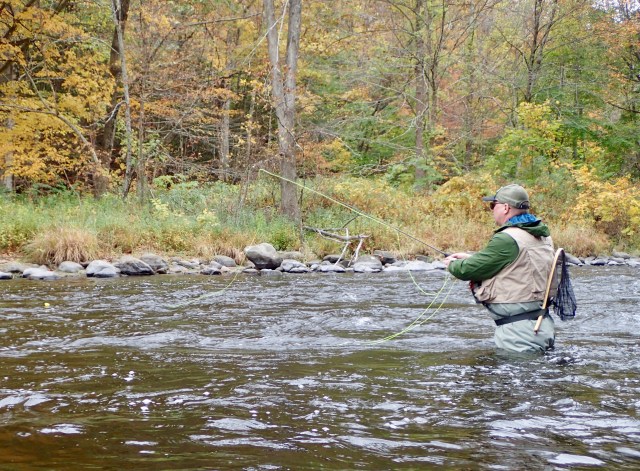
Magnus working a run at the head of a pool. We had a brief flurry of activity here, sticking two fish in the space of 5 minutes.

OLYMPUS DIGITAL CAMERA

~

Glenn waiting for the strike…here it comes…

OLYMPUS DIGITAL CAMERA

Housy Report 10/8/19: BWOs and Truttasaurus

I fished the four marks within the Housatonic River TMA today, late morning to early afternoon, and while the action was spotty I was able to score my biggest brown of the season on a Squirrel and Ginger.

I began the day dedicated to the streamer cause, but after 45 minutes I’d only had one bump. Since there were tiny BWOs (size 18-22) and caddis (size 16) in the air, I switched over to a three-fly wet fly team. That produced one stocker rainbow. The third mark was a blank, so I returned to where I’d seen some fish rising earlier. Not really classic wet fly water but the trout were clearly on small stuff (as evidenced by the sipping rise rings) and emergers of some sort (the tell of splashy rises). I missed two before connecting with a 20″ holdover brown.

The take was gentle but unmistakable, as was the fish’s size once it realized it was hooked. Love the comfort factor of fishing with Maxima 4-pound — ain’t no trout in this river going to break that.

OLYMPUS DIGITAL CAMERA

~

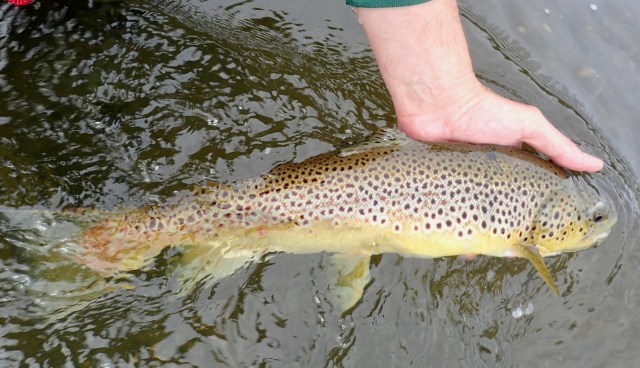
It’s hard to take a beauty shot mid stream when you’re flying solo, so this is the best I could do. Still, you get some sense of this truttasaurus‘ length, and check out the ginormous tail. The mouth of my net is 17″ — this one did not slide in easy. We like that problem! Wet flies fished in the film, delivered to active feeders, continue to be a highly productive big fish method. 

OLYMPUS DIGITAL CAMERA

River conditions: 450cfs and rising, light stain, some leaves and pine needles, 58 degrees. And crowded for a Tuesday in October! Thanks to everyone who greeted me by name today, and as always, if you’re on the river and you see me please say hello.


RI Striper Report 10/1/19: For old times’ sake

I suspect that at 9:45pm last night many of you were either watching MNF or getting ready for bed. Me? I was pulling out of my garage to go striper fishing in Rhode Island.

Used to be that fall meant many long nights spent banging around the beaches, breachways, and salt ponds of the Ocean State. Sadly, the state of the striper stocks have reduced that autumn fishery to a shell of its former self. Nonetheless, needs must go, if only to remember the glorious nights of yore when the surface of my thumb was reduced to shredded flesh.

“Steve, can you get me on the hook? For old times’ sake.” Can do, Sally.

CandoSally

I fished two marks. The first was a skinny water flat where I used a three fly team (Orange Ruthless, small PB bucktail, Morning Glory) and wet fly tactics. The flat was loaded with silversides, and although I heard a few pops, I was only able to manage a couple of touches. The lack of sharpness on the hits led me to believe that dink stripers were the culprit.

Off to Spot B, an area with an elevated perch and nearby incandescent lights. Peanut bunker and mullet in the bait mix. Now well after 1am, I was just about to call it when I heard some mischief and saw a pod of six school bass harassing bait down current. I made a cast, didn’t like it, and as I was pulling my rig out of the water one of the bass struck. The upshot was a miss, but those fish were there to eat, and on the next cast I connected with a double on the PB and the Morning Glory.

And so a happy and tired me crawled into bed just after 3am.

Not from last night, but a good likeness of my customers.

OLYMPUS DIGITAL CAMERA


Farmington River Report 9/25/19: The soft hackles have it

I guided repeat client John yesterday and we were blessed with spectacular weather. Water was low (130/160cfs, permanent TMA/Unionville) but very fishable and cool, even down south. John wanted to work on his wet fly game, so we headed up to Riverton to take advantage of the recent stocking. If the DEEP trucks made a recent visit, we saw no evidence of it: we hit three marks in two hours, and waded hundreds of yards of water without a single touch. Other anglers we encountered also reported blanking. Very curious.

Look like a good place for a SOB-ing trout to be hiding out? I certainly thought so. John covering some very sexy water with a team of three.

OLYMPUS DIGITAL CAMERA

~

Thus spanked, we headed down to the permanent TMA for a nymphing lesson. John had never done any nymphing, but he took to it quickly, and before too long was rewarded with a gorgeous Survivor Strain brown. We took one more rainbow, and both fish came on the top dropper, a tiny (sz 18 2x short) SHPT.

Parr marks, haloed spots, clipped adipose and obstreperous behavior once netted clearly IDed this fish as a Survivor Strain brown. Not a bad first Farmington River brown, nor a bad first trout ever on a nymph!

OLYMPUS DIGITAL CAMERA

~

We finished up swinging wets on the lower river and brought a few more fish to hand. Nice job John in some challenging conditions!

This seems like a good time to mention that I am a teaching guide, and if you’re like John — someone who has had some success in fly fishing but wants to expand their skill set — maybe you should consider a few hours on the water with me. I teach anglers of all levels, from beginner to experienced. You can find out more here.


Housy Mini-Report 9/18/19: Like buttah

I intended to fish the Hous for smallmouth, but I didn’t like the cold front that came through the day before. So to hedge my bets, I began in the TMA in hopes of some Salmo action. A brilliant day for fishing! 70 degrees, sun and clouds, crisp autumn-like air. Water 191cfs. Started with a streamer in a popular hole, and had a couple small bumps. Then I noticed some risers, and tied on a white fly soft hackle.  “The Wrong Fly Presented Correctly” Part 1: the fish were on Tiny BWO emergers, but I didn’t have anything close to that in my box. So I went with a swung soft hackle just below the surface. Bang!

Like buttah, a gorgeous mid-teens brown that’s been in the river for a while (look at those pecs). I love how nature finds a way despite low flows and scorching summer temps. 

OLYMPUS DIGITAL CAMERA

~

Downstream in the TMA I discovered a pod of smutting trout in a placid pool. Again, on tiny BWO emergers and again, only the size 10 soft hackle (and 8-pound test tippet to boot) at my disposal. “The Wrong Fly Presented Correctly” Part 2: the answer again was yes.

Wrapped up the trip with some new smallmouth water recon. Very sexy water, but as I feared the cold front put the kibosh on the action. Not to worry. It’s going to be warm this weekend…and there’s always next year.


Farmington River mini report 9/13/19: Low. Slow. (But Go.)

Gadzooks! I had not fished the Farmington since mid-July. Today’s remedy was a bounce around, state-of-the-river fact finding mission. I visited five marks from Burlington up to New Hartford, and although the water was low, it was plenty cold. So rest assured: the fish are healthy if not happy. I was dedicated to the nymphing cause today, and despite my best efforts I blanked. (Although one run I visited was on lockdown, and — surprise — the anglers there were getting into fish.) The last run had some active feeders, but I ran out of time and space and couldn’t switch over to wets. Observed: tiny BWOs, small un-IDed creamy mayflies, and some size 16-18 light-colored caddis.

Flood-like conditions in the permanent TMA after Thursday’s rain (he said sarcastically).

Screen Shot 2019-09-13 at 6.34.32 PM

It was fairly crowded for a weekday in September in very low flows, and as these conditions require what I call “real estate fishing” — location, location, location — you would be wise to have a backup plan in case your favorite run is occupied. As always, please say hi if you see me — it’s always a pleasure meeting a currentseams follower, and you never know when you might be gifted with some flies.

Today’s instant winner freebie was Pat Torrey’s Tiny BWO soft hackle. Dust it up with some Frog’s Fanny, fish it like a dry, and let the trout do the rest.

OLYMPUS DIGITAL CAMERA


Farmington River Sampling/Survivor Strain Broodstock Collection This Week

As I write this, the Farmington is chugging along at a low 120cfs or so within the permanent TMA. Cooler-than-normal temperatures have been a blessing during these extended low flows.

The MDC will be cutting the flow to double digits on Tuesday August 27-Thursday August 29 so that DEEP crews can sample the Farmington River and collect broodstock for the Survivor Strain program. (Here’s another nifty article on the Survivor Strain program, complete with elastomer color codes.) They will be focusing their attention on some popular pools and runs within the permanent TMA. You can still fish the river — you are merely asked to yield to the crews as they work. Better still, volunteer to work on  the crew — there’s no better way to discovery where the lunkers live! You can contact the DEEP here.

She’s a big mamma jamma. Just as fine as she can be. Not a Survivor Strain (note intact adipose) but a fine example of the potential of the Farmington River.

DCIM100GOPROG0013068.


Housy Mini Report 8/19/19: Low, slow, and small

A quick zip in/zip out (there have been a lot of those this summer) last night from 7:00pm-8:30. I hit three marks in the FFO section and it was tough going. First spot blank, second spot one pipsqueak, third spot nothing until the 8pm to dark slot. A couple on streamers, a half dozen then on White Wulffs (although the white fly hatch is kaput). No real size — biggest was 10″.

The mysteries of smallies on the Hous continue, as I have fished these marks in past years at the same height (200cfs) at the same time of year and same time frame and done gangbusters. This was by far the worst outing of the year in terms of size and numbers.

Where’d you go, bubba?

July18HousySmallie


Loch-Style Fly Fishing in Scotland: Kate McClaren, I think I love you

I’d been to Scotland before. My Nana and Grandpa, two off-the-boat Scots, took me when I was ten years old. Now, nearly fifty years later, I was going back with my wife and kids.

Chanelling my inner Scotsman. Nae kilt for me, but surely there’s an auld angler within each of us who fishes traditional wet flies.
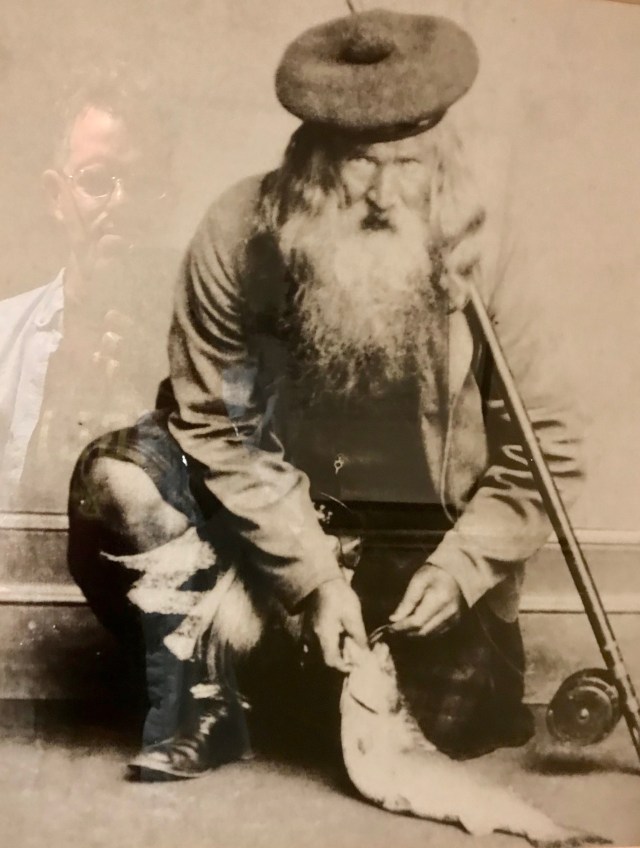
ScotsChanelling

Although this was a family trip, it seemed a moral imperative to not only fish, but to fly fish in the homeland of my forefathers. And if I could catch a trout on an ancient or traditional Scottish wet fly pattern, that would immeasurably sweeten the pot. So, where and how to do this? I ruled out Salmon fishing: cost-prohibitive and a greater chance of failure than success (maybe next time). So trout it was. Buddy Matt Supinski hooked me up with Graeme Ferguson, and we made plans this past spring for August 9.

Well, that’s the thing about booking so far in advance in a land thousands of miles away: you play the weather and conditions lottery. And my goodness, did we lose. Cam and I have a knack for choosing disaster weather on fishing trips, and we nailed this one dead center. The forecast called for heavy rain and 10-20mph winds. The Scots call it dreich. That sounds about right.

Brown, swollen rivers meant loch fishing — or in this case, lake fishing. Our mark was Lake Menteith, the only lake in country of lochs. Now, stillwater fishing is not my bag, but I was willing to try. And so we launched in a driving rainstorm accompanied by banshee winds. What the hell — the fish don’t know it’s wet.

We started off with sink tip lines and teams of three flies. I had the first touch, but I didn’t really know what to look for in a take. A botched hook set proved to be my downfall. A while later, Cam was on. If it looks wet and wicked and wild, it was. But a bent rod tends to make you oblivious to the conditions.
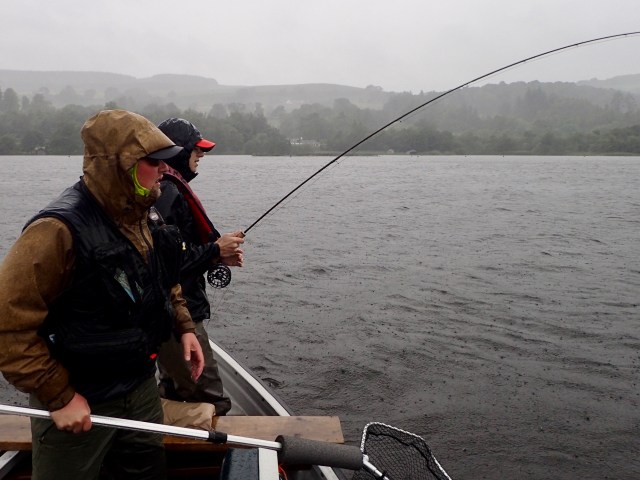
OLYMPUS DIGITAL CAMERA

~

Attaboy, Cam! Trip bought and paid for. These landlocked rainbows reminded me of junior steelhead in temperment and leaping capability. They’re also not shy about going deep — we had several fish sound on us as if the lake were bottomless. This fish took Cam’s point fly, a very Nuke Egg-like day-glo pattern.

OLYMPUS DIGITAL CAMERA

~

Are we having fun yet? We’d launched around 9:30, and three hours later the rain was dissipating. Graeme suggested we break for lunch, so we headed back to the clubhouse to dry out and re-fortify. A most civilized menu: Carrot/leek/corriander soup (a triumph, Mrs. Ferguson!), meat pie, and scotch eggs (hard boiled, surrounded by sausage, bread crumb coating, decadent).

HappyAnglers

~

Two critical events turned the afternoon tide in our favor: conditions improved (the rain stopped, it warmed up, hatches began, and the trout showed on the surface to feed) and I managed to fire up — in the wind, no small task with matches — a beloved Partagas Serie D No. 4. Floating lines on, first stop, bang! I’m on. You can see from the glassy water just below my elbow that we’re fishing in the shallow water of a cove, sheltered from the blow. We’d drift where the wind took us, adjusting as needed. Graeme also brought a subsurface drogue chute — brilliant! — that when deployed slowed our drift. 

OLYMPUS DIGITAL CAMERA

~

I bagged another one not ten minutes after the above photo was taken. We moved to a mark where a wee burn was dumping colder water into the lake. I decided to clip off one of Graeme’s buzzers (UK for midge larva) and tie on a fly I’d tied and brought with me, the traditional loch bob fly Kate McLaren. One of the beauties of fishing a team of three is that you often don’t know which fly the fish chose until you land it. Fish on, battle fought and won, and as Graeme netted it, he announced, “You’ll never guess which fly she took. The Kate McLaren.” I loved that fly, that moment, and especially that fish so much I decided to give her a kiss. The trout may look traumatized, but she swam away no worse for the wear.
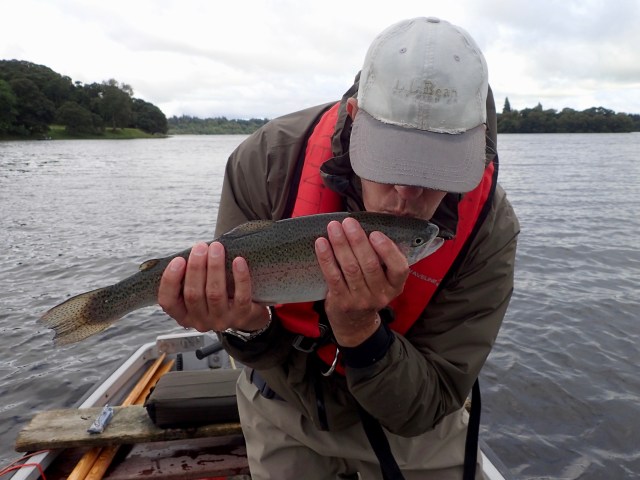
OLYMPUS DIGITAL CAMERA

~

Final tally was four for dad, two for Cam, and one very happy father-son team. Our boat, #4 (coincidence?) was a fine vessel. I can’t say enough good things about our guide, Graeme Ferguson: professional, matey, courteous, knowledgeable, capable, and his wife makes incredibly delicious soup. Here’s his contact information: graemeferguson_82@hotmail.com. He does rivers and salmon, too. Highly recommended. Tell him Steve sent ‘ya.
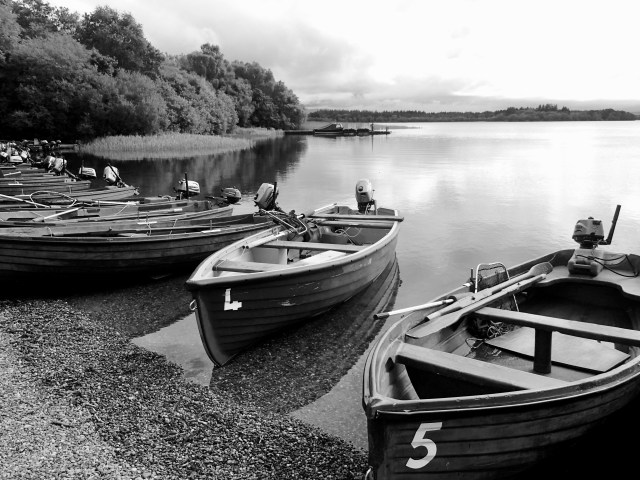
OLYMPUS DIGITAL CAMERA


Housy Report 8/1/19: Ladies & Gentlemen, start your White Wulffs!

The White Fly hatch is officially on! I experienced a heavy blizzard last night below the TMA beginning at 8:45pm. Up until then, the fishing was slow, with a handful of bass coming to surface (Gurgler and Countermeasure) patterns. Decent size fish in the 10-12″ class. But not a lot in terms of numbers. Water was 78 degrees, 250cfs and less stained than yesterday. Same bite pattern: waning as it got darker. Then the White Flies came.

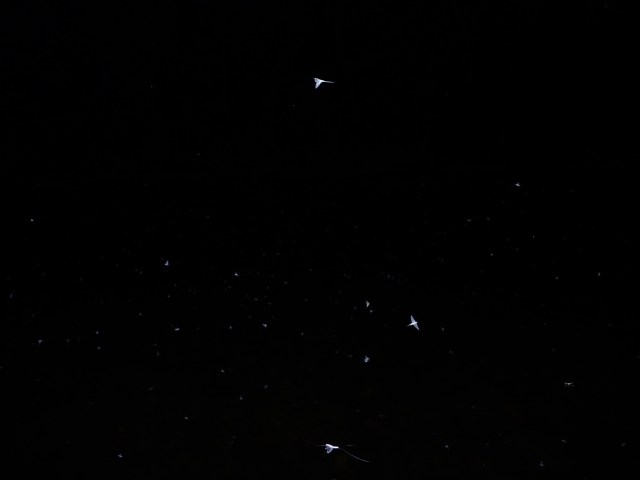
It starts like this…

OLYMPUS DIGITAL CAMERA

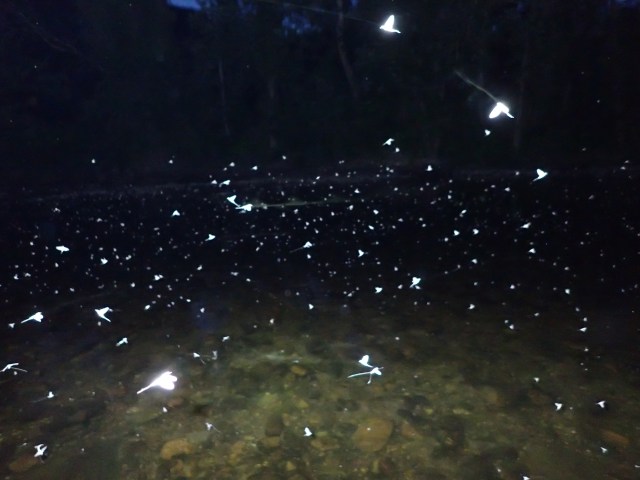
If you’re a White Fly newbie, this is a big (size 8-12) mayfly that hatches as dusk, then forms a dense cloud of mating activity, such that it looks like it’s snowing big, chunky flakes. If you turn your headlamp on, they will inundate you (they don’t taste very good — ask me how I know). It’s a late July/early August hatch, and when it’s going the bass will key on the insect to the exclusion of larger offerings. Wet flies swung pre-hatch and chunky dries like the White Wulff, Usual, and Light Cahill will serve you well. (You’ll want to tie those dries on stout hooks.) If you’re fishing spinners they have very long tails, twice the length of the hook shaft.

The hatch can be fickle and come and go, so jump on it this weekend.

…and before you know it, it’s snowing in August. All I had to do during last night’s hatch was pick a rise ring, make a drift over it, use the bucket method of strike detection, then set the hook. I took many fish on a flat that was only a foot deep. Don’t let those dainty, tiny sipping rise rings fool you — with the exception of one fish, every smallie I connected with at dark was in the double-digits length class.

OLYMPUS DIGITAL CAMERA