10/15/20 Housy Report and Thank You CFFA, Russell Library, and Croton TU!

Thanks so much to the Connecticut Fly Fisherman’s Association, Middletown’s Russell Library, and the Croton Watershed TU Chapter for inviting me to host some fly fishing Zoom meetings. I was able to speak to over 100 people this week, and I’m grateful for the opportunity.

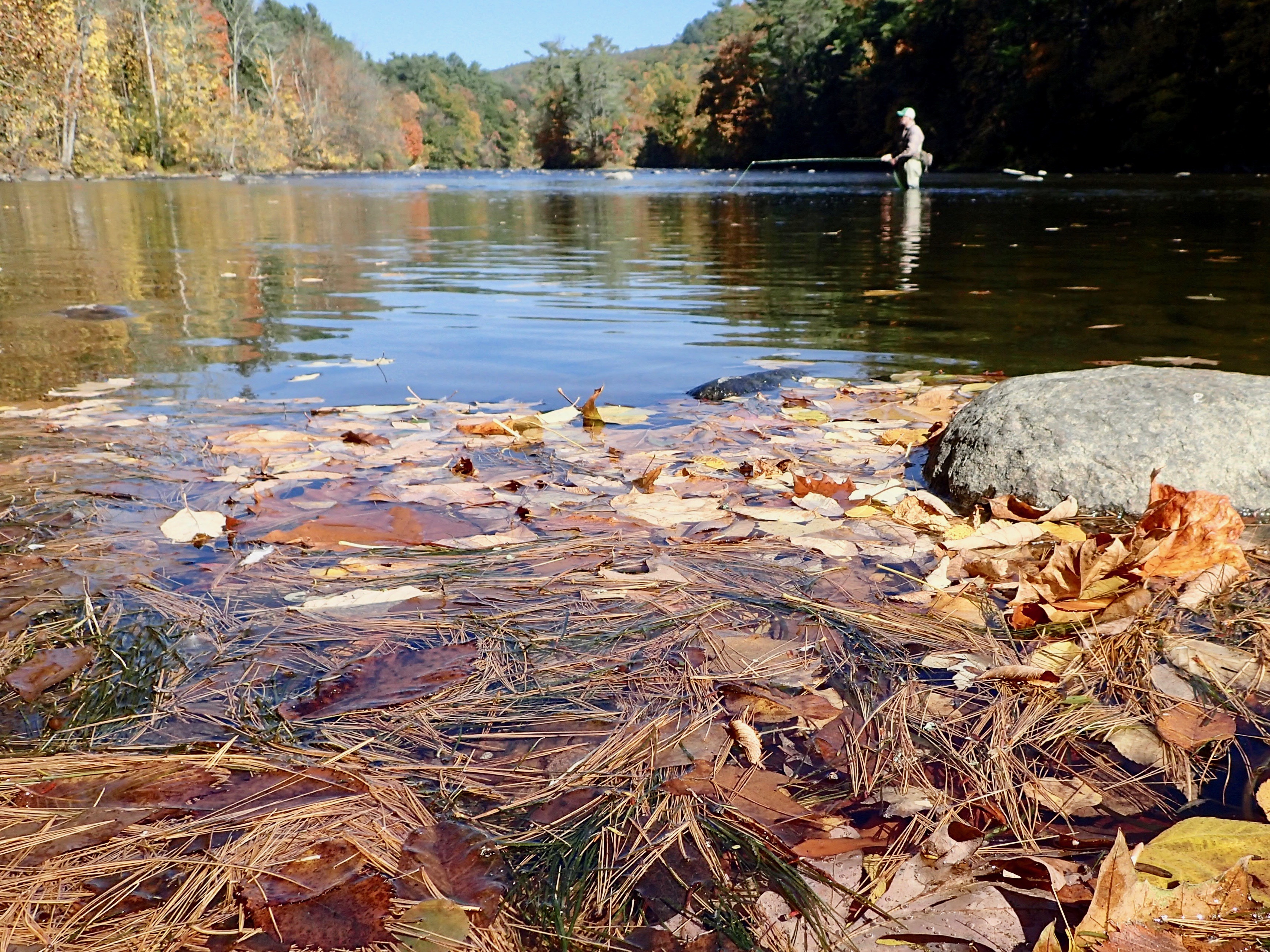
To the Hous: I fished within the TMA yesterday, and my experience can best be summed up by one Mr. Robert Zimmerman, who said in his epic song “Highlands,” “you picked the wrong day to come.” Okay, the weather was magnificent. It was great to be out. But there were scores of anglers competing for the honey holes (more people yesterday than I’ve seen in the last 10 years in the fall combined — really) — the water was loaded with leaves and evergreen needles (beware the windy autumn day) — and the trout were most uncooperative (I hit five marks in two hours and saw one fish landed). The river height was an excellent 325cfs, but those looking for solitude and leaf-free waters should be advised to wait a bit. Rain’s coming as I write this, and that should spike the flow this weekend.

With all this flotsam, it was challenging to get an unmolested drift.
Striper Report 10/8/20: the beat goes on

The hunt for big bass continues…slowly. I’ll make this brief. I fished last night with Toby Lapinski for about two hours at mark in southeast CT. Toby was on spin gear, I had the big two-hander. Not a touch for me, and Toby managed a single hello tap from a smaller fish. And that’s about all I have to say about that, other than this: the more you put in your time, and the more you learn the particulars of a potential big bass spot, the more big bass you’re going to catch. Looking forward to round three.

The water was a little milky due to surf/sand/wind, but plenty of visibility; certainly enough to see a fly like this. Mmmmmm. Squidcicle.

Farmington River Report 10/2/20: A great day for olives

Yesterday was a spectacular day for the tiny blue winged olives of fall: overcast, cool, drizzly. The bugs were out in force, and they had neither avian nor aquatic predators to contend with.

I guided Matt and his son Theo from 10am to 2pm. I know the fishing has been slow, but yesterday was ridiculous given the conditions and the hatch activity. We hit three marks, and managed only one 11th-hour hookup (which went quickly south when the trout melted the 5x leader I had tied on). Ugh. We focused on nymphing, and I had Theo doing some wet fly swinging and dangling when we saw some all-too-brief surface action. They both did a great job working hard, covering water, persevering, and I hope they’ll come back for a chance at revenge in the spring. It’s great to see a young generation fly angler who’s so enthusiastic!

Theo’s indicator dipped, and he set the hook. Not a fish, but rather this rig. I’ll give the creator bonus points for ingenuity, but I must also deduct points for using braid. Oops! That’s also a barbed hook, verboten within the permanent TMA. Boo-hiss on you.

OLYMPUS DIGITAL CAMERA

Farmington River Report 10/1/20: low, slow, and still crowded

I did a series of lightning raids on three spots yesterday within the permanent TMA. (I only had 90 minutes to fish.) The method was nymphing, both indicator and tight line. I found one fish that wanted to jump on. The other two marks were blanks. Even in these low, slow conditions there were anglers everywhere. Usually this time of year, on a weekday, I might see three or four angler cars during my travels. I saw three or four cars in several dirt pulloffs, and multiple solo vehicles. Fishing the Hous the last couple months has clearly spoiled me, as I’ve become accustomed to sharing the water with herons only.

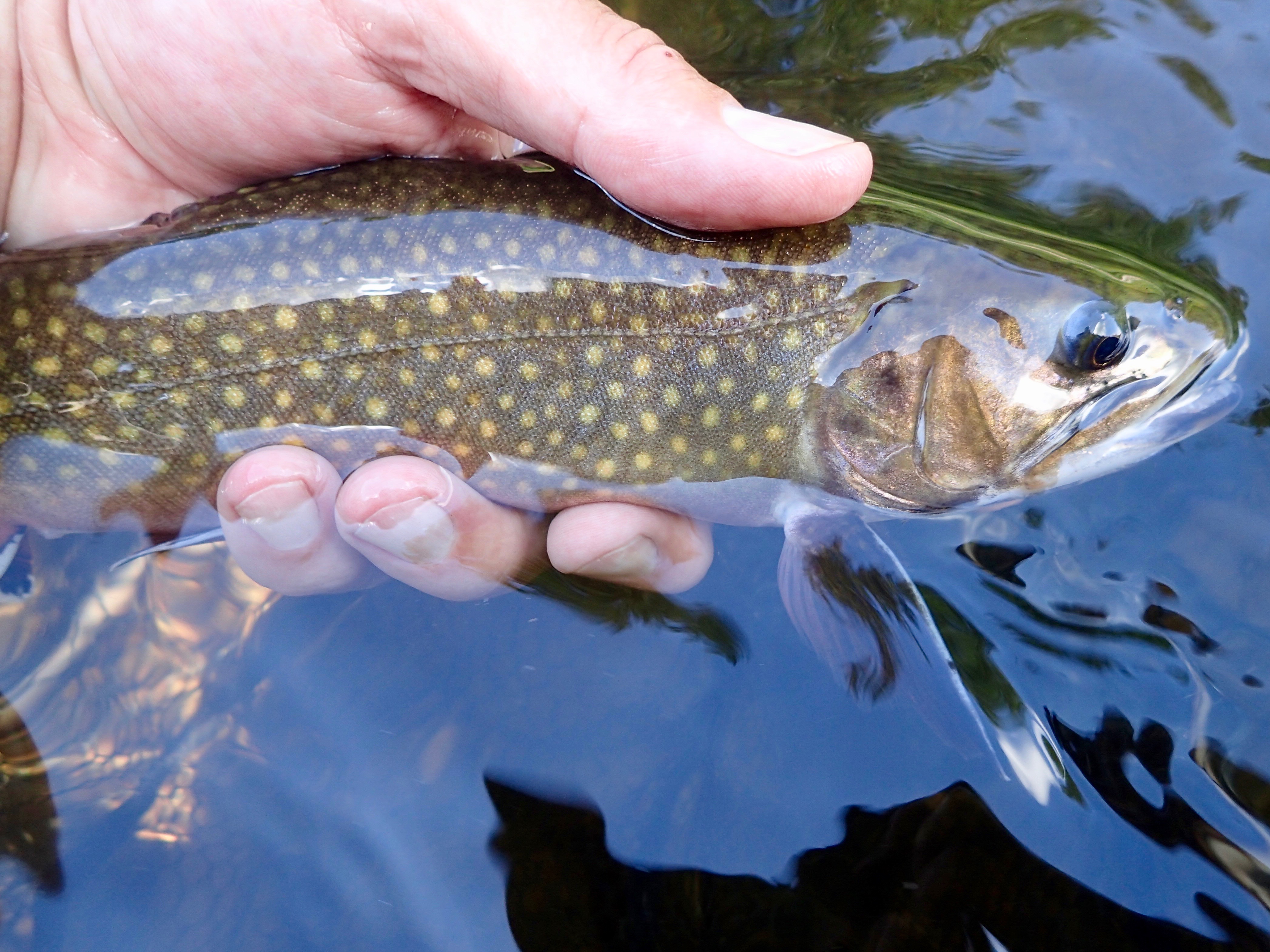
Good news is that the water was nice and cool and there were bugs about. Even with all those other anglers, this was the only trout I saw hooked all day. Lovely halos. She took the Frenchie Nymph variant. Leaves were an issue, and will continue to be with this early foliage drop.

Mini striper report 9/25/20: spotty but promising

I fished with Toby Lapinski last night — make that very early this morning — at a top secret location in eastern CT. (Toby is the Managing Editor of the New England Edition of The Fisherman magazine. Look for some stuff from yours truly in that pub coming soon!) Toby was spinning and I was flying. I love that combination because of the instant feedback it provides both anglers, and last night the response was: up the spin guy, down the long rod. I didn’t get a touch. Toby, who was fishing a variety of surface plugs and soft plastics, had a few bumps, an unfortunate bluefish lure removal, and a nice 20-pounder. The action was sporadic and sparse, leading us to conclude that Toby’s encounters were with lone wolves rather than any pods of fish moving through. To be continued this fall…

I pride myself in my photography, but let’s face it: this shot sucks. In the heat of the moment, both photographer and camera screwed the pooch. As always, we strive for a quick, striper friendly release, photo op be damned, so by the time I figured out the issue we could only manage this blurry disaster. Try to imagine 30-something inches of piggy striper swimming away. Please.

Tiny bait, lots of bait = a good time for droppers

I fished three marks in SoCo last night, and while the striper action was slow, the bait story was consistent: smallish to tiny, and lots of it. Confirmed sightings: silversides, anchovies, peanut bunker, and I may have seen a stray finger mullet.

My night began in the surf, but the meatball factor (bright headlamps used early and often) and a lack of action had me moving to Spot B, an estuary with a moving tide. Lots of bait, too few marauders.

I finished the evening at Spot C, some skinny water on flat, just as the tide began to flow out. Lots of worried bait in this location, and it’s a perfect place to fish a team of three. I had 2″ long Ray’s fly on top dropper, a Magog Smelt bucktail in the middle, and a micro Gurgler on point to do double duty as a suspender and waking fly. I was disappointed with the number of assembled diners, but it is what it is and you do your best. Two fish to hand in 45 minutes and I was satisfied, abetted in no small amount by a Rocky Patel Vintage 1990 corona and a come-from-behind Mets victory.

In case you haven’t seen it, here’s a quick refresher.

Why I love topwater smallmouth

It’s been a tough year for smallmouth in terms of size and numbers, but I’m finding enough topwater action to keep me stoked. I’ll present a more detailed report on my summer adventures in the next few weeks, but for now this picture says it all. I’ve been getting a lot of action on Jack Gartside’s  Gurgler and my Countermeasures bug.

GurglerSmallie

Farmington River Report 8/12/20: Howling back at the dog days

While it’s positively tropical across the rest of the state, the Farmington continues to offer respite. True, they’ve lowered the flow (165cfs within the Permanent TMA) but the water is plenty cold. This can be a tough time of year to fish: hatches are sporadic and sometimes light at best; and in flows this low the fish are concentrated in certain areas and can be downright spooky. Nonetheless, Dave wanted a wet fly lesson, and off we went.

At this height, the river is still quite agreeable to the wet fly. You’ve got water that’s deep enough to swing, enough water to create a good current, and as a bonus the fish are always looking up. Dave did a great job, and his enthusiasm was palpable. We fished three marks, and found players in one of them, a nice mix of brook trout and a jewel of a wild brown. All of our fish came in faster water/riffles. Dave is awarded the Currentseams Order of the Straight Line: he is my only student this year to make it through a wet fly session without a tangled leader! Well done, good sir, under some challenging conditions (we did not see another fish caught all day).

Guides love bent rods (although I must’ve got him between strips). Fish on, baby!

OLYMPUS DIGITAL CAMERA

~

This was a stocked brookie, but he’s been in the river long enough to regain some lost lustre and begin to grow some proper Fontinalis fins.

OLYMPUS DIGITAL CAMERA


Farmington River Report 8/5/20: the last second winning drive

I guided Abe yesterday from 2:45-6:45pm. Abe, who said he’d never done particularly well on the Farmington, wanted to focus on wet flies. For the longest time it looked like we’d picked the wrong day. The river was in fine shape, no worse for the wear after the storm. They lowered the flow out of the gate to 160cfs, but the Still was adding another 100 or so to make an ideal summer level, and the water was plenty cold. Getting there was an issue for me: closed roads in Bristol and Farmington turned a 50 minute drive into 90.

We hit four marks and found spotty action at best. Hatch activity was virtually nil, a 1 out of 10. I don’t need to tell you that that meant a paucity of active visible feeders. Nonetheless, we stuck a few fish in the first mark and had an LDR. The second mark was a bust, with only a couple courtesy taps. The third was even worse, without a single fine how-do-you-do? But the fourth…ah, the fourth. We broke out the wading staff and ventured into a snotty, pocketed, riffly run that always holds fish this time of year. I switched out the Hackled March Brown on point for a SHBHPT to give us a little more weight. Time was running out on our session. Whack! Mid-teens rainbow. Bang! Gorgeous wild brown. Bap! JV Atlantic salmon. Three fish in 15 minutes made for a very satisfying end to our session. Kudos to Abe for fishing hard, fishing well, and never giving up!

You’d be smiling, too, if you’d just landed a quality trout on a wet fly on such a slow day. Our quarry was camera shy. Thankfully, Abe isn’t. While angler traffic was light, we didn’t see anyone else hook up all day.

OLYMPUS DIGITAL CAMERA


Farmington River Report 7/29/20: “We can catch that fish.”

I guided Andrew yesterday and our focus was wet fly fishing, reading water, and finding productive water. We fished two marks into late afternoon/early evening, one within the Permanent TMA and the other above it. Conditions were as about as good as you could want for this time of year, with a healthy 270cfs flow and the water plenty cold. The first mark was frustrating as we found feeding fish, but not a high percentage of players. Like many beginning wet fly fishers, Andrew needed to learn to let the fish set the hook. In fairness, most of these trout were smaller, their feeding sporadic, and as I told Andrew, the bigger fish don’t miss when they commit to the wet fly.

The second mark was a snotty run loaded with boulders, pockets, and all kinds of rocks that wanted to trip you up if you’re not careful. But Andrew was game and we went exploring. Things began slowly, but then we started to see sulphurs, olives, and Isonychia, along with one giant yellow mayfly (Potomantis?) and a corresponding spike in feeding. We found a big rainbow carelessly slashing at emergers at the end of a pocket run, and I said to Andrew, “We can catch that fish.” And then, “Remember, don’t set the hook.” Second cast, bang! Off to the races.

You can see that smile all the way through the mask. Andrew and his prize, a mid-teens chunker rainbow. Not an easy fish to land in a ripping current, but the trout hooked itself neatly on a Hackled March Brown. (Note arms bent at a 90-degree angle. There’ll be no fish thrusting on this site!)

OLYMPUS DIGITAL CAMERA

~

The battle won, the fish kept wet in the net until a quick photo is taken, then the release. Always a  highly gratifying moment.

OLYMPUS DIGITAL CAMERA

We finished up in another long pocket run that was populated with trout feeding on sulphur emergers. They proved to be tougher customers, but we landed a few on the Partridge and Light Cahill and called it a day. Great job, Andrew! I took a break and then got in a little wet then dry fly session. Hatch and feeding was about a 5/10. But you get what you get and you don’t get upset, especially when you have and entire pool to yourself at dusk.