The Everglades is big and wild and intimidating. It’s also intimate and beautiful and serene. I know, this sounds like the beginning of a middle schooler’s essay. But it’s truly a challenge to describe the place. One thing’s for sure: we don’t have anything like it at home.
In case you’ve never been, the Everglades is an enormous subtropical wetlands that ranges from Lake Okeechobee to the southernmost Florida mainland. You see things like palm trees and sawgrass and mangroves, and it’s evident that you’re in a warm, wet climate. But when you’re out in a boat in the middle of one of the expansive watery areas, a glance at the distant verdant shores could make you believe you’re on a lake in Minnesota. The only clue that you’re not is that there are no houses dotting the landscape. The lack of ego in the form of architecture definitely adds an allure of mystery.
But you’ll see birds and fish and reptiles…and mosquitos. Fortunately, my experience this time was mosquito light. (Not so four years ago in May, when those bloodsucking flesh drillers were so aggressive and relentless that I literally had to sprint from my car to the visitor center in Everglades National Park to find sanctuary.)
Parts of the Everglades have an extensive canal system, and on the first day we fished one of them for peacock bass. I managed to hook ten different species over the course of three days. Some of them were old friends from Connecticut like largemouth bass and bluegill. Others were recent acquaintances from a few years ago, namely jack and ladyfish. But six of them were brand new to me: gar, oscar, peacock bass, speckled trout, snook, and tarpon. To get to the Flamingo boat launch in the southern end of the Everglades, you need to travel a two-lane road that cuts a straight edge for most of its 50 miles. Once you launch, you head along a canal much like the one in the first picture, then out into what I call “the lake.” There are all manner of rivers and creeks and islands and coves to explore off the lake, and this is where the massive Everglades can reach that wonderful state of intimacy. Here’s a still from a video I shot. We’re water bushwhacking — those are mangrove trees — though a creek that’s not much wider than the boat. You had to parry the branches away from your head and body. It leads, as many of them do, to a small cove that resembles a New England salt pond flat. You go into stealth mode — whispering and hand signals only — and you look for cruising fish or travel lanes or little pockets against the mangroves to cast into. We blanked in most of these, but a few of them produced, and in a week where the bite was considered to be slow, you take those moments and don’t ask questions.Air plants are epiphytes, meaning they grow on other plants, in this case a mangrove. These look like the dried tops of pineapples. They draw their water from the humid air and from rainfall. One of the best parts of fishing in the Everglades is that you get to see and hear and sometimes even touch plants and animals that aren’t ever found where you’re from. Speaking of humidity, it wasn’t very warm or humid the first two days on the boat, but by the third the layers were getting peeled off as sunrise transitioned to mid-late-morning.Bon appetit! Monday’s quarry was peacock bass. This gator beat me to this particular fish, but I’ll tell you all about my first experience with peacocks next. Spoiler alert: there were lots of them, they provide great sport, and I want to catch more. Photo by Mark Giacobba.
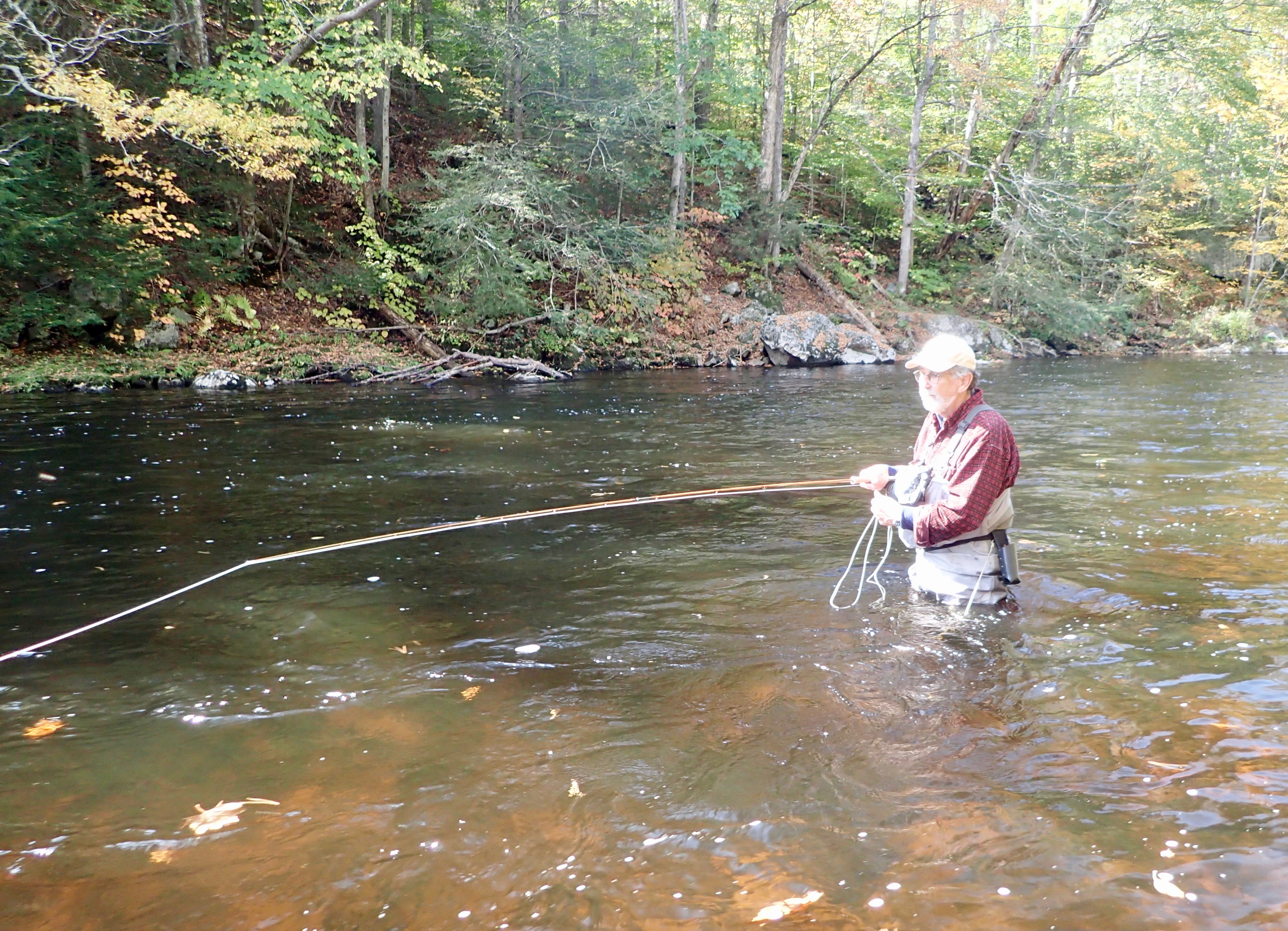
The trip didn’t start out like I’d hoped. While I was gearing up, I discovered that I’d forgotten my wading staff. (With flows over 1,300cfs, that would have come in handy.) Then, I realized I’d forgotten my streamer reel and line. Since I was dedicating the session to the streamer cause, I lined up with something I had remembered: my integrated full sinker. It was a classic case of, “somehow, it all works out,” because there were so many leaves in the water. By using a full sink and a tungsten-head streamer, I was generally able to avoid vegetation hits.
First cast with a Mickey Finn soft-hackle, and whack! I hadn’t even begun my strip cadence. It was a quartering cast downstream, and as I fumbled for the line, the streamer sank and began to move down and across. That’s when the hit came. It was a lovely holdover brown, about a foot long, and I thought this was going to be the start of a day where you land a pile of fish just by showing up. ‘Twas not to be. I didn’t see another angler hook a fish over two hours, and there were plenty of people out and about on this fine fall day.
The night before, I tied up two old Housy favorites, the soft-hackled Mickey Finn and Black Ghost. This is an old, crappy photograph, but essentialy the flies have a template of marabou tail, then a contrasting marabou hackle and some black Ice Dub for a collar. There’s flash, too; sometimes I use Krystal Flash and sometimes Flashabou. I’ll try to put together a complete recipe and shoot some better photos of the steamers.
A few minutes later, I stuck what I thought was going to be my biggest trout of the year. I’d felt a solid bump on the cast before; I repeated the cast, and the fish did not miss the second time. It sounded and bulldogged and I realized I might have hooked into a trophy brown. When I finally got its head up, surprise! Smallmouth. A good one, too, mid teens and fat, with dramatic fall camo colors. That’s the latest in the season I’ve ever caught a decent smallie on the Hous.
I visited a second mark and managed a courtesy tap, but with the clock ticking I moved to the last spot. This section was moving faster than the previous two pools, and with a well-defined slot I made the decision to switch to the long-leader jigged mini-streamer. Slow going, but I was rewarded with a fat stocker rainbow on my last cast. And that, I thought, is the perfect way to bookend a two-hour streamer set.
Doug and Paul chose a spectacular fall day for a session with yours truly. Unfortunately, the bite didn’t match up to the conditions. We fished two sizable marks from 10am-2pm, and all we could manage was one bump and one hookup. That actually isn’t as bad as it sounds; angler traffic was fairly heavy for a fall weekday, and I didn’t see anyone else hook up the entire time. So well done, Doug and Paul! The river was running medium high (530cfs) and the water is beginning to cool nicely. Observed: caddis and a few tiny BWOs. Leaves are a bit of an issue, and we had all our action on white streamers. (I should have mentioned that we were dedicated to the streamer cause, both traditional presentations and long-leader jigged micro streamers.) Both anglers fished hard and well, and on another day might have connected with dozens.
Doug having at it. Perseverance helps on slow days, and Doug was rewarded not too long after I took this shot.Paul makes the point that there are worse ways to spend a few minutes on a sunny fall afternoon than sitting on a log with your feet in a river. I loved how Paul asked so many questions. Thinking anglers are better anglers. A most enjoyable day, gents!
I’ve been focusing on small streams this month, partly to scratch an itch and partly to shoot video content for the new small stream presentation I’m building. Small streams are cool because they’re like any bigger river or ocean: weather changes, water levels (or tides) rise and fall, water clarity and temperatures fluctuate — you never know what you’re going to get until you get there. Here are few photos along with some things I’ve noticed that might help you on your next small stream adventure.
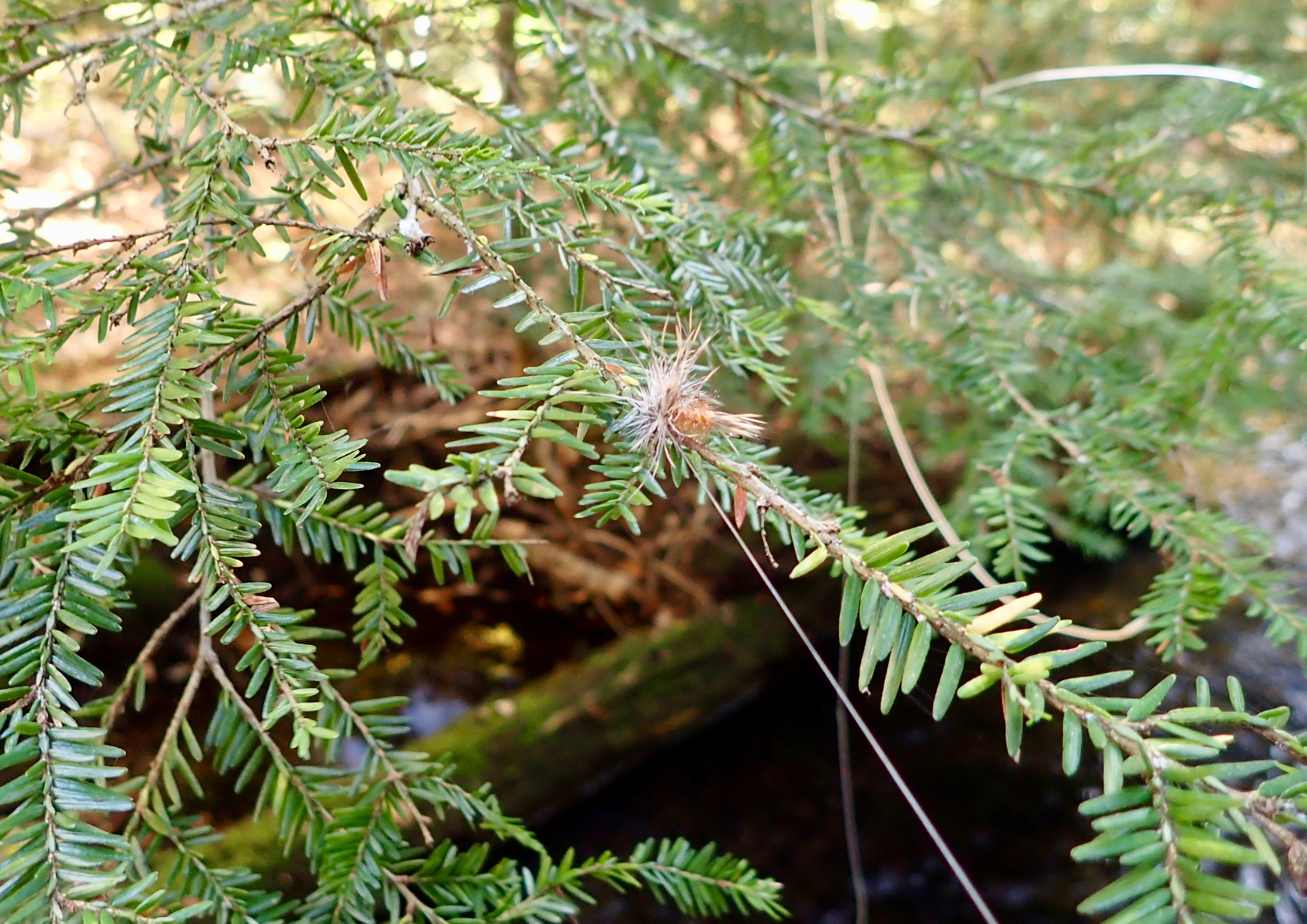
Micro Wigglies work — here’s proof. But I’ve been very disappointed by the generally poor reception the brookies have given them. Micro Wigglies are almost useless in high water, and even in low water need to be stripped to induce a strike. If you’re committed to the dry fly cause, it’s hard to go wrong with a big, bushy dry. What’s “big?” If I’m not necessarily interested in hooking sub-4″ fish, 14 is as small as I’ll go. Of course, you de-barb your hooks, limit photos, and only handle wild fish with wet hands. It goes without saying (but I’ll do it anyway) that you should never lay a fish down on rocks or dry leaves or sand for a photo. This may be self-evident, but the better dry fly days are the ones when the water is lower rather than higher.Using roll and bow-and-arrow casts helps you avoid annoyances like this. My rule of thumb for awkwardly-placed-by-nature streamside vegetation is: If it’s living, I never remove it. If it’s dead, it must not be visibly supporting life (spider webs, for example) or creating good natural structure/cover for the subsurface residents. So, if it’s a spindly twig that got knocked into the river last wind storm, and it keeps eating your streamer, feel free to toss that sucker.Dry flies are a hoot on a small stream — make ’em come up! — but the bigger fish are usually taken subsurface. I marvel at how curious these char are about any intruder in their underwater world. You can feel them bumping the fly moments after it hits the water. What is it? Food? Not food? Threat? Don’t mess with those teeth! I
Yesterday I wrapped up some drone footage with Director Matthew Vinick for his upcoming film “Summer on the Farmington.” Elevated flows (650cfs in the Permanent TMA) and leaves were an issue, but we got it done. Adverse conditions didn’t discourage the legions of anglers I saw out enjoying the river and weather. I had 30 minutes to fish for pleasure after the shoot, so I hit a favorite mark for some tight line nymphing. Sadly, every stall of the sighter or tangible bump turned out to be either bottom or debris. I was not alone — of the dozen or so anglers I shared water with, I did not see a single trout hooked. On a positive note, the water is noticeably cooler than it was a week ago. Things can only get better, right?
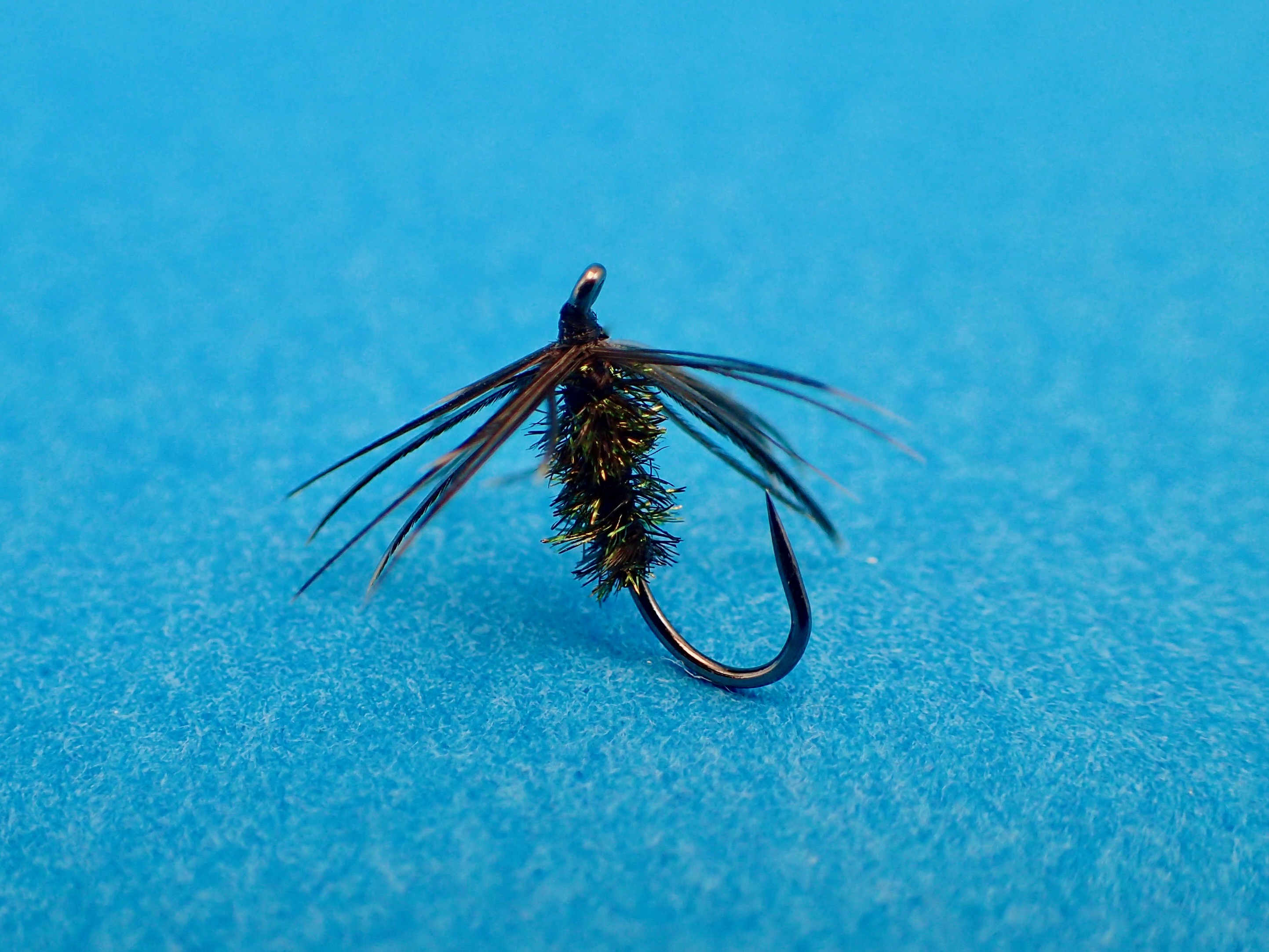
Pro tip: when there are so many orange/yellow/red leaves in the water, try going dark or white with streamers — and make sure one of your nymph droppers is small and dark (it’s tiny BWO season). A small Starling and Herl soft hackle would be a fine choice.
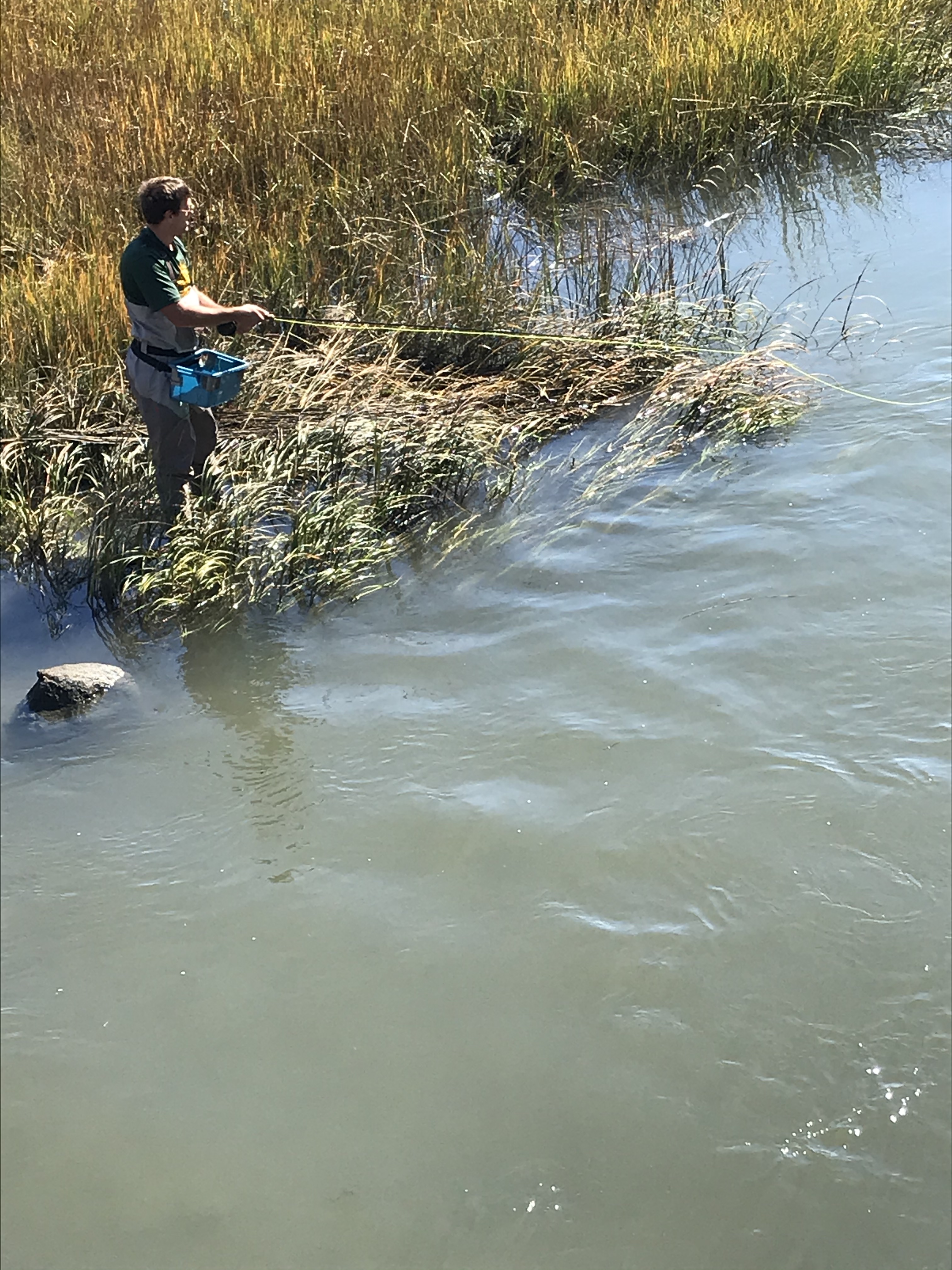
On Wednesday Alex took a striper lesson with me. He did a fantastic job. The point of these short (2 hours) lessons is to give students feel for how to approach multiple situations involving current — and especially for them to discover the expansive fly fishing life beyond cast-and-strip. We do it in the daytime (the better to eyeball things) and while the immediate goal isn’t to catch — that will come later — I have the highest amount of respect for those who want to invest in upping their game. Alex did a tremendous job; he has an intuitive feel for current and presentation. Now all he needs is some bass to play with.
As it turns out, so do I. I drove to Rhode Island that night to fish two different marks and, once again, I was disappointed by the paucity of striped things that swim. The first mark was one of my “guaranteed” spots. You know — a place you go to save a night when you desperately need a fish. No longer. I’ve fished it three times this year, blanked all three times, and it’s the first year in decades that I have not caught a bass there. Fooey. Not to be outdone, the second mark had plenty of bait, and not a single striper. So I casted, mended, and tried to pretend that maybe a bass would show up. Instead, I stayed out way too late. I won’t be going back this year (he said bitterly).
Alex really nailed the greased line swing. What a lovely day to be out fishing.
A bit of a busman’s holiday for me yesterday as I had a busy day shooting video on a small stream. This is one of those places where there’s no easy way to get there (both driving and walking). Plus it sucks to spend so much time setting up shots that end up being unusable. But whoa! Listen to me kvetch. What a lucky man I am to have such an office. There’s a certain beauty on display in the deep woods after a rain, hills shrouded in fog, water droplets collecting on leaves, rivulets rushing down hillsides. The water was up a tad from the rain, but running clear and cold and the char were open for business. I did well with bushy dries and mini tungsten head buggers. (I’m still a little bitter that they were indifferent to my micro Wigglies.) The better fish came on streamers — no surprises there. I guess I’ll have to go back next week to get all those shots I missed…
I like the metallic look of the gill plate. I like the blue halos. I like the specificity of the lateral line. Ah, screw it. I LOVE this fish.
Yesterday was supposed to be a shooting day for a film and some personal projects, but the wind was most uncooperative, so we bailed. Already on the river and two hours to kill…what’s an angler to do? If you said, “fish,” you are correct! I decided that absent any consistent rises, and with the gusty wind, indicator nymphing would be my best bet for hooking up. I fished three marks and found players in two of them. I was asleep at the switch for one of the hits, and dropped the fish as I fumbled and bumbled the late hook set. But I did connect with evidence that even in harsh, trout-stressy warm water, nature finds a way. Believe it or not, this was my first outing on the Farmington since June.
This YOY wild brown fought like a tiger and almost refused to sit still for a portrait. Taken on a size 18 soft-hackled pheasant tail. It’s always gratifying to discover that even seemingly fragile creatures have the genetic programming to make it through the most challenging conditions. See you in a few years, OK?
I had a rare Saturday night to myself so I ventured out to points salty. I won’t bore you with the details of the first 90 minutes, although they were pretty eventful, featuring: wedding party songs I don’t like, fireworks in the distance, almost perfect conditions, that long slow pull mystery solved (squid, of course), not a touch from a bass, and finally, a parking ticket. Egad!
After all that excitement, I decided to amuse myself at a well-lit estuary. I find places like this highly addicting; my intention was to fish for 15 minutes. Over an hour later, I had to drag myself away. The action wasn’t that great — there was a decent amount of bait (silversides and juvenile menhaden), but predators (hickory shad and bass) were few and far between.
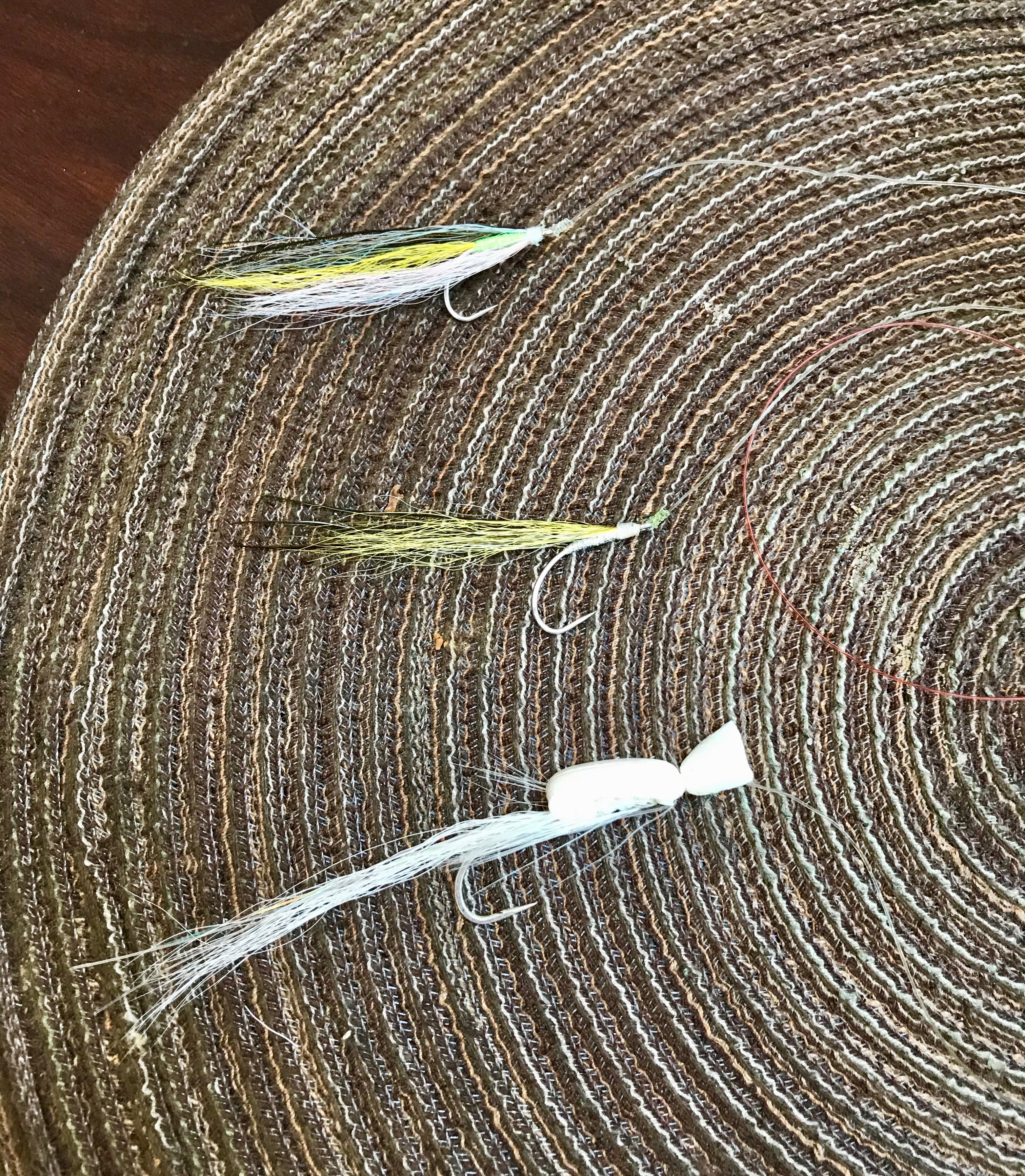
Which brings me to the point of this post. I was, of course, fishing a three-fly team — you do too, right? (If you don’t, you should read this short article on how to build a dropper rig for striped bass. You can thank me later.) Hits were few and far between, but every time I did get hit, I was doing one of three things: dead-drifting the team of three in the current, letting it dangle in the current, or performing a very slow hand-twist retrieve. I call this “trout fishing for stripers” because these are all traditional trout or salmon fly fishing tactics. Learn the art of presentation, and you’ll be able to catch the fish that everyone can’t.
Saturday night’s crew. I had touches on all three patterns.
On Tuesday the DEEP collected broodstock for the next generation of Survivor Strain brown trout. The MDC drew down the reservoir to about 70cfs and the collection crews had at it. Normally, I like to give warning of the event (you can still fish, but you need to stay clear of the collection crews) but I missed that boat. However, I’m happy to report that well over 100 trout were collected — and after the challenging summer conditions these fish made it through, you can rest assured that the survival aspect of their genetic material is exceptional.
With cooler days and nights upon us, re-stocking the river will begin soon. Then we can pretend that this summer never happened.
Task completed. Back up she goes! It may take a day or so for the fish to regain their bearings.








 currentseams.com