“Block Island Stripers from the Shore” in the Oct/Nov/Dec 2016 issue of Mid Atlantic Fly Fishing Guide

It’s the Destination Issue of MAFFG, and we’re all heading to Block Island! A nifty little primer on the island, its structure, flies, gear, and more. While this past year was (ahem) a bit of an off-year for stripers on the fly from the shore, the Block remains one of my favorite places to fish — and write about.

While I truly love answering your questions, let me head you off at the pass: no, I don’t know where you can find a copy of MAFFG. You can try contacting them through their Facebook page. And of course, let them know you enjoy my writing.

Hot off the presses.

OLYMPUS DIGITAL CAMERA


Ten Things Every Beginning Steelheader Should Know

“Ten Things Every Beginning Steelheader Should Know” first appeared in the October 2015 issue of Mid Atlantic Fly Fishing Guide. I had a lot of fun with this piece, as it mixes humor with practical advice. Even if you’re an old hand, you might find something useful here. Many thanks to MAFFG for allowing me to share it on currentseams.

So, you’ve decided that you’re going to take up fly fishing for steelhead. I don’t know whether to congratulate you or console you. No other form of fly fishing produces such soaring emotional highs or soul-crushing lows. But, the least I can do – as someone who was once in your bright-eyed position – is prepare you for what lies ahead.

Stop. Turn back now before it’s too late. Steelheading is an addiction. And once you’re hooked, dealers in the form of social media fishing reports, grip-and-grins, river conditions, dam release schedules (not to mention endless discussions about rods, reels, flies and gear) will have you at their command. “Obsession” is not too strong a word. Work, social, home life – will all suffer for the pursuit of fresh chrome. You think I’m writing this tongue-in-cheek. I am not.

Expect harsh weather. Great Lakes steelheading is largely a fall, winter, and early spring game. Be prepared for some of the most unforgiving conditions you’ve ever experienced: single digit (or lower) temperatures; lake effect snow; more lake effect snow; really, any and all forms of frozen precipitation. Truthfully, plain cold isn’t that bad. It’s the thirty-four-degrees-and-raining days that cut to the bone. Dressing like you’re going on an expedition to Everest is rarely a bad idea. Fleece is your friend. Think multiple, breathable layers. And those hand and toe warmers they sell in convenience stores? Buy many, many packs.

Prepare yourself for the demanding conditions of a big river. A skunking can be the least of your worries, as this sign along the banks of New York’s Salmon River warns.

srsign

~

Find a tippet you can trust. The most obvious dichotomy in steelheading is that you’re using a light tippet to land a very big fish. So your tippet material must be small enough to remain unnoticed by the steelhead, and strong enough to withstand a heated battle. Here are two such materials: Drennan six-pound fluorocarbon and Maxima Chameleon six-pound nylon. Be ruthless about the condition of your tippets. Check them frequently for abrasions or wind knots. If you find problems, replace the tippet. You’ll be happy you did when you’re fighting that fifteen-pound hen fresh from the lake.

The flies are a little strange. You can catch steelhead with a tuft of Day-Glo yarn tied to a hook, or a few turns of Estaz wrapped around the shank. You may hesitate to call these things flies. Nonetheless, they work. Don’t be afraid to experiment with more traditional patterns and color palettes. Small, simple black stoneflies (like the 60-Second Redhead) and bead-head Pheasant Tail-types account for a significant number of my Great Lakes steelhead every season.

Fluorescent colors dominate a typical steelhead fly box. While egg patterns, gaudy bead heads and brightly accented stoneflies like these certainly catch fish, so do flies in muted, natural colors.

steelhead-flies

Life is not fair. Neither is steelheading. You can do everything right, from presentation to hook set to managing leaps to applying pressure, and still lose the fish. You can do all those things wrong and then land the fish. You can stand in a lineup while every angler above and below you hooks multiple fish and you blank. The spot where you caught a dozen one day is a barren steelhead wasteland the next. I gave up trying to figure it all out years ago.

Sometimes steelheading makes no sense. On this warm late November day, the river was high from snowmelt, the color of chocolate milk, with visibility of less than a foot – and we still had a tremendous day of fishing.

Steel Cam and Me

~

Be prepared to put in your time. It took me forty hours of fishing to land my first steelhead. (It took my nine year-old son only thirty minutes. That was three years ago, and I’m still bitter about it. See “Life isn’t fair” above.) Experience will be your greatest teacher. Pay attention to factors like water temperature and water levels. For example, if the river is low, I know to head for what I call the hot water – snotty whitewater riffles and pockets. Learn where steelhead hang out in the cold winter months. Watch how other people fish. Note the methods of successful anglers. Most of all, get out and fish. You can’t catch steelhead from behind a desk.

Go find the fish. Don’t get lulled into thinking that because steelhead are migratory, they could show up at your feet any minute now. I’ve spent far too many hours – if not days – waiting for something to happen that never did. If you’ve blanketed a run with presentations and have come up empty, move. The fish that want to eat are somewhere else. And it is often true that where there is one hungry steelhead, there are many others.

Tom’s 60 Second Redhead, so named because it only takes a minute to tie. In this version, the abdomen is black Krystal Dub; the head red Ice Dub. This simple pattern excels in rivers with little black stonefly populations.

60Second RedHead

~

Hook set is everything. I suspect that more steelhead are lost to poor hook sets and dull hook points than any other factors. Most of the steelhead I lose come unhinged in the first few seconds of the fight. Get in the habit of checking your hook points early and often. If they aren’t sticky sharp, replace them. If you’re presenting under an indicator, watch it like a hawk. Look for a reason to set the hook on every drift. Set hard with a downstream sweep. Get tight to that fish fast, and set the hook again. Then, hang on. This is where the fun begins.

Don’t let them breathe. It’s easy to get caught up in the hype of a steelhead being in charge of any fight (though it’s true to some extent). Still, don’t let the fish intimidate you. Once your steelhead realizes that it’s hooked, it will want to run. Let it. It may want to leap and cartwheel. Enjoy the spectacle. But when it stops its histrionics, point the cork of your rod handle upstream, and crank that reel fast and hard. The fish stopped running because it’s exhausted. Don’t let it catch its breath. With a good hook set and a reliable tippet, you can put far more pressure on a fish than you think. Let the fish run again if it wants. Same drill: don’t let him breathe. Find that perfect equilibrium on your drag that makes the steelhead work hard for every foot of line without popping the tippet. Your goal is to land the fish as expeditiously as possible. The longer you play a steelhead, the more things can happen – and most of them are bad.

5mm neoprene insulated boot foot waders. In my opinion, this is the single greatest development in fly fishing for winter steelhead in the last 50 years.

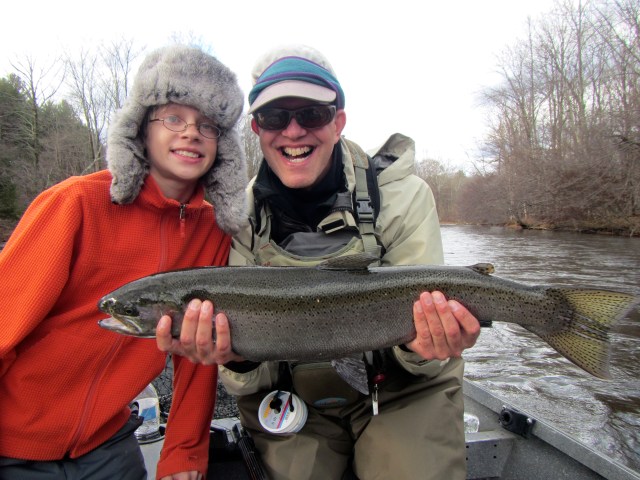
Why we steelhead. Brilliant chrome from Lake Ontario, taken in two feet of whitewater during low flows on a black and purple North Country Spider Egg.

Fresh Chrome, November 2014


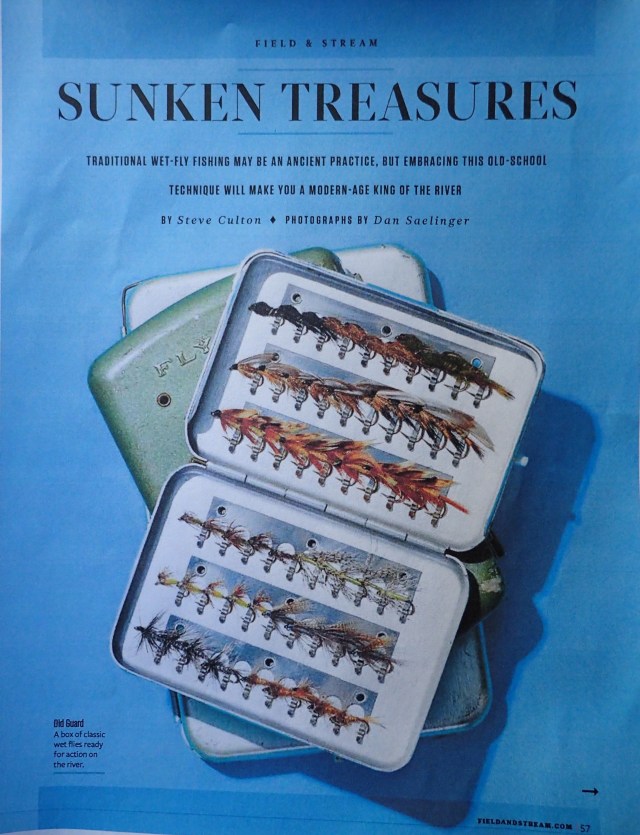
Discover “Sunken Treasures” in the current issue of Field & Stream

“Sunken Treasures” is my first piece for Field & Stream, and you can read it in the August 2016 issue. The article is a wet fly primer that is based on my “Wet Flies 101” class and presentation. For those interested in learning the ways of the wet fly, this is a good starting point. And it goes without saying that I’m grateful for your readership, both in print and here on the site. Here’s a link to the online version of the article.

If you haven’t yet, please visit the currentseams Facebook page and give us a like. You can get there by clicking here.

The cover.

Aug2016F&S

And the title page. I tied many of the flies pictured.

OLYMPUS DIGITAL CAMERA


“Nighttime Fishing for Big Trout” in the Aug/Sept issue of MAFFG

“Ten Things You Should Know About Nighttime Fly Fishing for Big Trout” is in the current (August/September 2016) issue of Mid Atlantic Fly Fishing Guide. Part how-to, part humor, it’s a piece I’m proud of. You should read it.

Hot off the presses and top billing. Whoo-hoo!

OLYMPUS DIGITAL CAMERA


The Myth of the Tapered Leader (and other striped bass nonsense)

The subject of saltwater fly fishing leaders comes up all the time on internet forums. The accompanying question is usually “which leader is best?” (Answer: There ain’t no best. Only what’s right for you.) Then, human nature being what it is, people come forward with many suggestions. They describe the leader they use, sometimes in great formulaic detail.

A client from my advertising agency days used to say that the internet is a great resource, but all it does is throw information at you. It doesn’t separate the good from the bad. I know what he means, because during these leader discussions someone invariably states that you need a tapered leader to turn your fly over.

Horse hockey.

For years now I’ve been using striped bass leaders constructed of a straight shot of 20, 25, or 30 pound test mono. (The stuff is called World Wide Sportsman Camouflage, and it’s sensational.) This is also the material I use to build my three-fly striper rig. Somehow, my flies manage to turn over. Somehow, I manage to catch fish. If, as so many internet quarterbacks maintain, a single diameter construction consistently led to the leader landing in a pile, my three fly team would be in a perpetual state of tangle.

This is not to say that tapered leaders don’t help a fly turn over. But if you’ve ever executed a pile cast with a tapered leader, you know that it’s the mechanics of the cast, not the leader, that determine if the fly turns over.

I find stripers to be a fascinating fish. But I have yet to meet one that cared if my fly turned over. Maybe you know one who does.

If so, please send him my way.

My three-fly striper rig, in case you missed it. 

OLYMPUS DIGITAL CAMERA

~

The last thing I’m thinking about on a striper outing is whether or not my flies are turning over. Stripers don’t care, either.

OLYMPUS DIGITAL CAMERA


Two pieces in the July/August 2016 American Angler

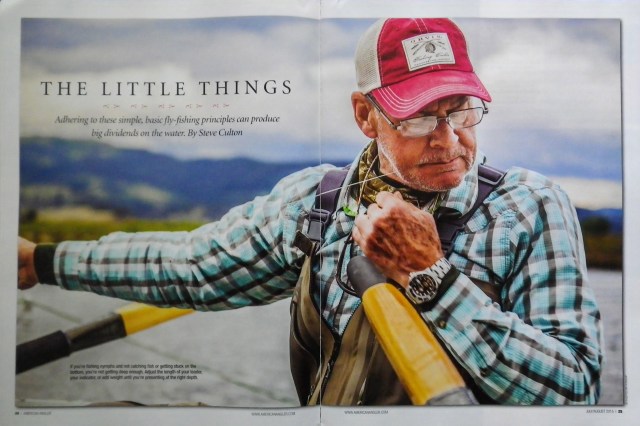
Submitted for your reading pleasure: “The Little Things V2.0” and “I’m Not Dead Yet — The last hurrah for wild Connecticut River strain Atlantic Salmon” in the current issue of American Angler.

“The Little things V2.0” serves as a springboard for a new presentation coming this fall (I will kick it off in Coventry, RI at the TU225 meeting in late September.

Many thanks to the Connecticut DEEP for sharing their time and knowledge for the salmon article, and a shout out to currentseams.com follower RM Lytle for the same (and a very spiffy photo of his prized catch).

The little things is like compounding interest. It all adds up. Then one day you’re rich.

OLYMPUS DIGITAL CAMERA

~

Look for it at your favorite fly shop or newsstand.

13310538_10154282210394038_8643290678313944983_n

Words flowing through the article pipeline

It seems like I am always writing. Some of it ends up here. Some of it never goes anywhere (sloth, concept that never gelled, editor indifference). And some of it makes its way into glorious print. Here’s what’s coming soon to a news stand or mailbox near you.

A feature article on wet flies in Field & Stream. Sometime this summer.

The Little Things V2.0. This summer in American Angler. More seemingly insignificant things you can do to help you catch more fish.

An shorter conservation piece on the failed Atlantic Salmon restoration project (Connecticut River strain-specific). American Angler, this summer (I think).

A primer on Block Island stripers on the fly from the shore. This fall in the Mid Atlantic Fly Fishing Guide.

Thanks for your continued readership and support. Speaking of support, I see we are tantalizingly close to 400 followers. Once we crack — and hold — that barrier, we’ll do a fly giveaway.

Working the night shift with a Rock Island flatwing.

IMG_0255


Read “The Little Things” on the American Angler site

I wrote “The Little Things” a couple years ago in support of a new presentation I was creating. Since then, it’s become one of my most popular talks. The concept behind “The Little Things” is as simple as it is effective: sweat the small stuff, and you’ll become a better angler. You can read the original piece by clicking here.

AALittleThings 2

Look for “The Little Things 2.0” this summer in American Angler.

Match Game (matching the hatch with wet flies)

“Match Game” first appeared in the May/June 2014 issue of American Angler. I’ve included several of the original wet fly portraits; you can find most of the recipes by doing a search on this site.

Match Game by Steve Culton

Next time your attempts to match a hatch with dry flies fail, try matching it with one of these time-tested wet fly patterns.

The words “match the hatch” conjure up images of dry fly aficionados patiently sifting through their boxes, searching for the perfect fly, achieving Nirvana when they make the correct selection. Indeed, there’s nothing I like more than fooling a trout on a dry – unless it’s fooling a trout on a wet fly.

The more I fish them, the more I recognize that wet flies are often the best match for a hatch. That’s because wet flies allow you to fish under the hatch – where the trout are feeding – as insects emerge or lay eggs. You’re fishing, as James Leisenring said, “at the point where the trout is most likely to take his food.”

Matching the hatch with wets isn’t rocket science. Most days, all you need to do is duplicate the size and color of the natural, then drift or swing the fly over the trout’s position. The takes on wets are among the most aggressive hits you’ll experience. What’s more, the fish also tend to be larger (big trout get that way, in part, by being shy about showing themselves).

Here are eight popular, widespread hatches, matched with a proven wet fly pattern, so you can look like a trout savant the next time you’re on the water.

Dark Hendrickson

Dark Hendrickson

Woody Allen said that 80% of success is showing up. It’s kind of like that with the Dark Hendrickson. In the initial stages of this hatch, trout wantonly gorge on the emerging mayflies. The surface erupts with their frenzied slashes and frantic boils. The dry fly will often be ignored, and those casting them can be identified by their grim countenance. This classic American wet will turn those puzzled frowns into mile-wide grins. Target a feeding fish, time his rise pattern (if he has one – I find that trout get reckless during a strong Hendrickson emergence), and drift your fly over his position. Trout will hammer this fly on the dead drift, the swing, and on the dangle (the fly holding in the current below you). Sometimes a slow, hand-twist retrieve on the dangle will draw a strike.

Don’t wait for the mayflies to be visible to fish the Dark Hendrickson. I like to start working it through runs and transition water a good two hours before the duns are scheduled to appear. If there’s going to be an impressive hatch, you’ll know long before anyone else. I like a 12, but go up or down a size if you need to match the profile of what’s hatching. If necessary, a bead head will help sink the fly; fish it as the point fly in your team of wets.

There will come a time late in the emergence where the wet fly is no longer effective. You’ll notice fewer splashy rises, and the trout will stop throwing themselves at your fly. That’s the time to switch over to a dry, like a Hendrickson Comparadun.

Tiny Blue-Winged Olive

Tiny BWOSH

Wet flies are incredibly versatile creations. For proof, look no further than the Tiny BWO. Pat Torrey describes the logic behind his design. “Almost every afternoon from mid-October until the first week of December, the Farmington River has a very consistent hatch of small Baetis mayflies. The extended time frame of the hatch allows the fish to get pretty familiar with this food source. Most anglers fish this hatch with standard dry fly and emerger patterns, which become less effective as time goes on.”

Pat’s use of a soft-hackle on a small fly is traditional and proven. (Sylvester Nemes devoted eleven new chapters to tiny soft-hackles when he revised his masterwork The Soft-Hackled Fly.) While Pat prefers to fish his diminutive wet just under the film, I like to present it as a dry-wet hybrid. Start by giving the hackle a gentle dusting of silica powder. This creates an emerging wings and legs profile on the surface, with a body and shuck just beneath it. As the dusted hackle loses its hydrophobic properties, the fly beings to sink a little deeper into the film. That’s usually when the fun begins.

Flies this small can be a difficult sell in fast-moving, broken water, so try presenting it to rising trout in a glassy pool. The pattern template also works for midges; try black thread and white hackle.

Squirrel and Ginger
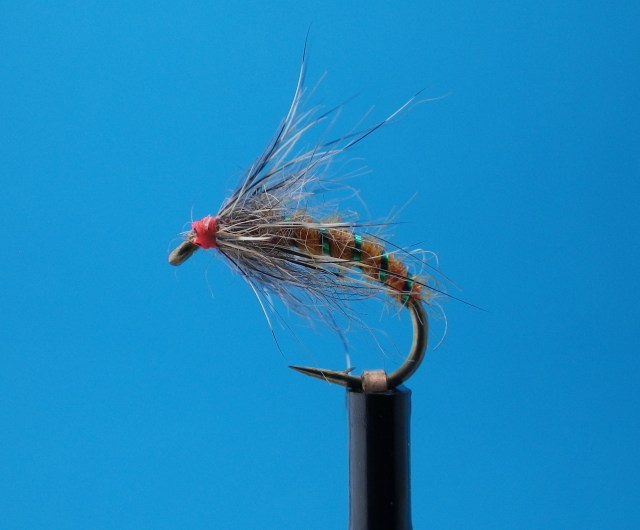
Squirrel & Ginger

Dave Hughes said, “Trout aren’t interested in neatness.” I’ll add that ugly, buggy flies catch fish. This fly started out as a fuzzy nymph called the Caddis Larva. I played around with adding a traditional feather hackle, but it wasn’t until I gave the fly a sparse collar of fox squirrel that the fly took on a dramatic new energy. The first time I fished the Squirrel and Ginger was a steaming hot July afternoon. The sun was high, and there was precious little hatch activity. Yet I took trout after trout as I walked the length of a swift two-foot deep run.

Besides being a reliable searching pattern, the Squirrel and Ginger excels at matching the caddis hatch. I like it on a 2x short scud hook; my default is a size 12, but you should alter its size and body color to match the naturals. A few notes about tying this fly: The hero is the fur hackle, so keep the body thin. Less is more with the squirrel. Use a quarter of what you think you need to start, and pull out the longer guard hairs. I like to spin the fur on a dubbing loop, then stroke the fibers back as I wind the hackle. Don’t fret if you end up with a messy head – remember the wise words of Mr. Hughes.

Light Cahill

IMGP2434

They have a seemingly endless parade of names. I just call creamy mayflies Light Cahills, after the old-school American pattern. Like the Dark Hendrickson, the Light Cahill uses a seductive wood duck wing. Its banding pattern whispers to trout, “I’m alive,” and offers an enticing contrast to the pale fur body and hackle.

Selectivity in feeding trout has always fascinated me. I don’t think trout are picky eaters (in the sense that you can’t get your kids to finish their broccoli); they are simply eating what’s hatching. It’s up to us to find out what that is, then properly present it. That’s where droppers become an indispensible tool. One evening I was fishing a hatch of Light Cahills with three flies: Light Cahill winged wets on the top dropper and point, and a soft-hackled bead head Pheasant Tail in the middle. Of the dozen fish I caught, none chose the Pheasant Tail. They were keyed on the lighter colored flies.

Follow Ray Bergman’s advice: “If it were necessary to confine my assortment of flies to only two or three, this would be one of them.” Tie the Light Cahill in sizes 10-20, and you’ll be ready for any virtually scenario.

Pale Watery Wingless Wet

Magic Flies

I don’t believe in magic flies; that is, if you fish with Fly X you’ll become an instant expert. But this fly makes me want to believe. Based on an old English pattern, I dispense with the original’s gold rib, tie it on a 1x fine hook, dust it with silica powder, and fish it like a dry.

Sulfurs are another in a long list of hatches that leave anglers muttering, pondering the error of their ways on the long drive home. But once you examine the science of the hatch, the magic behind this fly is revealed. Sulfurs take a long time to emerge from their nymphal shucks. This is significant for two reasons: it results in a high percentage of stillborns and cripples; and the emerger is sub-surface for an extended period. Absent duns on the water, those rise rings are from fish feeding just below the surface. Like the Usual, the Pale Watery Wingless Wet has a spikey body, and its soft hackle absorbs water, causing the fly to ride in the film, rather than on it.

If you’re getting refusals, try fishing this fly one size down from what’s hatching. Alakazam! Magic ensues.

Hackled March Brown

Hackled March Brown

There are so many wet flies – both caddis and mayfly patterns – called “March Brown” that the name reads like a generic label. This particular March Brown comes from an English book published in the 1930s, Trout Fishing From All Angles. It lists a winged and a wingless dressing; this is the wingless. The recipe calls for a “red ant colour” hare’s ear body; I have been tying this with rusty fur.

While we do get some March Browns on the Farmington, it isn’t a major hatch. There is, however, an impressive late summer Isonychia showing. Since it is likely to be the largest on my three-fly team of wets, I tie the Hackled March Brown on point. Because of its size, this fly shines in swift water: deeper riffles, pocketed slots, and boulder-strewn runs. If there’s no hatch, it also makes a fine searching pattern. I’ve taken some substantial trout on this fly while fishing it on the dangle. The hits are the rip-the-line-from-your-fingers type, the kind that make you wish it was August right now.

Drowned Ant

Drowned Ant

The Starling and Herl has been fooling trout for centuries. It possesses the alchemy created by the natural iridescence of starling and peacock. The fly represents any number of insects, from beetles to dark caddis to little black stones – and maybe ants? Let’s make sure. To create an ant-like profile, I’ve simply added a segment of working thread to the middle of the body.

Each summer, I catch a hefty percentage of my trout on this fly. To increase its durability, I reinforce the herl with a strand of thread, twisting the herl around the thread to form a chenille-like rope. If one of the herls happens to break, the entire fly will not be compromised.

I especially like to fish this fly along shaded wooded banks – prime territory for ants to take an accidental tumble. The dangle seems to produce an inordinate number of strikes. Curious, considering I’ve never seen ants tread water in a three-knot current. Sylvester Nemes said, “Any sunk artificial fly, to be good, must transform itself in the water into something alive, something suggestive and moving, something that looks good to eat.” That is clearly the case with the Drowned Ant.

The Hopper Hammerdown
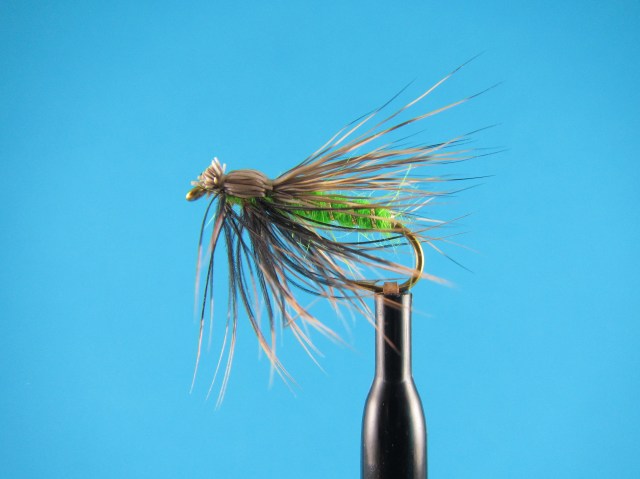
Culton_Hopper_Hammerdown

A consistent theme of wet flies through the centuries has been impressionism. Wets do not attempt to carbon copy an insect; they simply match its general size, color, and profile. With so many hopper patterns available, why the need for another? In three words: Simple. Impressionistic. Effective.

The Hopper Hammerdown is based on a steelhead fly called the Golden Stone Hammerdown. The fly does not give the fish, as Bill McMillan said, credit for being “more complicated than the rather primitive animal it is.” And it promises a calorie-dense meal to the trout, well worth the fish’s effort. This is another fly I’ll fish near the surface, usually as the top dropper. Sometimes I’ll treat it with floatant and fish it on a dead drift like a dry. It plays well along grassy and wooded banks on warm summer days when the trout instinctively know that something large and yummy might come struggling along at any minute.

No hatch? No worries.

What do you do if you get to the river and there are no signs of a hatch? You fish. With confidence. Wet flies make excellent searching patterns, and with a team of three, you can cover a lot of water quickly. Remember the first rule of droppers: they are the quickest way to find out what the fish want. Give the trout a choice: different sizes, colors, species, or life stages. Hedge your bets by choosing flies that are most likely to be hatching when you’re fishing. For example, on a late summer afternoon, you might fish a Squirrel and Ginger (caddis) as the top dropper, a Drowned Ant as the second dropper, and a Hackled March Brown (Isonychia) on point.

More rock snot in the Farmington

The Didymo hits just keep on coming. It’s all over the local media, but in case you missed it, here’s the story that appeared in this morning’s Courant.

While the news is discouraging, the sky has not yet fallen. If you fish the Farmington River, please use safe wading practices and common sense. I have a dedicated pair of boots and waders for the Farmington. If you don’t want to go to those lengths, be sure to clean/dry your gear before you venture elsewhere. You can learn more about preventing the spread of Didymo by doing an internet search.

Fred says: “A new species of rock snot? That blows.” This photo was taken well downstream of the invasive algae blooms.

Wild Farmy Brown 7/29/15