This was a weird spring. It was cold. Rainy. I suffered from a debilitating case of tennis elbow. Without my switch rod, there’s no way I could have even fished for stripers. Things started late – I didn’t get my first bass till well into April. Most of what I was catching was in the sub-twenty-inch class. While that bodes well for the future, April and May of 2014 will go down as a complete vexation for courting the big girls. Two of my traditional big fish spots were depressingly unproductive. It was weeks into May before I even had a legal sized striped bass. But, oh, what a bass. Here’s how it went down.
I was fishing a new location that had big bass written all over it: current, structure, and the presence of herring. Attached to my floating line was a seven-foot length of twenty-five pound test mono. The fly was one I’d tied several years ago: Ken Abrames’ Razzle Dazzle. This particular fly was a veteran many striper campaigns. Its top two saddles were long gone, and over the course of the seasons, some of the bucktail had likewise gone AWOL.
For two-and-a-half hours, I fought the good fight: cast. Upstream mend. Another mend. Another. Swing. Pulsing strip. Let the fly fall back. Retrieve. Repeat. If nothing else, greased line for striped bass is meditative, so absent any hits, the routine was comforting and pleasant.
But, it was time to leave. A walk down-current to a different section, then ten more minutes.
The takes on the greased line presentation are usually either a sensation of building pressure, or a sharp pull. Hers was neither. Suddenly, she was simply there, rolling on the fly, taking line downstream. I had dropped a substantial fish the week before when I couldn’t get a good hook set. With that wound still festering, I drove the point home. Hard. She felt strong. But I didn’t have a idea yet of what I was dealing with.
Every big bass fight presents a unique set of challenges. As expected, her first run was downstream. She peeled line off the drag, but I was surprised by how little it was – probably about thirty feet. I pointed the rod at her and set the hook again.
She turned abruptly, and headed upstream. I was simultaneously delighted and horrified; the former because in this heavy current she’d be burning a tremendous amount of oxygen in her flight, the later because of the memories of all those steelhead who shattered my heart with relentless upstream runs and hook-spitting leaps. The challenge was to re-gather line as fast as possible, staying tight to the fish. She was faster than my hands, though, and I was sure I was going to lose her. I raised the rod tip. Still there. I lowered the tip and re-set the hook.
Now, she sounded. I’ve heard that big bass will try to rub their cheeks against the bottom to rid themselves of a fly. I don’t know if that’s true, but I do know that the bottoms of rivers and oceans and estuaries are vast depositories for nature’s junk. Who knows what multiple opportunities for snag hell awaited below? I pulled on the line. It didn’t move an inch.
Unbelievable. Stuck on the bottom. Another good striper lost.
But wait. Did the bottom budge? Yes. A little. I moved the rod tip back and forth in a 180-degree arc over the water, trying to stir the fish. It worked. Instead of ripping down-current, she ran uptide. Paused. I re-set the hook. Again. I decided it was time to try and get her out of the abyss and onto the gravel bar. She would have none of that. “Down goes Frazier!” Or, as I imagined it in my head, Cosell shouting “Down goes Culton!” She sounded a second time.
Again, I couldn’t budge her with a straight pull. The rod wagging thing worked once before, so I tried it again. Now she came up a little faster. I could sense she was tiring. Once I coaxed her out of the depths, she took advantage of the shallows, ripping off a series of short runs. But all that sprinting was taking its toll. I still didn’t know what I had. I was hoping for twenty-five pounds. I decided to try to land her on the beach.
I put the rod over my shoulder and walked her in close, then pulled her to the water’s edge. Now I could see the fish. My mouth fell open, searching for words. My pulse rate skyrocketed. After lipping twenty-inchers all spring, her mouth felt like that of some alien creature. Its opening dwarfed my hand. The flesh between my thumb and forefinger was substantial. I could easily see a small dog disappearing down that gaping maw.
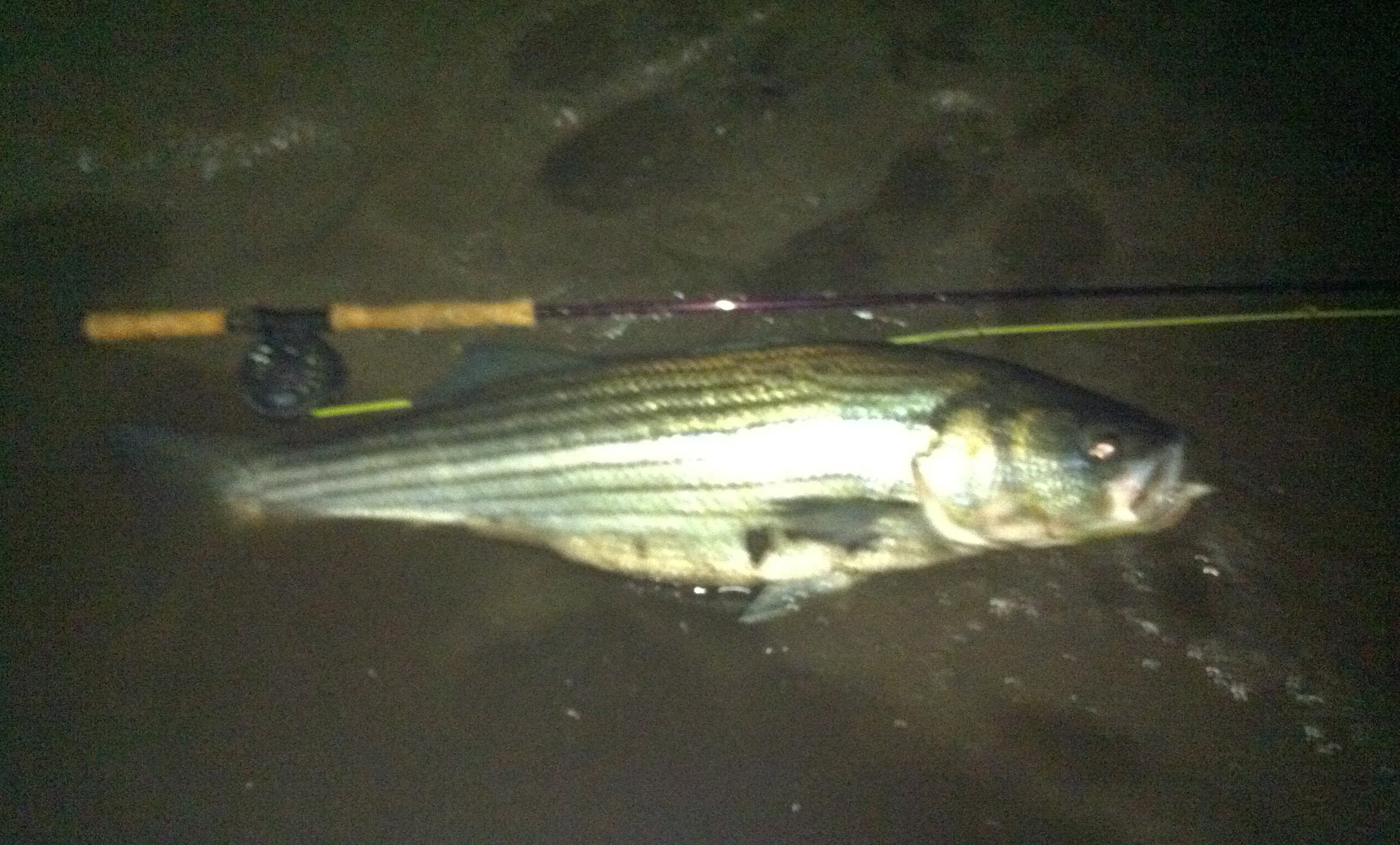
I held my rod against her length. Her gill plates came about to the first guide on my two-hander, thirty-four inches away from the butt. This was a striper over forty inches. The big three-oh in pounds. A new personal best on the fly from the shore. She certainly had been eating well, with a distended belly that gave her a perch-like shape.
Wouldn’t you know that this was the one night all spring I left my camera at home? Fortunately, I had my phone in my pack. I took a couple hurried shots, and felt guilty about it, because I really wanted this fish to live. I took hold of her – good Lord, what an impressive mass – and guided her into the shallows. I was expecting a lengthy revival. But no. Almost immediately she felt ready to go. Just to be sure, I held on a few more seconds. As I was re-adjusting my grip, she thrust from my hands.
She slipped away into the darkness, leaving a gentle wake.
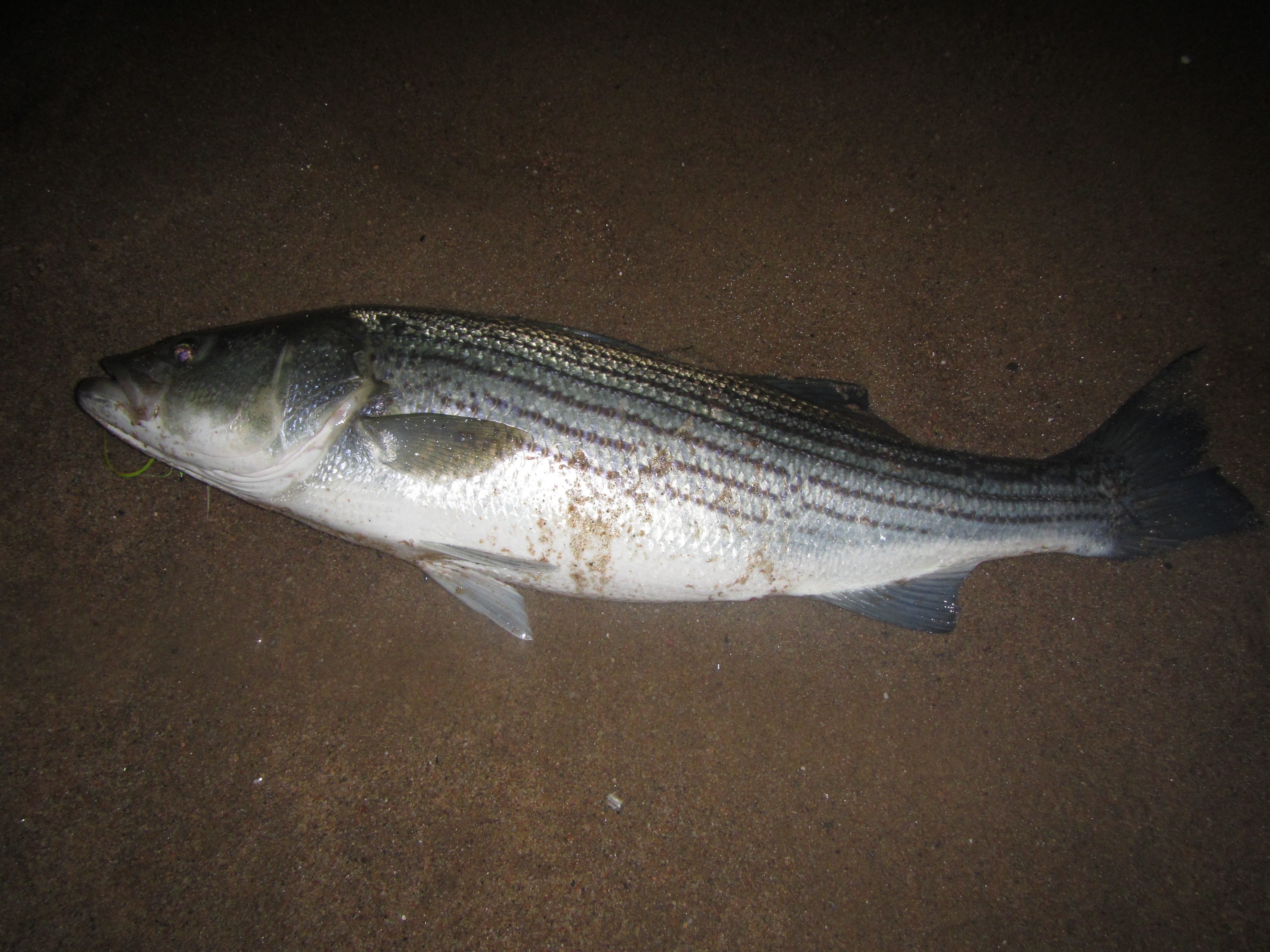
Miss Piggy. A thousand apologies for the sub-par photography. This is what happens when you forget your good camera and are reduced to using an iPhone wrapped in a ziploc baggie. But, you can get a good sense of the sheer mass of the fish. The bottom guide is 34″ from the butt, and her tail extends farther than you can see. Look at that belly full of herring.

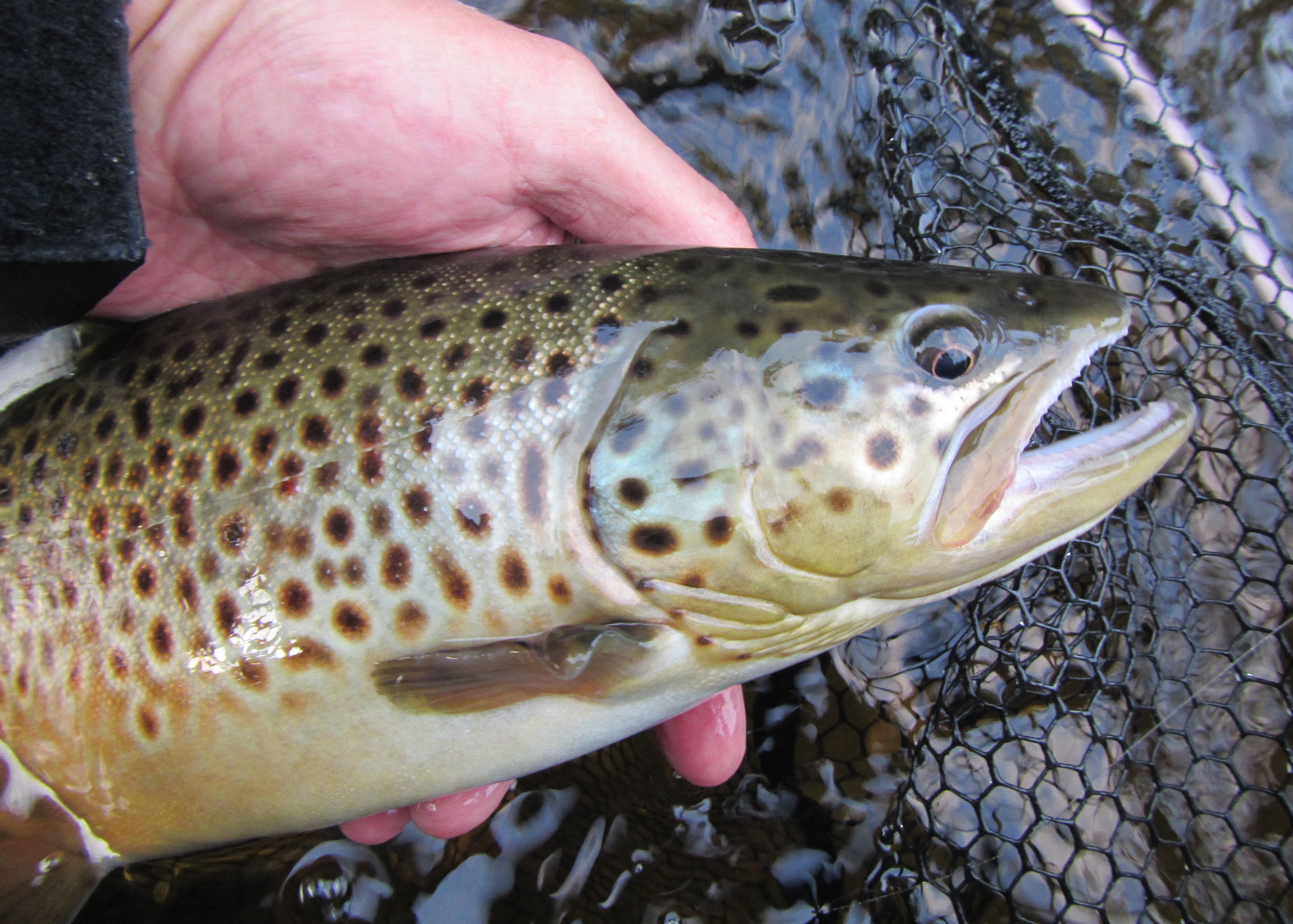
A better shot in terms of detail, but you don’t get the full length effect.

The winning fly. An old Razzle Dazzle, missing two saddles and a fair amount of bucktail. Here we make the case for sparse and impressionistic. This fly is now retired. I may put it out to stud.