Organizing and replenishing my summer striper box is an annual ritual. I thought you might like to see how I do it. The left side of my box is the busiest, in terms of number of flies and how often I’m dipping into it. This is the left side, the sand eel side, and I’m covered for both matchstick sand eels and larger ones up to about 5″. Let’s start with the box: it’s a C&F Design Permit Box, completely waterproof, four rows of slit foam, 7 3/4″ x 4 1/2″ x 1 2/3″. I’ve had this box for years, and I love it.
The top two rows are for sand eel patterns, so I start by removing every fly and taking inventory: what stays, what goes, what needs to be replaced? The bottom two rows are mostly small stuff, like shrimp, crustaceans and isopods, clam worms, and tiny baitfish. Then, I fill in the third row with smaller sand eels. Left to right, The Golden Knight, Ray Bondorew’s Marabou Sand Eel, and Ken Abrames’ Eelie on various hooks and in different color schemes. These smaller sand eels are most likely going to used as part of a dropper rig team of three.Now I’m ready to fill in the top row with Big Eelies. Note that I carry multiple color combinations (and I have more in reserve at home that I can use to fill in the blanks). I’ll choose a pattern based on conditions, light, bottom structure, ritual, tradition, and — most importantly — feeling. It’s easy to lift up the tail to see what’s beneath; this system allows me to maximize available space. I also carry a few extra Big Eelies in a baggie. I hand these out from time to time to people I meet on the beach. Right, John?
I don’t know if there’s a best sand eel fly, but the sand eel pattern in which I have the highest confidence is Ken Abrames’ Big Eelie. And right now’s the perfect time to be tying them up. My Rhode Island spies tell me that sand eels are out in good numbers. Surfcaster extraordinaire Dennis Zambrotta, author of Surfcasting Around The Block, tells me that unless you had a sand eel teaser rigged next to your plug the other night, you didn’t hook up. (This was at an undisclosed oceanfront location in SoCo.) One of the things I love about the Big Eelie is that it lends itself supremely well to different color combinations. I tie all manner of variants (do a search on this site for recipes, and I’ll even start you off with one, the L&L Big Eelie). And of course, the original colors (white/yellow/olive/blue) remain deadly as ever!
A Crazy Menhaden Big Eelie, still hot on the vise. You can find this and many other Big Eelie variants right here on currentseams.com. In fact, I’m playing around with a couple new variants that I’ll share with you soon.
Some of you may know that I am avid gardener. Right now, I am planting by the moon. What’s that, you say? The basic idea is that just as the moon’s gravitational cycle causes tides to rise and fall, it also affects soil moisture. So you want to plant seeds and transplant during periods when more moisture is being drawn to the surface.
Okay, Steve. But what the heck has this got to do with fishing?
I’m a firm believer in paying attention to natural rhythms.Using stripers as an example, I also believe that the angler who wants to catch more bass, and especially bigger bass, will not be one who places a premium on leader construction or casting distance — but rather one who focuses on things like tides, moon phase, wind direction, bait patterns, water type, structure, location, water temperature, frontal systems, and barometric pressure. What’s more, that angler should pay attention to common natural markers, like hearing the first spring peepers or when flowering trees bloom.
It’s all part of one magnificent puzzle. Every year is different, but nature is always right on time. It doesn’t hurt to be able to cast a plug or a fly line very far. But if you really want to crack the big bass code, pay attention to Mother Earth’s natural rhythms.
Yesterday was herb day. Today it’s peppers. I have it on good authority that this weekend is a great time to plant cukes and squash.
On the difficulty scale, keeping current with how the ASMFC plans to manage (I’ll be kind and not place quotes around manage) striper stocks is somewhere between Calculus II and Organic Chemistry. Flux and fast and fluid also come to mind as good descriptors. (And as always, alliteration.) But thanks to our friends at the American Saltwater Guides Association (ASGA) it’s become easier.
Next up will be draft Amendment 7. Public comment will be open later this year, and I’ll be sure to get you the links. To help you understand what’s going on before then — no degree in Chaos Theory required — here are some helpful links.
If it looks like a moratorium proposal, is it really? Nope. Here’s why.
If you’re finding this stuff helpful, and you really care about stripers, you should join the ASGA. You can do that here. And of course, any donation you can make helps them continue their outstanding work.
On Wednesday Alex took a striper lesson with me. He did a fantastic job. The point of these short (2 hours) lessons is to give students feel for how to approach multiple situations involving current — and especially for them to discover the expansive fly fishing life beyond cast-and-strip. We do it in the daytime (the better to eyeball things) and while the immediate goal isn’t to catch — that will come later — I have the highest amount of respect for those who want to invest in upping their game. Alex did a tremendous job; he has an intuitive feel for current and presentation. Now all he needs is some bass to play with.
As it turns out, so do I. I drove to Rhode Island that night to fish two different marks and, once again, I was disappointed by the paucity of striped things that swim. The first mark was one of my “guaranteed” spots. You know — a place you go to save a night when you desperately need a fish. No longer. I’ve fished it three times this year, blanked all three times, and it’s the first year in decades that I have not caught a bass there. Fooey. Not to be outdone, the second mark had plenty of bait, and not a single striper. So I casted, mended, and tried to pretend that maybe a bass would show up. Instead, I stayed out way too late. I won’t be going back this year (he said bitterly).
Alex really nailed the greased line swing. What a lovely day to be out fishing.
…and not much happens. Surfcaster extraordinaire Toby Lapinski and your humble scribe gave it the old college try last night for close to three hours. (Note the lack of large bass photos — heck, note the lack of any bass photos.) A couple small bumps for Toby and not even a courtesy tap for me. Although I did have a couple weird moments of pressure on the drift, my fly sweeping across a reef, no hooksets were forthcoming. It was probably something small. Light show: we were treated to a spectacular electrical display as a storm moved across western Long Island. Funny thing: that storm produced a sudden cold NE breeze and some raindrops on what was otherwise a calm night. So it goes. Round three to the bass. I gotta get some points on my card, so I’ll keep punching. This mark has yet to produce for me, but I believe it will. Then we’ll see some bass photos.
The main bait continues to be menhaden, juvenile and adult, and silversides. We also saw plenty of crabs, so there’s no shortage of food. The bass were simply somewhere else.
I fished the last two evenings at various marks in SoCo and enjoyed….not a touch. Well, that’s not entirely true. I felt every weed that brushed against my three fly team. Last night I accidentally snagged a few small menhaden. But nothing living that could be measured in pounds came in contact with my fly.
I fished inside a breachway in moving water, incoming and outgoing; in a pond area of an inflow; off a jetty; and from the beach. Not even a courtesy tap. I saw and heard a few stripers, but they were small and their presence fleeting, and I never really had a good shot at a target. Bait, on the other hand — wow! Masses of bait everywhere. Silversides, menhaden, and mullet in mother lode Vegas jackpot numbers everywhere. I don’t think I’ve ever seen such immense, dark clouds of menhaden.
The fighting is rounds. This was round one.
I’ll take menhaden. Look for an upcoming article from me in Field & Stream on matching fall run bait with classic striper flies.
I’ve been meaning to do this for a good, long time. I started by taking out every fly from the left side of my box — this is the working side that gets the most use. I returned a few of the smaller bugs to the lower slots, but the others, mostly sand eels, got straightened out (flies tend to get gershtunkled after years of non-use) under a running hot water bath, followed by a hang drying on corks, and then finally laid out on a sheet of paper. From there I took inventory to see which patterns needed replacing and replenishing. So, right now I’m in the middle of a massive sand eel tying blitz. And did I mention squid? Golly, I ‘ve got to tie a few more of those. And then my experiments! I’m going to be playing around with some Gurgling Sand Eel variants this summer. To the vise! To the water!
If you took the time to send in comments to the ASMFC prior to their May 5th meeting on Amendment 7, congratulations! After years of feeling like no one was listening, your voice was heard. The American Saltwater Guides Association (ASGA) has a fantastic summary of the meeting on their website. If you’re not familiar with the ASGA, you should be. We’re one of the good guys in the fight for striped bass conservation. We need your support!
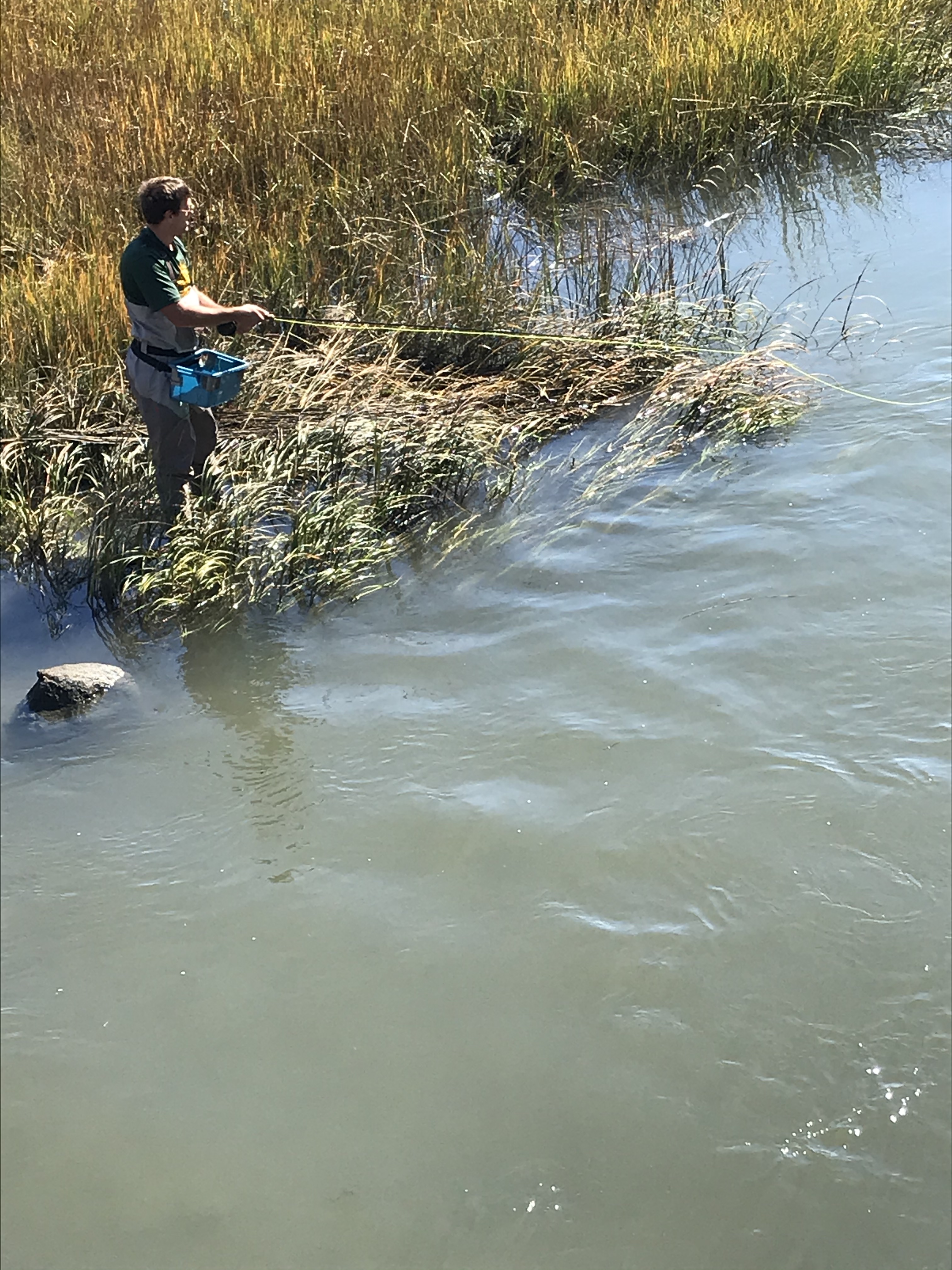
…I was standing in a river, practicing my greased line swings with a floating line and a 10″ Rock Island flatwing. My casting was good enough. My presentations were spot on. The bass were…not there. At least not in any numbers. We saw some wakes and swirls made by herring, but nothing to suggest that they were present en masse. We heard a couple reports of bass crashing bait, but they were in the first 30 minutes of our 2+ hour session, and then nothing. So it goes. This is why it’s called putting in your time.
In between casts, I found my mind wandering toward Block Island: plans and schemes and hopes and dreams. I could use a striper rainbow right about now.