I don’t think I used the five weight once last spring. Must remedy that. I knew I’d be unable to sleep after my hockey game, so at 10pm I ventured forth into the sultry darkness with a new Rio Outbound 9 weight floating line on the reel and a Crazy Menhaden flatwing to tempt Miss Piggy. I tend to want to get my money’s worth from a line, so I had forgotten how good a new one feels in the hand. The five weight did not disappoint, and conditions were perfect for casting and mending a large fly in the current. Sadly, no bass, no bait. The Meatballs were out in force, though, proudly displaying their coordinates to the world (and perhaps some low flying aircraft) with their headlamps. I must confess to having a smug sense of satisfaction when they left fishless. As did I after two hours of fighting the good fight.
Tag Archives: striped bass
The weirdness that is this year’s striper spring continues
I remember that Saturday afternoon like it was yesterday. About nine years ago. Bright sunshine, the middle of the afternoon, and we took striper after after striper on the fly. I can still see the gentleman who was fishing above me, how he so gracefully yet purposefully stripped in each bass he’d hooked. He’d recast, strip, and then he was on again. The only reason I left that day was because I promised my wife I’d be home in a few hours to spell her (we had two very young kids at the time). My friends who stuck out the tide each had a triple-digit day.
Well, that was then. This is now. Same spot. Same tide. Roughly the same kind of day. And I felt fortunate to get three dinks in the last hour of the tide. (These were river fish, as evidenced by their darker above-the-lateral line coloration.)
I’m fine that I haven’t yet experienced the Bass-O-Matic this year. Really, I am. It’s fascinating how every year is different. I know I’m going to have one of those world-of-hurt striper thumbs sooner or later.
So whoever is in charge of these things, if you’d like to make it sooner, I’d be totally cool with that. Or a thirty-pounder. Or a kick ass summer on Block Island. Whatever you think is best.
In the meantime, I’m going trout fishing.
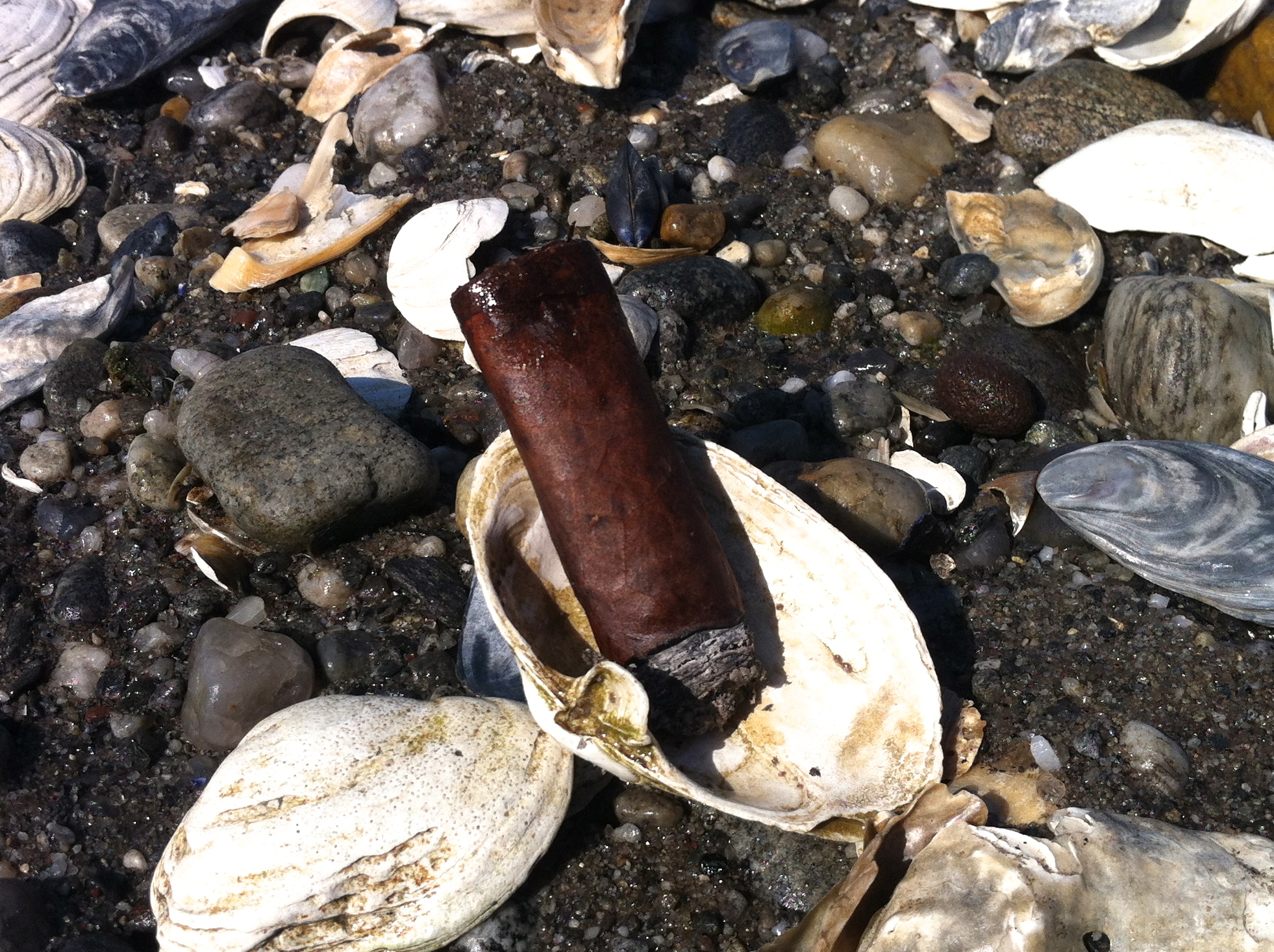
When nature calls, a clamshell makes a fine ash ray for your Aging Room Quattro F55.
Curl up baby. Curl up tight.
Back to the night shift. Dozing on the couch at 10:45, taking care to not really fall asleep because the bus is leaving at 11:30. On the road, JR Cuban Alternate Cohiba Esplendido ceremoniously lit at the appropriate landmark. Now past midnight, and it’s raining. Maybe it will keep the yahoos away. Only a few cars in the lot. That’s good. The weather people said showers, but this is more like a fine mist. Three other guys out fishing, more than I expected, but better than Monday’s daytime lineup. There are fish around — the spin guy to my left just hooked up. Now it’s really raining. I didn’t order this wetness. Everyone is leaving, and I’m all by myself. Thirty minutes in. The rain stops. A few stars try to wink through the parting clouds. There it is, a sharp pull at the end of the greased line swing. My first keeper of the year? No way. It feels like a short. And it is. Not why I came out tonight, but the stink is off. Working the stretch of water down, then backing up the pool, even though there is no true pool to be backed up. Over an hour of meditative casting, mending, swinging, repeating. Alone. Magnificently alone. Let’s try up there. I haven’t caught a striper up there in a long time. The answer is no. Until the answer is yes. A better fish, struck on the second mend, but still a short. I can see Scorpio and the Summer Triangle and it makes me dream of being out alone on Block Island in July. There’ll be some keepers there for sure. There probably are a few here, but not for me or my Crazy Menhaden. Perhaps when next I return. Big girls. Ready to eat.
Undercover of the night.
That’s AM, people. Very AM.

2015: A Striper Oddity
I never thought I’d be so excited about catching four school bass. But after this crazy spring, yowzah, woo-hoo, awwwright, yessiree Bob, good golly Miss Molly, I am all fired up.
Ahem.
Now that cooler heads have prevailed, I want to tell you about my funny faux pas today at Ye Olde Striper Spot. The wind was gusting out of the NNW, 10-20 easy, and the cloud structure was breathtaking. When I waded in, I was the fifth guy at the end of the line. We were all pretty evenly (and courteously) spaced. After an hour or so, our ranks had swollen to nearly ten. Some people were catching, others were not. I turned to look behind me and I noticed that the angler above me had closed the gap to about 30 feet. He hailed me. “Do you mind if I ask you something?” I thought I was going to get a question about the two hander, or the floating line, or what color fly I was using. No. “Can you stand back a bit? You’ve moved quite a ways toward me.”
Well, to clean up Jack Nicholson’s line from “A Few Good Men,” didn’t I feel like a freakin’ butt hole.
Sincere apologies were offered, as was a fly. I appreciated his politeness and understanding. We talked about fishing for a few minutes. Then, fences mended, we returned to our precious avocation on this strange grey-green-blue windy day.
Monday’s implements of destruction, drying for the next session. Water temp was 50 degrees.

No Fish Today
Every year is different, and this (April 16) is the latest I’ve ever gone into a year without catching a striper since I started fishing for them. The only question now is: when?
I thought the fly looked tasty enough. But you can’t catch what isn’t there. Not to worry. Instant expertdom is right around the corner.

A Floating Line Myth. Sunk.
I see it all the time on internet forums. Someone wants to know what’s the best line to use for striped bass: floating, intermediate, or full sink. They get many responses, and it’s nice that people want to help. Unfortunately, there’s usually some bad information in the mix of suggestions. And it almost always involves a floating line.
There is one frequent flier that dominates the bad advice airspace. It appears so regularly that it commands a gospel-like gravitas. Like any good urban (or in this case, saltwater) legend, it gives the reader permission to believe. Its exact wording is a variation on this theme: “It’s hard to stay in contact with your fly in waves or surf or a rip with a floating line.”
It baffles me. Because I don’t have any trouble maintaining contact with my fly when I’m using a floating line.
So, anglers who use floating lines in the surf can be placed into two groups. Those who have trouble staying in contact with their fly. And those who don’t. One is a dead end, a self-fulfilling prophecy of you can’t. The other is full of wonder and possibilities. Which group do you want to be in?
Before you answer, I’d like to tell you a couple of stories about fishing in the surf with a floating line.
Last summer, I fished on Block Island twelve hours before Hurricane Arthur hit. Anyone who is familiar with advance hurricane swell in New England knows that the breakers can be impressive. Even so, the waves that night were not what surfers would call gnarly. When I arrived at my spot on the southeast side, the swells were a very manageable three feet, with occasional four-foot sets.
I was fishing a boulder field, and I was mystified by a small group of rocks that kept poking their tops out of the waves. I couldn’t remember them ever being there. In one of those well, duh, moments it dawned on me that those weren’t rocks – it was a school of stripers, seemingly aware of what was approaching, and eating while the eating was good.
On my first cast with the floating line, the sand eel fly settled into a trough just to the right of where I reckoned the bass would be waiting. I hadn’t accounted for the wind, which had been picking up since the afternoon. Still, the line snapped to attention on my first strip, and a couple minutes later I was releasing a barely sub-legal striper back into the Atlantic. This went on for the better part of an hour; the only reason I stopped was because I didn’t like beaching the fish on the rocks in an exponentially increasing shore break. I hated leaving a school of active feeders, but I knew it was the right thing to do. I tucked the point of my Big Eelie into the hook holder just as the first wave of tropical rain began to tattoo my jacket hood.
~
Striped bass don’t read internet forums or hang out in breachway parking lots. This fifteen-pounder was part of school that was feeding in a strong rip. The bait, sand eels, was trapped between the rip and the shore and the stripers were feeding with impunity. It was one of those magic moments (rather, episodes — it lasted close to 90 minutes) where it was a fish on every cast. You guessed it. I was using a floating line.

~
Flash backward several years. Same island, different wave conditions. Our plan was to fish all night, and the trip started poorly. A ferocious north-northeast blow turned the harbor of refuge in Point Judith into a maelstrom of foam and chop and weeds. The ferry was pitching and rolling even before we cleared the breakwater. Once safely ashore, the normally sheltered Great Salt Pond provided no relief from sustained winds of twenty miles per hour. That banshee howled all night; it’s the only wind I can ever recall that made my ears hurt. One keeper bass was all I could manage. By five in the morning, beaten and bowed, I wearily trudged across the sand to one of the west side beaches for a desperation look-see.
Try to picture what the pre-dawn ocean looked like after nearly twenty-four hours of winds gusting to thirty-five knots. White-capped anarchy comes to my mind. I had no motive other than what-the-hell desperation when I made my first cast into a trough about twenty feet off the beach. Seven casts later, I had landed eight stripers. I had switched over to a full-sink integrated line in the middle of the night, and those first fish were obviously sitting in that trough, or cruising the shore break wash. But when I looked one hundred feet down the beach, I witnessed a scene that every striped bass angler dreams about.
It was an all-out blitz. Sand eels were spraying in desperation, their flanks reflecting the orange of sunrise. Seagulls excitedly chattered overhead, seemingly more stoked about the carnage than I was. And somewhere underneath, there were stripers. Untold numbers of them, rolling on the bait as they gorged themselves on an all-you-can-eat breakfast buffet.
I quickly swapped out the full sink for the floating line and a seven-foot leader. I don’t know how many stripers were in the school. I suspect it was hundreds. They ranged in size from eight to over twenty pounds. The blitz was taking place about sixty feet off the beach, and the wave chop beneath the floating line was substantial. Yet, for two hours it was bass after bass after bass. I caught them on the strip and I caught them on the dead drift. I lost count after the first dozen. The only reason I left is because I had a ferry to catch.
~
This all began with a question. So let’s close with one: If it’s so hard to stay in contact with a fly in waves with a floating line, how did I manage to catch all those stripers?
For me, the answer is self-evident. Perhaps your answer is still out there, on the water, waiting to be discovered. I encourage you to find it. As an old Rhode Island sharpie once said, “The path of the obvious is perhaps the most difficult path of all to find and unravel, but it is well worth the effort and the results are measurable in pounds not inches.”
Striper Report 4/3/15: Fifty Shades of Skunk
If you read your Bible, or if you’ve been paying attention in church over the years, you know that St. Peter had two jobs. I don’t know how good a fisherman he was, but I like that he fished for a living. I’ve gotten it into my head that given Peter’s involvement in the crucifixion, Good Friday is an appropriate day to honor him by going fishing. Striper fishing, specifically. So I’ve been doing that for years now.
With our prolonged winter and spring’s current refusal to make a proper stand on the issue of warm and sunny, I figured it would be a little early to find linesiders at Ye Olde Striper Spot. But you don’t know if you don’t go. Besides, I could shake off the big rod casting rust. And there was that EP Carrillo Golossos I had been saving.
Rain and wind, followed by mist and fog and utter calm. You could probably count fifty shades of grey here, but the only spanking was handed out by the bass. 
The water was loaded with organic flotsam: leaves and sticks and bark and reeds. I was surprised to see 42 degrees on my thermometer. No bass that I could find, nor any reported by the three other anglers who had the good sense to leave ninety minutes before I did. But I was glad that they left, because I got to fish in this gorgeous greyness all by myself. Well, just me and St. Peter.
Yes, it was wet out there. I love Ken Abrames’ RLS Easterly color scheme (grey, silver, peacock, and a touch of fluorescent yellow) on days like this. A little color goes a long way. The fly is a sparse, soft-hackled flatwing. 
Ken Abrames Catches a Big One (a Currentseams exclusive)
The striper grandmaster talks about setting the hook, playing big fish, the effects of pressure, and fear.
Ken Abrames is one of the most revered names in saltwater fly fishing. He is the creator of the modern flatwing streamer, presentation-style flies that can imitate everything from clamworms to menhaden. His books Striper Moon and A Perfect Fish belong on the shelves of anyone who is an aficionado of traditional New England striped bass fly tying and fishing methods. Besides being a world-class angler, Ken is also a rod designer, author, poet, and artist.
I have the good fortune to be able to talk fishing with Ken on a regular basis. He is funny, candid, a good storyteller, and highly experienced. Here is an excerpt from one of our conversations.

Currentseams: I remember you once telling me the story of how your father taught you, “You gotta set the hook.”
Ken: I was a little kid, eight or nine years old. We were fishing off Poppasquash Point in Bristol (RI). There were a lot of fish in those days, and very few fishermen. It was a hazy day in May. We were fishing with plugs. I was reeling and popping, and all of a sudden a big fish exploded on my plug. It was like someone had thrown a Volkswagen in the water. And the fish started running like crazy, the rod was bent over, and the reel was screaming. It was like heaven. And the fish just ran and ran and ran – and then he turned to the right and the plug popped out. It was devastating to me. So I started to reel in, and my father looked over at me and said, “You gotta set the hook.”
Currentseams: (laughter)
Ken: It’s so hard to set the hook when a fish is screaming off line. People think they’re hooked up. But the fact of the matter is, you need to set the hook. And if you don’t, as soon as he makes his first turn, it’s over.
Currentseams: That is exactly what happened to me this spring. I had a big striper blow up on a flatwing and I didn’t set the hook. So if you don’t get a good initial hookset, you have nothing to lose by trying to reset during that first run.
Ken: That’s right.
Currentseams: When you first started teaching me, you drilled into me, as a fundamental part of fly fishing for stripers, the practice of hitting that fish multiple times.
Ken: If you hit him three times, sometimes you still lose him. If you hit him four times, sometimes you lose him. If you hit him five times, you won’t lose him.
Currentseams: Tell us what you mean by “hit him.”
Ken: You grab your line, and you punch him. And then you punch him. Even though you think everything is going to come apart, you want to punch him, and punch him, and punch him. You’ve got to hit him at least five times with a very, very sharp hook. And if you have a dull hook, it doesn’t matter how many times you hit him. Because you’re not going to catch him. (laughs)
Currentseams: Talk about a sharp hook being the single most important thing in fishing.
Ken: Well, it is the single most important thing. Because all those things you hear – the fish struck short, the fish were playing, there’s too much bait in the water, those little taps are small fish – those are just excuses people make up because they don’t understand why they’re not hooking up. And the only thing that is necessary is a needle sharp hook. Once you have that, once you feel the pressure of the fish, the hook has already started in.
Currentseams: You’ve also used the phrase, “sticky sharp.”
Ken: Think of the inside of a striper’s mouth as your fingernail. You take a hook and you run it across the back of your thumbnail. If it doesn’t stick in, or stick to your nail like a piece of scotch tape, it’s not sticky sharp. And the same thing will happen inside a fish’s mouth. A hook that isn’t sticky sharp will slide right out.
Currentseams: Let’s talk about those little taps.
Ken: When you feel that little tap, that’s a fish. He just sucked in your fly. If you’re used to casting and retrieving, like with a spinning rod, you expect a big yank. But the fact of the matter is that it is often just a tiny little touch, or even just a change in pressure. And to be aware of that is one of the most important things you can learn. You have to develop it as a skill.
Currentseams: If you’re taking a simple cast-and-retrieve approach to fly fishing, when you feel those little blip hits, and miss the fish, are you just simply pulling the fly out of the fish’s mouth?
Ken: Yep. You are. Fish don’t make mistakes.
Currentseams: Fighting a 30-pound bass is different from fighting a 10-pound bass. Let’s talk about that.
Ken: The first thing is to not be afraid that you’re going to lose the fish. The other thing is to not try to stop him when he runs. Say you’re a sprinter, and you’re running the 100-yard dash. What’s the first thing your body does when the race is over?
Currentseams: You’re exhausted, you hunch over, go limp…
Ken: That’s what the fish does, too. At that moment when the fish reaches the end of his run, that fish is exhausted. Now I know this is true because I have caught so many fish in my life, it’s ridiculous. When I fished commercially for stripers, I would hook a fish, and he would run, and I would run my boat right after him. At the end of the run, the fish would come up near the surface on his side. He was exhausted. It would only take about three minutes. Didn’t make any difference if he was thirty pounds or fifty pounds. You understand?
Currentseams: Yes.
Ken: OK, so now a guy hooks a big fish, it runs like hell, and he wants to stop the fish. And he puts pressure on the fish, and he thinks he’s going to turn it. That’s ridiculous. Take the pressure off the fish and it will stop (laughs knowingly). You have to learn this. Fish don’t read books about what they’re supposed to do and not do. They do all kinds of things besides what I’m saying. When the fish stops running, you reel in nice and steady, keeping the pressure the same, and the fish will come in like a dog on a leash. It’s like you hypnotize him with that steady pressure. If he wants to run again, back off the handle and let him.
Currentseams: Some anglers overplay stripers.
Ken: They don’t put any pressure on the fish because they’re afraid something bad is going to happen. Fear is the deciding factor. As long as you’re afraid, you’re not going to learn anything, and you’re going to make the same mistakes over and over again.
Currentseams: So some things that help you be less afraid are sharp hooks and, would you say, strong leader?
Ken: Oh, absolutely. Throw away all these ideas about fish seeing leaders and all that crap. Some people think I’m speaking heresy, but it’s not heresy. It’s the truth.
Currentseams: I haven’t used anything other than thirty, twenty-five, and twenty-pound Worldwide Sportsman mono for years now.
Ken: Of course. If you’re worried about leaders, you’re going to have a built-in handicap. You’re going to catch a hell of a lot more stripers on thirty pound than you are on eight.
Currentseams: I’ve found very few situations where I felt my leader color or size was the reason I wasn’t catching.
Ken: The leader isn’t an invisible connection. It leads the fly. You’ve got to match the size of the leader to your fly so it will swim right. You want the fly to be presented in a certain way. The leader is about the mechanics of presentation, not invisibility. You know that mono you’re using? That’s the original mono. The first one that was ever made. Do you get it?
Currentseams: I think so.
Ken: They haven’t improved it. But they’ve found millions of ways to sell other different kinds.
Currentseams: Do you keep your drag ratcheted down tight?
Ken: I use my hands. My hands are my drag. I don’t want anything between me and the fish. I just keep my drag tight enough so that the reel doesn’t over spin.
Currentseams: Too many anglers let stripers take them into their backing. I’ve only gone backing with three or four stripers in my life.
Ken: This is a true story. And it was witnessed by two people. I was fishing off Watch Hill in a boat for false albacore with a seven-weight rod and a fifteen pound leader. I hooked a fish, let him run, then held him and held him until the leader popped. So I said, oh, okay. I tied on another fly. Then I caught forty-two albacore. And not one of them got into my backing. Not one. Because I knew exactly how hard to push.
Currentseams: That’s impressive.
Ken: I kept ten of them, and told people they were good to eat – even though everyone says they’re not – and I lied, because I wanted to find out if they were good to eat. Everyone was disappointed (laughs).
Currentseams: (laughter)
Ken: I don’t care about the rules, and about what everybody else does. I always want to find out for myself. I also caught a couple of false albacore that day on my spinning rod. Know what I caught them on?
Currentseams: No, tell me.
Ken: Plastic crawfish with blue claws (laughs).
Currentseams: I have this theory…
Ken: I have no theories. I’m just talking about experience.
Currentseams: …the more line or backing that’s out, the more things can go wrong.
Ken: Well, yeah. The only thing you want to do is break the fish’s spirit.
Currentseams: What about swinging your bent rod from horizon to horizon to keep the fish off balance? I’ve done that with steelhead, and sometimes stripers.
Ken: You can absolutely change the direction of a fish by moving your rod. If you put your rod down close to the water, you let the line cushion your leader. You can change a fish’s direction by backing right off the pressure. If the fish runs downstream, you can dump line into the current, and let it get below the fish. Then all of a sudden the fish feels the pull from downstream, and he’ll start swimming up, dragging that line right behind him. I’ve done that hundreds of times.
Currentseams: That seems counterintuitive: if you take the pressure off the fish, you’ll lose the fish.
Ken: The line in the water will keep it tight.
Currentseams: I get it now, but I worry when a fish runs downstream, then makes an abrupt turn and speeds upstream.
Ken: A fish running upstream means somehow the drag of the line got below him. The fish always goes against the pull. Mmm-hmm.
Currentseams: What are some of the bigger stripers you’ve caught on a fly rod?
Ken: Oh God…I’ve caught a lot of big fish. A lot of people have caught a lot of really big fish on flatwings, because they really are a big fish fly. And they’re castable, and they can imitate anything.
Currentseams: Are there any kind of basic strategies for targeting big fish?
Ken: Well yeah, there are, but you have to learn those things over time. And you can’t be listening to other people.
Currentseams: How about how to fight a big fish?
Ken: You fight the fish from the first guide closest to the reel. The rest of the rod is not important. That angle from that guide is the most power you’re going to get. And you use the rod to dampen that power – if you raise the rod, it lessens the drag and reduces the pressure. Reason can’t fish. You fight the fish with your gut – you don’t play it from your head. Most people have fear in their gut. And fear always comes from an idea.
Currentseams: I still have a certain amount of fear with any big fish, but it doesn’t inhibit me. Since I started resetting the hook like you taught me, I have not lost a striper over 28”.
Ken: Yep.
Currentseams: Sometimes people say to me, “Well, how do you know you haven’t lost one over 28?”
Ken: (laughs) I know what a big one feels like.
Currentseams: Yeah.
Ken: And that’s the truth. Some people just refuse to give up their reason. Everything has to have a cause and an effect. The fact of the matter is that the future is unwritten. You can’t get there by figuring out the past. It’s always now.
Currentseams Q&A video debut: Adding weight (or not) to striper flies
Welcome to the inaugural edition of Currentseams Q&A videos.
I really like the idea of answering questions in a video/podcast format. It allows me to provide more comprehensive answers, and include visual elements in my explanations. Everyone learns differently, and I hope this covers more bases for more people.
What’s more, while the internet is a terrific way to connect with people many miles away, sometimes the written word can’t compete with a little face time. (Although you may see now why I have a great face for radio.) Victor Borge said, “The shortest distance between two people is a laugh.” I hope these will be fun as well as instructive.
If there’s a question you’d like answered, send me an email or leave a comment. In the meantime, I hope this helps.
Salmon Fishing for Striped Bass
Salmon Fishing for Striped Bass first appeared in the October 2014 issue of Mid Atlantic Fly Fishing Guide. Many thanks to them for allowing me to share it on currentseams.
Most striper fly anglers have never heard of A.H.E. Wood or the book Greased Line Fishing For Salmon. That’s a pity, because Wood’s greased line swing is one of the most elegant, pleasing – not to mention effective – ways to fish for striped bass in current.
Wood fished for Atlantic salmon in Scotland over a hundred years ago. Greased Line Fishing for Salmon, a technical how-to based on his extensive letters and notes, was first published in the 1930s. It was re-issued in 1982 by Frank Amato Publications with “[and steelhead] “ added to its title. While the writing style is a bit moldy, the content will transform the way you fish for stripers. You may never approach an estuary or a breachway the same way again.
The greased line and the fly rod.
Before the advent of the modern floating line, anglers were compelled to use lanolin dressings (grease) to keep their silk lines on the surface. Why grease the line? A floating line allowed them to mend. Mending meant they could harness the power of the current, rather than have the current dictate the fly’s path. As Wood wrote, “The basic idea is to use the line as a float for, and controlling agent of the fly; to suspend the fly just beneath the surface of the water, and to control its path in such a way that it swims…entirely free from the pull on the line.” It is a concept, Wood observed, “entirely opposed to that of the normal sunk fly procedure.” If you fish for stripers but don’t use a floating line, here is your chance to break free from the shackles of the sinking line – and use your fly rod as a fly rod, rather than a glorified spinning rod.
You can perform the greased line swing with a standard-issue nine-foot rod. But a longer rod makes mending a delight instead of a chore. And mending is at the heart of the greased line presentation.
Open wide. That’s about all this fifteen-pound Block Island striper had to do to eat my sand eel fly.
Why greased line swing?
Like their salmonid cousins, striped bass love current. They will take up feeding positions, holding on station, moving no more than a few lateral inches while they dine. Often, the stripers will not chase a stripped fly. Why would they? The current is conveniently delivering their food. All they have to do is rise to meet each morsel with an open mouth. Those morsels can range in size from minutia like crab larva, to inch-long grass shrimp, to more substantial fare like mullet, menhaden and herring.
And therein lies the genius of the greased line swing. Regardless of the size of your fly, you are sending it on a pathway to a hungry striper’s mouth. She doesn’t have to work hard to eat. What’s more, during much of its drift, the fly is presented broadside to the fish. This gives the predator a full profile of what’s for dinner, rather than a fleeting glimpse of a tail or head.
Presentation flies like these Crazy Menhaden flatwings are an excellent choice for the greased line swing.

Performing a simple greased line swing.
Use the greased line swing in tidal rivers, breachways, sand bar rips – any place stripers hold in current to ambush bait. Make a cross-current cast with your floating line. The moment the line hits the water, begin throwing a series of upstream mends. Be sure to mend the entire fly line, from the rod tip to the line/leader junction; half a mend is no mend. While you are mending, the fly will be travelling downstream at the natural speed of the current, while appearing to slowly swim toward the shore behind you. When the fly is nearly two-thirds of the way down and across from your position, stop mending, and hold the line so the fly can complete its journey with a wet fly swing. Keep the fly in the current below you for a few moments, then retrieve and cast again.
Obviously, if you see signs of an actively feeding fish, be sure to present your fly over its feeding lane. The greased line swing is also an excellent searching tactic. “Backing up a pool,” another traditional presentation method, involves working a stretch of water by moving upstream. Backing up a pool with the greased line swing allows you to cover a tremendous amount of water.
To execute the greased line swing, cast cross-current and throw a series of upstream mends (A-C); hold the line so the fly makes a wet fly swing (D); at the end of the swing, retrieve and re-cast (E).

Hooking stripers on the greased line swing.
The take of a big striper on a greased line swing is sublime. Rather than the blunt force hit with a stripped fly, the angler initially feels only a presence – a mere building of pressure. This is the striper acquiring its target, flaring its gills to suck the fly into its mouth. You might be tempted to set the hook at this point; but that would be a mistake. You’ll pull the fly right out of the striper’s mouth. Instead, let the bass hook itself. It is feeding with confidence, and does not yet sense that it has been deceived. Simply hold the line, and let the bass come tight as it turns away with the fly in its mouth. All this happens in a matter of seconds, or less. The hook point (of course, you constantly check your hooks to make sure they’re sticky sharp) will find purchase in the corner of the striper’s mouth, just like your father taught you it should.
When you present on the greased line swing, the stripers you catch will be neatly hooked in the corner of the mouth every time.

You may be thinking, “But I like the way that big hit on the strip feels!” Not to worry. The adrenaline rush you crave is coming.
Now, the striper realizes that this baitfish bites back. The water erupts as the fish’s primal reflexes of fight and flight kick in. This is where you set the hook. Point your rod directly at the fish, hold the line tight to the rod handle, and thrust rearward with conviction. I cannot emphasize enough the importance of a solid hook set. If you’re fishing with a strong leader – mine is always twenty, twenty-five, or thirty-pound nylon, substantial enough for any inshore striper I’m likely to encounter – you can dictate terms to the fish. From this point, the striper will be fighting a losing battle.
And you’ll have Arthur Wood to thank.
 currentseams.com