Edison Fly Fishing Show Classes: Tying & Fishing Wet Flies, Friday January 24; Beyond Cast & Strip: Presentation Flies for Stripers, Saturday January 25.

Right now is a great time to sign up for one or both of my “Classes With The Experts” at the Edison Fly Fishing Show the last weekend in January. This is a great opportunity for you to book some time with me for far less than the cost of a guided trip. Both classes are designed to duplicate a teaching session on the water. Here are some details.

Tying & Fishing Wet Flies. Friday, January 24, 2:00-4:30PM. What you’ll learn: When, where and how to fish wet flies; how to tie classic spiders, soft hackles, winged and wingless wets (I will demo these patterns and discuss materials); leader construction and how to build a team of three wet flies; matching the hatch and fly selection; plus more. Oh yeah, we’re going to have fun!

It’s almost time for Little Brown Stones, and the Sandy Moorgame makes an excellent imitation. You can learn to tie and fish classic North Country Spiders like these, and other wet flies, at my Edison class.

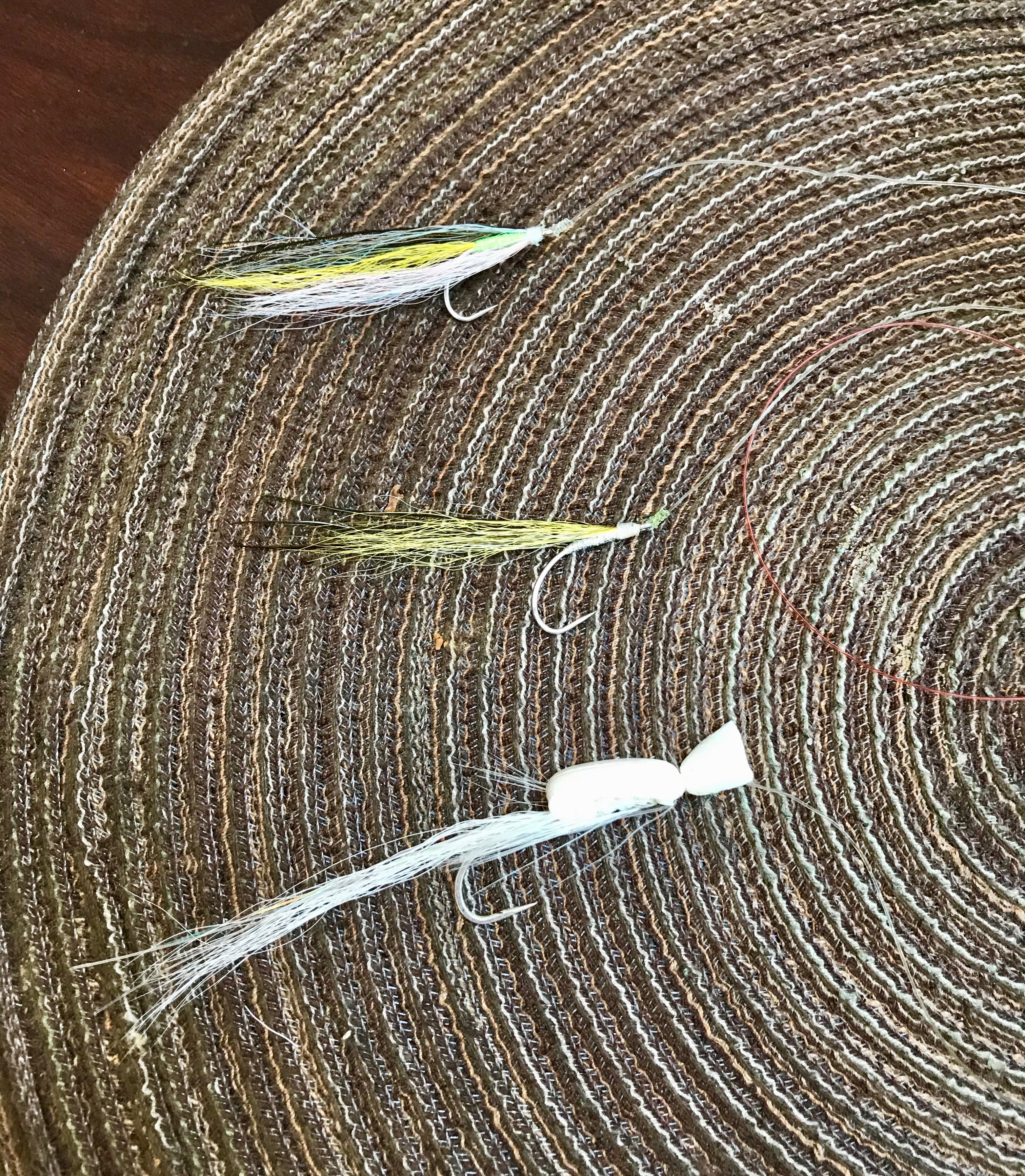
Beyond Cast & Strip: Presentation Flies For Stripers. Saturday, January 25, 8:30-11:00AM. What You’ll Learn: How to catch the stripers that other anglers can’t; why cast-and-strip presentations are ultimately limiting; how to target and catch bigger bass on a consistent basis; how to tie classic New England-style sparse flies like bucktails, soft-hackles, and flatwings (I will demo such patterns and discuss materials); the presentations that bring your fly to the fish; and more! Same deal — we also want to have fun.

Get on target to catch bigger bass from shore on a consistent basis. I’ll tell you how I do it when you take my class in Edison!

To register, you have to go to the Edison Fly Fishing Show site here. See you there!

Another crappy striper report, fishing by feeling, and a good surfcasting podcast with Jerry Audet.

I’m really not in a bad mood about it, but yeesh! I have been getting my butt kicked in the salt since June. Granted, it’s been a trip here, a trip there. Wednesday night I fished a top-secret mark with surfcaster extraordinaire Toby Lapinski. We both agreed that it looked fishy as hell: moon going behind a cloud bank for good, light winds making just the right amount of chop, falling barometer, moving tide, and….no bait. What?!? No legions of silversides? No juvenile menhaden? Toby managed a few courtesy bumps and a husky 8-10lb bluefish; all I could muster was a lightning fast double-blip hit that I suspect was a smaller blue. We only gave it 90 minutes, but we just weren’t feeling it.

Which brings us to the second part of this post. Dennis Zambrotta wrote that when he fishes the west side beaches of Block Island, he gives a mark 10 casts or so and then moves on. I don’t have any hard and fast rules like that, other than when I’m fishing by feeling, I get into a yeah or nay mindset. And on this night, the nays were screaming out loud. I was the one who formally called it, and Toby later confessed that he was ready to leave even before that. I guess when you reach a certain level, and have a certain familiarity with a mark and its patterns, you’re either feeling it or you’re not. Maybe if we stayed another hour, we’d have gotten into some fish. We did agree that if fellow surfcaster extraordinaire Jerry Audet was with us, he’d still be out there.

Jerry is a wonderful example of an angler with a plan. He knows who he is and how he wants to fish and he does it with consistently great results. You could learn a lot from a guy like Jerry — even if you never pick up a spinning rod — and a good place to start is last month’s Anglers Journal Podcast, Surfcasting With Jerry Audet. Give it a listen. Take notes. Appreciate his knowledge and passion.

Even if you’re inclined to get the hell off the reef and get to bed before 2am.

Striper Report 9/15/22: On the hunt for big bass with Toby Lapinski

Last night I was treated to a few hours of striper fishing with surfcaster extraordinaire Toby Lapinski. We fished a top-secret mark on Long Island Sound where there’s no public access (Toby has permission from the landowner, God bless him). Conditions were perfect, with a very light breeze out of the northwest. The air temp was decidedly cooler than the water, which was about 75 degrees.

Right away, I liked the spot. It’s a rocky reef where the incoming tide sweeps over the cobble and boulders from left to right. The tide was already moving when we arrived, and it wasn’t long before the current became quite pronounced. I started off with a team of two JV menhaden patterns, and about a half dozen casts in I had my first hit of the evening. It was a quick bump that felt like a small fish. Unfortunately, this was to become a pattern; I had dozens and dozens of these quick tugs, but was unable to get a hook set.

To make matters worse, my two-handed casting was rusty and I discovered that my two fly team had become irreparably tangled. Since I was feeling lazy, I clipped the dropper section and tied on a larger fly on the now 4-foot leader.

I had a few more bumps, but meanwhile, Toby was slaying them on plugs, especially his needlefish. I swapped out the deer-hair head contraption I was fishing for a “Sand Eel Punt” (basically an Eel Punt with sand eel-thin saddles) in Block Island Green. Finally, I connected with an 8-pound bass. That was my only fish landed of the evening. As my action slowed, Toby continued to pound up bass, albeit not in the size range we were hoping for. As the moon rose, the bite began to taper off.

The winning fly from last night, the “Sand Eel Punt.” I’m going to try this with some more substantial saddles.

Some observations: I can’t remember the last time I had so many hits that didn’t convert to hooksets. It was almost as if the stripers were afraid to commit to the fly; certainly some of those nips were from smaller bass. I can’t blame it stripping the fly right out of their mouths; any movement I was creating was no faster than about 1 foot-per-two-seconds, and I was doing plenty of greased line swinging. With the two-hander, I was able to cover far more water; however, when the bite was on, I had many hits when I only made casts of 50 feet or so. Lastly, why did Toby catch so many more fish than me? Was he covering more water? Was it the action or shape of his plugs? The depth he was fishing? Did my shorter leader have an influence? Why were Toby’s hits more demonstrative than mine? All stuff I’m trying to figure out today.

How planting by the moon can help you catch bigger bass

Some of you may know that I am avid gardener. Right now, I am planting by the moon. What’s that, you say? The basic idea is that just as the moon’s gravitational cycle causes tides to rise and fall, it also affects soil moisture. So you want to plant seeds and transplant during periods when more moisture is being drawn to the surface.

Okay, Steve. But what the heck has this got to do with fishing?

I’m a firm believer in paying attention to natural rhythms.Using stripers as an example, I also believe that the angler who wants to catch more bass, and especially bigger bass, will not be one who places a premium on leader construction or casting distance — but rather one who focuses on things like tides, moon phase, wind direction, bait patterns, water type, structure, location, water temperature, frontal systems, and barometric pressure. What’s more, that angler should pay attention to common natural markers, like hearing the first spring peepers or when flowering trees bloom.

It’s all part of one magnificent puzzle. Every year is different, but nature is always right on time. It doesn’t hurt to be able to cast a plug or a fly line very far. But if you really want to crack the big bass code, pay attention to Mother Earth’s natural rhythms.

Yesterday was herb day. Today it’s peppers. I have it on good authority that this weekend is a great time to plant cukes and squash.

“Striper Moon: A Legacy” film is now online

Director Lorri Shankar’s film about Ken Abrames, “Striper Moon: A Legacy” is now online. You can see the original film poster here. The link to the film, on Google Drive, is here. Enjoy!

A still from the opening of the film Striper Moon A Legacy.

Late striper quasi-report: When the best retrieve is no retrieve

I had a rare Saturday night to myself so I ventured out to points salty. I won’t bore you with the details of the first 90 minutes, although they were pretty eventful, featuring: wedding party songs I don’t like, fireworks in the distance, almost perfect conditions, that long slow pull mystery solved (squid, of course), not a touch from a bass, and finally, a parking ticket. Egad!

After all that excitement, I decided to amuse myself at a well-lit estuary. I find places like this highly addicting; my intention was to fish for 15 minutes. Over an hour later, I had to drag myself away. The action wasn’t that great — there was a decent amount of bait (silversides and juvenile menhaden), but predators (hickory shad and bass) were few and far between.

Which brings me to the point of this post. I was, of course, fishing a three-fly team — you do too, right? (If you don’t, you should read this short article on how to build a dropper rig for striped bass. You can thank me later.) Hits were few and far between, but every time I did get hit, I was doing one of three things: dead-drifting the team of three in the current, letting it dangle in the current, or performing a very slow hand-twist retrieve. I call this “trout fishing for stripers” because these are all traditional trout or salmon fly fishing tactics. Learn the art of presentation, and you’ll be able to catch the fish that everyone can’t.

Saturday night’s crew. I had touches on all three patterns.

Read “Old-School Striper Patterns are Still Deadly During the Fall Run” at Field & Stream online

Fly anglers are always looking for the next best thing. Especially when it comes to fly patterns. But often, “new” doesn’t translate to “better.” Some of these patterns are decades old, but they still get eaten because the stripers haven’t gotten any smarter. So if you want to see what’s in my fly box this fall — and at the end of my leader — read “These Old-School Striper Patterns are Still Deadly During the Fall Run,” brought to you by our good friends at Field & Stream.

The Magog Smelt Bucktail didn’t make the article, but it’s another fall favorite of mine. You can find out more about this pattern here.

A surfcaster and a fly rodder walk into Long Island Sound…

…and not much happens. Surfcaster extraordinaire Toby Lapinski and your humble scribe gave it the old college try last night for close to three hours. (Note the lack of large bass photos — heck, note the lack of any bass photos.) A couple small bumps for Toby and not even a courtesy tap for me. Although I did have a couple weird moments of pressure on the drift, my fly sweeping across a reef, no hooksets were forthcoming. It was probably something small. Light show: we were treated to a spectacular electrical display as a storm moved across western Long Island. Funny thing: that storm produced a sudden cold NE breeze and some raindrops on what was otherwise a calm night. So it goes. Round three to the bass. I gotta get some points on my card, so I’ll keep punching. This mark has yet to produce for me, but I believe it will. Then we’ll see some bass photos.

The main bait continues to be menhaden, juvenile and adult, and silversides. We also saw plenty of crabs, so there’s no shortage of food. The bass were simply somewhere else.

Fish Untamed Podcast Ep 55: “Trout Fishing for Stripers with Steve Culton”

Fish Untamed is website that’s run by Katie. She is self-described as “obsessed with chasing fish” — so right away, we like her! Katie also does podcasts, and yours truly is the subject of her current offering. Or, more specifically, the broad concepts of what I call “trout fishing for stripers.” We talk about that and lots of other things. But enough rambling; you want to listen. Here’s Fish Untamed Podcast Episode 55: Trout Fishing For Stripers With Steve Culton.

A floating line, a striped bass, and a very happy angler.

“Sensei Elmer & The 50-Fish Nights” in the current issue of Surfcaster’s Journal

Surfcaster’s Journal 68 is live right now — it’s an online-only ‘zine — and within its fantastic digital walls you can find my latest story, “Sensei Elmer & The 50-Fish Nights.” This is a piece I wrote a long time ago, revisited, rewrote, re-edited — and now, instead of hiding on my hard drive, it can be yours to read and enjoy. You get to see some decent photos taken by me, and some extraordinary shots from my immensely talented brother David . (You can see more of David’s work on Instagram @theplayoflight.) “Sensei Elmer” is about two memorable fly fishing nights I had one October. Or is it about something far deeper than catching fish?

Most of what I write eventually ends up here, but this piece won’t — so if you want to read it, you’ll have to subscribe to the Surfcaster’s Journal. It’s only $20 a year and you get six issues. Tell ’em Steve sent ya.

Get your Elmers here!