Yes, I Guide/Teach for Striped Bass

Do I guide for striped bass? The short answer is yes. But, these sessions are non-traditional in the sense of a typical guide trip/lesson. The focus is rarely on catching stripers in the moment; rather, it is to prepare you to catch stripers in the future. Depending on time/tide/conditions/season/luck, we may indeed catch some bass. But there is also a high probability that we won’t see a fish.

There are several reason for this. For starters, I do not guide at night. No exceptions. That leaves us with daylight hours, which in the abstract usually means fewer hookups. We’re also in the midst of striper downturn — there are far less fish than there were, say, 15 years ago. I can’t take you to Block Island or Cape Cod, which typically have an in-season abundance of stripers — you’d have to pay for my time and travel, and that would be cost-prohibitive. I’m shore wading only, so we can’t quickly zip off in a boat a few miles away to find the next blitz. Finally, my lessons are usually two hour sessions. Tides and time being ever-changing, that means we may not hit a strong bite window (if we do, good on us!). So, if you’re OK with trading immediate gratification for success down the road, read on.

What do I teach? A lot of good stuff you won’t find anywhere else. Most of you know me as a guide who fishes for stripers in a traditional and (in modern popular practice) unconventional manner. I primarily use floating lines. You should have one, too. My focus is on rigging, presentation, fly selection, and more presentation. You might want to spend a couple hours with me if you’re interested in learning traditional trout and salmon presentations like the greased line swing; how to tie and fish dropper rigs; fishing with multiple flies at or near the surface; reading water; fishing with your two-hand setup (sorry, I can’t supply you with a rod); and plenty of little things that sometimes make the difference between fishing and catching stripers.

I hope this clarifies what I do. My rate will vary depending on location. If you’re interested in setting up a trip, or need more information, please call me at 860-918-0228 or email swculton@yahoo.com.

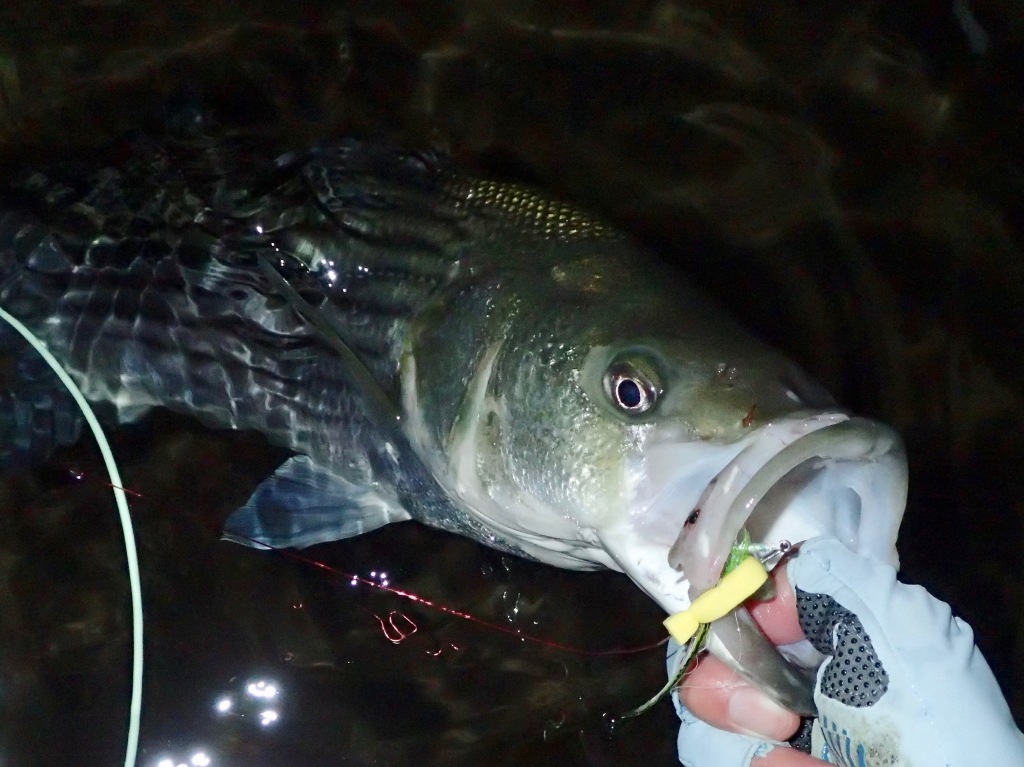
Not all Gurgler-type flies are meant to be stripped. I caught this handsome Block bass on a dead drift — the Gurgling Sand Eel was point fly on a team of three — and showing you how to do the same is just one of the things I teach.
The Countermeasure Fly Tying Video

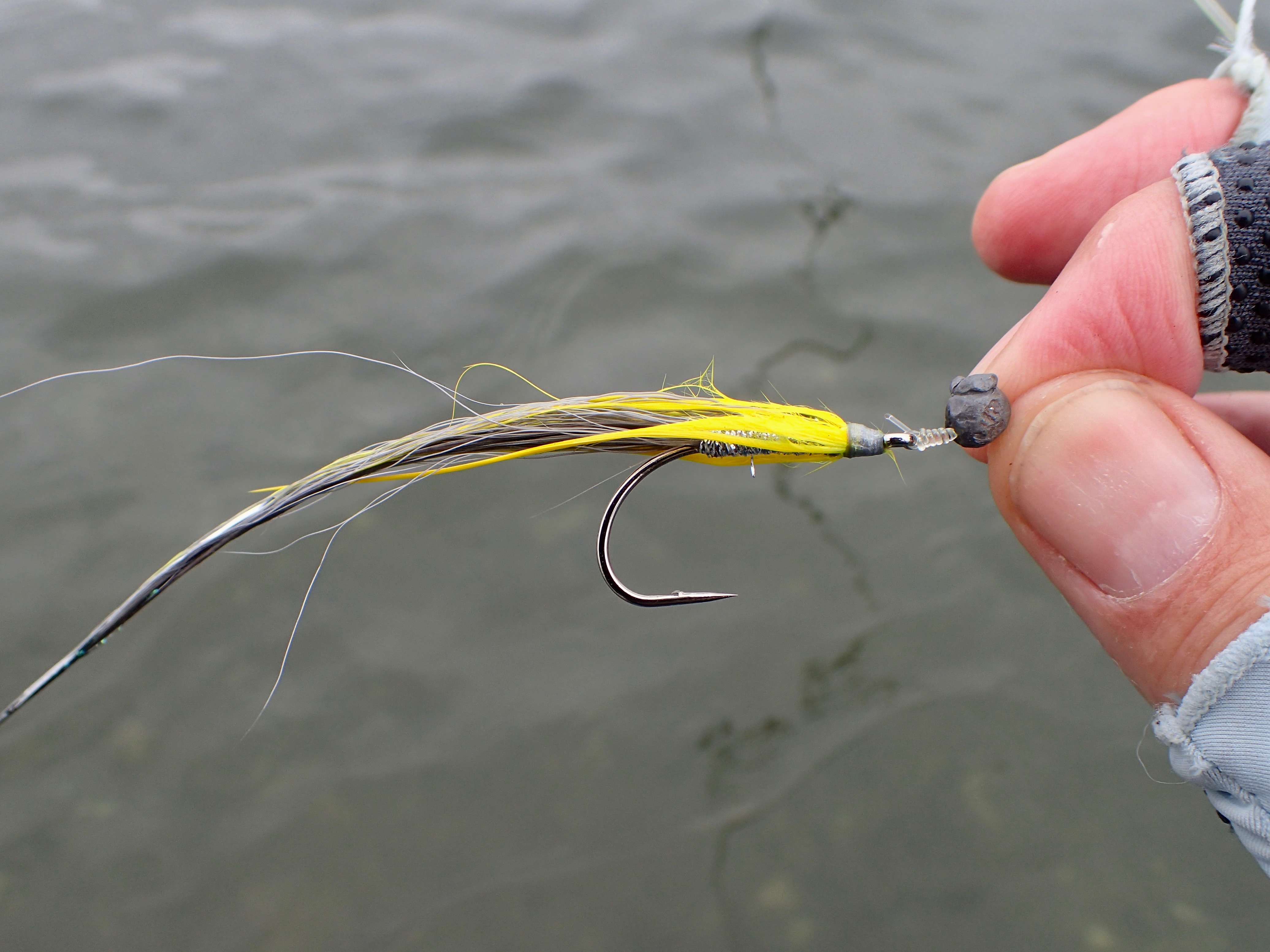
You’re now at Countermeasure Central on currentseams! Here you can watch the tying video (below); see the original post/recipe; and read the Guide Flies feature piece from On The Water magazine. In case you’re new to this pattern, the Countermeasure is a riff on several proven streamer designs (like the Zoo Cougar and Zonker). It’s loaded with bite triggers, and it’s one of my favorite smallmouth bass bugs. Oh! Big trout love it, too.

Striper Report: First Cast Fever, or: it’s all about adjustments

I decided to fish the mouth of the Hous for a couple hours simply because I could…and because it seemed like that time of year. I had the place to myself for about 30 minutes, but no love taps were forthcoming. The terminal rig was a Soft-Hackled Flatwing in R.L.S. Easterly colors on an 8-foot leader. It didn’t compute that there were no fish around, so I decided to make an adjustment.

This is the kind of little thing — I know you’ve heard that phrase somewhere before! — that can have huge impact on your fishing. If you know or suspect the fish are there and you’re not catching, do something different. So I swapped out my leader for a 6-foot section of T-11 and a three foot leader. Still nothing. Then, I added a 3/0 shot to the leader just above the fly. Next cast, bang! Then another two casts later. This made me happy.

Sometimes it’s the little adjustments that make the biggest difference. This single shot, clamped on with pliers, resulted in an immediate hookup.

You might think that this is how the story (happily) ends. But no. After those two fish, I went a good half hour without a tap. I have to confess that this kind of fishing holds little interest for me, even less so when the bite is off. But since we’re talking about adjustments, how’s this: go from dredging the bottom to skating on top.

Many years ago old friend Ed Simpson exclaimed, as we fished a spot not too far from where I was wading, “Make ’em come up!” Off came the full sink tip and shotted fly, on went the longer leader and a Gartside Gurgler. First cast, splash, boil, whack! Then another. And another. These fish were sporting the colors of bass not fresh from the sea, but rather those of winter residency. Not very big, but I love any striper that displays that marauding spirit. Many anglers think of fishing surface bugs as an active presentation, with the fly in constant motion, but every one of my hits came on the pause (see this post for more on varying your strip cadence).

My last adjustment came as the action and tide waned. I noticed a far sexier rip, abutted by a slick, 150 feet downriver. So I waded down, made some casts, and caught some more. And that, dear reader, brings us to our happy ending.

Striper Report and props for CT’s ASMFC reps

Hot on the heels of yesterday’s scathing menhaden management commentary comes a shout out to the Connecticut members of the ASMFC. This is from a post made by Charles Witek on Facebook: “The New England states are worried about lobster bait. Virginia is worried about Omega. Everyone is worried about cutting fishermen’s income. It’s probably no coincidence that–with the exception of Connecticut and Rhode Island–the states seeking a larger cut in menhaden landings were southern–North Carolina, Georgia and Florida–which have neither a lobster fishery nor a big menhaden fishery. Connecticut made a noteworthy effort to convince the Management Board to do the right thing, and Rhode Island has long been a leader for better menhaden management. Folks in those states–particularly in Connecticut–ought to thank their fisheries managers if they get the chance.” Huzzah! If you want to send them a thank you email, you can find their contact info here. Please comment here if you send an email!

On to striper fishing. I’ve spent a significant amount of time this fall learning a new mark. The going’s been slow, but on Tuesday night I finally had some action — about a dozen hits, and the water was so calm I could also see several follow-the-fly wakes. Nothing big, but the big fish potential remains. Then there was last night. Specifically, the fog. It came in on big galumphing herds of elephant feet. We’re talking horror-movie density fog. I hate fishing in fog. With a few notable exceptions, it’s always been a bite killer. And so it was last night. Still, I got to stand in the ocean and fish and smoke a cigar and you know, that ain’t all so bad…

If there is a defining line between heavy fog and actually rainfall, I think we reached that threshold.

800 Followers Contest is closed. Winners announced soon!

I will draw winners this week and notify you by email. Thank you to everyone who entered, and for your continued support and readership!

Cheers, fellow currentseamers. Actually, I’d better not — I’m writing right now.

Extending your long-distance dry fly drift, or: When not to mend.

I don’t usually double dip my Instagram (stevecultonflyfishing) and Currentseams posts, but I thought this one was worthy of a more in-depth discussion. It’s a video of a smallmouth blowing up on a dead-drifted Wiggly about 70 feet across the river:

Now that you’ve seen it, let’s get to what appears to be a problem. One sharp-eyed viewer made a trenchant comment: “Mend!” He noticed the long downstream belly in the line. It’s a fair point in the abstract, but it doesn’t address the situation or the presention in its entirety.

Let’s begin with conditions. We have very low, clear, slow moving water. That usually means spooky fish. Now, smallmouth are not known as picky eaters, but the longer you fish for them, the more you discover that they can be as difficult to entice as the world’s most finicky trout. I was fishing a Wiggly, which, if you’re a Wiggly purist, is supposed to be presented on a dead drift. Any angler-induced motion should include the legs only. That’s a daunting proposition, especially at 70 feet. It doesn’t mean that the fish won’t hit a waking or stripped Wiggly. It just means that you’re only going to get hits from aggressive, willing-to-chase bass. And sometimes, that eliminates the bigger fish.

Now let’s talk distance and tackle. 70 feet away is a challenging length to dead drift a dry fly. The 5-weight I’m using, although 10 feet long, isn’t enough stick to make a 70-foot mend with an 8-weight, weight forward long taper line. I could, of course, lengthen the leader if I was concerned about moving the fly on the mend. But that’s a moot point if you can’t make that mend in the first place.

So, how did I handle this situation? I began by determining where I wanted the fly to have the longest period of dead drift. I aimed my cast about 10 feet above that point. I made an aerial upstream mend, then a hard, full upstream mend with as much line as I could manage. The fly moved a bit, but that didn’t concern me — I was simply setting it up for where I thought the strike zone would be, well downstream. (I had seen this fish sipping bugs off the surface, and it appeared to be one of the larger bass in the pool.) As the fly dead-drifted downriver, I made another upstream mend with about two-thirds of the line — this was about as big a mend I could afford without disturbing the fly.

That sets up the large belly you see in the video. It’s not ideal, but it’s a necessary evil to obtain the drift I wanted. What you can’t see is me tracking the drift with my rod tip, then pointing my rod downstream, and extending my arm as far out as possible to make that drift last just a…few…more…feet. (I could also have stripped out line and fed it into the drift, but that tactic makes long distance hooksets even harder.) And that’s the rub: with that much line out, and that much slack from the downstream belly, it’s a challenge to get a good hookset. You have to rely on a sticky sharp hook and hope the fish does most of the work.

When it all comes together, as it did here, you understand that while catching isn’t necessarily the best part of fly fishing, it most certainly doesn’t suck. In the end, we are presented with one of the most important questions in fly fishing: “What do you want the fly to do?” If you answer that question, and figure out a way to make it happen, you’re going to catch a lot more fish.

It’s a Great Eight Hundred Followers Celebration!

Happy Tuesday, fellow Currentseamsers. Happy September, too. Where did the summer go? Seems like just yesterday I was heading out to Block with Jenks for some early summer stripers. Anyhow: Thank you for being part of the Great Eight Hundred! To celebrate, we’re doing our customary flies-tied-by-Steve giveaway. Here are the rules:

1) No purchase necessary.

2) You must be a follower of currentseams to enter. (If you’re not one already, you become a follower by clicking on the “Stay current with currentseams”  Sign Me Up button on the home page.)

3) To enter, leave a comment on this thread that responds to these questions: 1) How are you managing with the pandemic? Are you fishing more or fishing less? One entry per person. Deadline for entering is 11:59pm September 15, 2020. Three winners will be chosen at random. The winners will be notified in the comments section of this thread or by email, and will be responsible for sending me their address so I can ship the flies out. Sorry, I can only ship to U.S. addresses.

4) All decisions by me are final.

Thanks again for reading and following currentseams.

As Mick Jagger said, “You could be mine you could be mine all mine…”

Fun with Barr’s Meat Whistle

Barr’s Meat Whistle is another streamer pattern I’ve known about (and been meaning to tie) for years. But never got around to doing so until 2020. What I’ve tied up is actually good friend Tim Flagler’s variant, and I’m including Tim’s fine video tying lesson here. Tim calls the Meat Whistle “functional and adaptable” and I couldn’t agree more.

The Meat Whistle does double duty for trout and smallmouth (and dozens of other species) but I’ve only had the chance to use it as a smallmouth streamer. If you’ve been paying attention to my Instagram feed (stevecultonflyfishing) you know it’s been a challenging year for smallies. I haven’t done really well with it as a traditional streamer — its creator loves to hop and drop it along the bottom. But I had an eye-opening experience using a different method on Sunday.

The mark I was fishing was low and deep and at these low flows, not moving very fast. I knew the pool held a good number of fish, but they would not commit to surface bugs or a stripped or swung streamer. Given the amount of crayfish in the area — and the way crayfish scuttle along the bottom — I decided to try the Meat Whistle dead drifted along the bottom under an indicator. (Cue “ding-ding-ding” — or should that be “TWEEEEET!” sound effects here.) The takes were incredibly subtle, but I stuck and landed a decent number of bass. Man, this is one old dog who loves learning new tricks!

John Barr’s Meat Whistle (Tim Flagler Variant) in rusty crayfish colors.

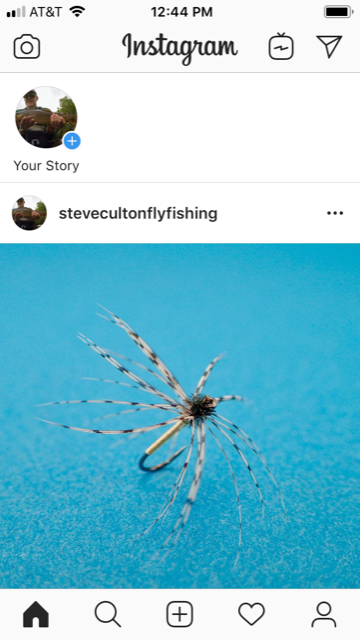
Steve Culton is now (finally) on Instagram

My goodness, sometimes I move at a glacial pace. (Remember glaciers? We used to have them everywhere it was cold…) But never mind. You can now find me on Instagram at stevecultonflyfishing. This location will be more quick hit copy and visual reference than the detailed articles you find on currentseams. And on the flip side, more situational shots from fishing trips or events in near real time.

While I’m hoping to cultivate new audiences, I encourage all my loyal readers to follow me on Instagram. There will certainly be material there that doesn’t make it to currentseams. Thanks, and I’ll see you on the river or at an event soon.

Yeah. That’s me.

IMG_4272