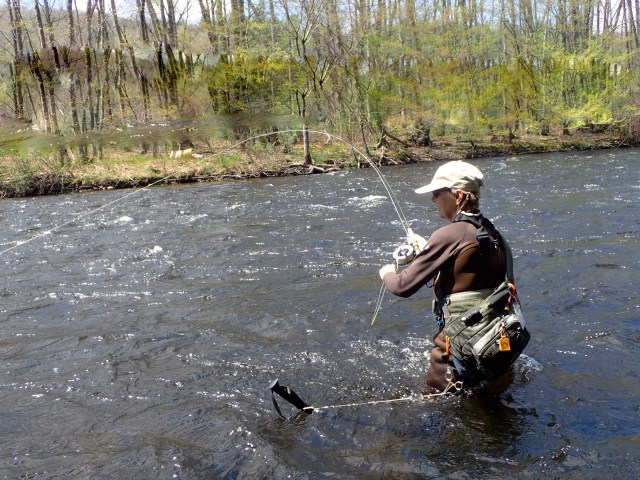
Small stream report: First wild brookies of 2017

The older I get, the more I embrace the philosophy of, “I don’t need to be right.” But boy, did I make a good call about fishing a small stream today.

I thought there would be enough water for the fish to be comfortable in. Yes, there’d be more tomorrow, but with a cold front approaching — and plenty of cloud cover — today would be the better mid-day option. So I visited an old friend from 11am-1:30pm. There are three things I want to tell you about.

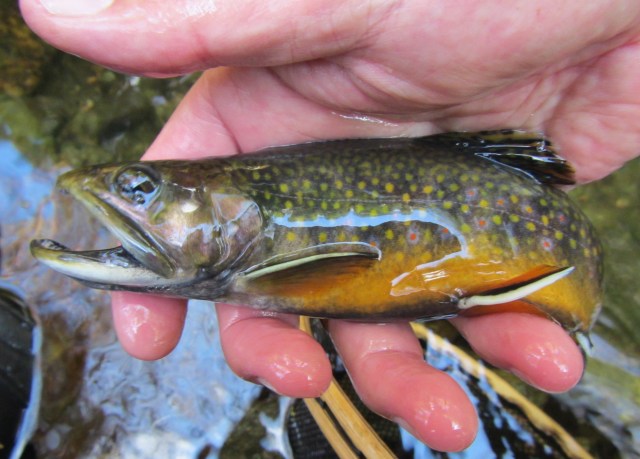
Nature finds a way. This particular brook was disastrously low  when I visited it in August (not to fish, just to look). Yet somehow the brookies made it through the stress of a scorching summer that reduced their home to a trickle. Today, I pricked ten, landed six. Jeez, I’d sign up for that in May. In January it comes off as an unimaginable bounty. I’ve never done this well on this stream in winter.

The first salmonid of 2017. I don’t usually handle fish this small, but this gorgeous creature made my heart leap up in my chest. Happy New Year!

OLYMPUS DIGITAL CAMERA

Droppers are the quickest way to find out what the fish want. You may be bored with me saying this, but I will continue to shout it from the rooftops. I started the day with a size 16 Improved Sofa Pillow dry. After 15 minutes of no luck, I added a 2x short size 18 SHBHPT dropper. While most of my fish — particularly in the deeper pools — feasted on the dropper, the dry took the largest char of the day.

One swing and a miss — then on the next cast, the kill shot delivered. 

OLYMPUS DIGITAL CAMERA

Small streams in winter are places of unparalleled tranquility. It rained the entire time I fished. My left boot foot leaked. My fingertips were frozen. Funny thing! I looked at my watch and realized I’d been fishing for two hours. Sure, it helped that the catching was good. But watching the smoke from my Punch Gran Puro Robusto curl into the mist didn’t suck either.

Looks cold. Was cold. And wonderful. 

OLYMPUS DIGITAL CAMERA

~

How my fingers got so numb. But the Fontinalis fins were worth the price of admission.

OLYMPUS DIGITAL CAMERA

Winter 2017 Appearances and Presentations

There’s still fishing, but winter is prime presentation season. Hope to see you on the river, at a club meeting, fly shop, or a show. There may be more additions to this list, so stay tuned. (Like right now. I’m adding a date on January 17th.)

“The Little Things,” Wednesday, January 11, 7pm, at Candlewood Valley TU, Bethel, CT. This is the original Little Things (there are currently two with a third on the way) presentation. From the CVTU website: Our meetings are free and open to members, guests and the general public. They are held at Stony Hill Fire Department, 59 Stony Hill Road, Bethel and start at 7:30 p.m. but doors open at 7 p.m. for pizza, soda and some good conversation with fellow anglers. For more information, visit cvtu.org.

“The Little Things,” Tuesday, January 17, 7pm, at Thames Valley TU, Bozrah, CT. Like above, this is the original Little Things. From the TVTU website: Fly tying starts at 6:00 p.m. and the meeting begins at 7:00 p.m. Meetings are open to the public and there is no charge so come and join us. For directions and stuff, visit thamesvalleytu.org.

“Wet Flies 101,” at the Fly Fishing Show, Marlborough, MA, Friday, January 20, 1pm, Catch Room. We’re in the big room for this one, so come out and support your friendly local fly fishing writer guy! I may be tying after the presentation. I’ll let you know if that’s so. For more information, visit the Fly Fishing Show website.

“Wet Flies 101,” at the Fly Fishing Show, Marlborough, MA, Saturday, January 21, 10am, Destination Theater, Room A. Smaller room, same energy and information. Ditto maybe tying after the presentation. For more information, visit the Fly Fishing Show website.

Tying at the CFFA Fly Fishing Expo & Banquet, Saturday, February 4, Maneely’s, South Windsor, CT. Come see why the Expo is the best little fly fishing show going. I’ll be there from the morning thru early afternoon. For more information, click here.

“The West Branch of the Farmington River,” Wednesday, February 8, at East Jersey TU, Rochelle Park, NJ. Have Farmington River enthusiasm, will travel. For more information, visit the EJTU website.

“Farmington River Favorites” Tying Demo, Saturday, February 11, 10am-2pm at The Compleat Angler, Darien, CT.  At this demo, I’ll be tying some of my favorite patterns for the Farmington River. There will be a little bit of everything: wets, dries, nymphs, and streamers, from traditional classics to new designs. These are all high-confidence, proven patterns, and I’ll also discuss how and when I like to fish them. For directions and stuff, visit the CA website.

“The Little Things 2.0,” Thursday, March 16, 6:30pm, at Farmington Valley TU, New Britain, CT. This is the followup to the original Little Things, and it’s currently one of my most popular presentations. For more information, visit the fvtu website.

Whew! That should keep me busy. I’m still trying to finalize some tying classes/demos as scheduling permits. Thanks for your support, and as always, if you come out to see me, please be sure to say hi.

Moving up to the big room in Marlborough, Friday, January 20, at 1pm.

Wet Flies 101

The Partridge Family

Surely any aficionado of the soft-hackled fly knows the value of the partridge. Although James Leisenring committed the act of understatement when he said, “The English or Hungarian partridge provides the flytier with some valuable gray and brown speckled feathers.” Some? There are enough glorious feathers on a full partridge skin to keep you in soft hackles for decades. I know, because I just bought my second skin. I still have the first one, purchased a decade ago, and it still has many seasons of flies left in it.

Forget the packaged bags of partridge feathers. Then listen to Dave Hughes, who said, “I cannot urge you strongly enough to purchase an entire skin, wings and all.” This one came from UpCountry Sportfishing. I like to buy hackle in person so I can eyeball the skin. And of course, it’s a good idea to support your local fly shop.

partridgeskin1

~

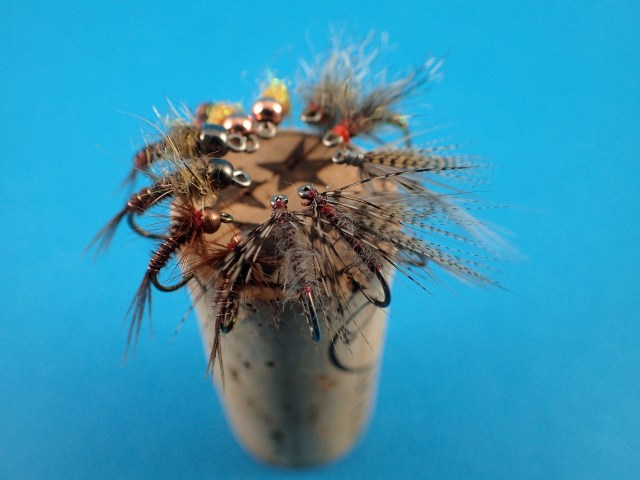
I use feathers from all over the skin — for saltwater flies, too — but the hackles I value most are the silver-grey and brownish feathers that line the neck, shoulders, and back. These are the feathers that are used in the North-Country spiders and dozens of other traditional patterns. The closer you go to the neck of the bird, the smaller the feathers. Look for a skin that is densely packed with these smaller feathers.

OLYMPUS DIGITAL CAMERA

~

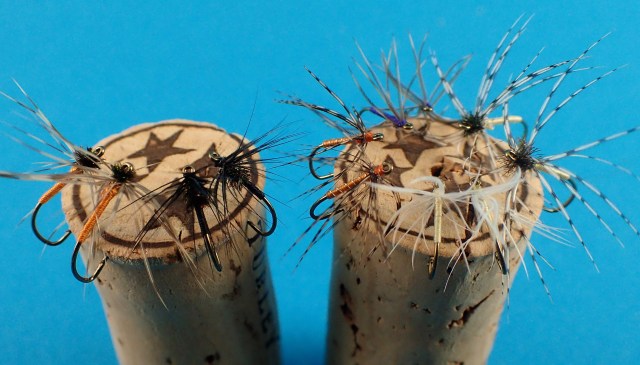
A hook, a partridge feather, and some thread. Simple, buggy spiders like these have been fooling fish for centuries.

Partridge and Light Cahills

Farmington River Report 12/28/16: Lockjaw

That was the general consensus up and down the river. Theories abounded, from snowmelt lowering the water temps to a grey, blustery day where the air temperatures never really spiked. I’ll throw in a pitiful amount of bugs and be done with it. I nymphed within and above the permanent TMA from 9:30am-2:30pm. Water was a cold 34 degrees, there were a few minor snow showers, and the river was running at the princely sum of 175cfs. Lots of folks out fishing today. Many thanks to those who kindly shared water.

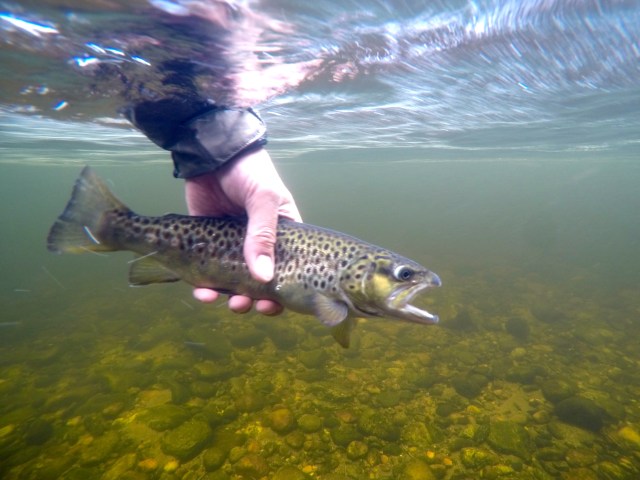
There was a 15-minute window of consistent sunshine in the early afternoon — enough to get a few bugs going — and that’s when I had my only touch of the day. I often tell people that I’ll always sign up for one fish in the winter, and when it’s a tank of a high-teens brown, all the better.

The winning fly, a Frenchie variant, on the day-saving fish.

OLYMPUS DIGITAL CAMERA

A low-water drop shot nymph rig with sighter

I recently mentioned that in these low, clear water conditions I had temporarily ditched my beloved indicator nymphing for a straight line drop-shot approach. I had many questions about the method, but also about the rig, which is presented below. The template is the same as the one I use in higher water; I’ve simply swapped out some materials to create a leader system that makes strike detection easier and uses thinner diameter nylon.

So, what’s changed?

— The top of the butt section is now Hi-Vis Gold Stren. You can of course use whatever color you like, or even a different material (like Dacron). The yellow jumps out to my eyes, though, and we can all agree that it’s important to be able to see your sighter.

— The bottom of the butt section is P-Line Floroclear (it’s fluorocarbon coated material). I’ve been using P-Line for years in my steelhead leaders. It’s strong as hell and has a thin diameter. Good stuff. I use it on my indicator drop-shot rigs, too.

— I sometimes use 5x instead of 4 lb.  Maxima Ultragreen for the top dropper. It’s strictly a diameter choice I leave up to the angler.

— The drop shot tag goes down a size to 6x. This is to a) insure the weakest link breaks on a shot snag, and b) I typically use smaller patterns for the point fly in the winter, and the 6x is easier to squeeze through the eye of a 16 or 18 hook.

— I’m using round BB shot, no wings. Hopefully that means less bottom hangups.

For your leader constructing pleasure.

OLYMPUS DIGITAL CAMERA

Here’s a pdf: lowwaterdropshotnymphrig

What you leave out of a fly may be as important as what you put in

Here’s to impressionism in fly tying. Here’s to creating the illusion of mass without adding bulk. Here’s to using water as a key ingredient in a fly pattern. Here’s to tying flies that try harder to look like something that’s alive and good to eat than try to carbon copy the bait or insect.

I often think of the discussions anglers have about herring or menhaden patterns. The chief complaint seems to be that a given pattern doesn’t mimic the deep belly profile of the bait. The next question that should be asked is, “Is that really necessary?” Anyone who has fished a large flatwing on the greased line swing to stripers feeding on herring knows the answer.

If you talk to Ken Abrames, he’ll tell you about how an angler will come to him and complain that he’s not catching any fish. One of the first things Ken will do is ask to see the fly. If it’s up there on the opacity meter, Ken will start pulling bits of hair and flash out of the fly. Often, the angler then begins to hook up (ask me how I know).

By all means, tie and fish the patterns you have confidence in. Just consider the sage advice of Bill McMillan, who doesn’t like to pretend that a fish is anything other than the primitive animal it is.

I don’t see any big honking bellies or ultra-realistic 3D eyes on these flies. Funny thing! Stripers eat them like candy.

Rock Island Flatwings

~

Doesn’t look like the any of the grasshoppers I used to catch when I was a kid. Yet this fly is in grave danger any time I drift it past a grassy bank on a sunny summer day.

Culton_Hopper_Hammerdown

~

For hundreds of years, the ultimate in sparse impressionism. And the fish haven’t gotten any smarter.

FebRedPPT

“Building a Better Trout Stream” in the Jan/Feb 2017 issue of American Angler

“Building a Better Trout Stream,” written by yours truly, is a neat little conservation piece. It’s about Hatchery Creek, a man-made — yet sustainable — trout stream built in south central Kentucky. Cool stuff, and you can read all about it in the current issue of American Angler.

You can create a perfect little trout stream out of dry land. Find out how on page 8.

OLYMPUS DIGITAL CAMERA

~

Yes, Virginia, there are more projects in the article pipeline. Details on those as they near printing stage in 2017.

I also have a busy appearance schedule this winter, including The Fly Fishing Show in Marlborough, MA. Updates to come in January 2017.

Farmington River Report 12/13/16: Subsurface spectacular

Going to be mighty chilly later this week, so I thought I’d get my licks in today. Good call. I fished within the permanent TMA from 9am-1pm, and found very cooperative fish in two of the three runs I fished — not to mention precious solitude. Here are the day’s notes:

Nymphing was incredibly productive for me. Those of you who are currentseams regulars know that I am a huge fan of indicator nymphing, especially in winter. However, in this low (100cfs and falling) and cold (34 degrees) water, I’ve gone away from the indicator to a basic short-line approach. The trout are beginning to stack up in their winter lies, and since the water is so shallow, those lies are very accessible via the long rod. I still like the indicator for covering water and for fishing faster, deeper runs, but in these conditions I’m doing better with the short-line approach. Still using the drop-shot rig, only I’ve added a yellow sighter.

Most of today’s trout were foot-long wild fish like this beauty. I did manage a well-fed rainbow and a mid-teens brown. 

OLYMPUS DIGITAL CAMERA

~

I fished two flies today: a size 16 2x short Frenchy variant on point and a size 16 March Brown wingless wet dropper. The trout were just about evenly split on both. But it’s interesting to note that my first half-dozen fish came on the top dropper. This came in advance of another strong morning W/S caddis hatch. It could have been that the trout were keying on emergers 1-2 feet off the bottom, or simply that they were looking up. Regardless, droppers continue to be the fastest way to find out what the fish want.

A fascinating mix of strike styles today. Some were oh-so-subtle pauses in the vertical line, others were sharp tugs. Good stuff.

Don’t let the exquisite red spots and delicate parr marks mislead you: this fish fought like a badass. I’d like to rumble with him again in a couple years.

OLYMPUS DIGITAL CAMERA

~

Finally, support your local fly shop. UpCountry Sportfishing is a good friend of currentseams, and they have a tremendous selection of just about anything you’d need for fly fishing or tying. Make sure Santa knows where to find that new rod, reel, vise, or whatever it is you don’t have — or need more of.

Housy Mini-Report 12/8/16: Lots of water — action, not so much.

I missed my annual October/November Housy streamer trips this year, so I went yesterday. The HRO website declared that at 860cfs, it was a good time to fish big streamers on a full sink line. I concurred. Sadly, the trout did not. I fished five familiar, favorite pools and came up blank. Not a touch. Oh, I nicked the bottom many times, and sacrificed three streamers to the river gods, but ’twas not my day. Fast water, slower water, pocket water, shallow and deep — bright colors, muted naturals — fast retrieve, slow retrieve, no retrieve — nada. On the positive side, I had the entire river to myself, always a bonus. We’ll get ’em next time.

With both air and water temperatures in the 30s, this is sound advice.

OLYMPUS DIGITAL CAMERA

Farmington River Report 12/6/16: Wet fly action in…December?

Trout blasting wet flies on the swing with a water temp of 36 degrees? Yes, indeed.

I fished the permanent TMA today from 9am-1pm. I was rigged for nymphs, and I spent the first 30 minutes bouncing along the bottom, desperately trying to ignore the growing number of trout slashing at W/S caddis. After the second or third time of telling myself that I was acting like an angler throwing Clousers at a school of stripers feeding on the surface, I disengaged the shot and re-tied the point fly to match the dropper: size 18 soft-hackled pheasant tail. It was by no means a proper wet fly rig, but what the heck — I’m lazy. Second cast, whack! A lovely late fall  wild brown. Next cast, ker-pow! (Those old enough to have watched will recognize the channeling of my inner 60s Batman TV show memories.) And so it went until the hatch waned.

The first fish of the day is always memorable, made even more so when it sports such finery.

OLYMPUS DIGITAL CAMERA

~

I got out to warm up, and after ten minutes the slashing resumed in earnest. Only this time it was tiny BWOs they were after. The fish proved to be more difficult to catch during this hatch; they wanted the fly on the dangle (if they wanted it at all). By now the sun was up good and proper, and the trout were for the most part hugging the shade line of the eastern side of the river. I had to work hard for the two I landed, but when you’re swinging wets and it’s December and you’ve never had this much success with that method this late in the year, you’re squarely in a no-kvetch zone.

One of the BWO trout, a low teens wild thang.

OLYMPUS DIGITAL CAMERA

~

But wait, there’s more. We also had a five-minute-blizzard of a midge hatch. I switched to dries for this, and fooled two on a size infinity Griffith’s Gnat, but sadly didn’t stick either fish.

And at this point, I won’t even bother writing about how I blanked on streamers.

On the way out I spoke with fellow guide Mark Swenson. Mark was Euro nymphing and had done quite well (in fact he landed one while we were chatting). He was also fishing small stuff, size 18s.

But for over two hours, I had the river all to myself. Just me, the trout, the bugs, and a December sunshine that made me feel like summer could come any day now.