This is the “Bead Head Stone, Rubber Legs” pattern from the first edition of Matt Supinski’s Steelhead Dreams. My spies in Pulaski tell me that this time of year, big stones with wiggly jiggly legs are all the rage, so I tied up a few (along with some long-legged Kaufmann Stone variants) to have in my box.
Here’s how I tied the Bead Head Stone, Rubber Legs: Hook: Orvis 1524 #8; Thread: black UNI 6/0; Legs/Antennae/Tail: black Life Flex; Abdomen/Rib: black SLF, copper wire; Thorax: black hen hackle; Bead: copper 5/32″; Head: black SLF.
For the second consecutive year, our #1 slot goes to steelhead. Normally, my August trip out west would have been the runaway winner, but what I experienced over the course of two days in December in Ohio and Pennsylvania was nothing short of extraordinary. Let me tell you about it…
Saturday, December 17: Conneaut Creek, OH. This trip was years in the making. I’d originally booked a trip to Steelhead Alley with guide Bob Packey (you can find Bob at Solitude Steelhead Guide Service LLC) for a fall trip, but we got flooded out. We rescheduled for last spring, but when the date all the fish had returned to the lake. That left us with a long wait for mid-December 2022. But oh, my goodness, what a worthy wait.
My plan was to drive out to Wooster, OH, on Friday the 16th to pick up #2 Son Cam from college. What should have been a nine-hour drive turned into well over ten, thanks to a snow squall in the Poconos. By the time we had dinner and reached our lodging in PA, it was pushing 11pm.
Conneaut Creek reminded me of the Sandy Creeks north of NY’s Salmon River. A medium-sized creek, shale bottom, water with a peculiar greenish-brown tint, and fish that hold in its deeper pockets and runs. Cam, who could hardly be called a fly fisher — his only serious big river foray in the last decade was this summer in CO — was into three steelhead before I even had my rod set up. Such is the teaching acumen of Mr. Packey, who knew the water by rote and had Cam casting and presenting functionally in minutes. I was using Bob’s leader system with one of my yellow yarn indicators, which was a good choice for me since I had great difficulty seeing Cam’s indicator. (I learned and relearned many lessons on this trip, and the first was: always fish the way you are most comfortable/have the most confidence in.) I dropped my first hookup, but before long I was putting my first Erie trib fish in the hoop.
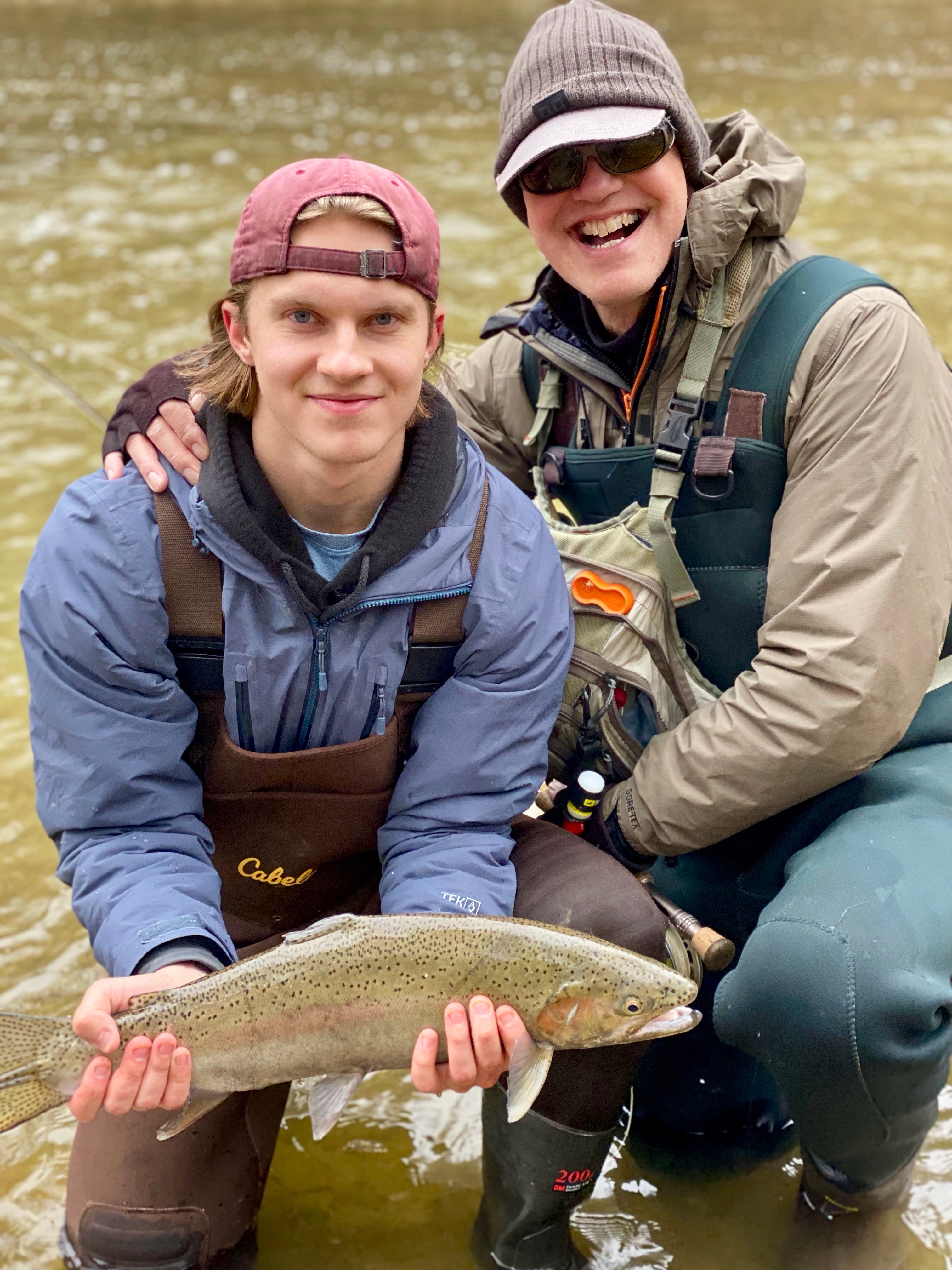
Giving my first Erie Mykiss a kiss. If this had been my only fish of the day — or, let’s get greedy and say the first of five — I would have left the creek a happy man. Little did I know the magnificent bounty that awaited us in the next pool. (Unless otherwise credited, all photos by Bob Packey.)We hiked/waded upstream several hundred yards to the next mark, a deep slot in the tailout of a faster moving pool. I’ve included this photo to show you the incredible shale walls that surround many of the Erie tribs. We were literally fishing from the ledges upon which you see each of my boots — backs to the wall — it’s only a few feet of wiggle room, and if you make a wrong step you’re into deep, 34 degree water. This mark was phenomenal; we had to alternate casts/presentations, and for the first several it was a hookup on every cast. After that, we took turns, the rule being you presented until you hooked up. We’d been using egg patterns — Bob’s favorite is the Blood Dot with an egg body and apricot supreme dot. I switched over to some of my bugs, and hooked up on a 60 Second Redhead and a Copperhead Stone. You can use two flies in both PA and OH, and that was the setup we fished with over both days.The third mark was an intriguing maze of ledges and submerged formations that created several fish-holding slots. I remember Bob suggesting we prospect in a mysterious looking pocket not far from our feet. Gold — or should I say chrome — was struck after a few casts. We fished a bit, ate some lunch, then went back at it. I’m good for at least one act of stupidity per trip, and on today it was a missed hook set that went straight over head and sent my leader cascading into the unreachable upper branches of a tree. While Bob was building a new leader for me, Cam hooked and landed this beauty with me handling net duties. We ended the day far downstream casting to a pod of steelhead that suddenly had lockjaw. My best guess was the cold front that was pushing through; the mercury had dropped, the wind had picked up, and it was a classic case of game over. My final tally for Saturday: 14 steelhead. After countless hours of disappointing fishing in near-freezing water and sub-freezing air in rivers and creeks long ago and far away, I had to ask myself: Was it all a dream? I fell asleep that night certain that it was not.
Now, before I continue, the reader must understand that it took me 40 hours of fishing time to land my first steelhead. It then took me over a decade to land 99 more. This will make what I am about to tell you seem positively magical.
Sunday, December 18, Elk Creek, PA. Bob had warned us that the water in Elk Creek was painfully low and clear. This would would make sight fishing easy; the tradeoff would be that the fish might be uber spooky, and their instinct for self-preservation could overpower any primal urge to strike. The weather had turned decidedly colder; air temperature in the 20s, buffeting wind gusts, lake effect snow squalls. We spent the entire day picking ice out of our guides.
The section of Elk Creek we fished is a hydrological wonderland. There are long sections that are literally only inches deep, and long glassy, glides that race over slippery, table-like pitches of shale. The bottom in other sections is a hodgepodge of skipping stones. Sprinkled throughout are small pockets only one or two feet deep; virtually all of them hold fish. Then there are deeper pools, veritable steelhead hotels with room for a hundred or more. Add in the clarity of the water and it’s an aquarium effect on steroids.
It was in the midst of this steelhead fantasyland that I decided to have one of my worst mornings, technique-wise, of my fly fishing career. Shoddy hook sets, late hook sets, hook sets in the wrong direction — it was embarrassing enough that I made Bob promise not to tell anyone. I wasn’t happy with my casting or my presentations, either. But sometimes you can do everything wrong and still land steelhead. Happily, it was that kind of day. I’m pleased to say that eventually, I got it together, and at one point it almost seemed like the steelhead were being delivered to my feet via conveyor belt. Figuring it all out put me in an even better mood, and I didn’t want to leave this paradise.
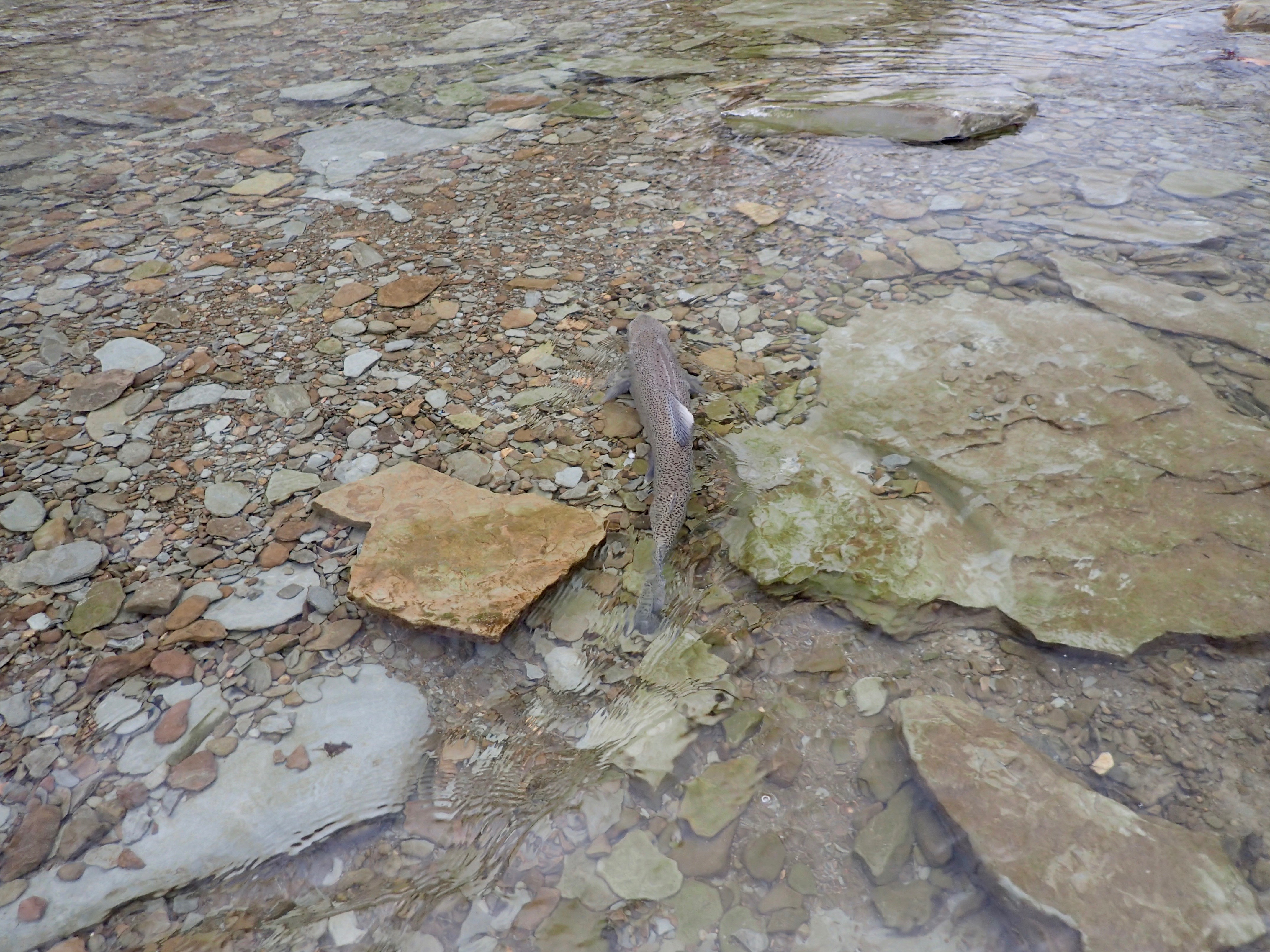
Holy aquarium, Batman! This just-released steelhead is 90% submerged, yet it looks like it’s high and dry on the rocks. The astonishing water clarity and cloud cover made for some exceptional sight fishing. I found this steelhead in a pocket the size of queen mattress. Nonetheless, you had to make a precision cast and presentation to get a hookup. At just over 33 degrees, the water had the fish firmly in winter lethargy mode. Thanks to Bob for letting me take this shot without revealing our location. Photo by Steve Culton.I mentioned a — ahem — less than stellar start. That improved during the morning, and by lunch time I was really dialed in. We were fishing a very slow moving, deep water pool that was loaded with steelhead. At Bob’s suggestion, I’d been using one of his tiny indicators, a mini-corkie in fluorescent yellow and orange. The takes were nearly imperceptible; the indicator didn’t go under. I didn’t even wobble or pause. It just slowed a tiny bit, a subtle enough deviation that you could only perceive it if you were simultaneously watching the tiny foam bubbles alongside it. In water this cold, a few fouls are unavoidable; I was delighted to see that these steelhead were indeed eating, as I hooked fish after fish, fly nestled firmly in the mouth every time.And that’s a wrap. Sunday’s score: Steve 21. Final tally: 35 landed over two days. Cam was also well into double digits. Well done, Bob Packey. Well done.
I fished the Salmon River in upstate NY on November 21-22 and I’m just writing about it today. Sloth? A little. Busy? Yessir. Late? Most definitely. So let’s get to it.
The drive up was a challenge; it was clear sailing from Connecticut until the Rome area, and then it was heavy lake-effect snow the rest of the way. (This was that system than buried Buffalo.) The roads weren’t plowed, and I passed numerous vehicles stranded in ditches. That’ll get you to slow down and pay attention.
Monday the 21st was a challenging day. We launched out of Altmar — I was floating with guide to the stars Row Jimmy — and although we found a pool with fish, the action wasn’t exactly red hot. We moved from one side of the pool to the other, and over the course of five hours we saw a dozen fish hooked, but only one landed. (I was responsible for three of the hookups and no landings.) Our best guess was that the takes were of a more subtle nature, and it didn’t help that I wasn’t on top of my game. None of the fish I touched were on for more than a few seconds; that tells me either a bad hook set or a very light take, or maybe both. Either way, you’ve got to be hard and fast and sure on your hook sets and I was certainly not.
James Kirtland is one of those guides who can tie knots quickly and efficiently and have you back in the water in no time flat. He’s also the kind of guide who will tell you when you’re doing something wrong, and offer suggestions to correct the issue. We all put our waders on one leg at a time, and I’m no different. Jim noticed that because I was using two hands to manage the line during the fly’s trip through the strike zone, I was losing precious micro-seconds on my hook sets. With one hand, excess slack eliminated, and the fly line gripped firmly against the cork, I could drill the hook point home with far greater efficiency. This is just one of the many things I’ve learned from Jim over the years, and it proved to be a difference maker on Tuesday.
We arrived at the Altmar boat launch Tuesday morning only to discover that I’d left my rod on top on my truck in Pineville. By the time we got back — whew, rod recovered! — we were late enough to not be able to get where we wanted to fish. That turned out to be a good thing, as Jim’s fellow guides reported the previous days’ pool was empty. (The river had come down to 500cfs from 750, and we figured the fish realized they had no depth of flow and skedaddled overnight.) So we set up shop in some fast water and spent the entire day in a few slots that took up no more than 50 yards of river. Right away we were into steelhead; I dropped the first, landed the second, and the third came off just as we were readying the net. But I was right on my hook sets, and it felt good even though the batting average was below .500.
Here’s the slick run we hit first. I’m always amazed at how many steelhead can fit into one little slot.We moved downstream and systematically carpet bombed a swift, churning run. After a morning egg bite, the steelhead got into my collection of small stoneflies: 60 Second Redheads, 60 Second Copperheads, and Copperhead Stones. I hooked 4 fish from late morning to early afternoon; this was the only one I landed. One came off right away. The second was a double-digit pound chrome beast that made a beeline for the Lake; I was into my backing so fast that I had no choice but to try and crank the handle. Doink! Broken off. It’s hard to get upset about episodes like that; when you’re in a boat, you can either lift anchor and follow the fish, or stay put and take your chances. You can’t undo the first option, so you accept a possible poor outcome and move on. The third one I dropped surprised me; I nailed him with my hook set, battled him hard and well, and then for no apparent reason, ploink! Sigh. Still, after Monday’s disappointment, two in the hoop felt like a bounty.
Thank you everyone for being so patient with me during a very busy time. My readers and followers — that’s you! — are something for which I am truly thankful.
I’m looking forward to getting back to giving you the kind of content you’re used to seeing here. And I’ve got a lot to write about: the International Fly Tying Symposium, my recent steelheading trip, some new materials I’m using for fly tying…just to name a few. Speaking of steelheading, it seems like every time I go, come what may, it only serves to fuel the addiction. I’ve been falling asleep visualizing strike indicators dipping below the surface. Really. Sweet dreams, indeed.
Neither Kansas nor Connecticut, but rather a little Salmon River sunshine of a wakeup call.
(cue drum roll) In the end, this was an easy choice. I’d been trying for over a decade to reach 100 steelhead landed. What with trips few and far between, some truly bad luck/bad timing, and dwindling runs, the last few years had slowed my progress to a glacial pace. A fish here…none there…one…repeat. I was stalled at 97, and when I dropped my first hookup on April’s trip, it seemed like I had another appointment with disappointment. And then, the mojo shifted. Fish were on. And landed. And then I held #100 in my hands. I capped the day with a monster hen and a celebratory cigar. You can read the full, original report here.
Number 100, trusty yarn indicator in the background. I’m truly lucky to be able to pursue my passion for fly fishing, write about it, teach it, and have an audience. Thank you, everyone. And to those steelhead who suddenly came off for no reason even though I had a good, sharp hook set and played you flawlessly…well, never mind. I’m trying to be nice here.
The pre-Thanksgiving Salmon River steelhead float trip is traditionally for myself and my middle son, Cam. But Cam was away at school. Gordo had school and hockey. Yup. Solo road trip! Coming off my Everglades experience, I was mentally prepared (but still dreading) the inclement weather I was sure to encounter. So, armed with my trusty Ken Abrames Salmo Sax #3, neoprene waders, and a pile of hand warmers, I headed northwest.
I have a knack — no, really, it’s a talent of mine — for picking days months in advance that are (ahem) un-ideal for fishing. This year I chose high water (1,500cfs out of the gate) and the coldest two days in the 10-day forecast. I can deal with both, but jeez Louise…again? The first day was the warmest, although it was mostly cloudy and we had long, frequent spells of “Salmon River Sunshine,” aka lake-effect snow. We did the Altmar-to-Pineville run both days, with the bulk of the fishing in the Altmar area. I would call the angler traffic moderately low, as higher water tends to keep the shore anglers away. Early on, we found an open hole that was deep, dark, and mysterious. My leader butt was 10 feet long, and I had four 3/0 shot on, but I still wasn’t getting down — I could tell by the lack of indicator chugging and dipping. So I asked my guide, Jim Kirtland, to build me a butt section of about four feet or so. That little adjustment was everything, as three casts later the indicator dipped, I set, and steelhead on hijinks ensued. It was a chrome skipper in the 16″18″ class, and I was thrilled to be on the board. My 1-for-1 was short-lived, though, as I dropped my next four touches. To be fair, I had no chance for a hook set on two of them as they occurred as I was lifting the rig at the end of very long drifts; one was totally operator error; and, maddeningly, one was a clean tippet break mid-battle. Not the best luck, but surely that can change.Persistence pays off. I tried not to let the previous misses get me down. We’d moved to a long, swift-flowing glide where I had the comfort of knowing that at 1.5K, any take would be amplified by the indicator. I’d been on my hook sets pretty good, and I tried to remain vigilant. I stuck this guy firmly, which was a good thing given his size, freshness, and propensity for hystrionics. One thing I haven’t mentioned yet was the unique problem we’d created by lengthening the leader. The position of the indicator on the leader system meant that I could only reel up so much line — not enough to lift the fish’s head to the net in a normal fashion. (I was using plastic Thingamabobber-type indicators because of the amount of weight, and those can be notoriously difficult to adjust, let alone in the middle of a battle with a steelhead.) To have a chance at landing the fish, I would need to navigate my way to the stern of the boat, reel the indicator to the rod tip, then lift the rod, arms completely extended over my head while trying to steer the fish to the front of the boat, where Jim would be waiting with the net. Easy enough with a skipper, but a challenge with a chrome buck like this. As you can see, we were successful! The first fish came on a Copperhead Stone. The second came on a small nymph called the Spider. Photo by James Kirtland.I wish I was signaling that I’m currently engaged with my fifth steelhead of the day, but it’s just a simple “Hi, Mom!” Tuesday was substantially colder than Monday — temperatures never got above freezing — and wind and iced-up guides were a constant scourge. Because of the cold front, the fishing was noticeable slower, and the only touch I had all morning was a certainly foul-hooked fish that began to roar upstream with unbridled speed before suddenly coming off. I also re-discovered that it’s a really good idea to crimp those shot down tight on the leader, as once they start wandering along its length, casting becomes a chuck-and-duck nightmare. On the positive side, I’d like you to notice the angle of attack of the rod. I’ve got the tip low to the water and the fish is being fought off the reel and the butt section. To be hyper-critical, I should probably have the cork of the rod pointed more upstream. Don’t let them breathe, put the screws to them, and you’ll get ’em in fast. Speaking of hyper-critical, we witnessed a steelhead being played to death. The battle lasted well over 15 minutes (not an exaggeration) and may have pushed past 20. You bet that it featured plenty of high sticking and long stretches of the steelhead holding in the current without reel handle being cranked. Inexcusable.Video still by James Kirtland.Victory is mine. After my success the day before with black and copper nymphs, and little to show for it today, I tied on a fluorescent chartreuse Crystal Meth, and boom! Sometimes you get lucky. I was right on this fish with my hook set, but I dropped one a few minutes later when I was slow on the draw. So, 1-for-3 on the day, which isn’t great, but all I need is one steelhead to make me happy. Photo by James Kirtland.
As you may know, I am currently occupied with getting ready for my oldest son’s wedding. In lieu of new material, I’m recycling some of my favorite posts from years past. Let’s continue on the steelhead kick (man, I really want to tie into some fresh chrome!). Six years after its publish date, Soft Hackles for Winter Steelhead remains relevant; I still use these flies, and whether swung or dead drifted along the bottom, they still catch fish.
Ever notice how 36-degree water doesn’t feel as cold when you’re releasing a steelhead?
November means steelhead. At least it does for me. This year, though, the steelhead adventures will have to wait a few weeks. In the meantime, here’s an oldie but goodie from the archives: Ten Things Every Beginning Steelheader Should Know. Even if you’re an experienced steelheader, you might find a useful nugget within. Enjoy the read — and enjoy the ride.
A man, a steelhead, and a cigar. Gotta love November!
I’m not in the habit of counting fish. But steelhead, being what they are — well, they’re just different. Trying to catch them is also different. I’ve been through all this with you before: you can do everything right and drop the fish. You can do (most) everything wrong and land the fish. Life isn’t fair, and neither is steelheading. The conditions you’re fishing in can be demanding, if not downright brutal. So when you get a decent flow and warm sunshine and bluebird skies and, most of all, a little luck, you thank the steelhead gods very much and you certainly don’t question any of it. I’d been stuck on steelhead #97 since November — my March trip was a blank — so here I was a month later, hoping something good would happen.
Tuesday April 13. I got to the river around 3pm. My float trip was scheduled for the next day, but I figured I should take advantage of the opportunity to fish. I hit a popular mark on the lower end of the river, one I was familiar with. As I was walking down the path, I saw an angler playing a steelhead, so this gave me hope. That was short-lived. For the next two-and-one-half hours, a total of eight anglers on the run hooked zero fish. I had a touch at one point, but my hookset didn’t even produce a head shake. I decided to save my chips for the next day, so I left disappointed, but clinging to the hope that sooner or later my lousy luck had to change.
If you need something spell-checked, you’re on your own.
Wednesday April 14. At first I thought it was the bottom, but it didn’t quite figure. No head shake, and I came away with air, but the more I thought about it, the more I realized that it had to be a steelhead. A dozen casts later, indicator down, hook set, fish on. It was a nice-looking drop-back, holding in some faster water, and now ripping line off the reel. True to form, the fish stopped at the bottom of the pool. I regained line, then another run and some aerials, too. Line regained, process repeated, and now this fish is whipped. Reel cranking, cork upstream, rod bent, steelhead just about 20 feet from the boat, Jim with the net ready. Here comes number 98. Doink! There goes number 98. This is the type of loss that vexes me no end. I had a good hookset, and I played this fish no differently that the last 50 I’ve landed. A few four-letter words provided only a moderate salve to this grievous wound. Is this how today is going to be?
An hour or so later, we bagged number 98. This relieved some of the pressure, even more so after 99, pictured here, went into the hoop. Now I felt like this was really going to happen. And if it didn’t, at least I’d made a significant dent — two steelhead was twice the number I’d landed in my last four days. The conditions were pretty darned good: water temps in the upper 40s, a little color to the water, flow 350cfs, and, best of all, a warm sunny day to help me forget that day in March when I was flicking ice out my guides for eight hours. Then, suddenly, it was over. I landed my 100th steelhead. Cue Howie Rose saying, “Put it in the books!” Not the prettiest specimen, but beautiful and perfect in his own way. What an eventful journey. I’d like to thank everyone who encouraged me, shared water, helped wrangle and land or net a steelhead, and especially my guide James Kirtland who has provided me with so many pro tips over the years. I’ve learned so much from him. Jim’s ClackaCraft was a great choice for low water. Jim’s a skilled oarsman, not to mention a pro with a landing net. This also seems like the appropriate time to give a shout out to Ken Abrames. Ken’s Salmo Saxatillis rod, taking a break after doing yeoman’s work, is a truly exceptional steelhead rod. The final tally for the day was five-for-nine. We also landed four steelhead smolt and a brown trout. We saved the best steelhead for last, this pug-nosed double-digit-pounds hen we nymphed up fishing western style. To revisit the “steelheading isn’t fair” theme: I had a lousy hookset, I mishandled my line, the run was laden with submerged logs and I still landed her. I’ll take all the luck I can get! And so, dear reader, if you’re counting along, this is number 102. Only 98 more to get to 200.
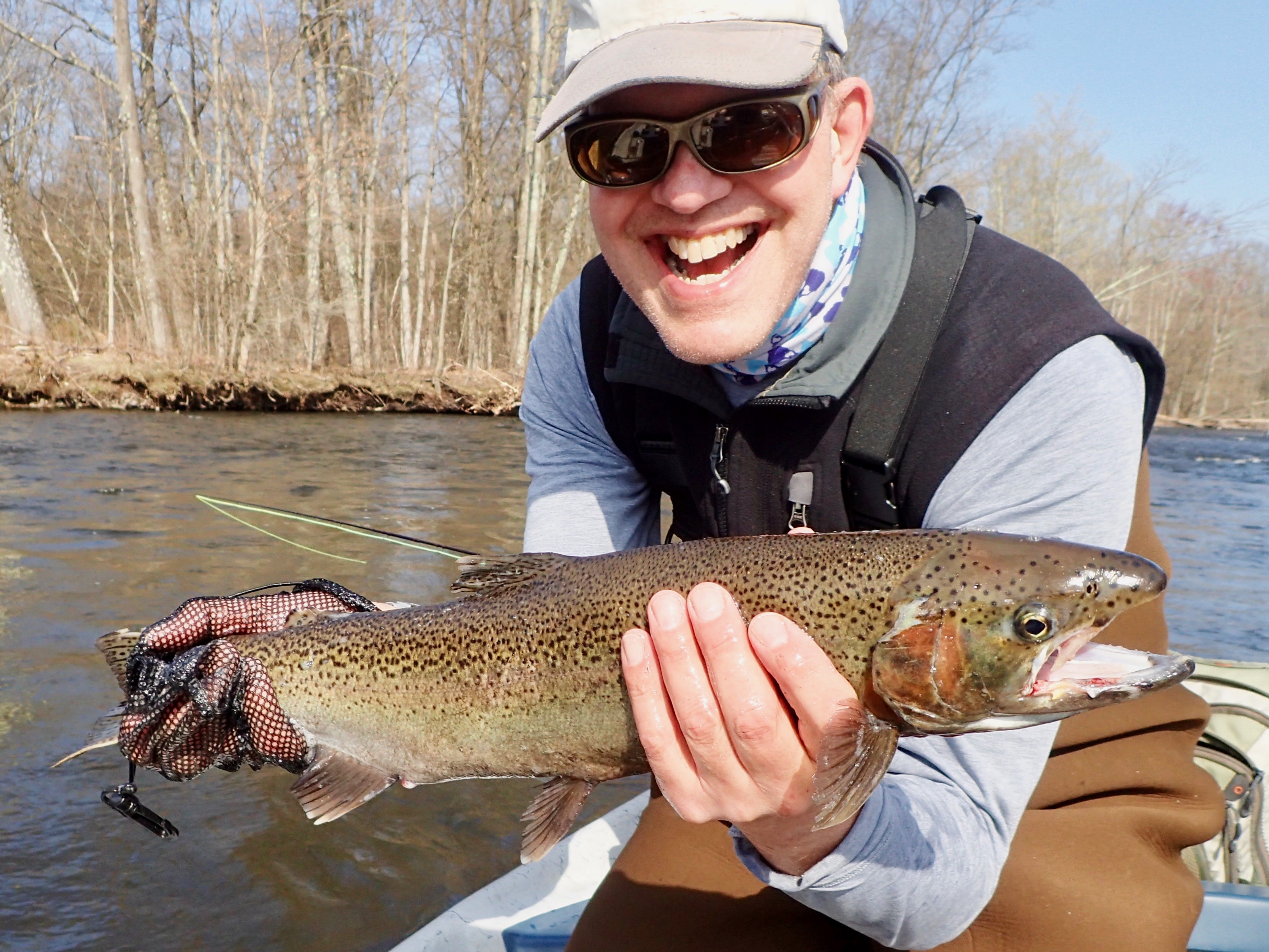
Finally, after so many disappointing outings, I hooked and landed my 100th steelhead. Not the prettiest fish given the time of year, but beautiful and perfect in his own way. It was an eventful day — full report to come next week. In the meantime, here’s a picture worth a hundred words.






 currentseams.com