I don’t mean to sound greedy. But after potting 23 steelhead and breaking 300 on Tuesday, all I could think about was landing more.
Fair enough, but things don’t always work out the way you hope they would. How many times have you planned a fishing trip, only to see Mother Nature and the elements conspire to crush your dreams with cruel indifference? We were supposed to get 3-5 inched of snow overnight, which would mean slush-filled creeks for most of the morning. And with temperatures predicted in the upper 30s/low 40s, melting would follow, then runoff. I didn’t have a good feeling.
But forecasts change, weather people are notoriously often not right, and we got only an inch of snow, if that. We were so optimistic, we started the day an hour earlier than yesterday. There was a little slush in the system, but far less than the day before, and it was all gone within an hour. Best of all: no one was out fishing. We saw three other anglers all day, and then only for a couple hours. That meant I could bounce around the creek and fish wherever my little heart desired. (My phone later told me that I’d walked and waded nearly 3 miles).
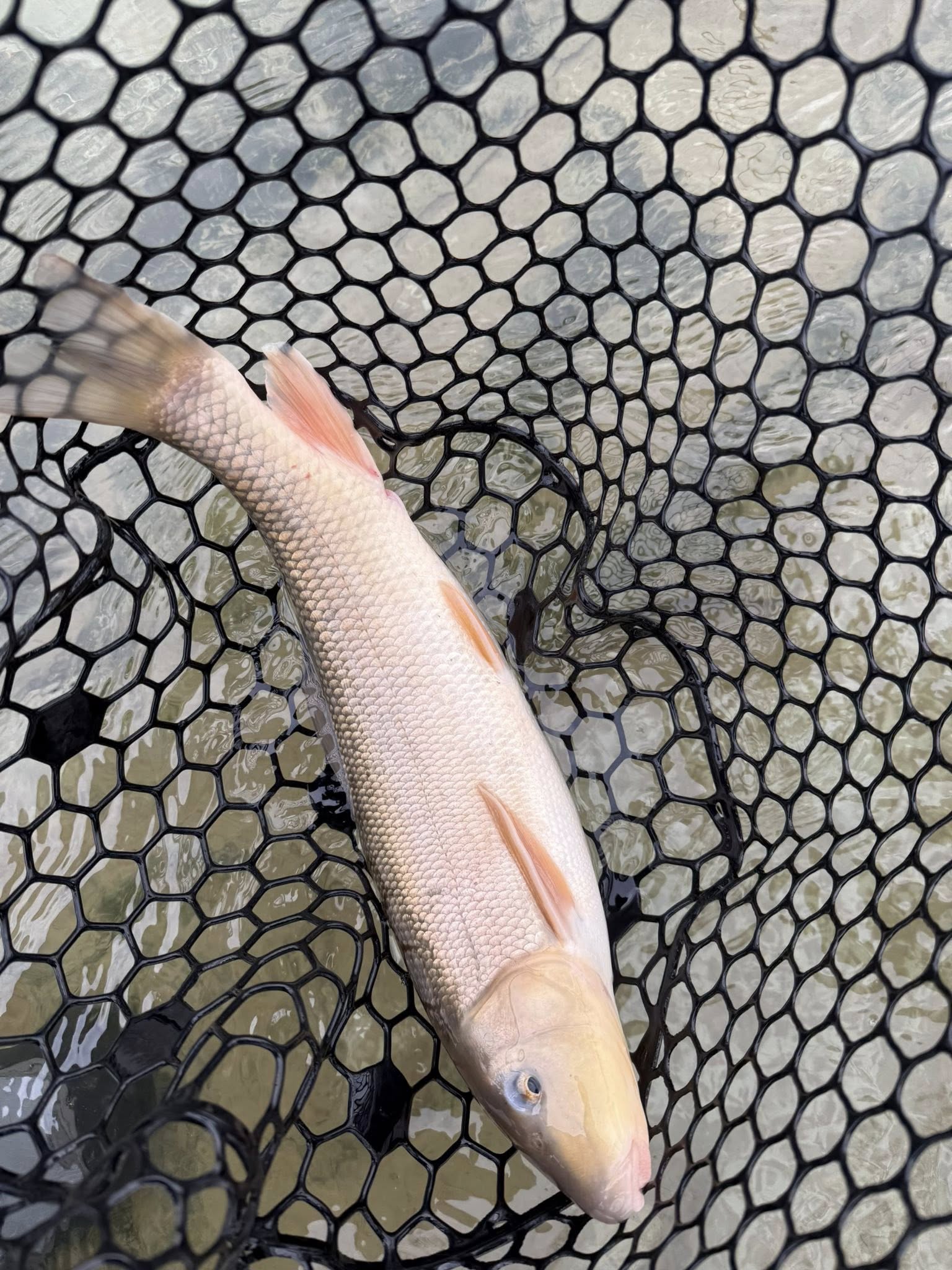
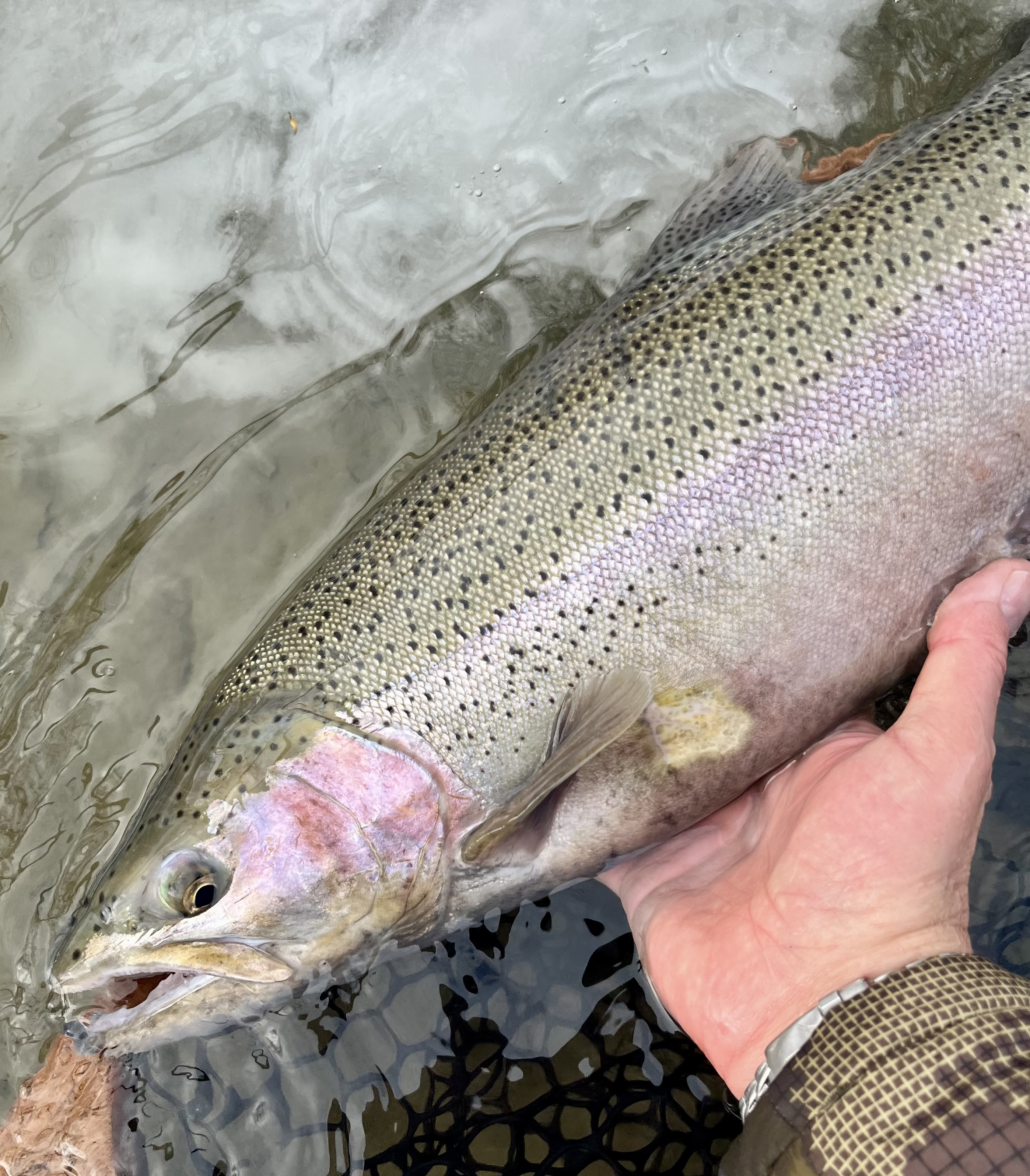
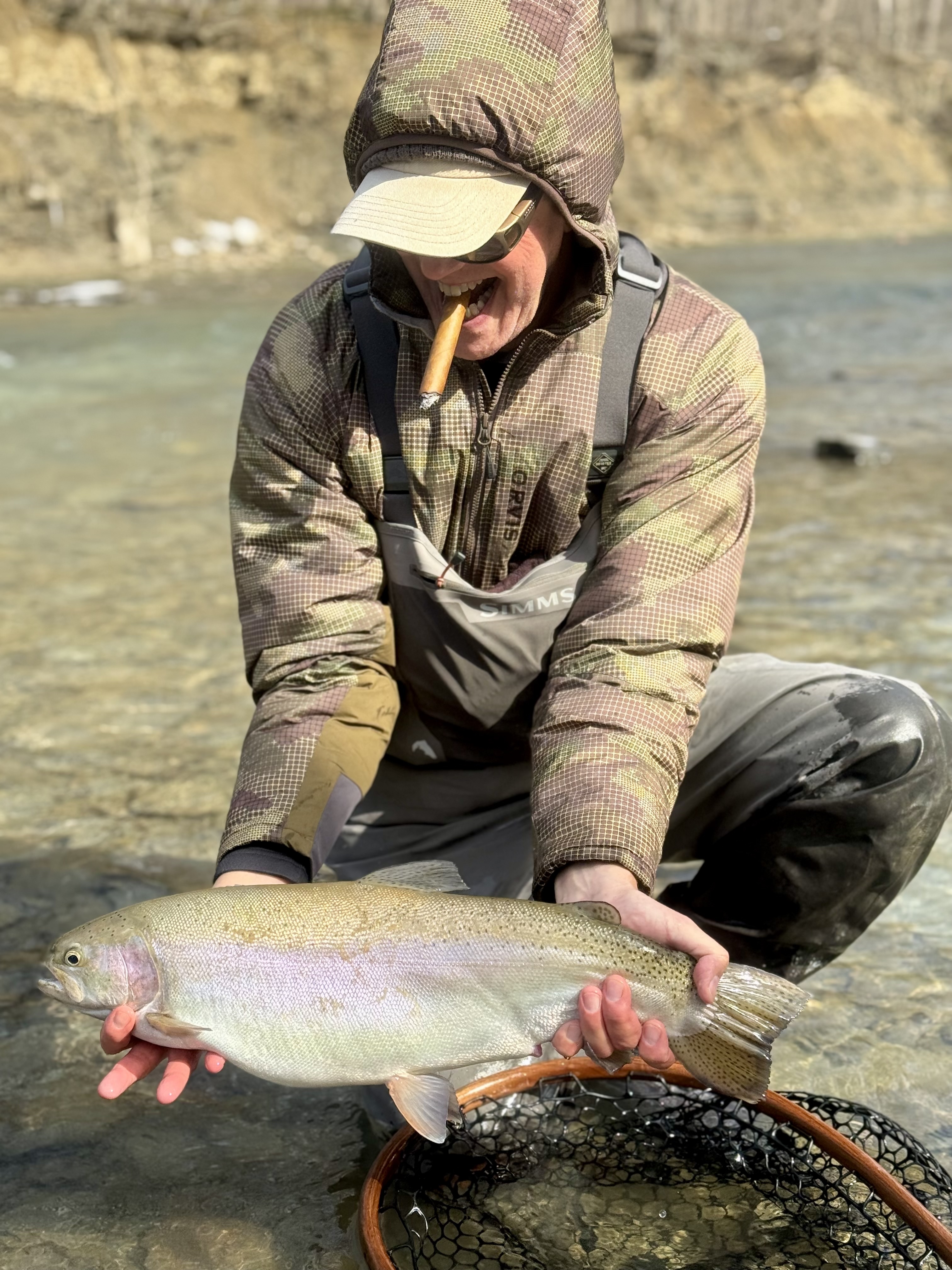
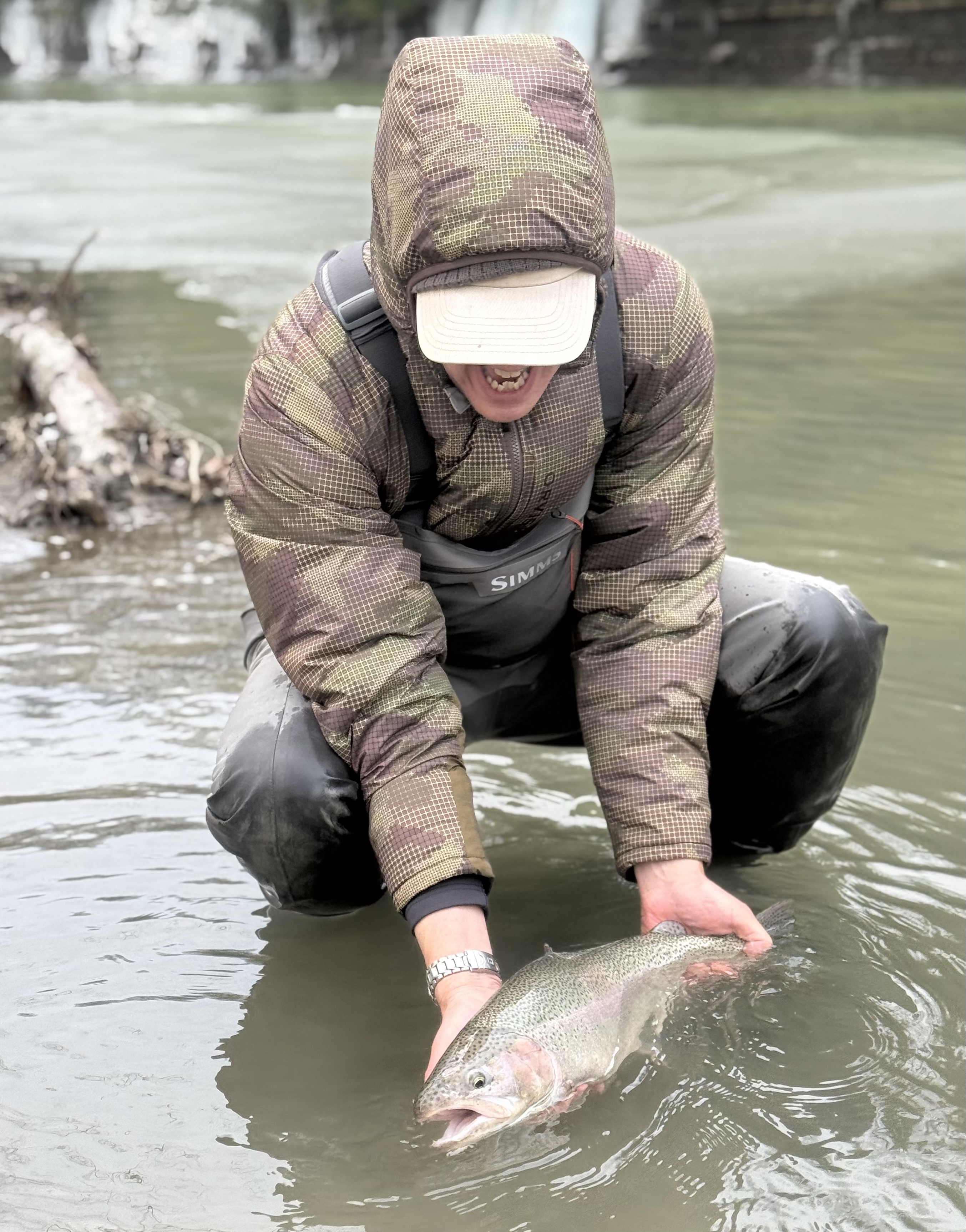
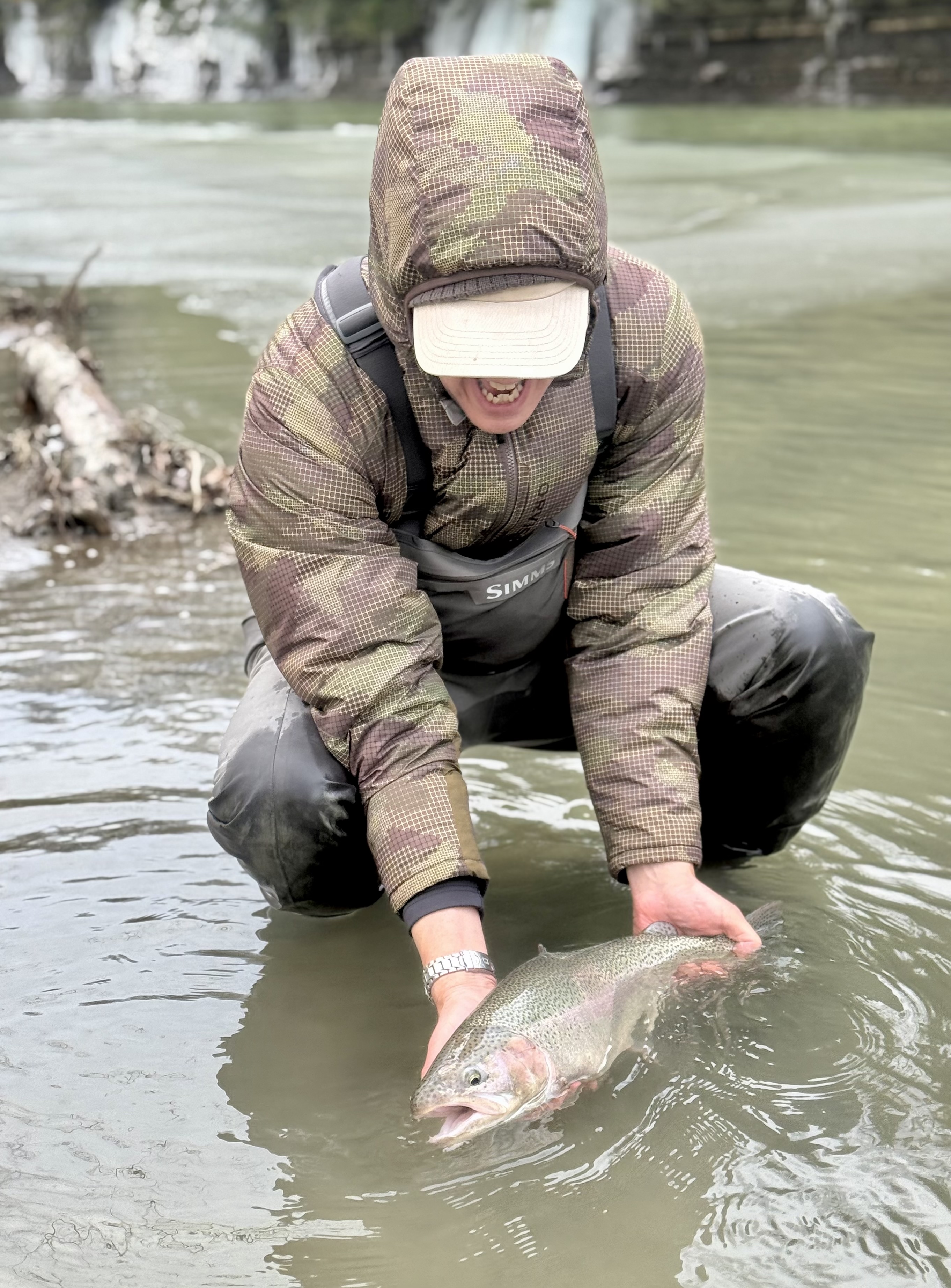
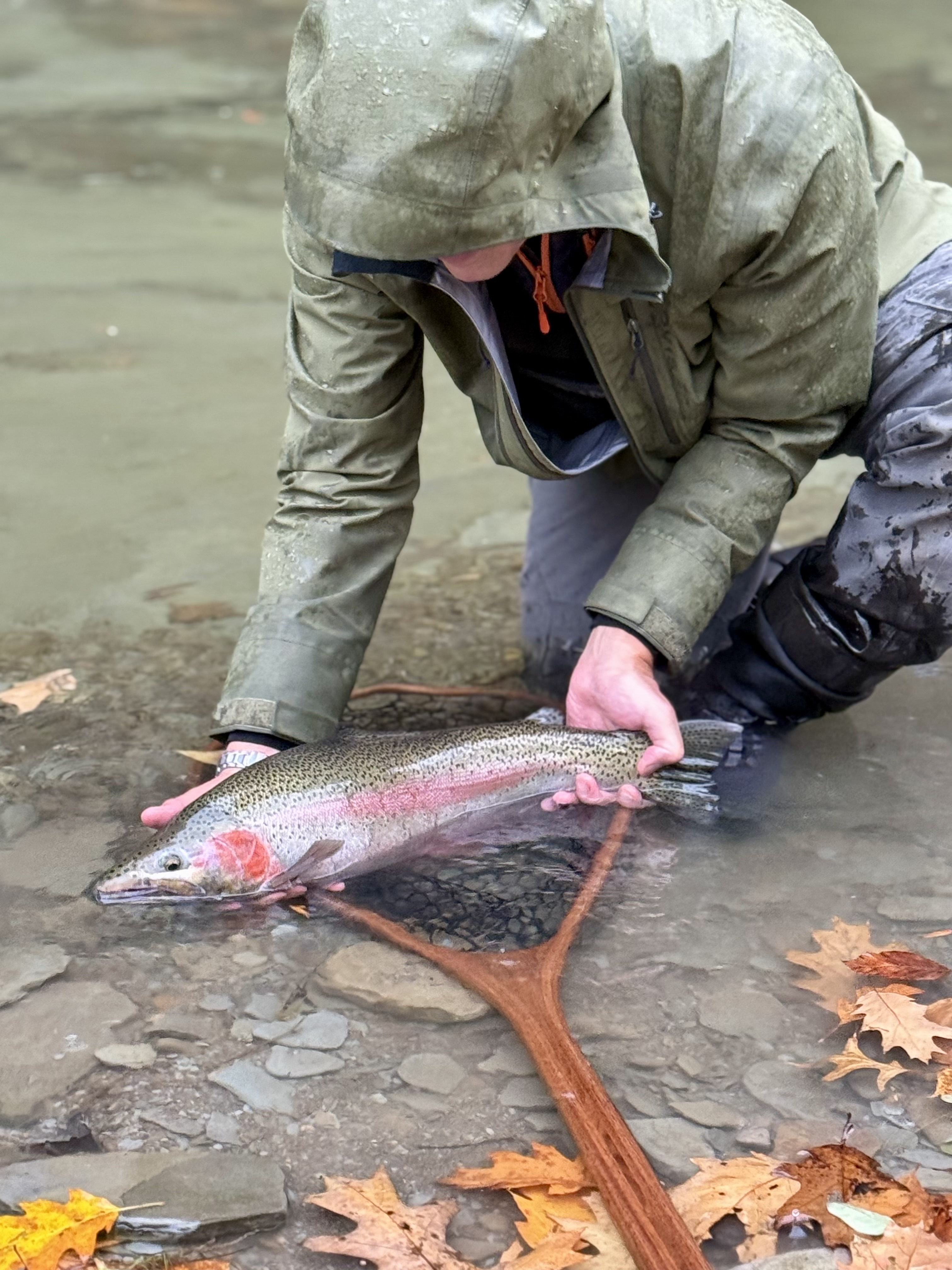
The suckers are in! Or singular, if you like, as this was the only one I found over two days. It was a little early to be matching the hatch with sucker spawn or Crystal Meths, although the patterns absolutely work any time during the season.Despite the lamprey scar, a breathtakingly beautiful fish. The water was still barely above freezing, but on this day the steelhead had a lot more fight in them. We worked upstream, targeting likely holding areas, concentrating on the ones that held fish and presenting flies until the bite stopped. I went from one landed to a half dozen, and then a dozen by about 1pm. It was already a fantastic day.One tank of a hen steelhead. While there were several good battles, I had three over the course of the day that truly tested my landing skills. I really wanted to land this fish, as she kept bulldogging me and running and refusing to come civilly. By early afternoon, a front began moving through; it got gusty and noticeably colder, and while it didn’t shut down the bite, it definitely tapped the brakes. The water began to take on color. And then, there were no more eats. It was time for lunch and another section of river.As you can see, the final section of river had a tea-with-a-few-drops-of-milk opacity. My batting average was not the best in this last mark, as I went 2-for-5. But I have no right to kvetch. The hump day total was 17 steelhead in the hoop, giving me 40 for the two-day trip. Did this really happen? Wasn’t I trapped by hundreds of feet of deep, wet snow a few days before? Weren’t conditions supposed to be entirely unfavorable? This is the argument for, “You don’t know if you don’t go” — and this is steelhead number 322.
I hightailed it out of CT Monday at 4pm, just as the blizzard was winding down, and drove to western PA, arriving a little past 1am. My goal was to fish a couple days, and hopefully inch a little closer to the magic number of 300 steelhead landed (I was on 282 for those of you keeping score at home). Folks, the trip exceeded my most wildly optimistic hopes and dreams. I not only made 300, I obliterated it. Details to come in a post next week, and you’ll also want to check out my Instagram for more!
This is the last steelhead of the two-day trip, which put me at 322. I’ll let you do the math.
In the UK, they celebrate November 5th — Guy Fawkes Day — with fireworks. In western PA, the day wasn’t nearly as explosive. Low, clear water; the approaching cold front lockjaw syndrome; wind and leaves; and the need for highly technical presentations were all formidable obstacles. But I can be the kind of angler who likes a challenge, even more so when I know the fish are there.
We fished Elk Creek, and the good news/bad news was significantly more water than this time last year, but far fewer fish. Places last year where the steelhead were wedged in like sardines were this year distressingly empty. Low, clear flows on these creeks require a certain level of stealth, and technical casts and drifts. To get dour, on-high-alert steelhead to eat, you’ve got to nail a perfect cast, then make all kinds of technical mends to keep the fly on target. Weight and indicator adjustments are a constant dance you perform until the judges tell you that you’ve got it right.
The first fish in the hoop is always a relief. I’ve been known to say that all I need is one steelhead to make me happy, and on most days that’s true. I had seven eats in the first three hours, and sealed the deal on three. Not a great batting average, but I did have some bad luck in the form of a snapped tippet, and another that mysteriously wriggled off after I slammed it with a powerful hookset. Blood Dot eggs, size 14, were the menu item of choice. By late morning, we decided to take a break and seek our pleasures elsewhere.
We did a bit of walking to try to get away from other anglers, but the story on new ground was the same: low, clear flows, leaves, and precious few fish that we could see. We finally located a pod of about a dozen fish, but in addition to the previously mentioned lockjaw, these steelhead seemed more interested in canoodling than eating. Two darker alpha males set the tone in the pool, chasing fish away from their lies, with the pod constantly shifting position after their antics.
Then, the rains came. This was a boon to the bite; the fouler the weather, the more takes. When bite windows open, you’ve got to jump on them, and so we did. I had one epic eat from a fish that was part of pod hiding under a ledge. The presentation was tricky. I had to cast into the main current, then drag the flies toward the ledge in front of me, resume dead drift, and hope the team of two would pass through the strike zone unimpeded by the edge of the shale barrier. As the flies moved into position, I had to switch to a quasi tight-line presentation. Of the dozens of attempts I made throughout the afternoon, one worked. That was my favorite fish of the day.
One of the alpha males that — finally! — made a mistake. Guy’s got some shoulders, and clearly, he’s been in the system for a few weeks. I lost a substantial chrome hen to a hysterical display of leaps and rolls. When I stuck the hookset, she bolted upstream like a dragster coming off the line. One, two, then three spectacular leaps worthy of a tarpon had us cackling with delight. She made a beeline for a shale ledge and rolled, then did it again, and on the second one she spit the hook. What tremendous sport! I finished the day with nine to hand, which I considered a major victory given the conditions. Yup. I love steelheading.
I realize I’m squarely in the better-late-than- space. So rather than blather, let’s get to it.
We start with a brief PA Erie tribs sortie in mid-November. The water was painfully low, and that made fishing extremely challenging, especially in the public water sections of Elk Creek. I did one day on private water (with a dabble in public), and then a half day on public water.
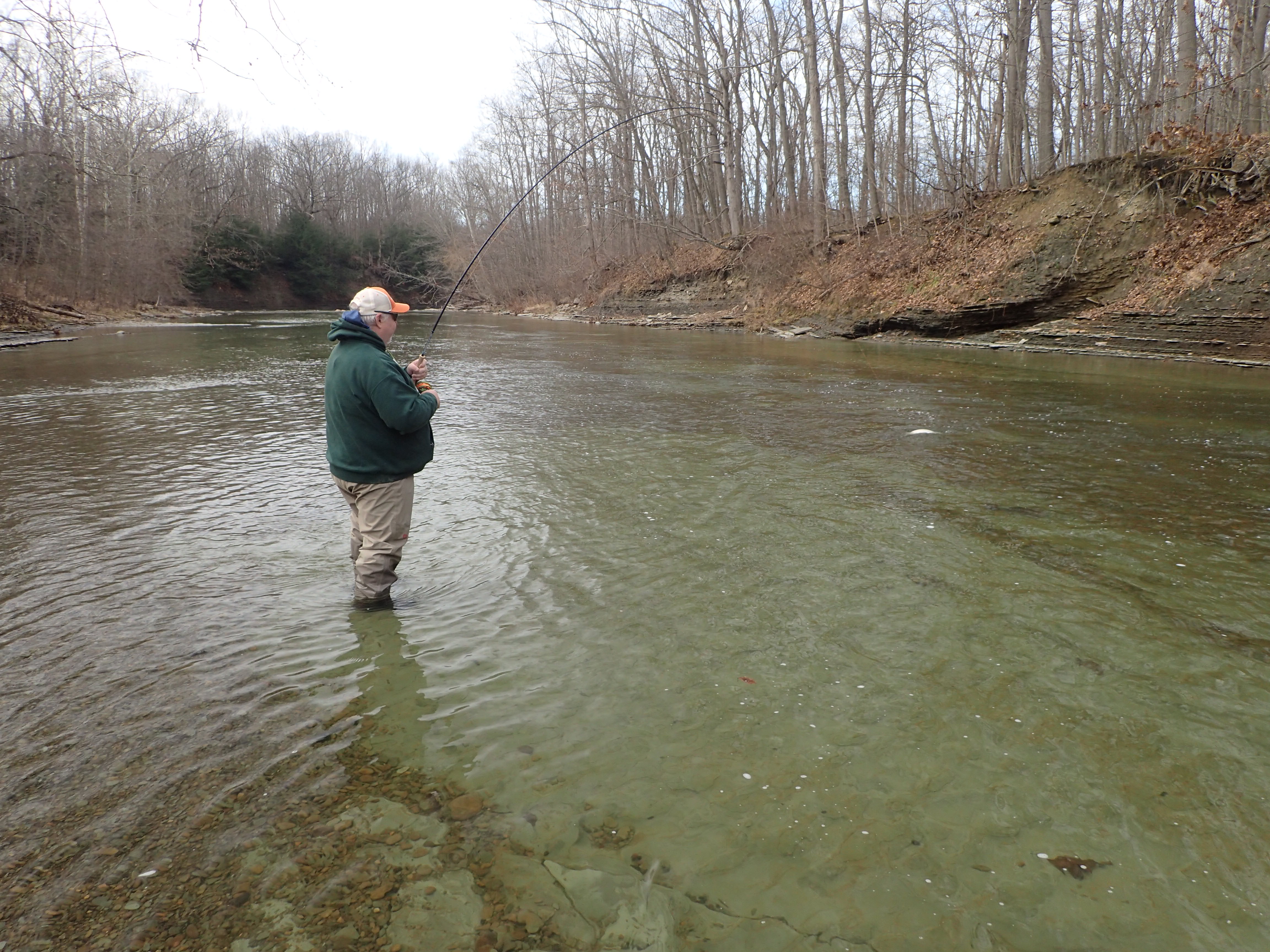
Harsh conditions. They’ve gotten ridiculous rain and snow since then, so where I’m standing is probably up to my chest! The fish were on high alert — we saw raptors everywhere and several fish with bird attack wounds. If the water had a flat surface and you were in the fish’s vision cone, they generally wanted nothing to do with your offerings. Even in the bigger, deeper pools that held a hundred steelhead, virtually every drift went ignored. With little-to-no current it was difficult to even get a drift. You had to make ultra-precise casts to get them to eat.I had my greatest success targeting fish that held in the shallow broken water of dump-ins and pockets. One such spot produced two steelhead. Here’s one of them. We fished Blood Dot eggs, White Death Zonkers, and pink Squirmy Worms, and the Blood Dot was the overwhelming favorite. Since you can fish two flies in PA, all of the flies were dropped off an another Blood Dot. This was the first time I’ve ever fished for steelhead without any weight. I also tried a new tactic to get my flies into the lane: as soon as the flies hit the water, I dragged them as needed to move them into position. Success!I finished the first day in public water. Holy hyper-spooky steelhead, Batman! It was extremely difficult to get into casting position, let alone present, without triggering the flight reflex. I managed one fish before a squall front moved in and blasted the area with gusty winds and torrential downpours. The next day, the creek was way up and running the color of tea with a dash of milk. Great color, but leaves were an issue. That influx of water moved all the steelhead out of the section I fished, and unfortunately no replacements came in overnight. I fought the good fight, but I didn’t get a single touch, and saw only one other fish hooked all morning. Time to head home and get ready for…
…Ontario tribs, and my long-awaited trip with Number One Son Bill. Bill had been steelheading before, but had never hooked and landed a fish. Under the watchful eye and excellent guidance of Row Jimmy, our mission was to change that. Like western PA, upstate NY had suffered from low rainfall. While the flows weren’t as dire, a float trip was ruled out. So crik stomping we went.
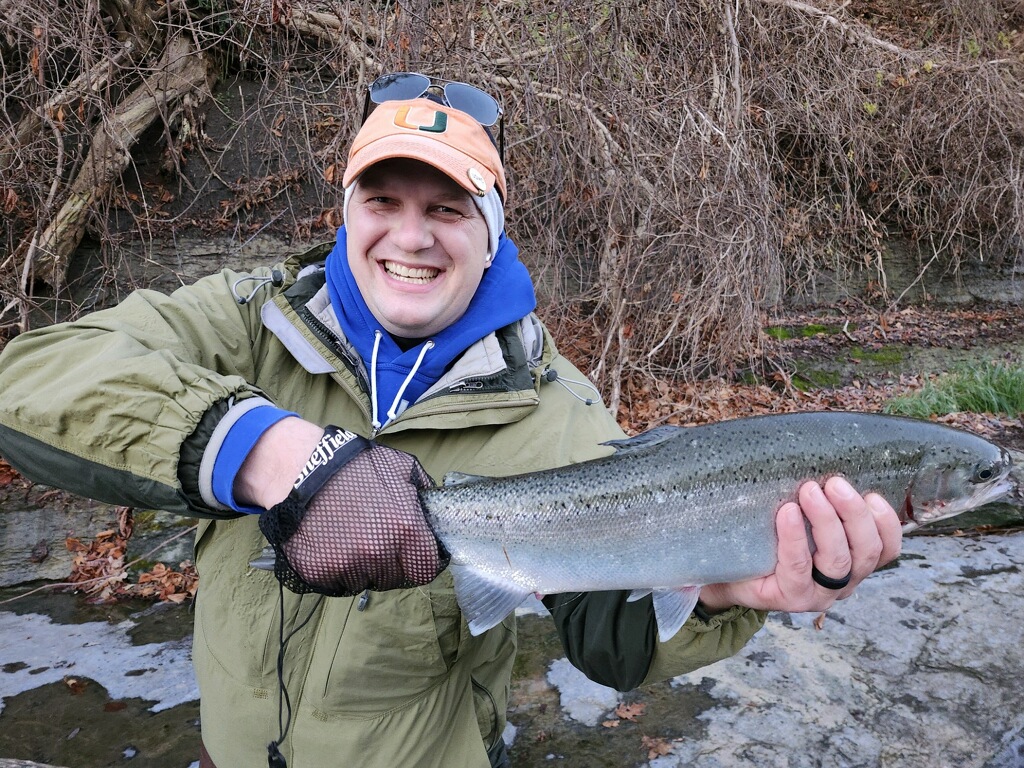
We arrived early and locked down a couple spots. I chose wrong, fruitlessly flogging the water for a three hours without so much as a courtesy touch. We had excellent conditions, and the clients of one of Jim’s guide friends had hooked 15 the day before. But something changed overnight in between dropping water levels (color was still good) and a dreaded cold front (I had ice in my guides until 9:30am. Nonetheless, Bill hooked and dropped one above me, so that gave us hope that creatures might be stirring. About 15 minutes later, yes! With pictures retaining their constant rate of worth, I’ll let Bill’s smile do the talking. Congratulations!
The rest of the day was peck away persistence fishing. I’ve never seen this creek so crowded, but people largely came and went because the action was virtually non-existent. It seemed like everyone had the same idea about the potential of the fishing, and then, once they realized they were wrong, left. We stuck it out, and I eventually landed three. With one more day to fish, we decided that rather than jockey for position and start well before dawn in the Altmar area, we would try some private water on the Salmon River.
We got a quarter inch of rain overnight, and that small amount was enough to move the fish out of our target run. Picture us standing in the rain at first light, wondering where all the fish went because no one is getting even a courtesy tap. Silver linings took the literal form of a few dime-bright steelhead fresh from the lake. Bill dropped a couple before hooking and landing a beautiful chrome hen, which he brandished with almost child-like delight. Though 1pm, all I had to show for my efforts was a silvery skipper.
I decided to attack a different section of the run, and it payed off. As my fly glided along the bottom of an uneven run, the indicator dipped as if it had somewhere else to be in a hurry. By the time I set the hook, the steelhead was running diagonally across and upstream, peeling off line at an astonishing rate. By the time he stopped, I could see the expanse of white that was my backing. I began furiously cranking the handle. As I regained precious line, the fish tuned and the line went slack. My heart sunk as I feared the worst. I even announced, “Fish off!” After I landed it, I remembered other such battles where the hook remained seated due to the tremendous drag of the line in the current. Next came the aerials, two of them, and I could see that I had a fresh fish the size of Bill’s. Bill grabbed the net and did a pro job netting the fish. Well, done, Bill! We decided to end on a high note, and victory was declared. Let’s go get a cheeseburger. I’m buying.
When I was a kid, I counted every fish. That continued for a few decades, along with a resurgence when I started fly fishing. Numbers was how I measured success.
As I’ve gotten older and more experienced, I find the energy has drifted away from “how many? and moved toward other questions. Were the people nice? Were there any people at all? Did I enjoy myself? Did I fish well? I think on a subconscious level, I still track numbers. Everyone likes catching a lot of fish, right? In the case of a dwindling supply of stripers, numbers tell a story outside of personal pride. But if it’s just about numbers, sooner or later you’ll be disappointed. If there is a state of Nirvana to be reached in fly fishing, surely it cannot be connected to volume.
Steelhead are different.
They can be maddeningly difficult to hook and land. One day they’re eating, the next day they’re not. You can do everything right during a battle and lose the fish (and that may be your only hookup of the day). The conditions under which you fish for them can be downright unpleasant, if not brutal. And, more often than not, you’re jockeying for position and territory, first finding it, then maintaining it, something that I do not enjoy.
It took me 40 hours of fishing time to land my first steelhead. Then it took me about 13 years to land the next 99. Astonishingly — at least to me — it took me just 2 and 1/2 years to get to 200.
Part of it was good fortune — being able to find and fish water that held a lot of willing steelhead. Part of it was a renewed commitment to steelheading, due to some very good runs in recent years. Part of it was branching out to new waters. A lot of it was newfound skill and acumen and careful observation and study, thanks to guide friends Bob Packey and Row Jimmy, who present a master course in steelhead fishing every time I head out with them. Gentlemen, I have learned so much from you!
And so, dear reader, you’ll forgive me for counting each and every steelhead. In fact, I hope you’ll celebrate along with me. 200 in the hoop!
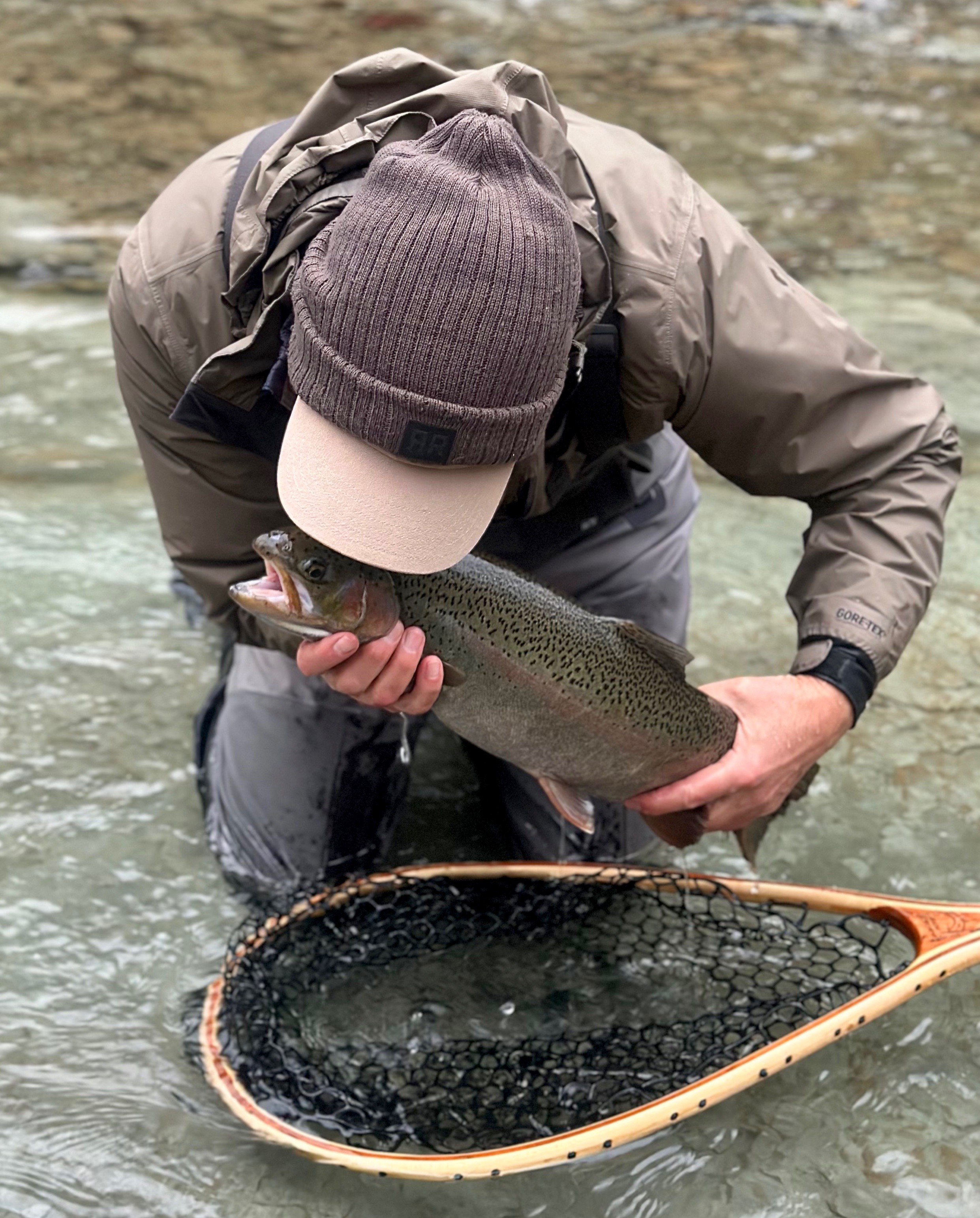
“He gave her three kisses and great was the smack.” — nearly the lyrics from an old folk song. Number 200, the second fish of the morning, gets the now traditional buss. It felt good to get it done early. How could I know there would be 19 more to come that day? What an embarrassment of riches!
~
On that grey, damp day, the steelhead ranged from dime-bright freshies from the lake……to the darkest horse I believe I’ve ever seen, courtesy of Cam. What a fantastic job he did. For someone who doesn’t fly fish all that much, he turned in an impressive performance. Yup, we’re as happy as we look. The number sits today at 219. And April is coming.
Many thanks to you, my readers, for subscribing, reading, asking questions, and, most of all, for your support, kind words, and enthusiasm. I wish you a happy and prosperous new year, and the tightest of lines in 2024.
I didn’t think I would land 17 steelhead today, but you never know. Crazier things have happened. We — Number 2 Son Cam was joining me today, along with our guide Bob Packey — would be fishing Conneaut Creek in Ohio. I love this stretch of Conneaut. It’s got the ubiquitous sheer shale cliff faces you associate with Erie tribs, and while it does have its share of shallow, easy-to-read flat bottom, much of it resembles a traditional trout stream like you’d find back east.
The weather was cooperating. At least at first it was. Overcast, which was nice, but then it began to shower, building to you-need-a-raincoat strength. Then, the wind picked up, whipping piles of leaves into the water. That was a wee bit of a problem. But when it comes to steelheading, you get what you get and you don’t get upset. The water was lightly stained, and with the leaves, increasingly tannic. Not necessarily a bad thing.
We started off at the tailout of a deep pool, hard against a shale ledge. We fished this mark last year, and did very well, but for the first 10 minutes this year the fish weren’t having it. Finally, they began eating. This is a challenging place to play a fish, as the tailout dumps into a series of rapids and pockets. If the steelhead goes down the chute, you’re either chasing after it, which can be dicey, or breaking it off, which is lose-lose for all parties. Fortunately, the steehead gods smiled upon us. Conneaut has several sections where playing a fish is difficult due to swift currents and rocky substrate. Landing fish on this day was far more challenging than yesterday at Elk. I felt like I earned every fish.
~
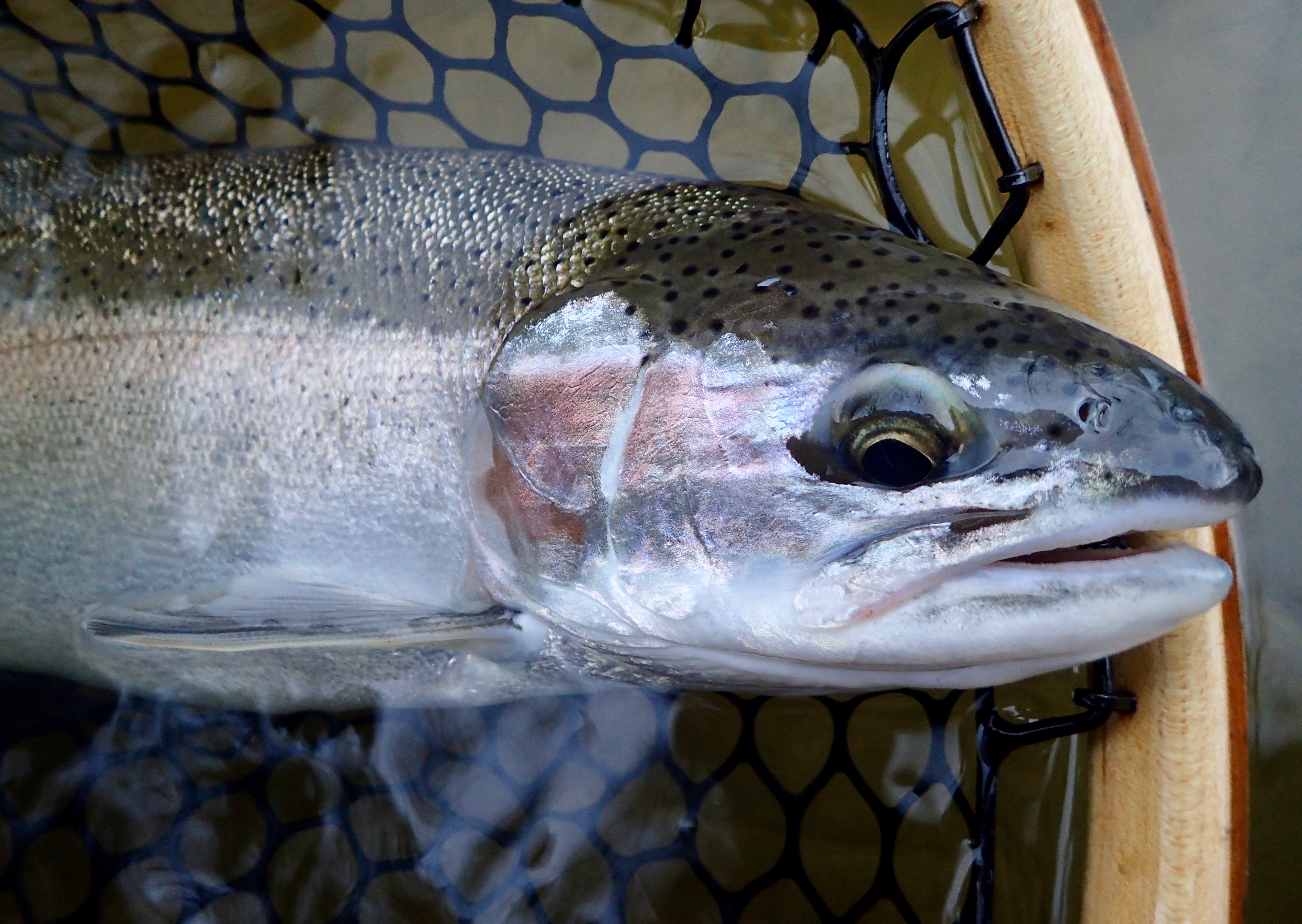
Adding to the challenge was a mix of fresher fish, and water temps that were a decidedly un-December-like 47 degrees. Many of the fish, like this one, were hot players not long from Erie. But I like a challenge. It sweetens the pot.
~
We worked our way downstream, banging away at pockets and runs that looked like good holding water. This lovely hen came out of a swirling pocket at the edge of a waterfall. I can’t say enough about the fine coaching Cam received from Bob Packey — and about Cam’s fly fishing. You see, Cam really doesn’t fly fish. But he gets it. Sure, he’s had experience landing steelhead on the fly rod (I used to hand my rod off to him when he was little and let him have at it) but as anyone who’s done it can attest, steelheading isn’t easy! Great job, Cam.
And so, dear reader, this is where the story gets interesting. We fished a tailout that held dozens of steelhead last year. This year, not so much. Only two touches, and zero fish landed. However, the run below was Yahtzee. At one point I hooked up on six consecutive casts. My landing percentage was good. Some quick math, and I was at 198.
Two to go.
And then, the steelhead gods stepped in and waved their collective index finger at me. Now, now. Not so fast, Steve. I had a chrome skipper just at the net before it bolted, ran between two rocks and wiggled off. I got snagged on the bottom and could not free it. A walk upstream and some direct pressure and…the bottom fought back. Big steelehead. Battle ensues. The fish spit the hook and got fouled on the dropper. Off it went. We made the command decision to stay a little later and finish the job. Again, the steelhead gods with their wagging fingers. Foul hooks, tippet failure, bad luck, no fish where they should be…200 would have to wait for another day.
I can’t say that I was mortally disappointed. 15 in the hoop is very, very good day.
I don’t normally count fish. But steelhead are a special case. They can be hard to find, hard to hook, and hard to land. You can do everything right, and still lose the fish. So every one you bring to the hoop and safely release is to be savored, even treasured.
Last Friday morning found me on Elk Creek in western PA at first light. The tally at that point was 175. I figured that 200 might be in reach on this three-day trip, and that five on day one would be reasonable. (In retrospect, it’s a little foolish to plan on catching a certain number of steelhead. You just never know what stream conditions, the elements, or the fish will throw at you.) I was flying solo, and got to the creek early enough to secure a prime mark. Within ten minutes, I was one-for-one. Then things slowed. I worked down the run and bagged another, a shiny fresh hen just in from the lake. Then nothing. By now the sun was up and I could clearly see into the tailout. It looked barren.
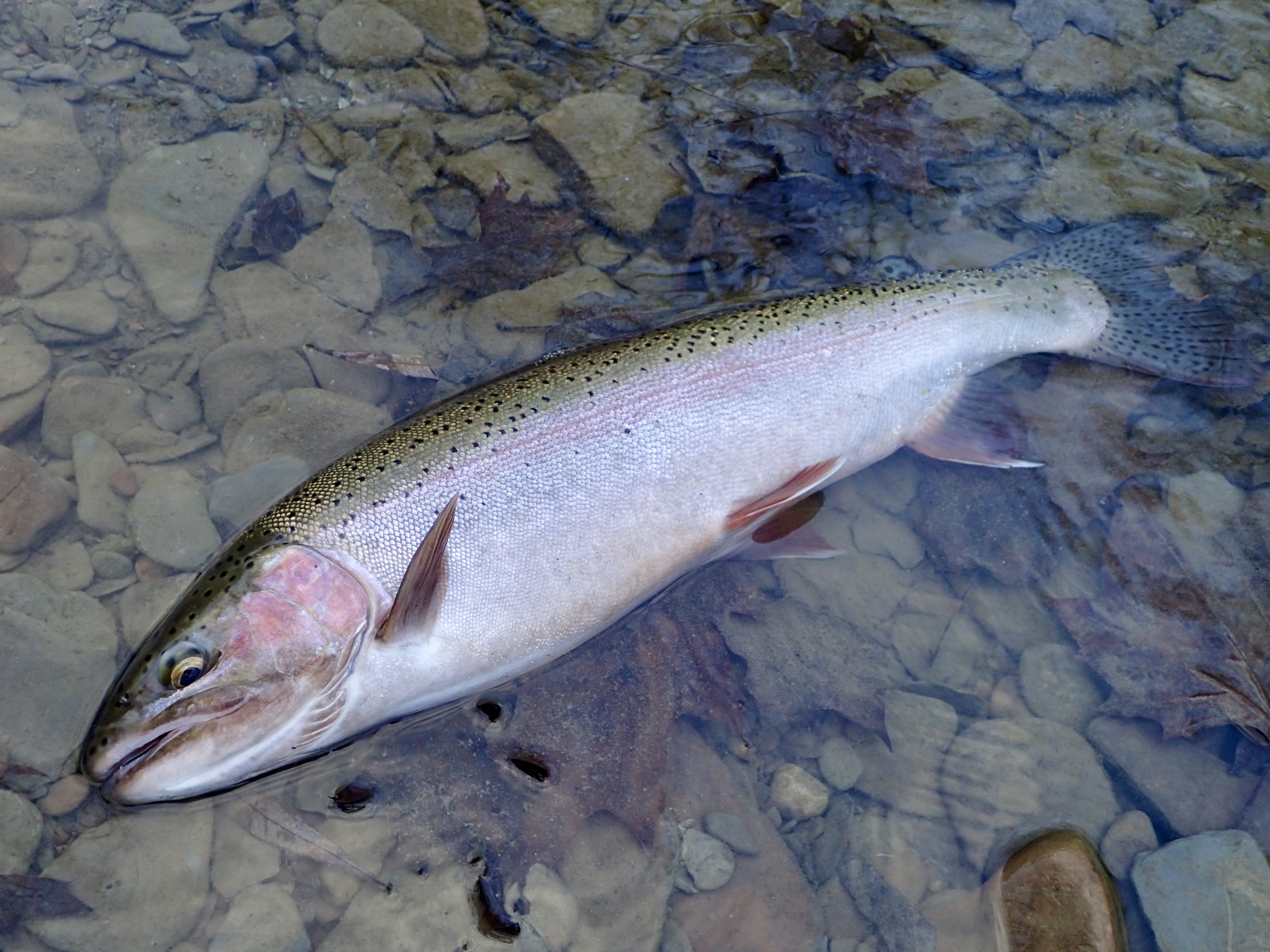
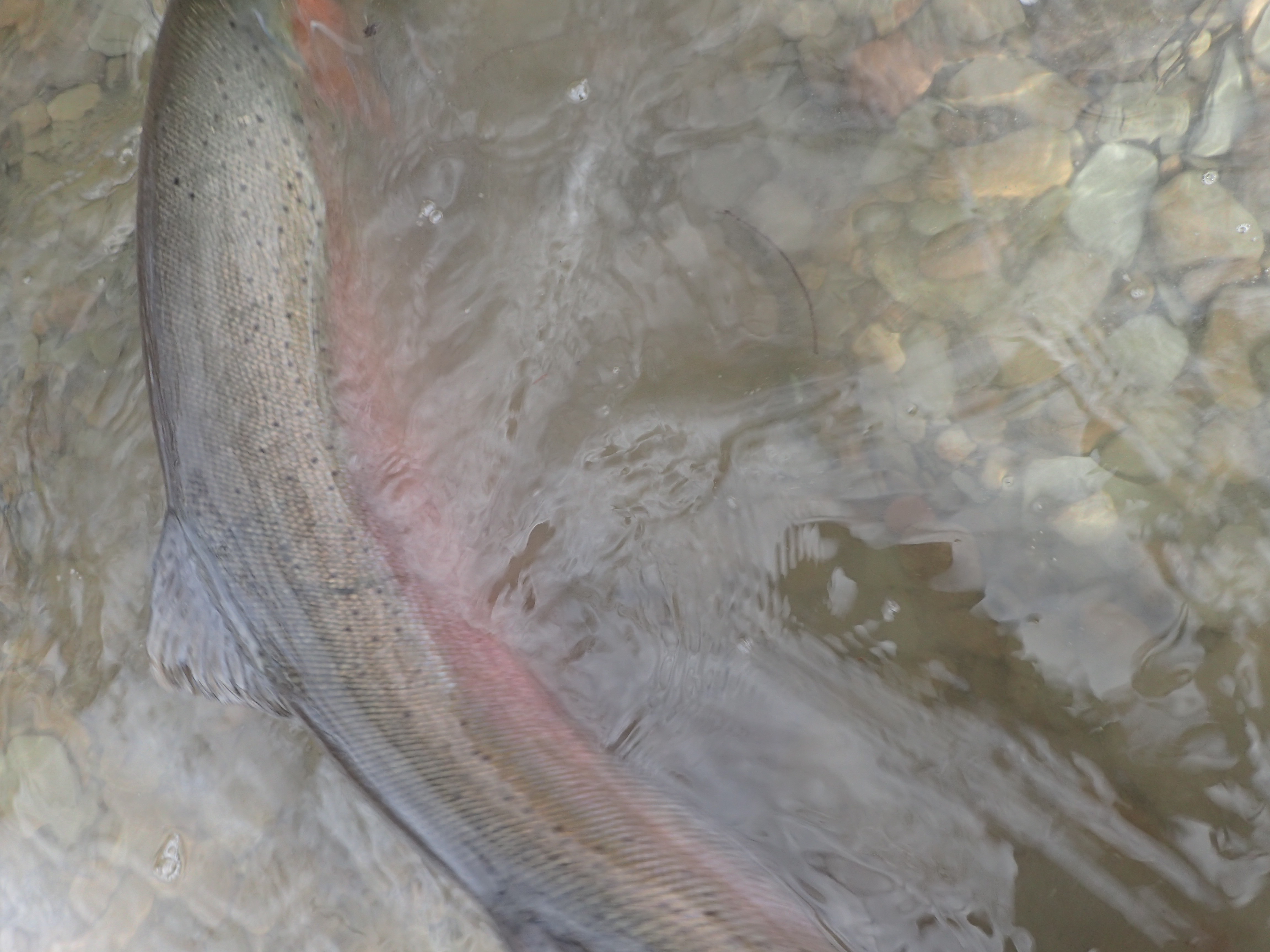
Every substrate is different, and ever-changing light also affects how well you can spot fish. As you can see, steelhead are masters at adapting their coloration to the environment. Sometimes you see them; sometimes you don’t. Learning to determine where they might be holding in any given condition, especially when you can’t see them, goes a long way toward improving your catch rate. I fished a couple pools and runs that certainly must have held fish — except they didn’t. At least not on that day and hour. If you’re not catching and you’re not snagging the bottom, you’re not fishing deep enough. And if you are fishing deep enough, and you’re not fouling a fish or two, there probably aren’t any steelhead in the pool. I lost many a rig in one indescribably sexy pool without a single hookup. But once I found the fish, it was go time.
Since another angler had jumped into my original spot, I decided to take a chance and walk upstream. As I neared some prime water, a guide materialized from the river banks to deter me from slipping in below his client. I gave them both a friendly wave, and announced that I had no intention of crowding them. This put everyone at ease, and I struck up a conversation with Glen, the client, and T (dagnabbit, I forget his name) the guide. Cigars were offered, flies and pleasantries exchanged, and before you know it I was fishing in a nifty slot above their pool. Funny how kindness and politeness goes a long way!
Friday was a tricky day. Whether due to pressure or other environmental factors, the steelhead went through stretches where they just would not eat. I got pretty good at recognizing early if a fish was fouled, and at taking steps to quickly de-hook the fish. I did land every fair-hooked fish, and on a challenging day where many anglers reported slow-to-no action, I was delighted to land eight steelhead. Many thanks to Glen for taking net duty, then this photo.Glen’s on! I can’t say enough kind words about Glen and T, who were kind, matey, and so generous with their water. In a matter of minutes, it was as if we were all old fishing buddies . You can see the different colored strata on the stream bed. The basic rule of thumb on a creek like this is to fish in the dark water, and near the edge of ledges. I hooked up several times by targeting a deeper, darker slot just downstream of a ledge. I’d toss my rig onto the ledge upstream, then let it drift down into the hole. If there was a player steelhead holding there, it would eat the egg fly the moment it dropped off the ledge.
I gave myself a hard stop of 1:30pm. I had to drive to OH to pick up Cam at college. Tomorrow, we’d be fishing in OH with a guide, and I wanted to be rested and ready. 183. We’re getting there.
You go on a fishing trip to unknown waters where there are going to be crowds. You’re unsure about what the energy will be. Competitive? Territorial? Downright rude? I must confess that I have a tendency to expect the worst from my fellow man (or woman). But, we can always hope for the best. And on my first solo run to the Erie tribs for steelhead, I got hopes and dreams and better angels.
It started Thursday morning when I was speed wading in the dark to the mark I wanted to fish. I could see headlamps bobbing in the woods upstream. I could tell they were moving at a slower pace, and as I closed ground I could see it was a guide with three clients. I caught up to them, and asked the guide where he was heading; in my mind, they were there first and would get dibs. I reassured him that I wasn’t going to race ahead and Bogart their water. The guide was appreciative, so much in fact that he asked for my cell number. His idea was that if I was blanking and they were pounding them, I could fish near them. Or if vice versa, we could share water.
It was a most excellent way to start a day. I was so excited by this conversation that I suddenly realized I was 100 yards past my mark. (I suspect the pre-daylight savings darkness had something to do with it, too.)
Cut to an hour later. First light. I saw Chris wading upstream toward me. I’d met Chris the day before when I came to the creek to scout some water with my guide, Bob Packey. Chris was new to fly fishing and had a positive energy and friendly spirit. He remarked how he’d seen me pounding fish up yesterday, and that he was having a tougher go of it. So I told him that if he was blanking, come find me later and we’ll see what we can do about it.
Around 11am, Chris shows up. I could tell from the look on his face that he had been struggling. He confirmed that he hadn’t had a touch. Come on in here, Chris, and let’s take a look at your rig. I didn’t like the size or placement of his shot, so we re-rigged. I told him what I’d learned about the 50-foot run I’d been working, how I had been approaching it, and where I thought he’d have success.
You can imagine how cool it must have been for Chris to hook up within a few casts. All told, he got into four steelhead in about a half hour. Chris’ excitement was matched only by the positive wave of sheer enjoyment that washed over me as I watched him do battle.
Chris getting acquainted with one of the locals. Sometimes a little instruction goes a long way.
The next day, I fished for just over two hours. I saw an angler looking for space, and I told him if he cared to wait, he could have my spot in 10 minutes. He did, and I ended that session with a smile on my face.
Thanksgiving is a season when we acknowledge the many blessings we have. I’m thankful to have met some nice people on the river. I’m thankful for the opportunity to give to someone in need. I’m a confident person, but I am humbled by this experience. Thank you for reading, and please do likewise the next time you fish.
Hot on the heels of the International Fly Tying Symposium, I made an overnight run to the Salmon River in Pulaski. I left Tuesday afternoon and was back home by 9pm Wednesday. I’ll post a more detailed report soon, but I ran the middle river with Row Jimmy. We had decent action in the mid-to-late morning, but then the bite tailed off and I had to be content with four in the hoop.
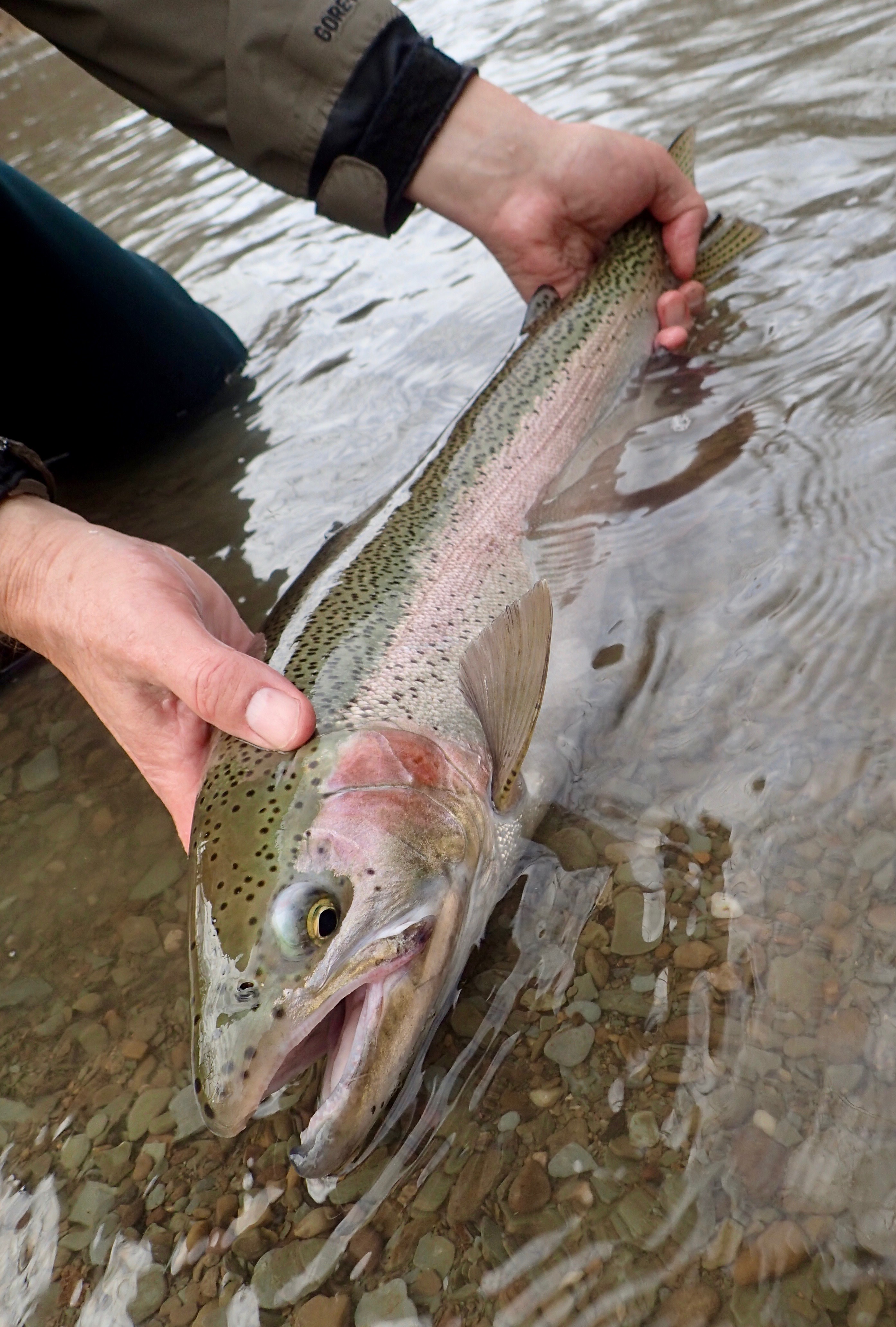
Another satisfied customer. I like the transparency of the tail on this one.
If you won flies from the 1k Followers contest, and you’re wondering where they are, I’ll tell you. I haven’t tied them yet. You have my apologies for the delay, and you’ll be pleased to know that it’s on my sooner-rather-than later list of things to do.
In the striped bass management world, ASMFC is soliciting public comment on Draft Addendum 2 to Amendment 7. Your participation and comment is important, so look for a post from me soon with my thoughts and the ASGA’s party line on the subject. We need to keep hammering ASMFC until they get it.
I’m still guiding if you’re interested in a late fall/early winter outing. This can be a very productive time to fish. Not to mention it’s less crowded!
Finally, my latest article for Surfcasters Journal should drop any day now. When it does, I’ll let you know.
I just got back form two days of spring — uh, make that winter’s resurgence — steelheading on the world-famous Salmon River in Pulaski. The weather was dreadful and so was the bite. More on that tomorrow. But for now, I’ll give you an image that perfectly sums up our Tuesday. As for the striper report, I went Sunday night for 90 minutes to Ye Olde Top Secret Striper Spot and am excited to report…not…a…touch. So it goes…
This photo needs no caption. Bonus points if you know the mark. Courtesy of Row Jimmy Guide Service.









 currentseams.com