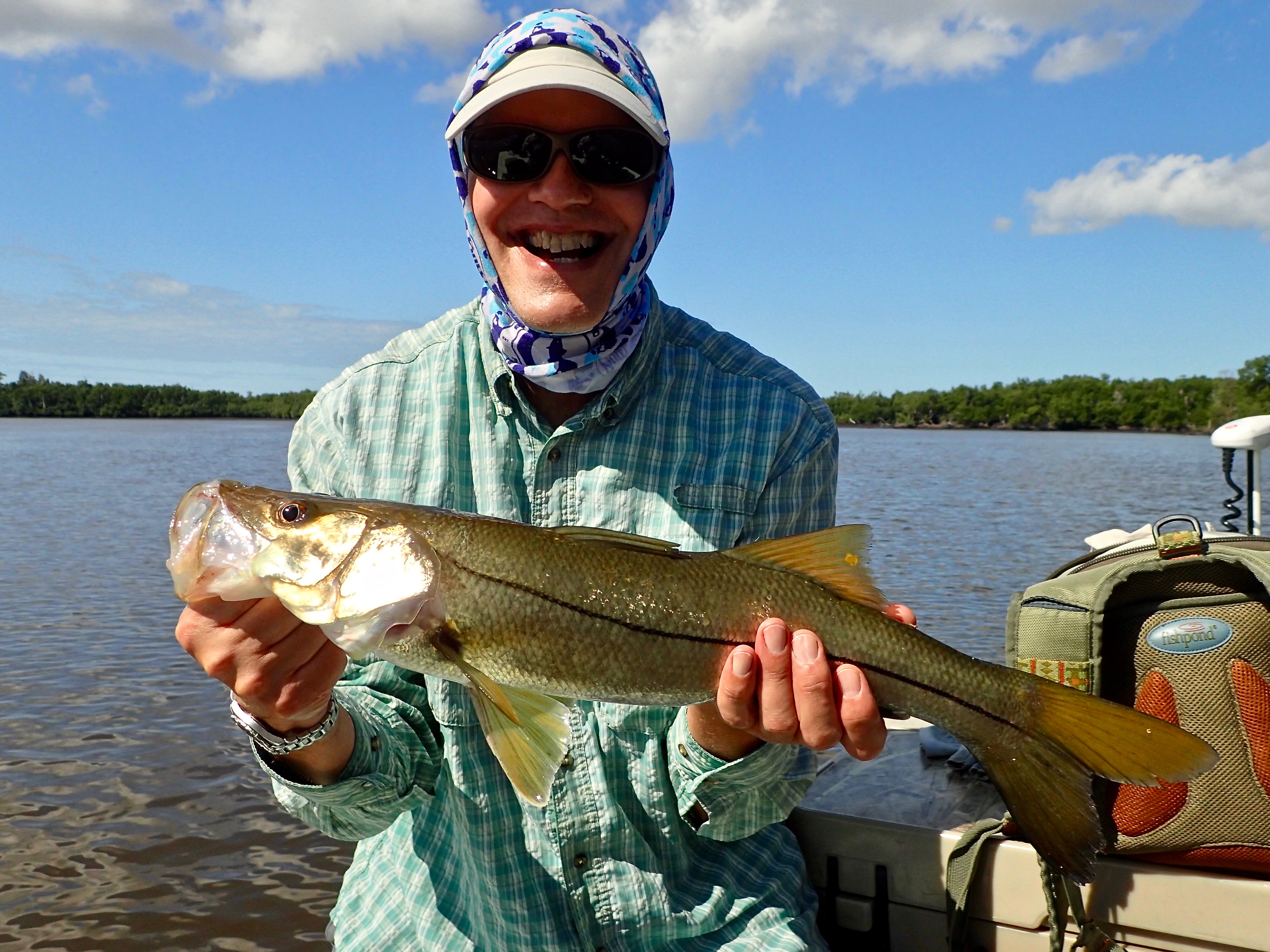
Before this trip, I’d had only one Everglades fishing experience. That was four years ago, and it was a single day excursion with my oldest son, Bill, who was graduating from law school. Our target on that May day was snook and tarpon, but I never even got a taste of a tug. Sure, the jacks and ladyfish and sea trout were fun, but I was disappointed. The highlight of the day was a fine snook Bill grabbed out of a shallow tidal flat.
And so it came to pass that Bill and I were heading out again. I’d already gotten my snook, and then some, and had an all-too-brief encounter with a tarpon, so in a sense this was a gravy day for me. Bill was getting married in three days, and at the very least we’d soak up some sunshine and enjoy some cigars.
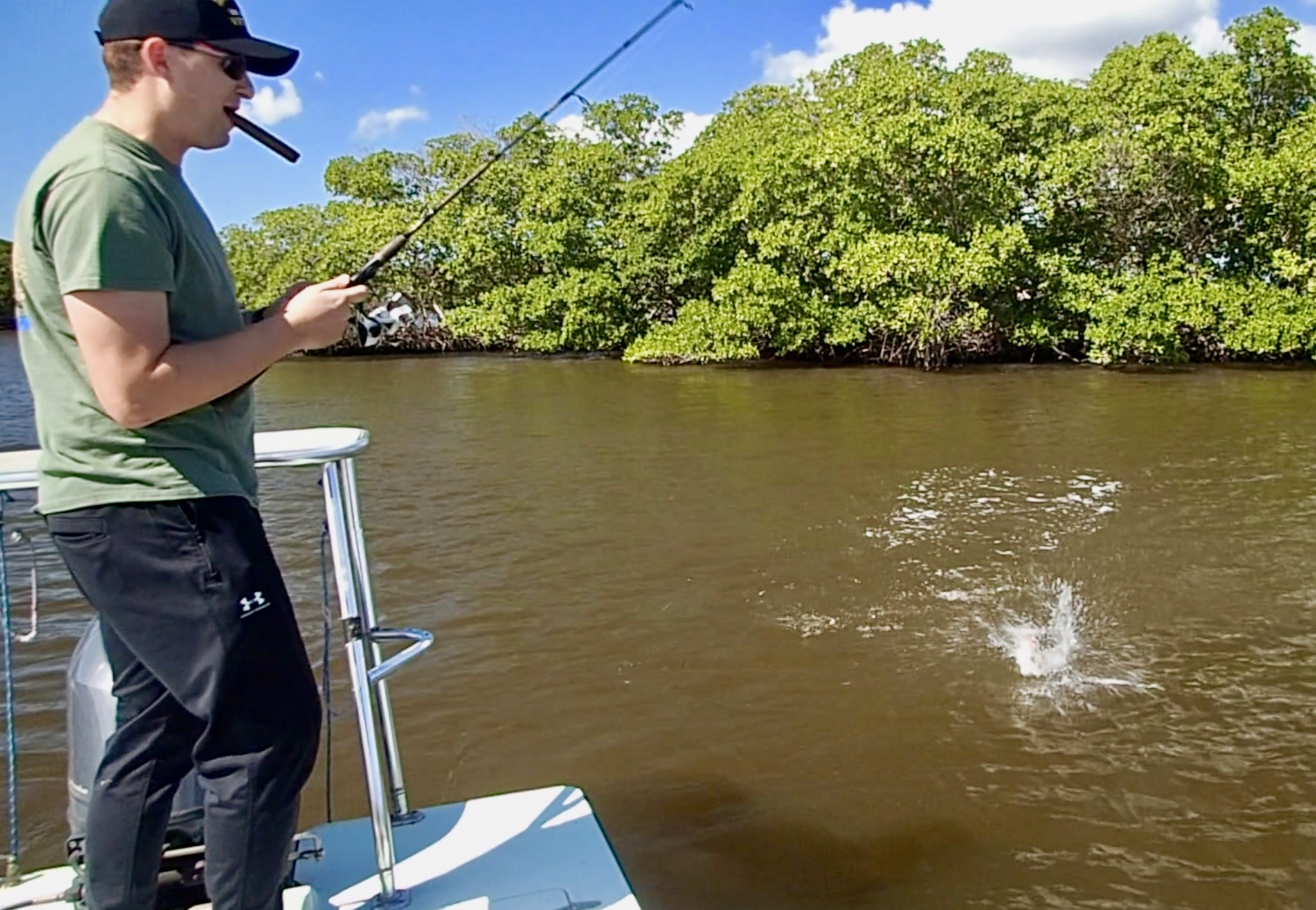
Wednesday turned out to be the warmest of the three days, but there was still an early morning chill that was amplified by the boat slicing through the pre-dawn canals. I wore fleece pants all three days — I’m generally always inclined to be cold — but later on this day I almost broke the shorts seal. I knew what was coming in a couple weeks, and I kept reminding myself that regardless of the action, this wasn’t steelheading — and I should enjoy the blessing of actually being able to feel my toes and fingers. A left-handed fly caster on the bow and a right-handed spin guy on the stern makes it easy to do double duty. However, as we drifted past this island, I wanted to get some footage of my Marine doing battle. Bill found a pod of sea trout and had at them. These are beautiful fish, and they can be highly aggressive with their follows and takes. We liked this spot so much that we asked Mark to do another pass around. we never saw another boat until the very end of the day.We made a run to where the Everglades dumps into the Gulf, and I loved this mark: current, loads of structure, and all kinds of birds and mammals and reptiles to eyeball. We actually fished hundreds of yards of shoreline. By now, I felt like my presentations and hook sets had come light years from my first trip. As we drifted past a downed tree within a pocket channel, I thought I saw a shadow. One cast, a couple strips, snook on! A decent fish for sure, but sight casting him in lightly stained water made me feel on top of my game. Bill and I each took multiple smaller snook at this mark. Of course, just when you think you’re all that, a baby tarpon in a cove near a creek mouth will remind you that you aren’t. And so, having touched two tarpon on the trip, I am resolved to get one on my next. Like Boss Rojack said in My Favorite Year, “The fighting is rounds…this is round one”
The Everglades is big and wild and intimidating. It’s also intimate and beautiful and serene. I know, this sounds like the beginning of a middle schooler’s essay. But it’s truly a challenge to describe the place. One thing’s for sure: we don’t have anything like it at home.
In case you’ve never been, the Everglades is an enormous subtropical wetlands that ranges from Lake Okeechobee to the southernmost Florida mainland. You see things like palm trees and sawgrass and mangroves, and it’s evident that you’re in a warm, wet climate. But when you’re out in a boat in the middle of one of the expansive watery areas, a glance at the distant verdant shores could make you believe you’re on a lake in Minnesota. The only clue that you’re not is that there are no houses dotting the landscape. The lack of ego in the form of architecture definitely adds an allure of mystery.
But you’ll see birds and fish and reptiles…and mosquitos. Fortunately, my experience this time was mosquito light. (Not so four years ago in May, when those bloodsucking flesh drillers were so aggressive and relentless that I literally had to sprint from my car to the visitor center in Everglades National Park to find sanctuary.)
Parts of the Everglades have an extensive canal system, and on the first day we fished one of them for peacock bass. I managed to hook ten different species over the course of three days. Some of them were old friends from Connecticut like largemouth bass and bluegill. Others were recent acquaintances from a few years ago, namely jack and ladyfish. But six of them were brand new to me: gar, oscar, peacock bass, speckled trout, snook, and tarpon. To get to the Flamingo boat launch in the southern end of the Everglades, you need to travel a two-lane road that cuts a straight edge for most of its 50 miles. Once you launch, you head along a canal much like the one in the first picture, then out into what I call “the lake.” There are all manner of rivers and creeks and islands and coves to explore off the lake, and this is where the massive Everglades can reach that wonderful state of intimacy. Here’s a still from a video I shot. We’re water bushwhacking — those are mangrove trees — though a creek that’s not much wider than the boat. You had to parry the branches away from your head and body. It leads, as many of them do, to a small cove that resembles a New England salt pond flat. You go into stealth mode — whispering and hand signals only — and you look for cruising fish or travel lanes or little pockets against the mangroves to cast into. We blanked in most of these, but a few of them produced, and in a week where the bite was considered to be slow, you take those moments and don’t ask questions.Air plants are epiphytes, meaning they grow on other plants, in this case a mangrove. These look like the dried tops of pineapples. They draw their water from the humid air and from rainfall. One of the best parts of fishing in the Everglades is that you get to see and hear and sometimes even touch plants and animals that aren’t ever found where you’re from. Speaking of humidity, it wasn’t very warm or humid the first two days on the boat, but by the third the layers were getting peeled off as sunrise transitioned to mid-late-morning.Bon appetit! Monday’s quarry was peacock bass. This gator beat me to this particular fish, but I’ll tell you all about my first experience with peacocks next. Spoiler alert: there were lots of them, they provide great sport, and I want to catch more. Photo by Mark Giacobba.
In case you missed it, the Maryland DNR just released their 2021 striped bass survey, and the news ain’t good. It’s actually pretty dire, as this chart shows.
You have to go all the way back to the disaster years of 1979-80-81 to find a worse three-year period on this chart.
In an article published by Chesapeake Bay Magazine, the DNR’s view of the recruitment situation is alternately described as “optimistic” and “concerned.” Huh? Which is it? Better still, why isn’t it “alarmed to the point of hyperventilation”? This is merely further evidence that some of the people in charge of striped bass conservation are at best fools, and and at worst, grotesquely incompetent.
Speaking of incompetent, the ASMFC Striped Bass Management Board is preparing to meet to discuss Amendment 7. Public comments will be needed in the next couple months, so stay tuned here for further information. We’ve got to keep hammering away, folks. The gods may not be able contend against stupidity, but perhaps a well-organized, highly motivated striped bass fan base can.
I’ve been focusing on small streams this month, partly to scratch an itch and partly to shoot video content for the new small stream presentation I’m building. Small streams are cool because they’re like any bigger river or ocean: weather changes, water levels (or tides) rise and fall, water clarity and temperatures fluctuate — you never know what you’re going to get until you get there. Here are few photos along with some things I’ve noticed that might help you on your next small stream adventure.
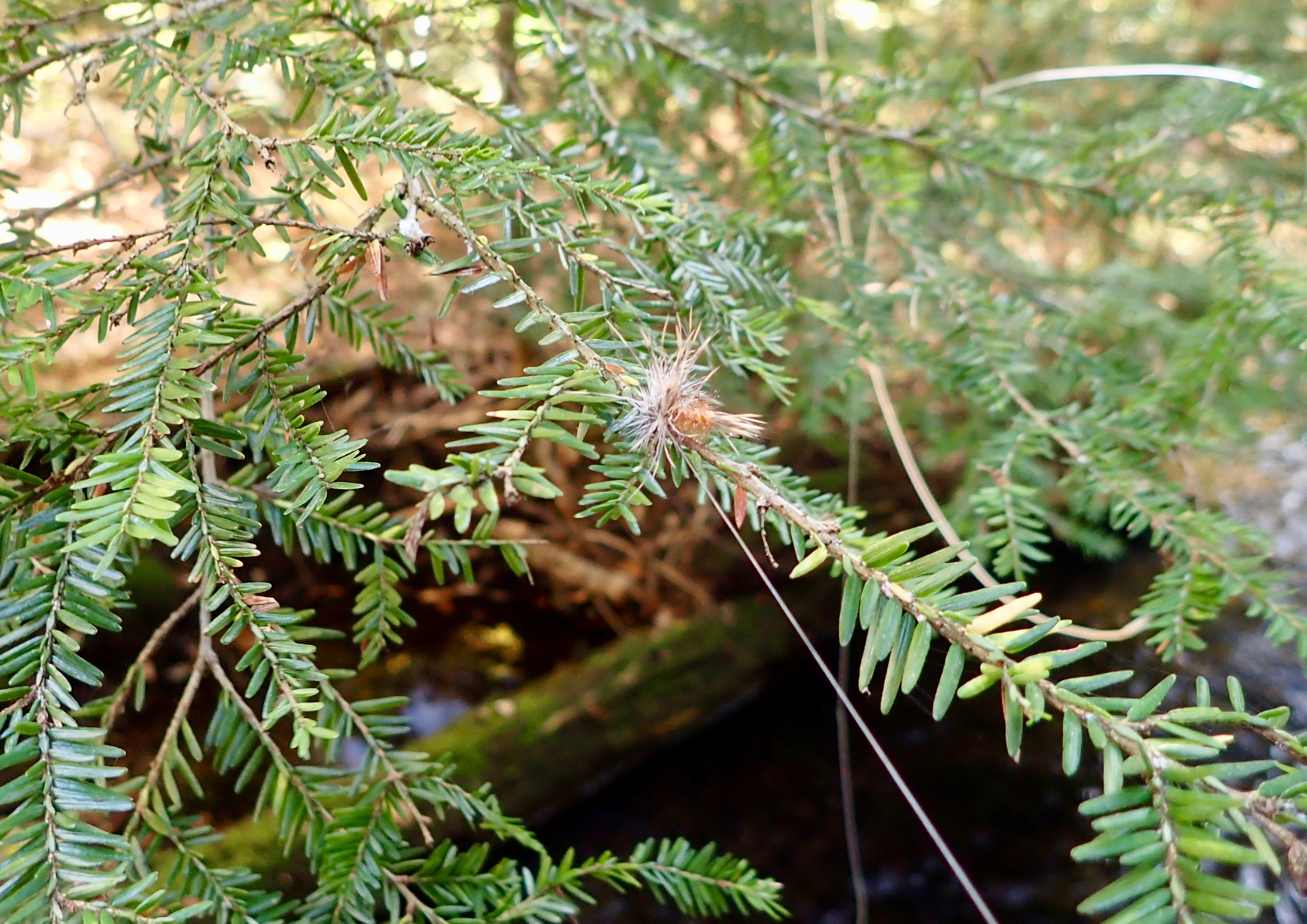
Micro Wigglies work — here’s proof. But I’ve been very disappointed by the generally poor reception the brookies have given them. Micro Wigglies are almost useless in high water, and even in low water need to be stripped to induce a strike. If you’re committed to the dry fly cause, it’s hard to go wrong with a big, bushy dry. What’s “big?” If I’m not necessarily interested in hooking sub-4″ fish, 14 is as small as I’ll go. Of course, you de-barb your hooks, limit photos, and only handle wild fish with wet hands. It goes without saying (but I’ll do it anyway) that you should never lay a fish down on rocks or dry leaves or sand for a photo. This may be self-evident, but the better dry fly days are the ones when the water is lower rather than higher.Using roll and bow-and-arrow casts helps you avoid annoyances like this. My rule of thumb for awkwardly-placed-by-nature streamside vegetation is: If it’s living, I never remove it. If it’s dead, it must not be visibly supporting life (spider webs, for example) or creating good natural structure/cover for the subsurface residents. So, if it’s a spindly twig that got knocked into the river last wind storm, and it keeps eating your streamer, feel free to toss that sucker.Dry flies are a hoot on a small stream — make ’em come up! — but the bigger fish are usually taken subsurface. I marvel at how curious these char are about any intruder in their underwater world. You can feel them bumping the fly moments after it hits the water. What is it? Food? Not food? Threat? Don’t mess with those teeth! I
On the difficulty scale, keeping current with how the ASMFC plans to manage (I’ll be kind and not place quotes around manage) striper stocks is somewhere between Calculus II and Organic Chemistry. Flux and fast and fluid also come to mind as good descriptors. (And as always, alliteration.) But thanks to our friends at the American Saltwater Guides Association (ASGA) it’s become easier.
Next up will be draft Amendment 7. Public comment will be open later this year, and I’ll be sure to get you the links. To help you understand what’s going on before then — no degree in Chaos Theory required — here are some helpful links.
If it looks like a moratorium proposal, is it really? Nope. Here’s why.
If you’re finding this stuff helpful, and you really care about stripers, you should join the ASGA. You can do that here. And of course, any donation you can make helps them continue their outstanding work.
A bit of a busman’s holiday for me yesterday as I had a busy day shooting video on a small stream. This is one of those places where there’s no easy way to get there (both driving and walking). Plus it sucks to spend so much time setting up shots that end up being unusable. But whoa! Listen to me kvetch. What a lucky man I am to have such an office. There’s a certain beauty on display in the deep woods after a rain, hills shrouded in fog, water droplets collecting on leaves, rivulets rushing down hillsides. The water was up a tad from the rain, but running clear and cold and the char were open for business. I did well with bushy dries and mini tungsten head buggers. (I’m still a little bitter that they were indifferent to my micro Wigglies.) The better fish came on streamers — no surprises there. I guess I’ll have to go back next week to get all those shots I missed…
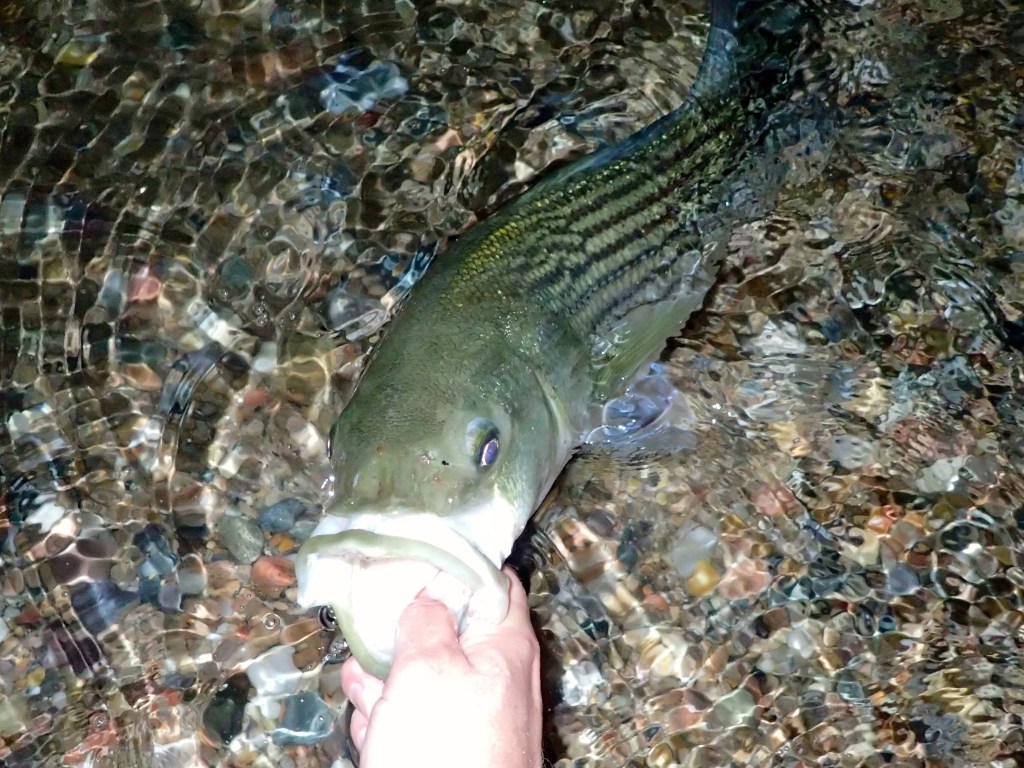
I like the metallic look of the gill plate. I like the blue halos. I like the specificity of the lateral line. Ah, screw it. I LOVE this fish.
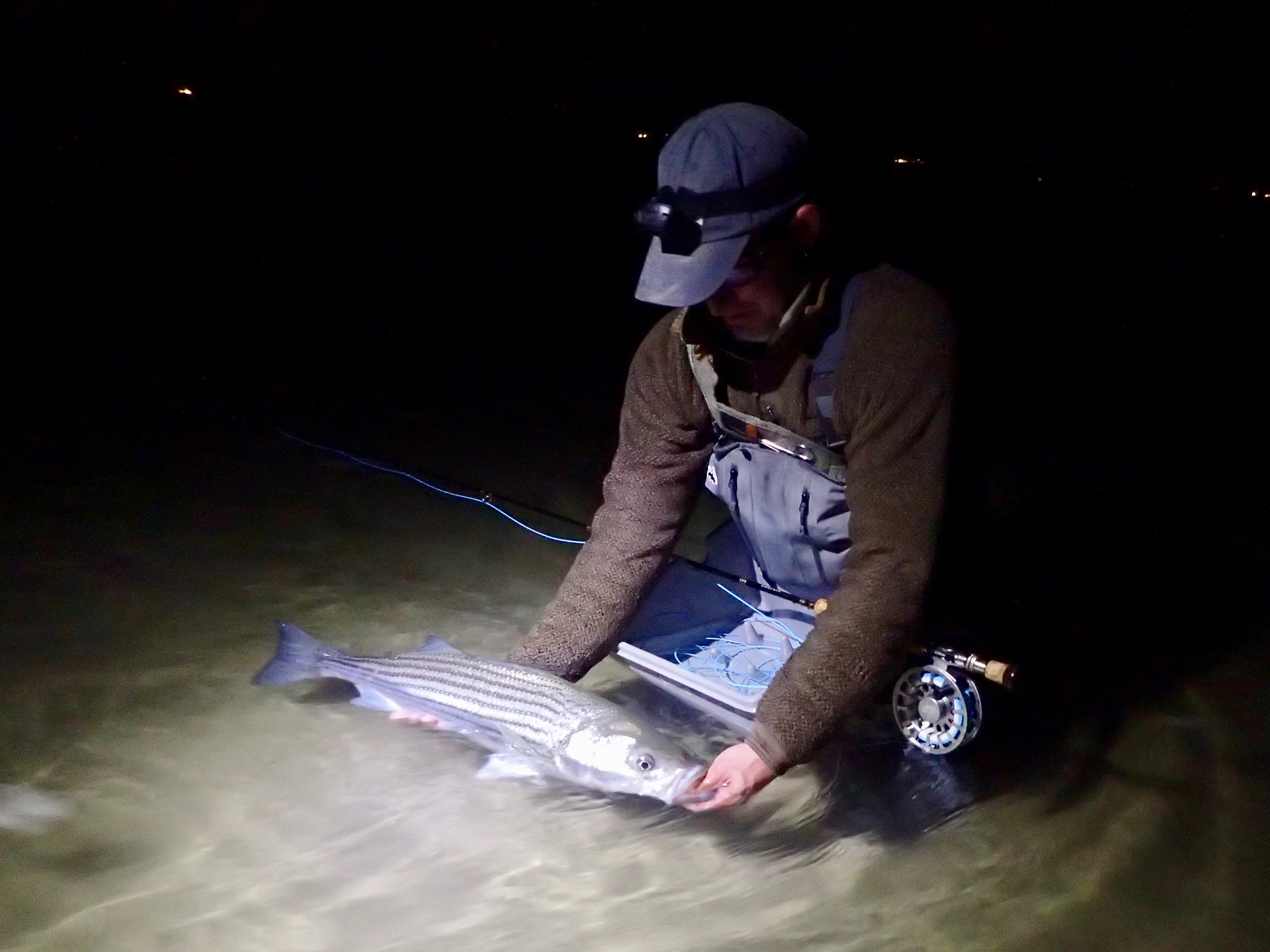
After last year’s feast or famine full-moon struggle, I was really looking forward to fishing the dark of the moon on Block. To add to my excitement, the shore fishing in the weeks leading up to my trip was en fuego. I’ll quote Chris Willi of Block Island Fishworks: “I haven’t seen this much bait and bass and blues and shad in the pond in 20 years.” Captain Hank chimes in: “There’s life in the drink everywhere!”
By the time I arrived, it was all gone.
The front that came through on July 4th weekend sent everything packing. To add to the weather mischief, tropical storm remnants swept through mid-week and further cocked things up. The result was some of the poorest fishing on Block I’ve experienced in the last decade. A dozen fish over the course of seven nights was the best I could do, and I felt like I did really well given the conditions. To give you some perspective, I got a dozen fish or more on four different nights last year. I did not see another angler catch a striper from the shore, fly or spinning, for the entire trip. I did not speak to any anglers who managed more than two stripers the entire trip. Perhaps worst of all, this is now the third consecutive year that I have not caught a bass over 28″ on Block. Not good.
The Cut was a barren bait and striped bass wasteland. Charlestown Beach likewise. The flats fishing, my favorite form of Block Island fly fishing entertainment, stunk. Even the East side beaches were spotty, with a fish here, a fish there — and that’s if you could find a weed-free zone. And yes, I hit up the South side and SE sides. Blanks.
But enough kvetching. There were some positives. I did not blank on any night. I fished three marks that I’d never fished before, and found fish in two of them. (In fact, one of them became my defacto skunk saver.) I loved all three spots, and I will be adding them to my rotation. I spent more time fishing open beaches in wind and wave, and the two-handed cannon once again proved its mettle. On the opposite side of the rod spectrum, I finally baptized my five weight with a Block Island bass. And let’s face it: anyone who gets to spend a week banging around Block Island with a fly rod and a humidor full of premium cigars has a pretty good lot in life.
There’s always next year.
Now, if the rivers would just come down so I can harass some smallies.
Someone lost a landing net on the upper Housatonic, and I have it. It’s a nice net, but it’s been in the water for sometime (it was mostly submerged). Describe its general size, frame shape/material/color, and net material/color and we’ll arrange a reunion.
I worked with Bill yesterday on his indicator nymphing and wet fly skills. Water conditions were perfect in the Permanent TMA: 325cfs, cold, clear. The trout and bugs were a wee bit more uncooperative. Hatches (sulphurs, caddis, olives) were spotty and the feeding was inconsistent at best. We fished two marks and saw four trout hooked all day, and since we had two of them, we declared victory. On the plus side, Bill landed his PB non-lake-run brown. He nailed it at high noon (we fished from 10am-2pm) while nymphing. I was observing from upstream, and when he set the hook it sure looked like a fish to me. Bill thought he was stuck on the bottom — that happens sometimes with larger Farmy trout — and then, gloriously, the bottom fought back. Sadly, Bill snapped his rod during the battle, but the fish was landed, much to his delight. To say nothing of mine!
Bill’s new personal best, a gorgeous high teens wild brown. Love those halos. He took the took dropper in our nymph rig, a size 18 soft-hackled pheasant tail. Since that hook was a 2x short, it’s effectively a size 22 fly. Do not underestimate the power of tiny soft hackles this time of year. I almost always make my top dropper on my drop-shot nymph rig a soft hackle. Congratulations, Bill!
It’s easy to see why New Jersey is nicknamed “the Garden State:” It’s from all the bullshit.
The manure was flying even before Thursday night’s “public” comment (say the P-word with your tongue planted firmly in cheek) session for the New Jersey Marine Fisheries Council.
Tony Friedrich of the American Saltwater Guides Association wrote a scathing summary that outlines the (Corrupt? Rigged? Incompetent? All of the above?) outrageous behavior of the Council. You can read it here.
Fish are considered stupid because they have small brains. However, all stupidity is not limited to small-brained creatures.






 currentseams.com