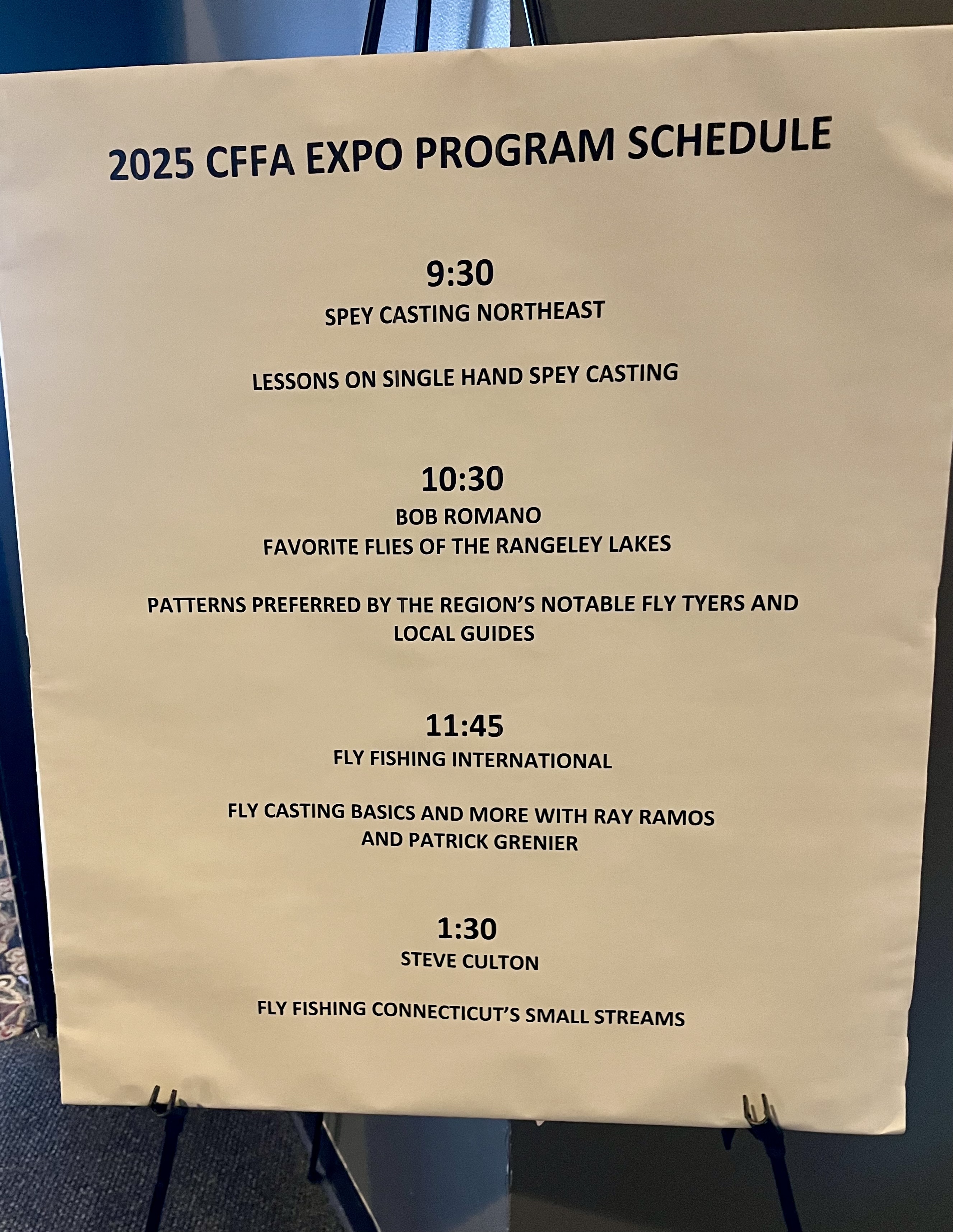
“Fly Fishing CT’s Small Streams” Thursday 9/12 7pm at Hammonasset Chapter TU

I’m kicking off my 2024 fall/winter speaking season Thursday night, September 12, 7pm, at the HCTU meeting in Meriden. The topic will be Fly Fishing CT’s Small Streams, a subject that I’m really passionate about. We’ll talk when, where, how, tackle, flies, tactics, conservation, and more. The meeting is open to the public, so I hope to see you there!

Fishing small streams returns you to the very soul of fly fishing.

Better late than never: Time to tie up some September Nights!

I’m way late on the draw here, but there’s still a lot of September left. Ken Abrames’ September Night is by far my favorite finger mullet fly, and you can tie it longer as the mullet get bigger and fatter. I have received confirmed, reliable reports that at least one RI salt pond is loaded with mullet, and that school bass have been harassing (if not enjoying) them. Here’s a good link with tying instruction from yours truly so you too can tie the September Night.

If you think this fly looks good on the vise, wait until you add some water and current. I also tie a variation with a ginger marabou collar. The stripers approve.

(Late) Farmington River Report: Trout (mostly) open for business!

My apologies or not getting this out last week. I’ll try to be a little more timely. The good news is that the terrible weekend rains mostly missed the Farmington, and the river has been fishing very well. Last week I guided Dan for a late afternoon-into evening session. The focus was on dry flies, and we started off with a hopper/dropper system. (‘Tis the season! And I promise, no more parenthetical statements.) We discovered a pod of trout taking emergers in a shallow run in bright sunshine. When Dan dialed in his cast and drift, his hopper got crushed by a very respectable mid-teens brown. We found another run formed by the confluence of two sections of river, but we couldn’t buy a hit. Even when we switched to wets, it was no dice. My best guess is that they were feeding on something far smaller than what we were throwing.

We ended the session at a classic dry fly pool within the PTMA. Hatch activity (22-24 BWOs, 18-20 Summer Stenos, and later, 12-14 Light Cahills and an absurd number of midges…and I guess I fibbed about the parenthetical statements) was light until 8:30pm, but Dan managed to stick a nice fish on a 22 BWO dry. We used a 14-foot leader-tippet system terminating in 6x to get better drifts in the languid, glassy pool. At 7:30 I was able to join in the fun. As predicted, that wild brown feeding just off the rock in the frog water got stupid as it got dark, and I took him — with great delight — on a size 16 Catskills Light Cahill dry. Both Dan and I had good action until we could no longer see our flies.

The next day, I shot some drone photos for the book with filmmaker extraordinaire Matthew Vinick. I fished for about 45 minutes below and within the PTMA until he arrived.

I was fishing some water in the PTMA I really haven’t spent any time in for at least five years when I connected with this gorgeous creature. She was part of a pod of trout taking emergers, and she chose my Squirrel and Ginger top dropper. Matt and I went to a couple other pools in the PTMA to shoot, and then we had places to be.

~

I had 30 minutes to fish before I had to pick up my son at Bradley. So I ventured into some snotty, treacherous water that’s rarely fished. This rainbow hit the Squirrel and Ginger so hard that she peeled off 20 feet of line before I could adjust my drag. The photo really doesn’t do her justice — she was fat and powerful and wonderful, and she just wouldn’t sit still for a picture.

~

There’s a happy guy! My last customer of the day was the best. She was feeding in a slot near the shore, and it took some maneuvering to get into a good position to present my team of three. This is where it helps to be physically fit (and carry a wading staff). There’s no way I could have reached her without being willing to wade into some dicey currents. Measured against my net, this is a high teens fish (I refuse to thrust a fish at arm’s length into the camera) that took an Isonychia soft hackle I’ve been prototyping for a year. I’ll publish that pattern soon, but in the meantime, I can tell you this: big fish like that fly. You can see a fly-in-mouth shot on Instagram, probably Tuesday.

A little bit of this and that, and Farmington River book tidbits

We’re preparing to host a big family reunion, so no fishing for me today. I hope you’ve been able to get out — I have, and the cooler weather this week has been a welcome respite from the relentless cycle of heat and humidity.

To the salt: A shout out to The Saltwater Edge for their Local Singles Program. Even if you’re not a spin angler, you can take a lesson from its energy — reducing striped bass C&R mortality — by mashing down the barbs on your flies. It really makes a difference. Earlier this month on Block Island, I deep hooked two bass on Big Eelie patterns. in both cases, the hook came out with ridiculous ease, with no blood nor visible damage, because I was fishing barbless. Come to think of it, it’s getting close to time to tie up some…nah, we’ll wait…

The Fly Fishing Guide to the Farmington River book project process continues. I’ll be out on the river a lot this week, both guiding, fishing, and shooting photos. If you see me, please come say hello.

Writing-wise, I’m working on the hatches section, and choosing flies to match. It just occurred to me that most of what gets the attention this time of year is either large or yellowish. Then I remembered, how many times have I seen tiny BWOs (20-26) in the air? How many times has a fishless outing turned because I started fishing a Tiny BWO parachute? The answer is: many. Tiny BWOs may not be the sexiest hatch in midsummer, but they are important. Now, let’s also not forget the attenuata…or the egg-laying caddis…

Catch ’em up.

Farmington River Report 7/3/24: Wet fly surprises, not my finest dry fly hour

We had a fishing trip/photo shoot on Wednesday from 3:30-9pm. Delaware River guide extraordinaire Bob Lindquist came down to take pics for the book and an article he’s writing. We (filmmaker Matthew Vinick of “Summer on the Farmington” fame) started off at the bottom end of the PTMA and the action was slow. Little to no hatch activity, and precious few risers. Matthew and I had to work our butts off (he was nymphing then dry flying, I was swinging wets) to put a few in the hoop over 90 minutes. Both of my trout took a large Iso soft hackle.

Matthew had to skedaddle, so Bob and I moved up to a dry fly pool above the PTMA. As I was wading in, an old crusty angler (meant as a compliment) was leaving, commenting that the sulphur hatch was not good. He was right. It never really got started, even later in the evening as sunset transitioned into dark. Id like to blame it all on the hatch, but I don’t think I fished particularly well, mostly because I was being stubborn. Let me explain.

I saw that the sulphurs that were on the water were an 18-20. But I wanted to see if I could get them to take the 16. They generally wouldn’t, and when I put a 20 on I had double the action. I was also committed to fishing the water in front of me, which, due to varying currents seams and speeds, was difficult to maintain a quality drift. Sometimes I like a challenge, you know? But my fish worthy-drifts were few, and even when I did fool fish, I came away with nothing. I rose six trout and stuck none of them. Ugh! Finally, I moved down a few feet to more drift-friendly water, but by then it was too late. (Stubborn Steve pays the price.)

I should mention that I had some surprising success on wet flies in some very slow-moving water pre-7pm. Two trout, two crushing hits, both on LaFontaine’s Diving Caddis size 14. Later, the pattern that the trout seemed to like best was a size 20 sulphur comparadun. As it got darker, I switched over to a size 12 Usual. Unfortunately, the typical dusk feeding orgy never manifested, and both Bob and I commented about the lack of spinners on the water at dark. So it goes.

The Diving Caddis wet. I’ve been tying these without the rib, and using tan caddis Prism dub for the body. The trout are all in favor.

Managing the hot weather on the Farmington

Summer is here early, and with a vengeance. The good news is that we have solid summer flows coming out of the dam at a favorable temperature:

However, note that the water temperature spikes five degrees by late afternoon, just from the release of the dam down to the measuring point at the bridge in Riverton. It doesn’t take a math whiz to reckon that once the river reaches Collinsville, the water is going to be significantly warmer.

This is where you and a good water temperature thermometer come in. If you don’t have one, you should get one. (I use this IR wine thermometer, $30 from Amazon). There is some debate about what the cutoff temperature for fishing is; 67-68 seems to be the number. My present policy is to call it at 67; that is, if it’s 67 or higher, I won’t fish for trout.

Also note that evening, night, and early morning are going to be your best times for find favorable temperatures; what’s more, those coincide with low light periods, which are generally good times to fish.

Finally, this time of year sees explosive feeding activity, starting around 7:30pm and building exponentially into dark. Don’t make the mistake of leaving the water at 8:15pm. You’ll be missing the best dry fly fishing of the day.

Farmington River Report 6/10 & 6/11/24: Foul language and frustration, then a wet and dry fly high

I fished the lower river Monday evening. The weather was vastly different than today’s; it was overcast and downright chilly for June. I swung wets for a couple hours, and the action was disappointing. Three trout on wets late afternoon this time of year ain’t exactly lighting it up. Part of that had to do with a sub-par hatch and very little visible feeding activity. Then, there was the cursing incident. Another angler thought I was bogarting his water; instead of talking to me about it, I was treated to a torrent of f-bombs and called various other unpleasant names that use slang to describe parts of the human body. Even though I thought he was being unreasonable (given the size and popularity of the pool) I apologized and backed away — and still, the venom and vitriol rain down upon me. Here’s the punch line: before I entered the water, I’d spent a few minutes asking where he was going to be fishing (he had been sitting on a log, taking a break), talking about flies, and I’d even gave him one of my favorite patterns. No good deed, etc.

To top it off, the fishing mostly stunk. I fooled a good number of fish on dries, and came away with no purchase on the hook set. I did eventually catch fish, but it wasn’t the lights out feeding orgy I had hoped for. Observed: midges, small caddis, a few sulphurs, a couple bigger Light Cahills.

But, every day is different, and Tuesday serves as the proof. I guided Brian from 1pm to 5pm, and he basically slayed them. We did our streamside classroom — this was a wet fly lesson — then we got into the water and began catching trout. The run we fished in the PTMA had a few risers, but nothing really consistent. Still, he got two in the hoop before we moved on to the lower river.

The pool we fished was a dream scenario for a wet fly lesson. You instruct the client; the client listens and executes, and the trout reward his efforts by jumping on with gusto. I don’t know how many trout we caught, but they smashed every fly on our team of three (sz 14 Squirrel and Ginger, sz 14 tan LF Diving Caddis, sz 12 BHSHPT multiple times. The rainbows offered tremendous sport; several of them performed cartwheels and aerials that would do any steelhead proud. Brian did a fantastic job of casting, mending, presenting, and covering water. Yet another Dangerous Wet Fly Machine has been created!

Hook. Play. Land. Repeat. Brian crushed them, and I was particularly impressed with how fast he landed his fish. Get ’em in, get ’em off — that’s the way to do it when you’re playing the catch-and-release game. Well done, Brian!

After our lesson, I was feeling ambivalent about fishing, but I had plans to meet “Summer on the Farmington” film director Matthew Vinick, so I headed up to the PTMA. I found him in a snotty boulder field, and while my plan was to start by swinging wets, there was no one(!) in one of the most popular dry fly pools on the river. So I jumped on that.

Within 15 minutes, there were five other anglers in the run. Funny thing! We all managed to share the water (and we were all significantly closer together than I was to the Monday Night Curser) without anyone getting upset.

Even though I was the first in the pool, I made the wrong choice of real estate. Has this ever happened to you? You pick your water and the trout are rising above you, and below you, but not in front of you. I did catch a few fish on The Usual sz 16 and the Magic Fly size 16, but when the gentleman below me left around 7:45 pm, I eagerly moved into his slot. And that was the right call, because there were far more active feeders in that area. The trout were taking sulphur emergers and the occasional straggling sulphur dun, and on this night it was just like the early June Farmington River dry fly playbook said it would be: match the hatch in size and color, make a good drift over a feeding lane, and the trout will eat the fly. I have no idea how many eats I had, but it was a lot.

At 8:15 I switched over to a sz 16 Light Cahill Catskills style dry, and it took about 10 minutes of fading light for the trout to want to eat that fly. By 8:40 I had upped to a size 12, same fly, and it was a fish on every cast until I could no longer see the fly and the frenzy began to wane. I went 10 casts without a take, then called it.

I couldn’t remember the last time I left the river so happy.

Farmington River Report 6/3/24: Photos and trout and lots of both

My deepest apologies for being so late with this report. On Monday I spent a lovely afternoon on the river with Farmington River guide extraordinaire Steve Hogan and Delaware River guide/photographer par excellence Bob Lindquist. Steve and I were fishing and Bob was shooting, both for an article he’s writing and for my book. We started off in the PTMA, me swinging wets and Steve with a dry/dropper combo. There were a few caddis about, but not a lot. We both took several trout.

We moved operations to the lower river where I focused on some snotty whitewater in a boulder field to swing wets. Steve went to Euronymph the dum- in to a pool and took trout after trout on his rig, mostly fat, stocked rainbows. I had less action, but did take a gorgeous wild brown with brilliant orange spots. Witnessed: caddis, Light Cahill, Isonychia, and sulphur, albeit in statistically insignificant numbers.

At this point, you may be wondering, “Steve, you were on a photoshoot. Where the heck are all the amazing photos?” Sadly, what Bob shot — and he got some wonderful pictures of fish and anglers and action and bent rods and splashing trout — is for his article and the book only. What’s more, I forgot to bring my camera along, so I have no secondary shots to share. All I can tell you is: it will be worth the wait.

Not from Monday. But there was a lot of this going on!

At this point Steve left and Bob and I ventured off to another boulder field. Even though the sun was still high and there was virtually no hatch activity, I had a banner 60 minutes bailing trout on wet flies. We called it just before 6pm, as Bob had a long drive home, but I have no doubt that if I had stayed, I would have done some significant damage as the evening hatch ramped up.

Later, I did some thinking about why I didn’t get as many fish on wet flies as I thought I should have. My best guess is that in the bright sunlight, the trout were congregating in the deepest water they could find. The last mark I fished was mostly in shade. The evening hatches were probably starting to ramp up. So there’s your most likely answer.

This is a great time to be fishing the river. I hope you get the chance to get out.

Striper Report 5/31/24: A little grass shrimp action

As I suspected, writing the book is has become a major time sink. Not that I’m necessarily complaining — I really enjoy writing about fly fishing — but I’d rather be doing it than writing about it.

So, the fishing has suffered a bit, and my mid-to-late spring grass shrimp outings are a perfect case study. Normally by this time of year I’ve been out multiple times. Last night was my first, and I may not get out for it again until next year. I picked a meh night for it. The swarm was probably a 3 out of 10, and there wasn’t much on it. I fished my usual three-fly team (last night’s lineup: Grass Shrimp Solution top dropper, Orange Ruthless clam worm middle dropper, Micro Gurgler on point). I fished a modified swing and dangle. I had to work over the course of 90 minutes to hook one shad and two bass, and those fish came in a bite window of 30 minutes. But I was happy to be there, the cigar was swell, and I felt like I spent part of an evening with a dear old friend.

Some nights, you get fish on all three flies. Other nights, they want one thing only, and last night it was the Micro Gurgler.

Farmington River Report 5/28/24: A tale of two outings

I’ve been having a tough time with lessons this year. Not the clients! All have been enthusiastic learners and a treat to coach and teach. Rather, the bite windows have generally stunk (and they really shouldn’t be stinking). Yesterday’s lesson was a case in point. Craig did an outstanding job casting and mending and presenting and hunting and covering water. The last couple hours in particular, you could really see him taking to the wet fly. He never got discouraged, and he deserved a lot better than four touches and two in the hoop. But I’m happy to declare that Craig is going to be a certified Wet Fly Dangerous Machine if he keeps on keeping on! Great job, Craig.

The river was up from the rains, but in the 400s of cfs it was not too high for the wet fly. Weather was perfect, save for some breezy moments. No, I think the main culprit was the almost total lack of hatch activity, and zero visible feeding. I think I saw a half dozen(!) caddis in four hours. This was Craig’s first fish. I thought at first it might be a salmon/trout half-breed, but after closer inspection the maxillary is all brown trout. What threw me off was the tail, but I believe the fork is created by rending of the tissue. Whatever it is, it smacked the fly with gusto, and is a beautiful creature worthy of the wet fly.

I had a window of opportunity, so I decided to try my luck with the evening rise, although, between you and me, I didn’t think there would be much of one. Turns out I was right. Kindof. I wanted to fish the lower river, which was running much higher at 730cfs. It was, to say the least, a tricky wade. I was in the water fishing at 6:15, and for quite a while, absolutely nothing was happening. I started debating the merits of fishing vs. having a couch date with my wife, but decided to stick it out, if for no other reason than scientific curiosity. Then I got into a fish. And another. It wasn’t gangbusters, and still nothing was happening bug- or hatch- or rise-wise, but I was catching trout and having fun. I stuck it out to 8:30. Moments before, I had declared that it was over, when a big wild brown slammed by fly. I don’t usually put fish on the reel, but this hefty brown told me I really should. Final tally was 15 hooked and 12 in the hoop. Not bad for high water and nothing going on.

Of the dozen to net, 9 were stocked rainbows, a few of which thought they were steelhead, with multiple gravity-defying aerials. Three were wild browns: the big guy, a little guy, and this mid-range guy. This is significant because I was fishing in an area that would have been torched last summer in the heat and low flows. Nature finds a way. For those keeping score at home, the big one took LaFontaine’s Diving Caddis winged wet, middle dropper, which you should be fishing right now late afternoons into dusk.