Farmington River Report 7/19/18: Generation Next

Yesterday I had the pleasure of guiding the next generation of Farmington River fly anglers. Patrick and his cousin David and I spent the afternoon walking a stretch of water I call “The River Wild.” Wow, a lot of anglers were out enjoying the weather. Seemed more like a Saturday than a Thursday in the middle of the summer. The fishing was slow, but both Patrick and David got into fish. I had Patrick fishing a Stim with a small BHPT dropper, and David fishing a two-fly wet team. The trout liked the Stim and the top dropper on David’s rig, a Squirrel and Ginger. Good job, guys. That was fun, and keep on keepin’ on!

David working the seams of run. We moved into this pool moments after another angler left, and connected with a trout on our second cast.

OLYMPUS DIGITAL CAMERA

~

This is Patrick’s first ever Farmington River brown. He hit is a snotty riffle in about 18″ of water. 

OLYMPUS DIGITAL CAMERA

Afterwards I went dry fly fishing. Holy crowds, Batman! Nine anglers in Campground Pool at 5pm. So I sought my pleasures elsewhere. I had a tough night of sorts — I fooled well over a dozen fish (they were on larger sulphurs, Dorothea, and tiny BWOs) but only connected with four of them. I completely botched the hookset on one; another broke off at my tippet/leader connection (that’s the end of that old spool, and if you catch a nice brown with a Hendrickson Usual in its mouth, please remove it); the remainder made it in and were released to fight another day. We are now firmly in the summer dry fly fishing pattern. That is, lower water, smaller flies, trout on emergers and spinners, hatches (and therefore action) that seems to randomly wax and wane. I recommend a long tippet/leader setup  (I’ve been going about 13 feet) and be advised that the fish may not be feeding on those bright yellow bugs. The 7:30-to-dark window continues to be productive.

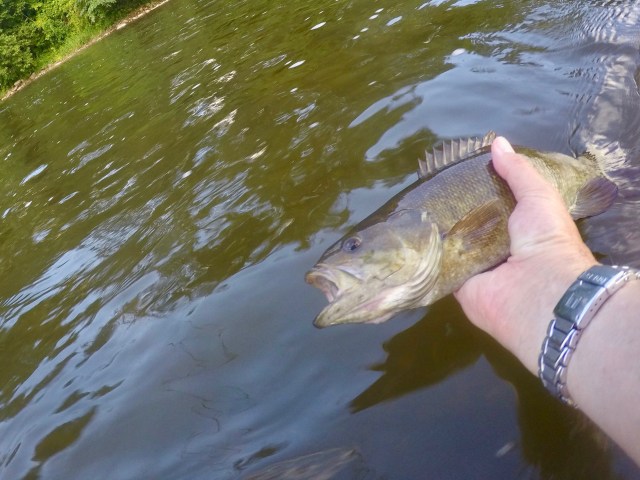
I think it’s about time I headed over to the Hous for some smallies…

Farmington River Report 7/17/18: Big Bang Boom

I guided Paul for four hours yesterday before the fireworks began. Atmospheric, that is — although the fishing was slow, we managed to conjure up plenty of electric action. We fished three locations within the permanent TMA and found players in all of them. The water was down to 237cfs (they dropped the dam 100cfs) but still plenty cold. Wet flies were the first order of business, and we induced a savage strike from a lovely wild brown in the snotty water at the head of a run. Upstream there were trout smutting in that difficult-to-present-to frog water along the edge of a faster current. Then I saw a moth skitter across the surface, and one of the trout snapped at it. We clipped off the SHBHPT on point and tied on a Stimulator. Three trout later, we moved to another spot. This was a very sexy run, but we had no interest in swung wets. I figured there were trout in residence, so we added a BB shot to the middle dropper knot and presented along the bottom. Ding! We have a winner, with Paul landing a gorgeous kyped Survivor Strain brown. Great job by Paul with his casting, wading, presenting, and especially his no-time-wasted landing those trout. They just didn’t stand a chance. A pleasure, sir!

The skunk was off with this lovely wild brown. Man, did he open up a can of whupass on the wet fly.

OLYMPUS DIGITAL CAMERA

~

Men at work: Paul demonstrating the advantages of a ten-foot rod on the Farmington.

OLYMPUS DIGITAL CAMERA

~

What the fly saw moments before the take. A good fish, Survivor Strain, well-earned. (There’ll be no pictures of anglers thrusting fish into the camera at arm’s length on this site.)

OLYMPUS DIGITAL CAMERA


Sand Eel Secrets

There are several baits that give striper anglers fits: clam worms, grass shrimp, and truly tiny stuff (like crab larvae), just to name a few. You can also add sand eels to the list. I see the forlorn souls trudging off the beach, beleaguered and bewildered, always with the same mournful complaint: “There were all these fish feeding and we couldn’t catch them.” Sand eels might be the sulphurs of the salt. They’re a plentiful bait, easy to identify, the fish love to eat them — and most anglers approach the situation the wrong way.

I love fishing for striped bass that are feeding on sand eels. Some of my best nights of striper fishing have occurred during a sand eel hatch. Here are some things I’ve observed that will help you catch more bass that are feeding on sand eels.

— Striped bass are very much like trout. They like current, and they will key on certain food sources at certain times at the expense of all other menu options. What’s more, they will feed in a certain manner in a certain part of the water column. Sound like trout taking emergers just below the surface film? Good! Once you grasp this concept, you’re halfway home.

— When confronted with the scenario of stripers crashing sand eels on the surface, most anglers attack the problem with sinking lines and/or weighted flies. This is the equivalent of wading into a trout stream where trout are sipping Trico spinners, then tossing a tungsten cone head Woolly Bugger. (Sidebar: yes, stripers will root along the bottom for sand eels, then eat them as they shoot for the surface. Dredging the bottom with a weighted fly can be productive. But if you see the fish leaving rise rings or splashy boils, that should be your first clue that a floating line and an unweighted sand eel pattern is a good place to start.)

A floating line, a sparse, unweighted sand eel pattern, and a very happy angler. My friend John, who was fishing next to me, caught a bass in this size class on 11 consecutive casts.

900x900px-LL-8da1a41d_38incher-1

— This is not rocket science. Recall Fly Fishing 101: What are the fish eating? How are they eating it? What do I have in my box that most closely resembles the bait (size, color, profile)? How can I present my fly to mimic what the naturals are doing?

— It’s almost never a bad idea to target an actively feeding bass.

— Aggressive feeders will take a stripped fly with gusto. I like very short (3″ or less) rapid strips. Wait until you feel the weight of the fish before you set the hook. Always strip set.

— There often comes a time in the hatch when the bass will no longer chase. The stripped fly is rendered useless. But the catching doesn’t have to end. The smart angler will change tactics. He or she might use a dropper rig, suspended in the surface, managing it like a dry fly presentation (dead drifting over a feeding lane) or every-so-slightly maintaining tension on the line (not so much a retrieve as it is a gathering of slack). The takes in this scenario will be sublime. Again, strip set.

If the rise rings become softer and the stripers won’t chase a stripped fly, try a dropper rig suspended in the film.

OLYMPUS DIGITAL CAMERA

— Just because you don’t see stripers feeding on the surface doesn’t mean a) they’re not there, and b) they won’t take a sand eel fly at the surface.

— I like to shuffle into a beach trough or across a flat to see if I can roust some sand eels. On the dark of the moon I look for their biolume contrails, or feel for their crazy bounces off my legs. If I’m lucky, a nearby striper will ghost his position by stomping on the fleeing bait. Now I have a target.

— Confidence catches fish.

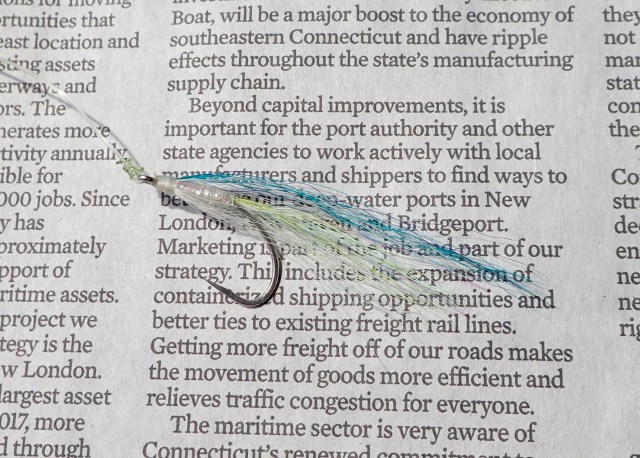
Find sand eel patterns that you have confidence in, then go forth and prosper. I happen to love Ken Abrames’ Big Eelie, shown here below the glasses and in the left side of the box. Note the vast array of colors; I’ve never experienced that stripers have a preference. I also like Ken’s smaller Eelie, and Ray Bondorew’s Marabou Sand Eel. And for the record, I haven’t caught a striper on sand eel fly that had eyes in over a decade.

Block Island All-Nighter Flies Big Eelies


Farmington River Report 7/11/18: The heat of the moment

Friends, I’m here to tell you that the Farmington River is cold. Readings of 58 and 54 degrees confirm that, as will Mark, my client — and he’ll also testify that the fishing is incendiary!

So. Mark came to me with the request — like so many of my clients do — to tell him “what I’m doing wrong.” In most of these cases, it’s not so much one grand point of error as it is a bunch of little things that could be improved upon. We started out below the permanent TMA for a little indicator nymphing. Mark took to it nicely, and we stuck a pile of fish on both a size 14 Rainbow Warrior (point) and a size 14 March Brown wingless (dropper).

Off we went upstream for the evening rise, which was that and then some. From 5:00 to 8:30 it seemed like there was always a target to cast to, and often multiple options within a couple rod lengths. We stuck fish on the Magic Fly, the Usual, Catskills Light Cahill, and Sulphur comparadun. The bug activity was mostly tiny BWOs, a few sulphurs, but mostly Dorotheas and perhaps some summer Stenos. The trout were on the emergers as well as duns on the surface. It was an easy night to be a guide. Well done, Mark! You were doing a lot of things right, as your fish count confirms.

Mark landed this nice wild brown on a March Brown wingless. The fish were taking the nymphs in the faster water at the head of the pool.

OLYMPUS DIGITAL CAMERA

~

The sweet sight of success: bent rod, splashy combatant. (Wide smile on client’s face not visible.) Speaking of visibility, we had varying degrees of fog for most of the evening. It didn’t seem to bother the fish.

OLYMPUS DIGITAL CAMERA

Farmington River report 7/9/18: Presentation is Everything

I guided David yesterday afternoon into the evening. David wanted to work on his presentations — a man after my own heart — and we began by swinging wets through some choppy water in the permanent TMA. Bug and surface activity was light — nonetheless, I was surprised that we didn’t find any players. We then headed upstream to some classic dry fly water to prepare for the evening rise. We had surface activity from around 4pm through darkness, and a lot more bugs in this pool: sulphurs, Light Cahills, mats of midges and a few caddis. The fishing wasn’t easy — David had dozens of quality drifts that went unscathed — but we fooled quite a few trout and netted some beauties. We fished with a 13-foot leader (9′ 5x) and tippet (4′ 6x) system, and took fish on the Pale Watery wingless (16), Catskills Light Cahill (14-16) and Sulphur Comparadun (18). Great job, David! And man, was that water cold. 56 degrees. I haven’t shivered that much since the winter. Double layers next time.

Mr. Presentation, getting it done.

DCIM100GOPROG0015823.

~

The size of the rise doesn’t always belie the size of the fish. This high teens Survivor Strain brown was making tiny swirls along the edge of some frog water. David did an exemplary job with his hook set and landing. All the fish we hooked were fat, healthy, and happy.

OLYMPUS DIGITAL CAMERA

Olive Fireworm Big Eelie Fireworks

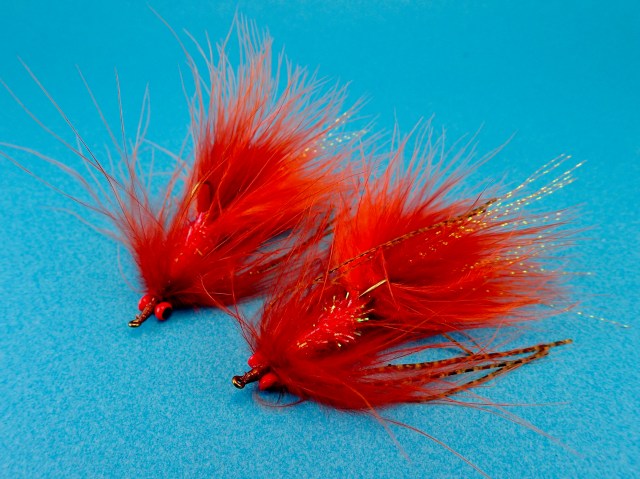
Flies don’t catch fish — anglers do. Still, I sometimes like to fish by feeling, and the Olive Fireworm Big Eelie is my traditional choice on the 4th of July.

On our nation’s birthday, this 15-pound striper said yes to the Olive Fireworm Big Eelie. What a tremendous battle. I’m always in awe of the power of Block Island bass.

OLYMPUS DIGITAL CAMERA

Farmington River Report 6/26/18: Subsurface Success

Chris wanted to work on his subsurface game, so we spent the morning nymphing and swinging wets. Success! We fished three spots below the permanent TMA and found players in two of them.

We started off indicator nymphing (using my homebrew indicators) with a drop shot rig, and I continued my catching-a-fish-while-doing-a-demo streak. (If you want to look cool, pretend you meant to do it.) Chris took over and made a bunch of quality drifts with no love. All of a sudden, it happened. An unseen hatch was underway, the trout were feeding, and we hooked a bunch if fish in 15 minutes.

Wets were next. Run A was a blank, and Run B did not produce in the areas it usually does. No worries — Chris kept a positive attitude (confidence catches fish), and it rapid succession he stuck a bunch of trout tight to the bank. Great job, Chris! The trout should be worried.

We won the weather lottery: Bluebird skies, warm sun, cool air. Of course, a tight line makes any day sunnier.

OLYMPUS DIGITAL CAMERA

~

We spotted a distressed rainbow in the shallows. It had been hooked, lost, and had the terminal tackle and a short length of mono still attached. Unfortunately, we failed in out attempts to net it.

OLYMPUS DIGITAL CAMERA

~

Chris kept pounding the banks in a shade line, mended swing presentation, and was rewarded with several slashing strikes. This gorgeous wild brown took the top dropper on his team of three wets, a Squirrel and Ginger.

DCIM100GOPROG0025627.

~

After our session, I spent two very entertaining hours swinging wets. I fished a Squirrel & Ginger (caddis) on top, a Drowned Ant middle dropper, and a Light Cahill on point. I saw all three insects out and about, as well as tiny BWOs, midges, inch worms, and sedges. Among the players today were three wild brookies. Funny thing! They all took the Drowned Ant. I don’t think it was a coincidence. This stunner is clearly from the Farmington River hatchery.

OLYMPUS DIGITAL CAMERA

`~

Another hat trick today, thankfully without a broken rod. This low-teens wild brown was feeding just along a shade line in about a foot of water. First cast, bang! Squirrel and Ginger. Catch-and-release works in the wild, too — note the long-ago healed bird wound just above the gill plate. I bounced around to three spots, found hungry fish in all of them, and lost track of both time and fish landed.

OLYMPUS DIGITAL CAMERA


Farmington River Report 6/20/18: Going out with a wet fly bang

The last day of spring 2018 was a memorable one for me. The evening wet fly bite was spectacular (where one loses count of fish). I had a Farmington River hat trick (brown, brookie, rainbow). And I landed a porcine high teens rainbow (after it snapped the tip of my cane rod mid-battle).

But let’s focus on the positive. I fished below the permanent TMA from 5:30pm- 9pm. Water was a perfect height and still plenty cold. The bug activity was an 8 out of 10. I had much to work with: midges, a few small (size 18) caddis, lots of size 16 sulphurs and size 14 Light Cahills, and some mongo mayflies (10-12) that were perhaps March Browns or Isos. I fished a three fly team until 7:30pm: Snipe and Yellow size 14 on top, size 16 Magic Fly in the middle, and a winged Light Cahill size 12 on point. All three flies produced. The conditions were perfect for wet flies: bugs, birds working, and a multitude of sloppy, splashy rise forms that went on for hours. I spent most of my time targeting active fish, and often the take came on the first cast. I even caught one dangling my line in the current below me as I walked to the shore to put on my jacket.

Then, disaster. The hit came suddenly and with ferocity. It felt like a decent enough fish, but once I got it in close I could see it was a big rainbow in the upper teens. Fat, spirited, and uncompromising in its belligerence. I didn’t even feel the rod tip snap; suddenly, it seemed, it was just broken. I cursed my luck (as it was). Fortunately, I had brought a second rod stream side: I waded out, re-rigged, and was back at it.

I finished the session throwing dries: Magic Flies, Usuals, and Light Cahills. The trout liked all three. As the gloaming lost its struggle against darkness, I walked back to the truck, unsure how to process the conflicting sensations of delight and regret.

At this size and coloration, most certainly not from the factory. You can’t see it here, but the dorsal side of these fish is dramatically dark. They almost look like chrome steelhead when you’re bringing them in.

OLYMPUS DIGITAL CAMERA

~

The culprit. The opening of my net is 17″; this little piggy exceeded that. So far, the best trout hit of the year. She took the Pale Watery wingless (Magic Fly), not the Cahill as I previously posted.

OLYMPUS DIGITAL CAMERA

Is anybody there? Does anybody care? Does anybody see what I see?

Followers and readers already know that I tend to fish how, where, and when others don’t — especially when it comes to stripers. I’ve always considered currentseams to be a teaching platform, and to a large extend that is what drives the content of this site. Still, there are times when I feel like a lonely island being battered by the waves of conventional wisdom. So when I get a letter like the one below, it restores me. I’ve edited some of it for brevity, but I think its message is important. Fans of 1776 will get the title reference — and the importance of the answer, “yes.”

“I believe in giving credit where credit is due. I also believe that if someone has helped you, made a part of life more enjoyable, or provided valuable guidance, you should thank them. currentseams has done all three of those things for me.
I moved to Barrington, Rhode Island 7 years ago. I was a sophomore in high school and by then an avid fly fisherman and fly tier of, again, 7 years. I knew little of Rhode Island’s saltwater opportunities then. I was a die-hard trout fisherman, but with the Farmington 2 hours away and no drivers license I thought I should figure out how to have fun in my own backyard.
After multiple run-ins with striped bass eccentrics my father and I were excited. Yet in our haste to get on the water (in reality it was just MY haste) we forgot to really take our time to learn and listen. “Whats the best fly? What’s the best line? Where’s the best spot? Okay, thank you and goodbye!” We wanted to know what everyone else was doing so that’s what we got: intermediate lines, weighted flies, and the strip retrieve. It wasn’t a productive spring, and you can bet our disappointment had us sticking to trout.
With my intermediate line and my Clouser minnows I set out to really figure out this whole striped bass thing. I had done the research. I knew they were around. Now I just had to catch them. This time I had some success. I got a better understanding of tides and where to find fish, but I still fished fast and deep because its all I knew and all I was told. Countless times I lamented my setup as stripers gorged on silver sides right before my eyes. Damned my sinking fly!
I decide to change it up. Time to ditch the internet and get some ink in my nails. Time to sort through my stacks of Eastern Fly Fishing magazine. After some digging I found it, an article titled “South County, RI: By Boots or By Boat”. I don’t have a boat, but I certainly have some boots. This could be good. The article featured beautiful imagery, informative writing, and a picture of a gray-haired man in all black fishing in a trout stream? What?
The caption reads: On a foggy day, the South County salt ponds and connecting estuaries closely resemble the English countryside. It’s no small reason that the original settlers called the area New England. And it’s why native son Kenney Abrames favorites trout and salmon techniques in the salt. 
Not a trout stream, but he was fishing it like one. Who is this Kenney Abrames? A quick internet search bears links to A Perfect Fish and Striper Moon. I scroll down a bit more and there it is, a search result titled “Ken Abrames- currentseams”. I clicked. I read. I explored and I never looked back. It was as if a whole new world had opened up to me. I blazed through currentseams. I quickly bought and read Striper Moon. I bought some floating line. And I put my stores of bucktail and peacock herl to work.
Funny enough, it worked. As soon as I got back from school I began catching striped bass using sparse flies, drifts, and swings. I was having a blast. It felt so satisfying to read something, execute what the writing said to do, and have the desired result.
I (also) realized something very important. This whole time I had been looking to you and Ken for absolutes. But there are no absolutes in fishing. There are only problems and solutions. As I began to re-read Striper Moon and currentseams I started to understand the true message behind both works. That message being this: Objects do not catch fish. People do.
I began to learn that there was no one fly, or one technique, or one rod, or one fly line, or one anything. Every fishing situation is different and it takes a creative angler to solve the riddle of each one. It was with this relization that I stopped looking at Striper Moon and currentseams like they were the Bibles of striped bass on the fly. These works are shared knowledge, not commandments.
Through the help of currentseams I have become a more creative angler. I have embraced the greased line swing, the floating line, and have even created my own fly as a solution to a fishing problem. Thank you for keeping alive the old traditions of striped bass fly fishing and for sharing your insights with the world. Keep up the good work and I cannot wait to read your next post.”
~
Thanks for making my day, Sam.
~
If you want to catch the fish that not everyone can catch, then don’t fish like everyone else.
TroutFishingStripers

Farmington River Report 6/13/18: Workin’ hard, playin’ hard

On the river for ten hours today and loving every minute of it! I started by guiding Brian from 11am-3pm. Brian had a story that is typical of many of my clients: loves the Farmington, but has had too many encounters with the skunk. He wanted to focus on wets, but I suggested we spend an hour working on his nymphing game, since that is the year-round highest percentage play on this river. Brian has mostly Euro-nymped, but I set him up with a drop shot ring under an indicator. He took to it like he’s been doing it forever. There’ll be no skunk, today, Brian. The first fish was noteworthy because the indicator never went under — it merely twitched. Look for a reason to set the hook on every drift, and like that Brian was on the board.

It was a cool, wet day, and there was precious little bug activity. The water is still unusually cold, with 48 degrees at the bottom end of the permanent TMA, which was running at 330cfs. Nonetheless, we managed a mix of browns and rainbows by (you’ve heard this if you’ve taken my class) moving around and covering water. Nice work, Brian.

Every guide loves the sight of a bent rod and a tight line. Brian did a great job with his hook sets today.

DCIM100GOPROG0015239.

~

Thank you for playing. They liked the bottom nymph, a size 14 Frenchie variant.

OLYMPUS DIGITAL CAMERA

~

Now it was my turn to play. I grabbed a sandwich and headed off to a snotty run to swing wets under a leaden sky. The cold from the river was a stark contrast to the warm and humid air (my lower legs and feet were uncomfortably cold by the time I finished.) By this time (4pm) there was a slight uptick in bug activity. Whack! My second cast produced a gorgeous wild brown.

They don’t make ’em like this in the factory. Absolutely flawless fins.

OLYMPUS DIGITAL CAMERA

~

Any pre-hatch period is my favorite time to swing wets, and I moved down to a more languid section of water. Sure enough, as the clock moved toward 5pm, there was an uptick in bug activity, mostly Light Cahills (Vitreus) 12-14 and caddis 14-16. The fish were rising a little more regularly now. I was fishing a three fly team of a Squirrel and Ginger on top, a Light Cahill winged in the middle and a Hackled March Brown on point. My strategy was to target active risers, and I caught a bunch of trout on all three flies.

There comes a time during every hatch when the subsurface wet becomes ineffective, and today it was 7pm. I switched over to dries, and had a blast fooling trout on the surface. I fished Magic Flies and Usuals, 14-16, and had a good couple dozen takes — but only about half of them stuck. I was going to leave at 8pm, but I remembered how fiercely I admonish those who depart from the river before the magic hour in June and July, so I stuck around until 9pm. The last half hour, the river was simmering with rise forms. I switched over to classic Light Cahill dries, 12-14, and ended the session with a healthy brown who was just showing the beginnings of a kype.

The best part? There was no one there except for me, the trout, and the bugs.

Our Lady of the Blessed Pink Band. First Farmy trout of the year on a dry. 

OLYMPUS DIGITAL CAMERA